
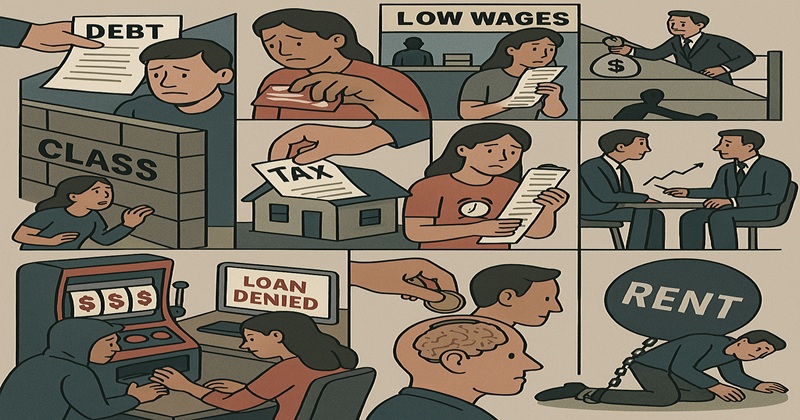
12 Ways The System is Built to Keep You Poor

Financial success in America is often portrayed as a simple matter of hard work, discipline, and smart choices. The narrative suggests that anyone can build wealth if they just try hard enough, make better decisions, and take personal responsibility. While personal choices certainly matter, this narrative conveniently ignores a uncomfortable truth: the economic system contains numerous structural mechanisms specifically designed—whether intentionally or through accumulated policy choices—to extract wealth from those who have little and transfer it to those who already have much.
This isn't conspiracy theory. It's documented economic reality visible in policies, business practices, fee structures, and institutional arrangements that systematically disadvantage low-income individuals while advantaging the wealthy. These mechanisms create what economists call "poverty traps"—situations where being poor is actually expensive, making it extraordinarily difficult to escape poverty even with hard work and good decisions.
Understanding these systemic barriers doesn't mean abandoning personal responsibility or financial discipline. Rather, it means recognizing that individual effort operates within a structural context that either supports or undermines wealth building. When you're trying to climb a ladder that's missing rungs, tilted backward, and coated in grease, pulling yourself up requires far more than just effort—yet the system often blames individuals for not climbing fast enough. This comprehensive examination explores twelve specific ways the economic system is structurally designed to keep people poor. Recognizing these mechanisms is the first step toward navigating around them and advocating for systemic change. You can't effectively fight an opponent you don't understand.
1. Poverty Fees: Being Poor is Expensive
One of the most insidious systemic traps is that poverty itself is expensive. Those with the least money pay the most for basic financial services.
How It Works
Banks charge monthly maintenance fees, overdraft fees, insufficient funds fees, and minimum balance fees that disproportionately affect low-income customers. A single overdraft can trigger $35+ in fees. Multiple overdrafts in a week can generate hundreds in fees—money extracted from those who can least afford it.
Check-cashing services charge 1-5% of check value just to access your own wages because you lack a bank account. Payday lenders charge effective APRs of 300-400% or higher. Rent-to-own stores charge double or triple retail prices for furniture and appliances. Late fees on bills compound when you're living paycheck to paycheck and timing payments around when money arrives. A 2014 study found that the median household income for those paying overdraft fees was $20,000-$30,000—those least able to afford these fees pay them most frequently.
The Systemic Design
Financial institutions profit enormously from fees targeting low-income customers. Major banks collected approximately $11 billion in overdraft fees in 2019 alone, disproportionately from the poorest customers. This isn't accidental—it's a business model based on extracting wealth from those with the least.
The Wealth Impact
A person paying $200 annually in bank fees, $500 for check-cashing, $150 in late fees, and $300 in predatory lending costs is losing $1,150 yearly just for being poor—money that could otherwise build savings or investments. Over 20 years, that's $23,000 directly extracted, plus lost investment growth that would have made that amount significantly larger.
2. The Credit Score Trap
Credit scores, ostensibly designed to measure creditworthiness, instead create a catch-22 that keeps poor people paying more for everything.
How It Works
Credit scores are built largely on credit history—length of accounts, payment history, credit utilization, types of credit. But building good credit requires having credit, creating an impossible situation: you can't get credit because you don't have credit history, and you can't build credit history because you can't get credit.
When poor people do access credit, they receive the worst terms—highest interest rates, lowest limits, most punitive fees—because their lower scores (often resulting from economic hardship rather than irresponsibility) categorize them as "risky."
These poor credit terms then make everything more expensive: higher interest rates on car loans (adding thousands to vehicle costs), higher insurance premiums (costing hundreds annually), security deposits for utilities and apartments, difficulty renting housing, and even employment challenges (many employers check credit).
The Systemic Design
The credit scoring system rewards those already in good financial position while punishing those struggling. Someone who's never been poor—whose parents helped them through college without debt, who never faced medical emergencies or job loss—easily builds excellent credit simply through normal financial activity. Someone who experienced poverty—maybe medical debt, maybe periods of unemployment—accumulates marks that follow them for seven years, making everything more expensive throughout that period.
The Wealth Impact
A person with poor credit might pay 10-15% on an auto loan versus 3-4% for someone with excellent credit. On a $25,000 car, that's potentially $5,000-8,000 more over the loan term. Higher insurance premiums might cost $500+ annually. Security deposits for apartments and utilities might require $1,000+ upfront that good-credit individuals avoid entirely.
The wealth extraction from poor credit scores—entirely systemic—can easily total $10,000-20,000 over a decade, plus opportunity cost of money that could have been invested instead.
3. The Employment Trap: Unpredictable Hours and No Benefits
The modern gig economy and "flexible" employment arrangements transfer risk from employers to workers while extracting maximum labor for minimum compensation.
How It Works
Many low-wage jobs feature:
- Unpredictable scheduling: Hours vary weekly, making it impossible to budget, plan childcare, or take second jobs
- On-call requirements: Being required to be available without guaranteed pay
- Just-in-time scheduling: Finding out your schedule days or even hours in advance
- No benefits: No health insurance, paid time off, retirement contributions, or sick leave
- Classification as "independent contractors": Avoiding employer responsibilities while maintaining control
These arrangements maximize employer flexibility and minimize costs while creating chaos in workers' lives. You can't plan when you don't know if you'll work 15 hours or 35 hours next week. You can't afford childcare when schedules change constantly. You can't take a second job when your primary employer demands complete availability.
The Systemic Design
This employment structure is deliberate business strategy, not accidental. It maximizes profits by treating labor as a variable cost to be minimized while maintaining complete workforce control. Companies get dedicated workers without commitment, availability without compensation, and flexibility without reciprocity.
The Wealth Impact
Unpredictable income makes budgeting impossible, often forcing reliance on expensive credit for gaps between paychecks. Lack of benefits means paying full price for healthcare (or going without), never accumulating paid time off, and receiving zero employer retirement contributions that higher-wage workers receive as "free money."
A low-wage worker receiving no benefits while a professional receives health insurance ($10,000+ annual value), retirement contributions (3-6% of salary), and paid time off (worth thousands annually) experiences a compensation gap far exceeding the wage difference. This systemic inequality ensures wealth never accumulates for those in precarious employment.
4. Education Debt Without Economic Mobility
Higher education is sold as the path to economic mobility, yet increasingly it delivers debt without corresponding opportunity.
How It Works
Students are told they must attend college to succeed economically. They borrow tens of thousands (often over $100,000) based on promised future earnings. But many degree programs—particularly at for-profit institutions and lower-tier schools—deliver minimal actual economic value.
Graduates emerge with massive debt but degrees that don't command higher wages. They're trapped in loan payments that consume 10-20% of income for decades, preventing wealth building during peak accumulation years.
Student loans are uniquely predatory: nearly impossible to discharge in bankruptcy, they follow you forever. Miss payments and face wage garnishment, tax refund seizure, and destroyed credit. The debt often grows rather than shrinks as interest compounds, creating situations where people pay for decades yet owe more than they originally borrowed.
The Systemic Design
The education-industrial complex profits enormously from this system. Universities raise tuition far faster than inflation, knowing students will borrow whatever's necessary. Loan servicers profit from extending repayment periods. The system extracts maximum revenue while providing minimal accountability for outcomes.
Meanwhile, wealthy families pay cash or graduate debt-free, allowing their children to immediately begin accumulating wealth. Poor and middle-class students begin adult life $30,000-100,000 in debt—a wealth gap that persists for decades.
The Wealth Impact
A graduate with $50,000 in student loans at 6% interest pays approximately $555 monthly over 10 years—total repayment of about $66,600. That's $16,600 paid just in interest, plus the opportunity cost of $66,600 that could have been invested instead.
Someone graduating debt-free can immediately begin investing that $555 monthly. Over 10 years at 8% returns, that becomes approximately $102,000. The debt-free graduate is $150,000+ ahead of their equally-educated peer simply because one family could afford to pay for education while the other couldn't.
5. Healthcare Bankruptcy Lottery
The American healthcare system is uniquely designed to financially devastate those who get sick while lacking adequate insurance.
How It Works
Low-wage jobs typically don't provide health insurance. Individual market insurance is often unaffordable, particularly with high deductibles—plans might cost $400+ monthly yet require $5,000-8,000 out-of-pocket before coverage begins.
Many people go uninsured, gambling they'll stay healthy. When they inevitably need care—accidents happen, illnesses occur—they face bills they cannot possibly pay. A single emergency room visit can cost $10,000+. A serious illness or injury easily generates $50,000-200,000+ in medical debt.
Medical debt destroys credit, leads to wage garnishment, and frequently triggers bankruptcy. This financial devastation results not from poor decisions but from the systemic reality that healthcare is unaffordable for those without good employer-sponsored insurance.
The Systemic Design
Every other developed nation provides universal healthcare, recognizing that health shouldn't cause bankruptcy. The U.S. system instead treats healthcare as a profit center, generating enormous wealth for insurance companies, pharmaceutical companies, and healthcare providers while financially destroying sick people who lack resources to pay.
This isn't accidental—it's policy choice reflecting the political power of healthcare industry profits over the wellbeing of ordinary people.
The Wealth Impact
A single serious health event can eliminate whatever modest savings a low-income family has accumulated. Medical debt frequently runs $20,000-50,000 or more for serious conditions, amounts that are absolutely devastating to families earning $30,000-50,000 annually.
Even with insurance, high deductibles and out-of-pocket maximums can require $5,000-10,000 in annual health spending—money that could have built emergency funds or retirement savings instead gets extracted by the healthcare system.
6. Housing Wealth Extraction: Rent Inflation Without Equity Building
Housing policy systematically advantages homeowners (who build equity) while extracting maximum wealth from renters (who build nothing).
How It Works
Homeowners receive substantial tax advantages: mortgage interest deduction, property tax deduction, capital gains exclusion on home sale profits. They build equity automatically through mortgage payments and property appreciation. After 30 years, they own an asset worth hundreds of thousands of dollars.
Renters receive no tax advantages, build zero equity, and face regular rent increases. After 30 years of paying rent—often totaling more than a mortgage would have cost—they own nothing.
Yet renters are often renting precisely because they cannot save for down payments due to high rent consuming income that could otherwise accumulate for home purchase—a perfect catch-22.
The Systemic Design
Housing policy was explicitly designed to build middle-class wealth through homeownership. Tax advantages subsidize home buying (disproportionately benefiting higher-income taxpayers who itemize deductions). Government-backed mortgages make homeownership accessible to those with resources for down payments.
But these advantages systematically exclude those without savings for down payments or credit scores sufficient for mortgage approval—precisely the people who most need wealth-building opportunities.
The Wealth Impact
Consider two people with identical $1,500 monthly housing costs. The homeowner is building equity—after 30 years, they own a home worth perhaps $400,000 (after appreciation) having paid approximately $540,000 total. Their net position: $400,000 in wealth.
The renter pays $1,500 monthly for 30 years—$540,000 total—and owns nothing. Their net position: zero.
The difference: $400,000 in wealth, stemming entirely from systemic advantages provided to homeowners but not renters.
7. Regressive Tax Structures
Tax systems are designed to extract maximum revenue from those with least while minimizing burden on those with most.
How It Works
The wealthy derive income primarily from capital gains (investments, property appreciation, business ownership), taxed at preferential rates typically 15-20%. They employ tax strategies—sophisticated accounting, tax-advantaged retirement accounts, business deductions, estate planning—that minimize tax burden.
Poor and middle-class workers derive income primarily from wages, taxed at ordinary income rates up to 37% federally, plus payroll taxes of 7.65%, plus state and local taxes. They have fewer deduction opportunities and less sophisticated tax planning.
Additionally, sales taxes—charged identically to rich and poor—consume a much larger percentage of poor people's income (who spend most of what they earn) versus wealthy people's income (who save substantial portions).
The Systemic Design
Tax policy reflects political power. Those with resources influence policy to advantage themselves. The preferential treatment of capital gains versus labor income, the cap on Social Security taxation (earnings above $160,200 in 2023 aren't subject to Social Security tax), and regressive sales taxes all reflect policy designed to advantage wealth over work.
The Wealth Impact
A worker earning $50,000 might pay effective federal tax rates around 12-15%, plus 7.65% payroll tax, plus state and local taxes—total effective rate potentially 25-30%.
A wealthy investor deriving $500,000 from long-term capital gains might pay effective federal rate around 20%, with no payroll tax and sophisticated planning reducing the burden further—total effective rate potentially 22-25%.
The person earning one-tenth as much pays a higher effective tax rate—a regressive system that extracts more from those with less.
8. Transportation Poverty
Lack of reliable transportation creates employment and economic barriers that trap people in poverty.
How It Works
Many low-wage jobs are geographically dispersed and poorly served by public transportation. Reaching these jobs requires personal vehicles. But poor credit means terrible auto loan terms (12-20% interest rates), and limited savings means buying unreliable used vehicles that frequently break down.
Vehicle breakdowns cause missed work, potentially job loss. Repairs require money that's not available, forcing expensive financing or predatory lending. Lack of transportation means inability to access better jobs, healthcare, education, or cheaper shopping options.
Meanwhile, those with resources buy reliable vehicles with low-interest financing, rarely experience breakdowns, and never face transportation barriers to employment or opportunity.
The Systemic Design
American infrastructure and urban planning prioritizes personal vehicles over public transportation, particularly outside major cities. This advantages those who can afford reliable transportation while systematically excluding those who cannot.
Many European countries invest heavily in public transportation, making car ownership optional rather than essential. In America, lack of transportation often means inability to participate in the economy—a systemic choice that perpetuates poverty.
The Wealth Impact
A person with poor credit paying 15% interest on a $15,000 car pays approximately $3,400 in interest over the loan term. Someone with good credit at 4% pays approximately $1,250—a $2,150 difference for the identical car, extracted solely because one person is poor.
Additionally, unreliable transportation leading to job loss or expensive repairs creates cascading financial emergencies that prevent wealth accumulation.
9. Food Deserts and Poverty Premiums
Poor neighborhoods systematically lack access to affordable, healthy food options, forcing residents to pay more for lower-quality food.
How It Works
Major grocery chains often don't operate in poor neighborhoods, considering them unprofitable. Residents rely on convenience stores, corner shops, and fast food—all significantly more expensive per calorie and less healthy than grocery store options.
Someone living in a food desert might pay $5 for a small amount of fruit at a corner store versus $3 for three times as much at a grocery store. They might rely on fast food costing $8-10 per meal versus $3-4 for home-cooked meals from grocery ingredients.
Lack of transportation to reach distant grocery stores compounds this—taking public transportation for an hour each way with heavy grocery bags is often impractical, forcing reliance on expensive local options.
The Systemic Design
Food deserts result from market forces that prioritize profitability over community needs. Stores close in poor neighborhoods because profit margins are lower (partially due to higher theft and operating costs). But this leaves residents without access, forcing them to pay poverty premiums for food. This systemic inequality means the poor pay more for basic nutrition, leaving less money for everything else while often suffering worse health outcomes from poor-quality food—a double disadvantage.
The Wealth Impact
Estimates suggest food deserts increase food costs by 30-50% or more. For a family spending $400 monthly on food, that's $120-200 monthly or $1,440-2,400 annually extracted simply because of where they live. Over 20 years, that's $28,800-48,000 in additional costs, plus lost investment returns that money could have generated.
10. Criminal Justice Poverty Traps
The criminal justice system extracts enormous wealth from poor communities through fines, fees, bail, and incarceration.
How It Works
Low-level offenses that wealthy people might handle with minimal consequence—traffic tickets, minor drug possession, missed court dates—spiral into catastrophic financial consequences for poor people. Unable to pay fines, they face escalating penalties, suspended licenses (making it illegal to drive to work), bench warrants, and incarceration. Bail systems keep poor people jailed before trial while wealthy defendants post bond and remain free. Criminal records—disproportionately concentrated among poor people and people of color—create permanent employment barriers. Public defender systems are overwhelmed and underfunded, meaning poor defendants receive inadequate representation compared to wealthy defendants with private attorneys.
The Systemic Design
Many jurisdictions fund operations partially through fines and fees extracted from poor residents—essentially taxation through the criminal justice system. This creates incentive to aggressively prosecute minor offenses in poor communities while generating revenue. Bail systems, cash-based fines, and fee structures systematically advantage those with resources while penalizing poverty itself. Inability to pay becomes criminalized, and criminal status becomes permanent economic disadvantage.
The Wealth Impact
A traffic ticket that's $200 to someone with resources might become $2,000+ for someone poor: original fine plus late fees, license reinstatement fees, court costs, potentially bail costs, potentially lost wages from incarceration or suspended license preventing work.
These extractions target those least able to pay, extracting thousands annually from communities that can least afford it while creating permanent barriers to economic mobility through criminal records.
11. Financial Illiteracy By Design
Financial education is systematically withheld from those who need it most, ensuring generations remain trapped in poverty.
How It Works
Most American schools provide minimal financial education. Students graduate without understanding credit, investing, taxes, or basic money management. This ignorance leaves them vulnerable to predatory lending, poor financial decisions, and missed wealth-building opportunities.
Wealthy families provide financial education at home—children see parents managing money, learn about investing, understand credit, and receive guidance on financial decisions. Poor children often see financial stress and survival mode but rarely receive systematic financial education. Complex financial systems—tax codes, investment vehicles, credit mechanisms—are deliberately opaque, requiring specialized knowledge to navigate effectively. This complexity advantages those with resources for financial advisors while disadvantaging those without such access.
The Systemic Design
Financial illiteracy serves the interests of institutions profiting from consumer financial mistakes. Banks profit from overdraft fees, credit card companies from interest on carried balances, payday lenders from desperation borrowing, investment companies from high-fee products sold to unsophisticated investors.
If everyone understood compound interest, fee structures, credit terms, and investment principles, these predatory practices would collapse. Financial illiteracy is maintained because it's profitable.
The Wealth Impact
Financial illiteracy costs thousands or tens of thousands annually through missed opportunities and poor decisions: carrying high-interest credit card debt, paying excessive fees, missing employer retirement matches, buying high-fee investment products, making poor credit decisions, or falling victim to scams.
Over a lifetime, financial illiteracy can easily cost $250,000-500,000 or more in lost wealth—a systemic tax on those who weren't taught what the wealthy learn at home.
12. Wealth Gaps Create Opportunity Gaps
Perhaps the most fundamental systemic mechanism keeping people poor is that wealth generates more wealth while poverty generates more poverty—and this compounds over generations.
How It Works
Wealthy families provide their children with advantages that ensure continued wealth: fully-funded education without debt, down payment assistance for home purchases, career networking and connections, financial bailouts when mistakes happen, inheritance and inter-generational wealth transfer, cultural capital and knowledge about how wealth systems work.
Poor families cannot provide these advantages, leaving their children to compete against wealthier peers without the resources, connections, knowledge, or safety nets those peers enjoy. This disadvantage persists across generations. Studies consistently show that parental wealth is the strongest predictor of children's eventual wealth—stronger than education, harder work, or any other factor. This means the system perpetuates inequality regardless of individual merit or effort.
The Systemic Design
Wealth compounds. Investment returns generate wealth without labor. Property appreciates. Business ownership creates equity. Tax advantages preserve wealth. Poverty compounds in the opposite direction. Lack of savings means expensive credit when emergencies hit. Lack of investments means no passive income. Lack of property means no appreciation. Lack of business ownership means no equity. These mechanisms ensure that those born with resources accumulate more while those born without struggle to gain any foothold—a system that perpetuates inequality structurally rather than through individual merit.
The Wealth Impact
The median white family has approximately 10 times the wealth of the median Black family—a gap stemming from centuries of systemic disadvantages including slavery, segregation, redlining, and ongoing discrimination. These gaps don't reflect individual choices—they reflect systemic extraction and advantage distribution.Two equally talented, hard-working people born into different economic circumstances will likely end up in vastly different financial positions purely due to systemic advantages or disadvantages—circumstances beyond their control.
What Can You Do? Individual Navigation and Collective Action
Understanding these systemic mechanisms doesn't mean accepting poverty as inevitable. It means recognizing that individual financial success requires both personal discipline AND strategic navigation around systemic barriers.
Individual Strategies
- Minimize fees ruthlessly: Use fee-free banks, avoid overdrafts, stay away from predatory lenders
- Build credit strategically: Use secured credit cards, become authorized users, dispute errors
- Seek stable employment: Prioritize jobs with benefits and predictable schedules when possible
- Pursue education strategically: Community colleges and trade schools often provide better ROI than expensive four-year degrees
- Access assistance programs: Use every available resource—SNAP, Medicaid, EITC, housing assistance
- Find financial education: Free resources exist through libraries, non-profits, and online platforms
- Build community: Mutual aid, skill-sharing, and collective action help navigate barriers together
Collective Advocacy
Individual navigation isn't enough—the system requires structural change:
- Advocate for progressive tax reform: Wealth should be taxed, not just work
- Support financial regulation: Protect consumers from predatory practices
- Demand universal healthcare: Health shouldn't cause bankruptcy
- Promote affordable housing: Everyone deserves stable, affordable housing
- Reform criminal justice: End wealth-based detention and poverty criminalization
- Expand financial education: Make it mandatory in schools
- Support worker protections: Stable employment with benefits should be standard
The Bottom Line
The system is rigged, but it's not invincible. Understanding how it's designed to extract wealth from those with little is the first step toward both protecting yourself and fighting for change.
Your poverty isn't your moral failing. Your struggle isn't because you're not trying hard enough. You're climbing a ladder that's deliberately missing rungs while being blamed for not climbing faster.But knowledge is power. Navigate strategically, advocate collectively, and refuse to internalize the lie that the system is fair and your poverty is your fault. It's not. Now fight smarter.
0 Comments
Be the first to share your thoughts on this article.