
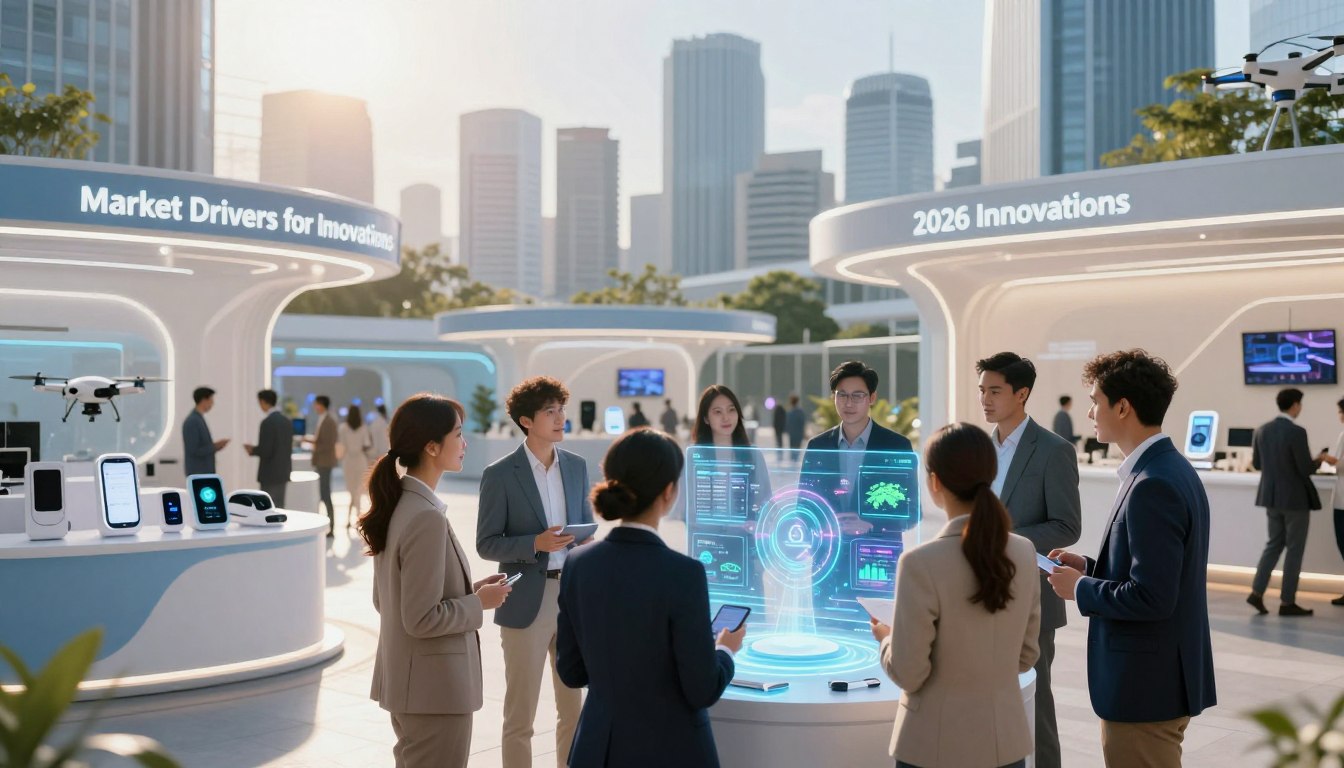
Latest Insights on Smart Technology Trends for 2026

The digital landscape is shifting rapidly. This report offers a clear look at the developments set to define the coming year. You will gain a forward-looking perspective on how innovation will impact both business operations and everyday life. Our analysis spans critical areas like artificial intelligence, cloud computing, and next-generation connectivity. We also examine vital cybersecurity advancements. This comprehensive scope ensures you understand the full
picture of what's ahead.The year 2026 marks a significant turning point. Many experimental concepts are moving from pilot tests to real-world use. This transition from speculation to practical application is a key theme explored in this authoritative analysis.
Our insights are built on a foundation of industry research and real-world case studies. This evidence-based approach provides a balanced and reliable forecast. It prepares you for the tangible changes arriving soon.
Key Takeaways
- 2026 is a pivotal year where experimental tech moves into widespread, practical use.
- The analysis covers AI, cloud systems, connectivity, and cybersecurity developments.
- Business leaders and tech professionals will find actionable insights here.
- The focus shifts from theoretical hype to scalable, real-world deployment.
- Predictions are grounded in industry research and real-world evidence.
- These advancements will transform how businesses operate and people interact with the digital world.
Introduction: The Rapid Evolution of Technology
The adoption timeline for groundbreaking innovations has compressed dramatically. Consider this: the telephone needed 50 years to reach 50 million users. The internet achieved this in just seven years. Today, leading generative AI tools can attract 100 million users in mere months. This acceleration creates a compounding effect. Better tech enables more applications. These generate more data, attracting investment and building superior infrastructure. The cycle reinforces itself, reducing costs and enabling further experimentation. For leaders, the critical question has shifted. It's no longer "What can we do with AI?" but "How do we move from experimentation to impact?" Proven business value now outweighs endless pilot programs in this fast-paced landscape. The time to study a new innovation often exceeds its relevance window. This creates urgency around decision-making. Organizations discover that existing infrastructure and processes cannot handle emerging demands. This rapid evolution context explains why 2026 focuses on practical implementation. The coming sections highlight specific advancements that deliver measurable returns and competitive advantage.
Market Drivers Shaping 2026 Tech Innovations
In 2026, the conversation around innovation shifts decisively from 'what is possible' to 'what delivers value'. Enterprises are sensible about real-world gains. They require vendors to demonstrate how solutions meet urgent priorities. Several interconnected forces are at play. You must handle exponentially growing data volumes. There is also pressure to automate operations as skilled workers become scarce. Delivering personalized customer experiences is now a key differentiator in crowded markets. This forces businesses to adopt sophisticated systems. Regulatory compliance is another major driver, especially in finance and healthcare. Competitive pressure serves as a powerful catalyst. Organizations that delay adoption risk falling behind rivals. These rivals have already integrated advanced analytics into their core operations.
Cost optimization remains critical. Leaders seek solutions that reduce expenses and improve resource utilization. The successful vendors will be those who clearly articulate how their innovation addresses these specific market drivers.
Deep Dive: Smart Technology Trends for 2026
Identifying which emerging innovations will deliver lasting impact demands a systematic approach to trend analysis. Research organizations combine quantitative data analysis with qualitative expert interviews to distinguish genuine transformations from temporary hype cycles. This year's examination reveals a critical shift from experimentation to production-scale deployment. Organizations are moving beyond proof-of-concept projects to implement systems that deliver measurable business value across entire operations. The identified developments are deeply interconnected rather than isolated. Advancements in artificial intelligence enable progress in robotics, while cloud infrastructure supports both AI and connectivity innovations. Security concerns shape how all technology is implemented. These trends span multiple domains including artificial intelligence, cloud computing, next-generation connectivity, and cybersecurity. Successful adoption requires thinking holistically about your technology ecosystem rather than implementing point solutions. This comprehensive perspective comes from authoritative sources like Deloitte's Tech Trends research, which has tracked emerging systems for 17 years. Their methodology ensures you understand how different developments relate to each other.
The analysis provides a roadmap for navigating the next wave of innovation. It helps you prepare models that integrate new capabilities with existing systems and processes effectively.
The Role of Data, Cloud, and AI in Trend Analysis
The synergy between data, cloud infrastructure, and artificial intelligence represents the new operational backbone for forward-thinking enterprises. These three elements work together to create powerful analytical capabilities.
Many organizations discover their existing infrastructure cannot handle production-scale deployment. They're adopting strategic hybrid approaches to overcome these limitations.
"The monthly AI bills reaching tens of millions demonstrate how usage is exploding faster than costs are declining, even with 280-fold token cost reductions."
Utilizing Data for Predictive Insights
Your data quality directly impacts AI model performance. Clean, standardized information enables reliable predictive insights. Organizations use time-series analysis for demand forecasting.
Anomaly detection identifies operational issues before they escalate. Predictive maintenance models significantly reduce equipment downtime. These techniques transform raw information into actionable intelligence.
Harnessing Cloud for Scalability
Cloud platforms provide the elastic computing resources needed for large-scale data processing. You can rapidly provision resources for experimental projects without major capital investment.
The shift to hybrid models recognizes different workload requirements. Consider this comparison of deployment options:
| Deployment Type | Best For | Key Advantage |
| Public Cloud | Variable workloads | Elastic scalability |
| On-Premises | Sensitive data | Consistent performance |
| Edge Computing | Latency-critical apps | Immediate response |
Successful organizations view data, cloud, and AI as an integrated system. Each component enhances the others' value and effectiveness in 2026.
Agentic AI: Redefining Automation and Human-Agent Teams
A new class of autonomous systems is emerging that fundamentally redefines how work gets accomplished. These agents represent a shift from passive tools to active collaborators that perceive environments and make independent decisions.
Traditional automation follows strict rules. Agentic intelligence adapts to exceptions and negotiates with other agents. This creates true collaborative teams rather than simple task executors.
Most organizations struggle with implementation. Only 11% have agents in production despite 38% running pilots. Gartner predicts 40% of projects will fail by 2027 due to automating broken processes.
Successful implementations require redesigning operations from the ground up. As HPE's CFO noted, selecting end-to-end processes delivers true transformation. The UiPath CEO advises tackling biggest problems for meaningful outcomes.
| Feature | Traditional Automation | Agentic AI |
| Decision Making | Predefined rules | Adaptive reasoning |
| Exception Handling | Human intervention required | Autonomous resolution |
| Collaboration | Independent operation | Multi-agent negotiation |
| Learning Capacity | Static workflows | Continuous improvement |
Human-agent teams represent the future model. Agents handle routine decisions while people focus on strategic thinking. This approach augments human
capabilities rather than replacing them.
Customer service agents that resolve issues independently demonstrate the value. Procurement agents negotiating with supplier systems show cross-boundary capabilities. These models create more effective organizations.
Physical AI: Robotics, Automation, and Real-World Integration
Artificial intelligence is now stepping out of digital interfaces and into the physical realm where robots perform real-world tasks. This convergence creates intelligent systems that navigate warehouses, factories, and hospitals with unprecedented autonomy.
Major companies demonstrate the scale of this transformation. Amazon deployed its millionth robot, while BMW's factories feature self-driving cars navigating kilometer-long production routes. These implementations show how physical automation is reshaping industrial operations.
Advancements in Robotic Process Automation
Robotic process automation has evolved beyond software to include physical robots handling material movement and assembly. New training approaches using synthetic data generation dramatically reduce deployment time.
Cloud-based development enables organizations to deploy specialized robotic systems without massive upfront investment. Startups partnering with
established integrators create market-ready solutions for specific industries.
Impact on Daily Operations
Physical AI transforms daily operations across manufacturing, logistics, and service industries. Robots handle repetitive or dangerous tasks while humans focus on supervision and problem-solving.
Successful implementations require careful safety protocols and change management. Employees should view robots as tools that enhance their work rather than threaten employment. As detailed in this analysis of physical AI advancements, human-robot collaboration models are essential for effective integration.
The technology continues advancing rapidly. While humanoid robots will reach customers, early adopters should expect limited capabilities. True human-level versatility remains years away, but current systems already deliver significant value in targeted operations.
Optimizing AI Infrastructure and Compute Strategies
Organizations embarking on artificial intelligence journeys quickly discover that conventional infrastructure approaches cannot support the computational demands of modern AI workloads. Despite 280-fold token cost reductions, monthly bills reach tens of millions as usage outpaces savings.
"The monthly AI bills reaching tens of millions demonstrate how usage is exploding faster than costs are declining, even with substantial token cost reductions."
This economic reality forces a strategic shift from cloud-first to hybrid deployment models. Each approach serves distinct workload characteristics and performance requirements.
| Infrastructure Type | Primary Advantage | Ideal Workload |
| Public Cloud | Elastic scalability | Experimental projects |
| On-Premises | Predictable costs | High-volume production |
| Edge Computing | Real-time response | Latency-sensitive applications |
Edge deployment becomes critical for applications requiring immediate data processing. Inference models run locally to minimize latency and bandwidth consumption.
Open standards like the Open Compute Project enable modular systems using best-in-class components. This approach reduces vendor lock-in and optimizes performance across your computing environment.
Continuous monitoring of resource utilization and costs ensures your infrastructure strategy remains aligned with evolving business needs. The right technology foundation supports scalable AI systems without overwhelming your budget.
Cloud and Hybrid Models: Accelerating Business Agility
Modern business agility hinges on deployment flexibility that balances innovation with operational control. Hybrid approaches let you rapidly scale resources while maintaining governance over critical systems.
Balancing On-Premises and Cloud Deployments
Your deployment strategy requires careful workload assessment. Sensitive data often stays on-premises for compliance. Variable workloads benefit from
public cloud elasticity.
Edge computing handles latency-sensitive applications near data sources. This distributed model optimizes performance across your entire infrastructure.
| Deployment Type | Primary Advantage | Ideal Workload | Control Level |
| Public Cloud | Rapid scale | Experimental projects | Provider-managed |
| On-Premises | Full control | Regulated data | Complete |
| Hybrid Model | Balanced flexibility | Mixed requirements | Granular |
| Edge Computing | Low latency | Real-time processing | Localized |
Cloud sovereignty emerges as a critical differentiator. Enterprises demand transparency across their entire stack. Providers offering open standards gain preference over proprietary solutions.
The neocloud market faces consolidation as infrastructure costs challenge smaller players. Your long-term strategy should prioritize stable platforms with predictable economics. This approach ensures sustainable business agility.
Enhancing Cybersecurity in the Age of AI and Connectivity
Artificial intelligence introduces a double-edged sword to the cybersecurity arena. It empowers attackers with unprecedented speed while offering
defenders their most potent tools. This dynamic fundamentally reshapes how you must protect your digital assets.
Traditional security methods, reliant on human analysis, are overwhelmed. Threats now operate at machine speed and scale. Your organizations need new strategies to keep pace.
"What we're experiencing today is no different than what we've experienced in the past. The only difference with AI is speed and impact."
Implementing AI-Driven Security Strategies
You must secure your AI systems across four critical domains: data, models, applications, and infrastructure. This prevents attacks like training data poisoning or model theft.
Simultaneously, you can deploy AI-powered defenses. These systems analyze network patterns to detect anomalies. They predict attacks and
trigger automatic responses in real-time.
Supply chain security is a major concern. Verizon's report shows third-party flaws cause 30% of breaches. A single compromise in shared
technology can impact thousands.
Effective cybersecurity requires a zero-trust architecture. This model assumes a breach has already occurred. It verifies every access request
for continuous control.
Regulatory frameworks like the EU Cyber Resilience Act are driving investments. They force organizations to embed security early in development. This proactive approach is essential for resilience.
Open Standards and Next-Generation Data Centers
A quiet revolution is transforming data center architecture through collaborative industry standards that enable component interoperability. This movement dismantles proprietary ecosystems that have long limited innovation and created vendor lock-in.
Initiatives like the Open Compute Project develop specifications for servers, storage, and networking. These frameworks allow any manufacturer to build compatible components. This fosters competition that drives down costs and accelerates innovation.
Open standards are particularly vital for AI infrastructure. Training and inference workloads demand high-performance networking and efficient cooling. Flexible compute architectures must accommodate rapidly evolving processor technologies.
The shift benefits enterprises building their own data centers and cloud providers alike. When not locked into proprietary ecosystems, they can offer more competitive and flexible services. This represents a fundamental change in how vendors compete.
| Feature | Proprietary Systems | Open Standards |
| Component Selection | Limited to vendor offerings | Best-in-class from multiple sources |
| Innovation Pace | Vendor-dependent timeline | Industry-wide acceleration |
| Cost Structure | Higher due to lock-in | Competitive market pricing |
| Future Flexibility | Constrained by ecosystem | Adaptable to emerging technologies |
Next-generation data centers support AI workloads with liquid cooling and high-bandwidth networking. Modular power systems scale capacity incrementally. This infrastructure development ensures your organization remains agile in adopting new computational models.
Transformative Impact of 6G and Ultra Connectivity
The telecommunications sector is adopting a more cautious stance with 6G development following previous hype cycles. Industry leaders now emphasize practical enhancements over revolutionary promises. This measured approach focuses on demonstrating concrete value in specific applications.
Early implementations will likely combine advanced 5G capabilities with selective 6G features. This hybrid model allows organizations to benefit from next-generation innovations without complete infrastructure replacement. The strategy targets niche markets where specific enhancements deliver immediate returns.
Real-World 6G Use Cases in Industry
Manufacturing operations gain significant advantages from integrated sensing capabilities. These systems enable precise positioning and coordination of autonomous robots. The technology reduces setup time while improving operational accuracy.
Logistics applications benefit from ultra-reliable low-latency communications. Real-time fleet coordination becomes possible with minimal delay. This trend transforms how companies manage supply chain operations.
Immersive extended reality applications require massive bandwidth and instant response times. 6G connectivity supports these demanding uses cases effectively. The systems enable collaborative environments that feel natural and responsive.
AI-driven network orchestration will become native to next-generation infrastructure. Networks automatically optimize resource allocation based on current demand patterns. This intelligent management ensures consistent performance across varying conditions.
Successful adoption hinges on vendor credibility and demonstrated ROI. The coming year will see focused deployments solving specific business problems. Broad transformative impact remains several years away as the technology matures.
Enterprise Adoption: Leveraging Tech to Drive Business Value
Successful companies are shifting their approach from asking 'what can we build?' to 'what problem should we solve?' This mindset change separates organizations that achieve real impact from those stuck in endless experimentation.
"Without focusing on a specific business problem and the value you want to derive, it could be easy to invest in AI and receive no return."
Aligning New Tech with Operational Goals
Leading enterprises adopt a "fail fast" methodology. They run small pilots to validate value before large-scale implementation. This approach reduces risk
while enabling rapid learning.
Walmart demonstrated this effectively. They involved store associates in building a scheduling app. The result? Scheduling time dropped from 90 minutes to 30 minutes with high adoption.
Cross-functional collaboration is essential. IT, operations, and finance must work together. This ensures technical capabilities serve business objectives rather
than existing as isolated projects.
Your organization should treat adoption as continuous learning. Establish feedback mechanisms to measure results and iterate. This creates lasting value from your technology investments.
Changing Workforce Dynamics in the New Tech Era
The fundamental relationship between human workers and digital systems is undergoing a profound transformation. Your organizations are restructuring to become leaner and more strategic. AI handles routine tasks while people focus on creativity and judgment.
This shift creates new models where humans and machines collaborate in teams. Workers now supervise multiple AI agents rather than performing repetitive work. They handle exceptions and continuously improve agent performance.
The Deloitte survey reveals only 1% of IT leaders report no major operating model changes. Successful organizations invest heavily in reskilling programs. They recognize institutional knowledge remains valuable even as tasks change.
New skills are essential across your workforce. People must effectively prompt AI systems and interpret their outputs critically. They need to know when human judgment should override algorithmic suggestions.
Leadership approaches must evolve with this shift. Technology leaders become evangelists who orchestrate human-agent collaboration. They help entire organizations understand AI capabilities and limitations.
Perpetual evolution is becoming a core capability. Workforce skills and structures must continuously adapt. Your teams will need to embrace this ongoing transformation in their daily work.
Vendor Strategies to Navigate the 2026 Tech Landscape
As enterprise buyers grow more discerning, technology providers must fundamentally rethink their go-to-market strategies. Successful companies now focus on solving specific operational challenges rather than offering generic platforms.
The most effective approach involves developing vertical solutions tailored to specific industries. These offerings incorporate deep domain expertise that resonates with target enterprises. This reduces customization requirements and accelerates deployment timelines.
Partnership strategies have become essential for vendor success. Leading companies collaborate with system integrators and industry specialists. This creates complete solutions that address complex business needs comprehensively.
Transparent business models differentiate successful vendors in this competitive market. Customers favor predictable pricing and contractual stability over visionary promises. This trend reflects the maturity of enterprise technology buyers.
Regulatory compliance capabilities are now table stakes for technology vendors. Organizations must build compliance features directly into their software offerings. This approach helps customers navigate requirements like the EU Cyber Resilience Act effectively.
Vendor credibility hinges on demonstrating real-world value through customer references and case studies. Industry leaders understand that proven results outweigh technological sophistication. This strategic shift is detailed in comprehensive market analysis of emerging vendor approaches.
The most successful providers position themselves as long-term partners rather than transaction-focused sellers. They offer ongoing support and strategic guidance as customer needs evolve. This partnership mindset creates sustainable competitive advantage in the dynamic technology market.
Future Outlook: Continuous Innovation and Market Resilience
Market leadership in the coming years will belong to those who master the art of continuous reinvention. The traditional playbook assumed you had time to get it right. That assumption no longer holds in today's fast-paced world.
ABI Research analysts see 2026 as a year of gradual modernization. Visionary concepts are being replaced by solutions offering quick wins. Organizations built for sequential improvement cannot compete with those operating in continuous learning loops.
Successful enterprises establish feedback cycles where they deploy, gather data, iterate, and redeploy. This creates exponential advantages over competitors using traditional project cycles. The gap between leaders and laggards widens dramatically.
The next wave of development focuses on integration rather than individual breakthroughs. Organizations connecting AI, automation, and security into unified systems realize more value. Sustainability considerations are becoming critical differentiators.
| Approach | Focus | Adaptation Speed | Long-term Impact |
| Sequential Improvement | Project completion | Slow, linear | Limited competitive advantage |
| Continuous Learning | Ongoing optimization | Rapid, exponential | Sustained market leadership |
| Technology-First | Latest features | Dependent on vendor roadmap | Often misaligned with business needs |
| Outcome-Driven | Business value | Flexible and responsive | Direct connection to results |
This fundamental shift represents permanent change rather than temporary trends. The organizations that succeed will have courage to redesign processes. They maintain discipline connecting every investment to business outcomes.
Navigating this future requires balancing bold action with thoughtful consideration. You must move quickly while building safeguards against risks. Maintaining focus on human outcomes remains essential as capabilities advance.
Conclusion
The journey through 2026's technological landscape reveals a critical inflection point for forward-thinking enterprises. As Kelly Raskovich emphasizes, "Innovation compounds. The gap between laggards and leaders grows exponentially." Your response determines which side of that divide your organization occupies. Success depends less on having the most advanced tools and more on organizational courage to redesign operations. You must connect every investment to measurable business outcomes. The interconnected nature of these developments means AI enables robotics, while cloud supports both. Thriving organizations view adoption as continuous learning rather than projects with endpoints. While specific predictions may vary, the trajectory toward intelligent, automated systems remains clear. This report provides a foundation for your strategy development.
Begin assessing your current position and identifying gaps. Take concrete steps now, before competitive windows close. Remember you're not navigating this transformation alone—every industry faces similar challenges in this pivotal year.
0 Comments
Be the first to share your thoughts on this article.