

Financial Literacy
5 Things You Should Stop Doing With Your Money Now

US credit card debt hit $1.28 trillion. 24% of Americans have zero emergency savings. The median retirement balance is $87,000 against a $823,000 target. Most of these numbers are driven not by low incomes but by five specific, fixable habits. Here is what they are, what each one costs, and the practical step that replaces each one

Tha Starting - Early Compounding Advantage
These numbers are not primarily the product of insufficient income. They are the product of five specific, identifiable money habits that quietly compound against financial security over years and decades. None of these habits feel catastrophic in the moment. The minimum payment keeps the bank happy. The emergency fund will be funded next month. The raise gets absorbed into a nicer lifestyle. The retirement contribution will be increased next year. The savings happen with whatever is left at the end of the month. Each of these feels like a reasonable, temporary state of affairs. The compounding effects are neither reasonable nor temporary.
This guide names the five habits, explains exactly what each one costs, and provides the single practical step that replaces each one. The goal is not a complete financial overhaul. It is five specific changes, each of which can be made in one decision.
US credit card debt: $1.28 trillion, Q4 2025 (Federal Reserve Bank of New York). Average balance: $7,886 at 25% APR = ~$2,000/year in interest. 24% of Americans have zero emergency savings (Bankrate 2026). Median retirement balance: $87,000 vs $823,800 average target (Clever Real Estate, August 2026). Personal savings rate: fell from 6% to 4% despite rising incomes, Q1 2024–Q4 2025.
The minimum payment trap is one of the most expensive financial habits that exists in consumer banking, and it is designed to be. The minimum payment on a $7,886 balance at 25% APR is approximately $175 per month. Paying only the minimum, the balance takes more than 30 years to clear and costs more than $22,000 in total — nearly three times the original balance — before the debt is gone (Consumer Financial Protection Bureau estimates). Every month the minimum is chosen over a larger payment, the cardholder is accepting a 25 percent annual charge on the outstanding balance.
What makes this habit particularly damaging is that high credit card utilisation simultaneously reduces the credit score, making future borrowing more expensive. TransUnion recommends keeping credit utilisation below 30 percent of the available limit; above this, the score impact begins to compound the financial cost of the debt itself.
Why this hurts more than you think: Buy Now, Pay Later (BNPL) services present an identical trap in a different costume. BNPL debt grew 20% year-over-year to $70 billion in transaction value in 2025. BNPL purchases do not appear on credit reports, making it easy for consumers to stack multiple invisible installment plans simultaneously. When budgets tighten, BNPL obligations default first, and the financial damage arrives without warning. The interest-free periods on BNPL products are not interest-free on late or extended payments.
List every credit card balance with its APR in descending order. Direct every pound and dollar above the minimum payment to the highest-rate balance until it is cleared (the avalanche method). If the minimum payments feel unmanageable, call the card issuer: hardship programmes, temporary rate reductions, and balance transfer options are all more available than most cardholders realise. A 0% balance transfer card for an existing balance, combined with a fixed monthly payment that clears the balance before the promotional period ends, can save hundreds to thousands in interest charges.
The absence of an emergency fund is not simply a savings problem. It is a debt accelerant. When an unavoidable expense arrives and there is no cash cushion to absorb it, the only available option for most households is a credit card at 25 percent APR, a personal loan, or a payday loan at rates that can exceed 300 percent on an annualised basis. A $1,000 car repair on a credit card at 25 percent that takes 12 months to clear costs $1,136. The same $1,000 funded from an emergency savings account costs exactly $1,000. The difference is $136 — which is also the amount that would have been needed to build a $1,000 emergency fund from scratch in under eight months at $130 per month.
The target for an emergency fund is three to six months of essential expenses in a liquid, accessible account. At current high-yield savings rates (4 to 5 percent in 2026 for many online savings accounts), that money earns something meaningful while it waits. GOBankingRates’ December 2025 guide recommends opening a high-yield savings account, automating a monthly transfer, and not worrying about the goal size at first: ‘Just start saving.’
An emergency fund is not a savings goal. It is insurance. Like car insurance, you hope you never need it, you do not expect to enjoy having it, and not having it is simply not a rational option if an unexpected bill would send you into high-interest debt. The expected value of having a three-month emergency fund is always positive — it does not just protect against the emergency itself, it protects against the compounding debt that the emergency generates without it.
At the individual level, lifestyle inflation typically operates through several channels that feel like entirely reasonable decisions in the moment:
Why this hurts more than you think: Lifestyle inflation is particularly dangerous because it is invisible and feels earned. The promotion genuinely was earned. The higher salary genuinely does make the new car affordable on a monthly basis. The problem is not the individual upgrade; it is the failure to allocate any portion of the increase to financial security before lifestyle consumption. A raise of $5,000 per year that is entirely consumed by lifestyle spending generates zero additional financial resilience.
Implement the 50/30/20 rule as a structural response to every pay rise: 50% of take-home pay to needs, 30% to wants, 20% to savings and debt repayment. The critical application is the pay rise rule: when income increases, increase savings contributions before lifestyle spending adjusts to the new income. Set pension or savings contributions to auto-escalate at every pay review. The most powerful implementation: redirect the first month of any pay rise entirely to savings before adjusting any other spending. Once the lifestyle is set at the new level, it is very difficult to reduce it.
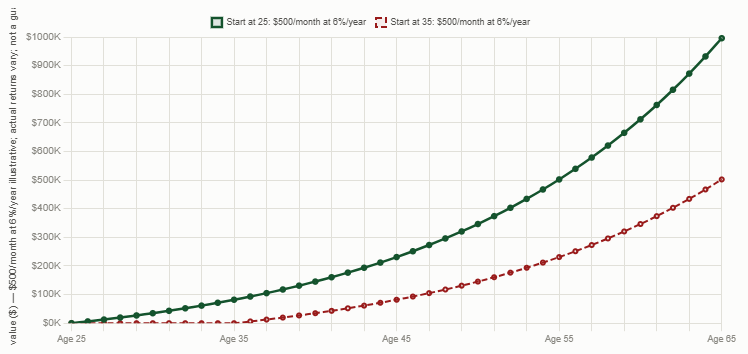
These figures represent, in large part, the accumulated consequence of starting too late. The most compelling arithmetic in personal finance is the compound growth advantage of early saving. WalletGrower’s July 2026 analysis quantifies this precisely: someone who starts investing $500 per month at age 25 instead of age 35 has approximately $500,000 more by age 65 — from identical monthly contributions. The only variable is time. The person who starts at 35 must invest a materially larger amount each month to reach the same outcome.
The employer match compounds this loss when it is not captured. The average employer match adds 3 to 4 percent of salary to retirement savings — equivalent to $2,250 to $3,000 per year on a $75,000 salary, or $90,000 to $120,000 over a full career before investment growth (WalletGrower). Not contributing enough to capture the full employer match is, as the analysis states, ‘mathematically equivalent to declining a guaranteed pay raise.’ Fidelity’s Q1 2026 data shows the combined employee and employer savings rate reached a record 14.4 percent, approaching the recommended 15 percent target — but this average masks the 40 percent of households who have contributed nothing.
If you have access to a workplace pension or 401(k) with an employer match and are not contributing enough to capture the full match, change this today. This is one financial decision that requires only one action: log into your pension or 401(k) provider online and increase your contribution to at least the match threshold. In the UK: if your employer offers 5% match on 5% contributions, and you are contributing 3%, you are leaving 2% of your salary in unclaimed benefit every month. In the US: the 2026 401(k) contribution limit is $23,500 ($31,000 for those 50+). If you are not in a workplace scheme, open an ISA (UK) or IRA (US) this week. The Roth IRA 2026 limit is $7,000 ($8,000 age 50+); contributions can be withdrawn penalty-free, making it an accessible starting point.
The personal savings rate data confirms this at scale. Only 23 percent of Brits actively save for retirement (Raisin, 2026). The US personal savings rate is 4 percent. These are not numbers that suggest most people are saving deliberately and running out of money before they can save more. They are numbers that suggest most people are saving whatever is left after spending — which, structurally, is very little.
The pay-yourself-first principle is the oldest and most consistently effective personal finance framework: on payday, before any spending occurs, a fixed amount transfers automatically to savings, investments, emergency fund, or debt repayment. The remaining balance is what is available for spending. This is not a budgeting technique. It is a structural change that removes willpower from the equation entirely. The savings happen whether or not motivation is present, whether or not the month has been expensive, and whether or not the spending looks like it will be tight.
The difference between a spending-first system and a saving-first system is not the amount saved in any given month. It is the reliability of saving across months, years, and decades. Willpower-dependent saving produces irregular, unpredictable, frequently zero outcomes. Automated, pre-committed saving produces consistent outcomes regardless of motivation, stress, or life events. Automation is what converts intention into compounding.
On the day of your next pay receipt, log into your banking app and set up the following automatic transfers to occur on payday, before any discretionary spending: (1) emergency fund top-up transfer, (2) pension or ISA/IRA contribution (or increase the payroll deduction to reach the employer match minimum), (3) any fixed debt overpayment above the minimum. Then spend the remaining balance freely. The system is now saving-first. You do not need motivation, willpower, or a budget review to make this work — only the one-time action of setting the transfers.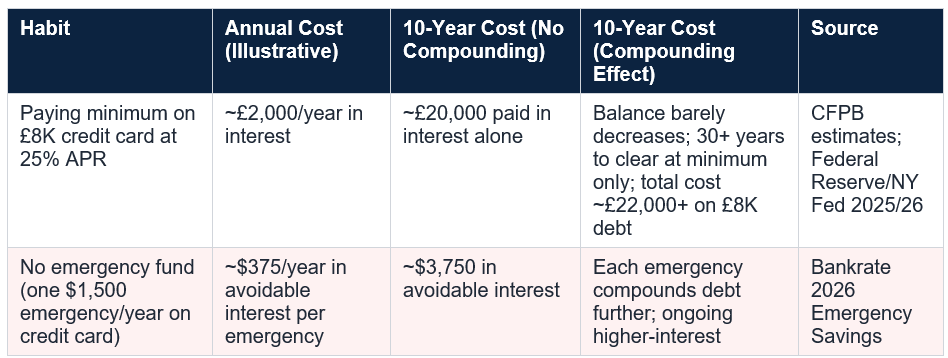
The compounding effects across all five habits simultaneously are not additive — they interact. High-interest credit card debt prevents emergency fund building. The absence of an emergency fund forces credit card use. Lifestyle inflation prevents debt paydown. Delayed retirement saving loses the most irreplaceable resource in personal finance: time. And the spending-first model is the structural enabler that allows all four other habits to persist because there is never money ‘left over’ to fix any of them.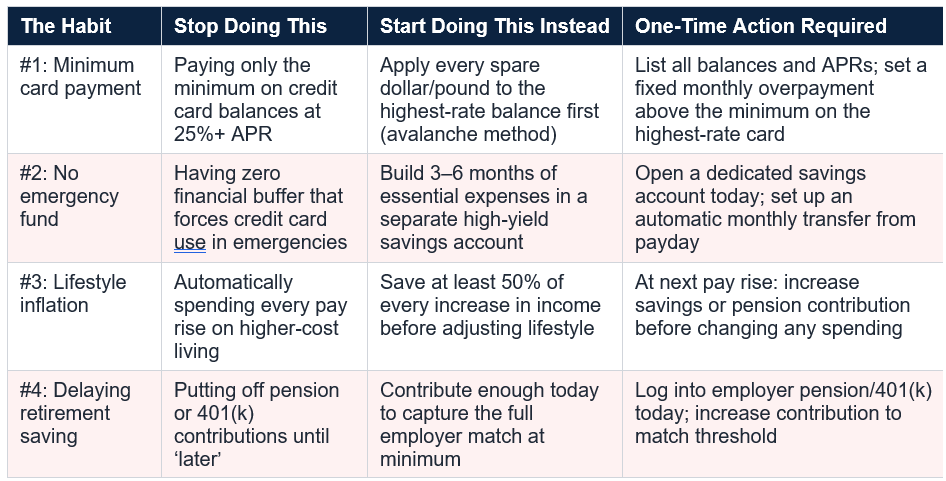

What makes this encouraging rather than discouraging is that each habit requires only one change, made once, to produce a materially different trajectory. The credit card overpayment is set once and runs automatically. The emergency fund transfer is automated on payday. The savings contribution at the next pay rise is set before the lifestyle adjusts. The pension match is captured with one click in the provider’s app. The payday savings automation is set up once and runs indefinitely.
None of these actions requires ongoing willpower, monthly budget reviews, or sustained lifestyle restriction. They require five decisions, each made once, each converting an expensive default behaviour into an automatic, financially productive one. The compounding then works in your favour rather than against it.
The best time to make these changes was ten years ago. The second best time is this week.
Paying only the minimum on high-interest credit card debt is likely the single most financially damaging common habit, because it is expensive, long-running, and worsens other financial problems simultaneously. The average US cardholder with a $7,886 balance at 25% APR pays approximately $2,000 per year in interest charges alone — money that could be building an emergency fund, contributing to retirement savings, or paying down the debt faster. Paying only the minimum on that balance means the debt persists for over 30 years and costs more than $22,000 in total (Consumer Financial Protection Bureau). The habit also keeps credit utilisation high, reducing the credit score and making future borrowing more expensive.
How much should I have in an emergency fund?
The widely cited target is three to six months of essential expenses. Essential expenses means the bills you must pay regardless of circumstances: rent or mortgage, utilities, groceries, transport, insurance, and minimum debt payments. If your essential monthly expenses are $3,000, your minimum emergency fund target is $9,000 and your full target is $18,000. If that feels very far away, the starting target is simply $1,000 — enough to cover most common emergencies (car repair, medical bill, appliance replacement) without reaching for a credit card. The account should be kept separate from your everyday current account and should be in a high-yield savings account so it earns something while it waits. According to Bankrate's 2026 Annual Emergency Savings Report, 24% of Americans have zero emergency savings — so simply having anything puts you ahead of nearly a quarter of adults.
What is the pay-yourself-first principle?
Pay-yourself-first means automating transfers to savings, investments, and debt repayment on the day your income arrives — before any discretionary spending occurs. The remaining balance in your current account after the transfers is what you spend. This structural approach removes the reliance on willpower that characterises 'save what's left at the end of the month,' which typically results in saving very little. The mechanics are simple: on payday, set automated transfers to your emergency fund, pension or ISA/IRA, and any fixed overpayment on high-interest debt. You then spend the remainder freely, knowing the important allocations have already been made. This is the system used by the most consistently financially secure households — not because they earn more, but because they have made saving the automatic outcome of income receipt rather than the residual outcome of spending.
How does lifestyle inflation happen and how do I stop it?
Lifestyle inflation happens because spending naturally expands to fill available income. When salary increases, the lifestyle adjusts upward to match: a nicer car, a more expensive rental, better holidays, more dining out. Each individual upgrade feels affordable and earned. The cumulative effect is that financial security does not improve even as income rises. The Bureau of Economic Analysis data from Q1 2024 to Q4 2025 shows this at a national scale: US per capita disposable income rose by approximately $4,000 per person per year, while the personal savings rate fell. The fix is the 50/30/20 rule applied specifically to every pay rise: before any lifestyle adjustment occurs, increase savings or pension contributions. The most powerful implementation: at the next pay review, redirect the entire first month of the additional income to savings before the lifestyle adjusts to the new number. Once the higher lifestyle is established, it feels like a need rather than a choice, and reducing it is psychologically much harder than preventing the upgrade in the first place.
What happens if I don't capture my employer 401(k) or pension match?
You lose free money — specifically, 50% to 100% of the matched portion of your salary, permanently. The employer match on a 401(k) or workplace pension is an immediate 50% to 100% return on the matched contribution before any investment growth occurs. On a $75,000 salary with a 4% employer match, not contributing enough to trigger the full match means losing $3,000 in employer contributions per year, every year. Over a full career, that is $90,000 to $120,000 in unclaimed employer contributions before investment growth is applied. If that money had been invested and grown at 6% per year over 25 years, the lost employer match alone would amount to approximately $175,000 of retirement savings — all from a single administrative decision not to increase the contribution rate to the match threshold. Fidelity's Q1 2026 data shows the combined employee and employer savings rate reached a record 14.4%, approaching the recommended 15% target — suggesting that more savers are capturing their match than before, but a significant proportion are still not.
Is it better to pay off debt or save first?
Generally, pay off high-interest debt before building savings beyond an emergency fund buffer — but always capture the employer match first. The reasoning: if you have a credit card at 25% APR, paying it down is a guaranteed 25% return. No savings account, investment, or pension contribution earns 25% with certainty. However, the employer match is an exception: a 50% to 100% immediate return on matched contributions outperforms even 25% APR debt repayment in the first year. The recommended sequence: (1) contribute enough to the pension/401(k) to capture the full employer match; (2) build a $1,000 emergency buffer; (3) attack high-interest debt using the avalanche method (highest APR first); (4) build the full emergency fund to 3–6 months; (5) maximise pension and investment contributions.
Table of Contents
- The Habits, Not the Income, That Determine the Outcome
- #1: Stop Paying Only the Minimum on Your Credit Card
- #2: Stop Living Without an Emergency Fund
- #3: Stop Letting Lifestyle Inflation Consume Every Raise
- #4: Stop Putting Off Retirement Saving
- #5: Stop Spending First and Saving What’s Left
- The Compounding Cost: What These Five Habits Cost Over a Decade
- The Five Fixes: A Quick-Reference Summary
- Conclusion: Five Habits, Changed Once
- Frequently Asked Questions
10 Years Cost of each Bad Habit.
Tha Starting - Early Compounding Advantage
The Habits, Not the Income, That Determine the Outcome
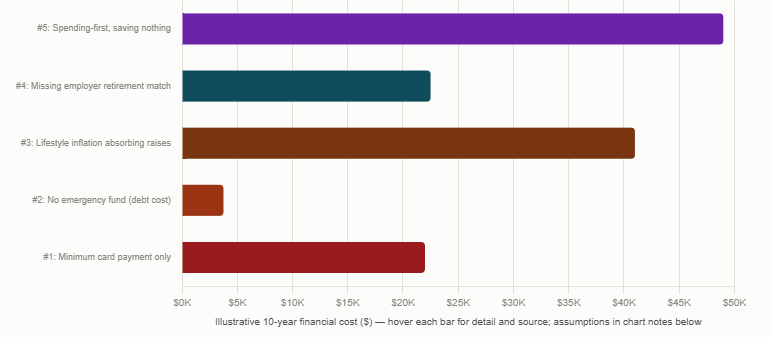
The financial statistics of 2025 and 2026 tell a story that is difficult to reconcile on the surface. Per capita disposable personal income in the US grew from $63,638 in Q1 2024 to $67,687 in Q4 2025 — Americans are earning more than ever. Yet over that same period, the personal savings rate fell from 6 percent to 4 percent. Credit card debt reached $1.28 trillion, the highest in history. Twenty-four percent of Americans have zero emergency savings. The median retirement account balance for working-age adults is $87,000 against an average retirement target of $823,800 — a shortfall of over $535,000.These numbers are not primarily the product of insufficient income. They are the product of five specific, identifiable money habits that quietly compound against financial security over years and decades. None of these habits feel catastrophic in the moment. The minimum payment keeps the bank happy. The emergency fund will be funded next month. The raise gets absorbed into a nicer lifestyle. The retirement contribution will be increased next year. The savings happen with whatever is left at the end of the month. Each of these feels like a reasonable, temporary state of affairs. The compounding effects are neither reasonable nor temporary.
This guide names the five habits, explains exactly what each one costs, and provides the single practical step that replaces each one. The goal is not a complete financial overhaul. It is five specific changes, each of which can be made in one decision.
US credit card debt: $1.28 trillion, Q4 2025 (Federal Reserve Bank of New York). Average balance: $7,886 at 25% APR = ~$2,000/year in interest. 24% of Americans have zero emergency savings (Bankrate 2026). Median retirement balance: $87,000 vs $823,800 average target (Clever Real Estate, August 2026). Personal savings rate: fell from 6% to 4% despite rising incomes, Q1 2024–Q4 2025.
#1: Stop Paying Only the Minimum on Your Credit Card
US credit card debt hit $1.28 trillion in Q4 2025 (Federal Reserve Bank of New York), with the average cardholder owing $7,886 at an average APR of approximately 25 percent. At this rate, the interest alone costs the average indebted cardholder nearly $2,000 per year. Twenty-one percent of Americans identified growing credit card debt as one of their top financial regrets of 2025 (Intuit Credit Karma, December 2025).The minimum payment trap is one of the most expensive financial habits that exists in consumer banking, and it is designed to be. The minimum payment on a $7,886 balance at 25% APR is approximately $175 per month. Paying only the minimum, the balance takes more than 30 years to clear and costs more than $22,000 in total — nearly three times the original balance — before the debt is gone (Consumer Financial Protection Bureau estimates). Every month the minimum is chosen over a larger payment, the cardholder is accepting a 25 percent annual charge on the outstanding balance.
What makes this habit particularly damaging is that high credit card utilisation simultaneously reduces the credit score, making future borrowing more expensive. TransUnion recommends keeping credit utilisation below 30 percent of the available limit; above this, the score impact begins to compound the financial cost of the debt itself.
Why this hurts more than you think: Buy Now, Pay Later (BNPL) services present an identical trap in a different costume. BNPL debt grew 20% year-over-year to $70 billion in transaction value in 2025. BNPL purchases do not appear on credit reports, making it easy for consumers to stack multiple invisible installment plans simultaneously. When budgets tighten, BNPL obligations default first, and the financial damage arrives without warning. The interest-free periods on BNPL products are not interest-free on late or extended payments.
List every credit card balance with its APR in descending order. Direct every pound and dollar above the minimum payment to the highest-rate balance until it is cleared (the avalanche method). If the minimum payments feel unmanageable, call the card issuer: hardship programmes, temporary rate reductions, and balance transfer options are all more available than most cardholders realise. A 0% balance transfer card for an existing balance, combined with a fixed monthly payment that clears the balance before the promotional period ends, can save hundreds to thousands in interest charges.
#2: Stop Living Without an Emergency Fund
Twenty-four percent of Americans have no emergency savings at all, according to Bankrate’s 2026 Annual Emergency Savings Report. A separate US News survey found that more than two in five Americans could not cover an unexpected expense of $1,000 from savings. These figures mean that almost a quarter of adults are one car repair, one medical bill, or one job disruption away from a financial crisis that will require borrowing at the highest available interest rates.The absence of an emergency fund is not simply a savings problem. It is a debt accelerant. When an unavoidable expense arrives and there is no cash cushion to absorb it, the only available option for most households is a credit card at 25 percent APR, a personal loan, or a payday loan at rates that can exceed 300 percent on an annualised basis. A $1,000 car repair on a credit card at 25 percent that takes 12 months to clear costs $1,136. The same $1,000 funded from an emergency savings account costs exactly $1,000. The difference is $136 — which is also the amount that would have been needed to build a $1,000 emergency fund from scratch in under eight months at $130 per month.
The target for an emergency fund is three to six months of essential expenses in a liquid, accessible account. At current high-yield savings rates (4 to 5 percent in 2026 for many online savings accounts), that money earns something meaningful while it waits. GOBankingRates’ December 2025 guide recommends opening a high-yield savings account, automating a monthly transfer, and not worrying about the goal size at first: ‘Just start saving.’
An emergency fund is not a savings goal. It is insurance. Like car insurance, you hope you never need it, you do not expect to enjoy having it, and not having it is simply not a rational option if an unexpected bill would send you into high-interest debt. The expected value of having a three-month emergency fund is always positive — it does not just protect against the emergency itself, it protects against the compounding debt that the emergency generates without it.
#3: Stop Letting Lifestyle Inflation Consume Every Raise
Lifestyle inflation is the process by which spending rises in lock-step with — or in excess of — rising income. The aggregate data for 2024–2025 makes this pattern visible at a national level: US per capita disposable personal income grew from $63,638 in Q1 2024 to $67,687 in Q4 2025, an increase of approximately $4,000 per person per year. Over the same period, the personal savings rate fell from 6 percent to 4 percent (Bureau of Economic Analysis, cited 24/7 Wall St., April 2026). At the aggregate level, Americans received a meaningful pay rise and spent every cent of it and then some.At the individual level, lifestyle inflation typically operates through several channels that feel like entirely reasonable decisions in the moment:
- The new car to match the new job title.
- The restaurant spending that expands when the salary review confirms the promotion.
- The subscription services added one by one over years of incrementally better income.
- The house purchase that stretches to the maximum afforded rather than the minimum adequate.
- The holiday upgrade that becomes the new baseline.
Why this hurts more than you think: Lifestyle inflation is particularly dangerous because it is invisible and feels earned. The promotion genuinely was earned. The higher salary genuinely does make the new car affordable on a monthly basis. The problem is not the individual upgrade; it is the failure to allocate any portion of the increase to financial security before lifestyle consumption. A raise of $5,000 per year that is entirely consumed by lifestyle spending generates zero additional financial resilience.
Implement the 50/30/20 rule as a structural response to every pay rise: 50% of take-home pay to needs, 30% to wants, 20% to savings and debt repayment. The critical application is the pay rise rule: when income increases, increase savings contributions before lifestyle spending adjusts to the new income. Set pension or savings contributions to auto-escalate at every pay review. The most powerful implementation: redirect the first month of any pay rise entirely to savings before adjusting any other spending. Once the lifestyle is set at the new level, it is very difficult to reduce it.
#4: Stop Putting Off Retirement Saving
The median retirement account balance for working-age Americans is $87,000 (Investment Company Institute Q1 2026 data). Forty percent of US households have nothing saved for retirement. The average amount retirees in 2026 say is needed for a comfortable retirement is $823,800 — against an average actual balance of $288,700 (Clever Real Estate, August 2026). Fifty-two percent of American workers say their retirement savings are not where they should be (Bankrate).These figures represent, in large part, the accumulated consequence of starting too late. The most compelling arithmetic in personal finance is the compound growth advantage of early saving. WalletGrower’s July 2026 analysis quantifies this precisely: someone who starts investing $500 per month at age 25 instead of age 35 has approximately $500,000 more by age 65 — from identical monthly contributions. The only variable is time. The person who starts at 35 must invest a materially larger amount each month to reach the same outcome.
The employer match compounds this loss when it is not captured. The average employer match adds 3 to 4 percent of salary to retirement savings — equivalent to $2,250 to $3,000 per year on a $75,000 salary, or $90,000 to $120,000 over a full career before investment growth (WalletGrower). Not contributing enough to capture the full employer match is, as the analysis states, ‘mathematically equivalent to declining a guaranteed pay raise.’ Fidelity’s Q1 2026 data shows the combined employee and employer savings rate reached a record 14.4 percent, approaching the recommended 15 percent target — but this average masks the 40 percent of households who have contributed nothing.
If you have access to a workplace pension or 401(k) with an employer match and are not contributing enough to capture the full match, change this today. This is one financial decision that requires only one action: log into your pension or 401(k) provider online and increase your contribution to at least the match threshold. In the UK: if your employer offers 5% match on 5% contributions, and you are contributing 3%, you are leaving 2% of your salary in unclaimed benefit every month. In the US: the 2026 401(k) contribution limit is $23,500 ($31,000 for those 50+). If you are not in a workplace scheme, open an ISA (UK) or IRA (US) this week. The Roth IRA 2026 limit is $7,000 ($8,000 age 50+); contributions can be withdrawn penalty-free, making it an accessible starting point.
#5: Stop Spending First and Saving What’s Left
The fifth habit is the one that makes all the others possible. Most people operate a spending-first financial model: income arrives, bills are paid, lifestyle spending occurs across the month, and savings receive whatever remains. In most households, whatever remains is nothing or near-nothing. This is not a failure of willpower. It is a structural failure: a system that makes saving the residual outcome of spending, rather than making saving the first allocation.The personal savings rate data confirms this at scale. Only 23 percent of Brits actively save for retirement (Raisin, 2026). The US personal savings rate is 4 percent. These are not numbers that suggest most people are saving deliberately and running out of money before they can save more. They are numbers that suggest most people are saving whatever is left after spending — which, structurally, is very little.
The pay-yourself-first principle is the oldest and most consistently effective personal finance framework: on payday, before any spending occurs, a fixed amount transfers automatically to savings, investments, emergency fund, or debt repayment. The remaining balance is what is available for spending. This is not a budgeting technique. It is a structural change that removes willpower from the equation entirely. The savings happen whether or not motivation is present, whether or not the month has been expensive, and whether or not the spending looks like it will be tight.
The difference between a spending-first system and a saving-first system is not the amount saved in any given month. It is the reliability of saving across months, years, and decades. Willpower-dependent saving produces irregular, unpredictable, frequently zero outcomes. Automated, pre-committed saving produces consistent outcomes regardless of motivation, stress, or life events. Automation is what converts intention into compounding.
On the day of your next pay receipt, log into your banking app and set up the following automatic transfers to occur on payday, before any discretionary spending: (1) emergency fund top-up transfer, (2) pension or ISA/IRA contribution (or increase the payroll deduction to reach the employer match minimum), (3) any fixed debt overpayment above the minimum. Then spend the remaining balance freely. The system is now saving-first. You do not need motivation, willpower, or a budget review to make this work — only the one-time action of setting the transfers.
The Compounding Cost: What These Five Habits Cost Over a Decade
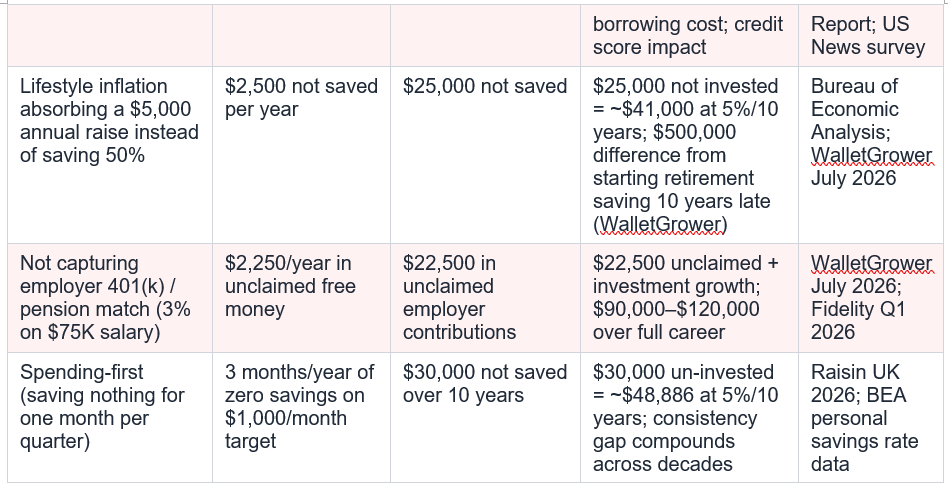
The compounding effects across all five habits simultaneously are not additive — they interact. High-interest credit card debt prevents emergency fund building. The absence of an emergency fund forces credit card use. Lifestyle inflation prevents debt paydown. Delayed retirement saving loses the most irreplaceable resource in personal finance: time. And the spending-first model is the structural enabler that allows all four other habits to persist because there is never money ‘left over’ to fix any of them.
The Five Fixes: A Quick-Reference Summary
Conclusion
The five habits described in this guide are not exotic or unusual. They are the default financial behaviour of the majority of adults in the US and UK in 2026. Credit card debt at $1.28 trillion. A savings rate of 4 percent. A median retirement balance a sixth of what is needed. These are the aggregate outcomes of five individually small habits that compound silently across decades.What makes this encouraging rather than discouraging is that each habit requires only one change, made once, to produce a materially different trajectory. The credit card overpayment is set once and runs automatically. The emergency fund transfer is automated on payday. The savings contribution at the next pay rise is set before the lifestyle adjusts. The pension match is captured with one click in the provider’s app. The payday savings automation is set up once and runs indefinitely.
None of these actions requires ongoing willpower, monthly budget reviews, or sustained lifestyle restriction. They require five decisions, each made once, each converting an expensive default behaviour into an automatic, financially productive one. The compounding then works in your favour rather than against it.
The best time to make these changes was ten years ago. The second best time is this week.
Frequently Asked Questions
What is the most financially damaging money habit?Paying only the minimum on high-interest credit card debt is likely the single most financially damaging common habit, because it is expensive, long-running, and worsens other financial problems simultaneously. The average US cardholder with a $7,886 balance at 25% APR pays approximately $2,000 per year in interest charges alone — money that could be building an emergency fund, contributing to retirement savings, or paying down the debt faster. Paying only the minimum on that balance means the debt persists for over 30 years and costs more than $22,000 in total (Consumer Financial Protection Bureau). The habit also keeps credit utilisation high, reducing the credit score and making future borrowing more expensive.
How much should I have in an emergency fund?
The widely cited target is three to six months of essential expenses. Essential expenses means the bills you must pay regardless of circumstances: rent or mortgage, utilities, groceries, transport, insurance, and minimum debt payments. If your essential monthly expenses are $3,000, your minimum emergency fund target is $9,000 and your full target is $18,000. If that feels very far away, the starting target is simply $1,000 — enough to cover most common emergencies (car repair, medical bill, appliance replacement) without reaching for a credit card. The account should be kept separate from your everyday current account and should be in a high-yield savings account so it earns something while it waits. According to Bankrate's 2026 Annual Emergency Savings Report, 24% of Americans have zero emergency savings — so simply having anything puts you ahead of nearly a quarter of adults.
What is the pay-yourself-first principle?
Pay-yourself-first means automating transfers to savings, investments, and debt repayment on the day your income arrives — before any discretionary spending occurs. The remaining balance in your current account after the transfers is what you spend. This structural approach removes the reliance on willpower that characterises 'save what's left at the end of the month,' which typically results in saving very little. The mechanics are simple: on payday, set automated transfers to your emergency fund, pension or ISA/IRA, and any fixed overpayment on high-interest debt. You then spend the remainder freely, knowing the important allocations have already been made. This is the system used by the most consistently financially secure households — not because they earn more, but because they have made saving the automatic outcome of income receipt rather than the residual outcome of spending.
How does lifestyle inflation happen and how do I stop it?
Lifestyle inflation happens because spending naturally expands to fill available income. When salary increases, the lifestyle adjusts upward to match: a nicer car, a more expensive rental, better holidays, more dining out. Each individual upgrade feels affordable and earned. The cumulative effect is that financial security does not improve even as income rises. The Bureau of Economic Analysis data from Q1 2024 to Q4 2025 shows this at a national scale: US per capita disposable income rose by approximately $4,000 per person per year, while the personal savings rate fell. The fix is the 50/30/20 rule applied specifically to every pay rise: before any lifestyle adjustment occurs, increase savings or pension contributions. The most powerful implementation: at the next pay review, redirect the entire first month of the additional income to savings before the lifestyle adjusts to the new number. Once the higher lifestyle is established, it feels like a need rather than a choice, and reducing it is psychologically much harder than preventing the upgrade in the first place.
What happens if I don't capture my employer 401(k) or pension match?
You lose free money — specifically, 50% to 100% of the matched portion of your salary, permanently. The employer match on a 401(k) or workplace pension is an immediate 50% to 100% return on the matched contribution before any investment growth occurs. On a $75,000 salary with a 4% employer match, not contributing enough to trigger the full match means losing $3,000 in employer contributions per year, every year. Over a full career, that is $90,000 to $120,000 in unclaimed employer contributions before investment growth is applied. If that money had been invested and grown at 6% per year over 25 years, the lost employer match alone would amount to approximately $175,000 of retirement savings — all from a single administrative decision not to increase the contribution rate to the match threshold. Fidelity's Q1 2026 data shows the combined employee and employer savings rate reached a record 14.4%, approaching the recommended 15% target — suggesting that more savers are capturing their match than before, but a significant proportion are still not.
Is it better to pay off debt or save first?
Generally, pay off high-interest debt before building savings beyond an emergency fund buffer — but always capture the employer match first. The reasoning: if you have a credit card at 25% APR, paying it down is a guaranteed 25% return. No savings account, investment, or pension contribution earns 25% with certainty. However, the employer match is an exception: a 50% to 100% immediate return on matched contributions outperforms even 25% APR debt repayment in the first year. The recommended sequence: (1) contribute enough to the pension/401(k) to capture the full employer match; (2) build a $1,000 emergency buffer; (3) attack high-interest debt using the avalanche method (highest APR first); (4) build the full emergency fund to 3–6 months; (5) maximise pension and investment contributions.
0 Comments
Be the first to share your thoughts on this article.