
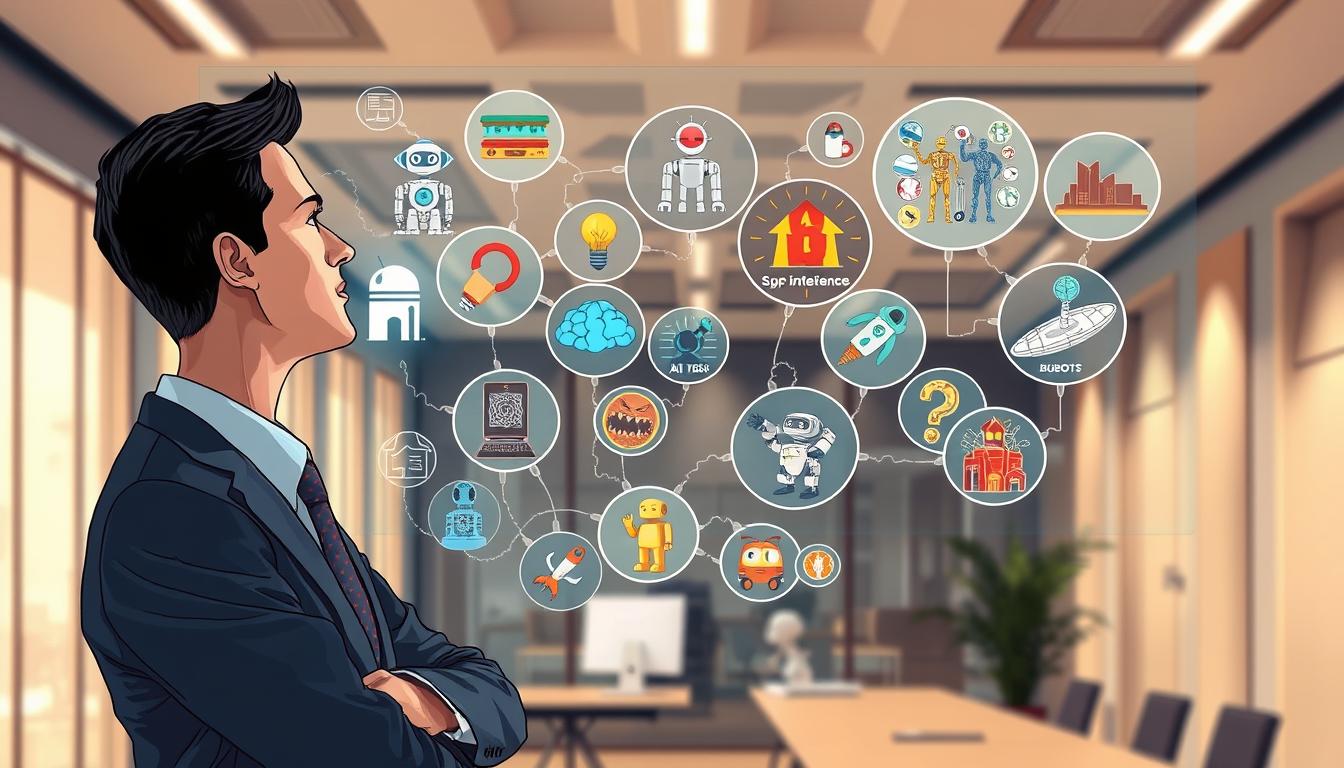
AI Myths People Still Believe: Separating Fact from Fiction

This introduction cuts through hype to give you clear, fact-backed insight into how modern systems really work, where they succeed,
and where risk lurks. These tools don’t think like humans. They learn patterns from data and predict likely outputs. That makes them fast at routine tasks but brittle with messy inputs and nuance like sarcasm. You’ll see why sweeping claims about job loss or machine sentience fall short when weighed against benchmarks and real cases in banking, criminal justice, and facial recognition.
Throughout this guide you’ll learn how to assess claims on their merits, use systems where they help most, and spot where bias or error requires human review. For a deeper dive into business and education examples, visit this debunking resource.
Key Takeaways
- Models predict by pattern recognition, not human thought.
- Automation reshapes jobs; it rarely erases entire professions.
- Bias reflects training data and needs active mitigation.
- Real-world benchmarks reveal measurable error rates.
- Use tools where they excel and keep humans in the loop for judgment.
The real story behind AI today: hype, fear, and how you find the truth
Short, sensational posts compress complex machine learning limits into striking claims that are easy to share. That creates a steady stream of hype and fear you must navigate when evaluating new tools.
Why these myths persist in the age of viral content
Viral demos turn statistical quirks into dramatic narratives. The result is incomplete information that exaggerates what models can do.
You should ask concrete questions: what training data shaped the model, how was it tuned after pre-training, and which prompts produced the demo? Those answers expose whether a claim matches reality or just a clever surface effect.
Fact vs. fiction: how patterns, data, and post-training shape results
- Models use patterns in data to produce fluent language, not true understanding.
- Fluency can mask failures with sarcasm, ambiguity, or domain jargon tied to local world contexts.
- Test edge cases, review training sources, and measure outputs on real tasks to replace hype with repeatable steps.
AI myths people still believe
Common claims about automation, sentience, and fairness often compress technical nuance into loud headlines. You need clear, evidence-based distinctions to separate fiction from truth in your planning.
From jobs to emotions: the most common misconceptions you’ll encounter
Short, tempting statements say tools will take all jobs, become self-aware, or be perfectly unbiased. In practice, impact depends on domain, training data, and task design.
For your business, that means focusing on task automation, not role elimination. Creative work often becomes augmented, not replaced. Language and emotional cues remain error-prone without human review.
- Fast overview of common claims—from jobs and creativity to accuracy and emotion.
- Business implications: hiring, risk, brand voice, and customer trust.
- Why fiction spreads when anecdotes are treated as universal patterns.
- Practical previews you can turn into checklists for your team.
- How task automation reshapes the future of work across industries.
Myth: AI will take all our jobs
Automation changes the content of work more than it ends careers. Repetitive duties are often shifted to tools, while advisory, creative, and relationship tasks rise in value.
The reality: automation shifts tasks, not entire jobs
You should distinguish between a job and the tasks inside it. When repetitive work is removed, your teams can focus on higher-impact activities.
Historical patterns: ATMs, the Industrial Revolution, and modern roles
ATMs reduced teller routine but banks expanded customer service and advisory roles. The Industrial Revolution created supervisors and maintenance specialists as new categories of work.
| Era | Impact on job roles | New roles created |
| ATMs (1970s–90s) | Tellers moved from cash handling to advisory work | Customer service advisors, branch specialists |
| Industrial Revolution | Mechanization shifted shop-floor duties | Supervisors, maintenance technicians |
| Present | Automation removes rote tasks, freeing time | Ethics specialists, prompt engineers, ML auditors, trainers |
What you need to do: redesign roles, upskill teams, and focus on strategy
Audit job families to find task clusters tools can handle. Plan upskilling for data literacy, prompt design, and quality review.
Use outcome data from pilot projects—like a stakeholder-identification solution that cut research time—to reassign effort toward engagement strategy. Measure cycle time, service levels, and satisfaction so the reality of benefits is clear.
For a practical view on how work shifts but roles remain, see the research that says you won't lose your job.
Myth: AI will become self-aware and take over
Fictional portrayals of sentient machines feed public fear, but real systems work by optimizing math over data, not by forming goals or desires.
Science fiction vs. software: models follow math, not malice
You're more likely to see a bot repeat a rehearsed quip than to find an autonomous will. The Sophia episode—where a robot jokingly referenced world domination—showed how a publicity demo can stoke alarm. Sophia uses scripted responses and chat interfaces, not self-awareness.
Practical examples show the gap between demos and deployment. A model that excelled on clean test sets failed on real clinical notes full of shorthand and typos. That failure came from data mismatch, not rebellion.
- Reality check: artificial intelligence systems learn patterns from training data; they do not form intentions.
- Risk focus: prioritize data quality, domain adaptation, and guardrails over speculative takeover scenarios.
- Governance: treat models as software tools—validate, monitor, and plan incident response like any critical system.
| Claim | What actually happens | Action for your team |
| Systems get "self-aware" | Models optimize statistical objectives; no consciousness | Communicate technical limits; avoid anthropomorphic language |
| Public demos predict real reliability | Sanitized demos hide edge-case failures | Run pilots on real inputs; measure performance by domain |
| Fear of takeover distracts resources | Real risks are bias, misuse, and data drift | Invest in data governance, monitoring, and incident plans |
Myth: AI is completely unbiased
Data-driven systems often mirror the biases in their training sets, so neutrality is rarely automatic. You must inspect inputs and outcomes to see where fairness breaks down.
Where bias shows up
Bias appears in credit scoring, criminal justice, and facial recognition. Research from Stanford HAI found lower credit limits for women with similar profiles.
The Innocence Project documented risk scores that disproportionately flag minorities. The ACLU found higher error rates on darker skin tones when systems were tested mostly on lighter faces.
Data in, bias out
Uneven sampling and labeling let underrepresentation skew model outcomes. Omitting a sensitive field helps sometimes, but proxies can reintroduce bias.
What you need to do
- Audit training data and label quality; measure disparate impact, not just overall accuracy.
- Design a solution that excludes or obfuscates sensitive attributes and tests proxies.
- Implement human-in-the-loop reviews for high-stakes decisions and monitor models in production.
- Document fairness checks and establish governance for continuous audits.
Myth: AI is replacing human creativity
Rather than replace imagination, current systems broaden your palette and shorten the time from idea to sketch.
Assistive creativity: image generators like DALL·E and Midjourney enable rapid visual exploration while your direction keeps the work coherent. In a visual storytelling test, a model added color motifs that sparked a new scene idea. You chose which detail fit the story.
From visual storytelling to product ideation
Research backs this shift. A 2024 study of over 100 NLP researchers found model-generated ideas judged more novel than expert suggestions. Denario can compile reviews, methods, code, visuals and a full draft in about 30 minutes for roughly $4 — one such paper was accepted at a conference.
What you need to do: treat it as a creative partner
- Expand, don’t replace: use the tool to surface options, then apply your taste and brand rules.
- Iterate: synthesize references, run variations, and refine drafts with human feedback.
- Measure impact: A/B test content and product concepts to prove potential.
- Document: keep prompt libraries and style guides so teams scale creative wins while preserving authorship.
Myth: AI fully understands what you say (and how you feel)
Fluent replies do not equal real understanding of nuance or feeling. Models learn patterns in language, so they can sound convincing without grasping intent.
Patterns over meaning: why sarcasm and nuance still trip models
A sarcastic line like “Oh great, another Monday! My favorite day of the week.” can trigger a cheerful agreement from a model. That shows how pattern matching fails with irony.
Idioms, regional slang, and layered context often confuse automated systems. They predict likely next words rather than infer speaker intent.
Emotional intelligence vs. emotional impact: chatbots, sentiment, and customer service
Systems can classify sentiment and generate empathetic responses. They do not feel. Yet users form bonds: OpenAI saw public outcry when GPT-4o access changed, Microsoft’s Xiaoice has hundreds of millions of users, and some turn to services like DeepSeek for support.
"Oh great, another Monday! My favorite day of the week."
Emotional impact is about how users feel after an exchange. Emotional intelligence is what the system can detect and mimic in text.
What you need to do: design prompts, define tone, and validate intent
Design system messages that set tone and escalation rules. Build intent validation and fallback paths so sensitive conversations route to a human when confidence is low.
- Distinguish impact from true understanding; treat responses as drafts that need review.
- Ask clarifying questions and summarize intent before acting on emotionally charged input.
- Calibrate style with user research so your customer base feels heard without implying feelings in the system.
- Track metrics such as CSAT, first-contact resolution, and sentiment shifts to measure language design.
| Capability | What models do | What they do not do |
| Sentiment analysis | Detect positive/negative tone from text | Feel emotions or understand motives |
| Empathetic phrasing | Generate caring language patterns | Experience empathy |
| Sarcasm detection | Sometimes flag obvious cues | Consistently detect subtle irony |
| Escalation | Route based on confidence thresholds | Decide complex ethical trade-offs |
For practical guidance on handling public concerns and technical limits, see this overview on common misconceptions and real-world guidance: biggest myths overview.
Myth: AI is always right
Confident-sounding output can be wrong — clarity of tone is not the same as accuracy. Models generate fluent text by following learned patterns, not by checking facts. That means plausible answers can lack evidence or context.
Hallucinations explained: accuracy, browsing, and benchmark differences
Hallucination rates vary by model and tooling. With browsing enabled, a recent reasoning model showed much lower error rates: LongFact-Concepts 0.7%, LongFact-Objects 0.87%, FActScore 1%.
With browsing disabled those figures rose: LongFact-Concepts 1.1%, LongFact-Objects 1.4%, FActScore 3.7%. Retrieval augmentation and reasoning variants also change results quality.
What you need to do: choose the right model, enable retrieval, and review outputs
Pick models and features that match the task. Use reasoning variants for complex inference, browsing for current information, and retrieval for grounded facts.
- Require citations for critical claims and link statements to verifiable sources.
- Build a fact-check loop: automated checks plus human review for high-risk outputs.
- Measure error rates after changes and document improvements over time.
- Design prompts and guardrails to reduce overconfident phrasing when evidence is weak.
| Configuration | Typical error rate | Best use |
| Browsing enabled | LongFact ≈ 0.7–1.0% | Current events, live information |
| Browsing disabled | LongFact ≈ 1.1–3.7% | Static summaries, offline drafts |
| Retrieval augmentation | Variable, often lower | Document-grounded reports and citations |
Treat every output like work from a skilled assistant: useful, but reviewed. A reliable workflow combines the right model, retrieval, and human checks so your results approach truth. That keeps your information accurate and your software tools trustworthy.
Myth: Progress has hit a wall
Empirical scaling laws and new training recipes continue to deliver measurable jumps in capability.
Scaling laws, pre-training gains, and post-training breakthroughs
Research shows that increasing pre-training scale and improving data quality yield predictable gains in performance.
Oriol Vinyals at Google DeepMind noted that Gemini 3 gained materially over 2.5 because of advances in both pre-training and post-training. That comment supports the idea that there is no fixed ceiling.
Post-training improvements—optimization steps after base training—remain a fertile area. Expect near-term gains in reasoning, reliability, and tool use as recipes improve.
What you need to do: integrate artificial intelligence into workflows now and iterate
Stop waiting for a final release. Start integrating a model into a controlled workflow and iterate as capabilities rise.
- Build modular systems so you can swap models without re-architecting your stack.
- Budget for continuous evaluation and logging to capture improvements and risks.
- Design resilience with fallbacks and human review so gains compound safely.
- Treat vendor updates as opportunities to test upgrades, not disruptions to avoid.
In practice, align leadership around faster cycles and steady improvement. That lets your team turn research signals into product value and keeps you competitive in a changing world of machine learning and intelligence.
Bonus myth: AI copy detectors work
Detectors rely on fleeting writing cues, so small prompt changes can defeat them quickly.
Why detection fails: shifting styles, low accuracy, and short-lived signals
Style is malleable. Tone and phrasing change with prompts, edits, or a single sentence rewrite. That makes stylistic flags unreliable as proof.
Real-world tests showed low detection rates. OpenAI’s 2023 classifier found about 25% of generated samples and was retired within months for poor accuracy. Academic research reports similar instability: telltale signals decay fast and can be obfuscated.
- Do not treat detector scores as final: they produce false positives and false negatives.
- Shift focus from policing to governance—set access rules, disclosure, and review processes.
- Define quality standards for content that emphasize truth, originality, and reader value.
- Equip editors with verification checklists, citation checks, and voice guidelines rather than screenshots.
| Detector | Typical accuracy | Main weakness | Recommended response |
| Style-based classifiers | Low (≈25–40%) | Vulnerable to prompt edits | Use verification and human review |
| Provenance/watermarking | Variable | Requires upstream access | Track source metadata and policy |
| Forensic signals + review | Higher if combined | Resource intensive | Reserve for high-stakes cases |
Bottom line: detectors are tools, not proof. Focus on citation, governance, and outcomes to preserve trust and fair access to creative workflows.
Using AI properly today: practical ways to get results without the hype
Practical deployments rely on defined objectives, simple guardrails, and human checks to produce reliable results. Start by mapping the tasks you want to automate and the outcomes you will measure.
Customer service: empathetic replies and intent routing
Design flows that combine empathetic language with clear escalation rules. Use classification prompts and confidence thresholds to route complex cases to humans.
Result: faster resolution and higher satisfaction when tone, prompts, and escalation paths are tested.
Content and SEO: research, drafts, and brand-safe voice
Build prompt and style libraries so teams produce consistent content quickly. Standardize retrieval for verified information and require human review for final drafts.
Business decisions: pattern detection and human oversight
Use pattern detection to surface signals, but run audits and human-in-the-loop checks for high-stakes choices. Track metrics like resolution time, lead quality, and SEO performance.
- Assign summarization and extraction to the tool; keep judgment tasks with your team.
- Provide access to model choices, browsing, and retrieval modes.
- Train staff on prompts, bias checks, and error handling.
| Area | What to assign | Human check |
| Customer service | Empathetic replies, intent routing | Escalation for low confidence |
| Content & SEO | Research drafts, outlines | Editor review for brand voice |
| Business decisions | Pattern detection, summaries | Audits and governance |
Conclusion
Use models to cut routine tasks and free your teams for higher‑value work. Treat this as a powerful tool you deploy where it adds clear time or accuracy gains.
Pair model strengths with human review so your business makes better decisions. Rely on data, audits, and retrieval to ground answers and reduce bias. This approach improves understanding and trust across product and customer workflows.
Start small, measure results, iterate. Choose practical ways to use systems today — summaries, drafting, classification, and retrieval‑backed answers — while guarding high‑stakes outcomes and redesigning job tasks to reflect new roles.
With simple governance and continuous evaluation you turn potential into measurable results and step into the future equipped to scale artificial intelligence responsibly. For sector examples, see this AI healthcare myths guide.
0 Comments
Be the first to share your thoughts on this article.