
Investing
All 30 Dow Jones Stocks Ranked: Buy, Sell or Hold?

Wall Street consensus ratings on all 30 DJIA stocks per S&P Global Market Intelligence, as of October 14, 2026. No Dow stock is rated Sell. Nvidia leads at 1.29. Travelers is the most cautious at 2.97. Disney, Boeing, and Visa are the surprises.
The Dow Jones Industrial Average is 30 stocks. They are not the 30 most innovative companies in America, nor the 30 fastest-growing. They are 30 industry leaders — the kind of blue-chip businesses that have survived and adapted through multiple economic cycles, bear markets, and technological revolutions. Half of the average’s components are low-beta stocks that tend to lag in rising markets but hold up better when everything is selling off. And right now, according to two of Wall Street’s most closely watched strategists, the selling-off scenario is not remote: Savita Subramanian at BofA has flagged that seven out of ten of their bear market indicators have been triggered. Amr Hanafy at Neuberger says higher yields, earnings growth pressure, and market fragility have shifted the balance of risks. In that context, knowing which of the 30 Dow components Wall Street’s analysts actually recommend — and with how much conviction — is genuinely useful information. This article covers all 30, from strongest conviction to least, using S&P Global Market Intelligence consensus data as of October 14, 2026. This is a general informational and educational article, and not investment advice.
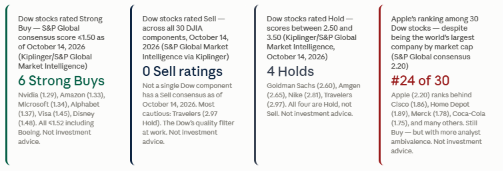
As of October 14, 2026, not a single one of the 30 Dow components carries a Sell consensus rating from Wall Street analysts. That fact alone says something about the quality bar for Dow inclusion. This article uses the S&P Global Market Intelligence consensus data, to rank all 30 from the most strongly recommended (Nvidia at 1.29) to the most cautious (Travelers at 2.97).
As of October 14, 2026: 0 Sell-rated Dow stocks. 6 Strong Buy (scores ≤1.52). 20 Buy (scores 1.52-2.50). 4 Hold (scores 2.60-2.97). Rating source: S&P Global Market Intelligence.
The S&P scoring system: 1.0 = unanimous Strong Buy; ≤2.5 = Buy; 2.5-3.5 = Hold; >3.5 = Sell. Lower scores = stronger conviction. Nvidia's 1.29 vs Apple's 2.20: both are Buy, but very different conviction levels. Source: S&P Global Market Intelligence via Kiplinger, October 14, 2026.
But Burrows makes a pointed observation: in the early 2026 market swoon of March, when the Nasdaq was off nearly 11% year-to-date and the S&P 500 had shed more than 7%, the Dow lost only 6% at its trough. That relative resilience is the Dow’s value proposition. Two strategists cited in the piece add urgency to the low-beta case. Amr Hanafy at Neuberger writes that ‘higher yields, potential earnings growth pressure and overall market fragility has shifted the balance of risks.’ Savita Subramanian at BofA notes that seven out of ten of their bear market indicators have been triggered — a level historically seen before market peaks. The Iran conflict and a new international trade regime add geopolitical risk to the mix. In that context, the Dow’s defensive characteristics and the specific stocks within it with strongest Buy consensus are worth examining closely.
S&P 500 +13% YTD; Nasdaq +15% YTD; DJIA +7% YTD . DJIA downside protection: Nasdaq -11% nadir March 2026 vs Dow -6%. Savita Subramanian (BofA): 7/10 bear market indicators triggered. Amr Hanafy (Neuberger): 'market fragility has shifted the balance of risks.' Iran conflict + new trade regime as geopolitical risks.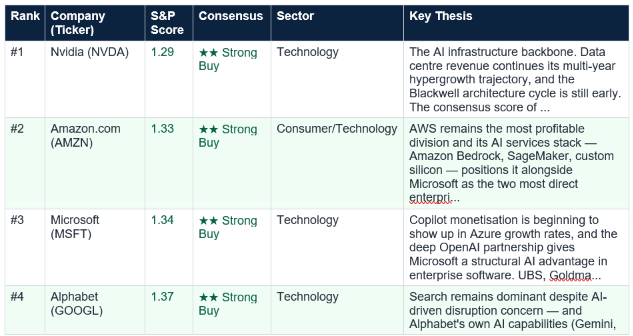
The second surprise is Boeing at 1.52 — a Buy on one of the most operationally troubled companies in the index. Safety crises, production halts, union disputes, a renegotiated defence contract landscape, and years of management instability all argue against confidence. But the analyst consensus Buy rests on three structural facts: the commercial aviation order backlog is the largest in Boeing’s history, no credible global competitor exists to absorb it, and the stock price already reflects a significant distress discount. Goldman Sachs, UBS, Jefferies and JP Morgan have all maintained Buy ratings through the turbulence (finanzen.ch 2026).
The third is Apple at 2.20 — ranked #24 of 30. The world’s largest company by market cap is only the 24th most-recommended stock in its own index. Apple’s regulatory battles in Europe, uncertain AI monetisation timeline through Apple Intelligence, and China revenue headwinds have created more analyst ambivalence than the brand name might suggest. It is still a Buy. But Cisco (1.86), Home Depot (1.89), Merck (1.78), Coca-Cola (1.75), and Chevron (1.72) are all more strongly recommended by the analyst consensus than Apple.
Disney (1.48): streaming turning profitable; ESPN sports pivot; park pricing power. Boeing (1.52): largest commercial aviation backlog in history; no credible global competitor; distress discount already in price. Visa (1.45): tollroad economics on global digital payments; no credit risk; network moat. Source: Kiplinger October 2026.
Apple (2.20): #24 of 30 — regulatory pressure in Europe; China headwinds; Apple Intelligence monetisation uncertain. Goldman Sachs (2.60 Hold): cyclical investment banking exposure; post-Marcus consumer banking retreat. Nike (2.81 Hold): DTC strategy reset under new CEO; China market share recovery timeline unclear. Travelers (2.97 Hold): catastrophic weather loss exposure; reinsurance cost pressure.
The concentration of conviction is clear: six stocks — Nvidia, Amazon, Microsoft, Alphabet, Visa, and Disney — have Strong Buy consensus ratings with scores below 1.50. The breadth of the Buy tier is also notable: 20 stocks in the middle of the index have Buy ratings spanning technology, healthcare, financials, consumer staples, industrials, and energy. The Dow, for all its reputation as a backward-looking old-economy index, contains more Buy ratings than most investors expect. Dow’s structural role in the current environment: it won’t keep up in a rising market, but it offers stability in a down one. With seven of ten bear market indicators triggered, that trade-off looks worth understanding. Not investment advice. Always consult a qualified financial adviser.
S&P Global Market Intelligence surveys the individual stock recommendations of sell-side analysts covering each company. Each analyst's call — Strong Buy, Buy, Hold, Sell, Strong Sell — is converted to a 1-5 numerical scale and averaged. A score of 1.0 means unanimous Strong Buy; 5.0 means unanimous Strong Sell. Scores equal to or below 2.5 mean analysts on average rate shares at Buy; scores between 2.5 and 3.5 are Hold; scores above 3.5 are Sell. The consensus is updated continuously as individual analysts publish new reports and revisions. The October 14, 2026 data used in this article represents the aggregate of all current analyst ratings at that date.
Why is the Dow Jones Industrial Average price-weighted, not market-cap weighted?
The Dow was designed in 1896, before market cap weighting was a standard methodology. The average adds up the stock prices of all 30 components and divides by a constantly adjusted divisor. This means a high-priced stock like UnitedHealth Group has more influence on the index than a lower-priced stock regardless of market capitalisation. This price-weighting limits the Magnificent 7's contribution on the way up — but also limits the damage they can do on the way down. In practical terms, it makes the Dow more defensive and less growth-oriented than the S&P 500 or Nasdaq.
Why has the Dow underperformed the S&P 500 in 2026?
S&P 500 was up approximately 13% on a price basis year-to-date, while the Dow had risen about 7%. The primary reason is the Magnificent 7 weighting effect. Microsoft, Amazon, Nvidia, Alphabet, and Apple are in the Dow, but the price-weighted structure limits their contribution compared to the market-cap weighted S&P 500 where they carry far greater weight. Half of the Dow's components are low-beta stocks that by design lag in rising markets. The trade-off: those same low-beta characteristics helped the Dow lose only 6% at its March 2026 trough, compared to the Nasdaq's nearly 11% drawdown.
Is there any Dow Jones stock rated Sell in October 2026?
No. As of October 14, 2026, per S&P Global Market Intelligence data, not one of the 30 Dow Jones Industrial Average components has a Sell consensus rating. The most cautious rating in the index belongs to Travelers (TRV) at 2.97 — a Hold, not a Sell. The next most cautious is Nike (NKE) at 2.81 (Hold), then Amgen (AMGN) at 2.65 (Hold), then Goldman Sachs (GS) at 2.60 (Hold). The absence of any Sell rating across all 30 components reflects both the Dow's quality filter and the general disposition of Wall Street's sell-side consensus, which historically rarely issues Sell ratings.
Why does Apple rank lower than many other tech stocks in the Dow?
Apple's consensus score of 2.20 places it 24th of 30 in the October 14, 2026 ranking — behind Cisco (1.86), Home Depot (1.89), Merck (1.78), Coca-Cola (1.75), Chevron (1.72), Salesforce (1.70), Walmart (1.56), UnitedHealth (1.58), Boeing (1.52), Disney (1.48), Visa (1.45), Alphabet (1.37), Microsoft (1.34), Amazon (1.33), and Nvidia (1.29). Several factors explain the relative caution: Apple faces ongoing regulatory pressure in Europe over the App Store, antitrust proceedings regarding digital payments, revenue headwinds in China where local competitors have gained smartphone market share, and uncertainty about the timeline for Apple Intelligence to meaningfully drive an upgrade cycle. It is still rated Buy — but with more analyst ambivalence than any other tech name in the index.
The Dow Jones Industrial Average is 30 stocks. They are not the 30 most innovative companies in America, nor the 30 fastest-growing. They are 30 industry leaders — the kind of blue-chip businesses that have survived and adapted through multiple economic cycles, bear markets, and technological revolutions. Half of the average’s components are low-beta stocks that tend to lag in rising markets but hold up better when everything is selling off. And right now, according to two of Wall Street’s most closely watched strategists, the selling-off scenario is not remote: Savita Subramanian at BofA has flagged that seven out of ten of their bear market indicators have been triggered. Amr Hanafy at Neuberger says higher yields, earnings growth pressure, and market fragility have shifted the balance of risks. In that context, knowing which of the 30 Dow components Wall Street’s analysts actually recommend — and with how much conviction — is genuinely useful information. This article covers all 30, from strongest conviction to least, using S&P Global Market Intelligence consensus data as of October 14, 2026. This is a general informational and educational article, and not investment advice.
Table of Contents
- Why the Dow? Understanding the Blue-Chip Benchmark
- How the Rating System Works
- The 2026 Market Backdrop: Why This Ranking Matters Now
- Complete Rankings: All 30 Dow Stocks from Best to Worst
- 4A. The Strong Buy Tier (Scores 1.29–1.52)
- 4B. The Buy Tier (Scores 1.56–2.28)
- 4C. The Hold Tier (Scores 2.60–2.97)
- The Complete Rankings Table: All 30 at a Glance
- The Surprise Picks: Disney, Boeing, and Why Apple Ranks #24
- Conclusion: What the Dow Tells Us About Wall Street’s Mood in October 2026
- Frequently Asked Questions
Why the Dow? Understanding the Blue-Chip Benchmark
The Dow Jones Industrial Average was created in 1896. In the 130 years since, it has survived the Great Depression, two World Wars, the tech bubble, the 2008 financial crisis, a global pandemic, and everything between. What it has never done is include a stock that Wall Street collectively rates Sell in a sustained way. Not because the index managers avoid troubled companies — Boeing has been in real difficulty. Not because every component is a growth dynamo — Nike has been challenged for two years. But because the index selects for proven durability, and that characteristic tends to produce companies that Wall Street’s consensus, across whatever short-term turbulence exists, still considers worth holding or buying.As of October 14, 2026, not a single one of the 30 Dow components carries a Sell consensus rating from Wall Street analysts. That fact alone says something about the quality bar for Dow inclusion. This article uses the S&P Global Market Intelligence consensus data, to rank all 30 from the most strongly recommended (Nvidia at 1.29) to the most cautious (Travelers at 2.97).
As of October 14, 2026: 0 Sell-rated Dow stocks. 6 Strong Buy (scores ≤1.52). 20 Buy (scores 1.52-2.50). 4 Hold (scores 2.60-2.97). Rating source: S&P Global Market Intelligence.
How the Rating System Works
S&P Global Market Intelligence surveys the individual stock recommendations of sell-side analysts covering each company and converts them to a numerical scale. A score of 1.0 means every analyst covering the stock has it rated Strong Buy. A score of 5.0 means every analyst has it rated Strong Sell. In practice, most stocks cluster between 1.5 and 3.5. The interpretation as described by Kiplinger: scores equal to or below 2.5 mean analysts, on average, rate shares at Buy. Scores between 2.5 and 3.5 translate into Hold recommendations. Scores above 3.5 equate to Sell ratings. The closer a score gets to 1.0, the stronger the conviction. In the Dow context, this means the difference between Nvidia’s 1.29 and Apple’s 2.20 is meaningful: Nvidia has near-unanimous Buy conviction while Apple has a solid but less unanimous Buy rating.The S&P scoring system: 1.0 = unanimous Strong Buy; ≤2.5 = Buy; 2.5-3.5 = Hold; >3.5 = Sell. Lower scores = stronger conviction. Nvidia's 1.29 vs Apple's 2.20: both are Buy, but very different conviction levels. Source: S&P Global Market Intelligence via Kiplinger, October 14, 2026.
The 2026 Market Backdrop: Why This Ranking Matters Now
Kiplinger’s Dan Burrows opens the October 2026 edition of this ranking with a notable caution. While the S&P 500 is up approximately 13% on a price basis year-to-date and the Nasdaq has added approximately 15%, the Dow has risen only about 7% — a consequence of its price-weighted structure and the fact that most of the Magnificent 7’s gains accrue to the S&P 500 and Nasdaq rather than the DJIA. Half of the Dow’s components are low-beta stocks, which by design lag in rising markets.But Burrows makes a pointed observation: in the early 2026 market swoon of March, when the Nasdaq was off nearly 11% year-to-date and the S&P 500 had shed more than 7%, the Dow lost only 6% at its trough. That relative resilience is the Dow’s value proposition. Two strategists cited in the piece add urgency to the low-beta case. Amr Hanafy at Neuberger writes that ‘higher yields, potential earnings growth pressure and overall market fragility has shifted the balance of risks.’ Savita Subramanian at BofA notes that seven out of ten of their bear market indicators have been triggered — a level historically seen before market peaks. The Iran conflict and a new international trade regime add geopolitical risk to the mix. In that context, the Dow’s defensive characteristics and the specific stocks within it with strongest Buy consensus are worth examining closely.
S&P 500 +13% YTD; Nasdaq +15% YTD; DJIA +7% YTD . DJIA downside protection: Nasdaq -11% nadir March 2026 vs Dow -6%. Savita Subramanian (BofA): 7/10 bear market indicators triggered. Amr Hanafy (Neuberger): 'market fragility has shifted the balance of risks.' Iran conflict + new trade regime as geopolitical risks.
Complete Rankings: All 30 Dow Stocks from Best to Worst
4A. The Strong Buy Tier (Scores 1.29–1.52)
These are the six stocks where Wall Street’s analyst consensus, in aggregate, approaches near-unanimous Buy conviction. The closer to 1.0, the fewer dissenters exist.#1 Nvidia (NVDA) ★★ Strong Buy Score: 1.29 | Technology
The AI infrastructure backbone. Data centre revenue continues its multi-year hypergrowth trajectory, and the Blackwell architecture cycle is still early. The consensus score of 1.29 — the best among all 30 Dow components — reflects near-unanimous bullishness. The key risk: valuation. Nvidia trades at a premium to almost everything in the index. Any deceleration in AI capex spending from cloud hyperscalers could reprice the stock sharply. But Wall Street is clearly willing to pay for the growth.#2 Amazon.com (AMZN) ★★ Strong Buy Score: 1.33 | Consumer/Technology
AWS remains the most profitable division and its AI services stack — Amazon Bedrock, SageMaker, custom silicon — positions it alongside Microsoft as the two most direct enterprise AI infrastructure beneficiaries. Amazon's retail business has structurally improved its margin profile over the past two years. A consensus score of 1.33 reflects broad conviction. Four out of Mag 7 names made the Dow cut — Amazon is one of them.#3 Microsoft (MSFT) ★★ Strong Buy Score: 1.34 | Technology
Copilot monetisation is beginning to show up in Azure growth rates, and the deep OpenAI partnership gives Microsoft a structural AI advantage in enterprise software. UBS, Goldman Sachs, Barclays, Jefferies, JP Morgan, RBC Capital Markets and DZ BANK all have Buy/Overweight/Outperform ratings (finanzen.ch May 2026 analyst log). At 1.34, the score is just fractionally behind Amazon. The durable nature of its enterprise moat and cloud growth are the primary bull factors.#4 Alphabet (GOOGL) ★★ Strong Buy Score: 1.37 | Technology
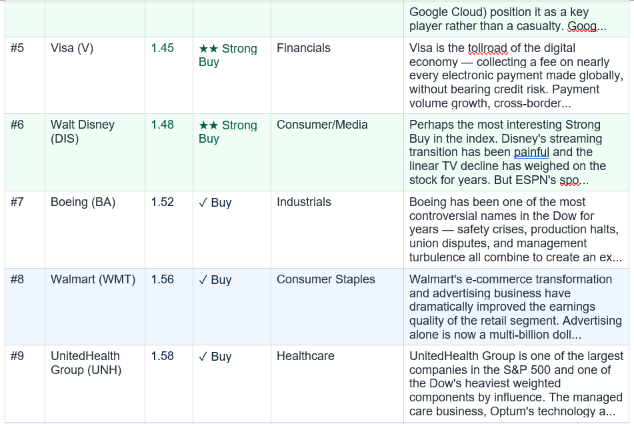
Search remains dominant despite AI-driven disruption concern — and Alphabet's own AI capabilities (Gemini, Google Cloud) position it as a key player rather than a casualty. Google Cloud has been gaining share. The score of 1.37 reflects Wall Street's reassessment of Alphabet's AI standing after initial concerns that large language models would erode search revenue. The antitrust overhang remains the primary risk.#5 Visa (V) ★★ Strong Buy Score: 1.45 | Financials
Visa is the tollroad of the digital economy — collecting a fee on nearly every electronic payment made globally, without bearing credit risk. Payment volume growth, cross-border travel recovery, and digital wallet integration are the structural growth drivers. The score of 1.45 is unusually strong for a financial stock, reflecting the durability and predictability of Visa's network economics. Visa as a top-ranked Dow stock in their June 2026 edition.Surprise pick
#6 Walt Disney (DIS) ★★ Strong Buy Score: 1.48 | Consumer/Media
Perhaps the most interesting Strong Buy in the index. Disney's streaming transition has been painful and the linear TV decline has weighed on the stock for years. But ESPN's sports streaming pivot is showing real subscriber momentum, the theme park business remains a pricing powerhouse, and the streaming division has moved toward profitability. A 1.48 consensus score indicates Wall Street believes the worst is behind it. This is one of the 'surprise' names Dan Burrows at Kiplinger flagged.Surprise pick
4B. The Buy Tier (Scores 1.56–2.28)
Twenty stocks sit in the Buy zone — a broad, credible Buy consensus across sectors. The scores here range from high-conviction (1.56 for Walmart) to borderline (2.28 for IBM). All represent companies where the analyst majority recommends buying shares.#7 Boeing (BA) ✓ Buy Score: 1.52 | Industrials
Boeing has been one of the most controversial names in the Dow for years — safety crises, production halts, union disputes, and management turbulence all combine to create an extremely difficult operating backdrop. And yet Wall Street's consensus is Buy at 1.52. The thesis: the commercial aviation backlog is enormous, no serious global competitor exists to fill it, and the defence business provides a floor. Goldman Sachs, UBS, Jefferies and JP Morgan have repeatedly reiterated Buy ratings (finanzen.ch). The recovery trade is long-dated but real.Surprise pick
#8 Walmart (WMT) ✓ Buy Score: 1.56 | Consumer Staples
Walmart's e-commerce transformation and advertising business have dramatically improved the earnings quality of the retail segment. Advertising alone is now a multi-billion dollar business at near-software margins. UBS reiterated Buy as recently as May 2026 (finanzen.ch). The company is seen as a defensive outperformer in a slowing consumer environment while benefiting from the structural shift in its business model.#9 UnitedHealth Group (UNH) ✓ Buy Score: 1.58 | Healthcare
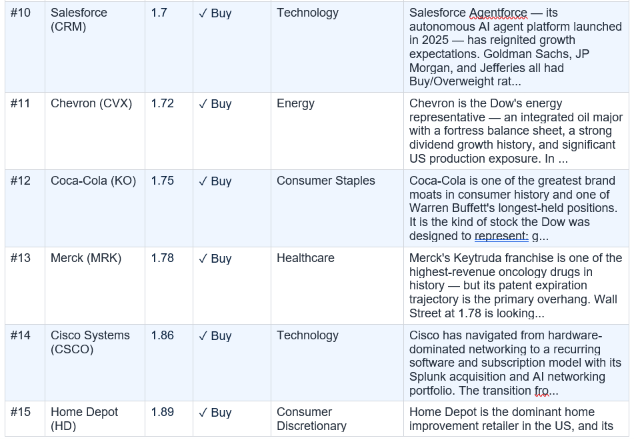
UnitedHealth Group is one of the largest companies in the S&P 500 and one of the Dow's heaviest weighted components by influence. The managed care business, Optum's technology and pharmacy benefit arms, and the data analytics capabilities make it one of the most vertically integrated healthcare businesses in the world. At 1.58, it represents a conviction Buy among most analysts.#10 Salesforce (CRM) ✓ Buy Score: 1.7 | Technology
Salesforce Agentforce — its autonomous AI agent platform launched in 2025 — has reignited growth expectations. Goldman Sachs, JP Morgan, and Jefferies all had Buy/Overweight ratings through early 2026 (finanzen.ch). The transition from CRM vendor to AI-powered enterprise automation platform is the central bull thesis. The stock has been a volatile ride but the 1.70 consensus Buy reflects broad conviction in the AI upgrade cycle.#11 Chevron (CVX) ✓ Buy Score: 1.72 | Energy
Chevron is the Dow's energy representative — an integrated oil major with a fortress balance sheet, a strong dividend growth history, and significant US production exposure. In a geopolitical environment where the Kiplinger article specifically mentions an Iranian conflict threatening global energy markets, Chevron's positioning is notable. The 1.72 Buy reflects defensive characteristics, commodity upside optionality, and yield.#12 Coca-Cola (KO) ✓ Buy Score: 1.75 | Consumer Staples
Coca-Cola is one of the greatest brand moats in consumer history and one of Warren Buffett's longest-held positions. It is the kind of stock the Dow was designed to represent: globally distributed, recession-resistant, consistent dividend grower. JP Morgan, UBS, and RBC all had Buy/Overweight/Outperform ratings in April-May 2026 (finanzen.ch). The 1.75 consensus Buy is a statement of durability.#13 Merck (MRK) ✓ Buy Score: 1.78 | Healthcare
Merck's Keytruda franchise is one of the highest-revenue oncology drugs in history — but its patent expiration trajectory is the primary overhang. Wall Street at 1.78 is looking past the patent cliff to the pipeline: multiple oncology, cardiometabolic, and infectious disease candidates are in late-stage development. The dividend and the defensive healthcare exposure add to the case.#14 Cisco Systems (CSCO) ✓ Buy Score: 1.86 | Technology
Cisco has navigated from hardware-dominated networking to a recurring software and subscription model with its Splunk acquisition and AI networking portfolio. The transition from equipment seller to software+services provider materially changed the earnings quality. At 1.86, the consensus Buy reflects continued confidence in the transition and attractive dividend yield.#15 Home Depot (HD) ✓ Buy Score: 1.89 | Consumer Discretionary
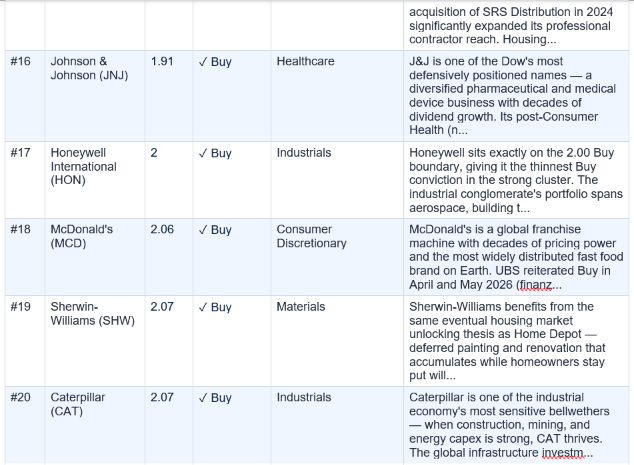
Home Depot is the dominant home improvement retailer in the US, and its acquisition of SRS Distribution in 2024 significantly expanded its professional contractor reach. Housing market headwinds have weighed on the near-term growth rate, but Wall Street's 1.89 Buy consensus reflects the long-cycle thesis: as the rate lock-in effect eventually unwinds and homeowners sell and move, deferred maintenance and renovation spending will accelerate.#16 Johnson & Johnson (JNJ) ✓ Buy Score: 1.91 | Healthcare
J&J is one of the Dow's most defensively positioned names — a diversified pharmaceutical and medical device business with decades of dividend growth. Its post-Consumer Health (now Kenvue) separation makes it a purer pharmaceutical and medtech play. At 1.91, the Buy consensus reflects confidence in the pipeline and the defensive characteristics of the business.#17 Honeywell International (HON) ✓ Buy Score: 2 | Industrials
Honeywell sits exactly on the 2.00 Buy boundary, giving it the thinnest Buy conviction in the strong cluster. The industrial conglomerate's portfolio spans aerospace, building technologies, and performance materials. A planned breakup into three separate businesses has been announced, which analyst models are beginning to account for. The 2.00 score reflects uncertainty about execution alongside the underlying business quality.#18 McDonald's (MCD) ✓ Buy Score: 2.06 | Consumer Discretionary
McDonald's is a global franchise machine with decades of pricing power and the most widely distributed fast food brand on Earth. UBS reiterated Buy in April and May 2026 (finanzen.ch). The 2.06 Buy consensus reflects confidence in the global brand, technology investment in digital ordering and delivery, and the defensive characteristics of the QSR model. Consumer pressures in developed markets remain a near-term headwind.#19 Sherwin-Williams (SHW) ✓ Buy Score: 2.07 | Materials
Sherwin-Williams benefits from the same eventual housing market unlocking thesis as Home Depot — deferred painting and renovation that accumulates while homeowners stay put will accelerate when rates normalise. Its professional painting contractor relationships are a structural competitive advantage. At 2.07, the Buy consensus is moderate but positive.#20 Caterpillar (CAT) ✓ Buy Score: 2.07 | Industrials
Caterpillar is one of the industrial economy's most sensitive bellwethers — when construction, mining, and energy capex is strong, CAT thrives. The global infrastructure investment supercycle (US IRA, European green industrial policy) is a long-term tailwind. At 2.07, the Buy consensus is moderate, reflecting concerns about near-term cyclical softness in key end markets.#21 JPMorgan Chase (JPM) ✓ Buy Score: 2.12 | Financials
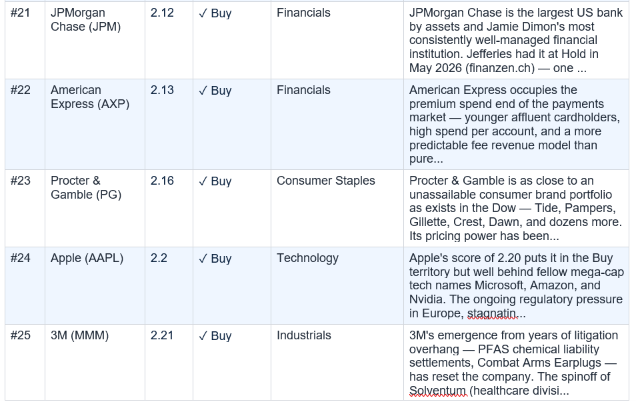
JPMorgan Chase is the largest US bank by assets and Jamie Dimon's most consistently well-managed financial institution. Jefferies had it at Hold in May 2026 (finanzen.ch) — one of the few dissenters — but the broader consensus sits at 2.12 Buy. Net interest margin, investment banking cycle recovery, and credit quality are the key variables. It is the bank stock most widely regarded as the Dow's best financial representative.#22 American Express (AXP) ✓ Buy Score: 2.13 | Financials
American Express occupies the premium spend end of the payments market — younger affluent cardholders, high spend per account, and a more predictable fee revenue model than pure merchant networks. The 2.13 Buy consensus is a moderate positive, reflecting confidence in the consumer spending resilience of its affluent cardholder base.#23 Procter & Gamble (PG) ✓ Buy Score: 2.16 | Consumer Staples
Procter & Gamble is as close to an unassailable consumer brand portfolio as exists in the Dow — Tide, Pampers, Gillette, Crest, Dawn, and dozens more. Its pricing power has been demonstrated repeatedly through inflationary cycles. The 2.16 Buy consensus reflects the defensive quality of the business and dividend growth credentials.#24 Apple (AAPL) ✓ Buy Score: 2.2 | Technology
Apple's score of 2.20 puts it in the Buy territory but well behind fellow mega-cap tech names Microsoft, Amazon, and Nvidia. The ongoing regulatory pressure in Europe, stagnating hardware revenue in China, and the uncertainty around Apple Intelligence's actual impact on the upgrade cycle are all weighing on the consensus. Goldman Sachs has Buy and Jefferies has Hold (multiple entries in finanzen.ch). The services revenue model — App Store, iCloud, Apple TV+, Apple Pay — is the primary bull argument.Surprise pick
#25 3M (MMM) ✓ Buy Score: 2.21 | Industrials
3M's emergence from years of litigation overhang — PFAS chemical liability settlements, Combat Arms Earplugs — has reset the company. The spinoff of Solventum (healthcare division) in 2024 makes 3M a purer industrial and consumer products play. At 2.21, the Buy consensus reflects a recovery thesis: the litigation discount is fading and the dividend has been reset to sustainable levels.Surprise pick
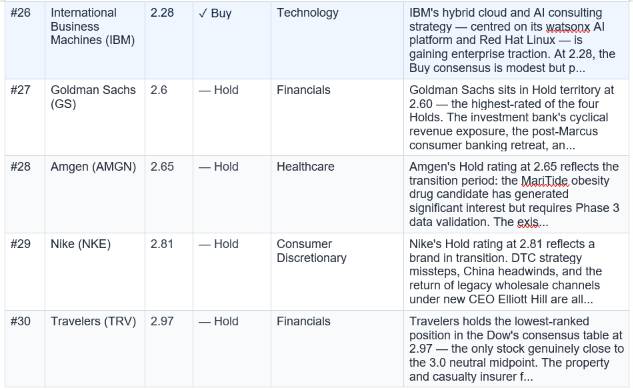
#26 International Business Machines (IBM) ✓ Buy Score: 2.28 | Technology
IBM's hybrid cloud and AI consulting strategy — centred on its watsonx AI platform and Red Hat Linux — is gaining enterprise traction. At 2.28, the Buy consensus is modest but positive. The company's transformation from hardware/legacy services to AI-augmented consulting and cloud infrastructure is the central thesis. The structural headwinds from mainframe decline remain.4C. The Hold Tier (Scores 2.60–2.97)
Four stocks sit in Hold territory. None are rated Sell. Each reflects a company where the balance of analyst opinion is watch-and-wait rather than conviction Buy or active Sell.#27 Goldman Sachs (GS) — Hold Score: 2.6 | Financials
Goldman Sachs sits in Hold territory at 2.60 — the highest-rated of the four Holds. The investment bank's cyclical revenue exposure, the post-Marcus consumer banking retreat, and the dependence on trading and underwriting cycles create earnings volatility that makes a strong Buy consensus difficult. The business is excellent; the entry point question is what moves the score toward Hold.#28 Amgen (AMGN) — Hold Score: 2.65 | Healthcare
Amgen's Hold rating at 2.65 reflects the transition period: the MariTide obesity drug candidate has generated significant interest but requires Phase 3 data validation. The existing biosimilars and oncology portfolio are stable but lack the growth catalysts needed for a conviction Buy. The obesity/GLP-1 opportunity is real; the timeline and clinical outcome are uncertain.#29 Nike (NKE) — Hold Score: 2.81 | Consumer Discretionary
Nike's Hold rating at 2.81 reflects a brand in transition. DTC strategy missteps, China headwinds, and the return of legacy wholesale channels under new CEO Elliott Hill are all mid-thesis variables. Joh. Brunckhorst (finanzen.ch May 2026) had it at Hold. The long-term brand power is not in question; the near-term earnings trajectory and market share recovery timeline are. It is a watch-and-see rating.#30 Travelers (TRV) — Hold Score: 2.97 | Financials
Travelers holds the lowest-ranked position in the Dow's consensus table at 2.97 — the only stock genuinely close to the 3.0 neutral midpoint. The property and casualty insurer faces ongoing pressure from catastrophic weather events, reinsurance costs, and the repricing of its loss exposure. Investment income has improved with higher rates, but the loss ratio uncertainty is the dominant Hold driver.5. The Complete Rankings Table: All 30 at a Glance
The Surprise Picks: Disney, Boeing, and Why Apple Ranks #24
Three names in this ranking likely surprise readers expecting the standard narrative. The first is Walt Disney at 1.48 — a Strong Buy consensus on a stock that has frustrated long-term holders through years of streaming losses, linear TV decline, and content spending debates. The Strong Buy reflects a specific thesis change: ESPN’s sports streaming pivot is gaining subscriber momentum, the parks business has demonstrated pricing power that has survived multiple economic tests, and the streaming division is finally approaching profitability. On this list is Disney as one of the names ‘that might surprise you.’The second surprise is Boeing at 1.52 — a Buy on one of the most operationally troubled companies in the index. Safety crises, production halts, union disputes, a renegotiated defence contract landscape, and years of management instability all argue against confidence. But the analyst consensus Buy rests on three structural facts: the commercial aviation order backlog is the largest in Boeing’s history, no credible global competitor exists to absorb it, and the stock price already reflects a significant distress discount. Goldman Sachs, UBS, Jefferies and JP Morgan have all maintained Buy ratings through the turbulence (finanzen.ch 2026).
The third is Apple at 2.20 — ranked #24 of 30. The world’s largest company by market cap is only the 24th most-recommended stock in its own index. Apple’s regulatory battles in Europe, uncertain AI monetisation timeline through Apple Intelligence, and China revenue headwinds have created more analyst ambivalence than the brand name might suggest. It is still a Buy. But Cisco (1.86), Home Depot (1.89), Merck (1.78), Coca-Cola (1.75), and Chevron (1.72) are all more strongly recommended by the analyst consensus than Apple.
Disney (1.48): streaming turning profitable; ESPN sports pivot; park pricing power. Boeing (1.52): largest commercial aviation backlog in history; no credible global competitor; distress discount already in price. Visa (1.45): tollroad economics on global digital payments; no credit risk; network moat. Source: Kiplinger October 2026.
Apple (2.20): #24 of 30 — regulatory pressure in Europe; China headwinds; Apple Intelligence monetisation uncertain. Goldman Sachs (2.60 Hold): cyclical investment banking exposure; post-Marcus consumer banking retreat. Nike (2.81 Hold): DTC strategy reset under new CEO; China market share recovery timeline unclear. Travelers (2.97 Hold): catastrophic weather loss exposure; reinsurance cost pressure.
Conclusion
The most striking fact in the entire October 14, 2026 ranking is the one at the bottom: not a single Dow Jones component has a Sell consensus rating. In a market where bear market indicators have been triggered, geopolitical uncertainty is elevated, and valuations remain historically stretched, every one of the 30 most prestigious publicly traded companies in the United States still has analysts, in aggregate, recommending Buy or Hold. That is either a statement of the Dow’s quality filter working exactly as intended, or a sign that consensus Wall Street opinion is insufficiently cautious at a cyclical turning point. Probably some of both.The concentration of conviction is clear: six stocks — Nvidia, Amazon, Microsoft, Alphabet, Visa, and Disney — have Strong Buy consensus ratings with scores below 1.50. The breadth of the Buy tier is also notable: 20 stocks in the middle of the index have Buy ratings spanning technology, healthcare, financials, consumer staples, industrials, and energy. The Dow, for all its reputation as a backward-looking old-economy index, contains more Buy ratings than most investors expect. Dow’s structural role in the current environment: it won’t keep up in a rising market, but it offers stability in a down one. With seven of ten bear market indicators triggered, that trade-off looks worth understanding. Not investment advice. Always consult a qualified financial adviser.
Frequently Asked Questions
How are analyst consensus ratings calculated for Dow Jones stocks?S&P Global Market Intelligence surveys the individual stock recommendations of sell-side analysts covering each company. Each analyst's call — Strong Buy, Buy, Hold, Sell, Strong Sell — is converted to a 1-5 numerical scale and averaged. A score of 1.0 means unanimous Strong Buy; 5.0 means unanimous Strong Sell. Scores equal to or below 2.5 mean analysts on average rate shares at Buy; scores between 2.5 and 3.5 are Hold; scores above 3.5 are Sell. The consensus is updated continuously as individual analysts publish new reports and revisions. The October 14, 2026 data used in this article represents the aggregate of all current analyst ratings at that date.
Why is the Dow Jones Industrial Average price-weighted, not market-cap weighted?
The Dow was designed in 1896, before market cap weighting was a standard methodology. The average adds up the stock prices of all 30 components and divides by a constantly adjusted divisor. This means a high-priced stock like UnitedHealth Group has more influence on the index than a lower-priced stock regardless of market capitalisation. This price-weighting limits the Magnificent 7's contribution on the way up — but also limits the damage they can do on the way down. In practical terms, it makes the Dow more defensive and less growth-oriented than the S&P 500 or Nasdaq.
Why has the Dow underperformed the S&P 500 in 2026?
S&P 500 was up approximately 13% on a price basis year-to-date, while the Dow had risen about 7%. The primary reason is the Magnificent 7 weighting effect. Microsoft, Amazon, Nvidia, Alphabet, and Apple are in the Dow, but the price-weighted structure limits their contribution compared to the market-cap weighted S&P 500 where they carry far greater weight. Half of the Dow's components are low-beta stocks that by design lag in rising markets. The trade-off: those same low-beta characteristics helped the Dow lose only 6% at its March 2026 trough, compared to the Nasdaq's nearly 11% drawdown.
Is there any Dow Jones stock rated Sell in October 2026?
No. As of October 14, 2026, per S&P Global Market Intelligence data, not one of the 30 Dow Jones Industrial Average components has a Sell consensus rating. The most cautious rating in the index belongs to Travelers (TRV) at 2.97 — a Hold, not a Sell. The next most cautious is Nike (NKE) at 2.81 (Hold), then Amgen (AMGN) at 2.65 (Hold), then Goldman Sachs (GS) at 2.60 (Hold). The absence of any Sell rating across all 30 components reflects both the Dow's quality filter and the general disposition of Wall Street's sell-side consensus, which historically rarely issues Sell ratings.
Why does Apple rank lower than many other tech stocks in the Dow?
Apple's consensus score of 2.20 places it 24th of 30 in the October 14, 2026 ranking — behind Cisco (1.86), Home Depot (1.89), Merck (1.78), Coca-Cola (1.75), Chevron (1.72), Salesforce (1.70), Walmart (1.56), UnitedHealth (1.58), Boeing (1.52), Disney (1.48), Visa (1.45), Alphabet (1.37), Microsoft (1.34), Amazon (1.33), and Nvidia (1.29). Several factors explain the relative caution: Apple faces ongoing regulatory pressure in Europe over the App Store, antitrust proceedings regarding digital payments, revenue headwinds in China where local competitors have gained smartphone market share, and uncertainty about the timeline for Apple Intelligence to meaningfully drive an upgrade cycle. It is still rated Buy — but with more analyst ambivalence than any other tech name in the index.
0 Comments
Be the first to share your thoughts on this article.