
Taxes
Average Council Tax by Band (2025–2026): A Comprehensive Guide

Council Tax is a mandatory charge on domestic properties in the United Kingdom, used by local authorities to fund essential public services. These services range from waste collection and street lighting to more critical social care, education, and emergency services. As we enter the 2025–2026 financial year, understanding your Council Tax bill is more important than ever, given the annual adjustments and the rising cost of local governance.
This guide provides an in-depth look at the average Council Tax levels for 2025–2026, explains how your property's band is determined, and highlights the various discounts and exemptions available to households. Whether you are a first-time renter, a homeowner, or a student, knowing how Council Tax works can help you manage your household budget and ensure you are not overpaying.
2 How Council Tax Bands are Determined (A–H)
3 The Statutory Ratios: Band A–H Comparison
4 Council Tax Discounts and Exemptions
6 Challenging Your Council Tax Band
7 Regional Variations in Council Tax
Conclusion
Frequently Asked Questions (FAQ)
External References and Resources
It is important to note that this figure is an average across all billing authorities in England. Your actual bill will depend on the specific requirements of your local council, police authority, fire service, and, in many cases, your parish or town council. The 2025–2026 average represents a 5.0% increase from the previous year, driven largely by the increasing costs of adult social care and inflationary pressures on local services.
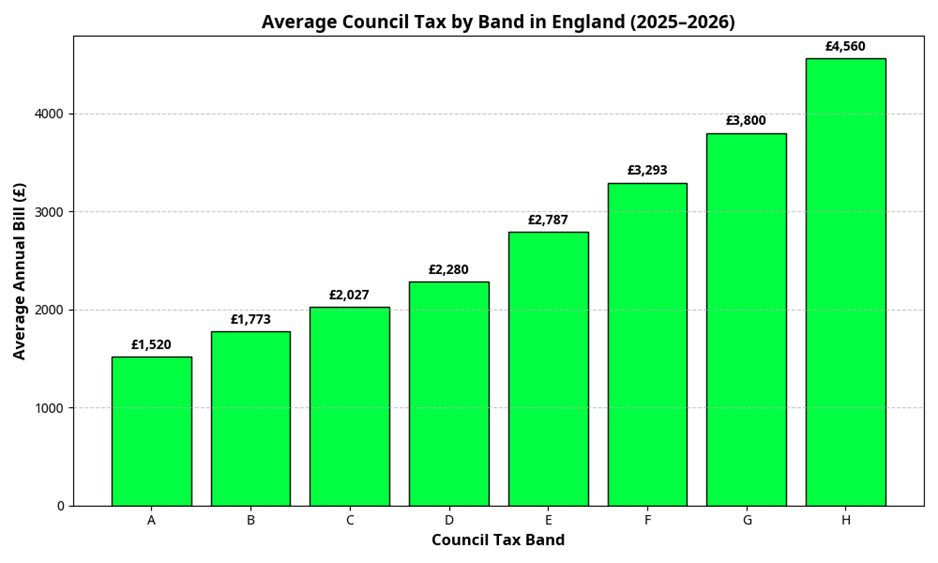
Note: These figures are based on the national average Band D rate of £2,280 and calculated using the statutory ratios for each band in England.
The Valuation Office Agency (VOA) is responsible for banding properties in England and Wales, while in Scotland, this task is handled by the local Assessor. The bands range from Band A (lowest value) to Band H (highest value). In Wales, a revaluation occurred in 2003, and the bands range from A to I.

Understanding these ratios is crucial for comparing costs between different property types. If you move from a Band C to a Band E property, your bill will not just increase based on the value difference but will jump from 8/9ths to 11/9ths of the local rate.
To challenge your band in England or Wales, you must contact the Valuation Office Agency (VOA). You will need to provide evidence, such as the bands of similar properties in your street or evidence of the house's value in 1991. In Scotland, challenges are made through the local Assessor.
Several alternative models have been proposed:
Always remember to check your band when moving and don't hesitate to contact your local council if your circumstances change. Public services depend on these contributions, but the system also includes vital safeguards to protect those on lower incomes or with specific household needs.
External References and Resources
This guide provides an in-depth look at the average Council Tax levels for 2025–2026, explains how your property's band is determined, and highlights the various discounts and exemptions available to households. Whether you are a first-time renter, a homeowner, or a student, knowing how Council Tax works can help you manage your household budget and ensure you are not overpaying.
Table of Contents
1 Average Council Tax by Band (2025–2026)2 How Council Tax Bands are Determined (A–H)
3 The Statutory Ratios: Band A–H Comparison
4 Council Tax Discounts and Exemptions
- Single Person Discount (25%)
- Student Exemptions (100% or 25%)
- Disability Reductions
- Severely Mentally Impaired (SMI) Discount
6 Challenging Your Council Tax Band
7 Regional Variations in Council Tax
Conclusion
Frequently Asked Questions (FAQ)
External References and Resources
Average Council Tax by Band (2025–2026)
The standard measure for Council Tax in England is the Band D property. For the 2025–2026 financial year, the average Band D Council Tax set by local authorities in England is £2,280 per year. When broken down into monthly payments, this equates to approximately £190 per month over a standard 12-month period, or £228 per month if paid over the traditional 10-month installment plan.It is important to note that this figure is an average across all billing authorities in England. Your actual bill will depend on the specific requirements of your local council, police authority, fire service, and, in many cases, your parish or town council. The 2025–2026 average represents a 5.0% increase from the previous year, driven largely by the increasing costs of adult social care and inflationary pressures on local services.
| Council Tax Band | Average Annual Bill (2025–2026) | Average Monthly Bill (12 Months) | Average Monthly Bill (10 Months) |
| Band A | £1,520 | £126.67 | £152.00 |
| Band B | £1,773 | £147.75 | £177.30 |
| Band C | £2,027 | £168.92 | £202.70 |
| Band D | £2,280 | £190.00 | £228.00 |
| Band E | £2,787 | £232.25 | £278.70 |
| Band F | £3,293 | £274.42 | £329.30 |
| Band G | £3,800 | £316.67 | £380.00 |
| Band H | £4,560 | £380.00 | £456.00 |
Note: These figures are based on the national average Band D rate of £2,280 and calculated using the statutory ratios for each band in England.
How Council Tax Bands are Determined (A–H)
In England and Scotland, every domestic property is assigned a Council Tax band based on its open-market value on April 1, 1991. Even for properties built after this date, the valuation is backdated to what the property would have been worth in 1991. This system has remained largely unchanged for over three decades, leading to significant debate about its fairness in the modern property market.The Valuation Office Agency (VOA) is responsible for banding properties in England and Wales, while in Scotland, this task is handled by the local Assessor. The bands range from Band A (lowest value) to Band H (highest value). In Wales, a revaluation occurred in 2003, and the bands range from A to I.
| Band | Property Value (as of April 1, 1991) - England |
| Band A | Up to £40,000 |
| Band B | £40,001 to £52,000 |
| Band C | £52,001 to £68,000 |
| Band D | £68,001 to £88,000 |
| Band E | £88,001 to £120,000 |
| Band F | £120,001 to £160,000 |
| Band G | £160,001 to £320,000 |
| Band H | More than £320,000 |
The Statutory Ratios: Band A–H Comparison
The amount you pay for your Council Tax is directly proportional to the Band D rate. Each band is assigned a statutory ratio, which determines the multiplier applied to the Band D charge. For example, a Band A property always pays 6/9ths (or 66.7%) of the Band D rate, while a Band H property pays 18/9ths (or 200%).Understanding these ratios is crucial for comparing costs between different property types. If you move from a Band C to a Band E property, your bill will not just increase based on the value difference but will jump from 8/9ths to 11/9ths of the local rate.
| Band | Ratio to Band D | Percentage of Band D Bill |
| Band A | 6/9 | 66.7% |
| Band B | 7/9 | 77.8% |
| Band C | 8/9 | 88.9% |
| Band D | 9/9 | 100.0% |
| Band E | 11/9 | 122.2% |
| Band F | 13/9 | 144.4% |
| Band G | 15/9 | 166.7% |
| Band H | 18/9 | 200.0% |
Council Tax Discounts and Exemptions
Many households are eligible for reductions in their Council Tax bill. These discounts are not always applied automatically, so it is the responsibility of the resident to check their eligibility and apply through their local council.Single Person Discount (25%)
If you are the only adult (aged 18 or over) living in your property as your main home, you are entitled to a 25% discount on your Council Tax bill. This applies regardless of your income or the value of your home. When calculating the number of adults in a household, certain people are "disregarded," meaning they do not count toward the total. This includes full-time students, some apprentices, and live-in carers.Student Exemptions (100% or 25%)
Households where every resident is a full-time student are completely exempt from Council Tax (100% discount). To qualify, students must be enrolled in a course that lasts at least one academic year and involves at least 21 hours of study per week. If a student lives with one non-student adult, the household receives a 25% discount (because the student is disregarded). However, if a student lives with two or more non-student adults, no student discount is usually applicable to the bill.Disability Reductions
The Disabled Band Reduction Scheme is designed to ensure that disabled people do not pay more Council Tax because they live in a larger property than they would otherwise need. If you have a room, an extra bathroom, or enough floor space for wheelchair use inside your home specifically to meet the needs of a disabled resident, you may be eligible to have your bill reduced to the next lowest band. For example, a Band D property would be charged at the Band C rate. If your home is already in Band A, you will receive a reduction equal to 1/9th of the Band D rate.Severely Mentally Impaired (SMI) Discount
People who are medically certified as having a permanent "severe impairment of intelligence and social functioning" (such as advanced dementia or severe learning difficulties) are disregarded for Council Tax purposes. If an SMI person lives alone, they receive a 100% exemption. If they live with one other adult, the household receives a 25% discount.How to Check Your Council Tax Band
Checking your Council Tax band is a straightforward process that can be done online in a few seconds. It is a vital step whenever you move house or if you suspect your property has been incorrectly banded.For Properties in England and Wales
- Visit the official GOV.UK website's "Check your Council Tax band" tool.
- Enter your postcode.
- Select your address from the list provided.
- The tool will display your current band and the effective date of the valuation.
For Properties in Scotland
- Visit the Scottish Assessors Association (SAA) website.
- Use the search function to enter your postcode or address details.
- The SAA portal will provide the band for any domestic property in Scotland.
Challenging Your Council Tax Band
If you believe your property is in the wrong band—perhaps because similar, neighboring properties are in a lower band—you have the right to challenge it. However, you should be cautious: a challenge can result in your band being moved up as well as down, and it could also trigger a review of your neighbors' bands.To challenge your band in England or Wales, you must contact the Valuation Office Agency (VOA). You will need to provide evidence, such as the bands of similar properties in your street or evidence of the house's value in 1991. In Scotland, challenges are made through the local Assessor.
Regional Variations in Council Tax
While the national average for Band D is £2,280, the actual amount varies significantly by region. These variations are caused by the differing funding needs of local authorities and the "tax base" of the area (the number and value of properties available to tax).- London: Generally has lower average Council Tax rates compared to the rest of the country, partly due to the high density of properties and different funding structures. The average Band D in London for 2025–2026 is approximately £1,982.
- Metropolitan Areas: Areas like Greater Manchester, Merseyside, and the West Midlands often see higher rates due to the extensive public services required in urban centers. The average Band D in these areas is around £2,289.
- Shire Counties: Rural areas often face high costs for infrastructure and social care across large geographic areas. Unitary authorities in these regions average £2,366 for a Band D property.
Deep Dive: Why Council Tax Varies Across the UK
To truly understand the 2025–2026 Council Tax landscape, we must look beyond the national averages. The £2,280 Band D figure is a useful benchmark, but it masks the dramatic differences between a resident in Westminster and one in Rutland. These variations are not arbitrary; they are the result of complex historical, social, and economic factors.1. The Funding Gap and Local Government Finance
Local councils receive their funding from three main sources: central government grants, business rates, and Council Tax. Over the last decade, central government grants have significantly decreased, forcing councils to rely more heavily on Council Tax. In areas with high levels of social deprivation, the demand for services like children's services and adult social care is much higher, yet the "tax base" (the number of high-value properties) might be lower. This creates a paradox where some of the poorest areas in the country have some of the highest Council Tax rates.2. The Adult Social Care Precept
Since 2016, the government has allowed councils with social care responsibilities to add a "precept" to their Council Tax bills specifically to fund adult social care. For the 2025–2026 year, most eligible councils have utilized the full 2% precept flexibility. This is a significant driver of the 5.0% national increase. As the UK's population ages, the cost of providing care for the elderly and disabled continues to outpace general inflation, making this precept a permanent and growing feature of your bill [1].3. Parish and Town Council Precepts
If you live in a rural area or a small town, your bill likely includes a "parish precept." These are set by the most local level of government to fund hyper-local services like allotments, community centers, and local parks. While these precepts are often small (averaging around £80–£100 per year for a Band D property), they are not subject to the same "referendum principles" as larger councils. This means a parish council can, in theory, increase its precept by a much higher percentage than the main billing authority, provided it can justify the cost to its residents.Strategic Advice: How to Lower Your Council Tax Bill in 2025
Beyond the standard discounts, there are several strategic ways to ensure you are paying the absolute minimum required by law.1. Check for "Disregarded" Residents
The Single Person Discount is the most common reduction, but many people forget that you can still get it even if you don't live alone. If everyone else in your house is "disregarded," you still qualify. Common disregarded groups include:- Full-time students and student nurses.
- Apprentices earning less than £195 per week.
- Youth Training trainees under 25.
- Care workers on low pay or living in the property they provide care in.
- Diplomats and members of international organizations.
2. Council Tax Support (Reduction) Schemes
If you are receiving Universal Credit, Pension Credit, or are on a low income, you must apply for Council Tax Support. This is a local scheme, meaning every council has its own rules. Some councils will cover 100% of the bill for those on the lowest incomes, while others require everyone to pay at least 20% regardless of their financial situation. This is separate from the national benefit system, so you must apply directly to your local council's website.3. Empty Properties and Second Homes
The rules for empty homes have changed significantly. From April 1, 2025, many councils are implementing a Second Homes Premium, which can double the Council Tax on properties that are furnished but not used as a main residence. Conversely, if your home is empty because it is undergoing major structural repair or is probate-related, you may be eligible for a short-term exemption. Always check your local council's policy on "unoccupied and unfurnished" dwellings, as many have scrapped these discounts to encourage property use.The Future of Council Tax: Is Reform Coming?
The 2025–2026 figures highlight the growing strain on the current system. Critics argue that basing 21st-century taxes on 1991 property values is fundamentally flawed. A property that was worth £40,000 in 1991 might be worth £400,000 today, yet it remains in Band A. Meanwhile, a property in a less buoyant market might have seen its value stagnate but remains in a higher band.Several alternative models have been proposed:
- Proportional Property Tax: A flat percentage of the current market value of the home. This would be more progressive but would require a massive national revaluation.
- Local Income Tax: Replacing property-based tax with a tax on what people actually earn in the local area.
- Land Value Tax: Taxing the value of the land itself rather than the buildings on it.
Conclusion
Council Tax remains one of the most significant monthly outgoings for UK households. With the average Band D bill reaching £2,280 for the 2025–2026 period, staying informed about your banding and eligibility for discounts is essential. By understanding the statutory ratios and the various exemptions available—from single-person discounts to student status—you can ensure that your contribution to local services is fair and accurate.Always remember to check your band when moving and don't hesitate to contact your local council if your circumstances change. Public services depend on these contributions, but the system also includes vital safeguards to protect those on lower incomes or with specific household needs.
Frequently Asked Questions (FAQ)
1. When do I have to pay my Council Tax?
Council Tax bills are usually sent out in March for the upcoming financial year starting April 1. Most people pay in 10 monthly installments from April to January, but you have a legal right to ask your council to spread the cost over 12 months to make the monthly payments smaller.2. Does Council Tax apply to renters?
Yes. In most cases, the resident of the property is responsible for paying the Council Tax, whether they own the home or rent it. In "Houses in Multiple Occupation" (HMOs), the landlord is usually responsible for the bill, though they often include the cost in the rent.3. What happens if I miss a Council Tax payment?
If you miss a payment, the council will send you a reminder. If you fail to pay within seven days of the reminder, you may lose the right to pay by installments and be asked to pay the full year's bill upfront. Persistent non-payment can lead to court action and the use of bailiffs.4. Can I get a discount if I am on a low income?
Yes. Every local council has a Council Tax Support (sometimes called Council Tax Reduction) scheme. Depending on your income, savings, and household circumstances, you could get your bill reduced by up to 100%.External References and Resources
0 Comments
Be the first to share your thoughts on this article.