
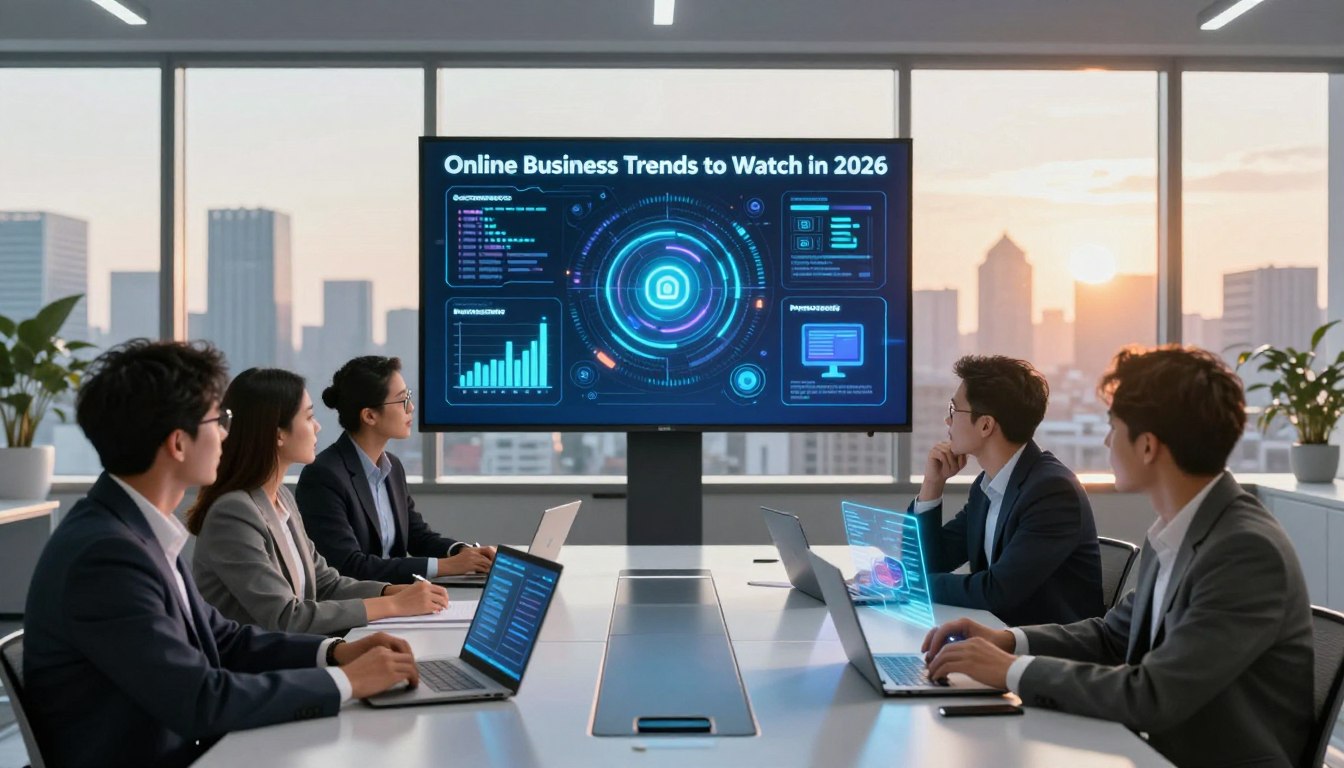
Discover the Top Online Business Trends to Watch in 2026

You’re entering an execution year. In 2026, winners connect experience, technology, and operations instead of chasing isolated tactics. Retail ecommerce scale is shifting fast; global sales estimates top trillions, which raises the baseline for customer experience and brings more competitors. This report defines "Online Business Trends to Watch" as changes in customer expectations, enabling technology, and operational models that shape growth. You’ll get a clear trend landscape, what drives adoption in the US market, and practical guidance on prioritizing without overbuilding.
Expect actionable signals: adoption windows, channel mix implications, and site capability needs. We evaluate each trend by customer value first, then feasibility, then margin impact. Major themes previewed include generative AI, hyper-personalization, AR, social selling, mobile-first UX, flexible payments, and composable architectures.
Key Takeaways
- 2026 favors integrated execution across experience, tech, and ops.
- Ecommerce growth raises expectations and competitive pressure.
- Trends are judged by customer value, feasibility, and margin impact.
- Focus areas include AI, personalization, AR, mobile UX, and payments.
- The guidance centers on practical adoption windows and channel mix.
Why 2026 Will Reward Faster, Smarter Online Businesses
As ecommerce expands, fast, data-driven organizations will capture outsized share and margins. The market is growing: BigCommerce projects $3.6T+ in 2025 and $4.9T+ by 2030. That growth expands opportunity, but it also raises expectations for performance and raises paid acquisition costs.
Through 2030, plan for scalable systems, not one-off campaigns. Invest in content workflows, merchandising platforms, fulfillment processes, and retention engines that scale as sales rise.
What the growth curve means for planning
Higher demand brings more volatility and faster trend cycles. Shorten planning loops and use better data for demand forecasting.
Rising competition from major brands makes speed, clarity, easy returns, and proactive support baseline expectations. These elements shape customer experience more than flashy features.
Where to prioritize first
Protect revenue by keeping customers: increasing lifetime value is often more reliable than chasing new-customer volume. Loyalty in 2026 is earned through consistent cross-channel experiences, transparency, and frictionless service.
- Remove friction at discovery, product pages, checkout, and post-purchase.
- Automate forecasting and shorten decision cycles for merchandising and fulfillment.
- Focus on trust-building moments that reduce churn and raise repeat sales.
The risk of doing nothing is real: customers switch faster when substitutes are one swipe away. Prioritize fixes that remove friction and increase trust at high-traffic moments to protect margin and growth.
Online Business Trends to Watch: The 2026 Landscape You Need to Prepare For
Prepare for 2026 by aligning customer-facing design, underlying systems, and day-to-day execution into one cohesive model.
The “trend stack” approach: experience, technology, and operations working together
The trend stack groups three layers that must move in lockstep: front-end experience, enabling technology, and operational execution.
If you add features without shoring up speed or fulfillment, gains vanish. For example, launching AR without improving mobile performance can hurt conversions rather than help them.
Where US consumers are shifting expectations across shopping, content, and service
US consumers expect faster answers, smoother checkout, clearer data choices, and more interactive content formats.
Content now drives commerce: social video, livestreams, and creator-led discovery shorten the funnel and change attribution.
Platforms — marketplaces, social channels, and your storefront — must share product data and consistent messaging for a seamless journey.
- What’s next: each trend section in this report will explain what’s changing, why it matters, and your next steps.
- Always-on expectations: personalization and 24/7 service must respect privacy and opt-in rules.
Readiness checklist (preview): clean data, fast UX, multiple payment options, adequate customer support coverage, and flexible integrations are table stakes for 2026.
Generative AI Becomes Your Default Growth Lever
Generative AI will be the practical tool that lets you scale output and responsiveness without scaling headcount at the same rate.
Scale content and commerce quickly. Use AI to create product descriptions at SKU scale, category copy, SEO-friendly FAQs, ad variants, and multilingual drafts. All drafts should pass editorial QA and brand style checks so your voice stays consistent.
Automation across operations
AI handles support triage, returns routing, inventory forecasting, and transaction monitoring for fraud signals. These automations cut manual work and free teams for higher-value tasks.
Agentic commerce and assistants
AI shopping assistants can compare options, build carts, and act on clear customer intent. That raises the bar for clean product data and explicit policies you publish on platforms and checkout flows.
Productivity, expectations, and guardrails
Nearly 70% of customers expect companies to use generative AI to improve the experience, and LLMs can affect about 40% of working hours. Set guardrails: allow autonomous content generation and support triage, but require human approval for pricing, refunds, and regulated claims.
- Measurable outcomes: faster time-to-publish content, higher product page conversion, lower support cost per order, and fewer fraud losses.
- For a strategic view, see the 2026 trends analysis on adoption windows and priorities.
Hyper-Personalization Powered by Customer Data (and Real Transparency)
Hyper-personalization turns raw customer signals into real-time actions that feel helpful, not invasive. It means using behavioral cues, purchase history, and explicit preferences to change experiences as people shop.
Turning first-party data into relevant recommendations across platforms
Unify browsing, purchase history, and stated preferences into a single model. That unified view feeds recommendations across your site, email, SMS, paid retargeting, and retail apps.
Operationalizing this data requires a clean identity layer, fast APIs, and simple rules that map signals to offers without over-personalizing.
Predictive analytics that helps you prevent churn and increase lifetime value
Predictive models flag risk signals such as falling engagement or delayed repurchase cycles. When the model detects risk, trigger a timely win-back flow—personalized incentives, relevant content, or an easy re-engagement message.
"Relevance reduces decision fatigue and makes repeat buying easier, directly supporting customer loyalty."
Opt-in personalization and privacy expectations in the US market
Consumers expect clear choices. Disclose what data you use, why you use it, and give controls that let people opt in or out without breaking the experience.
Transparency drives outcomes: higher opt-in rates, stronger trust, and better personalization performance.
- Define personalization as behavior-driven, real-time adjustments—not just name insertion.
- Keep recommendation logic consistent across platforms for a cohesive experience.
- Use predictive signals as early warnings and automate gentle recovery flows.
- New vs returning
- High-intent browsers
- Subscribers and high-LTV cohorts
- Discount-sensitive buyers
| Capability | What it uses | Primary outcome | Quick win |
| Real-time recommendations | Browsing + cart data | Higher conversion | Cross-sell widgets |
| Churn prediction | Engagement + purchase cadence | Lower churn | Automated win-back |
| Consent management | Opt-in signals | Trust & opt-in rates | Simple privacy center |
| Cross-platform sync | Unified profile | Consistent experience | Shared recommendation API |
For a deeper look at personalization technology and upcoming practices, see personalization technology.
Immersive Shopping Experiences Go Mainstream with AR
Augmented reality is shifting from novelty features into tools that cut hesitation and lift conversion. AR now helps shoppers check fit, color, and scale before they buy, which improves the overall shopping experience.
Virtual try-ons and 3D product visualization
Beauty, eyewear, apparel, and accessories gain the most from virtual try-ons. When customers preview fit and look, hesitation falls and returns drop.
“Try it in your home” placement tools
For furniture, decor, and appliances, in-home placement solves a key blocker: will it fit and match my room? AR shows scale and context so shoppers buy with more confidence.
Why 2026 is a practical adoption window
The AR market grew from about $5.8B in 2024 and is on track for faster expansion. Better device support and improved tooling mean you can pilot AR without massive custom builds.
- Implementation guidance: start with top-selling SKUs and high-return categories.
- UX tips: clear AR CTAs, quick-loading assets, and fallback imagery for non-AR devices.
- KPIs: measure conversion lift on AR pages, reduced returns, longer time on page, and higher AOV.
Livestream Shopping and Social Commerce Turn Content Into a Sales Channel
Real-time shopping events now blend demonstration, urgency, and community to shorten the path from discovery to purchase.
What the livestream surge means for your 2026 channel mix: treat livestream as both a performance channel and a trust layer. US livestream sales were about $50B in 2023 and may reach $68B by 2026, so this format moves meaningful sales and builds repeat audiences.
Real-time demos and urgency that close hesitation
Live demos let you answer questions and handle objections on-air. That reduces uncertainty and shows products in use.
Use limited drops, timed bundles, and exclusive codes to create urgency without across-the-board discounting.
Creators, short-form funnels, and community
Choose hosts whose voice matches your brand and who disclose partnerships properly. Authentic hosts create trust fast.
Short-form video on Reels, TikTok, or Shorts drives discovery and feeds viewers into scheduled livestreams.
Build community with regular shows, recurring hosts, and members-only perks that lift repeat attendance and demand.
Designing a frictionless shopping experience
Keep the path simple: shoppable overlays, pinned product links, and fast product detail access. Minimize steps from video to checkout.
| Action | Why it matters | Quick metric | Platform tip |
| Live demos + Q&A | Reduces buyer uncertainty | Conversion lift per session | Pin product links in chat |
| Timed drops & bundles | Creates urgency without blanket discounts | Units sold during event | Use countdown overlays |
| Creator-hosted shows | Builds fast trust | New customer rate | Match creator audience to product |
| Short-form feeds → live | Drives discovery into events | Audience funnel rate | Promote shows in Shorts/Reels |
Measure success by attributable sales, acquisition cost by platform, assisted conversions, and retention of livestream-acquired cohorts. These metrics tell you whether sessions build immediate sales and longer-term customer value.
Mobile-First Shopping Experience Becomes Nonnegotiable
When discovery happens on a screen in someone’s hand, your experience must be built for thumb-first interaction. Mobile is already the dominant path for browsing and buying, and that shift accelerates how you design flows and measure success.
Why phones are the primary storefront
Mobile will exceed 60% of ecommerce sales by 2027. That means most discovery and a growing share of purchases happen on devices, not desktop.
Design for short sessions and fast answers. Customers expect frictionless paths when they have limited time.
Mobile UX essentials
- Speed: fast loads, lightweight media, and good speed scores.
- Thumb-friendly design: clear hierarchy and large tap targets.
- One-tap checkout: fewer fields, autofill, and wallet-based payments.
Apps, notifications, and loyalty
Retail apps make sense when repeat buying and rewards matter. Studies show 76% shop via apps and 70% spend more for app rewards.
Use push notifications sparingly. Personalize triggers, cap frequency, and always offer clear value.
| Measure | Why it matters | Target | Quick test |
| Mobile conversion rate | Tracks purchase performance on devices | Beat desktop baseline | A/B simplified checkout |
| Speed score | Correlates with lower drop-off | 90+ (lab) / 3s load | Compress images, lazy load |
| App retention | Signals customer loyalty | Higher repeat purchase rate | Reward-first onboarding |
| Checkout drop-off | Shows friction points | Reduce by 20% | One-tap payment rollout |
Flexible Payments Win the Checkout Moment
The checkout is where small frictions become big revenue losses. Even a missing wallet option or a slow form can cost you real sales: 10% of shoppers abandon if they don’t see a preferred payment method.
Prioritize fast, familiar payments first. Digital wallets like Apple Pay and Google Pay cut fields and speed transaction time. They also raise perceived security, which helps customers who buy on mobile or on a first visit.
Buy Now, Pay Later and where it helps
BNPL lifts conversion and average order value in higher-AOV categories. Offer it for larger baskets and message limits clearly so you support purchases without encouraging overspending.
Reduce abandonment by matching payment preferences
Controlable drivers include payment mismatch, surprise fees, and unclear shipping or returns. Track abandonment by device and fix the quickest wins.
Operational and rollout guidance
Watch BNPL fees, chargeback risk, and fraud rules—these affect cost and margin. Roll out in phases: wallets first, then BNPL, then local methods for cross-border sales.
- KPIs: checkout conversion, abandonment rate by device, AOV, payment method mix, fraud/chargeback rate.
Voice Search and Voice Commerce Shape How Customers Find You
Voice search is reshaping how people ask questions and expect instant, single-answer results. With about 35% of US people aged 12+ owning a smart speaker, consumers now ask full questions like "best running shoes near me" or "how much does delivery cost."
What smart speaker adoption means for SEO and product pages
Voice queries favor concise answers and clear product attributes. Make shipping, returns, size, and price easy for assistants to surface.
How to optimize for conversational, long‑tail queries
Structure content as spoken Q&A: use question headings, FAQ blocks, and short paragraphs. Offer direct answers in the first sentence and expand below.
- Target problem/solution pages, comparisons, and compatibility guides.
- Use structured data and featured snippet-friendly summaries for "quick answer" wins.
- Keep product naming consistent across platforms and catalogs.
Measure success by growth in long-tail organic clicks, featured snippet wins, and assisted conversions from informational content. For practical guidance on local voice tactics, see voice search optimization tips.
Chat Marketing Evolves Into Always-On Customer Experience
Chat channels are shifting from reactive help desks into continuous, revenue-driving touchpoints.
In 2026, chat is not just support — it guides discovery, closes carts, and sustains loyalty.
Using AI chat to guide product discovery and personalize offers in real time
AI chat asks quick qualifying questions, recommends bundles, and surfaces policies that reduce hesitation.
When you pair behavior signals with explicit opt-ins, the system suggests offers in a helpful way without feeling intrusive.
Abandoned cart recovery and post-purchase support that protects customer loyalty
Recovery flows should start fast: an initial nudge within an hour, help offers at 24 hours, and a final reminder before discounting.
Post-purchase chat handles shipping updates, returns initiation, and self-serve order changes to protect loyalty and lower support load.
Balancing automation with a human handoff to keep your brand tone consistent
Set approved language, escalation rules, and a clear human handoff when sentiment or complexity rises.
Integrate chat with CRM, order systems, and your knowledge base so answers are accurate and fast.
| Use case | Primary tool | Goal | Quick KPI |
| Guided discovery | Generative chat | Higher cart rate | Conversion from chat |
| Abandoned cart flow | Automated messages + agent | Recover revenue | Recovery rate |
| Post-purchase care | Integrated chat + OMS | Reduce returns | CSAT / repeat purchase lift |
| Human handoff | Escalation rules | Protect brand tone | Resolution time |
Composable Commerce and Headless Architecture Power Faster Experimentation
Composable commerce lets you pick best-of-breed parts and assemble a custom stack that evolves with your needs. You replace modules instead of rebuilding the whole site, which lowers long-term cost and risk.
API-first tools are the enabler: they connect search, CMS, PIM, payments, inventory, and analytics so integrations happen faster. That means less vendor lock-in and quicker experiment cycles using modern frameworks like Next.js or Remix and headless frameworks such as BigCommerce Catalyst.
Headless separates frontend from backend so your storefront stays fast. You can deploy new UIs across web, app, kiosks, and other devices without duplicating product data. This improves conversion through speed and ensures omnichannel consistency.
Business case: lower time-to-market for tests, higher experiment velocity, and reduced long-term cost of change versus monolithic platforms. Choose headless when you run heavy experimentation, support multi-brand setups, or need bespoke experiences.
Operational realities matter: set clear governance, manage vendors, and invest in observability and uptime for all services. Track KPIs like deploy frequency, page performance, experiment velocity, integration time, and total cost of ownership to measure success.
Blockchain and Digital Trust Become Differentiators in Online Retail
When verified provenance appears at checkout, hesitant customers buy more often. Visible trust signals reduce doubt and make you stand out as scams and fraud rise.
Security, transparency, and fraud prevention
Blockchain adds tamper-resistant records that support stronger fraud narratives. You can show immutable transaction history so a customer knows a payment and claim are valid.
Supply chain tracking and product authenticity
Trace provenance for high-risk categories like luxury goods, supplements, cosmetics, and sustainably sourced materials.
Serialization, QR verification, and product history for resale lift conversion and cut authentication tickets.
Smart contracts and privacy-forward approaches
Smart contracts automate verification and settlement, reducing operational friction in specific workflows.
Design privacy-first practices that minimize personal data exposure while preserving verification signals.
| Use case | Benefit | Quick metric |
| Provenance tracking | Clear chain-of-custody for products | Support tickets about authenticity ↓ |
| QR / serialization | Instant buyer verification | Conversion lift where shown |
| Smart settlements | Faster reconciliations in operations | Reduced dispute time |
Start where trust gaps hurt margin: pilot where fraud loss, chargebacks, or authenticity tickets are highest. The blockchain market is growing fast, but avoid adopting the tech for its own sake. Focus on measurable impact in the industry and on your customers.
Operational Trends That Protect Margins While Meeting Rising Demand
Operations are the margin protector behind every experience upgrade. If your backend can’t keep pace, faster site features and richer content only raise costs and customer frustration.
Self-serve returns and order portals cut tickets and free agent time. Build portals that generate labels, show status updates, and surface clear policies.
With 81% of consumers wanting more self-service options, this investment reduces support volume and speeds resolution.
Shipping that actually pencils out
Fast and free are expected, but you can design models that protect margin. Use thresholds, zone pricing, and local delivery partners. Test a paid upgrade for same-day and measure margin by promise tier.
Subscription models that stabilize revenue
Subscriptions smooth demand and simplify reordering. Start with refill or replenishment categories, offer flexible cadence, and make skips or pauses obvious. These models lift predictable revenue and lower acquisition cost over time.
Hybrid shopping and showrooming
In‑person touchpoints reduce returns and increase certainty while keeping inventory lean. Use buy-online-pickup-in-store, local fulfillment hubs, and appointment slots for higher-value items.
"Position operations as the system that scales experience without eroding margin."
| Focus | What it improves | Quick KPI |
| Self-serve portals | Customer experience & time saved | Tickets per 1,000 orders ↓ |
| Tiered shipping | Cost control & delivery speed | Margin by promise tier |
| Subscription model | Predictable revenue | Subscription retention rate |
| Hybrid showrooming | Return rate & conversion | Return rate % |
Operational tradeoffs matter: staffing, reverse logistics, and local fulfillment add complexity. Forecast demand across channels and track cost per order, time-to-refund, return rate, and revenue by channel. Prioritize solutions that save your team time while preserving margin.
Sustainability and Circular Economy Models Move From “Nice to Have” to Competitive Edge
Sustainability has shifted from marketing copy into a core differentiator for brands competing on value and trust.
About half of US consumers now say they will pay more for greener products. That willingness changes how you price and position items. Use verified claims and third‑party certifications to support higher price points.
Practical circular practices you can adopt
- Packaging returns and take-back discounts for reuse.
- Refill stations and refill subscriptions for repeat sales.
- Recycling partnerships and repair/resale programs for extended life of materials.
Message materials reuse clearly and avoid vague claims. State exact percentages reused or recycled and show how you track that data.
Turning sustainability into loyalty and measurable impact
Customers who share your values are likelier to repurchase and advocate. Publish progress, FAQs, and per-order impact metrics so shoppers see results before big cost savings arrive.
"Transparent practices build trust faster than aspirational language."
| Initiative | Primary benefit | Quick metric | Operational need |
| Take-back program | Materials recovery | Opt-in rate | Reverse logistics |
| Refill options | Lower packaging waste | Repeat purchase rate | Refill supply chain |
| Certified sourcing | Credible claims | Conversion lift | Supplier audits |
| Repair/resale | Extended product life | Resale revenue | Refurb process |
For a practical implementation roadmap and lifecycle analysis, review this circular economy guide.
Conclusion
Winning in 2026 means turning scattered innovations into one measurable system that lifts conversion and protects margin.
BigCommerce forecasts ecommerce growth through 2030, Statista projects livestream sales growth through 2026, AR is climbing toward wider adoption, smart speakers reach about 35% of US users, and mobile will top 60% of sales by 2027.
Start with mobile-first UX, flexible payments, and AI-assisted support and content. Then add personalization, social livestream, and immersive shopping pilots.
Fix product and customer data, set privacy-forward controls, and measure outcomes: conversion rate, retention, revenue per customer, and lower cost per order.
Practical next step: pick 2–3 trends to pilot this quarter, define KPIs, and run a repeatable test-and-scale cadence that preserves speed and trust.
0 Comments
Be the first to share your thoughts on this article.