
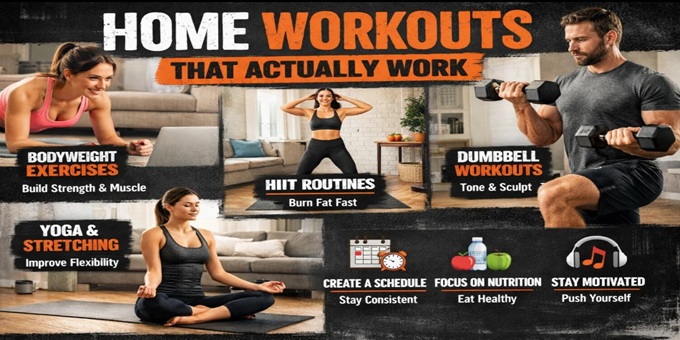
Home Workouts That Actually Work: Get Fit at Home

You’ll find a clear plan here — one that builds strength, conditioning, and mobility through simple progressions instead of random daily routines. Start by clearing a small space in any room and focus on bodyweight moves. These sessions can raise aerobic fitness, help manage body fat, and improve cardiometabolic health like blood pressure and heart risk factors. Expect realistic outcomes: more energy, stronger muscles, and steady habit gains without a gym membership. Progress is measurable and safe when you follow gradual overload and recovery. The guide is organized from beginner to advanced so you can get started at theright level. Location won’t decide your results; a well-built plan will.
Core ingredients: bodyweight moves, optional gear, progressive overload, and recovery. This approach fits busy schedules, small spaces, or anyone who prefers training at home.
Key Takeaways
- A simple progression beats random routines for steady gains.
- Bodyweight sessions can boost strength, endurance, and heart health.
- You can get started quickly with minimal space and optional gear.
- Follow beginner→intermediate→advanced to progress safely.
- Consistency, overload, and recovery are the core ingredients.
Why home workouts work for real fitness results
Your body adapts the same way whether you train in a gym or a living room—if you apply progressive stress and recovery. Results follow clear rules:
regular overload, planned rest, and gradual progression. Where you exercise is secondary to how you structure effort and recovery.
Proven health wins, including cardiometabolic benefits
Research shows consistent home-based exercise can lower blood pressure and reduce risk factors for heart disease and obesity. Short, focused sessions
still move markers in the right direction when intensity and volume add up over the week.
"Short bouts of effort, done with purpose, produce measurable gains in strength and endurance."
Convenience and comfort remove common barriers
Fewer logistics—no commute, no waiting for equipment—makes it easier to fit training into busy days. Privacy helps you practice technique without distraction and reduces self-consciousness.
Small “exercise snacks” can still build strength and endurance
Exercise snacks are brief efforts you scatter through the day. Examples: three stair trips, a set of push-ups, or a quick squat set between meetings.
| Snack type | Duration | Benefit |
| Stair climbs | 2–5 minutes | Cardio and leg strength |
| Bodyweight set (push/squat) | 1–3 minutes | Strength, movement practice |
| Timed AMRAP (as many reps) | 10–15 minutes | Endurance and metabolic boost |
- Key point: short sessions work, but weekly total and intensity matter for lasting gains.
- Consistency across days and weeks decides progress more than isolated long sessions.
Set up your home workout space and schedule
You don’t need a lot of room to get meaningful full-body movement. Experts say a cleared 2-by-2 meter area works for equipment-free sessions. Pick a quiet corner so you can focus and remove loose rugs, low tables, or clutter that could cause slips.
How much space you need
Test your zone with a quick space check: arm circles, hip hinge, and a lunge step-back. If any motion catches furniture, clear more floor or move to a different corner.
Simple cues and rewards to stay consistent
Make setup automatic. Set shoes by the mat, pre-fill a water bottle, or queue a favorite podcast only for sessions. Use calendar alerts or timers as cues.
"A designated zone reduces decision fatigue and makes it easier to get started."
- Schedule options: fixed days (Mon/Wed/Fri) or flexible minimums (10 minutes, 3×/week).
- Fallback: a short 4-minute movement sequence to keep the habit alive on busy days.
- Use a simple plan and consistent cues to turn occasional effort into a lasting routine.
| Item | Action | Why it helps |
| Clear 2×2 m | Remove furniture and rugs | Safe full-body movement |
| Space check | Arm circles, hinge, lunge | Identify hazards |
| Cues & rewards | Shoes by mat, podcast reward | Improves consistency |
For more setup ideas, see this guide to maximize your space: maximize your home workout space.
Build your plan the smart way: strength, cardio, and mobility
Build a weekly blueprint that balances strength, cardio, and mobility without overcomplicating your schedule.
How to balance strength training, cardio, and flexibility at home
Split sessions so you hit resistance, aerobic, and mobility targets across the week. For example, do 2–3 dedicated strength days, 2 cardio sessions, and short mobility routines on training or rest days. Bodyweight strength sessions build muscle and improve movement economy, helping your body handle longer cardio efforts and daily tasks.
Weekly targets to aim for based on US activity guidelines
Follow the Physical Activity Guidelines: aim for 150 minutes moderate or 75 minutes vigorous activity per week.
- Option A: 5×30 minutes moderate cardio.
- Option B: 3×25 minutes vigorous cardio + extra walks across the week.
- Combine with 2–3 strength sessions weekly to support muscle and bone health.
Picking the right workout length when time is tight
Choose session lengths by availability and recovery: 10–20 minutes for quick, focused bodyweight strength or intervals; 20–40 minutes for balanced circuits; 45+ minutes for extended conditioning or heavy strength work. Keep intensity practical: cardio should be a moderate-to-hard effort where you can speak in short sentences, and strength sets should approach but not sacrifice form — stop a couple reps before failure.
"Short, consistent sessions add up. A clear plan beats random routines every week."
For a tested progression guide and sample plans, see this resource: progressive training plans.
Home Workouts That Actually Work for beginners
Begin with focused moves that teach safe mechanics while you develop basic strength. This short routine runs in about 15–20 minutes and uses simple bodyweight exercises so you can learn form and progress reliably.
Beginner full-body circuit structure
Circuit: chair squat → bridge → stationary lunge (each side) → knee pushup → plank to Downward Dog → bird dog → forearm plank → bicycle crunch.
Do 2 sets of 10–15 reps per exercise, rest 30–60 seconds between sets. Total time ~15–20 minutes.
How to scale reps, rest, and range
Scale by reducing reps, extending rest, cutting range of motion, or shortening plank holds. Track your level and add reps or reduce rest as you improve.
"Focus on controlled depth in chair squats and full hip extension on bridges — these cues help build durable movement patterns."
| Exercise | Target | Coaching cue |
| Chair squat | legs, squats | Controlled depth, knees track toes |
| Bridge | glutes, posterior chain | Full hip extension, braced core |
| Stationary lunge | balance, lunges | Stable hips, even reps per side |
| Knee pushup / Plank to DD | upper body, mobility | Straight line head→knees; neutral neck |
For additional beginner at-home guidance and variations, see this short guide: at-home workouts.
Intermediate home workouts to build muscle and stamina
Step into intermediate training by choosing formats that target muscular growth and lasting stamina. Pick the layout that fits your goals: classic strength sets or timed conditioning rounds.
How to run your circuit: sets and rest versus timed rounds
Option A — Sets/rest: 2 sets of 10–15 reps, ~1 minute rest between exercises. This format favors strength and controlled loading.
Option B — Timed rounds: 1 minute per move, repeat the circuit twice. Use this when you want more stamina and metabolic challenge.
Strength progressions and lower-body control
Progress the squat from assisted to full bodyweight. Emphasize controlled depth and steady tempo to increase training effect safely.
Upgrade push variations from knee pushups to standard pushups. Focus on hand placement, core brace, and syncing shoulder and hip movement.
Balance, lunges, and posterior chain upgrades
Program forward/backward lunge patterns to train balance and change-of-direction control. Alternate directions each rep to build coordination. Include kneeling squats for time under tension when you want a strong burn without added load.
Core and back options
Pair dead bug with superman and add plank with alternating leg lift (hold ~5 seconds) to train anti-rotation, spinal control, and posterior chain strength.
"Small, consistent progress—add 1–2 reps, shave 10–15 seconds of rest, or add a round—keeps you moving up without risking form."
- Next-step goal: increase reps or rounds gradually to level up your training.
- Keep sessions 20–30 minutes for efficient gains in muscle and stamina.
Advanced bodyweight training when you’re ready for a challenge
Advanced means clean technique first. Once your form is solid, you add intensity with leverage, speed, and long muscle tension rather than sloppy reps. Thisapproach keeps gains high and injury risk low.
Power and plyometrics: safe jumping and faster transitions
Use jumping lunges and quicker transitions to train power. Land softly, bend hips and knees, and keep knee alignment stable over the toes.
Program 2 sets of 10–15 reps or circuit-style rounds. Take longer rest between sets when power output drops.
High-tension strength progressions
Work toward one-legged pushup and overhead squat only after you demonstrate control in regressions like elevated pushup and assisted single-leg squat. These moves demand mobility, tight bracing, and shoulder stability. Progress slowly and test range before adding reps.
Next-level core and anti-rotation holds
Advance core work with one-leg forearm plank holds and hollow hold to jackknife. These exercises train continuous tension and whole-body connection. If the full move is too hard, use a wide-stance plank leg lift or shorter hollow holds as regressions.
"Progressive overload tracked over weeks beats random spikes in intensity."
- Programming tip: 2×10–15 reps with 30–60 seconds rest, or repeat circuits with longer rests for quality.
- Track reps, rest, and perceived effort to measure real progression.
Add equipment for faster strength gains (optional but effective)
A few compact pieces of equipment let you push progressive overload more efficiently. Add gear when bodyweight no longer challenges you enough to stimulate steady strength gains.
Minimal gear that fits small spaces
Start with adjustable dumbbells and a set of resistance bands. They take little room and let you add meaningful load without building a full gym. Keep purchases simple so you’ll actually use the equipment and not clutter your area.
Three weighted staples to center your plan
- Goblet squat — targets quads, glutes, and core. Recommended: 4 sets of 10–15 reps.
- Floor press (dumbbell lying press) — targets chest and triceps. Recommended: 4 sets of 8–15 reps.
- Bent-over row — targets back and posterior chain. Recommended: 4 sets of 6–12 reps.
Progressive overload without a gym
You can increase weight, add reps or sets, slow the lowering phase, or shorten rests to raise demand. Time under tension is a simple and effective method.
"Small, consistent increases beat sporadic spikes in load."
Practical safety and budget tricks
Clear floor space, wear stable footwear, and stop sets when form breaks. If you’re not ready to buy dumbbells, use a backpack with books or water jugs to add weight safely.
Get results without getting hurt: form, recovery, and common pitfalls
When you train, aim for quality reps—clean technique builds stronger muscles and protects joints more than extra repetitions. Good form keeps your back,
shoulders, and hips safe while you progress.
Why form beats extra reps for long-term progress
Prioritize control over speed. Rushing transitions or losing brace wastes effort and raises injury risk.
- Common faults: collapsing knees in squats, sagging hips in planks, and poor shoulder position on presses.
- Self-cues: slow the descent, keep knees tracking toes, tighten your core, and reset between sets.
Rest days, recovery, and managing joint or muscle pain
Schedule rest days and rotate hard and easy sessions across the week. Prioritize sleep, hydration, and short mobility work on easy days.
Recovery basics: 1–2 minutes warm-up, planned rest day per training cycle, and lighter sessions to avoid overload.
Fat loss reality: why you can’t “spot reduce” belly fat
You can’t burn fat from a single area. Focus on total-body training plus sustainable nutrition to reduce body fat over time. If you feel sharp pain, stop and scale: shorten range of motion, slow tempo, add longer rests, or swap impact moves for low-impact cardio. Seek professional advice for persistent joint pain.
"Consistency across the week matters more than one intense day."
Conclusion
Start small, stick to the plan, and let gradual increases create real change. Choose a simple home schedule you can follow each week and keep sessions short and consistent. This steady approach helps build fitness and makes progress measurable. Your next actions: pick a level, set your first week on the calendar, and clear a small space so tomorrow’s workout is easy to start. Track minutes and reps, and add equipment like bands or dumbbells only when you need more resistance. Over the next month, progress by adding reps, a set, or one harder variation. Prioritize clean form, planned recovery, and patience. A few repeatable sessions per week beat sporadic long days—consistency wins.
0 Comments
Be the first to share your thoughts on this article.