

Budgeting
How A Mum of 3 Teens Feed Her Family on £70 ($95) a Week.

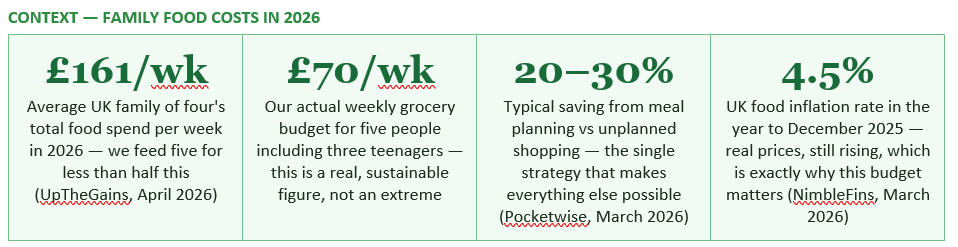
The average UK family of four spends £161 per week on food in 2026, according to UpTheGains — and that's before you add a fifth person with the appetite of a teenager. This is the story of how I feed five people, including three hungry teenagers aged 13, 15, and 17, for £70 per week. Not a temporary emergency budget. Not a deprivation diet. A real, sustainable, seven-dinner-a-week plan that keeps three teenagers fed, happy, and none the wiser that the budget is anything other than normal.
Two years ago, our weekly food shop was closer to £130. Then real life happened in the way it does: costs went up, income did not keep pace, and I had to get serious about what we were spending on food for five people. I did not want to feel like we were eating in scarcity. I did not want the teenagers eating cereal for dinner. I wanted proper, filling, nutritious food that did not make anyone feel like the family was struggling — even when the budget said otherwise.
The Frugal Family's February 2026 analysis of realistic UK food budgets puts this kind of budget in context: 'On the lower end, some families manage £80 to £95 a week by batch cooking, planning their meals and keeping eating out to a minimum. Their total tends to land around £380 to £430 a month. That feels like the realistic budget-conscious but still normal life range.' We are below even that lower end — at £70 — not because we are extreme minimalists, but because I have spent two years learning exactly what works and what does not.
Tahnee Beck's March 2026 Substack documented a similar journey, reducing her family of four's food budget to £70 a week when her income did not keep up with inflation: 'I have been honing my frugal food budgeting skills and can now stretch £70 quite far.' Her approach mirrors mine: it is not about eating badly. It is about deciding in advance, shopping deliberately, and cooking in a way that makes every ingredient earn its place. This guide shares everything I do, in practical detail, week by week.
The single most impactful budget strategy is meal planning — deciding what you will eat for the week before shopping, buying only what you need, and cooking in batches. Unplanned shopping and impulse buying consistently increases food spend by 30–50%.
— VANDA'S KITCHEN — HEALTHY EATING ON A BUDGET UK 2026 (APRIL 2026)
Three specific teenager dynamics drive food costs higher: volume, variety, and timing. Volume is the most obvious — teenagers eat significantly more than younger children, with active teenage boys in particular capable of eating adult-plus quantities at every meal. Variety matters because teenagers who eat the same rotation of meals week after week will find ways to supplement with expensive snacks, deliveries, or 'there's nothing to eat' declarations that end in a takeaway. And timing is tricky because teenagers eat outside of family meal times — after school, late evening, early morning — in ways that consume ingredients not counted in the official meal plan.
My solution to all three has been to cook more, plan for snacks explicitly, and get the teenagers involved in meal choice. Each week, I ask all three what one dinner they would like that week. Within the budget and my constraints, I accommodate it — which means they feel heard, they are more willing to eat what I put in front of them the other nights, and I get intelligence about what they are actually likely to eat rather than waste. This consultation also extends to snacks: I ask what they want for their after-school options and plan those into the £70 rather than being blindsided by 'there's nothing to eat' at 4pm.
My planning ritual takes about 20 minutes on a Thursday or Friday, before I do the main shop. I follow a consistent process: check the fridge and freezer for what needs using up (this comes first — it determines what I build the week around), check what staples in the cupboard are running low (rice, pasta, tinned tomatoes, dried lentils — the workhorses of a budget kitchen), check what the teenagers have requested, check the supermarket app for what is on offer this week, and then build seven dinners around the intersection of these inputs.
Pocketwise's March 2026 analysis confirms the maths behind this discipline: 'Households that meal plan typically spend 20 to 30 per cent less than those that shop without a list or plan.' On a £100 baseline spend, 20 to 30 per cent is £20 to £30 saved per week — approximately £1,300 to £1,560 per year — simply from deciding what to eat before buying rather than after. For a family at a £70 target, the meal plan is not a helpful extra step. It is the entire mechanism.
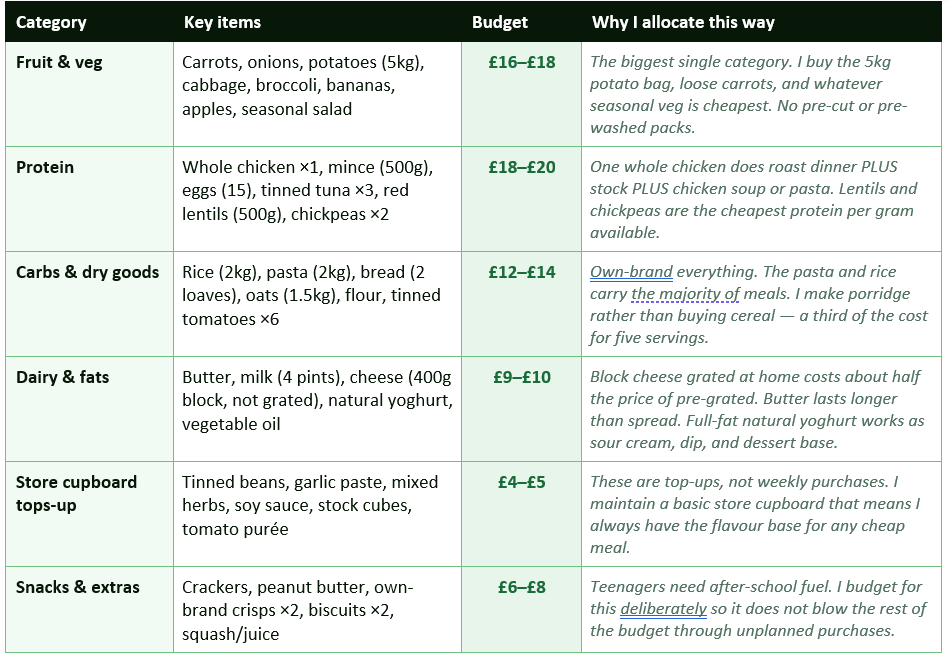
Total typical week: £65–£75, averaging £70. I use any underspend on one week as a small buffer for the following week when costs are slightly higher.
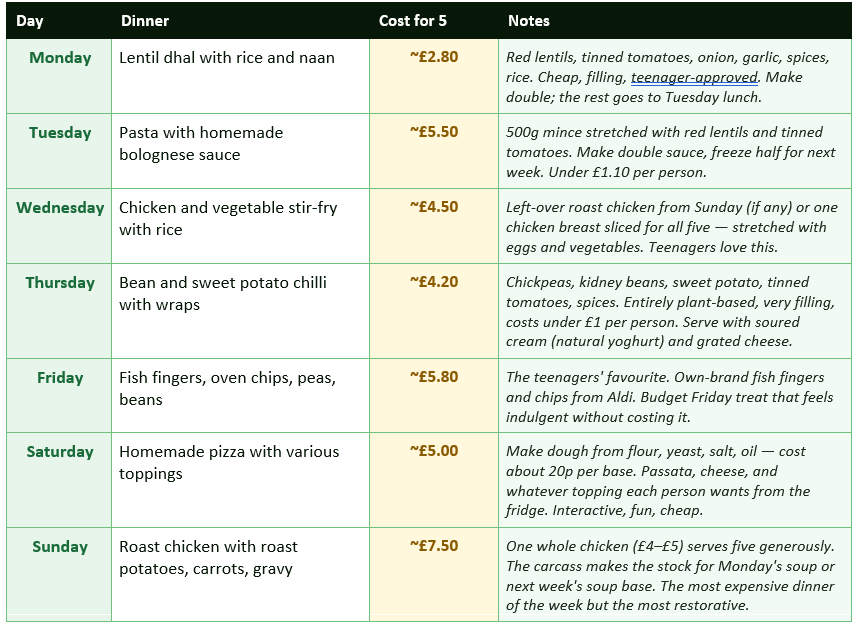
Total dinner cost: approximately £35 for the week. Remaining £35 covers breakfasts, lunches, snacks, and store cupboard items.
Here is what Sunday looks like. While the chicken is roasting, I cook a large pot of rice (enough for three dinners), a big batch of pasta (enough for Tuesday dinner and Thursday lunch leftovers), and either a pot of lentil dhal or bolognese sauce — whichever is not on the week's menu goes in the freezer for next week. I also chop all the onions and carrots for the week at once (ten minutes on Sunday saves five minutes per meal on four evenings), and I portion and freeze anything that will not be used within three days. By the time Sunday dinner is on the table, I have done most of next week's cooking.
WonderHowTo's budget cooking guide describes this approach well: 'One family of three sticks to budget with stretch meals — they cook one or two big dishes each week and eat them over two days.' This is exactly the principle: the marginal cost of cooking double is almost zero (you are already standing there, the hob is already on) but the time and money saving across the week is very significant.
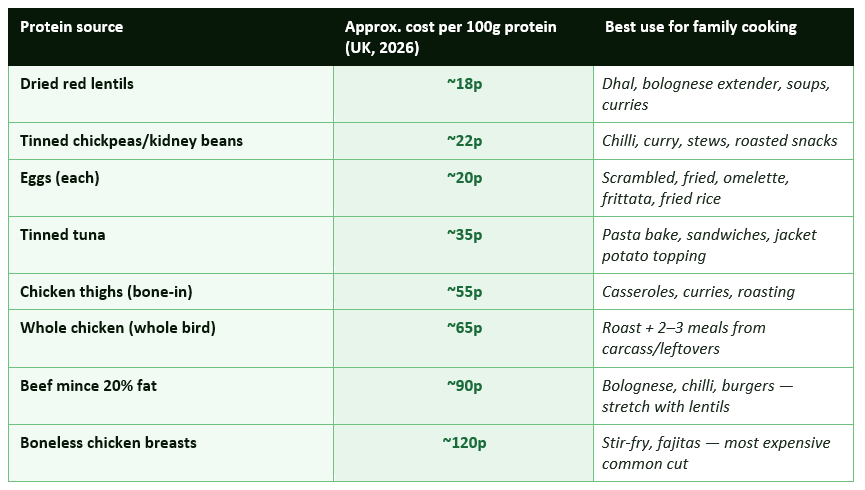
My protein strategy has four components. First, I use whole cuts rather than processed — a whole chicken at £4.50 provides three meals (the roast, the leftovers in Wednesday's stir-fry, and a stock-based soup), whereas four chicken breasts at £5.00 provide one meal. The whole chicken is better value by approximately three times. Second, I use lentils as a 50-50 extender in bolognese sauce — 200g of red lentils cooked into the sauce with the mince makes 500g of mince feed five people with seconds, at a cost of about 25p for the lentils. Third, I plan two entirely meat-free dinners per week — lentil dhal and bean chilli, both of which my teenagers actively enjoy rather than merely tolerate. Fourth, I buy meat from the reduced-to-clear section whenever it is available and freeze it immediately.
My waste elimination system has four elements. The first is the stock-take before I shop — I only buy what I do not already have, which means I never accumulate duplicates of items that then expire unused. The second is the 'use it up' meal: one dinner per week (usually Wednesday or Thursday) is built entirely around what is in the fridge that needs using before it turns. This is how pasta and random vegetables become a pasta bake, and how leftover roast chicken becomes a stir-fry.
The third is the freezer as the first resort rather than the last: when I cook double quantities, the second portion goes straight to the freezer before anyone can eat it informally. The fourth is root-to-tip cooking — carrot tops in the stock, stale bread as breadcrumbs for the pasta bake topping, the oil from a tin of tuna in the pan before adding other ingredients. None of this is exotic. It is simply the cooking practice of not throwing anything away until its last possible use has been exhausted.
My primary shop is Aldi for the majority of staples — the 5kg potato bag, the dried lentils, the pasta, the eggs, the tinned tomatoes, the cheese, the butter, and the bread. Aldi's own-brand equivalents of these staples are consistently 20 to 40 per cent cheaper than the equivalent own-brand products at Tesco, Asda, or Sainsbury's, without meaningful quality difference for cooking purposes. The fish fingers that constitute the teenagers' favourite Friday dinner are Aldi own-brand, indistinguishable from their branded equivalents.
I supplement with specific items from other supermarkets where they are meaningfully cheaper or better. Lidl's bakery section for end-of-day reduced bread (which I freeze immediately) saves approximately £1.50 per week versus fresh bread from Aldi. I check the reduced-to-clear sections of both Aldi and the nearest Tesco for meat and dairy that is close to its use-by date — this is the single best source of quality protein at low prices, and I freeze whatever I buy there immediately on getting home.
WonderHowTo's budget shopping guide mentions an additional option worth exploring in many areas: 'Food waste reduction shops. One family of three found The Very Green Grocery, spending just £11 a week on finds like M&S cooked chicken, Sainsbury's meals, fresh produce, Yorkshire puddings, cheese, and even flowers. These alternative venues rescue perfectly good food from landfills while delivering exceptional household savings.' Apps like Too Good To Go, Olio, and local community pantries operate on the same principle and can supplement a tight food budget significantly.'
The US equivalent shopping strategy focuses on Aldi (which now has widespread US presence), Lidl, Walmart Great Value own-brand, and Store-brand items at Kroger, Meijer, or regional discount grocers. The protein swap logic is identical: dried lentils, canned beans, eggs, and whole chicken are the cheapest high-quality proteins in the US market just as in the UK. Dried black beans, pinto beans, and chickpeas bought in bulk are the US equivalent of the UK's dried lentils and tinned pulses.
US-specific budget advantages include the wider availability of bulk bins for grains, legumes, and spices (which can dramatically reduce the cost of store-cupboard ingredients), the ubiquity of frozen vegetables at prices considerably below UK frozen veg (making nutrient-dense, convenient cooking even cheaper), and the App-based coupon and cashback ecosystem (Ibotta, Fetch Rewards, and store loyalty apps) that can add an additional $10 to $20 of weekly value on a $95 grocery shop. The meal plan structure — two plant-based dinners, two chicken-based dinners, one pasta-based dinner, one flexible/fridge-use dinner, and one family favourite dinner — transfers directly to any country.
The emergency week protocol is straightforward: abandon anything requiring fresh meat, buy the absolute cheapest versions of the five essential items (oats, potatoes, eggs, tinned tomatoes, and one bag of dried lentils or pasta), and build the week entirely from the store cupboard and whatever is already in the freezer. A week built on lentil soup, potato and egg frittata, pasta with tomato sauce, rice and beans, and egg fried rice can feed five people adequately for approximately £25 to £30 and involves no sacrifice of nutrition or sufficient calories.
The pantry that makes this possible is built during normal budget weeks — not as a separate project but as a by-product of always buying tinned goods in multiples when on offer, always cooking double quantities, and always freezing a second portion. After three months of the standard approach, you have a freezer and pantry that can sustain two to three weeks of emergency-level cooking without any fresh shopping at all. This is the food security that makes the rest of the financial plan possible.
The average UK family spends £161 a week on food, according to UpTheGains' April 2026 data. We spend less than half that — and we eat well. Three teenagers are not complaining. The fridge is never empty. Sunday's roast is a family ritual, not an emergency measure. The difference between £161 and £70 is not about sacrifice. It is about planning, protein strategy, batch cooking, and waste elimination. Start with the meal plan. The rest follows naturally.
NimbleFins — Average UK Household Cost of Food 2026 (March 2026) https://www.nimblefins.co.uk/average-uk-household-cost-food
NimbleFins — What the Average UK Food Budget Buys in 2026 (January 2026) https://www.nimblefins.co.uk/average-uk-household-cost-food/what-average-budget-buys
Tahnee Beck — Feeding a Family of 4 on £70 per Week (March 2026 — Substack) https://tahneebatchcooking.substack.com/p/feeding-a-family-of-4-on-50-per-week
UpTheGains — Average Food Shop Per Week UK: How Much Should You Spend in 2026? (April 2026) https://upthegains.co.uk/blog/average-food-shop-per-week
Vanda's Kitchen — Healthy Eating on a Budget UK 2026: Practical Guide (April 2026) https://www.vandaskitchen.co.uk/blogs/news/healthy-eating-on-a-budget-uk
Pocketwise — Average Grocery Bill UK 2026 — Weekly and Monthly Food Costs (March 2026) https://pocketwise.co.uk/money-budgeting/average-grocery-bill-uk/
WonderHowTo / Food Hacks — Feed Your Family for £50: Smart Budget Meal Planning (2025) https://food-hacks.wonderhowto.com/how-to/feed-your-family-for-50-smart-budget-meal-planning/
TABLE OF CONTENTS
- How We Got Here: The £70 Budget Story
- Why Teenagers Make This Harder (and What to Do About It)
- The Foundation: How I Build the Week Before I Buy a Thing
- The Weekly Shopping List Broken Down by Category
- The Full Seven-Day Meal Plan with Costs
- The Big Batch Cooking Session: Sunday Two Hours That Save the Week
- The Protein Swap: How I Halved Our Meat Spend
- Reducing Food Waste to Zero (or as Close as Possible)
- The Supermarket Strategy: Where I Shop and Why
- Snacks, Packed Lunches, and Teenagers' Extras
- The US Version: How This Translates to $95 a Week
- When the Budget Gets Really Tight: Emergency Weeks
- Conclusion
- Frequently Asked Questions
- References
How We Got Here: The £70 Budget Story
Two years ago, our weekly food shop was closer to £130. Then real life happened in the way it does: costs went up, income did not keep pace, and I had to get serious about what we were spending on food for five people. I did not want to feel like we were eating in scarcity. I did not want the teenagers eating cereal for dinner. I wanted proper, filling, nutritious food that did not make anyone feel like the family was struggling — even when the budget said otherwise.The Frugal Family's February 2026 analysis of realistic UK food budgets puts this kind of budget in context: 'On the lower end, some families manage £80 to £95 a week by batch cooking, planning their meals and keeping eating out to a minimum. Their total tends to land around £380 to £430 a month. That feels like the realistic budget-conscious but still normal life range.' We are below even that lower end — at £70 — not because we are extreme minimalists, but because I have spent two years learning exactly what works and what does not.
Tahnee Beck's March 2026 Substack documented a similar journey, reducing her family of four's food budget to £70 a week when her income did not keep up with inflation: 'I have been honing my frugal food budgeting skills and can now stretch £70 quite far.' Her approach mirrors mine: it is not about eating badly. It is about deciding in advance, shopping deliberately, and cooking in a way that makes every ingredient earn its place. This guide shares everything I do, in practical detail, week by week.
The single most impactful budget strategy is meal planning — deciding what you will eat for the week before shopping, buying only what you need, and cooking in batches. Unplanned shopping and impulse buying consistently increases food spend by 30–50%.
— VANDA'S KITCHEN — HEALTHY EATING ON A BUDGET UK 2026 (APRIL 2026)
Why Teenagers Make This Harder (and What to Do About It)
Feeding teenagers on a budget is categorically different from feeding younger children. A seven-year-old can be redirected from an expensive preference with relative ease. A fifteen-year-old who wants pasta not rice, who needs substantial after-school snacks, who is sometimes eating lunch at school and sometimes at home, who has friends around occasionally, and who is growing at a rate that makes hunger a near-constant state — this is a more complex catering challenge.Three specific teenager dynamics drive food costs higher: volume, variety, and timing. Volume is the most obvious — teenagers eat significantly more than younger children, with active teenage boys in particular capable of eating adult-plus quantities at every meal. Variety matters because teenagers who eat the same rotation of meals week after week will find ways to supplement with expensive snacks, deliveries, or 'there's nothing to eat' declarations that end in a takeaway. And timing is tricky because teenagers eat outside of family meal times — after school, late evening, early morning — in ways that consume ingredients not counted in the official meal plan.
My solution to all three has been to cook more, plan for snacks explicitly, and get the teenagers involved in meal choice. Each week, I ask all three what one dinner they would like that week. Within the budget and my constraints, I accommodate it — which means they feel heard, they are more willing to eat what I put in front of them the other nights, and I get intelligence about what they are actually likely to eat rather than waste. This consultation also extends to snacks: I ask what they want for their after-school options and plan those into the £70 rather than being blindsided by 'there's nothing to eat' at 4pm.
The Foundation: How I Build the Week Before I Buy a Thing
The entire £70 budget rests on one thing: planning the week before spending a penny. Without a meal plan, there is no budget — there is just shopping until the money runs out. With a meal plan, every item on the shopping list has a specific purpose, and nothing is bought without one.My planning ritual takes about 20 minutes on a Thursday or Friday, before I do the main shop. I follow a consistent process: check the fridge and freezer for what needs using up (this comes first — it determines what I build the week around), check what staples in the cupboard are running low (rice, pasta, tinned tomatoes, dried lentils — the workhorses of a budget kitchen), check what the teenagers have requested, check the supermarket app for what is on offer this week, and then build seven dinners around the intersection of these inputs.
Pocketwise's March 2026 analysis confirms the maths behind this discipline: 'Households that meal plan typically spend 20 to 30 per cent less than those that shop without a list or plan.' On a £100 baseline spend, 20 to 30 per cent is £20 to £30 saved per week — approximately £1,300 to £1,560 per year — simply from deciding what to eat before buying rather than after. For a family at a £70 target, the meal plan is not a helpful extra step. It is the entire mechanism.
The Weekly Shopping List Broken Down by Category
Here is how the £70 actually breaks down across a typical week. The figures are approximate — they vary by £2 to £5 week to week depending on what is on offer and what specials I find — but this is the standard allocation.Total typical week: £65–£75, averaging £70. I use any underspend on one week as a small buffer for the following week when costs are slightly higher.
The Full Seven-Day Meal Plan with Costs
This is a real week, not a theoretical one. Every meal below is something I have made multiple times and that all five members of the family will actually eat — which is itself the most important criterion for any family meal plan.Total dinner cost: approximately £35 for the week. Remaining £35 covers breakfasts, lunches, snacks, and store cupboard items.
The Big Batch Cooking Session: Sunday Two Hours That Save the Week
Sunday afternoon, after the roast is in the oven, is when I do the batch work that makes the rest of the week manageable. I am already in the kitchen. The oven is already on. The teenagers are doing their Sunday evening wind-down. And two hours of deliberate batch cooking on Sunday means that Monday through Thursday are largely just reheating and assembling.Here is what Sunday looks like. While the chicken is roasting, I cook a large pot of rice (enough for three dinners), a big batch of pasta (enough for Tuesday dinner and Thursday lunch leftovers), and either a pot of lentil dhal or bolognese sauce — whichever is not on the week's menu goes in the freezer for next week. I also chop all the onions and carrots for the week at once (ten minutes on Sunday saves five minutes per meal on four evenings), and I portion and freeze anything that will not be used within three days. By the time Sunday dinner is on the table, I have done most of next week's cooking.
WonderHowTo's budget cooking guide describes this approach well: 'One family of three sticks to budget with stretch meals — they cook one or two big dishes each week and eat them over two days.' This is exactly the principle: the marginal cost of cooking double is almost zero (you are already standing there, the hob is already on) but the time and money saving across the week is very significant.
The Protein Swap: How I Halved Our Meat Spend
Meat is the most expensive ingredient in most family meals — and it is the category where the biggest savings are available without anyone noticing a meaningful reduction in satisfaction. The WonderHowTo budget cooking guide captures the principle: 'Instead of centering every plate on meat, treat it like a seasoning and bulk out with beans, lentils, or grains. Same satisfaction, lower bill.'My protein strategy has four components. First, I use whole cuts rather than processed — a whole chicken at £4.50 provides three meals (the roast, the leftovers in Wednesday's stir-fry, and a stock-based soup), whereas four chicken breasts at £5.00 provide one meal. The whole chicken is better value by approximately three times. Second, I use lentils as a 50-50 extender in bolognese sauce — 200g of red lentils cooked into the sauce with the mince makes 500g of mince feed five people with seconds, at a cost of about 25p for the lentils. Third, I plan two entirely meat-free dinners per week — lentil dhal and bean chilli, both of which my teenagers actively enjoy rather than merely tolerate. Fourth, I buy meat from the reduced-to-clear section whenever it is available and freeze it immediately.
Reducing Food Waste to Zero (or as Close as Possible)
Food waste is the silent budget killer. A 2026 analysis from WRAP estimates the average UK household throws away approximately £730 worth of food per year — the equivalent of more than ten weeks of our grocery budget. Eliminating waste is not just environmentally responsible. It is one of the most financially significant things a family can do without changing what they eat at all.My waste elimination system has four elements. The first is the stock-take before I shop — I only buy what I do not already have, which means I never accumulate duplicates of items that then expire unused. The second is the 'use it up' meal: one dinner per week (usually Wednesday or Thursday) is built entirely around what is in the fridge that needs using before it turns. This is how pasta and random vegetables become a pasta bake, and how leftover roast chicken becomes a stir-fry.
The third is the freezer as the first resort rather than the last: when I cook double quantities, the second portion goes straight to the freezer before anyone can eat it informally. The fourth is root-to-tip cooking — carrot tops in the stock, stale bread as breadcrumbs for the pasta bake topping, the oil from a tin of tuna in the pan before adding other ingredients. None of this is exotic. It is simply the cooking practice of not throwing anything away until its last possible use has been exhausted.
The Supermarket Strategy: Where I Shop and Why
The supermarket choice is not a moral one — it is a mathematical one. Pocketwise's March 2026 analysis is explicit: 'Budget shoppers tend to use discount supermarkets (Aldi, Lidl), buy own-brand products, meal plan carefully, and minimise waste.' This describes exactly how I shop.My primary shop is Aldi for the majority of staples — the 5kg potato bag, the dried lentils, the pasta, the eggs, the tinned tomatoes, the cheese, the butter, and the bread. Aldi's own-brand equivalents of these staples are consistently 20 to 40 per cent cheaper than the equivalent own-brand products at Tesco, Asda, or Sainsbury's, without meaningful quality difference for cooking purposes. The fish fingers that constitute the teenagers' favourite Friday dinner are Aldi own-brand, indistinguishable from their branded equivalents.
I supplement with specific items from other supermarkets where they are meaningfully cheaper or better. Lidl's bakery section for end-of-day reduced bread (which I freeze immediately) saves approximately £1.50 per week versus fresh bread from Aldi. I check the reduced-to-clear sections of both Aldi and the nearest Tesco for meat and dairy that is close to its use-by date — this is the single best source of quality protein at low prices, and I freeze whatever I buy there immediately on getting home.
WonderHowTo's budget shopping guide mentions an additional option worth exploring in many areas: 'Food waste reduction shops. One family of three found The Very Green Grocery, spending just £11 a week on finds like M&S cooked chicken, Sainsbury's meals, fresh produce, Yorkshire puddings, cheese, and even flowers. These alternative venues rescue perfectly good food from landfills while delivering exceptional household savings.' Apps like Too Good To Go, Olio, and local community pantries operate on the same principle and can supplement a tight food budget significantly.'
Snacks, Packed Lunches, and Teenagers' Extras
Three teenagers come with three sets of after-school hunger, three packed lunches on school days, and three entirely different opinions about what constitutes a good snack. Managing this within the £70 budget is one of the more complex parts of the whole system.The snacks and lunches system that keeps three teenagers fed within budget
- After-school snacks (the biggest single extra cost): I budget £6 to £8 per week specifically for after-school snacks and I choose them deliberately. A 700g jar of peanut butter at £1.80 provides approximately 35 servings of peanut butter on crackers or bread — far better value than individually packaged snack bars. A box of own-brand crackers (£0.59), a bag of apples (£0.99 for 6), and a 500g bag of own-brand crisps (£0.79) together cover three teenagers' after-school snacking for most of the week for under £4.
- Packed lunches (Monday–Friday for up to three): The cheapest packed lunches are built from the same batch cooking that powers the evening meals. Leftover pasta or rice with yesterday's sauce, a piece of fruit, and a cracker with peanut butter is a complete, filling lunch for under 60p per person. I also make large batches of oat flapjacks once a fortnight (oats, butter, sugar, syrup — about £1.50 for a batch of 16) which provide a week's worth of lunchbox sweet treats at a fraction of the cost of shop-bought cereal bars.
- Breakfasts: Porridge is the highest-value breakfast available. A 1.5kg bag of own-brand oats (approximately £1.20) provides roughly 20 servings. With a banana and a spoon of peanut butter, this is a complete, filling, nutritious breakfast for under 20p per person. I rotate with boiled eggs on toast (cheap and fast), and own-brand toast with butter and jam. I have not bought a branded breakfast cereal in two years — the cost per serving of Weetabix or Cornflakes is roughly three to four times the cost of porridge per bowl.
- The 'there's nothing to eat' emergency: The most expensive thing in a teenager household is the moment when there is genuinely nothing quick and easy to eat and a teenager makes a unilateral decision to order food. I prevent this by keeping the following permanently stocked: bread, peanut butter, eggs, crackers, and either cheese or yoghurt. These four or five items together cost under £5 and cover every emergency hunger scenario without requiring anyone to cook a meal.
The US Version: How This Translates to $95 a Week
For US readers, £70 translates to approximately $88 to $95 at current exchange rates — and the same principles apply almost exactly, with some product name translations. The average US family of four spends approximately $290 per week on groceries according to USDA data (2024), putting the $95 target for five people at well below half the national average. The strategies that achieve this in the UK achieve it just as reliably in the US.The US equivalent shopping strategy focuses on Aldi (which now has widespread US presence), Lidl, Walmart Great Value own-brand, and Store-brand items at Kroger, Meijer, or regional discount grocers. The protein swap logic is identical: dried lentils, canned beans, eggs, and whole chicken are the cheapest high-quality proteins in the US market just as in the UK. Dried black beans, pinto beans, and chickpeas bought in bulk are the US equivalent of the UK's dried lentils and tinned pulses.
US-specific budget advantages include the wider availability of bulk bins for grains, legumes, and spices (which can dramatically reduce the cost of store-cupboard ingredients), the ubiquity of frozen vegetables at prices considerably below UK frozen veg (making nutrient-dense, convenient cooking even cheaper), and the App-based coupon and cashback ecosystem (Ibotta, Fetch Rewards, and store loyalty apps) that can add an additional $10 to $20 of weekly value on a $95 grocery shop. The meal plan structure — two plant-based dinners, two chicken-based dinners, one pasta-based dinner, one flexible/fridge-use dinner, and one family favourite dinner — transfers directly to any country.
When the Budget Gets Really Tight: Emergency Weeks
Some weeks, the £70 budget is simply not available. An unexpected bill, a school trip payment, a repair that could not be deferred — and suddenly the food budget is £45 or £50 rather than £70. These weeks happen. Having a plan for them prevents a financial squeeze from becoming a nutritional crisis.The emergency week protocol is straightforward: abandon anything requiring fresh meat, buy the absolute cheapest versions of the five essential items (oats, potatoes, eggs, tinned tomatoes, and one bag of dried lentils or pasta), and build the week entirely from the store cupboard and whatever is already in the freezer. A week built on lentil soup, potato and egg frittata, pasta with tomato sauce, rice and beans, and egg fried rice can feed five people adequately for approximately £25 to £30 and involves no sacrifice of nutrition or sufficient calories.
The pantry that makes this possible is built during normal budget weeks — not as a separate project but as a by-product of always buying tinned goods in multiples when on offer, always cooking double quantities, and always freezing a second portion. After three months of the standard approach, you have a freezer and pantry that can sustain two to three weeks of emergency-level cooking without any fresh shopping at all. This is the food security that makes the rest of the financial plan possible.
CONCLUSION
Feeding five people, including three teenagers, for £70 a week is not about deprivation. It is about decision-making. Every pound saved on an unplanned impulse purchase is a pound that stays in the budget for something everyone actually enjoys. Every 20 minutes of Sunday batch cooking is an hour saved across three weeknights. Every whole chicken that becomes a roast and a stir-fry and a stock is three times the value of four pre-cut breasts that cost more and produce only one meal.The average UK family spends £161 a week on food, according to UpTheGains' April 2026 data. We spend less than half that — and we eat well. Three teenagers are not complaining. The fridge is never empty. Sunday's roast is a family ritual, not an emergency measure. The difference between £161 and £70 is not about sacrifice. It is about planning, protein strategy, batch cooking, and waste elimination. Start with the meal plan. The rest follows naturally.
Frequently Asked Questions
Is £70 a week for four people actually realistic in 2026 with food inflation?
Yes — but it requires deliberate strategy rather than hoping for the best. NimbleFins' March 2026 analysis confirms UK food and non-alcoholic drink prices rose 4.5% in the year to December 2025, meaning prices are still above pre-2022 levels even though the rate of rise has slowed. Against this backdrop, £70 for five people is achieved through consistent meal planning, Aldi/Lidl as primary shops, whole-cut rather than portioned protein, minimum two plant-based dinners per week, and zero food waste as a target. Tahnee Beck's March 2026 Substack documents a real family achieving this budget from a starting point of £100 per week, reducing through gradual habit change rather than overnight transformation. The Frugal Family's February 2026 analysis confirms £80 to £95 as the 'realistic budget-conscious but still normal life range' for families with older children — our £70 is achievable by consistently applying the strategies in this guide.How do I get teenagers to eat budget meals without complaints?
Three principles work consistently. First, consultation: ask each teenager to name one dinner they want this week and, within your constraints, provide it. This creates buy-in for the other four nights they did not choose. Second, presentation: budget food that is well-seasoned, appropriately portioned, and served attractively is received far better than budget food presented apologetically. Lentil dhal on a plate with good rice, fresh coriander from the garden window box, and a warm naan is an appealing dinner — the price point is invisible if the result is good. Third, quantity: teenagers' primary complaint about budget meals is often that there is not enough. Cook generously — lentils and rice are cheap enough that serving portions should be as large as they want, which eliminates the sense of deprivation that drives resistance.What are the best cheap meals for a large family?
The consistently best-value meals for large families combine cheap ingredients with high volume and good flavour: lentil dhal with rice (approximately 56p per person for five); pasta with bolognese extended with red lentils (approximately £1.10 per person); bean chilli with wraps (approximately 84p per person); homemade pizza from scratch dough (approximately £1.00 per person including toppings); egg fried rice with frozen vegetables (approximately 70p per person); and potato and onion frittata (approximately 60p per person). All of these feed five people for under £4 total, none of them tastes like a poverty meal when cooked well, and all are teenager-approved in this household.How much should I spend on food per week in the UK in 2026?
UpTheGains' April 2026 data, based on ONS Family Spending 2025/26 data and Confused.com research, shows the average UK family of four spends £161 per week on food including groceries and food outside the home, and the average UK household grocery shop alone is £119 per week as of March 2026. For a family of five with teenagers, the average unmanaged spend is likely £170 to £200 or more. Budget-conscious families managing their spending deliberately typically spend £80 to £100 per week for four to five people, according to the Frugal Family's February 2026 analysis. Our £70 is below even the budget range and is achieved through the consistent combination of strategies described in this guide.What is the US equivalent of the £70 family food budget?
At current exchange rates, £70 is approximately $88 to $95. The USDA's 2024 Thrifty Food Plan — its lowest tier of food budget guidance — estimates $175 per week for a family of four, making a $95 target for five people considerably below even the Thrifty Plan's minimum. This is achievable through the same strategies that work in the UK: Aldi and Walmart as primary shops, dried beans and lentils as the primary protein base, eggs and whole chicken rather than boneless cuts, and consistent meal planning. US-specific advantages include bulk bins for grains and legumes, widely available and very cheap frozen vegetables, and app-based coupon programmes (Ibotta, Fetch Rewards) that can recover $10 to $20 per week on a $95 shop.References
Frugal Family — What's a Realistic Food Budget in 2026? (February 2026) https://www.frugalfamily.co.uk/whats-a-realistic-food-budget-in-2026/NimbleFins — Average UK Household Cost of Food 2026 (March 2026) https://www.nimblefins.co.uk/average-uk-household-cost-food
NimbleFins — What the Average UK Food Budget Buys in 2026 (January 2026) https://www.nimblefins.co.uk/average-uk-household-cost-food/what-average-budget-buys
Tahnee Beck — Feeding a Family of 4 on £70 per Week (March 2026 — Substack) https://tahneebatchcooking.substack.com/p/feeding-a-family-of-4-on-50-per-week
UpTheGains — Average Food Shop Per Week UK: How Much Should You Spend in 2026? (April 2026) https://upthegains.co.uk/blog/average-food-shop-per-week
Vanda's Kitchen — Healthy Eating on a Budget UK 2026: Practical Guide (April 2026) https://www.vandaskitchen.co.uk/blogs/news/healthy-eating-on-a-budget-uk
Pocketwise — Average Grocery Bill UK 2026 — Weekly and Monthly Food Costs (March 2026) https://pocketwise.co.uk/money-budgeting/average-grocery-bill-uk/
WonderHowTo / Food Hacks — Feed Your Family for £50: Smart Budget Meal Planning (2025) https://food-hacks.wonderhowto.com/how-to/feed-your-family-for-50-smart-budget-meal-planning/
0 Comments
Be the first to share your thoughts on this article.