

Investing
How to Start Investing for Your Children in 2026

Table of Contents
- The Most Powerful Gift You Can Give
- Why Time Is the Ultimate Advantage When Investing for Children
- The Compounding Calculator: What Small Monthly Amounts Actually Grow To
- UK Options: Junior ISA — The Gold Standard
- UK: Stocks & Shares JISA vs. Cash JISA
- UK: The Best Junior ISA Providers in 2026
- UK: Child Trust Funds — If Your Child Has One
- US Options: The 529 College Savings Plan
- US: Custodial Accounts (UGMA/UTMA)
- US: The Custodial Roth IRA — The Best-Kept Secret
- US: Trump Accounts — The New 2025 Option
- What to Actually Invest In: Fund Choices for Children
- How Much Should You Invest Each Month?
- How to Involve Your Child as They Grow
- Common Mistakes Parents Make
- Conclusion: Start Small, Start Now, Stay Consistent
- Frequently Asked Questions
Key Statistics: UK Junior ISA annual allowance 2026/27: £9,000. US 529 plan annual contribution: up to $18,000 per child without gift tax implications (2026 exclusion). Research shows children form financial habits by age 7 (Slow Money Movement, Jan 2026). £50/month invested from birth at 7% annual return = approximately £28,300 by age 18. £100/month at 7% for 18 years = approximately £56,600. £200/month at 7% for 18 years = approximately £113,200. Utah 529 plans alone held $23.961 billion by 2025. Cash JISAs remain more popular than stocks and shares JISAs by account numbers (HMRC Annual Savings Statistics 2025). Top UK platform for Junior ISA: Hargreaves Lansdown (zero platform fees, MoneyMagpie June 2025). Top low-cost UK option: Vanguard Junior Stocks & Shares ISA. Trump Accounts (US, 2025 legislation): $1,000 government seed for children born in 2025–2029, accessible at 18 for education, home, or business. Custodial Roth IRA (US): tax-free growth, no mandatory withdrawal age.
The Most Powerful Gift You Can Give
There are many things parents give their children: love, time, education, experiences. But one of the most financially consequential gifts a parent can give — and one of the most overlooked — is time in the market. Not a large lump sum. Not a trust fund. Just a small, regular investment that starts as early as possible and is left alone long enough for compounding to do what it always does, given sufficient time.Research cited by the Slow Money Movement’s 2026 guide confirms that children form their financial habits by age 7. The habits, instincts, and attitudes toward money that shape adult financial behaviour are established early in childhood — which means that the best time to introduce children to the idea of investing, and to begin building something on their behalf, is not when they are teenagers but when they are very young. Even from birth.
This guide covers everything a parent — in the UK or the US — needs to know to begin investing for their child in August 2026: the available accounts and their tax advantages, the best providers and their fees, what to invest in, how much to invest, and how to involve your child in the process as they grow into an understanding of what you have built for them.
Why Time Is the Ultimate Advantage When Investing for Children
The single most important factor in investing for children is time — and children have more of it than any other investor. A parent who opens an investment account for a child on the day of their birth gives that investment 18 years of compounding before the child reaches adulthood. A grandparent who contributes from the child’s birth may see 18 to 25 years of growth before the child makes their first significant financial decision.The mathematics of compounding over 18 years are extraordinary. At 7 percent average annual return — a reasonable long-term expectation for a globally diversified equity index fund based on historical data — an investment doubles approximately every 10.3 years. A lump sum of £1,000 invested at birth becomes £3,380 at age 18 at 7 percent. Monthly contributions of £50 from birth to 18 become approximately £28,300. Monthly contributions of £200 from birth to 18 become approximately £113,200.
The comparison that makes the starting-early argument most viscerally clear: £50 per month invested from birth generates approximately £28,300 by age 18. The same £50 per month started at age 10 generates approximately £11,000 by age 18. The difference — £17,300 — is the cost of waiting eight years. Compounding rewards patience. It punishes delay. Nowhere is this more true than when the investor is a child with decades ahead of them.
Key Insight: The best time to start investing for your child was the day they were born. The second-best time is today. Even £25 or $25 per month, started now and left untouched, will grow to a meaningful sum by the time your child reaches adulthood.
The Compounding Calculator: What Small Monthly Amounts Actually Grow To
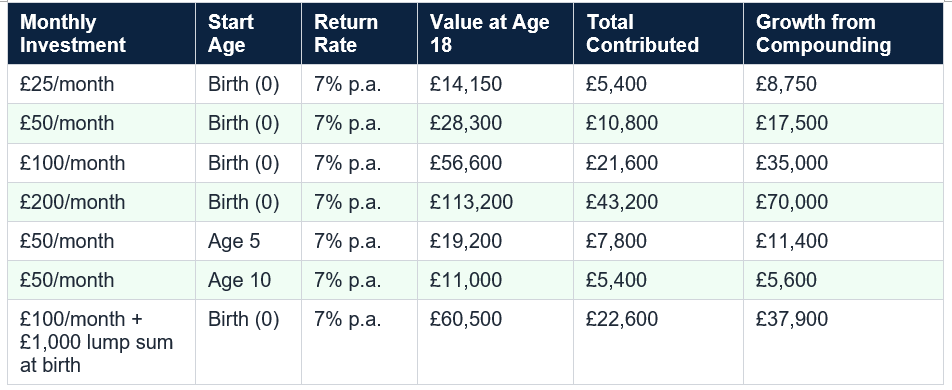
The table illustrates the most important principle of investing for children: the timing of the start matters as much as the amount contributed. The £50/month started at birth produces £17,300 more than the same £50/month started at age 10, despite the early investor making only £5,400 more in contributions. The extra £11,900 is pure compounding — returns generating their own returns over eight additional years.
UK Options: Junior ISA — The Gold Standard
For parents in the United Kingdom, the Junior Individual Savings Account (Junior ISA or JISA) is the primary and most tax-efficient vehicle for investing on behalf of a child. Introduced in 2011 to replace Child Trust Funds as the product for new children, the Junior ISA has become the cornerstone of children’s saving and investing in the UK.The key features of the Junior ISA in 2026/27:
- Annual allowance: £9,000 per child per tax year (6 April 2026 to 5 April 2027). This allowance can be contributed by anyone — parents, grandparents, other family members, or friends — but the combined contributions across all sources cannot exceed £9,000 in any single tax year.
- Tax advantages: no income tax on dividends or interest earned within the JISA. No capital gains tax on investment growth. All returns are tax-free, regardless of how much the investment grows.
- Control and access: the child cannot access the money until they turn 18. At 18, the JISA automatically converts to an adult ISA in the child’s own name. Until 18, the registered contact (typically a parent or guardian) manages the account but cannot withdraw funds for their own use.
- Who can open one: parents or legal guardians of children under 18 who are UK residents. Only one stocks and shares JISA and one cash JISA can be held per child at any one time.
- Transferability: funds can be transferred between JISA providers if a better deal is found elsewhere, subject to the receiving provider’s terms.
UK: Stocks & Shares JISA vs. Cash JISA
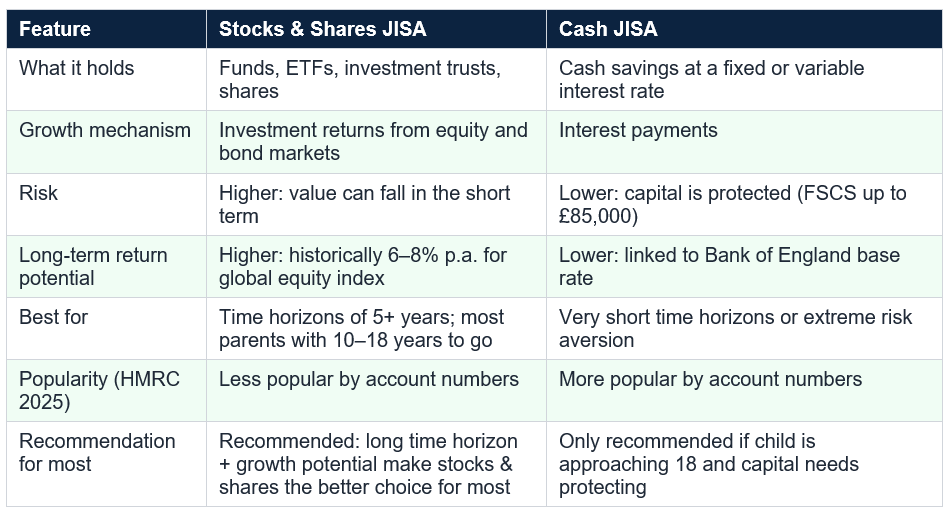
The evidence consistently supports stocks and shares JISAs over cash JISAs for most families with children below 15. The 18-year time horizon is precisely the kind of long-term period over which equity markets have historically produced their strongest returns and where the higher short-term volatility of equity investing is effectively irrelevant. HMRC’s 2025 Annual Savings Statistics show cash JISAs are more popular by account numbers, but financial advisers and consumer bodies consistently recommend the stocks and shares version for families with young children.
UK: The Best Junior ISA Providers in 2026
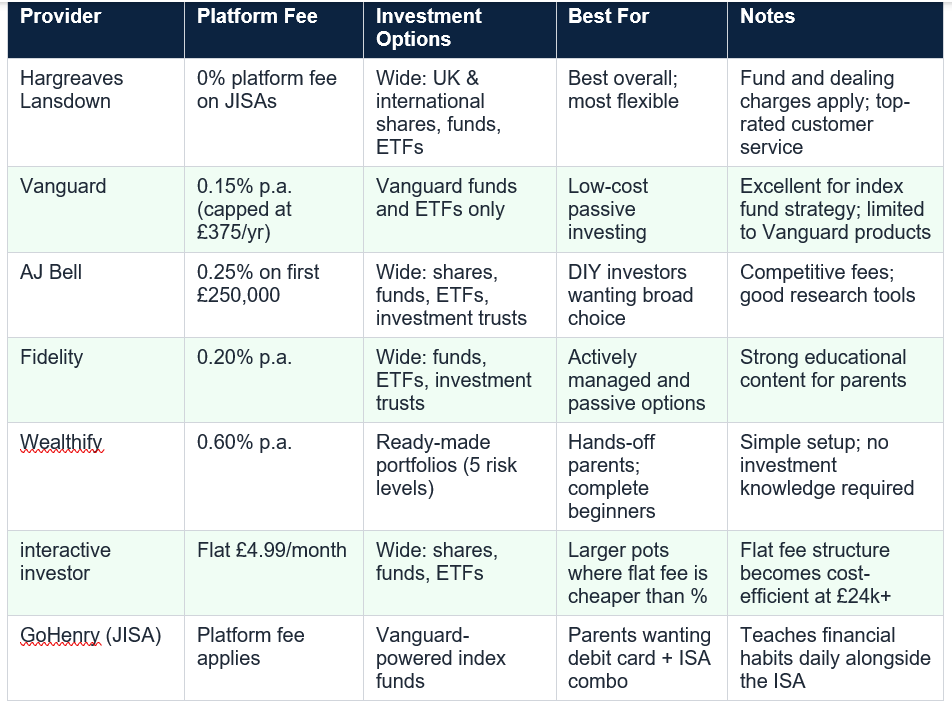
Key Insight: For most parents starting out, Hargreaves Lansdown (zero platform fee on JISAs) or Vanguard (ultra-low 0.15% fee) are the two strongest starting points. Both allow a global equity index fund investment that requires minimal ongoing management. Set up a monthly direct debit, choose a global index fund, and leave it alone.
UK: Child Trust Funds — If Your Child Has One
Child Trust Funds (CTFs) were the predecessor to Junior ISAs, available to children born between 1 September 2002 and 2 January 2011. It is no longer possible to open a new CTF, but if your child was born in this window and received a government voucher, they may still have a CTF in place.If your child has a CTF, you can continue contributing up to £9,000 per year. You can also transfer the CTF into a Junior ISA, which is typically recommended because cash JISAs tend to offer higher interest rates than their CTF counterparts, and stocks and shares JISAs provide access to more diverse investment options at lower fees than most CTF providers.
To find a lost CTF: use the government’s official CTF lookup service at gov.uk/child-trust-funds. An estimated £2 billion in CTF accounts remains unclaimed by young adults who have turned 18 but do not know their CTF exists or how to access it. If your child is approaching 18 and you believe they had a CTF, locate it now so the money does not sit idle.
US Options: The 529 College Savings Plan
For parents in the United States, the 529 college savings plan is the most widely used and most specifically designed account for investing on a child’s behalf. Named after Section 529 of the Internal Revenue Code, these are state-sponsored savings accounts that offer significant tax advantages for education savings.Key features of the 529 plan:
- Tax-free growth: contributions are made with after-tax dollars but grow entirely tax-free within the account. Qualified withdrawals for educational expenses are also tax-free at the federal level.
- Qualified expenses: tuition, fees, room and board, books, and supplies at accredited colleges and universities. Since 2017, up to $10,000 per year can be used for K-12 private school tuition. Up to $35,000 in unused 529 funds can now be rolled into a Roth IRA for the account beneficiary (subject to annual Roth contribution limits and Roth eligibility).
- Annual contribution: no statutory maximum, but contributions above $18,000 per beneficiary per year (the 2026 annual gift tax exclusion) may have gift tax implications. Five-year superfunding allows a lump sum of up to $90,000 per beneficiary at once, treating it as five years of annual exclusions.
- State tax deductions: many states offer a state income tax deduction or credit for contributions to their own state’s 529 plan. You are not required to use your home state’s plan, but the state tax benefit is worth comparing.
- Transferability: if the designated beneficiary does not use the funds for education, the account can be transferred to another family member (sibling, cousin, parent) without tax penalty.
US: Custodial Accounts (UGMA/UTMA)
Uniform Gifts to Minors Act (UGMA) and Uniform Transfers to Minors Act (UTMA) accounts are custodial accounts that allow adults to invest in a child’s name. Unlike 529 plans, they have no restrictions on how the money is used — the child can spend it on anything at the age of majority (18 or 21, depending on the state).Key features of custodial accounts:
- Investment flexibility: can hold any investment — stocks, ETFs, index funds, bonds, mutual funds, and in some cases real estate or collectibles (UTMA only).
- Tax treatment: the account is in the child’s name. Investment income and capital gains are taxed at the child’s rate under the Kiddie Tax rules — unearned income above $2,500 in 2026 is taxed at the parent’s rate until the child is 19 (or 24 if a full-time student).
- No annual limit: there is no statutory cap on contributions, though gift tax rules apply to contributions above $18,000 per year per donor.
- Irrevocable: once money is transferred to a custodial account, it legally belongs to the child. It cannot be taken back by the parent and will be the child’s to use at the age of majority regardless of how it is spent.
US: The Custodial Roth IRA — The Best-Kept Secret
For children or teenagers with earned income — from babysitting, a part-time job, lawn mowing, or any other compensated activity — the custodial Roth IRA is described by Bright Advisers’ 2025 analysis as a fantastic choice, providing tax-free growth and withdrawals without age limits, empowering families to invest for the long term.Key features of the custodial Roth IRA:
- Eligibility: the child must have earned income. Contributions cannot exceed the child’s earned income in the year, or the annual IRA limit ($7,000 in 2026), whichever is less.
- Tax-free growth and withdrawals: contributions are made with after-tax dollars. All growth within the account is tax-free. Qualified withdrawals in retirement (after age 59½) are entirely tax-free.
- Penalty-free withdrawal of contributions: unlike traditional IRAs, Roth IRA contributions (not earnings) can be withdrawn at any time without tax or penalty. This provides some flexibility if the child needs the money for education or a first home before retirement.
- 60 years of compounding: a 10-year-old who contributes $5,000 to a custodial Roth IRA and leaves it invested until age 70 has 60 years of tax-free compounding. At 7 percent annual return, that $5,000 becomes approximately $147,000 by age 70 — entirely tax-free.
US: Trump Accounts — The New 2025 Option
In 2025, US legislation created a new account category informally called Trump Accounts, or ‘Baby Bonds.’ These investment accounts provide a $1,000 government seed contribution for children born between 1 January 2025 and 31 December 2029, accessible when the child reaches 18 for specific qualifying purposes.Key features based on the July 2026 CNBC Select analysis:
- Government contribution: a $1,000 deposit from the federal government for eligible children born in the qualifying window.
- Tax treatment: tax-advantaged growth similar to other qualified accounts.
- Withdrawal conditions at 18: qualifying uses include higher education, first-time home purchase, and business formation. After age 18 and before age 59½, withdrawals for non-qualifying purposes are subject to ordinary income tax and a 10 percent early withdrawal penalty (subject to specific exemptions still being clarified in regulation).
What to Actually Invest In: Fund Choices for Children
Once you have chosen your account type and provider, the most important decision is what to invest in. For most parents investing for children with an 18-year horizon, the answer from decades of investment research is straightforward: a globally diversified, low-cost equity index fund.Global Equity Index Funds
A global equity index fund tracks the performance of a broad index of publicly traded companies across multiple countries — typically the MSCI World or FTSE All-World index, which covers approximately 2,900 companies across 50 countries. Specific options available in UK JISAs include Vanguard LifeStrategy 80% Equity (a one-stop globally diversified fund), Fidelity Index World Fund, and HSBC FTSE All-World Index Fund. In US 529 plans, index fund options including S&P 500 and total market index funds are available through most state plans.Why Index Funds for Children
The case for index funds over actively managed funds is particularly strong for children’s investment accounts because of the fee advantage over long time periods. An actively managed fund charging 1.5 percent per year compared to an index fund charging 0.1 to 0.2 percent compounds into a very large fee difference over 18 years. On a portfolio growing to £60,000, the difference between 0.15 percent and 1.5 percent in annual fees over 18 years is approximately £10,000 to £15,000 — money that stays in the index fund investor’s pocket rather than going to fund managers.Target Date Funds
For parents who want a completely hands-off approach, target date funds (called Lifestyle or Lifepath funds in the UK) automatically adjust their asset allocation as the target date approaches, shifting from higher-equity to lower-equity mixes as the child nears 18. This provides automatic risk reduction in the final years before the child can access the money, without any action required from the parent.How Much Should You Invest Each Month?
The right monthly amount is whatever you can invest consistently without affecting your own financial stability. Investing £200 per month for a child while carrying credit card debt at 20 percent APR is not optimal financial planning. The priority order is: your own emergency fund, then your own pension or retirement account (particularly to the employer match), then your own high-interest debt, then investing for your children.With that priority order in place, any amount directed consistently to a child’s investment account is genuinely valuable. The table in Section 3 shows that even £25 per month from birth grows to over £14,000 by age 18. Starting small and increasing the contribution as income grows — particularly directing a portion of any pay rise to the child’s account before lifestyle inflation absorbs it — is a practical approach that balances financial reality with long-term intention.
Grandparents, godparents, aunts, and uncles can also contribute to UK JISAs and US custodial accounts. In the UK, anyone can contribute to a child’s JISA up to the annual £9,000 allowance. In the US, anyone can contribute to a 529 plan or custodial account, subject to gift tax rules. Requesting JISA or 529 contributions instead of (or in addition to) toy gifts for birthdays and Christmas is a genuinely valuable alternative use of the money that well-meaning family members want to spend on a child.
How to Involve Your Child as They Grow
The investment account you open for a child is not just a financial asset. It is a financial education in progress. As children grow, gradually involving them in understanding what has been built on their behalf produces financial adults who are capable of managing and growing the asset they inherit at 18 — rather than spending it impulsively.- Ages 5 to 8: use coins, jars, and simple visual metaphors. Plant a seed and water it as a metaphor for investment. Explain that the money grows because it is working, like a seed growing into a plant.
- Ages 8 to 12: show them the account statement. Let them see the actual number and discuss what it means. Explain that every month a small amount goes in, and over time it grows because the growth itself grows. This is the moment to introduce the concept of compound interest in simple terms.
- Ages 12 to 16: introduce the concept of what the money might be used for at 18. Discuss the difference between spending it all immediately and investing a portion for the next decade. Let them research one investment — a company or an index — and understand what they would be buying.
- Ages 16 to 18: involve them in the actual investment decisions. What is the fund doing? What is the market doing? How has the account grown? Review the statement together. This is the most important financial education most teenagers will ever receive, and it is delivered in the context of their own money.
Common Mistakes Parents Make
- Waiting until they can invest a ‘meaningful’ amount: there is no such thing as too small an amount to start with. £10 per month started the week after birth has 18 years to compound. £100 per month started at age 10 has 8 years. The smaller, earlier amount is often the better investment.
- Keeping children’s savings in a cash savings account: for time horizons of 5 or more years, a cash savings account paying 3 to 4 percent is unlikely to match the real returns of a globally diversified equity index fund over the same period. Cash protects capital in the short term but underperforms investment over long periods.
- Choosing high-fee actively managed funds: for most parents, the evidence for low-cost passive index funds over active management in children’s accounts is as strong as it is for their own portfolios. Lower fees compound to a larger final amount over 18 years.
- Withdrawing from the account when family finances are tight: UK JISAs cannot be withdrawn before 18 in most circumstances (which is actually a protection). For US custodial accounts, withdrawals are possible but should be avoided — the child’s investment account should be treated as a separate financial resource, not as a family emergency fund.
- Not telling the child about it: the financial education value of an investment account is zero if the child never knows it exists and why. The account is both a financial gift and a teaching tool. Both purposes are served only if the child is involved.
Conclusion
Investing for your children is one of the most financially consequential decisions a parent can make — not because it requires large sums or sophisticated knowledge, but because it harnesses the one resource that children uniquely possess: time. An 18-year investment horizon transforms small, regular contributions into a life-changing sum through the mathematics of compounding, working invisibly in the background of a busy family life.The mechanics are accessible to any parent. In the UK, a Junior ISA takes 15 minutes to open online at any major investment platform, has a £9,000 annual allowance, offers complete tax-free growth, and can be funded with as little as £25 per month. In the US, a 529 plan or custodial account can be opened with comparable ease at most major brokerages. A single global equity index fund, with annual charges below 0.2 percent, is sufficient investment complexity for most children’s accounts.
The only decision that genuinely matters is the one to start. Not the perfect platform. Not the optimal fund. Not the ideal contribution amount. The decision to start, this week, with whatever amount is affordable — and then to leave it alone long enough for compounding to do what it always does.
Frequently Asked Questions
What is the best account to invest for a child in the UK?For most UK families, a Stocks and Shares Junior ISA (JISA) is the best option. It provides a £9,000 annual allowance (2026/27), all growth is tax-free, and the money is locked away until the child turns 18. The best providers for low cost and flexibility are Hargreaves Lansdown (zero platform fee on JISAs, wide investment choice) and Vanguard (0.15% annual fee, excellent low-cost index funds). For parents who want a completely hands-off approach, Wealthify offers ready-made portfolios with no investment decisions required.
How much can I invest in a Junior ISA per year?
The Junior ISA annual allowance for 2026/27 is £9,000 per child. This is a combined limit across all JISA types — you can put the full £9,000 into a stocks and shares JISA, the full £9,000 into a cash JISA, or split it between the two. The allowance can be contributed by anyone (parents, grandparents, family friends) but the total from all sources cannot exceed £9,000 in one tax year.
What happens to a Junior ISA when my child turns 18?
At age 18, the Junior ISA automatically converts into an adult ISA in the child’s own name. The child becomes the account holder and can access the money, withdraw it, leave it invested, or transfer it to another ISA provider. There is no tax on withdrawal. The child can continue adding to the account under their own adult ISA allowance.
What is a 529 plan and should I open one for my child (US)?
A 529 is a state-sponsored education savings plan available to US residents. Contributions are made with after-tax dollars but grow entirely tax-free. Qualified withdrawals for higher education expenses (tuition, fees, room and board, books) are tax-free at the federal level. Many states also offer state income tax deductions for contributions. Since 2022, up to $35,000 in unused 529 funds can be rolled into a Roth IRA. Contributions above $18,000 per year per donor may have gift tax implications. For families focused on education funding, the 529 is the most tax-efficient vehicle available.
Can grandparents contribute to a child’s Junior ISA?
Yes. Anyone can contribute to a child’s Junior ISA, provided the combined contributions from all sources do not exceed the £9,000 annual allowance. Only a parent or legal guardian can open the account, but once open, grandparents, godparents, relatives, and family friends can all contribute. Requesting JISA contributions instead of toy gifts for birthdays and Christmas is increasingly common and financially beneficial.
What should I invest the money in once the account is open?
For most parents with an 18-year time horizon, a globally diversified, low-cost equity index fund is the recommended starting point. In UK JISAs, suitable options include the Vanguard LifeStrategy 80% Equity fund, the Fidelity Index World Fund, or the HSBC FTSE All-World Index Fund. These funds invest in hundreds or thousands of companies across multiple countries, spreading risk broadly. Their annual charges are typically 0.1 to 0.2 percent, significantly lower than actively managed alternatives. Once invested, the most important action is to leave the investment alone and continue contributing regularly.
Is it better to invest in cash or stocks and shares for a child?
For children with a time horizon of five or more years, stocks and shares consistently produce better long-term returns than cash, based on historical data. Cash JISAs are safer in the short term — the capital value does not fall — but at current interest rates, cash is unlikely to keep pace with inflation over 18 years, let alone grow meaningfully above it. The long time horizon of a Junior ISA makes it ideally suited to equity investing, where short-term volatility is irrelevant over a decades-long investment period. Switch to cash or lower-risk investments only as the child approaches 18 and will need the money soon.
0 Comments
Be the first to share your thoughts on this article.