
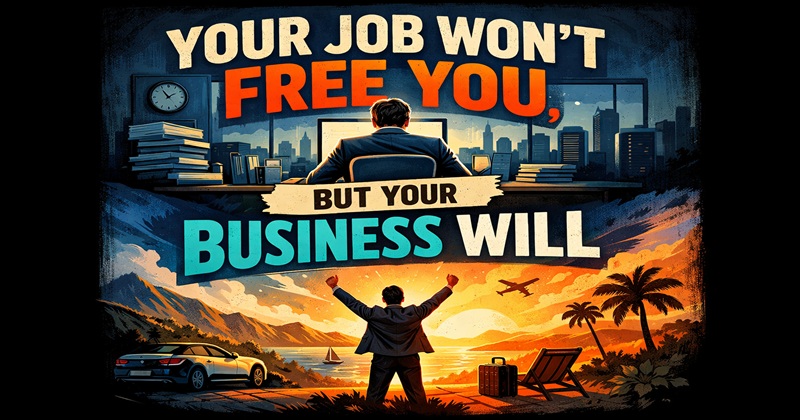
Your Job Won't Free You, But Your Business Will

The alarm clock rings at 6 AM. You drag yourself out of bed, rush through your morning routine, fight traffic for an hour, and settle into your cubicle for another eight-hour shift. This is the reality for millions of people worldwide—the traditional employment trap that promises security but often delivers only survival. While a steady paycheck provides comfort, it rarely provides freedom. The harsh truth is that your job, no matter how prestigious or well-paying, will never truly set you free. But your business? That's a different story entirely.
The Illusion of Job Security
For decades, we've been sold a compelling narrative: go to school, get good grades, land a stable job, work for 40 years, and retire comfortably. This formula worked for our grandparents' generation, but the landscape has fundamentally shifted. The concept of job security is increasingly becoming an illusion in our modern economy.
According to the Bureau of Labor Statistics, the average person changes jobs 12 times during their career, and younger workers are switching even more frequently. Corporate layoffs have become routine, with companies eliminating thousands of positions overnight to boost quarterly earnings. Even during periods of economic growth, no job is truly safe from automation, outsourcing, or corporate restructuring.
When you work a traditional job, you're essentially trading time for money—and there's a hard ceiling on how much time you can trade. You're limited by the hours in a day, the energy in your body, and the policies of your employer. You might receive raises and promotions, but you're still operating within someone else's system, following someone else's rules, and building someone else's dream.
The Hidden Costs of Employment
Beyond the obvious time constraints, employment carries hidden costs that chip away at your freedom:
Limited Income Potential: Your salary is predetermined, and raises typically hover between 3-5% annually if you're lucky. Your earning potential is capped by pay grades, industry standards, and budget constraints that have nothing to do with your actual value or effort.
Time Poverty: The average American spends 8.8 hours per day working, plus commuting time, which averages 54 minutes daily. That's nearly 10 hours devoted to employment before you even consider the mental energy consumed by work stress and preparation.
Lack of Control: You don't control your schedule, your projects, your colleagues, or your work environment. You need permission to take vacation, and you're expected to sacrifice personal time when the company demands it. Your autonomy is fundamentally compromised.
Single Point of Failure: Your financial well-being depends entirely on one income stream. If that stream disappears—through layoffs, company bankruptcy, or health issues—your financial stability crumbles instantly. This isn't just theoretical; millions experienced this reality during the COVID-19 pandemic.
Tax Disadvantages: Employees face the highest tax burden. You're taxed before you see your paycheck, with limited deductions available. Business owners, meanwhile, can deduct legitimate business expenses, reducing their taxable income significantly.
What Real Freedom Looks Like
Freedom isn't just about money—though financial independence is certainly a component. True freedom encompasses multiple dimensions:
Time Freedom: The ability to structure your day according to your priorities, not someone else's schedule. Working when you're most productive, taking breaks when you need them, and having the flexibility to attend your child's school play or take a spontaneous trip without requesting approval.
Financial Freedom: Having multiple income streams that continue generating revenue regardless of whether you're actively working. Building wealth that compounds over time rather than trading hours for dollars. Creating a financial buffer that eliminates the constant anxiety of living paycheck to paycheck.
Location Freedom: The ability to work from anywhere—your home, a beach in Bali, or a café in Paris. Not being tethered to a specific office or geographic location opens up lifestyle possibilities that traditional employment rarely affords.
Creative Freedom: Pursuing projects that genuinely excite you, experimenting with new ideas, and building something that reflects your values and vision rather than executing someone else's strategic plan.
Legacy Freedom: Creating something that outlasts you—a business that can be passed down to your children, sold for a significant sum, or continues generating impact long after you've stepped away.
Why Business Ownership Changes Everything
Starting a business fundamentally transforms your relationship with work and money. Here's why:
Unlimited Income Potential
In a business, your income isn't capped by a salary range or corporate budget. If you double your sales, you can potentially double your income. If you create a product that serves 1,000 people or 100,000 people, your earning potential scales accordingly. The value you create directly correlates to your financial reward.
Many entrepreneurs earn in a single month what took them a year to earn as employees. This isn't because they work harder necessarily—though entrepreneurship certainly demands effort—but because they've leveraged their time and skills more effectively.
Asset Building
A job provides income that stops the moment you stop working. A business, however, becomes an asset. According to research from BizBuySell, the average small business sells for 2-3 times its annual earnings. If you build a business generating $200,000 in annual profit, you're potentially sitting on an asset worth $400,000-$600,000 that you could eventually sell—in addition to the income it generates while you own it.
This asset can appreciate over time, provide passive income through delegation and automation, and serve as collateral for loans or investments in other ventures.
Tax Advantages
The tax code in most countries, including the United States, heavily favors business owners. Legitimate business expenses—from home office costs to travel, equipment, education, and even meals—can be deducted, reducing your taxable income.
Business owners can also take advantage of strategies like retirement plan contributions with higher limits than employees, depreciation deductions, and the ability to pay themselves through more tax-efficient methods like dividends or distributions, depending on their business structure.
Diversification and Security
While having a job represents a single income source, a business can develop multiple revenue streams. An online business might have product sales, consulting services, affiliate income, advertising revenue, and digital courses all contributing to total revenue. If one stream declines, others can compensate, creating actual security rather than the illusion of it.
The Compound Effect
Businesses benefit from compound growth in ways jobs simply cannot. As you build systems, develop your brand, grow your audience, and refine your processes, each improvement builds on the previous one. Your business becomes more valuable and more profitable without necessarily requiring proportionally more effort from you.
Common Objections (And Why They're Wrong)
"Starting a business is too risky."
Yes, entrepreneurship involves risk. But so does employment—you just don't recognize it as such because it's familiar. The risk of building your financial life on a single income source controlled entirely by someone else is substantial. At least in business, you control the variables and can pivot when needed.
Additionally, you don't have to quit your job immediately. Many successful businesses started as side hustles, allowing entrepreneurs to test and validate their ideas while maintaining their income security.
"I don't have enough money to start."
Many of today's most successful businesses launched with minimal capital. Service businesses—consulting, coaching, freelancing—require virtually no startup costs beyond your time and skills. Digital businesses can be started with a few hundred dollars for website hosting and basic tools.
The notion that you need massive capital to start a business is outdated. You need creativity, problem-solving ability, and willingness to start small and scale gradually.
"I don't have a groundbreaking idea."
You don't need to invent the next iPhone. Most successful businesses aren't based on revolutionary ideas—they're based on executing well-known concepts better, serving a specific niche more effectively, or improving existing solutions.
You can start a landscaping company, a bookkeeping service, an e-commerce store selling existing products, or a consulting practice in your area of expertise. The world needs good execution more than it needs novel ideas.
"I don't know how."
This is the age of unprecedented access to information. Thousands of resources—courses, books, podcasts, YouTube videos, and mentorship programs—can teach you anything you need to know about starting and running a business.
More importantly, entrepreneurship is learned through doing. You'll make mistakes, but each one teaches you something valuable that no course could convey. The best way to learn is to start.
Making the Transition: Practical Steps
If you're convinced that business ownership is your path to freedom, here's how to begin:
1. Start While Employed
Don't quit your job impulsively. Use your employment as a financial runway while you build your business on nights and weekends. This approach reduces risk and allows you to validate your business concept before going all-in.
2. Solve a Real Problem
The most successful businesses solve genuine problems for specific people. Identify pain points in your industry, community, or area of expertise. Talk to potential customers about their challenges. Build something people actually need, not just something you think is cool.
3. Start Small and Test
Launch a minimum viable product or service. Don't wait until everything is perfect—perfectionism is the enemy of entrepreneurship. Get something into the market, gather feedback, and iterate based on real-world responses.
4. Focus on Revenue Early
Many aspiring entrepreneurs get caught up in branding, business cards, and fancy websites before making a single sale. Focus on generating revenue immediately. Can you get your first customer this week? Your business needs cashflow to survive and grow.
5. Build Systems and Leverage
As your business grows, develop systems and processes that allow it to run without your constant involvement. Hire help, outsource tasks, automate where possible. Your goal is to work ON the business, not just IN the business.
6. Reinvest in Growth
In the early stages, reinvest profits back into the business. Upgrade your tools, expand your marketing, improve your skills, or hire team members. This accelerates growth and helps you reach financial freedom faster.
7. Maintain Your Lifestyle Until Stable
Resist the temptation to inflate your lifestyle the moment your business generates income. Maintain your current lifestyle until your business income consistently exceeds your employment income for at least six months, with adequate cash reserves.
Real Stories of Transformation
Consider Sarah, who worked as a marketing manager earning $75,000 annually. Frustrated by corporate politics and limited growth potential, she started a social media consulting business as a side hustle. Within 18 months, she was earning more from her five consulting clients than her full-time job provided. She quit employment, scaled her consulting firm to $250,000 in annual revenue, and now works 25 hours per week from her home office.
Or Marcus, a software developer who spent evenings building a project management tool for freelancers. After two years of development while employed, he launched the product. Within six months, subscription revenue reached $8,000 monthly. A year later, it hit $25,000 monthly—more than his annual salary—and he left employment to focus on the business full-time.
These aren't lottery-winner stories or overnight successes. They're examples of ordinary people who recognized that their job would never provide the freedom they sought and took consistent action to build businesses that could.
The Long-Term Vision
Building a business that truly frees you isn't a six-month project. For most people, it takes 2-5 years of focused effort to build something sustainable that generates significant income. But compare that timeline to the 40-year employment plan that promises freedom only after you're too old to fully enjoy it.
The path of entrepreneurship is challenging. You'll face setbacks, rejections, and moments of doubt. You'll work harder initially than you ever did as an employee. But the work is fundamentally different—you're building equity, developing valuable skills, creating assets, and moving toward genuine freedom rather than simply treading water.
The Choice Is Yours
Your job provides comfort, routine, and the appearance of security. It's the known path, the socially acceptable choice, the safe option. But it will never truly free you. You'll always be constrained by someone else's decisions, limited by arbitrary salary caps, and vulnerable to forces beyond your control.
Your business, on the other hand, offers unlimited potential—for income, for impact, for freedom, and for building something meaningful. It requires courage to step off the employment treadmill and forge your own path. It demands resilience when challenges arise. But it's the only path that leads to genuine freedom.
The question isn't whether you're capable of building a business—you are. The question is whether you're willing to trade the comfortable cage of employment for the uncertain freedom of entrepreneurship. Whether you value security over sovereignty, or whether you're ready to bet on yourself instead of betting your future on an employer's goodwill.
Your job will never free you. It will provide, sustain, and possibly even satisfy you—but it won't free you. Only your business can do that.
The time to start isn't someday. It's not when conditions are perfect, when you have more money, or when you feel completely ready. The time to start building your path to freedom is now. What you do with that opportunity is entirely up to you.
Appendix: References and Resources
Statistical References:
-
Bureau of Labor Statistics - Average Number of Jobs in a Lifetime
- https://www.bls.gov/news.release/nlsoy.nr0.htm
-
Bureau of Labor Statistics - American Time Use Survey (Work Hours)
- https://www.bls.gov/tus/
-
U.S. Census Bureau - Average Commute Time Statistics
- https://www.census.gov/topics/employment/commuting.html
-
BizBuySell - Business Valuation and Sale Price Data
- https://www.bizbuysell.com/
0 Comments
Be the first to share your thoughts on this article.