

Hustle
15 Ways to Make Extra Money While Working Full-Time

You do not need to quit your job to earn more money. Millions of full-time workers across the UK and US earn a meaningful secondary income in the hours around their day job. This guide gives you 15 practical, proven ways to do exactly that — with realistic earning estimates and honest tips for each one.
But side hustles require honest expectations. Most do not produce significant income in the first month. The ones that produce the most money over time — freelancing, content creation, affiliate marketing — require patience and consistency to build. The ones that produce money more quickly — delivery driving, selling unwanted belongings, renting spare space — tend to have lower ceilings and require ongoing time in exchange for each pound or dollar earned.
Two ground rules before you choose: first, check your employment contract. Some contracts restrict outside employment, particularly in similar industries, or require you to notify your employer. This is not common, but it is worth confirming before you spend time building something that conflicts with your terms. Second, keep track of everything you earn — in both the UK and US, income from side activities is taxable above certain thresholds, and you may need to register as self-employed or file a self-assessment tax return. We cover this in detail in Section 4.
The goal is not to work twice as hard. The goal is to build income streams that work around your life — and eventually, some that work without you.
— MONEYSAVINGEXPERT — SIDE HUSTLES GUIDE
Freelancing is the most direct route to significant side income for anyone with a marketable skill. Writing, graphic design, web development, social media management, bookkeeping, translation, video editing, and software development are all in high demand on platforms including Upwork, Fiverr, Freelancer, and Toptal. If you have a skill that your employer currently pays for, there are almost certainly clients willing to pay you directly for it in your spare hours. The difference between a beginner and an experienced freelancer on the same platform can be a factor of five to ten in hourly rate, so it pays to specialise and build a portfolio.
Tip: Start with a niche rather than a general offering. A 'social media manager for independent restaurants in London' will win more clients more quickly than a generic 'social media manager'. Build three to five portfolio pieces before you launch, and price your time realistically — undercharging as a freelancer trains clients to expect low prices.

If you are knowledgeable in any subject — from GCSE maths to university-level economics, from coding to conversational Spanish — online tutoring is one of the most straightforward ways to earn on evenings and weekends. Platforms including Tutor.com, SuperProf, MyTutor (UK), Wyzant (US), and Preply connect tutors with students globally. Most tutors charge £20 to £60 per hour in the UK, with specialist technical subjects commanding more. Teaching English as a foreign language (TEFL) to international students is another strong option — platforms like iTalki and Cambly pay per lesson and allow fully flexible scheduling.
Tip: Set your availability to fit around your full-time hours. Many successful part-time tutors work four to six sessions per week in the evenings and Saturday mornings, generating a consistent monthly income without disrupting their main job.

Selling unwanted belongings is the easiest entry point to side income — no new skills required, no business registration needed for occasional sales, and the money arrives quickly. Start with items around your own home, then develop an eye for underpriced items at car boot sales, charity shops, and Facebook Marketplace that you can resell at a profit (a practice known as retail arbitrage). Clothing on Vinted, collectibles and electronics on eBay, and furniture on Facebook Marketplace are all consistently strong categories. In the UK, the first £1,000 of trading income per year is tax-free under the trading allowance.
Tip: Photograph items against a plain light background and write accurate, keyword-rich descriptions. Check recently sold prices before listing to price competitively. For reselling, specialism in one category (vintage clothing, secondhand books, collectable figures) builds expertise and allows you to spot bargains faster.

Delivery platforms including Deliveroo, Uber Eats, and Just Eat (UK); DoorDash, Instacart, and Amazon Flex (US) allow you to earn per delivery with completely flexible hours — you work when you choose to. A bicycle or car opens access to more platforms and higher earnings. Most delivery riders earn between £10 and £16 per hour in UK cities depending on the platform, location, and time of day — peak earnings are at mealtimes (lunch and dinner) and on weekends. Amazon Flex in particular offers competitive pay for package delivery in your own car.
Tip: Peak hours matter significantly. Earning during Friday and Saturday evenings and Sunday lunchtimes can produce double the effective hourly rate compared with off-peak mid-week shifts. Factor in vehicle costs (fuel, maintenance, wear) when calculating your real hourly rate.

If you own or rent a property with a spare bedroom, renting it out is one of the highest-return, lowest-effort ways to earn extra income. In the UK, the Rent a Room Scheme allows homeowners and some tenants to earn up to £7,500 per year tax-free from letting furnished accommodation in their home — that is £625 per month tax-free with no additional paperwork. In the US, the equivalent income is taxable, but the IRS has a 14-day de minimis rule: if you rent your home for 14 days or fewer per year, the income is completely tax-free. Platforms including SpareRoom (UK) and Spare Room listings via Craigslist or Facebook Marketplace (US) make finding tenants straightforward.
Tip: Check your mortgage or tenancy agreement before listing, as some restrict subletting. If you are letting short-term on Airbnb rather than to a long-term lodger, the income threshold works differently — consult HMRC or a tax adviser.

Matched betting is a mathematical technique that exploits promotional free bets offered by bookmakers to guarantee a profit regardless of sporting outcomes — it is not gambling in the traditional sense because both outcomes of an event are covered. It is legal, widely practised in the UK, and completely risk-free when executed correctly. Platforms including OddsMonkey, Profit Accumulator, and Matched Bets walk beginners through every step. Beginners can typically extract £200 to £500 per month during the period when introductory offers are available; experienced bettors continue to earn through reload offers, casino bonuses, and more complex techniques.
Tip: Note: matched betting is only available in the UK and certain other markets where licensed bookmakers operate promotional offers. It is not available in the US due to the different legal structure of sports betting. It is not suitable for anyone with a history of problem gambling — the techniques require mathematical discipline, not luck.

Etsy is the world's largest marketplace for handmade, vintage, and craft items. If you make jewellery, ceramics, artwork, candles, knitting, woodwork, or any other craft, Etsy provides instant access to a global audience of buyers actively looking for handmade goods. Success on Etsy requires good product photography, strong SEO in your listing titles and descriptions, and patience to build reviews. Initial months are typically slow, but a well-optimised shop with a distinctive product range can build consistent sales over time.
Tip: Digital products on Etsy — downloadable prints, planners, templates, and digital artwork — require no materials or postage and can generate passive income once created. A single successful digital product can sell hundreds of times with no additional work after the initial creation.

Starting a blog, YouTube channel, or podcast around a topic you know well and enjoy is one of the highest potential side income activities — but also one of the slowest to monetise. It typically takes 12 to 18 months of consistent publishing before a blog or channel generates meaningful income through advertising (Google AdSense, YouTube Partner Programme), affiliate commissions, or sponsored content. However, once built, a successful content channel generates income with relatively low ongoing time investment. The key is choosing a niche with genuine audience interest and search demand, and creating content that is more useful or more entertaining than what already exists.
Tip: Treat content creation as a long-term investment, not a quick income source. The full-time workers who succeed at it are those who enjoy the content creation itself and would do it regardless of income — the money follows consistency, not urgency.

If you like animals and have flexibility around your hours, pet care is a sociable, low-barrier way to earn extra income. Rover and Wag (US), and Rover and Tailster (UK) connect pet owners with local sitters and walkers. Dog walking typically earns £10 to £20 per walk in UK cities; overnight pet sitting can earn £25 to £50 per night. A full schedule of regular clients — which typically builds over two to three months — can generate several hundred pounds per month from a handful of morning or evening walks that fit comfortably around a standard working day.
Tip: Build reviews quickly by offering introductory discounts for your first few clients, then gradually increase rates as your review profile grows. Regular, reliable clients are the most valuable — focus on retaining them rather than constantly chasing new bookings.

Paid surveys and user research sessions are the lowest-effort entry to side income — you can complete them during commutes, lunch breaks, or evenings watching television. Legitimate platforms including Prolific, Swagbucks, Valued Opinions, and LifePoints (UK and US) pay real money (or vouchers convertible to cash) for answering surveys and participating in studies. The earnings are modest — typically £5 to £20 per hour for surveys and up to £60 to £100 for longer research sessions — but the time commitment is genuinely flexible and the barrier to entry is zero.
Tip: Prolific is consistently rated as the most legitimate and well-paying survey platform. Focus on completing your profile thoroughly, as better-paid studies often have eligibility criteria and a complete profile means you qualify for more of them. User research sessions on platforms like UserTesting pay significantly more per session than standard surveys.

Print-on-demand services (Redbubble, Society6, Merch by Amazon, Printful via Etsy) allow you to upload designs to mugs, t-shirts, phone cases, posters, and other products, which are manufactured and shipped only when a customer orders. You earn a royalty on each sale with no inventory, no upfront cost, and no packaging or postage to handle. The limiting factor is design — products with strong, original designs that target specific communities (fandoms, professions, hobbies) sell significantly better than generic ones. Income builds slowly with volume of designs and quality of targeting.
Tip: Use free tools like Canva or Adobe Express to create designs if you are not a professional designer. Research bestselling categories on Redbubble and Merch by Amazon before uploading — popular niches include hobby-specific humour, professions, pets, and regional identity.

If you take good photos or have video footage of high-quality subjects — nature, travel, cities, food, business scenarios — you can license them on stock platforms including Shutterstock, Adobe Stock, Getty Images (iStock), and Alamy. You upload once and earn royalties every time someone downloads your image. A large, well-tagged library of images can generate a steady passive monthly income. The most in-demand categories are currently authentic lifestyle images, diverse people in professional settings, food photography, and technology images. Niche, specific content (a particular landmark, an unusual occupation, a seasonal event) often sells more reliably than generic subjects.
Tip: Tag every image thoroughly with descriptive keywords — how your images are found is determined entirely by search tags. Upload consistently to grow your library: most contributors need 200 to 500 high-quality images uploaded before they see meaningful monthly royalties.

If you own assets you are not using to full capacity, renting them out is among the most passive income options available. In the UK, platforms including JustPark and YourParkingSpace allow you to rent your driveway when you are at work or away — a driveway in a busy urban area can earn £50 to £200 per month with zero ongoing effort after initial set-up. In the US, Neighbor.com allows you to rent unused garage or storage space. Car-sharing platforms including Turo (US) and Hiyacar or Zipcar Fleet (UK) allow you to earn income from your car when you are not using it.
Tip: Check your home insurance and car insurance policies before listing any assets — most standard policies do not cover commercial rental use, and you may need to upgrade your cover or use the platform's included protection. The administrative overhead once set up is genuinely minimal.

Virtual assistant (VA) work involves providing remote administrative, scheduling, research, email management, customer service, or social media support to businesses and entrepreneurs who need help but do not want a full-time employee. VA work can be done from home, in the evening, and fits naturally around existing employment. Platforms including Belay, Time Etc (UK and US), Virtual Assistant Jobs, and direct sourcing via LinkedIn or freelancing platforms all connect VAs with clients. Rates range from £12 to £25 per hour for general administration to £25 to £50 per hour for specialist skills such as bookkeeping, email copywriting, or CRM management.
Tip: Your existing professional skills are directly transferable to VA work. If you manage complex schedules, handle correspondence, or run projects in your full-time role, those same skills have market value as a VA. Specialise early — a VA who specifically supports online course creators or e-commerce businesses commands higher rates than a generalist.

Affiliate marketing involves promoting other people's products or services and earning a commission when someone buys through your unique referral link. It works best when combined with a content channel — a blog, YouTube channel, social media presence, or email newsletter — where you already have an audience that trusts your recommendations. Amazon Associates, AWIN, ShareASale, and individual brand affiliate programmes all pay commissions ranging from 1% to 50% depending on the product category. Software, financial services, and online courses tend to pay the highest commissions.
Tip: Authenticity is the key variable in affiliate marketing success. Audiences can tell the difference between genuine recommendations from someone who uses and believes in a product, and low-quality promotional content designed purely to generate clicks. Build trust first, then monetise — never the other way around.
In the UK, the first £1,000 of trading income per tax year is covered by the Trading Allowance and does not need to be declared. The first £1,000 of property income (renting space or a room is separate — covered by the Rent a Room Scheme at £7,500 for lodgers). Once your total trading income from side activities exceeds £1,000 in a tax year, you must register as self-employed with HMRC and file a Self-Assessment tax return. You will pay income tax on your side income above the Trading Allowance at your marginal rate (20%, 40%, or 45%), and Class 4 National Insurance on profits above the lower profits limit.
In the US, any self-employment income above $400 per year must be reported on a Schedule C (or Schedule SE) with your federal income tax return. Self-employment income is subject to both federal income tax at your marginal rate and self-employment tax of 15.3% (covering Social Security and Medicare). You can deduct legitimate business expenses — equipment, platform fees, mileage for delivery driving, home office costs — from your self-employment income before calculating tax. Many side hustlers need to pay quarterly estimated taxes to avoid an underpayment penalty at year end.
The honest summary: keep records of everything you earn from side activities from day one. A simple spreadsheet tracking all income and expenses is sufficient at the beginning. As your earnings grow, consider using accounting software or consulting a tax adviser to ensure you are compliant and claiming all legitimate deductions.
The most important thing you can do today is choose one option — just one — that matches your skills, time, and goals, and take a single concrete first step. Create the Upwork profile. List the first three items on eBay. Sign up on Rover. Register as a tutor. The gap between the people who earn extra money and the people who talk about it is almost always not skill, time, or opportunity — it is the willingness to start.
GOV.UK — Register as Self-Employed and Self-Assessment Tax Returns https://www.gov.uk/register-for-self-assessment
GOV.UK — Trading Allowance: £1,000 Tax-Free Trading Income https://www.gov.uk/guidance/tax-free-allowances-on-property-and-trading-income
Upwork — Freelancing Platform for All Skills https://www.upwork.com
Etsy — Sell Handmade and Digital Products https://www.etsy.com/sell
Rover — Pet Sitting and Dog Walking Platform (UK and US) https://www.rover.com
Prolific — Paid Academic Research Surveys https://www.prolific.com
Redbubble — Print-on-Demand Marketplace https://www.redbubble.com
OddsMonkey — Matched Betting Platform (UK) https://www.oddsmonkey.com
IRS — Self-Employment Tax: What You Need to Know https://www.irs.gov/businesses/small-businesses-self-employed/self-employment-tax-social-security-and-medicare-taxes
TABLE OF CONTENTS
- Before You Start: Getting the Mindset Right
- The 15 Ways Explained in Full
- How to Choose the Right Side Hustle for You
- Tax and Self-Assessment: What You Need to Know
- Avoiding Common Side Hustle Mistakes
- Conclusion
- Frequently Asked Questions
- References
Before You Start: Getting the Mindset Right
A survey by Bankrate in 2025 found that 39% of US adults had some form of side income alongside their main job — and the UK picture is similar, with millions of employed workers earning additional income through freelancing, selling, renting, or online activities. The barriers to starting a secondary income stream have never been lower: the gig economy, digital platforms, and online marketplaces have made it possible to start earning in almost every area of skill or interest with minimal upfront investment.But side hustles require honest expectations. Most do not produce significant income in the first month. The ones that produce the most money over time — freelancing, content creation, affiliate marketing — require patience and consistency to build. The ones that produce money more quickly — delivery driving, selling unwanted belongings, renting spare space — tend to have lower ceilings and require ongoing time in exchange for each pound or dollar earned.
Two ground rules before you choose: first, check your employment contract. Some contracts restrict outside employment, particularly in similar industries, or require you to notify your employer. This is not common, but it is worth confirming before you spend time building something that conflicts with your terms. Second, keep track of everything you earn — in both the UK and US, income from side activities is taxable above certain thresholds, and you may need to register as self-employed or file a self-assessment tax return. We cover this in detail in Section 4.
The goal is not to work twice as hard. The goal is to build income streams that work around your life — and eventually, some that work without you.
— MONEYSAVINGEXPERT — SIDE HUSTLES GUIDE
The 15 Ways Explained in Full
Freelancing is the most direct route to significant side income for anyone with a marketable skill. Writing, graphic design, web development, social media management, bookkeeping, translation, video editing, and software development are all in high demand on platforms including Upwork, Fiverr, Freelancer, and Toptal. If you have a skill that your employer currently pays for, there are almost certainly clients willing to pay you directly for it in your spare hours. The difference between a beginner and an experienced freelancer on the same platform can be a factor of five to ten in hourly rate, so it pays to specialise and build a portfolio.
Tip: Start with a niche rather than a general offering. A 'social media manager for independent restaurants in London' will win more clients more quickly than a generic 'social media manager'. Build three to five portfolio pieces before you launch, and price your time realistically — undercharging as a freelancer trains clients to expect low prices.
If you are knowledgeable in any subject — from GCSE maths to university-level economics, from coding to conversational Spanish — online tutoring is one of the most straightforward ways to earn on evenings and weekends. Platforms including Tutor.com, SuperProf, MyTutor (UK), Wyzant (US), and Preply connect tutors with students globally. Most tutors charge £20 to £60 per hour in the UK, with specialist technical subjects commanding more. Teaching English as a foreign language (TEFL) to international students is another strong option — platforms like iTalki and Cambly pay per lesson and allow fully flexible scheduling.
Tip: Set your availability to fit around your full-time hours. Many successful part-time tutors work four to six sessions per week in the evenings and Saturday mornings, generating a consistent monthly income without disrupting their main job.
Selling unwanted belongings is the easiest entry point to side income — no new skills required, no business registration needed for occasional sales, and the money arrives quickly. Start with items around your own home, then develop an eye for underpriced items at car boot sales, charity shops, and Facebook Marketplace that you can resell at a profit (a practice known as retail arbitrage). Clothing on Vinted, collectibles and electronics on eBay, and furniture on Facebook Marketplace are all consistently strong categories. In the UK, the first £1,000 of trading income per year is tax-free under the trading allowance.
Tip: Photograph items against a plain light background and write accurate, keyword-rich descriptions. Check recently sold prices before listing to price competitively. For reselling, specialism in one category (vintage clothing, secondhand books, collectable figures) builds expertise and allows you to spot bargains faster.
Delivery platforms including Deliveroo, Uber Eats, and Just Eat (UK); DoorDash, Instacart, and Amazon Flex (US) allow you to earn per delivery with completely flexible hours — you work when you choose to. A bicycle or car opens access to more platforms and higher earnings. Most delivery riders earn between £10 and £16 per hour in UK cities depending on the platform, location, and time of day — peak earnings are at mealtimes (lunch and dinner) and on weekends. Amazon Flex in particular offers competitive pay for package delivery in your own car.
Tip: Peak hours matter significantly. Earning during Friday and Saturday evenings and Sunday lunchtimes can produce double the effective hourly rate compared with off-peak mid-week shifts. Factor in vehicle costs (fuel, maintenance, wear) when calculating your real hourly rate.
If you own or rent a property with a spare bedroom, renting it out is one of the highest-return, lowest-effort ways to earn extra income. In the UK, the Rent a Room Scheme allows homeowners and some tenants to earn up to £7,500 per year tax-free from letting furnished accommodation in their home — that is £625 per month tax-free with no additional paperwork. In the US, the equivalent income is taxable, but the IRS has a 14-day de minimis rule: if you rent your home for 14 days or fewer per year, the income is completely tax-free. Platforms including SpareRoom (UK) and Spare Room listings via Craigslist or Facebook Marketplace (US) make finding tenants straightforward.
Tip: Check your mortgage or tenancy agreement before listing, as some restrict subletting. If you are letting short-term on Airbnb rather than to a long-term lodger, the income threshold works differently — consult HMRC or a tax adviser.
Matched betting is a mathematical technique that exploits promotional free bets offered by bookmakers to guarantee a profit regardless of sporting outcomes — it is not gambling in the traditional sense because both outcomes of an event are covered. It is legal, widely practised in the UK, and completely risk-free when executed correctly. Platforms including OddsMonkey, Profit Accumulator, and Matched Bets walk beginners through every step. Beginners can typically extract £200 to £500 per month during the period when introductory offers are available; experienced bettors continue to earn through reload offers, casino bonuses, and more complex techniques.
Tip: Note: matched betting is only available in the UK and certain other markets where licensed bookmakers operate promotional offers. It is not available in the US due to the different legal structure of sports betting. It is not suitable for anyone with a history of problem gambling — the techniques require mathematical discipline, not luck.
Etsy is the world's largest marketplace for handmade, vintage, and craft items. If you make jewellery, ceramics, artwork, candles, knitting, woodwork, or any other craft, Etsy provides instant access to a global audience of buyers actively looking for handmade goods. Success on Etsy requires good product photography, strong SEO in your listing titles and descriptions, and patience to build reviews. Initial months are typically slow, but a well-optimised shop with a distinctive product range can build consistent sales over time.
Tip: Digital products on Etsy — downloadable prints, planners, templates, and digital artwork — require no materials or postage and can generate passive income once created. A single successful digital product can sell hundreds of times with no additional work after the initial creation.
Starting a blog, YouTube channel, or podcast around a topic you know well and enjoy is one of the highest potential side income activities — but also one of the slowest to monetise. It typically takes 12 to 18 months of consistent publishing before a blog or channel generates meaningful income through advertising (Google AdSense, YouTube Partner Programme), affiliate commissions, or sponsored content. However, once built, a successful content channel generates income with relatively low ongoing time investment. The key is choosing a niche with genuine audience interest and search demand, and creating content that is more useful or more entertaining than what already exists.
Tip: Treat content creation as a long-term investment, not a quick income source. The full-time workers who succeed at it are those who enjoy the content creation itself and would do it regardless of income — the money follows consistency, not urgency.
If you like animals and have flexibility around your hours, pet care is a sociable, low-barrier way to earn extra income. Rover and Wag (US), and Rover and Tailster (UK) connect pet owners with local sitters and walkers. Dog walking typically earns £10 to £20 per walk in UK cities; overnight pet sitting can earn £25 to £50 per night. A full schedule of regular clients — which typically builds over two to three months — can generate several hundred pounds per month from a handful of morning or evening walks that fit comfortably around a standard working day.
Tip: Build reviews quickly by offering introductory discounts for your first few clients, then gradually increase rates as your review profile grows. Regular, reliable clients are the most valuable — focus on retaining them rather than constantly chasing new bookings.
Paid surveys and user research sessions are the lowest-effort entry to side income — you can complete them during commutes, lunch breaks, or evenings watching television. Legitimate platforms including Prolific, Swagbucks, Valued Opinions, and LifePoints (UK and US) pay real money (or vouchers convertible to cash) for answering surveys and participating in studies. The earnings are modest — typically £5 to £20 per hour for surveys and up to £60 to £100 for longer research sessions — but the time commitment is genuinely flexible and the barrier to entry is zero.
Tip: Prolific is consistently rated as the most legitimate and well-paying survey platform. Focus on completing your profile thoroughly, as better-paid studies often have eligibility criteria and a complete profile means you qualify for more of them. User research sessions on platforms like UserTesting pay significantly more per session than standard surveys.
Print-on-demand services (Redbubble, Society6, Merch by Amazon, Printful via Etsy) allow you to upload designs to mugs, t-shirts, phone cases, posters, and other products, which are manufactured and shipped only when a customer orders. You earn a royalty on each sale with no inventory, no upfront cost, and no packaging or postage to handle. The limiting factor is design — products with strong, original designs that target specific communities (fandoms, professions, hobbies) sell significantly better than generic ones. Income builds slowly with volume of designs and quality of targeting.
Tip: Use free tools like Canva or Adobe Express to create designs if you are not a professional designer. Research bestselling categories on Redbubble and Merch by Amazon before uploading — popular niches include hobby-specific humour, professions, pets, and regional identity.
If you take good photos or have video footage of high-quality subjects — nature, travel, cities, food, business scenarios — you can license them on stock platforms including Shutterstock, Adobe Stock, Getty Images (iStock), and Alamy. You upload once and earn royalties every time someone downloads your image. A large, well-tagged library of images can generate a steady passive monthly income. The most in-demand categories are currently authentic lifestyle images, diverse people in professional settings, food photography, and technology images. Niche, specific content (a particular landmark, an unusual occupation, a seasonal event) often sells more reliably than generic subjects.
Tip: Tag every image thoroughly with descriptive keywords — how your images are found is determined entirely by search tags. Upload consistently to grow your library: most contributors need 200 to 500 high-quality images uploaded before they see meaningful monthly royalties.
If you own assets you are not using to full capacity, renting them out is among the most passive income options available. In the UK, platforms including JustPark and YourParkingSpace allow you to rent your driveway when you are at work or away — a driveway in a busy urban area can earn £50 to £200 per month with zero ongoing effort after initial set-up. In the US, Neighbor.com allows you to rent unused garage or storage space. Car-sharing platforms including Turo (US) and Hiyacar or Zipcar Fleet (UK) allow you to earn income from your car when you are not using it.
Tip: Check your home insurance and car insurance policies before listing any assets — most standard policies do not cover commercial rental use, and you may need to upgrade your cover or use the platform's included protection. The administrative overhead once set up is genuinely minimal.
Virtual assistant (VA) work involves providing remote administrative, scheduling, research, email management, customer service, or social media support to businesses and entrepreneurs who need help but do not want a full-time employee. VA work can be done from home, in the evening, and fits naturally around existing employment. Platforms including Belay, Time Etc (UK and US), Virtual Assistant Jobs, and direct sourcing via LinkedIn or freelancing platforms all connect VAs with clients. Rates range from £12 to £25 per hour for general administration to £25 to £50 per hour for specialist skills such as bookkeeping, email copywriting, or CRM management.
Tip: Your existing professional skills are directly transferable to VA work. If you manage complex schedules, handle correspondence, or run projects in your full-time role, those same skills have market value as a VA. Specialise early — a VA who specifically supports online course creators or e-commerce businesses commands higher rates than a generalist.
Affiliate marketing involves promoting other people's products or services and earning a commission when someone buys through your unique referral link. It works best when combined with a content channel — a blog, YouTube channel, social media presence, or email newsletter — where you already have an audience that trusts your recommendations. Amazon Associates, AWIN, ShareASale, and individual brand affiliate programmes all pay commissions ranging from 1% to 50% depending on the product category. Software, financial services, and online courses tend to pay the highest commissions.
Tip: Authenticity is the key variable in affiliate marketing success. Audiences can tell the difference between genuine recommendations from someone who uses and believes in a product, and low-quality promotional content designed purely to generate clicks. Build trust first, then monetise — never the other way around.
How to Choose the Right Side Hustle for You
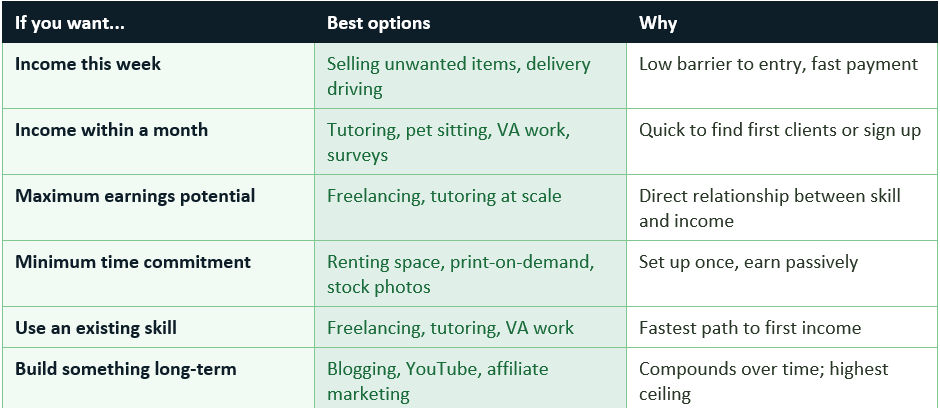
With 15 options in front of you, the risk is picking none of them. The best side hustle is not the one with the highest theoretical earnings — it is the one that you will actually start, continue, and enjoy enough to persist through the slow early weeks.Tax and Self-Assessment: What You Need to Know
In both the UK and US, income from side activities is taxable income. Ignoring this is one of the most common mistakes made by first-time side hustlers — and the penalties for undeclared income can significantly exceed any tax savings.In the UK, the first £1,000 of trading income per tax year is covered by the Trading Allowance and does not need to be declared. The first £1,000 of property income (renting space or a room is separate — covered by the Rent a Room Scheme at £7,500 for lodgers). Once your total trading income from side activities exceeds £1,000 in a tax year, you must register as self-employed with HMRC and file a Self-Assessment tax return. You will pay income tax on your side income above the Trading Allowance at your marginal rate (20%, 40%, or 45%), and Class 4 National Insurance on profits above the lower profits limit.
In the US, any self-employment income above $400 per year must be reported on a Schedule C (or Schedule SE) with your federal income tax return. Self-employment income is subject to both federal income tax at your marginal rate and self-employment tax of 15.3% (covering Social Security and Medicare). You can deduct legitimate business expenses — equipment, platform fees, mileage for delivery driving, home office costs — from your self-employment income before calculating tax. Many side hustlers need to pay quarterly estimated taxes to avoid an underpayment penalty at year end.
The honest summary: keep records of everything you earn from side activities from day one. A simple spreadsheet tracking all income and expenses is sufficient at the beginning. As your earnings grow, consider using accounting software or consulting a tax adviser to ensure you are compliant and claiming all legitimate deductions.
Avoiding Common Side Hustle Mistakes
The 6 most common side hustle mistakes — and how to avoid them
- Spreading too thin: Trying five side hustles at once means you do none of them well. Pick one, commit for 90 days, and evaluate results before adding anything else.
- Underpricing your time: Many people starting freelancing or tutoring charge far less than their skills are worth. Research market rates on Upwork, Bark, or LinkedIn for your specific skill and location before setting prices.
- Ignoring tax: As covered in Section 4, all side income is taxable above certain thresholds. Not registering with HMRC or the IRS when required can result in backdated tax bills and penalties. Set aside 20–25% of all side income from day one.
- Quitting too early: Most side hustles have a slow start. A freelancing profile with no reviews, an Etsy shop with 10 items, or a blog with no backlinks will generate little income in month one. The people who succeed are those who persist through the slow first 90 days.
- Neglecting your main job: Your full-time salary is your financial foundation. Never let side hustle fatigue damage your main job performance. Set clear limits on side hustle hours and protect your sleep and recovery.
- Starting with no goal: 'I want to earn more money' is not a plan. Define a specific monthly target (for example, an extra £300 per month to pay off a specific debt) and choose a side hustle realistically capable of reaching it within a specific timeframe.
CONCLUSION
Making extra money while working full-time is not a fantasy — it is what millions of people are doing right now, in evenings, weekends, and lunch breaks, using the skills, assets, and time they already have. The 15 ways in this guide range from ones you can start tonight with no investment to ones that build slowly into significant long-term income streams. None of them require you to quit your job, take a risk, or put money you cannot afford on the line.The most important thing you can do today is choose one option — just one — that matches your skills, time, and goals, and take a single concrete first step. Create the Upwork profile. List the first three items on eBay. Sign up on Rover. Register as a tutor. The gap between the people who earn extra money and the people who talk about it is almost always not skill, time, or opportunity — it is the willingness to start.
Frequently Asked Questions
How much can I realistically earn from a side hustle while working full-time?
It depends heavily on which side hustle you choose, how many hours you put in, and your level of skill or experience. At the lower end, paid surveys and occasional selling might add £50 to £100 per month with minimal effort. Consistent freelancing or tutoring for ten to fifteen hours per week can realistically generate £500 to £1,500 per month for someone with strong skills. Most people who commit seriously to one side hustle for six months or more earn between £200 and £600 per month extra — enough to make a meaningful difference to financial goals like debt repayment, saving for a house, or building an emergency fund.Do I need to tell my employer about my side hustle?
You should check your employment contract. Some contracts, particularly in professional services, financial services, or roles where conflicts of interest could arise, include clauses restricting outside employment or requiring employer notification. In most cases, a completely unrelated side hustle is not a problem — but failing to check and being in breach of your contract is a risk not worth taking. When in doubt, a brief, informal conversation with HR or your manager is usually sufficient to clarify the position.How do I pay tax on side hustle income in the UK?
In the UK, the first £1,000 of trading income per tax year is covered by the Trading Allowance and does not need to be declared. Above that threshold, you must register as self-employed with HMRC (register at gov.uk/register-for-self-assessment) and file an annual Self-Assessment tax return by 31 January following the end of the tax year. You will pay income tax on profits above your trading allowance at your marginal rate, and Class 4 National Insurance on profits above the lower profits limit. Keep receipts for all legitimate business expenses, as these reduce your taxable profit.What is the fastest side hustle to start making money from today?
For money this week: list items you already own on eBay, Vinted, or Facebook Marketplace. For money within a month: sign up on a tutoring platform (if you have a subject expertise), register with Rover or Tailster for pet sitting, or create a delivery account on Deliveroo or DoorDash and start as soon as your application is approved. Paid surveys via Prolific take about 30 minutes to set up and you can start earning the same day. These options are all low or zero barrier to entry and pay relatively quickly compared with content creation or freelancing platforms that take longer to generate income.Is matched betting legal?
Yes, matched betting is entirely legal in the UK and works by mathematically covering all outcomes of a sporting event using bookmaker promotional free bets and betting exchanges. It is not gambling in the traditional sense because the mathematical approach ensures a profit regardless of the sporting result when executed correctly. It is not available in the US due to the different legal structure of sports betting there. HMRC does not typically classify matched betting winnings as taxable income in the UK, but it is worth confirming this position with a tax adviser if your earnings are significant.Can I do multiple side hustles at the same time?
You can, but the most common mistake is trying to do too many at once and doing none of them well. The recommended approach is to start with one side hustle, commit to it for 90 days, evaluate whether it is generating the income and satisfaction you want, and only then consider adding a second. The exception is passive or semi-passive income streams like print-on-demand, stock photography, or renting space — once set up, these require very little ongoing time and can run alongside a more active side hustle without competing for your energy.References
MoneySavingExpert — Side Hustle Guide: The Best Ways to Earn Extra Cash https://www.moneysavingexpert.com/banking/side-hustles/GOV.UK — Register as Self-Employed and Self-Assessment Tax Returns https://www.gov.uk/register-for-self-assessment
GOV.UK — Trading Allowance: £1,000 Tax-Free Trading Income https://www.gov.uk/guidance/tax-free-allowances-on-property-and-trading-income
Upwork — Freelancing Platform for All Skills https://www.upwork.com
Etsy — Sell Handmade and Digital Products https://www.etsy.com/sell
Rover — Pet Sitting and Dog Walking Platform (UK and US) https://www.rover.com
Prolific — Paid Academic Research Surveys https://www.prolific.com
Redbubble — Print-on-Demand Marketplace https://www.redbubble.com
OddsMonkey — Matched Betting Platform (UK) https://www.oddsmonkey.com
IRS — Self-Employment Tax: What You Need to Know https://www.irs.gov/businesses/small-businesses-self-employed/self-employment-tax-social-security-and-medicare-taxes
0 Comments
Be the first to share your thoughts on this article.