

Taxes
2027 IRS Tax Brackets Are Set: What They Mean for Your Taxes

Inflation adjustments of about 3.2% for almost 70 provisions; rates unchanged at 10%, 12%, 22%, 24%, 32%, 35% and 37%; standard deduction $16,600 (single), $33,200 (joint), $24,925 (head of household), up from $16,100, $32,200 and $24,150; 37% above $661,375 (single) and $793,650 (joint). Single brackets 2027: 10% to $12,800; 12% to $52,025; 22% to $109,125; 24% to $208,325; 32% to $264,550; 35% to $661,375. Joint: 10% to $25,600; 12% to $104,050; 22% to $218,250; 24% to $416,650; 32% to $529,100; 35% to $793,650. Context: inflation 3.7%; median full-time earnings up 1.5% vs CPI up 3.5% (BLS, Q3). My arithmetic: a single filer earning $75,000 in both years pays about $7,670 in 2026 and $7,390 in 2027, saving about $280; a couple earning $150,000 saves about $561; with a 3.5% raise the single filer’s tax would be about $7,967, and the effective rate would rise from about 10.23% to 10.26%.
One thing to get straight at the start: these numbers apply to income you earn in 2027, reported on the return you file in 2028. The return you file in early 2027 covers 2026 and uses this year’s brackets, so the news is a planning tool, not a change to your next return. This guide gives the new tables, shows what they could mean in dollars, explains why your raise matters and lists what to do now.
Every threshold I checked rose between 3.22% and 3.25%, in line with the 3.2% adjustment. Forbes notes the 2026 brackets for the lowest two rates received an extra increase under the One Big Beautiful Bill Act, while 2027 simply follows inflation. For heads of household, one source lists the 10% bracket up to $18,250 and the 12% bracket up to $69,650; I did not retrieve the full table, so check the IRS.
IRS, November 5, 2026: 2027 thresholds up about 3.2%, rates unchanged. Single: 10% to $12,800; 12% to $52,025; 22% to $109,125; 24% to $208,325; 32% to $264,550; 35% to $661,375; 37% above. Joint: 10% to $25,600; 12% to $104,050; 22% to $218,250; 24% to $416,650; 32% to $529,100; 35% to $793,650; 37% above.
Each increase is about 3.1% to 3.2%, in line with the brackets. In my arithmetic, the extra $500 for a single filer is worth about $60 in tax at the 12% rate and $110 at 22%, and the extra $1,000 for a couple $120 to $220: a small gain, but with wider brackets it keeps your real tax burden from rising just because prices do.

These savings assume your income does not change, and most people get raises, which is the next point. The figures are also federal income tax only, excluding payroll taxes, state taxes and credits such as the child tax credit, which one site reports rising to a $2,300 maximum, a figure I could not confirm in the IRS excerpt I retrieved. Treat them as illustrations, not estimates.
In my illustration, a single filer earning $75,000 in 2026 who gets a 3.5% raise to $77,625 in 2027 would pay about $7,967 in federal tax, an effective rate of about 10.26% against 10.23% in 2026. Without indexing, the tax on $77,625 would be about $8,248, or 10.62%. So the adjustment still helps but gives no tax cut when pay rises faster than it, and median full-time weekly earnings rose only 1.5% in the third quarter against CPI of 3.5%, per the BLS, so many raises lag.
Your effective rate is your total tax divided by your income, and it is lower than your top bracket: a single filer with $75,000 of wages in 2027 has a top bracket of 22% but an effective federal rate of about 9.85%. You never take home less because a raise tips you into a higher bracket. The marginal rate tells you what the next dollar costs; the effective rate tells you what you actually pay.
These figures help planning. Near the top of a bracket, a bonus, Roth conversion or capital gain could be taxed at the next rate, while pre-tax retirement or HSA contributions could pull taxable income back down. The 12% bracket now reaches about $2,100 further for singles and $4,250 further for joint filers than in 2026, though credits, other income and state taxes will change your real figures.
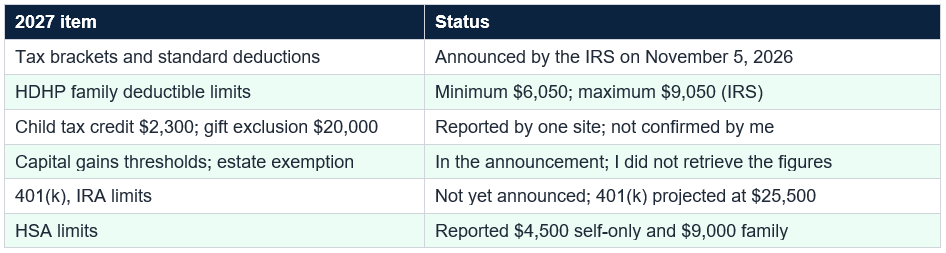
Retirement plan limits are not part of this release. They are usually announced separately, and figures online are projections: Milliman projected in October a 2027 401(k) limit of $25,500, up from $24,500, and some sources report 2027 HSA limits of $4,500 (self-only) and $9,000 (family). A new federal Saver’s Match for low- and moderate-income savers also begins in 2027. Watch for the IRS announcement of the final limits.
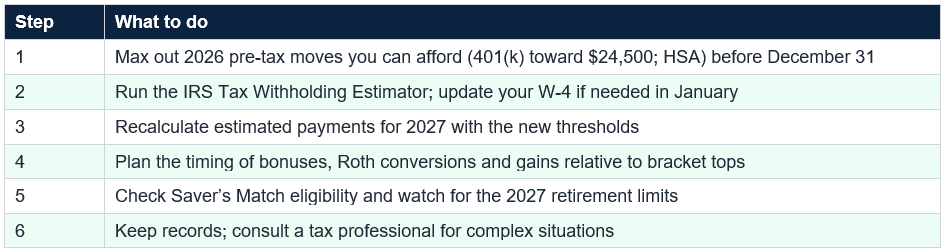
Fourth, think about the timing of income: if a bonus, Roth conversion or sale of investments would put you near the top of a bracket, knowing the 2027 thresholds helps you choose the year and amount. Fifth, check Saver’s Match eligibility and watch for the 2027 retirement limits. And keep expectations modest: the bracket changes are worth hundreds of dollars for many households, not thousands. A tax professional can help with complex income.
Look up your expected 2027 taxable income against the new bracket tops. If a planned bonus or conversion would cross a threshold, decide now whether to spread it over two years.
These numbers apply to 2027 income and the return you file in 2028, the 2026 return you file next spring uses this year’s figures and 2027 retirement limits have not yet been announced. Use the rest of 2026 to make pre-tax contributions, review withholding and plan the timing of income. The changes are inflation housekeeping, not a rewrite of the tax code, and they work best as a reminder to look at your plan.
No. The seven rates stay at 10%, 12%, 22%, 24%, 32%, 35% and 37%. What changed are the income thresholds where each rate starts, which the IRS raised about 3.2% for inflation in Revenue Procedure 2026-35, announced on November 5, 2026. The standard deduction also rose: to $16,600 for single filers, $33,200 for joint filers and $24,925 for heads of household.
When do the 2027 brackets apply?
To income earned in 2027, which you report on the return you file in 2028. The return you file in early 2027 covers 2026 income and uses the 2026 brackets and standard deduction: $16,100 for single filers and $32,200 for joint filers. Mixing the two years up is a common mistake.
Will I pay less tax in 2027?
Possibly, if your income does not rise faster than the 3.2% adjustment. In my illustration, a single filer earning $75,000 in both years would pay about $280 less in 2027, and a married couple earning $150,000 about $561 less. If your pay rises 3.5%, the savings mostly disappear because your income grows slightly faster than the brackets. State and payroll taxes are separate.
How do marginal tax brackets work?
Only the part of your taxable income inside each bracket is taxed at that bracket’s rate, so moving into a higher bracket does not tax all your income at the higher rate. For a single filer in 2027, the first $12,800 of taxable income is taxed at 10%, the next slice up to $52,025 at 12% and so on. Your effective rate is your total tax divided by your income, and it is lower than your top bracket.
What should I do now to prepare?
Use 2026 deadlines first: maximize 401(k) and HSA contributions before year-end if you can, review withholding with the IRS Tax Withholding Estimator, and plan raises, bonuses and Roth conversions with the new thresholds in mind. The IRS has not yet announced 2027 retirement contribution limits, so figures you see online are projections. This is general education, not personal tax advice.
Table of Contents
- The IRS Has Set the 2027 Numbers
- The Short Answer
- The 2027 Brackets: Single and Joint
- The Standard Deduction
- What It Means in Dollars
- Bracket Creep and Why Your Raise Matters
- How Marginal Brackets Work
- How Much Income Fits in Each Bracket
- Other 2027 Numbers: What Is Known and Not
- What to Do Now
- Common Mistakes
- Conclusion
- Frequently Asked Questions
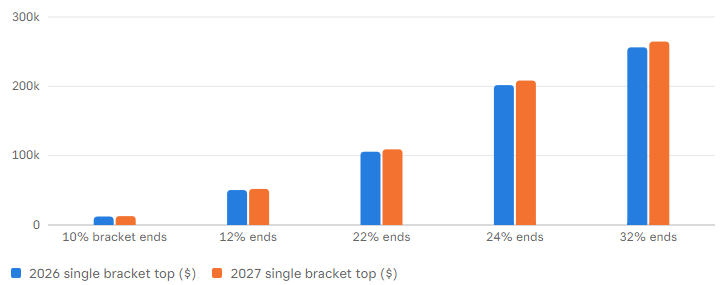
2026 vs. 2027 federal brackets, single filers: top of each bracket ($ taxable income)
Taxable income ($) by IRS Revenue Procedure 2026-35 via IRS, NerdWallet and TaxPayers.net (announced Nov 5, 2026); the 35% bracket ends at $640,600 in 2026 and $661,375 in 2027; rates unchanged
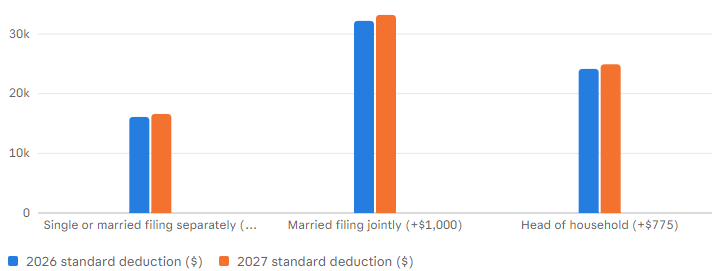
The standard deduction rises for 2027 ($)
Standard deduction ($) by IRS news release IR-2026-133 (November 5, 2026); one site lists the head-of-household figure as $24,950, conflicting with the IRS's $24,925
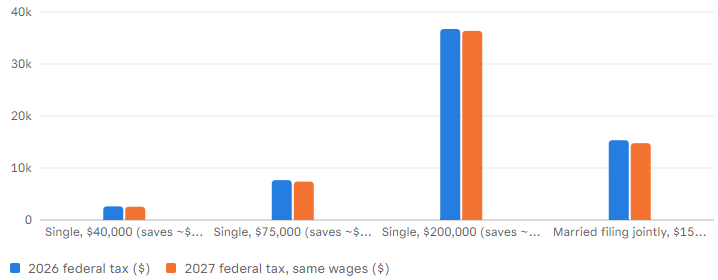
What it could save: federal income tax on the same wages, 2026 vs. 2027 ($)
Federal income tax ($) by Author's simplified arithmetic: wages only, standard deduction, no credits, state or payroll taxes; assumes income does not change; not an estimate of your taxThe IRS Has Set the 2027 Numbers
Every autumn the IRS publishes the next year’s inflation adjustments, and on November 5, 2026 it released the 2027 set. In news release IR-2026-133 and Revenue Procedure 2026-35, it adjusted almost 70 provisions, including the rate schedules and standard deductions. The seven rates, from 10% to 37%, are unchanged; the dollar thresholds where each rate begins and the standard deduction rose by about 3.2%.One thing to get straight at the start: these numbers apply to income you earn in 2027, reported on the return you file in 2028. The return you file in early 2027 covers 2026 and uses this year’s brackets, so the news is a planning tool, not a change to your next return. This guide gives the new tables, shows what they could mean in dollars, explains why your raise matters and lists what to do now.
The Short Answer
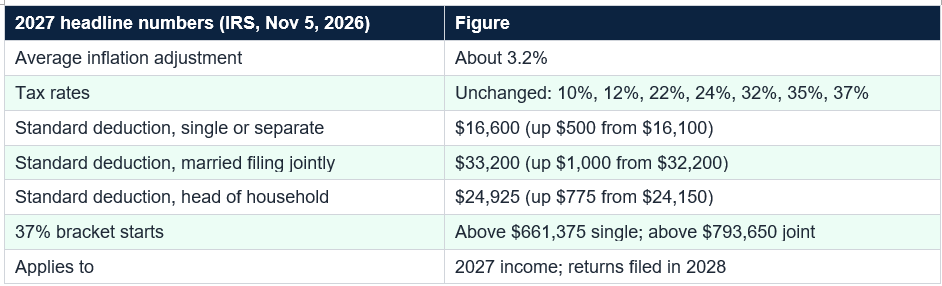
The IRS raised every bracket threshold for 2027 by about 3.2%, left the seven rates unchanged and lifted the standard deduction to $16,600 for single filers, $33,200 for married couples filing jointly and $24,925 for heads of household. The 37% rate now starts above $661,375 for single filers and $793,650 for joint filers. For a taxpayer whose income stays flat, that means a modestly lower tax bill, about $280 for a single filer at $75,000 in my illustration; if income grows faster than 3.2%, the benefit mostly disappears.
The 2027 Brackets: Single and Joint
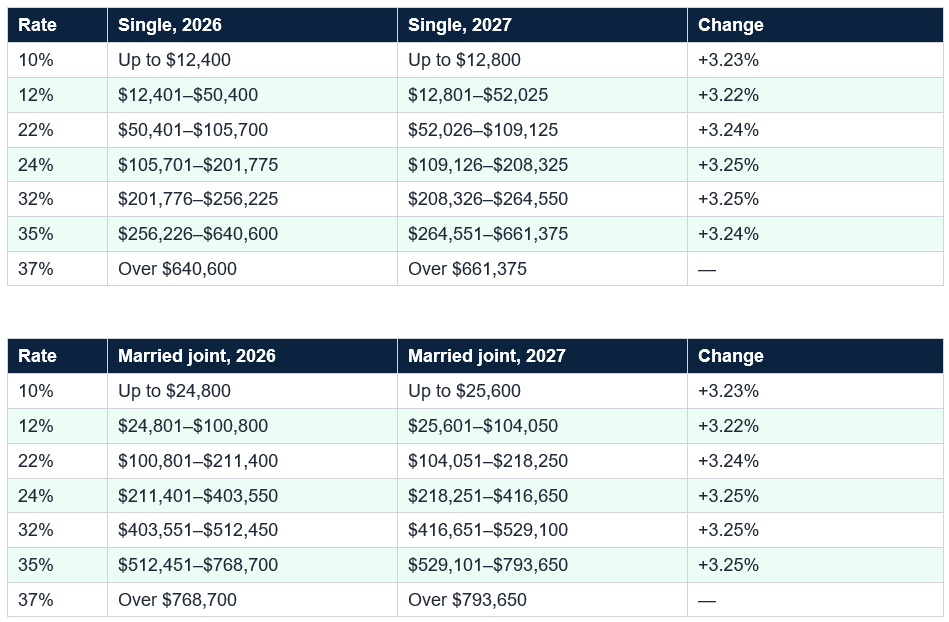
The tables below show the 2027 brackets for single and joint filers with 2026 for comparison, drawn from the IRS announcement as reported by several sources. For single filers, 10% covers taxable income up to $12,800, 12% up to $52,025, 22% up to $109,125, 24% up to $208,325, 32% up to $264,550, 35% up to $661,375 and 37% above; for joint filers the cutoffs are roughly double at the lower brackets.Every threshold I checked rose between 3.22% and 3.25%, in line with the 3.2% adjustment. Forbes notes the 2026 brackets for the lowest two rates received an extra increase under the One Big Beautiful Bill Act, while 2027 simply follows inflation. For heads of household, one source lists the 10% bracket up to $18,250 and the 12% bracket up to $69,650; I did not retrieve the full table, so check the IRS.
IRS, November 5, 2026: 2027 thresholds up about 3.2%, rates unchanged. Single: 10% to $12,800; 12% to $52,025; 22% to $109,125; 24% to $208,325; 32% to $264,550; 35% to $661,375; 37% above. Joint: 10% to $25,600; 12% to $104,050; 22% to $218,250; 24% to $416,650; 32% to $529,100; 35% to $793,650; 37% above.
The Standard Deduction
The standard deduction matters to most taxpayers because it is the amount of income not taxed at all if you do not itemize. For 2027 it is $16,600 for single filers and married individuals filing separately, up $500 from $16,100, $33,200 for married couples filing jointly and qualifying surviving spouses, up $1,000, and $24,925 for heads of household, up $775, according to the IRS. One site lists the head-of-household figure as $24,950, which conflicts with the IRS, so use the official number.Each increase is about 3.1% to 3.2%, in line with the brackets. In my arithmetic, the extra $500 for a single filer is worth about $60 in tax at the 12% rate and $110 at 22%, and the extra $1,000 for a couple $120 to $220: a small gain, but with wider brackets it keeps your real tax burden from rising just because prices do.
What It Means in Dollars
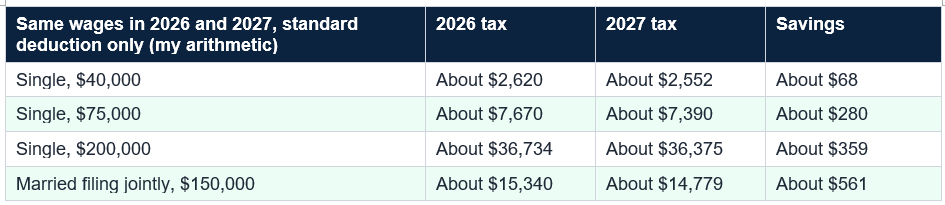
I ran simple examples: wages only, the standard deduction and no credits or other taxes. A single filer earning $75,000 in both years would have taxable income of $58,900 in 2026 and $58,400 in 2027, giving federal tax of about $7,670 and $7,390, a saving of about $280, or 3.7%. A single filer at $40,000 saves about $68 and one at $200,000 about $359, and a married couple earning $150,000 would pay about $15,340 in 2026 and $14,779 in 2027, saving about $561.These savings assume your income does not change, and most people get raises, which is the next point. The figures are also federal income tax only, excluding payroll taxes, state taxes and credits such as the child tax credit, which one site reports rising to a $2,300 maximum, a figure I could not confirm in the IRS excerpt I retrieved. Treat them as illustrations, not estimates.
Bracket Creep and Why Your Raise Matters
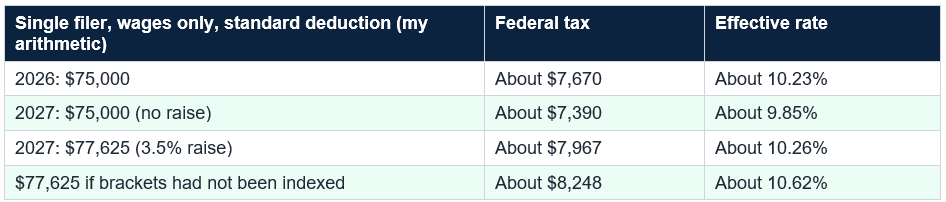
Inflation adjustments exist to prevent bracket creep: if brackets were fixed in dollars, a raise that merely matched inflation would push you toward higher rates even though your purchasing power did not grow. The IRS uses a chained consumer price index, which came to about 3.2% for 2027, but it is one national number and does not match your pay: if your income rises 3.5% and the brackets 3.2%, a little creep returns.In my illustration, a single filer earning $75,000 in 2026 who gets a 3.5% raise to $77,625 in 2027 would pay about $7,967 in federal tax, an effective rate of about 10.26% against 10.23% in 2026. Without indexing, the tax on $77,625 would be about $8,248, or 10.62%. So the adjustment still helps but gives no tax cut when pay rises faster than it, and median full-time weekly earnings rose only 1.5% in the third quarter against CPI of 3.5%, per the BLS, so many raises lag.
How Marginal Brackets Work
A common misunderstanding is that moving into a higher bracket taxes all your income at the higher rate. It does not: only the slice of taxable income inside each bracket is taxed at that rate. For a single filer in 2027, the first $12,800 is taxed at 10%, the portion from $12,801 to $52,025 at 12% and the portion above that at 22% up to $109,125, so a raise that pushes your last dollars into the 22% bracket taxes only those dollars at 22%.Your effective rate is your total tax divided by your income, and it is lower than your top bracket: a single filer with $75,000 of wages in 2027 has a top bracket of 22% but an effective federal rate of about 9.85%. You never take home less because a raise tips you into a higher bracket. The marginal rate tells you what the next dollar costs; the effective rate tells you what you actually pay.
How Much Income Fits in Each Bracket
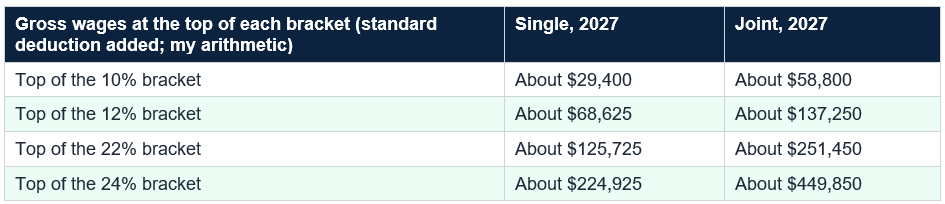
Translating taxable income into gross wages for a worker with only wages and the standard deduction: for a single filer in 2027, the 10% bracket ends at about $29,400, the 12% bracket at about $68,625, the 22% bracket at about $125,725 and the 24% bracket at about $224,925, adding the $16,600 standard deduction to each threshold. For joint filers the figures are about $58,800, $137,250, $251,450 and $449,850. In 2026 the 12% bracket ended at about $66,500 for singles and $133,000 for joint filers.These figures help planning. Near the top of a bracket, a bonus, Roth conversion or capital gain could be taxed at the next rate, while pre-tax retirement or HSA contributions could pull taxable income back down. The 12% bracket now reaches about $2,100 further for singles and $4,250 further for joint filers than in 2026, though credits, other income and state taxes will change your real figures.
Other 2027 Numbers: What Is Known and Not
Among provisions I could confirm from the IRS release, the minimum deductible for a family high-deductible health plan rises to $6,050 from $5,850 and the maximum to $9,050, up $300. One site reports the child tax credit rising to $2,300 per child and the annual gift exclusion to $20,000, but I could not confirm either in the IRS text I retrieved, and CNBC notes changes to capital gains brackets, the estate and gift exemption and the earned income tax credit that I did not retrieve in detail.Retirement plan limits are not part of this release. They are usually announced separately, and figures online are projections: Milliman projected in October a 2027 401(k) limit of $25,500, up from $24,500, and some sources report 2027 HSA limits of $4,500 (self-only) and $9,000 (family). A new federal Saver’s Match for low- and moderate-income savers also begins in 2027. Watch for the IRS announcement of the final limits.
What to Do Now
You cannot use the 2027 brackets yet, but you can prepare. First, use 2026 opportunities before December 31: increase 401(k) contributions toward the $24,500 limit and contribute to an HSA if eligible, since both lower taxable income. Second, review withholding with the IRS Tax Withholding Estimator, since wider brackets in 2027 may mean adjusting your W-4 in January. Third, recalculate any estimated payments using the new numbers.Fourth, think about the timing of income: if a bonus, Roth conversion or sale of investments would put you near the top of a bracket, knowing the 2027 thresholds helps you choose the year and amount. Fifth, check Saver’s Match eligibility and watch for the 2027 retirement limits. And keep expectations modest: the bracket changes are worth hundreds of dollars for many households, not thousands. A tax professional can help with complex income.
Look up your expected 2027 taxable income against the new bracket tops. If a planned bonus or conversion would cross a threshold, decide now whether to spread it over two years.
Common mistakes include assuming the 2027 brackets apply to the return you file next spring, believing a higher bracket taxes all your income at that rate, forgetting that a raise above 3.2% can still push more income into higher brackets, ignoring state and payroll taxes, relying on unconfirmed figures such as the child tax credit and treating projected retirement limits as official. The adjustments are modest; the best use of them is a calm review.
Conclusion
The IRS has set the 2027 tax brackets: seven unchanged rates, thresholds up about 3.2% and a standard deduction of $16,600 for single filers, $33,200 for joint filers and $24,925 for heads of household. The 37% bracket now starts above $661,375 for singles and $793,650 for couples. For a taxpayer whose income stays flat, federal tax falls modestly, about $280 for a single filer at $75,000 and $561 for a couple at $150,000 in my simplified examples. For taxpayers whose pay rises faster than the adjustment, the savings shrink or vanish.These numbers apply to 2027 income and the return you file in 2028, the 2026 return you file next spring uses this year’s figures and 2027 retirement limits have not yet been announced. Use the rest of 2026 to make pre-tax contributions, review withholding and plan the timing of income. The changes are inflation housekeeping, not a rewrite of the tax code, and they work best as a reminder to look at your plan.
Frequently Asked Questions
Did the 2027 tax rates change?No. The seven rates stay at 10%, 12%, 22%, 24%, 32%, 35% and 37%. What changed are the income thresholds where each rate starts, which the IRS raised about 3.2% for inflation in Revenue Procedure 2026-35, announced on November 5, 2026. The standard deduction also rose: to $16,600 for single filers, $33,200 for joint filers and $24,925 for heads of household.
When do the 2027 brackets apply?
To income earned in 2027, which you report on the return you file in 2028. The return you file in early 2027 covers 2026 income and uses the 2026 brackets and standard deduction: $16,100 for single filers and $32,200 for joint filers. Mixing the two years up is a common mistake.
Will I pay less tax in 2027?
Possibly, if your income does not rise faster than the 3.2% adjustment. In my illustration, a single filer earning $75,000 in both years would pay about $280 less in 2027, and a married couple earning $150,000 about $561 less. If your pay rises 3.5%, the savings mostly disappear because your income grows slightly faster than the brackets. State and payroll taxes are separate.
How do marginal tax brackets work?
Only the part of your taxable income inside each bracket is taxed at that bracket’s rate, so moving into a higher bracket does not tax all your income at the higher rate. For a single filer in 2027, the first $12,800 of taxable income is taxed at 10%, the next slice up to $52,025 at 12% and so on. Your effective rate is your total tax divided by your income, and it is lower than your top bracket.
What should I do now to prepare?
Use 2026 deadlines first: maximize 401(k) and HSA contributions before year-end if you can, review withholding with the IRS Tax Withholding Estimator, and plan raises, bonuses and Roth conversions with the new thresholds in mind. The IRS has not yet announced 2027 retirement contribution limits, so figures you see online are projections. This is general education, not personal tax advice.
0 Comments
Be the first to share your thoughts on this article.