

Taxes
7 Questions Before Taking Tax-Free Cash From Your Pension
Taking up to 25% of your pension tax-free sounds simple. The rules around it are anything but. From the £268,275 lifetime cap and the April 2027 inheritance tax change, to the MPAA trigger you must avoid and the question of whether leaving the money invested might serve you better — seven questions can save you from an expensive, irreversible mistake.
The appeal is obvious. The consequences of taking it without properly thinking through these seven questions are less obvious, and sometimes severe and permanent. Once you crystallise your pension and take your tax-free cash, you cannot take it again from the same pot. If you trigger the Money Purchase Annual Allowance (MPAA) by also taking taxable income at the same time, your ability to make future pension contributions drops from £60,000 per year to £10,000. If you fail to account for the April 2027 inheritance tax change, what you thought was an IHT-efficient strategy may need to be completely refrawn.
These seven questions are not a reason to avoid taking your tax-free cash. They are the structure of the conversation you should have with yourself, and with a qualified adviser, before you make a decision that will shape your retirement finances for the rest of your life. This guide applies to UK pensions only. Not financial advice. Free regulated guidance is available from Pension Wise (MoneyHelper) at moneyhelper.org.uk or by calling 0800 138 3944.
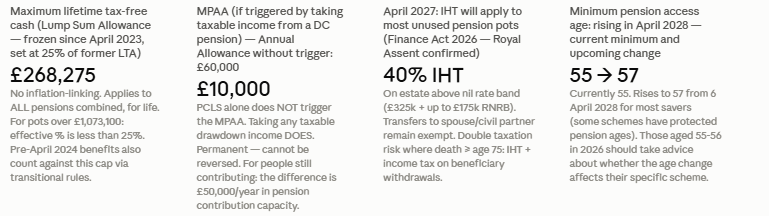
PCLS maximum: £268,275 (frozen since April 2023; set at 25% of the former £1,073,100 Lifetime Allowance; no inflation-linking; frozen going forward). Basic rule: 25% of your DC pension pot tax-free, from age 55 (rising to 57 from April 2028). Remaining 75%: taxed as income at your marginal rate when withdrawn. MPAA: £10,000/year (if triggered by taking taxable income from a DC pension). Annual Allowance 2026/27: £60,000. April 2027: IHT will apply to most unused pension funds. IHT rate: 40% on estate above nil rate band (£325,000; +£175,000 residence NRB where applicable). Double taxation risk post-April 2027: IHT + income tax on beneficiary withdrawals where death occurs aged 75 or over. Sources: GetChip June 2026; Rathbones April 2026; Menzies; PensionBee March 2026; People's Pension; BTPS; Armstrong Watson.
Your pension tax-free cash is not going anywhere if you leave it. While it sits inside your pension, it continues to grow tax-free — no income tax on growth, no capital gains tax on investment returns, and (until April 2027) outside your estate for IHT. Taking it out converts it from a tax-sheltered investment into a cash asset that is fully part of your estate, will attract income tax on its reinvested returns, and may reduce the total amount available to you over a lifetime if the investment growth it would have achieved inside the pension was substantial.
There are excellent reasons to take your tax-free cash: paying off a high-interest mortgage or significant debt, funding a known near-term expenditure (home renovation, a gift to children, a major holiday), reducing the size of a pension that, combined with other income, is likely to push you into higher-rate tax territory, or converting the cash into a tax-efficient wrapper like an ISA. But ‘because I can’ is not, by itself, a reason. Money inside a pension growing tax-free has a compounding advantage over money sitting in a bank account paying savings rate interest that is then taxed above your Personal Savings Allowance.
Test this before acting: write down the specific use of the tax-free cash you are planning. If the answer is 'I’ll put it in a savings account' or 'I’ll invest it myself,' model the post-tax return on that money outside the pension against what it would have generated inside. In most cases, money invested inside a pension grows more efficiently than the same money outside, because inside there is no income tax on dividends, no CGT on gains, and no income tax on growth until the remaining 75% is drawn. Not financial advice. Consult a qualified IFA.
The cap applies to the total tax-free cash you take across your lifetime and across all your pension schemes combined. If you took £50,000 in tax-free cash from one pension five years ago, your remaining LSA is £218,275. If you take £50,000 now from a different pension, your remaining LSA reduces again. If you take it all from a single crystallisation event, the remaining LSA is zero and no further tax-free cash is available from any pension, ever.
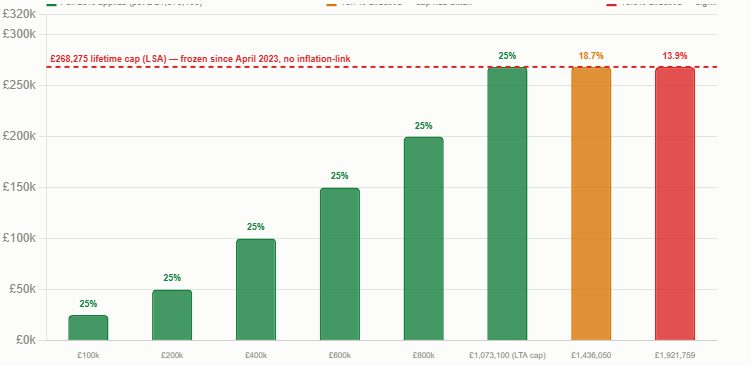
For most people with pension pots below £1,073,100, the basic 25% rule is straightforward: you can take 25% of your pot tax-free up to the £268,275 cap. But for those with larger pots, the effective tax-free percentage is lower. A pension of £1,436,050 yields the same £268,275 in tax-free cash — but that is only 18.7%, not 25%. A pension of £1,921,759 is still limited to £268,275 in tax-free cash, or just 13.9% of the pot (Armstrong Watson).
Individuals who accessed pension benefits before 6 April 2024 need to understand the transitional rules. Rathbones (updated 7 April 2026) explains that a Transitional Tax-Free Amount Certificate (TTFAC) can ensure that individuals who have already taken less than 25% of their pension retain the right to take up to 25% going forward. However, this requires application and professional guidance, and once granted, cannot be revoked. Anyone who had pension benefits in payment before April 2024 should take specific advice on their TTFAC position before taking further tax-free cash.
The Rule: The Lump Sum Allowance (£268,275) is a LIFETIME allowance across ALL pensions, not a per-pension or per-year allowance. Tax-free cash taken from any pension at any time counts against it. Benefits crystallised before April 2024 also count (via transitional rules). If you have pension protections (Enhanced Protection, Individual Protection), your entitlement may be higher. If your pot exceeds £1,073,100, you will receive less than 25% tax-free even though the rule says '25%'. Source: GetChip June 2026; Armstrong Watson; Rathbones April 2026; Fiscari/Glasscubes; BTPS. Not financial or tax advice.
The most common tax pitfall when taking pension tax-free cash is taking a large PCLS alongside significant taxable income in the same tax year. Although the PCLS is tax-free, any taxable pension income drawn in the same year — from the remaining 75% in drawdown, or from other income sources — is added to your total income and taxed at your marginal rate. If the combination of State Pension, employment income, rental income, or drawdown withdrawals already fills your basic rate band (£50,270 in 2026/27), then any additional taxable pension income drawn on top would be taxed at 40%.
A separate but related consideration is emergency tax. HMRC may not have an up-to-date tax code for your pension provider, particularly if this is the first payment. In this case, the first lump sum payment may be taxed at emergency rate (often equivalent to a month-one basis, which significantly overstates the tax due for a year). You can reclaim the overpaid tax from HMRC, but it takes time and requires submitting the correct form (P55, P53Z, or P50Z depending on your circumstances). Planning the timing and taking professional advice can avoid the emergency tax complication entirely.
For higher earners: taking large pension withdrawals in a year when your adjusted income already approaches or exceeds £100,000 can reduce or eliminate your Personal Allowance (which is reduced by £1 for every £2 of income above £100,000). This creates an effective 60% marginal tax rate on income between £100,000 and £125,140. For anyone in this position, the timing of pension withdrawals — including the choice of tax year — is a critical planning consideration.
Emergency tax on the first pension payment is a very common problem. Pension providers typically apply an emergency tax code (1257L on a month-one basis) to the first taxable pension payment if no proper tax code is held. On a £10,000 drawdown payment, this can result in £4,000-£5,000 being withheld in tax when the true annual liability might be much lower. The PCLS itself is not subject to emergency tax (it is paid gross). But if you take PCLS and a taxable drawdown withdrawal simultaneously, the taxable element may attract emergency tax. Reclaim using HMRC form P55 (if you are not taking regular payments) or P53Z/P50Z if you have taken all the money from the pension. Not tax advice. Consult HMRC or a qualified tax adviser.
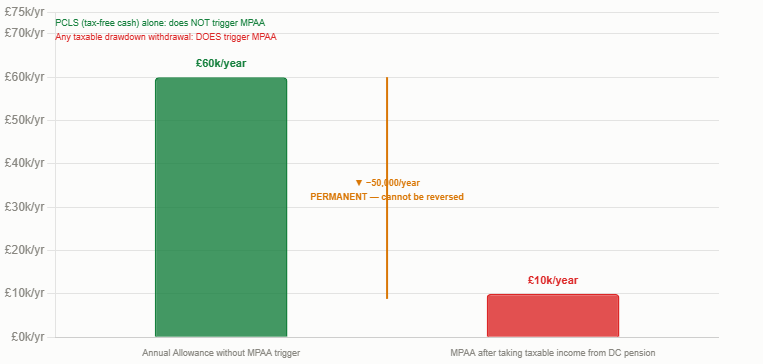
The critical distinction is this: taking your PCLS (tax-free cash) alone does NOT trigger the MPAA. Taking taxable income from your DC pension DOES. This means it is possible to crystallise your pension pot, take the 25% PCLS, and move the remaining 75% into a flexi-access drawdown arrangement without triggering the MPAA — provided you do not immediately draw any taxable income from the drawdown pot. You retain the full £60,000 annual allowance and can continue making substantial pension contributions.
The MPAA matters most to people who are still working, still contributing to a pension, and who might be tempted to access their pension early (perhaps from a previous employer’s scheme) while continuing to build their current workplace pension. If they take taxable income from the old pension, even a relatively small amount, the MPAA is triggered and their ability to benefit from the tax efficiency of large pension contributions is permanently curtailed. The MPAA cannot be reversed once triggered.
For those who are retired and have no intention of making further pension contributions, the MPAA is less relevant. But for anyone still in employment — particularly higher earners who benefit significantly from higher-rate tax relief on pension contributions — the MPAA trigger is potentially among the most expensive mistakes available in retirement planning.
The Rule: Taking PCLS (tax-free cash) alone: does NOT trigger the MPAA. Moving the remaining 75% into flexi-access drawdown without withdrawing any taxable income: does NOT trigger the MPAA. Taking a UFPLS (which is partly tax-free, partly taxable): DOES trigger the MPAA. Taking any taxable drawdown withdrawal: DOES trigger the MPAA. MPAA 2026/27: £10,000. No carry forward once MPAA is triggered. Sources: Heidelberg Materials pensions; Menzies; Compare Drawdown 2026; BTPS. Not financial or tax advice.
Flexi-access drawdown keeps your money invested and gives you flexibility to withdraw taxable income at a pace that suits your tax position year by year. It is well-suited to people who have other income in early retirement (employment, rental income, other pensions) and do not need large immediate withdrawals from the 75%. The investment remains inside the pension wrapper, growing largely free of tax, until you choose to withdraw it. The downside is investment risk and longevity risk — if you live longer than expected or markets underperform, the pot may deplete more quickly than planned.
An annuity converts the 75% (or a portion of it) into a guaranteed income for life. Annuity rates have improved significantly since 2022 as interest rates have risen: a healthy 65-year-old can now typically secure a level income of approximately 6-7% of the annuity purchase price annually, with enhanced rates available for health conditions. The guarantee of income for life eliminates longevity risk but forfeits flexibility and investment upside. A level annuity also loses real value to inflation unless an inflation-linked version is purchased, which is significantly more expensive.
A less commonly used but sometimes appropriate option is to phase crystallisation over multiple years. Rather than crystallising the entire pension pot at once, you crystallise a proportion each year — taking the PCLS on each slice and drawing only the income needed. This spreads the taxable income across multiple tax years, potentially keeping withdrawals within the basic rate band each year, and delays the crystallisation of the remaining fund (which continues to grow tax-free inside the pension on an uncrystallised basis).
Phased crystallisation is particularly valuable for people who retire before their State Pension age: they have a window of potentially several years with lower total income, during which the first £12,570 (Personal Allowance) of each year’s pension income is tax-free. Taking regular annual slices that generate £12,570 in taxable income per year, combined with tax-free cash on each slice, can significantly improve the overall tax efficiency of pension drawdown compared to crystallising everything at once. Not financial or tax advice. Consult a qualified IFA.
From April 2027 (Finance Act 2026, which has received Royal Assent), most unused pension funds will be included in the estate for IHT. If the estate — now including the pension pot — exceeds the available nil rate band (£325,000 standard; £175,000 residence nil rate band where applicable; up to £1 million combined for married couples and civil partnerships), the excess will be subject to IHT at 40%. Transfers to spouses and civil partners remain IHT-exempt. Transfers to children, grandchildren, and other beneficiaries above the available nil rate band are no longer exempt.
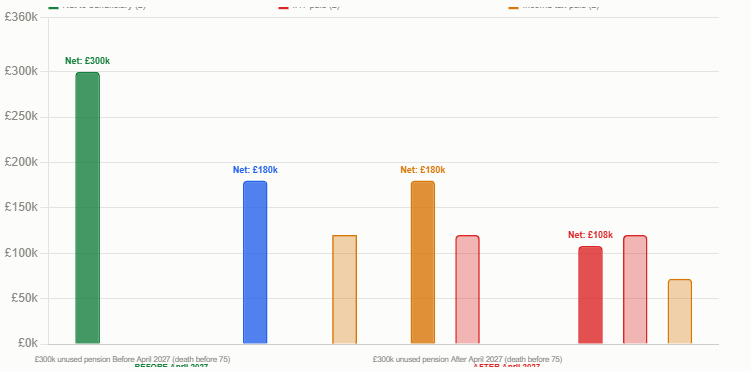
The double taxation risk deserves specific attention. Where the pension holder dies at or after age 75, beneficiaries face both IHT (40%) on the pension pot and income tax at their marginal rate on withdrawals from the inherited pension. PensionBee’s analysis (March 2026) gives a clear illustration: if a £500,000 pension pot is inherited by a child, and the nil rate band has been used by other estate assets, IHT at 40% on £500,000 = £200,000. The remaining £300,000 in the inherited pension is then subject to income tax at the child’s marginal rate as they withdraw it. A higher-rate taxpaying child pays 40% on withdrawals, netting approximately £180,000 from the original £500,000.
The April 2027 change does not alter the mechanics of PCLS: you can still take up to 25% of your pension pot tax-free up to £268,275. But it changes the strategic context. The pension pot is no longer automatically the most IHT-efficient asset to preserve. For some individuals, the calculus now favours spending down the pension during lifetime (and specifically using the tax-free cash to fund spending, ISA contributions, or gifts) while preserving other assets that receive step-up treatment on death or benefit from the CGT-free uplift at death. For others, the pension remains the right asset to preserve. The change simply means the analysis is now necessary rather than automatic.
April 2027 strategic implications for your PCLS decision: (1) The argument for using the pension last (because it was IHT-exempt) is now weakened -- the pension pot will face IHT in most estates. (2) Taking the PCLS and investing it into an ISA preserves the money inside a tax-free wrapper where it grows free of income and CGT tax on returns, while potentially reducing the taxable pension pot. (3) Gifts from the PCLS (within annual exemptions and using potentially exempt transfers subject to 7-year rule) could reduce the overall estate tax liability. (4) The case for reviewing expressions of wish with your pension provider is now urgent -- beneficiary nominations and estate planning should be reviewed in conjunction with the April 2027 change. Source: Rathbones (February 2026, updated April 2026); PensionBee March 2026; People's Pension; Menzies 2026; Nucleus Financial. Not financial, tax, or legal advice.
The case for taking it earlier is clearest when: you have an immediate and specific use for the capital that represents a higher return than leaving the money invested; you are concerned about rule changes (although the current government has confirmed that tax-free cash is a permanent feature of the system and has no plans to change it); or your estate planning objectives make withdrawing and reinvesting in an ISA or gifting the money the more tax-efficient route, particularly in the context of the April 2027 IHT change.
The case for deferring is clearest when: you are still in employment and do not need the income; the pension remains invested in a well-diversified portfolio with reasonable expected returns that exceed what you can achieve with the money outside the pension; your taxable income is already filling the basic or higher rate band, making taxable pension withdrawals expensive; or you are below your State Pension age and expect a period of lower income in retirement where phased withdrawals would be more tax-efficient.
The minimum pension age rises from 55 to 57 on 6 April 2028 for most savers. If you are 55 or 56 in 2026 and would like flexibility before the age change potentially affects schemes with protected pension ages, this is a specific timing consideration worth discussing with an adviser. The interaction between the minimum pension age change and individual scheme rules is complex and depends on the specific pension.
The most important timing consideration for many people in 2026 is the April 2027 IHT change. For those whose estate planning has been built around the pension as an IHT-free legacy vehicle, the April 2027 change removes the core rationale for that strategy. The 2026/27 tax year is the last full tax year in which the old rules apply, making it ‘one of the final opportunities to review pension strategies under the existing regime,’ as Menzies puts it.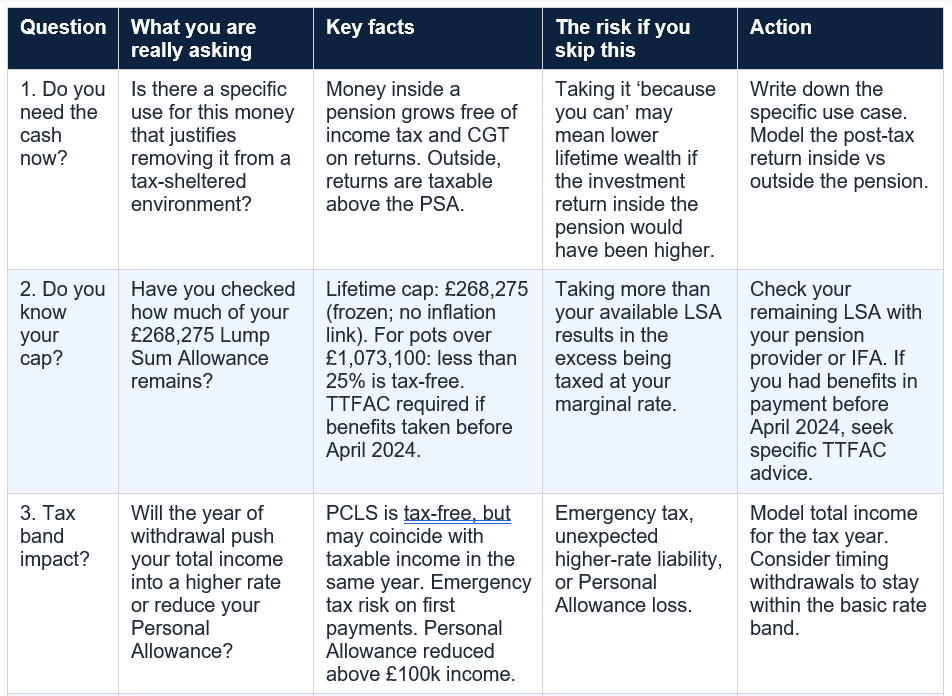
But the value of the benefit is not the same as the value of taking it immediately, or taking all of it at once, or taking it without a plan for the remaining 75%. The seven questions in this guide are not designed to create doubt about whether to take your tax-free cash at all. They are designed to ensure that when you do take it, you take it at the right time, in the right amount, in the right tax year, with a clear plan for the remaining 75%, without accidentally triggering the MPAA, with full awareness of the £268,275 lifetime cap, and with the April 2027 IHT change factored into your estate planning.
The one action that this guide most strongly recommends before any pension access decision: book a Pension Wise appointment (free, at moneyhelper.org.uk or 0800 138 3944) and, if your circumstances are at all complex, follow that with a session with a qualified independent financial adviser. The cost of good advice is modest relative to the cost of a misstep on a decision that cannot be reversed. Not financial, tax, or legal advice.
Yes, in most cases. You can crystallise your pension pot, take the PCLS (up to 25% of the crystallised amount, subject to the £268,275 lifetime cap), and move the remaining 75% into a flexi-access drawdown arrangement without immediately drawing any taxable income. This does not trigger the MPAA, and the remaining 75% continues to grow inside the pension wrapper until you choose to withdraw it. Whether your specific pension scheme allows this depends on the scheme rules — not all schemes offer drawdown; some require you to transfer to a SIPP or similar to access it. Contact your pension provider to confirm what options are available. Not financial advice. Free guidance: Pension Wise at moneyhelper.org.uk.
Does taking pension tax-free cash count as income?
No. The Pension Commencement Lump Sum (PCLS) — your 25% tax-free cash — is completely free of income tax and does not count as income for any purpose: not for Personal Allowance calculations, not for the Personal Savings Allowance, not for MPAA trigger purposes, and not for Child Benefit High Income Tax Charge calculations. It is received gross, in full, with no withholding tax. Once received, however, it is a capital sum that forms part of your estate, and any returns generated by investing it outside a tax-free wrapper (an ISA, for example) will be subject to the normal income and capital gains tax rules that apply to your other investments. Not tax advice. Consult HMRC or a qualified tax adviser for guidance specific to your circumstances.
Does taking pension tax-free cash trigger the MPAA?
Taking the PCLS (tax-free cash) alone does not trigger the MPAA. The MPAA (£10,000 per year, 2026/27) is triggered when you take taxable income from a defined contribution pension — for example, a drawdown withdrawal, an Uncrystallised Fund Pension Lump Sum (UFPLS) that includes a taxable element, or any other taxable payment from a money purchase scheme. If you take the PCLS and move the remaining 75% to flexi-access drawdown without making any taxable withdrawals, the MPAA is not triggered and your annual allowance remains at £60,000. This distinction is critical for people still working and making pension contributions. Source: Heidelberg Materials pensions; Menzies; Compare Drawdown 2026. Not financial or tax advice.
How does the April 2027 pension IHT change affect my tax-free cash decision?
The April 2027 change — under which unused pension pots will be brought into the estate for IHT from 6 April 2027 — changes the strategic context for pension tax-free cash decisions in two key ways. First, it weakens the rationale for leaving money in the pension indefinitely as an IHT-free legacy vehicle, because from April 2027 the pension will face potential IHT at 40% on the amount above the nil rate band (just like other estate assets). Second, it makes the 2026/27 tax year strategically important: it is the last full tax year in which the old rules apply, and some individuals are reviewing their pension drawdown and estate planning strategies accordingly. Taking the PCLS and placing it in an ISA (where it grows free of income and CGT tax and does not currently attract IHT in the same way as a pension) is one strategy. Gifting from the PCLS within available exemptions is another. The right approach depends entirely on your individual circumstances, estate size, and family situation. Consult a qualified IFA and solicitor. Source: Rathbones April 2026; PensionBee March 2026; People's Pension; Menzies 2026. Not financial, tax, or legal advice.
What is the maximum pension tax-free cash I can take in my lifetime?
The maximum tax-free cash you can take across your lifetime from all pensions combined is £268,275 (the Lump Sum Allowance, or LSA, set at 25% of the former Lifetime Allowance of £1,073,100). This cap was introduced when the Lifetime Allowance was abolished from 6 April 2024. It is frozen — there is no inflation-linking and no mechanism in current legislation to increase it. If your total pension savings are below £1,073,100, you can take 25% of each pot tax-free, up to the £268,275 total cap. If your pension pot exceeds £1,073,100, the effective tax-free percentage is less than 25% (for example, a £1,436,050 pot yields £268,275 in tax-free cash, which is 18.7%, not 25%). Any tax-free cash taken before April 2024 also counts against the cap via transitional rules. Source: GetChip June 2026; Armstrong Watson; Rathbones April 2026; BTPS; Hodsons. Not financial or tax advice. Free guidance from Pension Wise at moneyhelper.org.uk.
Table of Contents
- The Decision That Cannot Be Undone
- Question 1: Do You Actually Need the Cash Right Now?
- Question 2: Do You Know the Lifetime Cap and What Counts Against It?
- Question 3: Will Taking the Money Push You Into a Higher Tax Band?
- Question 4: Will You Trigger the MPAA and Why Does That Matter?
- Question 5: What Happens to the Remaining 75%?
- Question 6: How Does the April 2027 IHT Change Affect Your Decision?
- Question 7: Is This the Right Time, or Would Later Work Better?
- The 7 Questions at a Glance: A Decision Summary Table
- Getting Help: Free Guidance and Professional Advice
- Conclusion: Take It With Open Eyes
- Frequently Asked Questions
The £268,275 cap — what different pot sizes actually get
The MPAA trap — what triggers it and what it costs
April 2027 IHT change — the strategic impact
The Decision That Cannot Be Undone
Taking your 25% pension tax-free cash — formally called the Pension Commencement Lump Sum, or PCLS — is one of the most financially significant decisions in retirement planning. It is widely described as a key perk of the UK pension system: the ability to take a quarter of your pension pot completely free of income tax, regardless of what you do with it. For a £200,000 pension pot, that is £50,000 tax-free. For a £400,000 pot, it is £100,000. The maximum is £268,275.The appeal is obvious. The consequences of taking it without properly thinking through these seven questions are less obvious, and sometimes severe and permanent. Once you crystallise your pension and take your tax-free cash, you cannot take it again from the same pot. If you trigger the Money Purchase Annual Allowance (MPAA) by also taking taxable income at the same time, your ability to make future pension contributions drops from £60,000 per year to £10,000. If you fail to account for the April 2027 inheritance tax change, what you thought was an IHT-efficient strategy may need to be completely refrawn.
These seven questions are not a reason to avoid taking your tax-free cash. They are the structure of the conversation you should have with yourself, and with a qualified adviser, before you make a decision that will shape your retirement finances for the rest of your life. This guide applies to UK pensions only. Not financial advice. Free regulated guidance is available from Pension Wise (MoneyHelper) at moneyhelper.org.uk or by calling 0800 138 3944.
PCLS maximum: £268,275 (frozen since April 2023; set at 25% of the former £1,073,100 Lifetime Allowance; no inflation-linking; frozen going forward). Basic rule: 25% of your DC pension pot tax-free, from age 55 (rising to 57 from April 2028). Remaining 75%: taxed as income at your marginal rate when withdrawn. MPAA: £10,000/year (if triggered by taking taxable income from a DC pension). Annual Allowance 2026/27: £60,000. April 2027: IHT will apply to most unused pension funds. IHT rate: 40% on estate above nil rate band (£325,000; +£175,000 residence NRB where applicable). Double taxation risk post-April 2027: IHT + income tax on beneficiary withdrawals where death occurs aged 75 or over. Sources: GetChip June 2026; Rathbones April 2026; Menzies; PensionBee March 2026; People's Pension; BTPS; Armstrong Watson.
Question 1: Do You Actually Need the Cash Right Now?
The Question: Before anything else: what are you going to do with the money? Do you need it now, and if so, for what specifically?
This sounds like a simple question. It is not. The decision to take your pension tax-free cash is often driven by a feeling that you ‘should’ take it rather than a specific, concrete need for the money. The logic goes: ‘It’s mine, it’s tax-free, and I might as well have it before the rules change.’ All three parts of that instinct deserve examination.Your pension tax-free cash is not going anywhere if you leave it. While it sits inside your pension, it continues to grow tax-free — no income tax on growth, no capital gains tax on investment returns, and (until April 2027) outside your estate for IHT. Taking it out converts it from a tax-sheltered investment into a cash asset that is fully part of your estate, will attract income tax on its reinvested returns, and may reduce the total amount available to you over a lifetime if the investment growth it would have achieved inside the pension was substantial.
There are excellent reasons to take your tax-free cash: paying off a high-interest mortgage or significant debt, funding a known near-term expenditure (home renovation, a gift to children, a major holiday), reducing the size of a pension that, combined with other income, is likely to push you into higher-rate tax territory, or converting the cash into a tax-efficient wrapper like an ISA. But ‘because I can’ is not, by itself, a reason. Money inside a pension growing tax-free has a compounding advantage over money sitting in a bank account paying savings rate interest that is then taxed above your Personal Savings Allowance.
Test this before acting: write down the specific use of the tax-free cash you are planning. If the answer is 'I’ll put it in a savings account' or 'I’ll invest it myself,' model the post-tax return on that money outside the pension against what it would have generated inside. In most cases, money invested inside a pension grows more efficiently than the same money outside, because inside there is no income tax on dividends, no CGT on gains, and no income tax on growth until the remaining 75% is drawn. Not financial advice. Consult a qualified IFA.
Question 2: Do You Know the Lifetime Cap and What Counts Against It?
The Question: Have you checked how much of your £268,275 Lump Sum Allowance is still available, and whether you have any pension protections that alter your entitlement?
The maximum tax-free cash most people in the UK can take across their lifetime is £268,275. This is the Lump Sum Allowance (LSA), which replaced the old 25%-of-Lifetime-Allowance calculation when the Lifetime Allowance was abolished from April 2024. The £268,275 figure was set at 25% of the former LTA of £1,073,100 and is frozen at this level — there is no inflation-linking and no mechanism in the current legislation to increase it.The cap applies to the total tax-free cash you take across your lifetime and across all your pension schemes combined. If you took £50,000 in tax-free cash from one pension five years ago, your remaining LSA is £218,275. If you take £50,000 now from a different pension, your remaining LSA reduces again. If you take it all from a single crystallisation event, the remaining LSA is zero and no further tax-free cash is available from any pension, ever.
For most people with pension pots below £1,073,100, the basic 25% rule is straightforward: you can take 25% of your pot tax-free up to the £268,275 cap. But for those with larger pots, the effective tax-free percentage is lower. A pension of £1,436,050 yields the same £268,275 in tax-free cash — but that is only 18.7%, not 25%. A pension of £1,921,759 is still limited to £268,275 in tax-free cash, or just 13.9% of the pot (Armstrong Watson).
Individuals who accessed pension benefits before 6 April 2024 need to understand the transitional rules. Rathbones (updated 7 April 2026) explains that a Transitional Tax-Free Amount Certificate (TTFAC) can ensure that individuals who have already taken less than 25% of their pension retain the right to take up to 25% going forward. However, this requires application and professional guidance, and once granted, cannot be revoked. Anyone who had pension benefits in payment before April 2024 should take specific advice on their TTFAC position before taking further tax-free cash.
The Rule: The Lump Sum Allowance (£268,275) is a LIFETIME allowance across ALL pensions, not a per-pension or per-year allowance. Tax-free cash taken from any pension at any time counts against it. Benefits crystallised before April 2024 also count (via transitional rules). If you have pension protections (Enhanced Protection, Individual Protection), your entitlement may be higher. If your pot exceeds £1,073,100, you will receive less than 25% tax-free even though the rule says '25%'. Source: GetChip June 2026; Armstrong Watson; Rathbones April 2026; Fiscari/Glasscubes; BTPS. Not financial or tax advice.
Question 3: Will Taking the Money Push You Into a Higher Tax Band?
The Question: Have you modelled the income tax impact of taking your tax-free cash in this tax year, particularly if you are also drawing taxable pension income?
The tax-free cash itself creates no income tax liability. But the decision of when and how much to take, and what you do with the remaining 75%, can have significant income tax consequences that are worth thinking through carefully.The most common tax pitfall when taking pension tax-free cash is taking a large PCLS alongside significant taxable income in the same tax year. Although the PCLS is tax-free, any taxable pension income drawn in the same year — from the remaining 75% in drawdown, or from other income sources — is added to your total income and taxed at your marginal rate. If the combination of State Pension, employment income, rental income, or drawdown withdrawals already fills your basic rate band (£50,270 in 2026/27), then any additional taxable pension income drawn on top would be taxed at 40%.
A separate but related consideration is emergency tax. HMRC may not have an up-to-date tax code for your pension provider, particularly if this is the first payment. In this case, the first lump sum payment may be taxed at emergency rate (often equivalent to a month-one basis, which significantly overstates the tax due for a year). You can reclaim the overpaid tax from HMRC, but it takes time and requires submitting the correct form (P55, P53Z, or P50Z depending on your circumstances). Planning the timing and taking professional advice can avoid the emergency tax complication entirely.
For higher earners: taking large pension withdrawals in a year when your adjusted income already approaches or exceeds £100,000 can reduce or eliminate your Personal Allowance (which is reduced by £1 for every £2 of income above £100,000). This creates an effective 60% marginal tax rate on income between £100,000 and £125,140. For anyone in this position, the timing of pension withdrawals — including the choice of tax year — is a critical planning consideration.
Emergency tax on the first pension payment is a very common problem. Pension providers typically apply an emergency tax code (1257L on a month-one basis) to the first taxable pension payment if no proper tax code is held. On a £10,000 drawdown payment, this can result in £4,000-£5,000 being withheld in tax when the true annual liability might be much lower. The PCLS itself is not subject to emergency tax (it is paid gross). But if you take PCLS and a taxable drawdown withdrawal simultaneously, the taxable element may attract emergency tax. Reclaim using HMRC form P55 (if you are not taking regular payments) or P53Z/P50Z if you have taken all the money from the pension. Not tax advice. Consult HMRC or a qualified tax adviser.
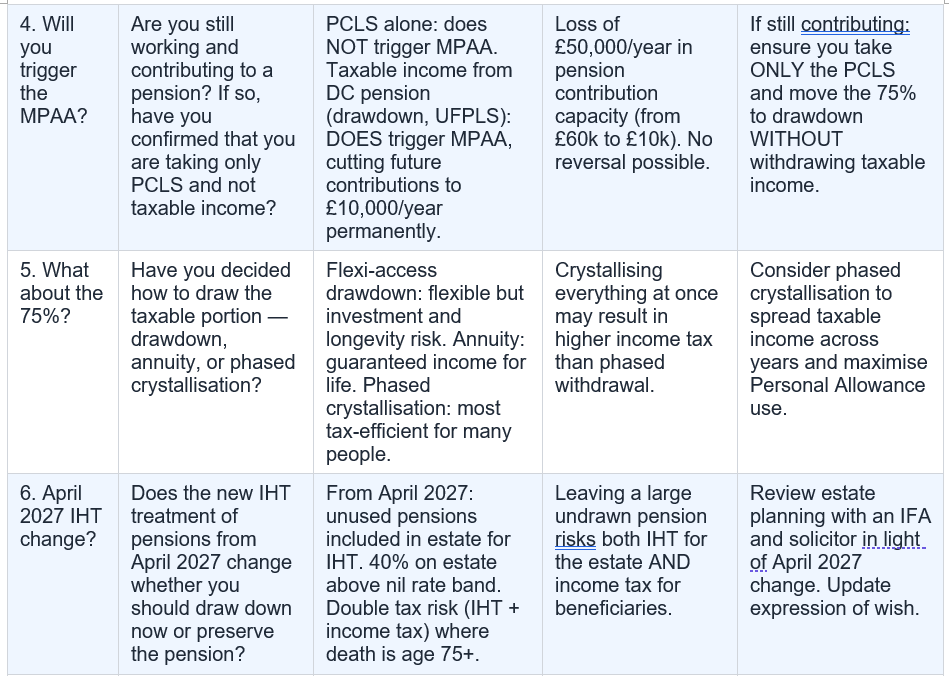
Question 4: Will You Trigger the MPAA and Why Does That Matter?
The Question: Are you still working and contributing to a pension? If so, have you understood the difference between taking PCLS and taking taxable income from your pension — and which one triggers the MPAA?
The Money Purchase Annual Allowance (MPAA) is one of the most consequential and least understood rules in UK pension planning. It works as follows: once you begin drawing taxable income from a defined contribution (DC) pension — through flexi-access drawdown withdrawals, Uncrystallised Fund Pension Lump Sum (UFPLS) payments, or any other taxable payment from a DC pension — the amount you can pay into any DC pension in the future without facing a tax charge drops from £60,000 to £10,000 per year. Crucially, no carry forward of unused annual allowance is available once the MPAA is triggered.The critical distinction is this: taking your PCLS (tax-free cash) alone does NOT trigger the MPAA. Taking taxable income from your DC pension DOES. This means it is possible to crystallise your pension pot, take the 25% PCLS, and move the remaining 75% into a flexi-access drawdown arrangement without triggering the MPAA — provided you do not immediately draw any taxable income from the drawdown pot. You retain the full £60,000 annual allowance and can continue making substantial pension contributions.
The MPAA matters most to people who are still working, still contributing to a pension, and who might be tempted to access their pension early (perhaps from a previous employer’s scheme) while continuing to build their current workplace pension. If they take taxable income from the old pension, even a relatively small amount, the MPAA is triggered and their ability to benefit from the tax efficiency of large pension contributions is permanently curtailed. The MPAA cannot be reversed once triggered.
For those who are retired and have no intention of making further pension contributions, the MPAA is less relevant. But for anyone still in employment — particularly higher earners who benefit significantly from higher-rate tax relief on pension contributions — the MPAA trigger is potentially among the most expensive mistakes available in retirement planning.
The Rule: Taking PCLS (tax-free cash) alone: does NOT trigger the MPAA. Moving the remaining 75% into flexi-access drawdown without withdrawing any taxable income: does NOT trigger the MPAA. Taking a UFPLS (which is partly tax-free, partly taxable): DOES trigger the MPAA. Taking any taxable drawdown withdrawal: DOES trigger the MPAA. MPAA 2026/27: £10,000. No carry forward once MPAA is triggered. Sources: Heidelberg Materials pensions; Menzies; Compare Drawdown 2026; BTPS. Not financial or tax advice.
Question 5: What Happens to the Remaining 75%?
The Question: Have you decided what to do with the taxable 75% of your crystallised pension, and does that decision align with your income needs, tax position, and estate planning objectives?
The decision about the tax-free cash is inseparable from the decision about the remaining 75%. When you crystallise your pension and take the PCLS, the remaining 75% of the crystallised amount must be used for one of the following: placed into flexi-access drawdown (from which you can take taxable income as and when you need it); used to purchase an annuity (a guaranteed income for life); taken as further taxable lump sums; or a combination of these. Understanding which option or combination is right for your circumstances is at least as important as the decision to take the PCLS itself.Flexi-access drawdown keeps your money invested and gives you flexibility to withdraw taxable income at a pace that suits your tax position year by year. It is well-suited to people who have other income in early retirement (employment, rental income, other pensions) and do not need large immediate withdrawals from the 75%. The investment remains inside the pension wrapper, growing largely free of tax, until you choose to withdraw it. The downside is investment risk and longevity risk — if you live longer than expected or markets underperform, the pot may deplete more quickly than planned.
An annuity converts the 75% (or a portion of it) into a guaranteed income for life. Annuity rates have improved significantly since 2022 as interest rates have risen: a healthy 65-year-old can now typically secure a level income of approximately 6-7% of the annuity purchase price annually, with enhanced rates available for health conditions. The guarantee of income for life eliminates longevity risk but forfeits flexibility and investment upside. A level annuity also loses real value to inflation unless an inflation-linked version is purchased, which is significantly more expensive.
A less commonly used but sometimes appropriate option is to phase crystallisation over multiple years. Rather than crystallising the entire pension pot at once, you crystallise a proportion each year — taking the PCLS on each slice and drawing only the income needed. This spreads the taxable income across multiple tax years, potentially keeping withdrawals within the basic rate band each year, and delays the crystallisation of the remaining fund (which continues to grow tax-free inside the pension on an uncrystallised basis).
Phased crystallisation is particularly valuable for people who retire before their State Pension age: they have a window of potentially several years with lower total income, during which the first £12,570 (Personal Allowance) of each year’s pension income is tax-free. Taking regular annual slices that generate £12,570 in taxable income per year, combined with tax-free cash on each slice, can significantly improve the overall tax efficiency of pension drawdown compared to crystallising everything at once. Not financial or tax advice. Consult a qualified IFA.
Question 6: How Does the April 2027 IHT Change Affect Your Decision?
The Question: Have you understood how the Finance Act 2026’s change to pension inheritance tax affects your pension as a legacy vehicle, and does it change your tax-free cash strategy?
From 6 April 2027, the rules on pension inheritance change fundamentally. Under current rules (before April 2027), unused pension funds sit outside the estate for inheritance tax purposes. They can accumulate without income tax or capital gains tax on growth, and on death they pass to nominated beneficiaries without IHT. This has made undrawn pension pots a highly effective estate planning vehicle, and many advisers have recommended drawing on other assets first and preserving the pension as long as possible precisely because of its IHT exemption.From April 2027 (Finance Act 2026, which has received Royal Assent), most unused pension funds will be included in the estate for IHT. If the estate — now including the pension pot — exceeds the available nil rate band (£325,000 standard; £175,000 residence nil rate band where applicable; up to £1 million combined for married couples and civil partnerships), the excess will be subject to IHT at 40%. Transfers to spouses and civil partners remain IHT-exempt. Transfers to children, grandchildren, and other beneficiaries above the available nil rate band are no longer exempt.
The double taxation risk deserves specific attention. Where the pension holder dies at or after age 75, beneficiaries face both IHT (40%) on the pension pot and income tax at their marginal rate on withdrawals from the inherited pension. PensionBee’s analysis (March 2026) gives a clear illustration: if a £500,000 pension pot is inherited by a child, and the nil rate band has been used by other estate assets, IHT at 40% on £500,000 = £200,000. The remaining £300,000 in the inherited pension is then subject to income tax at the child’s marginal rate as they withdraw it. A higher-rate taxpaying child pays 40% on withdrawals, netting approximately £180,000 from the original £500,000.
The April 2027 change does not alter the mechanics of PCLS: you can still take up to 25% of your pension pot tax-free up to £268,275. But it changes the strategic context. The pension pot is no longer automatically the most IHT-efficient asset to preserve. For some individuals, the calculus now favours spending down the pension during lifetime (and specifically using the tax-free cash to fund spending, ISA contributions, or gifts) while preserving other assets that receive step-up treatment on death or benefit from the CGT-free uplift at death. For others, the pension remains the right asset to preserve. The change simply means the analysis is now necessary rather than automatic.
April 2027 strategic implications for your PCLS decision: (1) The argument for using the pension last (because it was IHT-exempt) is now weakened -- the pension pot will face IHT in most estates. (2) Taking the PCLS and investing it into an ISA preserves the money inside a tax-free wrapper where it grows free of income and CGT tax on returns, while potentially reducing the taxable pension pot. (3) Gifts from the PCLS (within annual exemptions and using potentially exempt transfers subject to 7-year rule) could reduce the overall estate tax liability. (4) The case for reviewing expressions of wish with your pension provider is now urgent -- beneficiary nominations and estate planning should be reviewed in conjunction with the April 2027 change. Source: Rathbones (February 2026, updated April 2026); PensionBee March 2026; People's Pension; Menzies 2026; Nucleus Financial. Not financial, tax, or legal advice.
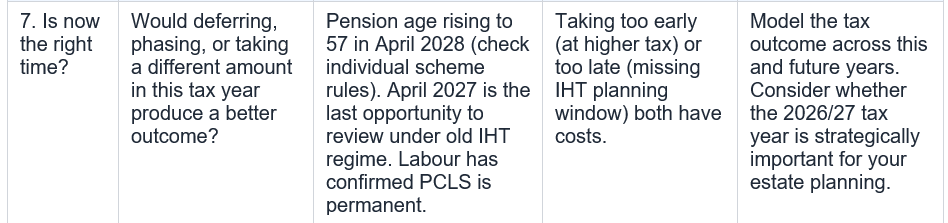
Question 7: Is This the Right Time, or Would Later Work Better?
The Question: Have you considered whether taking your tax-free cash now, at this age and in this tax year, is more beneficial than taking it in a future year when your circumstances may be different?
The timing of your PCLS is a genuine planning variable, not a fixed event. You do not have to take your tax-free cash at 55 (or 57 from April 2028), or at retirement, or all at once. The phased approach — crystallising the pension in stages over multiple years, taking the tax-free element on each slice — is available on most modern pension platforms and is a powerful tool for tax-efficient retirement income.The case for taking it earlier is clearest when: you have an immediate and specific use for the capital that represents a higher return than leaving the money invested; you are concerned about rule changes (although the current government has confirmed that tax-free cash is a permanent feature of the system and has no plans to change it); or your estate planning objectives make withdrawing and reinvesting in an ISA or gifting the money the more tax-efficient route, particularly in the context of the April 2027 IHT change.
The case for deferring is clearest when: you are still in employment and do not need the income; the pension remains invested in a well-diversified portfolio with reasonable expected returns that exceed what you can achieve with the money outside the pension; your taxable income is already filling the basic or higher rate band, making taxable pension withdrawals expensive; or you are below your State Pension age and expect a period of lower income in retirement where phased withdrawals would be more tax-efficient.
The minimum pension age rises from 55 to 57 on 6 April 2028 for most savers. If you are 55 or 56 in 2026 and would like flexibility before the age change potentially affects schemes with protected pension ages, this is a specific timing consideration worth discussing with an adviser. The interaction between the minimum pension age change and individual scheme rules is complex and depends on the specific pension.
The most important timing consideration for many people in 2026 is the April 2027 IHT change. For those whose estate planning has been built around the pension as an IHT-free legacy vehicle, the April 2027 change removes the core rationale for that strategy. The 2026/27 tax year is the last full tax year in which the old rules apply, making it ‘one of the final opportunities to review pension strategies under the existing regime,’ as Menzies puts it.
The 7 Questions at a Glance: A Decision Summary Table
Getting Help: Free Guidance and Professional Advice
Pension decisions are among the most consequential financial decisions you will make, and many of the rules described in this guide have specific personal applications that depend on your individual circumstances, income, pension pot size, age, health, and estate. General information is a starting point, not a substitute for personalised guidance.- Pension Wise (MoneyHelper): free, government-backed regulated guidance for people aged 50 and over approaching pension access. Provides a one-to-one session (phone or in person) covering your options, the rules, and the questions to ask before taking benefits. Does not provide personal financial advice or recommendations. Website: moneyhelper.org.uk/pension-wise. Phone: 0800 138 3944. Highly recommended as a first step before any pension access decision.
- Independent Financial Adviser (IFA): a qualified, regulated IFA who specialises in pension planning can model the specific financial outcomes for your circumstances, compare drawdown and annuity options, advise on phased crystallisation strategies, and integrate pension access with tax planning, estate planning, and investment management. To find a regulated IFA, use the FCA register (register.fca.org.uk) or the professional directories at Unbiased (unbiased.co.uk) or VouchedFor (vouchedfor.co.uk).
- HMRC: for tax-specific queries about pension withdrawals, HMRC guidance is available at gov.uk/tax-on-your-private-pension. For reclaiming emergency tax overpaid on pension withdrawals, HMRC forms P55, P53Z, and P50Z are available at gov.uk.
- Your pension provider: for information about your specific scheme’s rules, your available tax-free cash, your expression of wish, and the crystallisation process, contact your pension provider directly. They can confirm your scheme’s specific options and any deadlines or processes you need to follow.
Conclusion
Pension tax-free cash is one of the most genuinely valuable features of the UK pension system. The ability to take up to £268,275 completely free of income tax — regardless of your tax band, regardless of what else you earn in the same year — represents a real and meaningful financial benefit. For many people, it is the largest single tax-free receipt they will ever receive.But the value of the benefit is not the same as the value of taking it immediately, or taking all of it at once, or taking it without a plan for the remaining 75%. The seven questions in this guide are not designed to create doubt about whether to take your tax-free cash at all. They are designed to ensure that when you do take it, you take it at the right time, in the right amount, in the right tax year, with a clear plan for the remaining 75%, without accidentally triggering the MPAA, with full awareness of the £268,275 lifetime cap, and with the April 2027 IHT change factored into your estate planning.
The one action that this guide most strongly recommends before any pension access decision: book a Pension Wise appointment (free, at moneyhelper.org.uk or 0800 138 3944) and, if your circumstances are at all complex, follow that with a session with a qualified independent financial adviser. The cost of good advice is modest relative to the cost of a misstep on a decision that cannot be reversed. Not financial, tax, or legal advice.
Frequently Asked Questions
Can I take my 25% pension tax-free cash without accessing the rest of my pension?Yes, in most cases. You can crystallise your pension pot, take the PCLS (up to 25% of the crystallised amount, subject to the £268,275 lifetime cap), and move the remaining 75% into a flexi-access drawdown arrangement without immediately drawing any taxable income. This does not trigger the MPAA, and the remaining 75% continues to grow inside the pension wrapper until you choose to withdraw it. Whether your specific pension scheme allows this depends on the scheme rules — not all schemes offer drawdown; some require you to transfer to a SIPP or similar to access it. Contact your pension provider to confirm what options are available. Not financial advice. Free guidance: Pension Wise at moneyhelper.org.uk.
Does taking pension tax-free cash count as income?
No. The Pension Commencement Lump Sum (PCLS) — your 25% tax-free cash — is completely free of income tax and does not count as income for any purpose: not for Personal Allowance calculations, not for the Personal Savings Allowance, not for MPAA trigger purposes, and not for Child Benefit High Income Tax Charge calculations. It is received gross, in full, with no withholding tax. Once received, however, it is a capital sum that forms part of your estate, and any returns generated by investing it outside a tax-free wrapper (an ISA, for example) will be subject to the normal income and capital gains tax rules that apply to your other investments. Not tax advice. Consult HMRC or a qualified tax adviser for guidance specific to your circumstances.
Does taking pension tax-free cash trigger the MPAA?
Taking the PCLS (tax-free cash) alone does not trigger the MPAA. The MPAA (£10,000 per year, 2026/27) is triggered when you take taxable income from a defined contribution pension — for example, a drawdown withdrawal, an Uncrystallised Fund Pension Lump Sum (UFPLS) that includes a taxable element, or any other taxable payment from a money purchase scheme. If you take the PCLS and move the remaining 75% to flexi-access drawdown without making any taxable withdrawals, the MPAA is not triggered and your annual allowance remains at £60,000. This distinction is critical for people still working and making pension contributions. Source: Heidelberg Materials pensions; Menzies; Compare Drawdown 2026. Not financial or tax advice.
How does the April 2027 pension IHT change affect my tax-free cash decision?
The April 2027 change — under which unused pension pots will be brought into the estate for IHT from 6 April 2027 — changes the strategic context for pension tax-free cash decisions in two key ways. First, it weakens the rationale for leaving money in the pension indefinitely as an IHT-free legacy vehicle, because from April 2027 the pension will face potential IHT at 40% on the amount above the nil rate band (just like other estate assets). Second, it makes the 2026/27 tax year strategically important: it is the last full tax year in which the old rules apply, and some individuals are reviewing their pension drawdown and estate planning strategies accordingly. Taking the PCLS and placing it in an ISA (where it grows free of income and CGT tax and does not currently attract IHT in the same way as a pension) is one strategy. Gifting from the PCLS within available exemptions is another. The right approach depends entirely on your individual circumstances, estate size, and family situation. Consult a qualified IFA and solicitor. Source: Rathbones April 2026; PensionBee March 2026; People's Pension; Menzies 2026. Not financial, tax, or legal advice.
What is the maximum pension tax-free cash I can take in my lifetime?
The maximum tax-free cash you can take across your lifetime from all pensions combined is £268,275 (the Lump Sum Allowance, or LSA, set at 25% of the former Lifetime Allowance of £1,073,100). This cap was introduced when the Lifetime Allowance was abolished from 6 April 2024. It is frozen — there is no inflation-linking and no mechanism in current legislation to increase it. If your total pension savings are below £1,073,100, you can take 25% of each pot tax-free, up to the £268,275 total cap. If your pension pot exceeds £1,073,100, the effective tax-free percentage is less than 25% (for example, a £1,436,050 pot yields £268,275 in tax-free cash, which is 18.7%, not 25%). Any tax-free cash taken before April 2024 also counts against the cap via transitional rules. Source: GetChip June 2026; Armstrong Watson; Rathbones April 2026; BTPS; Hodsons. Not financial or tax advice. Free guidance from Pension Wise at moneyhelper.org.uk.

0 Comments Comments