

Taxes
How to Take Advantage of Your Pre-Tax Savings

Only 14% of employees max out their 401(k). The median worker contributes just 7% — enough to capture the match but leaving a $1.2 million retirement gap by age 65. The US tax code offers pre-tax savings vehicles that reduce your taxable income today, compound tax-free or tax-deferred, and in the case of the HSA, let you withdraw tax-free. In 2026, the total sheltering capacity across these accounts reaches $32,500 for workers under 50 — and $44,650 or more for those over 60. Here is exactly how each vehicle works and how to use them together.

In 2026, only 14% of employees at firms offering defined contribution plans contribute the maximum to their 401(k), according to Vanguard data (Yahoo Finance, December 2025). The median employee contributes 7% — enough to capture the employer match at most companies but far below the 15% total savings rate that Fidelity recommends. The gap between a 6% contribution (to get the match) and a 15% contribution (the recommended rate) produces an estimated $1.2 million shortfall at retirement for a 30-year-old earning $70,000 with 3% annual raises and 7% real returns (Wealthvieu, May 2026).
The stakes are real and measurable. This guide explains each major pre-tax savings vehicle in 2026, the exact contribution limits, the tax mechanics, the strategic priority for using them in sequence, and the specific rules introduced by SECURE 2.0 that create new opportunities for workers approaching retirement. Every figure is drawn from IRS announcements and confirmed by 2026 sources.
401(k) employee limit 2026: $24,500 (age 50–59/64+: $32,500; age 60–63 super catch-up: $35,750). HSA limit 2026: $4,400 self-only / $8,750 family (+$1,000 catch-up age 55+). Traditional IRA limit: $7,500 ($8,500 age 50+). Healthcare FSA: $3,200/yr. Dep. Care FSA: $5,000/household. Only 14% of eligible workers max their 401(k) (Vanguard). Median contribution rate: 7%. $1.2M retirement gap from contributing 6% vs 15% over a career (Wealthvieu May 2026).

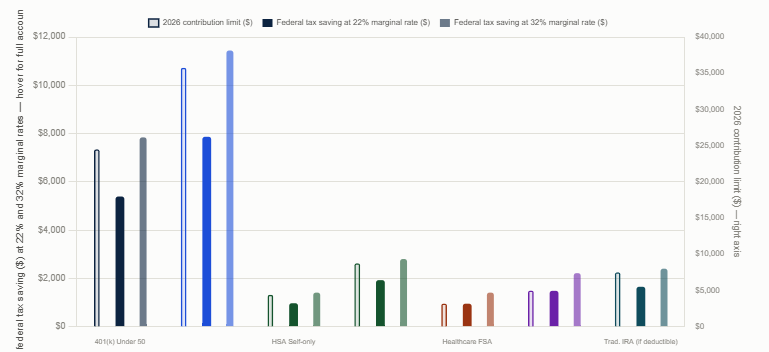
Example: Tax saving at different marginal rates on a $24,500 401(k) contribution (2026, illustrative): 22% federal rate: $5,390 in federal tax saved. 24% federal rate: $5,880 saved. 32% federal rate: $7,840 saved. 37% federal rate (top): $9,065 saved. These are federal savings only — most states with income taxes provide an additional deduction on 401(k) contributions, typically adding 3%–10% of the contribution amount in state tax savings. Not tax advice; individual circumstances vary.
Under SECURE 2.0, effective January 1, 2026, employees who earned more than $150,000 in FICA wages in 2025 (Box 3 W-2) are required to make their catch-up contributions to the Roth side of their 401(k) — not the pre-tax side. This Roth catch-up rule applies to all catch-up eligible workers (age 50+) above the threshold. If your 2025 W-2 Box 3 wages were under $150,000, you can still choose traditional (pre-tax) or Roth for catch-up contributions. Check your W-2 and your plan's current setup before assuming your catch-up contributions are going to the right account.
The 2026 data on employer matches:
Log into your benefits portal today and confirm: (1) the exact match formula your employer uses; (2) the contribution percentage required to capture 100% of the match; (3) your current contribution percentage; (4) your vesting schedule and current vested percentage. If your current contribution is below the match threshold, increase it immediately — this is the highest-return single financial action available to most employees.
Example: HSA as a long-term investment vehicle: a 45-year-old who contributes $4,400/year (self-only) to an HSA invested in a broad equity index fund at a hypothetical 7% return, paying all current medical costs out of pocket rather than from the HSA, accumulates approximately $88,000 in the HSA by age 65. Every dollar of this balance can be withdrawn tax-free for qualified healthcare expenses — including the $185,500 Fidelity estimates a 65-year-old needs for retirement healthcare (2026 estimate). The 20-year compounding of tax-free growth is the mechanism that makes the HSA uniquely valuable as a healthcare funding vehicle. Illustrative only; actual results vary. Not financial advice.
The most expensive HSA mistake, documented by Fidelity research cited in Boldin.com (July 2026): 40% of HSA owners have not invested their balance. An uninvested HSA earns a cash or money market rate; an invested HSA compounds at the equity rate. If you have an HSA and are not investing the balance — after maintaining a small cash buffer for near-term medical costs — you are leaving the most powerful component of the account unused.
The 2026 Healthcare FSA limits:
The FSA use-it-or-lose-it rule is the most common FSA mistake. If you contribute $3,200 and spend only $2,500 on qualified expenses during the plan year (with no carryover or grace period), the remaining $700 is forfeited to the employer. Contribute conservatively: estimate your year's likely qualified medical expenses, subtract a buffer for uncertainty, and contribute only what you are confident you will spend. Common qualified FSA expenses include prescription copays, dental care, vision (glasses, contacts), over-the-counter medications, and medical equipment.
An important distinction: if you have an HSA, you generally cannot also contribute to a general-purpose Healthcare FSA. The two accounts conflict because both cover the same expense categories. However, a ‘limited-purpose FSA’ (restricted to dental and vision only) is compatible with an HSA, allowing workers with an HDHP to use both for their respective cost categories.
The 2026 Dependent Care FSA limits:
Important interaction: the DCFSA reduces the amount eligible for the Dependent Care Tax Credit (DCTC). If your employer offers a DCFSA, you generally cannot claim both the DCFSA exclusion and the full DCTC on the same expenses. For most middle and upper-income families, the DCFSA produces a larger tax benefit than the DCTC, but the optimal strategy depends on income and specific care costs. Consult a tax professional for guidance on the interaction.
SECURE 2.0 2026 super catch-up: workers aged 60–63 can contribute up to $35,750 to their 401(k) — $3,250 more than the standard 50+ catch-up. At a 32% marginal rate: additional $3,250 × 32% = $1,040 in additional federal tax savings. Roth catch-up rule: applies to those earning $150,000+ in 2025 FICA wages. Student loan match: allows retirement savings to accumulate while repaying debt. Source: IRS SECURE 2.0 provisions; Taxfyle (January 2026); HighEarnerPlaybook (April 2026).
The simple rule: choose pre-tax if you expect your tax rate in retirement to be lower than your current marginal rate. Choose Roth if you expect your tax rate in retirement to be higher, or equal to, your current marginal rate. Choose Roth if you are early in your career and in a low marginal bracket that is likely to rise.
Most financial planners recommend a mix of both in order to have flexibility in retirement — the ability to withdraw from either account depending on which is more tax-efficient in any given year. For workers in the 22–24% bracket with substantial pre-tax savings already, adding Roth contributions provides tax diversification. For workers in the 32–37% bracket, the current-year tax saving from pre-tax contributions is substantial and typically dominates the Roth case unless very high retirement income is expected.
The PaycheckCalculatorOnline 2026 pre-tax deductions guide summarises the key distinction concisely: ‘Traditional 401(k) contributions are pre-tax — they reduce your taxable income today, and withdrawals in retirement are taxed as ordinary income. Roth 401(k) contributions are post-tax — no current-year tax reduction, but qualified withdrawals in retirement are completely tax-free, including all investment growth.’
The data shows that most workers are not using this capacity. Only 14% max out their 401(k). Just one-third are saving for healthcare expenses (Bank of America, 2025). The median contribution rate of 7% leaves a $1.2 million retirement gap compared to the 15% recommended savings rate. These are not failures of income — they are largely failures of awareness. The contribution limits exist because the government has decided, through legislation, that these amounts of saving are worth incentivising. The incentive is real, immediate, and dollar-for-dollar.
The practical first step is simple: log into your employer benefits portal, confirm your current contribution rates across every available vehicle, and increase any account that is not yet at the optimal level. Start with the 401(k) match, then the HSA, then work through the priority stack. The tax bill you are paying today almost certainly includes dollars that could legally be redirected to your own pre-tax savings accounts instead.
Pre-tax savings accounts are employer-sponsored or individually established accounts that allow you to contribute money before federal (and often state) income tax is calculated on your income. Common pre-tax accounts include the traditional 401(k), traditional IRA (if deductible), Health Savings Account (HSA), Healthcare FSA, Dependent Care FSA, and pre-tax commuter benefits. In each case, the contribution is excluded from your taxable income for the year, reducing your current tax bill. For most accounts, taxes are paid when you withdraw the money in retirement (traditional 401(k), traditional IRA) or not paid at all if used for qualified expenses (HSA). The aggregate tax saving can reach thousands of dollars per year for workers who use multiple pre-tax vehicles simultaneously.
What is the 401(k) contribution limit for 2026?
The 2026 401(k) employee contribution limits are: $24,500 for workers under age 50; $32,500 for workers aged 50–59 and 64+ (standard catch-up of $8,000 on top of the base); $35,750 for workers aged 60–63 (the SECURE 2.0 super catch-up of $11,250, a new provision effective January 1, 2026). The combined employee-plus-employer limit (Section 415(c)) is $72,000 for workers under 50, $80,000 for ages 50–59/64+, and $83,250 for ages 60–63. The employer match does not count toward the employee contribution limit but does count toward the combined limit. Sources: IRS 2026 limits; Taxfyle (January 2026); High Earner Playbook (April 2026).
How much does a 401(k) contribution actually save me in taxes?
The tax saving depends on your marginal income tax bracket. At the 22% federal bracket, each dollar of pre-tax 401(k) contribution saves $0.22 in federal income tax. On a $24,500 maximum contribution: approximately $5,390 in federal tax savings. At 24%: $5,880. At 32%: $7,840. At 37% (top bracket): $9,065. Most states with income taxes provide an additional deduction on 401(k) contributions, adding a further 3–10% saving on the same contribution. The contribution does not reduce payroll taxes (Social Security and Medicare/FICA), which continue to apply to gross wages before the 401(k) deduction. Compare this to HSA and FSA contributions made through payroll, which do reduce FICA, making them marginally more tax-efficient for that component.
What is the HSA contribution limit for 2026 and why is it called the 'triple tax advantage'?
The 2026 HSA contribution limits are $4,400 for self-only HDHP coverage and $8,750 for family coverage, with an additional $1,000 catch-up for those aged 55 or older who are not enrolled in Medicare. The triple tax advantage refers to the three simultaneous tax benefits the HSA provides: (1) contributions are pre-tax or tax-deductible — they reduce taxable income today; (2) growth is tax-free — investments inside the HSA compound without generating annual taxable events; (3) qualified withdrawals are tax-free — money used for IRS-defined qualified medical expenses (including Medicare premiums, dental, vision, LTC insurance premiums, and many others) is withdrawn without any tax. No other savings account in the US tax code provides all three benefits simultaneously. The HSA is often described by financial planners as the most tax-efficient account available. Source: IRS 2026; countrytaxcalc.com (June 2026); High Earner Playbook (April 2026).
Can I have a 401(k) and an HSA at the same time?
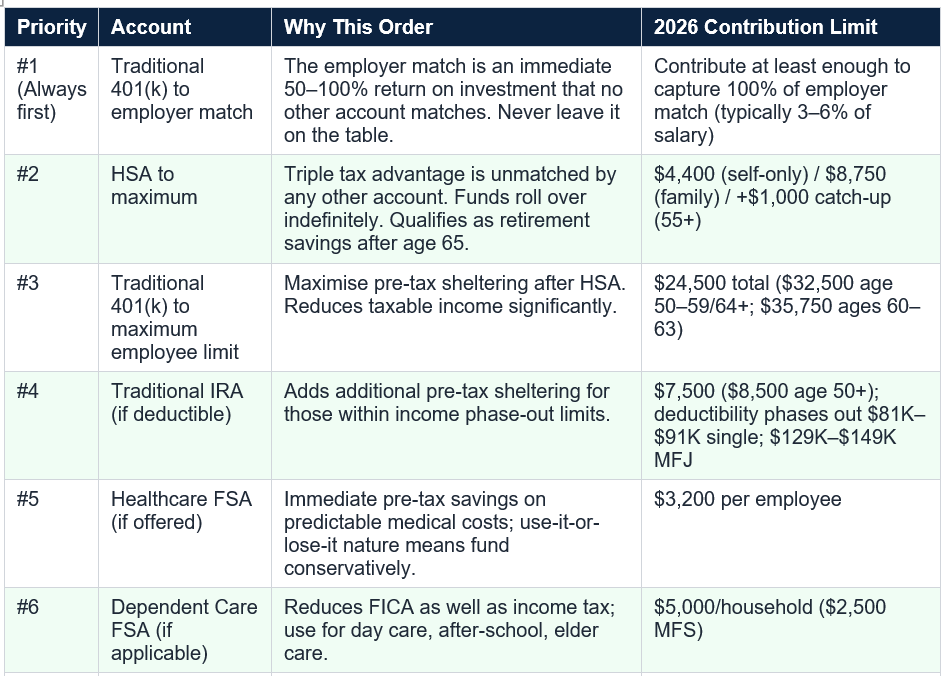
Yes, and combining the two is widely recommended as the optimal pre-tax savings strategy. The 401(k) and HSA are completely separate vehicles with separate contribution limits. Having both does not reduce the limit on either. The priority order: fund the 401(k) enough to capture the full employer match first (typically 3–6% of salary); then fund the HSA to the maximum; then continue funding the 401(k) toward the employee maximum. The HSA is ranked above the 401(k) maximum in most planners' priority sequences because its triple tax advantage (including the tax-free withdrawal feature for healthcare) is superior to the 401(k)'s single tax advantage. The only requirement for the HSA is enrollment in a qualifying High-Deductible Health Plan (HDHP). If your employer offers both an HDHP and a traditional health plan, the tax comparison between the two should factor in the HSA benefit of the HDHP.
What is the Dependent Care FSA and how does it differ from the Healthcare FSA?
A Dependent Care FSA (DCFSA) and a Healthcare FSA (HCFSA) are two entirely separate pre-tax accounts. The Healthcare FSA (limit: $3,200 in 2026) is for your own and your family's medical, dental, and vision expenses — copays, prescriptions, glasses, medical equipment. The Dependent Care FSA (limit: $5,000/household in 2026) is for child care and dependent care expenses — day care, preschool, after-school programmes, summer day camps, and elder care for a qualifying dependent. You can hold both simultaneously. The DCFSA has a unique additional advantage: it reduces FICA taxes (Social Security and Medicare) as well as income taxes, because Dependent Care FSA contributions are excluded from the FICA wage base under Section 129. At a 22% marginal rate plus 7.65% FICA, the combined tax saving on a full $5,000 DCFSA contribution is approximately $1,482 — making $5,000 of child care effectively cost $3,518 after tax savings.
Table of Contents
- The Tax Bill You’re Voluntarily Overpaying
- How Pre-Tax Savings Accounts Work: The Core Mechanism
- The Priority Stack: What to Fund First in 2026
- Account 1: The Traditional 401(k) — The Workplace Workhorse
- The Employer Match: The Closest Thing to Free Money in Personal Finance
- Account 2: The HSA — The Triple Tax Champion
- Account 3: The Traditional IRA — The Flexible Supplement
- Account 4: The Healthcare FSA — Immediate Tax Savings on Known Costs
- Account 5: The Dependent Care FSA — FICA Savings Too
- Account 6: Commuter Benefits — The Overlooked Pre-Tax Perk
- SECURE 2.0 in 2026: What’s New for Catch-Up Contributors
- The Combined Pre-Tax Power: Total Sheltering Capacity by Age
- Pre-Tax vs Roth: When Each Strategy Wins
- Conclusion: The Tax Code Is Trying to Help You
- Frequently Asked Questions
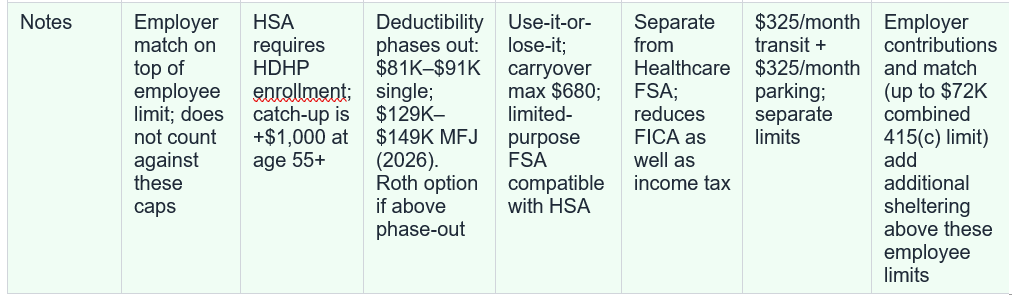
2026 Contribution Limits And Federal Tax Savings At Key Marginal Rates
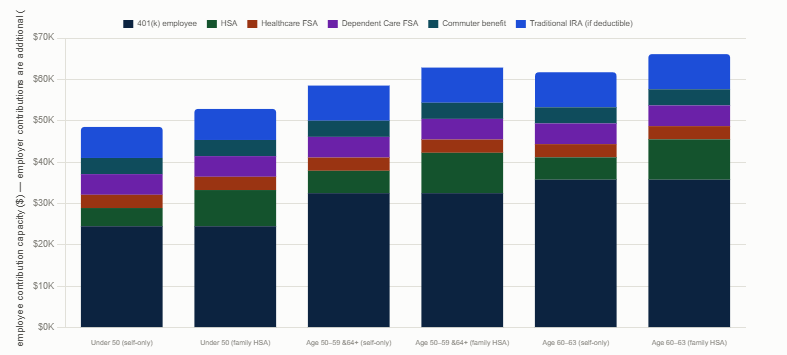
Total Pre-Tax Sheltering By Age Group (All Accounts Combined)
The Tax Bill You’re Voluntarily Overpaying
The US tax code contains a set of legally sanctioned mechanisms that allow workers to earn income, contribute a portion of it to specific savings accounts, and exclude that contribution from taxable income for the year. The resulting reduction in the current year’s tax bill is immediate, dollar-for-dollar, and entirely legal. The accounts that use these mechanisms — the 401(k), the HSA, the traditional IRA, the healthcare FSA, the dependent care FSA, and pre-tax commuter benefits — are collectively called pre-tax savings vehicles.In 2026, only 14% of employees at firms offering defined contribution plans contribute the maximum to their 401(k), according to Vanguard data (Yahoo Finance, December 2025). The median employee contributes 7% — enough to capture the employer match at most companies but far below the 15% total savings rate that Fidelity recommends. The gap between a 6% contribution (to get the match) and a 15% contribution (the recommended rate) produces an estimated $1.2 million shortfall at retirement for a 30-year-old earning $70,000 with 3% annual raises and 7% real returns (Wealthvieu, May 2026).
The stakes are real and measurable. This guide explains each major pre-tax savings vehicle in 2026, the exact contribution limits, the tax mechanics, the strategic priority for using them in sequence, and the specific rules introduced by SECURE 2.0 that create new opportunities for workers approaching retirement. Every figure is drawn from IRS announcements and confirmed by 2026 sources.
401(k) employee limit 2026: $24,500 (age 50–59/64+: $32,500; age 60–63 super catch-up: $35,750). HSA limit 2026: $4,400 self-only / $8,750 family (+$1,000 catch-up age 55+). Traditional IRA limit: $7,500 ($8,500 age 50+). Healthcare FSA: $3,200/yr. Dep. Care FSA: $5,000/household. Only 14% of eligible workers max their 401(k) (Vanguard). Median contribution rate: 7%. $1.2M retirement gap from contributing 6% vs 15% over a career (Wealthvieu May 2026).
How Pre-Tax Savings Accounts Work: The Core Mechanism
Pre-tax savings accounts reduce your taxable income before federal (and often state) income tax is calculated. The mechanism is the same across all vehicles, even though the specific rules, limits, and permitted uses differ:- Step 1 — You earn income: your gross salary is your starting point.
- Step 2 — You contribute to a pre-tax account: the contributed dollars are excluded from your taxable income for the year, reducing the base on which your income tax is calculated.
- Step 3 — You pay tax on a smaller number: your federal (and often state) income tax liability is calculated on the reduced gross income.
- Step 4 — The money grows: inside the account, the investment grows tax-deferred (401(k), traditional IRA) or tax-free (HSA for qualified medical expenses). You do not pay annual capital gains or dividend tax on growth inside the account.
- Step 5 — Withdrawals are taxed (for most accounts): when you withdraw money from a traditional 401(k) or IRA in retirement, the withdrawal is taxed as ordinary income. For an HSA used for qualified medical expenses, withdrawals are tax-free.
The Priority Stack: What to Fund First in 2026
With multiple pre-tax vehicles available, the question of which to fund first — and in what sequence — has a clear answer that most financial planners agree on. The High Earner Playbook (April 2026) formalises the recommended priority order, and it is worth stating explicitly before diving into each individual account:
Account 1: The Traditional 401(k) — The Workplace Workhorse
The traditional 401(k) is the most widely used pre-tax retirement account in the United States. Contributions are made pre-tax — they reduce your taxable income dollar-for-dollar in the year they are made — and withdrawals in retirement are taxed as ordinary income. The 2026 contribution limits represent the most generous cap in the account’s history:- Employee contribution limit: $24,500 (up from $23,500 in 2025).
- Catch-up contribution (age 50–59 and 64+): additional $8,000, for a total of $32,500.
- SECURE 2.0 super catch-up (ages 60–63): additional $11,250, for a total of $35,750. This new age band, effective January 1, 2026, was created specifically to allow workers in the final decade before typical retirement to accelerate savings in the years when their earning power and disposable income are often greatest.
- Total combined employee + employer limit (Section 415(c)): $72,000 for workers under 50; $80,000 for ages 50–59 and 64+; $83,250 for ages 60–63.
Example: Tax saving at different marginal rates on a $24,500 401(k) contribution (2026, illustrative): 22% federal rate: $5,390 in federal tax saved. 24% federal rate: $5,880 saved. 32% federal rate: $7,840 saved. 37% federal rate (top): $9,065 saved. These are federal savings only — most states with income taxes provide an additional deduction on 401(k) contributions, typically adding 3%–10% of the contribution amount in state tax savings. Not tax advice; individual circumstances vary.
Under SECURE 2.0, effective January 1, 2026, employees who earned more than $150,000 in FICA wages in 2025 (Box 3 W-2) are required to make their catch-up contributions to the Roth side of their 401(k) — not the pre-tax side. This Roth catch-up rule applies to all catch-up eligible workers (age 50+) above the threshold. If your 2025 W-2 Box 3 wages were under $150,000, you can still choose traditional (pre-tax) or Roth for catch-up contributions. Check your W-2 and your plan's current setup before assuming your catch-up contributions are going to the right account.
The Employer Match: The Closest Thing to Free Money in Personal Finance
The employer 401(k) match is a contribution your employer makes to your retirement account based on how much you contribute yourself. It is supplementary compensation that you receive only by participating in the plan. Failing to contribute enough to capture the full match is leaving compensation on the table — compensation that has already been budgeted for you in the employer’s total compensation model.The 2026 data on employer matches:
- Average employer match in 2026: 4.6% of pay (Vanguard How America Saves 2025 report; digitalcalculator.info, July 2026). The Bureau of Labor Statistics National Compensation Survey shows a median formula closer to 3.5% of salary.
- Most common formula: 50% of contributions up to 6% of salary — an effective 3% match if you contribute 6%.
- Common alternative: 100% (full dollar-for-dollar) match on the first 3–4% of pay.
- The long-term value: on a $100,000 salary, the average 4.6% match equals $4,600 per year, which compounds to approximately $434,000 over 30 years at 7% annual returns (digitalcalculator.info, July 2026).
- The additional employer contribution: beyond the match, the average employer contributes an additional 4.7% of income to 401(k) plans, bringing the typical total savings rate to 14.2% — close to the 15% Fidelity recommends (Yahoo Finance, December 2025).
Log into your benefits portal today and confirm: (1) the exact match formula your employer uses; (2) the contribution percentage required to capture 100% of the match; (3) your current contribution percentage; (4) your vesting schedule and current vested percentage. If your current contribution is below the match threshold, increase it immediately — this is the highest-return single financial action available to most employees.
Account 2: The HSA — The Triple Tax Champion
The Health Savings Account (HSA) is available to individuals enrolled in a High-Deductible Health Plan (HDHP). Multiple sources describe it as the most tax-efficient account in the US tax code, and the characterisation is accurate: the HSA provides three simultaneous tax benefits that no other account provides together:- Contributions are pre-tax (or tax-deductible): made through payroll, they reduce taxable income before withholding. Made directly and claimed as a deduction, they reduce adjusted gross income at filing.
- Growth is tax-free: money inside the HSA grows without generating annual taxable events. Dividends, capital gains, and interest inside the HSA are not taxed.
- Qualified withdrawals are tax-free: money used for qualified medical expenses — Medicare premiums, dental, vision, prescription drugs, long-term care insurance premiums, and many other IRS-defined costs — is withdrawn without tax.
- Self-only HDHP coverage: $4,400 per year.
- Family HDHP coverage: $8,750 per year.
- Catch-up contribution (age 55 or older, not yet enrolled in Medicare): additional $1,000.
Example: HSA as a long-term investment vehicle: a 45-year-old who contributes $4,400/year (self-only) to an HSA invested in a broad equity index fund at a hypothetical 7% return, paying all current medical costs out of pocket rather than from the HSA, accumulates approximately $88,000 in the HSA by age 65. Every dollar of this balance can be withdrawn tax-free for qualified healthcare expenses — including the $185,500 Fidelity estimates a 65-year-old needs for retirement healthcare (2026 estimate). The 20-year compounding of tax-free growth is the mechanism that makes the HSA uniquely valuable as a healthcare funding vehicle. Illustrative only; actual results vary. Not financial advice.
The most expensive HSA mistake, documented by Fidelity research cited in Boldin.com (July 2026): 40% of HSA owners have not invested their balance. An uninvested HSA earns a cash or money market rate; an invested HSA compounds at the equity rate. If you have an HSA and are not investing the balance — after maintaining a small cash buffer for near-term medical costs — you are leaving the most powerful component of the account unused.
Account 3: The Traditional IRA — The Flexible Supplement
The traditional Individual Retirement Account (IRA) is available to anyone with earned income, whether or not they have access to a workplace retirement plan. The 2026 limits:- Contribution limit: $7,500 per person per year.
- Catch-up contribution (age 50 or older): additional $1,000, for a total of $8,500.
- If neither you nor your spouse is covered by a workplace plan: contributions are fully deductible regardless of income.
- If you are covered by a workplace plan (single filer, 2026): deduction phases out between $81,000 and $91,000 MAGI. Above $91,000, no deduction.
- If you are covered by a workplace plan (married filing jointly, contributing spouse covered, 2026): phase-out range is $129,000–$149,000 MAGI. Above $149,000, no deduction for the contributing spouse.
Account 4: The Healthcare FSA — Immediate Tax Savings on Known Costs
A Healthcare Flexible Spending Account (FSA) is an employer-offered benefit that allows employees to set aside pre-tax dollars for qualified medical expenses. Unlike the HSA, it does not require enrollment in an HDHP, it is not individually owned (it is an employer account), and it has a use-it-or-lose-it rule.The 2026 Healthcare FSA limits:
- Maximum employee contribution: $3,200 per employee per plan year.
- Carryover maximum (for plans that allow carryover): $680.
- Grace period (for plans that offer this alternative to carryover): 2.5 months after the plan year ends to use remaining funds.
The FSA use-it-or-lose-it rule is the most common FSA mistake. If you contribute $3,200 and spend only $2,500 on qualified expenses during the plan year (with no carryover or grace period), the remaining $700 is forfeited to the employer. Contribute conservatively: estimate your year's likely qualified medical expenses, subtract a buffer for uncertainty, and contribute only what you are confident you will spend. Common qualified FSA expenses include prescription copays, dental care, vision (glasses, contacts), over-the-counter medications, and medical equipment.
An important distinction: if you have an HSA, you generally cannot also contribute to a general-purpose Healthcare FSA. The two accounts conflict because both cover the same expense categories. However, a ‘limited-purpose FSA’ (restricted to dental and vision only) is compatible with an HSA, allowing workers with an HDHP to use both for their respective cost categories.
Account 5: The Dependent Care FSA — FICA Savings Too
A Dependent Care FSA (DCFSA) is a separate employer benefit for child care and dependent care expenses — day care, preschool, after-school programmes, summer day camps, and elder care for a qualifying dependent. It is not the same as the Healthcare FSA and has a distinct set of rules and limits.The 2026 Dependent Care FSA limits:
- Maximum contribution: $5,000 per household per plan year ($2,500 if married filing separately).
Important interaction: the DCFSA reduces the amount eligible for the Dependent Care Tax Credit (DCTC). If your employer offers a DCFSA, you generally cannot claim both the DCFSA exclusion and the full DCTC on the same expenses. For most middle and upper-income families, the DCFSA produces a larger tax benefit than the DCTC, but the optimal strategy depends on income and specific care costs. Consult a tax professional for guidance on the interaction.
Account 6: Commuter Benefits — The Overlooked Pre-Tax Perk
Employer-sponsored commuter benefits allow employees to set aside pre-tax dollars for qualified commuting expenses — transit passes (subway, bus, train, ferry, vanpooling) and qualified parking at or near the workplace. The 2026 monthly limits:- Transit passes and vanpooling: $325 per month ($3,900/year).
- Qualified parking: $325 per month ($3,900/year, separate from transit).
SECURE 2.0 in 2026: What’s New for Catch-Up Contributors
The SECURE 2.0 Act of 2022 implemented several provisions that take full effect in 2026, creating meaningful new opportunities for specific categories of workers:- Super catch-up for ages 60–63 (NEW in 2026): the most significant change. Workers aged 60, 61, 62, or 63 can contribute an additional $11,250 on top of the standard $24,500 limit, for a total of $35,750 in 401(k) employee contributions. This is $3,250 more than the standard age 50+ catch-up of $8,000. At 64, the contribution reverts to the standard $32,500 (under 50 limit + $8,000 catch-up). This super catch-up period is specifically designed for the final accumulation window before typical retirement.
- Roth catch-up requirement (NEW in 2026): employees who earned more than $150,000 in FICA wages in 2025 must make all catch-up contributions to the Roth side of their 401(k) — not the pre-tax side. This applies regardless of which type of catch-up they are making. The threshold is indexed to inflation in $5,000 increments; the 2025 lookback amount is $150,000.
- Emergency savings accounts linked to 401(k) plans: employers can now offer emergency savings accounts as a 401(k) plan feature, allowing employees to designate up to $2,500 of Roth contributions as an emergency fund within the plan that can be withdrawn penalty-free.
- Student loan match: employers can now match employee student loan repayments with 401(k) contributions, effectively allowing employees to build retirement savings while paying off student debt. The match is treated identically to a contribution match.
SECURE 2.0 2026 super catch-up: workers aged 60–63 can contribute up to $35,750 to their 401(k) — $3,250 more than the standard 50+ catch-up. At a 32% marginal rate: additional $3,250 × 32% = $1,040 in additional federal tax savings. Roth catch-up rule: applies to those earning $150,000+ in 2025 FICA wages. Student loan match: allows retirement savings to accumulate while repaying debt. Source: IRS SECURE 2.0 provisions; Taxfyle (January 2026); HighEarnerPlaybook (April 2026).
The Combined Pre-Tax Power: Total Sheltering Capacity by Age
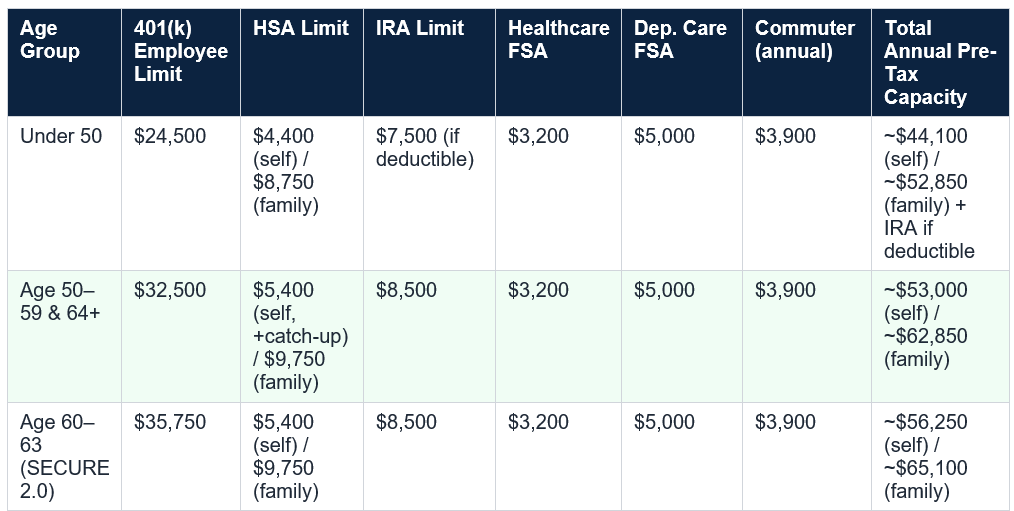
The following table shows the total pre-tax contribution capacity across all major vehicles in 2026, by age group. All figures assume: covered by HDHP (for HSA), traditional 401(k) elected, deductible traditional IRA eligible (within phase-out limits), Healthcare FSA and DCFSA elected, and commuter benefits elected at maximum. Not every individual will qualify for every vehicle; actual capacity depends on plan access and income.
Pre-Tax vs Roth: When Each Strategy Wins
Every pre-tax decision involves a comparison with its Roth alternative. The Roth contribution is made with after-tax dollars — no deduction today — but qualified withdrawals in retirement are entirely tax-free, including all investment growth. The traditional (pre-tax) contribution saves tax today; the Roth contribution saves tax in retirement.The simple rule: choose pre-tax if you expect your tax rate in retirement to be lower than your current marginal rate. Choose Roth if you expect your tax rate in retirement to be higher, or equal to, your current marginal rate. Choose Roth if you are early in your career and in a low marginal bracket that is likely to rise.
Most financial planners recommend a mix of both in order to have flexibility in retirement — the ability to withdraw from either account depending on which is more tax-efficient in any given year. For workers in the 22–24% bracket with substantial pre-tax savings already, adding Roth contributions provides tax diversification. For workers in the 32–37% bracket, the current-year tax saving from pre-tax contributions is substantial and typically dominates the Roth case unless very high retirement income is expected.
The PaycheckCalculatorOnline 2026 pre-tax deductions guide summarises the key distinction concisely: ‘Traditional 401(k) contributions are pre-tax — they reduce your taxable income today, and withdrawals in retirement are taxed as ordinary income. Roth 401(k) contributions are post-tax — no current-year tax reduction, but qualified withdrawals in retirement are completely tax-free, including all investment growth.’
Conclusion
The US tax code has built a set of mechanisms specifically designed to encourage saving: the 401(k) with its pre-tax contributions and employer match; the HSA with its unique triple tax advantage; the traditional IRA for supplementary pre-tax savings; the FSAs for predictable healthcare and child care costs; and the commuter benefit for everyday commuting expenses. In 2026, a worker who uses all of these vehicles simultaneously can shelter $44,000 to $65,000 of income from federal taxation depending on age and family situation — in addition to whatever their employer contributes on top.The data shows that most workers are not using this capacity. Only 14% max out their 401(k). Just one-third are saving for healthcare expenses (Bank of America, 2025). The median contribution rate of 7% leaves a $1.2 million retirement gap compared to the 15% recommended savings rate. These are not failures of income — they are largely failures of awareness. The contribution limits exist because the government has decided, through legislation, that these amounts of saving are worth incentivising. The incentive is real, immediate, and dollar-for-dollar.
The practical first step is simple: log into your employer benefits portal, confirm your current contribution rates across every available vehicle, and increase any account that is not yet at the optimal level. Start with the 401(k) match, then the HSA, then work through the priority stack. The tax bill you are paying today almost certainly includes dollars that could legally be redirected to your own pre-tax savings accounts instead.
Frequently Asked Questions
What are pre-tax savings accounts?Pre-tax savings accounts are employer-sponsored or individually established accounts that allow you to contribute money before federal (and often state) income tax is calculated on your income. Common pre-tax accounts include the traditional 401(k), traditional IRA (if deductible), Health Savings Account (HSA), Healthcare FSA, Dependent Care FSA, and pre-tax commuter benefits. In each case, the contribution is excluded from your taxable income for the year, reducing your current tax bill. For most accounts, taxes are paid when you withdraw the money in retirement (traditional 401(k), traditional IRA) or not paid at all if used for qualified expenses (HSA). The aggregate tax saving can reach thousands of dollars per year for workers who use multiple pre-tax vehicles simultaneously.
What is the 401(k) contribution limit for 2026?
The 2026 401(k) employee contribution limits are: $24,500 for workers under age 50; $32,500 for workers aged 50–59 and 64+ (standard catch-up of $8,000 on top of the base); $35,750 for workers aged 60–63 (the SECURE 2.0 super catch-up of $11,250, a new provision effective January 1, 2026). The combined employee-plus-employer limit (Section 415(c)) is $72,000 for workers under 50, $80,000 for ages 50–59/64+, and $83,250 for ages 60–63. The employer match does not count toward the employee contribution limit but does count toward the combined limit. Sources: IRS 2026 limits; Taxfyle (January 2026); High Earner Playbook (April 2026).
How much does a 401(k) contribution actually save me in taxes?
The tax saving depends on your marginal income tax bracket. At the 22% federal bracket, each dollar of pre-tax 401(k) contribution saves $0.22 in federal income tax. On a $24,500 maximum contribution: approximately $5,390 in federal tax savings. At 24%: $5,880. At 32%: $7,840. At 37% (top bracket): $9,065. Most states with income taxes provide an additional deduction on 401(k) contributions, adding a further 3–10% saving on the same contribution. The contribution does not reduce payroll taxes (Social Security and Medicare/FICA), which continue to apply to gross wages before the 401(k) deduction. Compare this to HSA and FSA contributions made through payroll, which do reduce FICA, making them marginally more tax-efficient for that component.
What is the HSA contribution limit for 2026 and why is it called the 'triple tax advantage'?
The 2026 HSA contribution limits are $4,400 for self-only HDHP coverage and $8,750 for family coverage, with an additional $1,000 catch-up for those aged 55 or older who are not enrolled in Medicare. The triple tax advantage refers to the three simultaneous tax benefits the HSA provides: (1) contributions are pre-tax or tax-deductible — they reduce taxable income today; (2) growth is tax-free — investments inside the HSA compound without generating annual taxable events; (3) qualified withdrawals are tax-free — money used for IRS-defined qualified medical expenses (including Medicare premiums, dental, vision, LTC insurance premiums, and many others) is withdrawn without any tax. No other savings account in the US tax code provides all three benefits simultaneously. The HSA is often described by financial planners as the most tax-efficient account available. Source: IRS 2026; countrytaxcalc.com (June 2026); High Earner Playbook (April 2026).
Can I have a 401(k) and an HSA at the same time?
Yes, and combining the two is widely recommended as the optimal pre-tax savings strategy. The 401(k) and HSA are completely separate vehicles with separate contribution limits. Having both does not reduce the limit on either. The priority order: fund the 401(k) enough to capture the full employer match first (typically 3–6% of salary); then fund the HSA to the maximum; then continue funding the 401(k) toward the employee maximum. The HSA is ranked above the 401(k) maximum in most planners' priority sequences because its triple tax advantage (including the tax-free withdrawal feature for healthcare) is superior to the 401(k)'s single tax advantage. The only requirement for the HSA is enrollment in a qualifying High-Deductible Health Plan (HDHP). If your employer offers both an HDHP and a traditional health plan, the tax comparison between the two should factor in the HSA benefit of the HDHP.
What is the Dependent Care FSA and how does it differ from the Healthcare FSA?
A Dependent Care FSA (DCFSA) and a Healthcare FSA (HCFSA) are two entirely separate pre-tax accounts. The Healthcare FSA (limit: $3,200 in 2026) is for your own and your family's medical, dental, and vision expenses — copays, prescriptions, glasses, medical equipment. The Dependent Care FSA (limit: $5,000/household in 2026) is for child care and dependent care expenses — day care, preschool, after-school programmes, summer day camps, and elder care for a qualifying dependent. You can hold both simultaneously. The DCFSA has a unique additional advantage: it reduces FICA taxes (Social Security and Medicare) as well as income taxes, because Dependent Care FSA contributions are excluded from the FICA wage base under Section 129. At a 22% marginal rate plus 7.65% FICA, the combined tax saving on a full $5,000 DCFSA contribution is approximately $1,482 — making $5,000 of child care effectively cost $3,518 after tax savings.
0 Comments
Be the first to share your thoughts on this article.