

Taxes
Could a Pay Rise Cut Your Tax Allowances?

A pay rise can trigger a 62% marginal rate, wipe out your entire Personal Allowance, remove Tax-Free Childcare worth up to £2,000 per child, and claw back every penny of Child Benefit. UK income tax thresholds are now frozen until 2031. Here is how each trap works — and how to legally reduce your bill.

The mechanism is not complicated. The UK income tax system uses fixed nominal thresholds at which tax rates change, allowances disappear, and government support is withdrawn. Those thresholds have been frozen since April 2021 — and are now frozen until April 2031 under the Autumn Budget 2025 (Deloitte/Taxscape). In the same period, wages have risen. The result is that more and more workers find themselves approaching, crossing, or sitting just above thresholds that were designed for people earning materially less than they do today.
This guide maps the five principal income tax traps in the 2026/27 UK tax system, explains exactly how each one works and how much it costs, and then identifies the legal strategies that reduce adjusted net income to stay below the thresholds or to reduce the tax bill materially. The strategies are available to most employed people and require no special status, no exotic products, and nothing more complicated than making pension contributions or donating to charity under Gift Aid.
The freeze is the core mechanism. Each year that wages rise while thresholds remain fixed, more income crosses into taxed territory, more people hit the threshold at which their HICBC begins, and more are pushed into the Personal Allowance taper band. The same nominal income that was once comfortably below a threshold finds itself at or above it after a pay review. No change in the law. No announcement. Just fiscal drag doing its quiet work.
This trap has a second dimension that is easy to miss: savings interest. The Personal Savings Allowance (PSA) halves from £1,000 to £500 when a taxpayer crosses into the higher-rate band. An employee earning £49,000 with £30,000 in savings earning 4.5 percent generates £1,350 in interest, of which £350 above the £1,000 PSA is taxed at 20 percent. After a pay rise to £51,500, the higher-rate band applies, the PSA drops to £500, and £850 of the same interest is now taxed at 40 percent. The pay rise has changed both the income tax rate and the savings interest tax rate simultaneously.
National Insurance adds to the picture. Employee NIC is 8 percent on earnings between the primary threshold (£12,570) and the Upper Earnings Limit (£50,270), falling to 2 percent above the UEL. A pay rise that carries income just above £50,270 means the marginal NIC rate drops from 8 to 2 percent on the crossing-over portion — which partially offsets the higher income tax rate on the additional income, but does not eliminate it. The combined income tax and NIC marginal rate for someone moving just above the higher-rate threshold remains 42 percent (40% income tax + 2% NIC above the UEL).
Child Benefit rates for 2026/27:
The single most counterintuitive feature of the HICBC is that it applies to individual income, not household income. Two partners each earning £59,000 — a combined household income of £118,000 — pay no HICBC at all. A single earner on £65,000 loses 25 percent of their Child Benefit. A single earner on £80,000 loses all of it. This structural anomaly has been noted by the IFS and Resolution Foundation; the government committed to consulting on a household-income basis for HICBC by April 2026, but no implementation has been confirmed as of August 2026 (House of Commons Library July 2026; OneShekel June 2026).
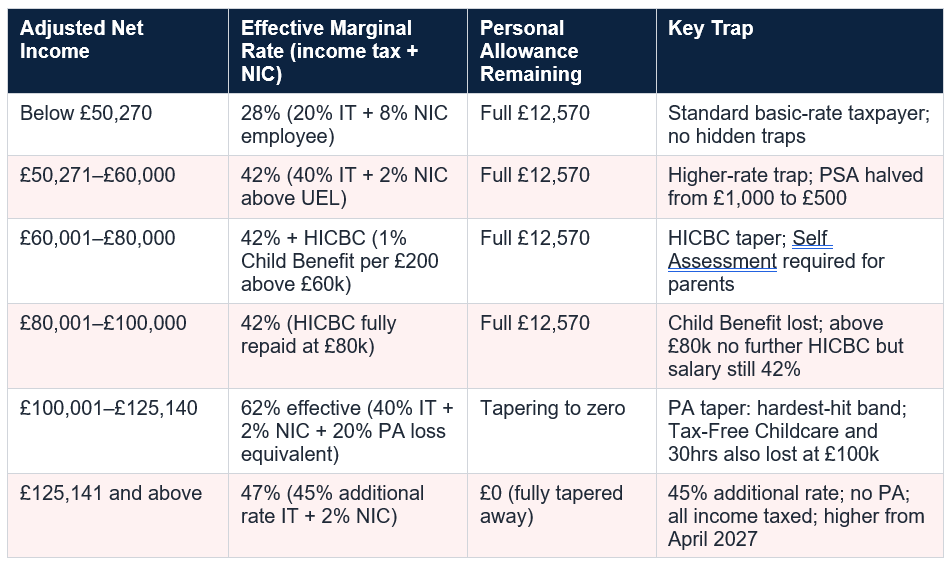
The effect on the effective marginal tax rate in this band is extraordinary:
SalaryTax.uk (June 2026): The £100,000–£125,140 band is the highest-marginal-rate slice in UK personal tax — 62% before any High Income Child Benefit Charge, student loan or pension annual allowance taper stacks on top. For parents, the effective rate spikes past 100% on small slices of income: a £1,000 pay rise can produce zero net gain after all withdrawals are accounted for.
Tax-Free Childcare provides a £25 government top-up for every £80 saved toward eligible childcare, up to £2,000 per year per child (£4,000 for disabled children). Both parents must be working to qualify, and neither can have adjusted net income above £100,000. A family with two children in full-time childcare may be receiving £4,000 per year in government childcare top-up (plus the 30 free hours, worth potentially another £6,000 to £10,000 per year depending on location and provider rates).
The arithmetic at the £100,000 cliff:
For taxpayers above £125,140, the effective marginal rate falls back from 62 percent to 47 percent (45 percent income tax plus 2 percent NIC above the Upper Earnings Limit). This ‘relief’ from 62 to 47 percent is often misunderstood as making the additional-rate band better than the taper band in absolute terms — which it is — but the total tax position is substantially worse than for basic-rate taxpayers because no income is sheltered at 0 percent and all income is taxed at the additional rate.
Pension contributions remain effective at reducing adjusted net income for those above £125,140, though very high earners face a tapered annual pension allowance that reduces the maximum pension contribution allowed. For threshold income above £200,000 and adjusted income above £260,000, the pension annual allowance tapers from £60,000 to a minimum of £10,000 (£1 reduction for every £2 of adjusted income above £260,000). This is a specialist area requiring qualified professional advice (MoneyHelper March 2026).
The practical consequences:
Salary sacrifice pension contributions have additional advantages over personal pension contributions:
The Gift Aid gross-up works as follows: for every £80 you donate to charity, the charity claims £20 in basic-rate tax relief, making the gross donation £100. Higher-rate taxpayers can claim the additional £20 of relief (the difference between 40 percent tax and the 20 percent claimed by the charity) through Self Assessment. For adjusted net income purposes, the full £100 (the grossed-up amount) is deducted from adjusted net income.
The income tax mechanics: Gift Aid donations extend the basic-rate tax band rather than directly reducing income tax. This means more of the donor’s income is taxed at 20 percent rather than 40 percent. For someone whose income is in the higher-rate band, each £100 of grossed-up Gift Aid donation redirects £100 of income from 40 percent to 20 percent tax — saving £20 in income tax per £100 of gross donation.
For the HICBC and Personal Allowance taper: the gross Gift Aid donation is deducted from adjusted net income directly. A parent with adjusted net income of £62,500 who makes a £2,000 net donation (£2,500 gross after Gift Aid top-up) reduces their adjusted net income to £60,000 — exactly below the HICBC threshold. The £2,000 net donation has preserved Child Benefit worth potentially £1,330 per year for the eldest child (£25.60 x 52 = £1,331.20) while also generating higher-rate tax relief of £500 for the donor.
For income tax and threshold planning: EV salary sacrifice reduces gross pay, which reduces both the income tax calculation and the NIC liability. Where the salary reduction brings income below a key threshold (below £60,000, below £100,000), the associated allowance preservation benefit adds to the overall value of the arrangement.
Key eligibility conditions: the transferring partner must have income below the Personal Allowance (£12,570) or have income that does not use their full allowance. The receiving partner must be a basic-rate taxpayer — the Marriage Allowance is not available where the higher-earning partner is in the higher-rate or additional-rate band. Applications can be made online at GOV.UK and backdated up to four tax years.
HMRC data for 2024/25 indicates approximately 1.8 million couples claim Marriage Allowance. Independent estimates suggest approximately 2 million eligible couples do not yet claim it, representing a combined annual tax saving of up to £504 million that is being left unclaimed. Checking eligibility takes approximately five minutes at GOV.UK/marriage-allowance.
For higher earners, the more significant income-splitting consideration is whether to shift dividend income, savings income, or investment assets to a lower-earning partner — using their lower rate, their own Personal Allowance, and their own Personal Savings Allowance. Inter-spouse asset transfers are exempt from Capital Gains Tax on transfer, and the transferred income is then taxed at the receiving partner’s lower marginal rate. This strategy requires genuine transfer of beneficial ownership to be effective under HMRC’s settlements legislation.
Practical timing strategies:
The traps described in this guide are not obscure tax law edge cases. They apply to millions of working people across the income spectrum: the newly higher-rate taxpayer above £50,270 whose savings interest is now taxed at 40 percent; the parent on £65,000 losing Child Benefit they did not expect to lose; the senior professional on £105,000 paying a 62 percent effective marginal rate and losing childcare they value more than the pay rise itself.
The strategies to address each trap are legal, widely available, and in most cases, simple to implement with employer co-operation or a pension contribution. The pension contribution is the Swiss Army knife of the UK tax planning toolkit: it reduces adjusted net income for every threshold calculation simultaneously, provides immediate tax relief at the marginal rate, and builds long-term wealth in a tax-advantaged wrapper. Gift Aid, salary sacrifice, Marriage Allowance, and ISA sheltering complete the toolkit.
The system rewards those who plan. The pay rise is worth more to the person who routes part of it into a pension before it breaches a threshold than to the person who accepts the full nominal increase and finds the effective net gain far smaller than expected. The planning does not require sophisticated financial instruments or specialist knowledge. It requires understanding where the thresholds are and acting before the salary is processed.
Yes, at specific income levels, a pay rise can leave you worse off in net terms when all threshold effects are included. The clearest example is at £100,000. A pay rise from £99,000 to £101,000 creates £2,000 in gross additional income. That £2,000 is taxed at an effective rate of around 62% (40% income tax + 20% equivalent loss of Personal Allowance through the taper), leaving approximately £760 in net income after tax. But if the pay rise takes adjusted net income above £100,000 and the recipient has children in paid childcare, they lose Tax-Free Childcare (worth up to £2,000 per child per year) and 30 free hours of childcare — both of which are removed at the £100,000 hard cliff with no taper. A parent of two children in full-time childcare may find that a £2,000 gross pay rise produces a net loss of over £3,000 after all withdrawals. The legal solution is to use pension contributions or salary sacrifice to reduce adjusted net income below £100,000.
What is the 60% or 62% tax rate in the UK?
The 60%/62% effective marginal tax rate applies in the £100,000 to £125,140 adjusted net income band, where the Personal Allowance (£12,570 in 2026/27) is tapered at a rate of £1 reduction for every £2 of income above £100,000. This creates an unusual situation: in addition to paying 40% higher-rate income tax on income in this band, the person is also losing Personal Allowance that was sheltering other income from tax. The combined effect is that each £1 of income above £100,000 generates an effective 60% income tax rate (40% IT + 20% loss of PA equivalent). When 2% employee National Insurance contributions above the Upper Earnings Limit are added, the effective rate reaches 62%. The band ends at £125,140, where the Personal Allowance is fully exhausted and the standard 45% additional rate applies (47% with 2% NIC).
How does the High Income Child Benefit Charge work in 2026/27?
The HICBC begins when the higher-earning partner's adjusted net income exceeds £60,000 (this threshold applies from 6 April 2024; it was previously £50,000). Child Benefit is withdrawn at a rate of 1% for every £200 of income above £60,000. At £80,000, the charge equals 100% of the Child Benefit received and the net benefit is zero. HICBC is based on individual adjusted net income, not household income: two partners each earning £59,000 (combined £118,000) pay no HICBC, while a single earner on £65,000 pays a charge. Child Benefit rates in 2026/27: £25.60 per week for the eldest child (£1,331.20 per year) and £16.95 per week for additional children. Parents affected by the HICBC must register for Self Assessment and file a tax return. The charge can be eliminated by reducing adjusted net income below £60,000 through pension contributions, salary sacrifice, or Gift Aid donations.
What is salary sacrifice and how does it reduce income tax?
Salary sacrifice is an arrangement where you agree with your employer to give up part of your salary in exchange for a non-cash benefit or an employer pension contribution. The salary you give up is not subject to income tax or National Insurance contributions (employee or employer). Common salary sacrifice arrangements include additional employer pension contributions (the most tax-efficient for most people), electric vehicle leasing, Cycle to Work schemes, and childcare vouchers (for arrangements pre-dating April 2018). For income tax planning, salary sacrifice reduces gross pay before tax is calculated and reduces adjusted net income for the purposes of the Personal Allowance taper, HICBC, and Tax-Free Childcare eligibility. For every £1,000 of salary sacrifice pension contribution near the £100,000 threshold (where the effective marginal rate is 62%), the net cost to the employee is approximately £380 (£1,000 – £620 effective tax relief). Salary sacrifice arrangements are governed by your employment contract; check with your HR or payroll department for what is available.
What is adjusted net income and why does it matter?
Adjusted net income (ANI) is the income figure used to test eligibility for the Personal Allowance taper (above £100,000), the High Income Child Benefit Charge (above £60,000), and Tax-Free Childcare (must not exceed £100,000). ANI is calculated from total taxable income minus: gross pension contributions (both salary sacrifice and personal pension contributions via relief-at-source); grossed-up Gift Aid donations; and trading losses. The distinction between ANI and gross income is important because reductions to ANI can preserve multiple allowances simultaneously. A salary of £103,000 with £3,000 in personal pension contributions creates ANI of £100,000 — just below the threshold, preserving Tax-Free Childcare, avoiding the £100,000–£125,140 taper zone, and saving approximately £1,860 in additional income tax on the tapered allowance. Salary sacrifice pension contributions are particularly effective at reducing ANI because they reduce gross pay before tax, generating both income tax and NIC savings.
What is Marriage Allowance and who can claim it?
Marriage Allowance allows one partner in a marriage or civil partnership to transfer £1,260 of their unused Personal Allowance to their partner, reducing the receiving partner's income tax bill by up to £252 per year. To be eligible: the transferring partner must have income below £12,570 (or at least £1,260 below the Personal Allowance); the receiving partner must be a basic-rate taxpayer (not higher or additional rate). The allowance can be claimed online at GOV.UK/marriage-allowance and can be backdated up to four tax years, potentially generating a lump sum of up to £1,008 in backdated tax savings. HMRC estimates approximately 1.8 million couples currently claim Marriage Allowance. Independent estimates suggest approximately 2 million eligible couples do not yet claim it. Marriage Allowance is not available where the higher-earning partner is in the higher-rate or additional-rate tax band.
Table of Contents
- The Pay Rise That Costs You More Than It Pays
- The Frozen Thresholds Creating the Traps: 2026/27 Income Tax Bands
- Trap #1: The Basic-to-Higher Rate Crossing at £50,270
- Trap #2: The High Income Child Benefit Charge (£60,000–£80,000)
- Trap #3: The £100,000 Personal Allowance Cliff — Where the 62% Marginal Rate Lives
- Trap #4: Tax-Free Childcare and 30 Free Hours Removed at £100,000
- Trap #5: The Personal Allowance Is Gone at £125,140
- Why Fiscal Drag Is Pushing More People Into Every Trap
- Cut #1: Pension Contributions and Salary Sacrifice
- Cut #2: Gift Aid Donations
- Cut #3: Salary Sacrifice — Electric Vehicles, Cycle to Work, and More
- Cut #4: Marriage Allowance and Income Splitting
- Cut #5: Timing Income Strategically
- The Complete Tax Reduction Planning Checklist
- Conclusion: The Frozen System Rewards Those Who Plan
- Frequently Asked Questions
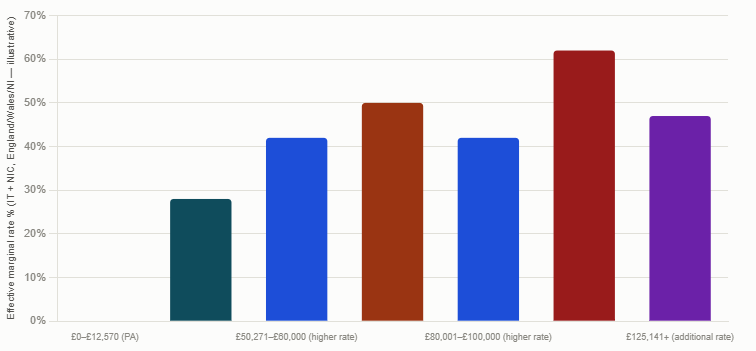
Effective Marginal rate By Income
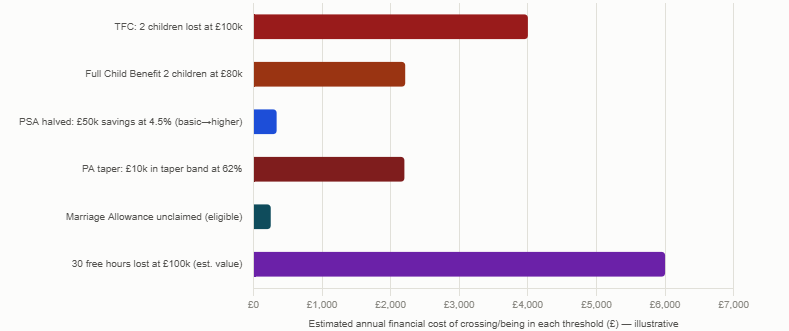
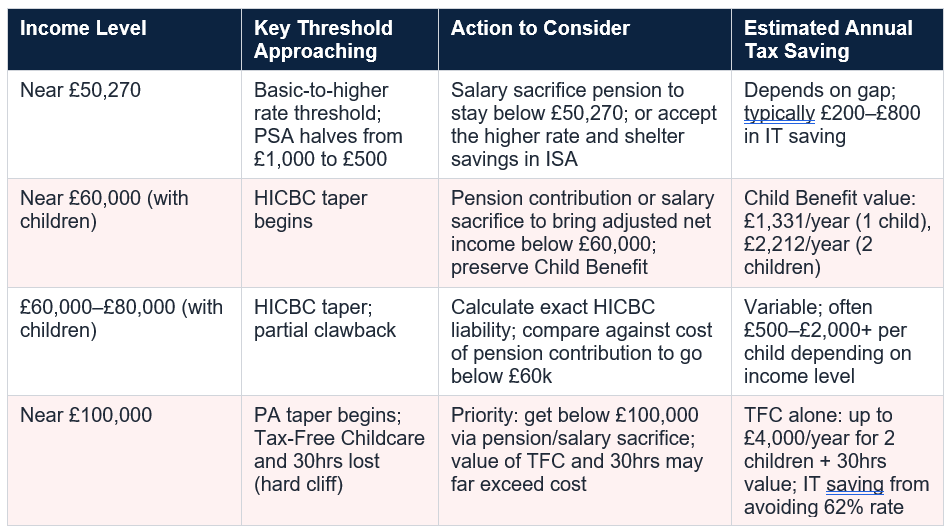
Annual Cost By Each threshold Trap
The Pay Rise That Costs You More Than It Pays
A pay rise is supposed to leave you better off. In the UK in 2026, a pay rise can, under the right — or wrong — circumstances, leave a person materially worse off than before. Not in theory. In practice, for identifiable salary ranges, a £1,000 gross pay rise can produce an effective net gain of less than nothing when the withdrawal of tax allowances, government benefits, and employer-funded childcare entitlements is factored in.The mechanism is not complicated. The UK income tax system uses fixed nominal thresholds at which tax rates change, allowances disappear, and government support is withdrawn. Those thresholds have been frozen since April 2021 — and are now frozen until April 2031 under the Autumn Budget 2025 (Deloitte/Taxscape). In the same period, wages have risen. The result is that more and more workers find themselves approaching, crossing, or sitting just above thresholds that were designed for people earning materially less than they do today.
This guide maps the five principal income tax traps in the 2026/27 UK tax system, explains exactly how each one works and how much it costs, and then identifies the legal strategies that reduce adjusted net income to stay below the thresholds or to reduce the tax bill materially. The strategies are available to most employed people and require no special status, no exotic products, and nothing more complicated than making pension contributions or donating to charity under Gift Aid.
The Frozen Thresholds Creating the Traps: 2026/27 Income Tax Bands
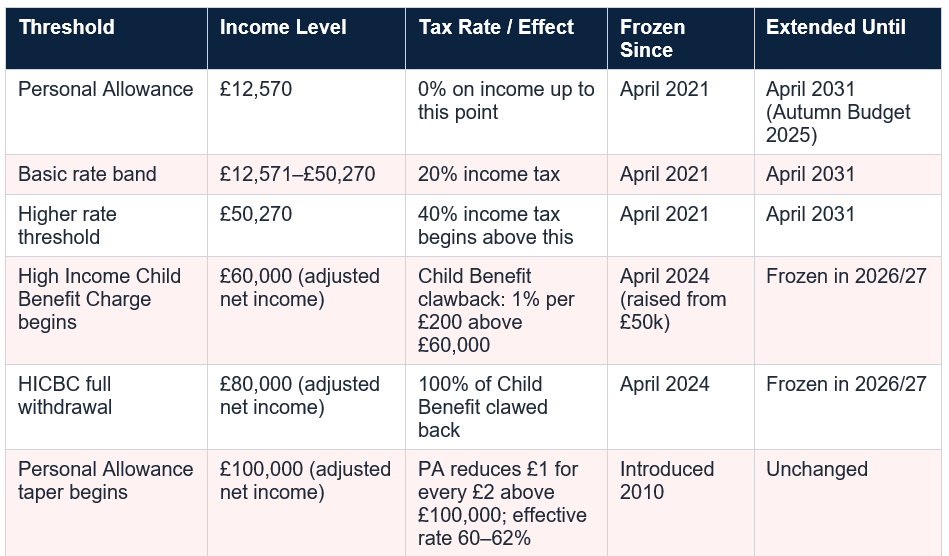
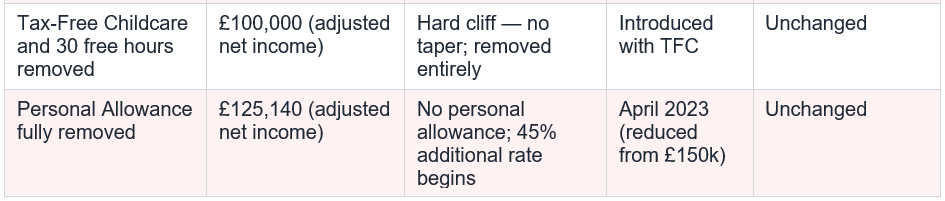
The structural context for every income tax trap in this guide is the freeze on income tax thresholds that has been in place since April 2021 and is now confirmed to run until April 2031. The key thresholds in 2026/27 (England, Wales, and Northern Ireland):The freeze is the core mechanism. Each year that wages rise while thresholds remain fixed, more income crosses into taxed territory, more people hit the threshold at which their HICBC begins, and more are pushed into the Personal Allowance taper band. The same nominal income that was once comfortably below a threshold finds itself at or above it after a pay review. No change in the law. No announcement. Just fiscal drag doing its quiet work.
Trap #1: The Basic-to-Higher Rate Crossing at £50,270
The most commonly encountered threshold is the one at which the income tax rate doubles: from 20 percent to 40 percent on the portion of income above £50,270. For anyone approaching this threshold, a pay rise that carries income above it means the additional income is taxed at 40 percent rather than 20 percent.This trap has a second dimension that is easy to miss: savings interest. The Personal Savings Allowance (PSA) halves from £1,000 to £500 when a taxpayer crosses into the higher-rate band. An employee earning £49,000 with £30,000 in savings earning 4.5 percent generates £1,350 in interest, of which £350 above the £1,000 PSA is taxed at 20 percent. After a pay rise to £51,500, the higher-rate band applies, the PSA drops to £500, and £850 of the same interest is now taxed at 40 percent. The pay rise has changed both the income tax rate and the savings interest tax rate simultaneously.
National Insurance adds to the picture. Employee NIC is 8 percent on earnings between the primary threshold (£12,570) and the Upper Earnings Limit (£50,270), falling to 2 percent above the UEL. A pay rise that carries income just above £50,270 means the marginal NIC rate drops from 8 to 2 percent on the crossing-over portion — which partially offsets the higher income tax rate on the additional income, but does not eliminate it. The combined income tax and NIC marginal rate for someone moving just above the higher-rate threshold remains 42 percent (40% income tax + 2% NIC above the UEL).
Trap #2: The High Income Child Benefit Charge (£60,000–£80,000)
For parents with children, the High Income Child Benefit Charge (HICBC) is one of the most financially damaging thresholds in the UK tax system. The charge begins when the higher-earning partner’s adjusted net income exceeds £60,000 and removes Child Benefit at a rate of 1 percent for every £200 of income above that threshold. By £80,000 adjusted net income, the full benefit is clawed back and the net Child Benefit is zero (LITRG; TaxFly August 2026; House of Commons Library July 2026).Child Benefit rates for 2026/27:
- Eldest child: £25.60 per week (£1,331.20 per year).
- Additional children: £16.95 per week per child (£881.40 per year each).
- A family with two children receives approximately £2,212.60 per year in Child Benefit.
The single most counterintuitive feature of the HICBC is that it applies to individual income, not household income. Two partners each earning £59,000 — a combined household income of £118,000 — pay no HICBC at all. A single earner on £65,000 loses 25 percent of their Child Benefit. A single earner on £80,000 loses all of it. This structural anomaly has been noted by the IFS and Resolution Foundation; the government committed to consulting on a household-income basis for HICBC by April 2026, but no implementation has been confirmed as of August 2026 (House of Commons Library July 2026; OneShekel June 2026).
Trap #3: The £100,000 Personal Allowance Cliff — Where the 62% Marginal Rate Lives
The single most distorting tax band in the UK tax system for high earners is the £100,000 to £125,140 Personal Allowance taper. Above £100,000 of adjusted net income, the £12,570 Personal Allowance is reduced by £1 for every £2 of income above the threshold. By £125,140, the Personal Allowance has been reduced to zero.The effect on the effective marginal tax rate in this band is extraordinary:
- Income in the band is taxed at 40 percent (the higher rate).
- But the loss of the Personal Allowance means an additional 20 pence in every pound above £100,000 is also taxed — income that was previously sheltered by the allowance is now exposed to 40 percent tax.
- Combined, the effective marginal income tax rate in the £100,000 to £125,140 band is 60 percent.
- Including the 2 percent employee NIC rate above the Upper Earnings Limit, the effective marginal rate is 62 percent.
SalaryTax.uk (June 2026): The £100,000–£125,140 band is the highest-marginal-rate slice in UK personal tax — 62% before any High Income Child Benefit Charge, student loan or pension annual allowance taper stacks on top. For parents, the effective rate spikes past 100% on small slices of income: a £1,000 pay rise can produce zero net gain after all withdrawals are accounted for.
Trap #4: Tax-Free Childcare and 30 Free Hours Removed at £100,000
The most severe single-point income trap in the UK tax system is the combined withdrawal of Tax-Free Childcare and 30 free hours of funded childcare at exactly £100,000 adjusted net income. Unlike the Personal Allowance taper (which is gradual across a £25,140 band) and the HICBC (which tapers across a £20,000 band), these childcare entitlements are removed instantly and completely at £100,000 — a hard cliff with no taper.Tax-Free Childcare provides a £25 government top-up for every £80 saved toward eligible childcare, up to £2,000 per year per child (£4,000 for disabled children). Both parents must be working to qualify, and neither can have adjusted net income above £100,000. A family with two children in full-time childcare may be receiving £4,000 per year in government childcare top-up (plus the 30 free hours, worth potentially another £6,000 to £10,000 per year depending on location and provider rates).
The arithmetic at the £100,000 cliff:
- A pay rise from £99,000 to £101,000 creates a £2,000 increase in gross income.
- This £2,000 additional income is taxed at the effective 62 percent marginal rate (income tax + PA loss): approximately £1,240 in additional tax.
- The net gain from the pay rise before childcare withdrawal: approximately £760.
- If Tax-Free Childcare for two children is lost: minus £4,000 in government top-up per year.
- Net position after the pay rise: approximately £3,240 worse off than before it.
Trap #5: The Personal Allowance Is Gone at £125,140
Above £125,140 of adjusted net income, the Personal Allowance has been entirely tapered away. Every pound of income is taxed at 45 percent (the additional rate) with no tax-free portion. This threshold was reduced from £150,000 in April 2023, drawing a larger group of high earners into the additional rate band.For taxpayers above £125,140, the effective marginal rate falls back from 62 percent to 47 percent (45 percent income tax plus 2 percent NIC above the Upper Earnings Limit). This ‘relief’ from 62 to 47 percent is often misunderstood as making the additional-rate band better than the taper band in absolute terms — which it is — but the total tax position is substantially worse than for basic-rate taxpayers because no income is sheltered at 0 percent and all income is taxed at the additional rate.
Pension contributions remain effective at reducing adjusted net income for those above £125,140, though very high earners face a tapered annual pension allowance that reduces the maximum pension contribution allowed. For threshold income above £200,000 and adjusted income above £260,000, the pension annual allowance tapers from £60,000 to a minimum of £10,000 (£1 reduction for every £2 of adjusted income above £260,000). This is a specialist area requiring qualified professional advice (MoneyHelper March 2026).
Why Fiscal Drag Is Pushing More People Into Every Trap
Each of the five traps described above existed in some form before 2021. The change since 2021 — and accelerating into the confirmed freeze to 2031 — is that the same person, on the same real income in inflation-adjusted terms, is now crossing thresholds they never expected to reach. Fiscal drag is the mechanism: frozen nominal thresholds in an inflationary environment are real-terms cuts in the income at which each threshold applies.The practical consequences:
- A worker earning £48,000 in 2021 who has received 3 percent annual pay rises now earns approximately £57,700 in 2026 — a 20 percent increase in nominal income, flat in real terms against accumulated inflation. In 2021, they were a basic-rate taxpayer. In 2026, they are a higher-rate taxpayer on the same purchasing power income.
- A professional household where the higher earner was on £55,000 in 2021 is now, with typical pay progression, in the zone where the HICBC applies and Child Benefit is being clawed back — a situation they never anticipated when they first started claiming Child Benefit.
- A senior manager on £95,000 in 2021 who has received merit pay rises may now find their adjusted net income approaching or crossing £100,000 — triggering the 62 percent marginal rate and threatening Tax-Free Childcare.
Cut #1: Pension Contributions and Salary Sacrifice
The single most powerful legal mechanism for reducing adjusted net income — and with it, income tax, HICBC, and Tax-Free Childcare cliff exposure — is pension contributions. Pension contributions reduce adjusted net income pound for pound and provide immediate income tax relief at the contributor’s marginal rate. For higher-rate taxpayers, a £1,000 gross pension contribution reduces the income tax bill by £400 and reduces adjusted net income by £1,000.Salary sacrifice pension contributions have additional advantages over personal pension contributions:
- Salary sacrifice reduces gross pay before tax and National Insurance are calculated, generating both income tax relief and NIC savings for the employee.
- Employer NIC savings (at 15 percent in 2026/27) can sometimes be passed on to the employee as additional pension contributions, increasing the effective return on salary sacrifice.
- For the HICBC, Personal Allowance taper, and Tax-Free Childcare calculations, salary sacrifice pension contributions reduce adjusted net income as effectively as personal pension contributions.
- Near £60,000: a parent with adjusted net income of £62,000 can make a £2,000 pension contribution (or salary sacrifice) to reduce adjusted net income to £60,000 and avoid the HICBC entirely — preserving potentially £2,000+ in Child Benefit while also receiving higher-rate tax relief on the contribution.
- Near £100,000: reducing adjusted net income below £100,000 preserves Tax-Free Childcare, prevents 30 free hours withdrawal, and avoids the 62 percent effective marginal rate in the taper band.
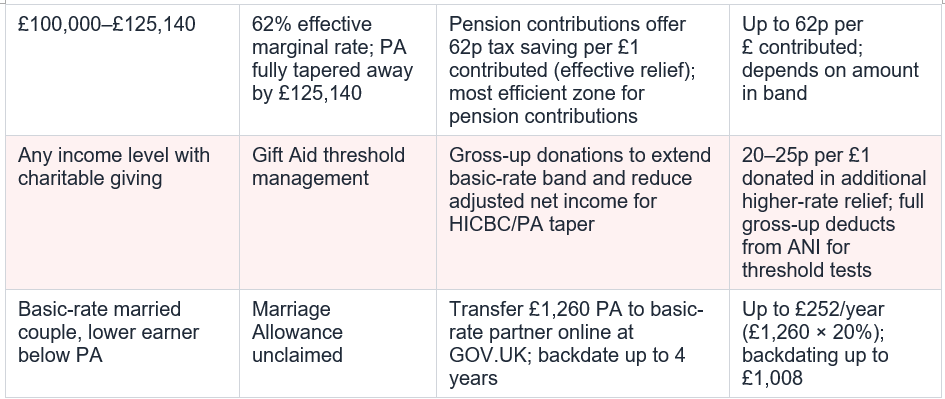
- In the £100,000–£125,140 band: every £1,000 of pension contribution reduces income taxed at the effective 62 percent rate, generating effective relief of up to £620 per £1,000 contributed.
Cut #2: Gift Aid Donations
Donations to registered UK charities under Gift Aid extend the basic-rate tax band by the grossed-up amount of the donation. For adjusted net income calculations — including the HICBC and Personal Allowance taper — the grossed-up Gift Aid donation is deducted from adjusted net income, reducing the income tested against each threshold.The Gift Aid gross-up works as follows: for every £80 you donate to charity, the charity claims £20 in basic-rate tax relief, making the gross donation £100. Higher-rate taxpayers can claim the additional £20 of relief (the difference between 40 percent tax and the 20 percent claimed by the charity) through Self Assessment. For adjusted net income purposes, the full £100 (the grossed-up amount) is deducted from adjusted net income.
The income tax mechanics: Gift Aid donations extend the basic-rate tax band rather than directly reducing income tax. This means more of the donor’s income is taxed at 20 percent rather than 40 percent. For someone whose income is in the higher-rate band, each £100 of grossed-up Gift Aid donation redirects £100 of income from 40 percent to 20 percent tax — saving £20 in income tax per £100 of gross donation.
For the HICBC and Personal Allowance taper: the gross Gift Aid donation is deducted from adjusted net income directly. A parent with adjusted net income of £62,500 who makes a £2,000 net donation (£2,500 gross after Gift Aid top-up) reduces their adjusted net income to £60,000 — exactly below the HICBC threshold. The £2,000 net donation has preserved Child Benefit worth potentially £1,330 per year for the eldest child (£25.60 x 52 = £1,331.20) while also generating higher-rate tax relief of £500 for the donor.
Cut #3: Salary Sacrifice — Electric Vehicles, Cycle to Work, and More
Beyond pension contributions, salary sacrifice arrangements can reduce gross pay for other benefits, thereby reducing both income tax and National Insurance and — where adjusted net income is relevant — reducing the income tested against tax thresholds.Electric Vehicle Salary Sacrifice
Zero-emission car salary sacrifice is excluded from the Optional Remuneration Arrangement (OpRA) rules that removed the income tax advantage of most salary sacrifice benefits from April 2017. This makes EV salary sacrifice one of the most tax-efficient benefit arrangements currently available. The benefit-in-kind percentage for zero-emission cars is 4 percent in 2026/27, rising to 5 percent in 2027/28 (RPGCC June 2026). The arrangement allows an employee to take a car via salary sacrifice at a monthly cost that is significantly lower than a personal lease when tax and NIC savings are factored in.For income tax and threshold planning: EV salary sacrifice reduces gross pay, which reduces both the income tax calculation and the NIC liability. Where the salary reduction brings income below a key threshold (below £60,000, below £100,000), the associated allowance preservation benefit adds to the overall value of the arrangement.
Cycle to Work
The Cycle to Work scheme allows employees to sacrifice salary for a bicycle and safety equipment, up to a commonly used limit of £1,000 (higher limits are available through some providers). The salary sacrifice reduces gross pay, saving income tax and NIC on the sacrificed amount. At a 40 percent income tax rate and 2 percent NIC rate, a £1,000 Cycle to Work arrangement saves approximately £420 in combined tax and NIC.Cut #4: Marriage Allowance and Income Splitting
The Marriage Allowance allows a non-taxpaying partner (or a basic-rate taxpayer with income below the Personal Allowance) to transfer £1,260 of their unused Personal Allowance to their basic-rate taxpayer partner, reducing the higher earner’s income tax bill by up to £252 per year (£1,260 × 20 percent). The transfer is available to married couples and civil partners.Key eligibility conditions: the transferring partner must have income below the Personal Allowance (£12,570) or have income that does not use their full allowance. The receiving partner must be a basic-rate taxpayer — the Marriage Allowance is not available where the higher-earning partner is in the higher-rate or additional-rate band. Applications can be made online at GOV.UK and backdated up to four tax years.
HMRC data for 2024/25 indicates approximately 1.8 million couples claim Marriage Allowance. Independent estimates suggest approximately 2 million eligible couples do not yet claim it, representing a combined annual tax saving of up to £504 million that is being left unclaimed. Checking eligibility takes approximately five minutes at GOV.UK/marriage-allowance.
For higher earners, the more significant income-splitting consideration is whether to shift dividend income, savings income, or investment assets to a lower-earning partner — using their lower rate, their own Personal Allowance, and their own Personal Savings Allowance. Inter-spouse asset transfers are exempt from Capital Gains Tax on transfer, and the transferred income is then taxed at the receiving partner’s lower marginal rate. This strategy requires genuine transfer of beneficial ownership to be effective under HMRC’s settlements legislation.
13. Cut #5: Timing Income Strategically
For employees who have some control over the timing of income — particularly bonus income, director’s remuneration, or the crystallisation of share option gains — timing can be used to manage which tax year income falls into and to avoid threshold crossings.Practical timing strategies:
- Bonus deferral: requesting that a bonus be paid in the following tax year (from April 6) defers the income tax and NIC liability and may avoid a threshold crossing in the current year, particularly if the current year’s income is close to £60,000, £100,000, or £125,140. This requires employer agreement and cannot always be arranged retrospectively.
- Share option timing: for employees with approved share options (EMI, CSOP, SAYE), the choice of when to exercise the option affects which tax year the employment income gain falls into. Exercising in a lower-income year (for example, a year of reduced hours or a sabbatical) can reduce the effective marginal rate.
- Pension contribution timing: contributions can be made up to 5 April of the current tax year and are effective for that year’s adjusted net income calculation. A large pension contribution in March or early April, after the final salary information for the year is known, can be precisely targeted to bring adjusted net income to the desired level below a threshold.
- Charitable giving: large Gift Aid donations can similarly be timed before 5 April to reduce the current year’s adjusted net income calculation. Gift Aid donations can also be ‘carried back’ to the prior tax year if made before the Self Assessment filing deadline for that year (31 January 2028 for 2026/27 donations carried back to 2025/26).
The Complete Tax Reduction Planning Checklist
Before accepting a pay rise or at the start of each tax year, review each of the following:
Conclusion
Income tax thresholds are frozen until 2031. The Personal Allowance will not rise. The higher-rate threshold at £50,270 will not rise. The HICBC thresholds at £60,000 and £80,000 are frozen in 2026/27. The £100,000 Personal Allowance cliff will not be tapered more gently. Each year that wages rise while these thresholds stay fixed, more people enter each trap.The traps described in this guide are not obscure tax law edge cases. They apply to millions of working people across the income spectrum: the newly higher-rate taxpayer above £50,270 whose savings interest is now taxed at 40 percent; the parent on £65,000 losing Child Benefit they did not expect to lose; the senior professional on £105,000 paying a 62 percent effective marginal rate and losing childcare they value more than the pay rise itself.
The strategies to address each trap are legal, widely available, and in most cases, simple to implement with employer co-operation or a pension contribution. The pension contribution is the Swiss Army knife of the UK tax planning toolkit: it reduces adjusted net income for every threshold calculation simultaneously, provides immediate tax relief at the marginal rate, and builds long-term wealth in a tax-advantaged wrapper. Gift Aid, salary sacrifice, Marriage Allowance, and ISA sheltering complete the toolkit.
The system rewards those who plan. The pay rise is worth more to the person who routes part of it into a pension before it breaches a threshold than to the person who accepts the full nominal increase and finds the effective net gain far smaller than expected. The planning does not require sophisticated financial instruments or specialist knowledge. It requires understanding where the thresholds are and acting before the salary is processed.
Frequently Asked Questions
Can a pay rise actually leave me worse off in the UK?Yes, at specific income levels, a pay rise can leave you worse off in net terms when all threshold effects are included. The clearest example is at £100,000. A pay rise from £99,000 to £101,000 creates £2,000 in gross additional income. That £2,000 is taxed at an effective rate of around 62% (40% income tax + 20% equivalent loss of Personal Allowance through the taper), leaving approximately £760 in net income after tax. But if the pay rise takes adjusted net income above £100,000 and the recipient has children in paid childcare, they lose Tax-Free Childcare (worth up to £2,000 per child per year) and 30 free hours of childcare — both of which are removed at the £100,000 hard cliff with no taper. A parent of two children in full-time childcare may find that a £2,000 gross pay rise produces a net loss of over £3,000 after all withdrawals. The legal solution is to use pension contributions or salary sacrifice to reduce adjusted net income below £100,000.
What is the 60% or 62% tax rate in the UK?
The 60%/62% effective marginal tax rate applies in the £100,000 to £125,140 adjusted net income band, where the Personal Allowance (£12,570 in 2026/27) is tapered at a rate of £1 reduction for every £2 of income above £100,000. This creates an unusual situation: in addition to paying 40% higher-rate income tax on income in this band, the person is also losing Personal Allowance that was sheltering other income from tax. The combined effect is that each £1 of income above £100,000 generates an effective 60% income tax rate (40% IT + 20% loss of PA equivalent). When 2% employee National Insurance contributions above the Upper Earnings Limit are added, the effective rate reaches 62%. The band ends at £125,140, where the Personal Allowance is fully exhausted and the standard 45% additional rate applies (47% with 2% NIC).
How does the High Income Child Benefit Charge work in 2026/27?
The HICBC begins when the higher-earning partner's adjusted net income exceeds £60,000 (this threshold applies from 6 April 2024; it was previously £50,000). Child Benefit is withdrawn at a rate of 1% for every £200 of income above £60,000. At £80,000, the charge equals 100% of the Child Benefit received and the net benefit is zero. HICBC is based on individual adjusted net income, not household income: two partners each earning £59,000 (combined £118,000) pay no HICBC, while a single earner on £65,000 pays a charge. Child Benefit rates in 2026/27: £25.60 per week for the eldest child (£1,331.20 per year) and £16.95 per week for additional children. Parents affected by the HICBC must register for Self Assessment and file a tax return. The charge can be eliminated by reducing adjusted net income below £60,000 through pension contributions, salary sacrifice, or Gift Aid donations.
What is salary sacrifice and how does it reduce income tax?
Salary sacrifice is an arrangement where you agree with your employer to give up part of your salary in exchange for a non-cash benefit or an employer pension contribution. The salary you give up is not subject to income tax or National Insurance contributions (employee or employer). Common salary sacrifice arrangements include additional employer pension contributions (the most tax-efficient for most people), electric vehicle leasing, Cycle to Work schemes, and childcare vouchers (for arrangements pre-dating April 2018). For income tax planning, salary sacrifice reduces gross pay before tax is calculated and reduces adjusted net income for the purposes of the Personal Allowance taper, HICBC, and Tax-Free Childcare eligibility. For every £1,000 of salary sacrifice pension contribution near the £100,000 threshold (where the effective marginal rate is 62%), the net cost to the employee is approximately £380 (£1,000 – £620 effective tax relief). Salary sacrifice arrangements are governed by your employment contract; check with your HR or payroll department for what is available.
What is adjusted net income and why does it matter?
Adjusted net income (ANI) is the income figure used to test eligibility for the Personal Allowance taper (above £100,000), the High Income Child Benefit Charge (above £60,000), and Tax-Free Childcare (must not exceed £100,000). ANI is calculated from total taxable income minus: gross pension contributions (both salary sacrifice and personal pension contributions via relief-at-source); grossed-up Gift Aid donations; and trading losses. The distinction between ANI and gross income is important because reductions to ANI can preserve multiple allowances simultaneously. A salary of £103,000 with £3,000 in personal pension contributions creates ANI of £100,000 — just below the threshold, preserving Tax-Free Childcare, avoiding the £100,000–£125,140 taper zone, and saving approximately £1,860 in additional income tax on the tapered allowance. Salary sacrifice pension contributions are particularly effective at reducing ANI because they reduce gross pay before tax, generating both income tax and NIC savings.
What is Marriage Allowance and who can claim it?
Marriage Allowance allows one partner in a marriage or civil partnership to transfer £1,260 of their unused Personal Allowance to their partner, reducing the receiving partner's income tax bill by up to £252 per year. To be eligible: the transferring partner must have income below £12,570 (or at least £1,260 below the Personal Allowance); the receiving partner must be a basic-rate taxpayer (not higher or additional rate). The allowance can be claimed online at GOV.UK/marriage-allowance and can be backdated up to four tax years, potentially generating a lump sum of up to £1,008 in backdated tax savings. HMRC estimates approximately 1.8 million couples currently claim Marriage Allowance. Independent estimates suggest approximately 2 million eligible couples do not yet claim it. Marriage Allowance is not available where the higher-earning partner is in the higher-rate or additional-rate tax band.
0 Comments
Be the first to share your thoughts on this article.