

Taxes
What Is Capital Gains Tax? UK & US: Accountants' Guide

Table of Contents
- The Tax on Profitable Selling
- What Is Capital Gains Tax?
- Capital Gains Tax in the UK: 2025/26 Rates, Allowances, and Rules
- UK CGT Rates for 2025/26
- The Annual Exempt Amount (AEA)
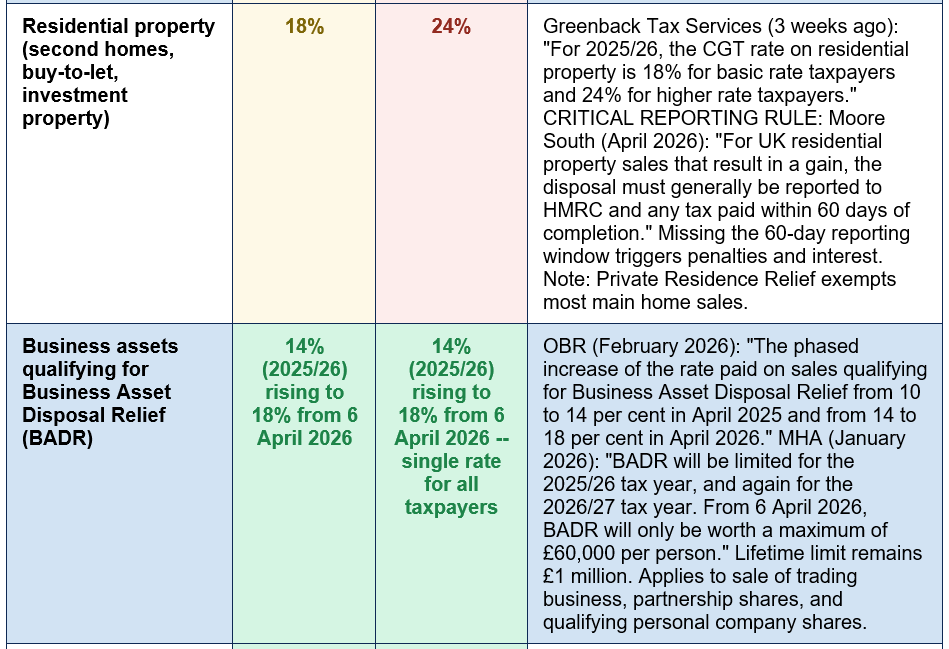
- Business Asset Disposal Relief (BADR) -- Changing Rates
- UK Property: The 60-Day Reporting Rule
- Capital Gains Tax in the US: 2025 and 2026 Rates, Brackets, and Rules
- The Short-Term vs Long-Term Distinction: The Most Important Rule in US CGT
- The 2026 US Long-Term CGT Brackets
- The Net Investment Income Tax (NIIT) -- The Hidden Surcharge
- Special US CGT Rates
- What Assets Are Subject to Capital Gains Tax?
- How to Calculate Capital Gains Tax: Worked Examples
- UK Capital Gains Tax Worked Example
- US Long-Term Capital Gains Tax Worked Example
- Key Exemptions and Reliefs: What Is Exempt from Capital Gains Tax?
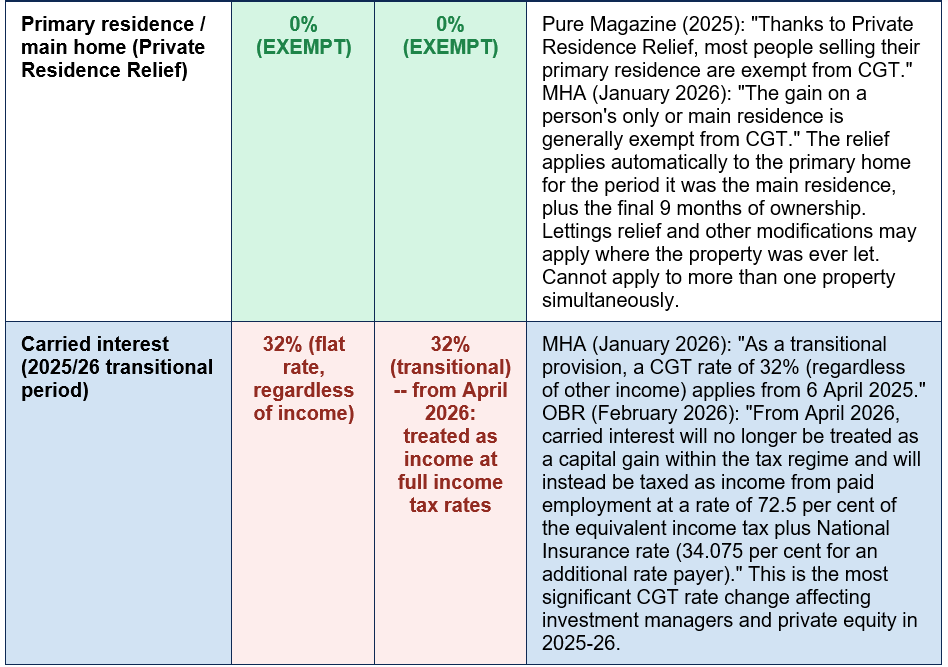
- UK CGT Exemptions and Reliefs
- US CGT Exemptions
- How to Reduce Capital Gains Tax Legally: Key Strategies
- Conclusion
- Frequently Asked Questions (FAQ)
The Tax on Profitable Selling
Imagine buying a house in 2018 for £200,000 and selling it in 2026 for £340,000. Or purchasing shares in a technology company in 2020 for $5,000 and selling them in 2026 for $18,000. Or acquiring a buy-to-let property, a piece of fine art, or cryptocurrency -- and then selling at a gain. In each of these situations, you have made a profit on the sale of an asset. That profit is called a capital gain, and in both the UK and the US, it is subject to a specific category of tax designed precisely for this type of income: capital gains tax.Capital gains tax is neither income tax nor sales tax -- it is a tax specifically on the profit realised when you sell an asset for more than you paid for it. The gain is the difference between the price you received (the disposal proceeds) and the price you originally paid (the acquisition cost, also called the 'basis' in US tax terminology). Certain allowable costs -- purchase expenses, improvement costs, professional fees -- can be deducted to reduce the gain before tax is calculated. What remains after deductions is the taxable capital gain.
In 2026, capital gains tax regimes in both the UK and the US have seen significant activity. In the UK, the Chancellor's Autumn 2024 Budget introduced rate changes that took effect from October 2024 and further changes from April 2025 and April 2026 -- including increases to the main CGT rates, changes to Business Asset Disposal Relief, and the phasing out of favourable carried interest treatment. In the US, the long-term capital gains rates of 0%, 15%, and 20% remain unchanged in 2026 (Kiplinger, March 2026 confirmed no impact from the One Big Beautiful Bill Act on CGT rates), with only inflation-adjusted threshold changes. This guide covers both systems completely -- rates, thresholds, exemptions, examples, and the most impactful legal strategies for reducing the tax owed.
What Is Capital Gains Tax?
Capital gains tax (CGT) is a tax levied on the profit -- the gain -- made when you sell or otherwise dispose of an asset that has increased in value since you acquired it. FinanceWonk: 'Capital gains tax applies when you sell an asset for a profit. Common assets include stocks, bonds, mutual funds, ETFs, cryptocurrency, real estate, and collectibles.' The key principle is that CGT taxes the profit from the disposal, not the total proceeds. If you sell shares for £50,000 that cost you £35,000, your capital gain is £15,000 -- and it is the £15,000, not the £50,000, that is taxable.A capital gain is 'realised' when the asset is actually sold or disposed of. Simply holding an asset that has increased in value does not create a CGT liability -- the gain must be realised through a taxable disposal event. Stacker/Motley Fool: 'A capital gain is the increase in value between what you paid for a capital asset and what you received when you sold it, subject to adjustments in certain cases. Most of the things you own count as capital assets, including investments, real estate, and personal property.' In the UK, a disposal also includes giving an asset away (a gift), transferring an asset to a trust, exchanging assets, and receiving insurance proceeds when an asset is lost or destroyed.
The opposite of a capital gain is a capital loss -- where an asset is sold for less than its acquisition cost. In both the UK and the US, capital losses can be used to offset capital gains in the same tax year, reducing the overall CGT liability. In the US, if capital losses exceed capital gains in a year, up to $3,000 of net losses can be deducted against ordinary income, and any remaining losses can be carried forward indefinitely to offset future gains. In the UK, capital losses can be carried forward (but not back) indefinitely to offset future capital gains.
Capital gains tax in 2026 -- key rates summary: UK: 18% basic / 24% higher rate. Annual exempt: £3,000. US long-term: 0%/15%/20%. Short-term US: up to 37% (ordinary income rates). — LITRG (2025/26 and 2026/27): 'The main rate of CGT is 18% for basic rate taxpayers. For higher or additional rate taxpayers, the rate is 24.' Moore South (April 28, 2026): 'The Capital Gains Tax allowance for the 2025/2026 tax year is £3,000 for individuals.' US Tax Tools (3 days ago, IRS Rev. Proc. 2025-32): 2026 long-term CGT 0% up to $49,450 single/$98,900 MFJ; 15% to $545,500/$613,700 MFJ; 20% above. NerdWallet (1 month ago): 'Per the IRS, most people pay no more than 15%.' Forbes Advisor (2 weeks ago): short-term gains taxed as high as 37%.
Capital Gains Tax in the UK: 2025/26 Rates, Allowances, and Rules
UK CGT Rates for 2025/26
The UK CGT system underwent significant rate changes in October 2024 (Budget) that continue through 2025/26 and 2026/27. LITRG confirms the current rates: 'For disposals in 2025/26 and 2026/27, the main rate of CGT is 18% for basic rate taxpayers. For higher or additional rate taxpayers, the rate is 24%.' These rates apply to most capital assets -- shares, ETFs, cryptocurrency, non-residential property, and second homes. Prior to October 2024, the main rates were 10% (basic rate) and 20% (higher rate) for non-property assets -- the increase to 18% and 24% represents a significant tightening.The Annual Exempt Amount (AEA)
Every individual in the UK benefits from an Annual Exempt Amount (AEA) -- the amount of capital gain that can be realised each tax year without paying any CGT. Moore South (April 2026): 'For the 2025/2026 tax year, the Capital Gains Tax allowance is £3,000 for individuals and personal representatives. If your total taxable gains for the year are £3,000 or less, there will be no Capital Gains Tax to pay. If your gains exceed £3,000, tax is only charged on the amount above the allowance. The allowance cannot be carried forward.' This £3,000 figure represents a dramatic reduction from the £12,300 AEA that applied in 2022/23 -- making proactive CGT planning significantly more important for investors and property owners.Business Asset Disposal Relief (BADR) -- Changing Rates
Business Asset Disposal Relief (BADR, formerly Entrepreneurs' Relief) provides a lower CGT rate on qualifying gains from the sale of trading businesses, partnership shares, and qualifying company shares, up to a lifetime limit of £1 million. The rate is being phased upward: OBR (February 2026): 'The phased increase from 10% to 14% in April 2025 and from 14% to 18% in April 2026.' MHA (January 2026): 'From 6 April 2026, BADR will only be worth a maximum of £60,000 per person.' Greenback Tax Services (3 weeks ago): 'The rate on qualifying business gains rises to 18% from 6 April 2026, up from 14% in 2025/26.'UK Property: The 60-Day Reporting Rule
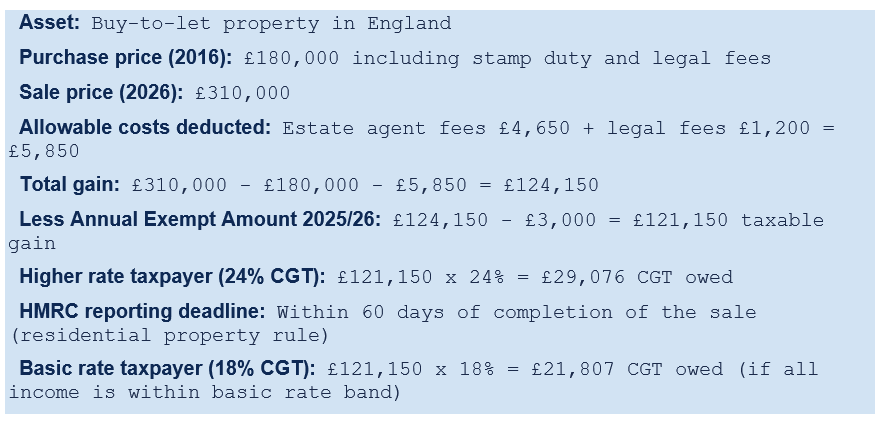
Residential property disposals have their own reporting requirement. Moore South (April 2026): 'For UK residential property sales that result in a gain, the disposal must generally be reported to HMRC and any tax paid within 60 days of completion. Other capital gains are reported through your Self Assessment tax return, with tax payable by 31 January following the end of the tax year. Missing these deadlines can result in penalties and interest.' The 60-day rule is particularly important for buy-to-let landlords, second home owners, and inherited property disposals.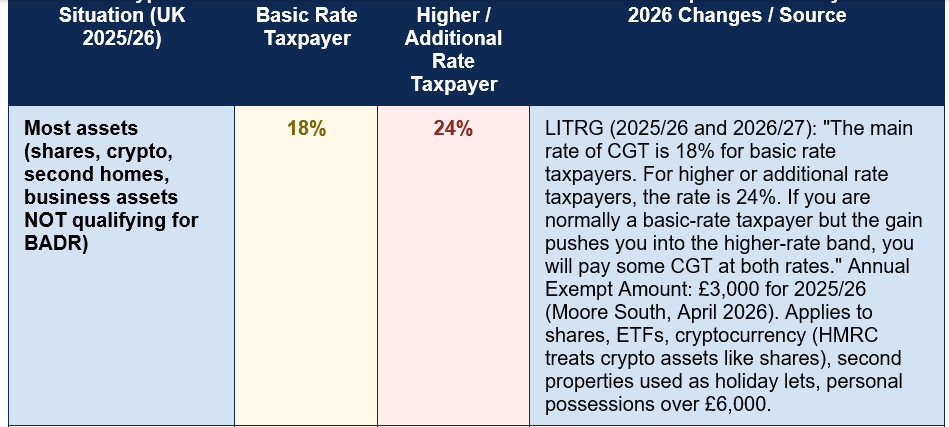
Capital Gains Tax in the US: 2025 and 2026 Rates, Brackets, and Rules
The Short-Term vs Long-Term Distinction: The Most Important Rule in US CGT
The US capital gains tax system turns primarily on one variable: how long the asset was held before sale. NerdWallet (1 month ago): 'Short-term capital gains tax is a tax on profits from the sale of an asset held for one year or less. Short-term capital gains are treated as regular income and taxed according to ordinary income tax brackets: 10%, 12%, 22%, 24%, 32%, 35% or 37%. Profits from the sale of an asset held for more than a year are subject to long-term capital gains tax. The long-term capital gains tax rates are 0%, 15% or 20%, depending on taxable income and filing status.' Forbes Advisor (2 weeks ago) summarises the reward for patience: 'Short-term gains can be taxed as high as 37%, while long-term gains get better treatment, typically 0%, 15% or 20%. Knowing how it works could save you thousands of dollars.'The 2026 US Long-Term CGT Brackets
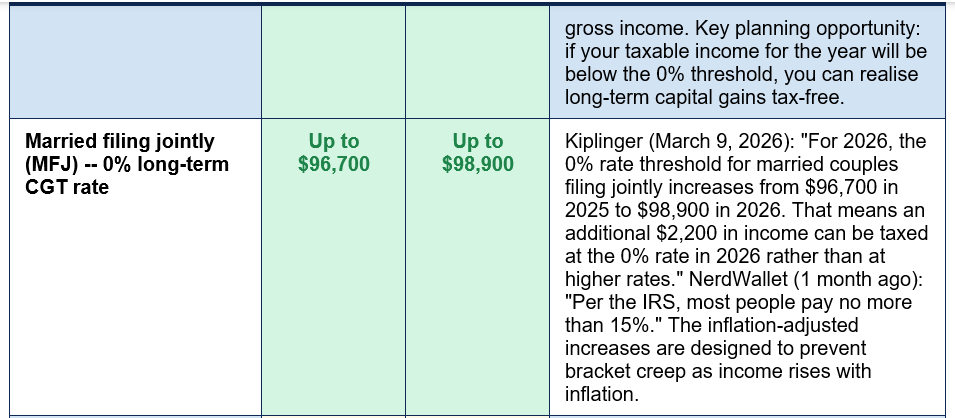
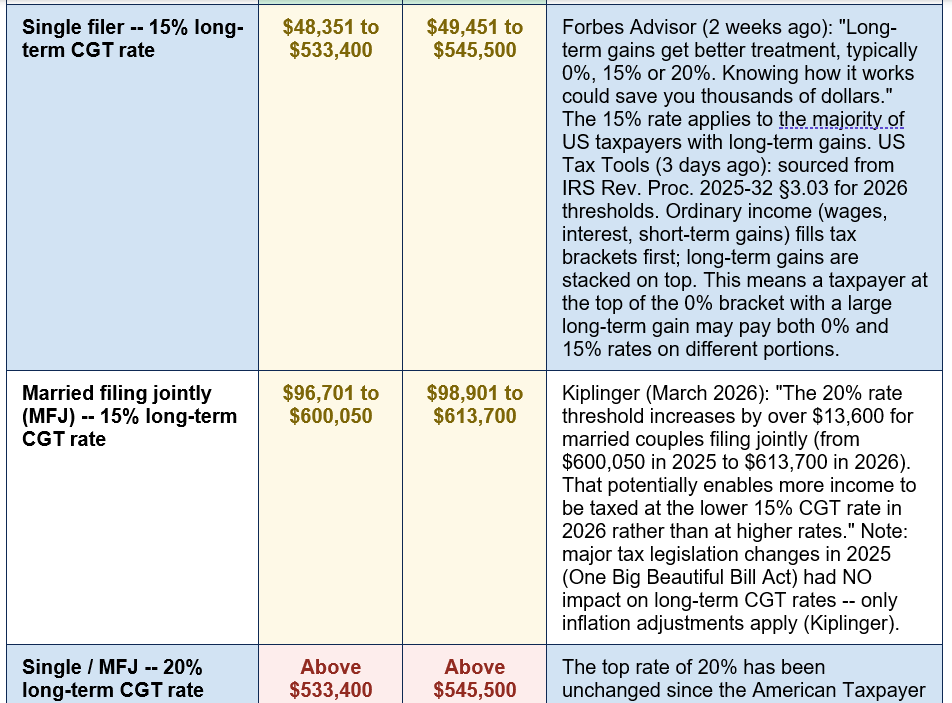
For the 2026 tax year (returns filed in early 2027), the long-term CGT rates remain 0%, 15%, and 20%, with thresholds adjusted for inflation under IRS Revenue Procedure 2025-32. US Tax Tools (3 days ago): '2026: 0% up to $49,450 single / $98,900 MFJ; 15% to $545,500 / $613,700 MFJ; 20% above.' Kiplinger (March 9, 2026): 'The changes are designed to provide some relief against bracket creep. The 20% rate threshold increases by over $13,600 for married couples filing jointly (from $600,050 in 2025 to $613,700 in 2026).' Note: these thresholds apply to TAXABLE income (after standard or itemised deductions), not gross income.The Net Investment Income Tax (NIIT) -- The Hidden Surcharge
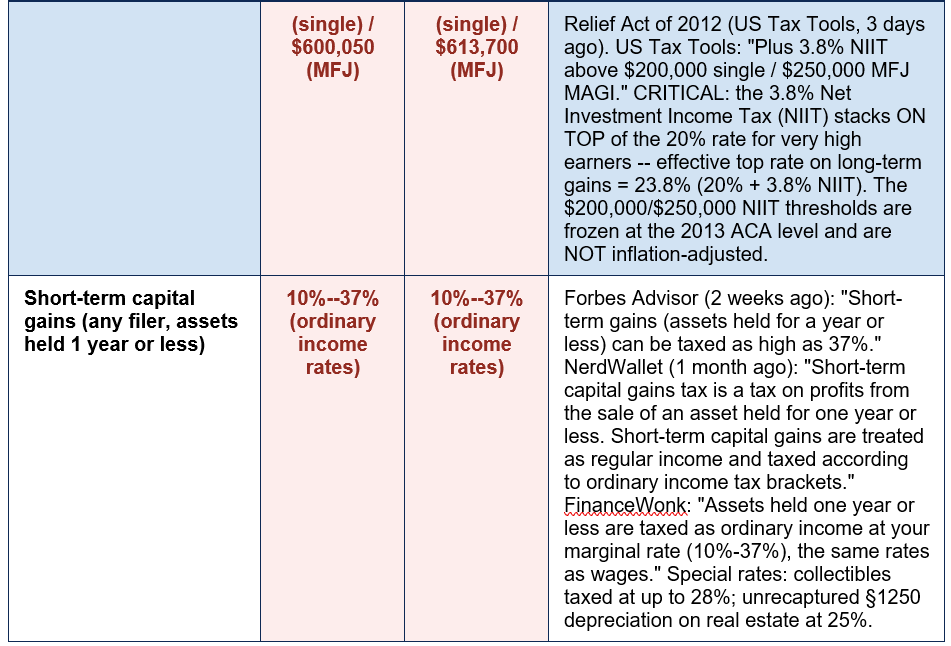
High-income US taxpayers face an additional 3.8% surcharge on investment income called the Net Investment Income Tax (NIIT). US Tax Tools (3 days ago): '3.8% NIIT above $200,000 single / $250,000 MFJ MAGI. Above certain MAGI thresholds, IRC §1411 adds a 3.8% surtax on net investment income (including capital gains, interest, dividends, and rental income) -- on TOP of the LTCG rate, not instead of it. Unlike the LTCG brackets, these thresholds are fixed by 2013 statute and are NOT adjusted for inflation.' This means the effective top long-term CGT rate for very high earners is 23.8% (20% + 3.8% NIIT).Special US CGT Rates
FinanceWonk and US Tax Tools both confirm special rates for certain asset classes: collectibles (artwork, coins, precious metals, wine) are taxed at a maximum of 28% regardless of income; unrecaptured Section 1250 depreciation on real estate is taxed at a maximum of 25%; and assets sold inside tax-deferred accounts (IRAs, 401(k)s) do not generate capital gains tax at the point of sale -- they are taxed as ordinary income when distributions are taken.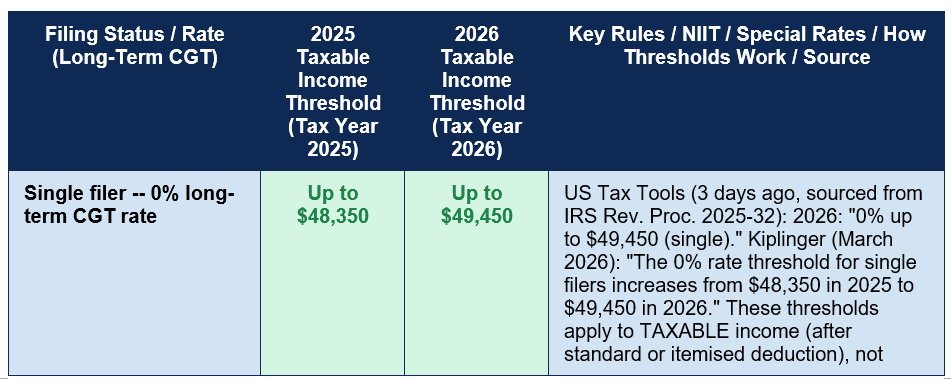
What Assets Are Subject to Capital Gains Tax?
Most capital assets are subject to CGT in both the UK and the US when sold at a profit. Key categories:- Stocks, shares, and investment funds: Shares in UK or US companies; ETFs; investment trusts; unit trusts; mutual funds. In the UK, gains on ISA-held investments are exempt from CGT -- one of the most significant UK CGT planning tools. In the US, gains inside IRAs and 401(k)s are not subject to CGT at the point of sale.
- Cryptocurrency: Pure Magazine (2025): 'HMRC treats crypto assets like shares, meaning profits from buying and selling coins are taxable under CGT rules.' In the US, the IRS also treats cryptocurrency as property, meaning capital gains rules apply to all disposals including crypto-to-crypto swaps. Both countries have increased crypto reporting requirements significantly in 2025-2026.
- Property: In the UK: investment properties, second homes, buy-to-let, inherited properties, and overseas property owned by UK residents. The main home is generally exempt via Private Residence Relief. In the US: investment properties and second homes are subject to CGT; the primary home has a significant exemption ($250,000 gain for single filers, $500,000 for married filing jointly, subject to ownership and use tests).
- Business assets: Sale of a business, partnership interest, or shares in a private company. In the UK, BADR provides a reduced rate (14% in 2025/26, rising to 18% from April 2026) on qualifying gains up to the £1 million lifetime limit. In the US, small business stock (QSBS) under IRC §1202 may qualify for a 0% or reduced rate under specific conditions.
- Personal possessions and collectibles: In the UK: personal possessions worth over £6,000 (chattels exemption); jewellery, antiques, artwork, coins, and other collectibles. In the US: collectibles face the special 28% maximum rate. Wasting assets (those with a predictable useful life of 50 years or less) are generally exempt from UK CGT.
How to Calculate Capital Gains Tax: Worked Examples
UK Capital Gains Tax Worked Example
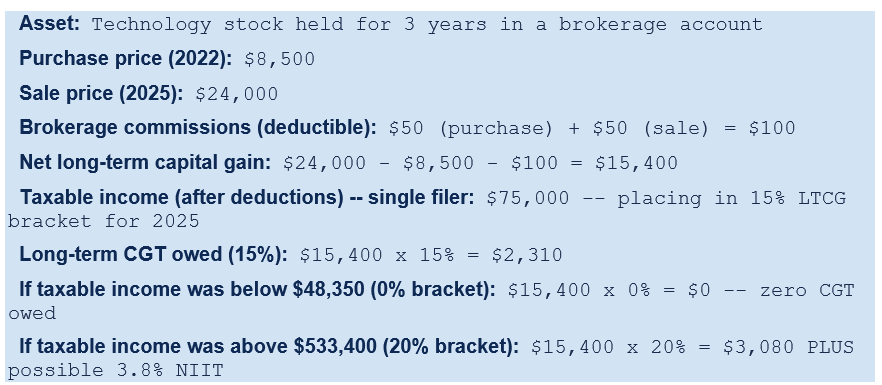
US Long-Term Capital Gains Tax Worked Example
Key Exemptions and Reliefs: What Is Exempt from Capital Gains Tax?
UK CGT Exemptions and Reliefs
- Private Residence Relief (main home exemption): MHA (January 2026): 'The gain on a person's only or main residence is generally exempt from CGT.' Pure Magazine: 'Thanks to Private Residence Relief, most people selling their primary residence are exempt from CGT.' The relief covers the entire ownership period during which the property was the main residence, plus automatically the final 9 months of ownership. Cannot apply simultaneously to more than one property.
- ISA (Individual Savings Account) exemption: All gains made on investments held within an ISA are completely exempt from CGT, regardless of size. ISAs are the most powerful UK CGT shelter available to individual investors. In 2025/26 the annual ISA subscription limit is £20,000.
- Bed and ISA strategy: Selling taxable investments and immediately repurchasing them within an ISA 'beds' the investment inside the ISA shelter for future gains -- but realises the gain to date in the taxable account, ideally using the current year's Annual Exempt Amount. This must be done with care to avoid wash sale-equivalent rules.
- Transfers between spouses and civil partners: Transfers of assets between married couples and civil partners take place at no gain/no loss for CGT purposes -- no CGT is triggered on the transfer itself. This enables tax planning through spousal transfers to use both partners' Annual Exempt Amounts and basic rate bands.
- Business Asset Disposal Relief (BADR): Reduced CGT rate (14% in 2025/26; 18% from April 2026) on qualifying business disposals up to the £1 million lifetime limit.
US CGT Exemptions
- Primary home exclusion ($250,000 / $500,000): US taxpayers can exclude up to $250,000 of gain on the sale of a primary residence ($500,000 for married filing jointly), provided they owned and used the home as their main home for at least 2 of the 5 years preceding the sale. This exclusion can be used repeatedly (but only once every 2 years).
- Tax-deferred accounts (IRAs, 401(k)s): Investments inside traditional IRAs and 401(k)s are not subject to capital gains tax at the point of sale -- gains accumulate tax-deferred and are taxed as ordinary income only when distributions are taken. Roth IRAs and Roth 401(k)s allow tax-free growth entirely, provided qualified distribution rules are met.
- 0% long-term CGT rate for low-income taxpayers: Kiplinger (March 2026): 'If your income varies yearly, you might consider realising long-term capital gains in years when your total taxable income is below the 0% threshold.' A single filer with taxable income below $49,450 in 2026 pays 0% on long-term capital gains -- a significant planning opportunity for early retirees and strategic gain realisation.
The UK and US CGT systems compared at a glance: UK: Single rate structure (18%/24%) applied to ALL capital assets (with residential property and non-property now using the same rates). Annual exemption of £3,000. No short-term/long-term distinction -- holding period does not affect the rate. Reports most gains through Self Assessment (annual); residential property gains must be reported within 60 days of sale. US: Three-rate structure (0%/15%/20%) for LONG-TERM gains (held over 1 year). Short-term gains taxed as ordinary income (up to 37%). Income thresholds inflation-adjusted annually. NIIT surcharge (3.8%) applies to high earners above $200,000/$250,000 MAGI. Special rates for collectibles (28%) and real estate depreciation recapture (25%). No annual exemption equivalent to the UK AEA.
How to Reduce Capital Gains Tax Legally: Key Strategies
- UK: Use your Annual Exempt Amount every year: The £3,000 annual exemption cannot be carried forward. If you have gains available to realise, using the full exemption each year -- including through modest portfolio rebalancing -- prevents the exemption from being wasted. Spouses and civil partners each have their own £3,000 exemption, enabling £6,000 of joint gains per year free of CGT.
- UK: Maximise ISA contributions: Gains made on investments inside ISAs are completely exempt from CGT. Every pound of investment that can be moved inside an ISA (within annual limits) permanently shelters future gains from CGT. In 2025/26, the ISA limit is £20,000 per person.
- US: Hold assets for more than one year: Forbes Advisor: 'Knowing how it works could save you thousands of dollars.' Selling an asset after 366 days rather than 365 days can reduce the tax rate from up to 37% (ordinary income) to a maximum of 20% (long-term rate) -- potentially saving tens of thousands of dollars on large gains.
- US: Realise gains in 0% rate years: Kiplinger (March 2026): A single filer with taxable income below $49,450 in 2026 pays 0% on long-term capital gains. Taxpayers in years with lower income (post-retirement, career break, sabbatical) should consider realising long-term gains specifically to use this 0% window.
- Both countries: Use capital losses to offset gains (tax-loss harvesting): Capital losses reduce the taxable gain in the same year. Selling loss-making investments to offset gains is called tax-loss harvesting. In the UK, losses must be reported to HMRC even if not immediately useful -- they can be carried forward indefinitely. In the US, net capital losses (after offsetting all gains) can offset $3,000 of ordinary income per year, with the remainder carried forward indefinitely.
- UK: Transfer assets to a spouse before sale: Transfers between spouses/civil partners are exempt from CGT. Transferring an asset to a lower-rate-paying spouse before sale can enable the gain to be taxed at 18% rather than 24%, saving 6 percentage points on the entire gain above the AEA.
CAPITAL GAINS TAX PLANNING CHECKLIST -- 2026: UK: (1) Have you used your full £3,000 Annual Exempt Amount this tax year? Unused AEA is wasted. (2) Are your investments inside an ISA? ISA gains are permanently exempt from CGT. (3) If selling a residential investment property, do you have the 60-day HMRC reporting deadline in your diary from the completion date? (4) If selling a business, does the sale qualify for Business Asset Disposal Relief (14% in 2025/26; 18% from April 2026)? (5) Can any capital losses be offset against the gain to reduce the taxable amount? US: (6) Have you held the asset for more than one year to qualify for the long-term CGT rate (max 20%) rather than the short-term rate (max 37%)? (7) Is your taxable income below $49,450 (single) or $98,900 (MFJ) for 2026? If so, your long-term gains may be taxed at 0%. (8) Are any investments inside an IRA or 401(k)? Gains inside these accounts are not subject to CGT at the point of sale. (9) Have you considered tax-loss harvesting -- selling loss-making positions to offset gains? (10) BOTH COUNTRIES: Always consult a qualified tax adviser before any significant asset disposal. The tax saving from professional advice typically far exceeds the cost.
FIVE CAPITAL GAINS TAX MISTAKES THAT COST TAXPAYERS MONEY: (1) UK: MISSING THE 60-DAY RESIDENTIAL PROPERTY REPORTING DEADLINE. Moore South (April 2026): residential property gains must be reported to HMRC and any tax paid within 60 days of completion. Missing this deadline triggers automatic penalties and interest. Set a calendar reminder on the day of completion. (2) UK: FORGETTING THAT THE ANNUAL EXEMPT AMOUNT CANNOT BE CARRIED FORWARD. The £3,000 AEA expires at the end of each tax year (5 April). Unused allowance is permanently lost. (3) US: TREATING CAPITAL GAINS AS INCOME TAX. Capital gains are a separate category with their own rates and rules. Many taxpayers assume CGT is the same as their income tax rate -- for long-term gains this is almost always wrong (and usually lower). (4) BOTH: IGNORING CRYPTO AS A CGT EVENT. HMRC and the IRS both treat cryptocurrency as a capital asset. Every disposal -- including crypto-to-crypto swaps in the US -- is a taxable event that must be reported. Failure to report crypto gains is not a technicality; it is non-compliance. (5) BOTH: NOT OFFSETTING CAPITAL LOSSES IN THE SAME YEAR. Capital losses in the same tax year reduce the taxable gain. Many taxpayers pay CGT on gains without realising they have offsetting losses available in the same portfolio. Review all investment positions before any disposal.
Conclusion
Capital gains tax is one of the most financially significant taxes for investors, property owners, and business sellers in both the UK and the US. In the UK in 2025/26, the main rates are 18% for basic rate taxpayers and 24% for higher and additional rate taxpayers on most assets, with a £3,000 annual exemption that cannot be carried forward and a 60-day reporting deadline for residential property sales. Business Asset Disposal Relief continues to offer a reduced rate (14% in 2025/26, rising to 18% from 6 April 2026) on qualifying business disposals up to the £1 million lifetime limit.In the US, the holding period determines everything. Short-term gains (assets held one year or less) are taxed as ordinary income at rates up to 37%. Long-term gains (assets held over one year) are taxed at the preferential rates of 0%, 15%, or 20% depending on taxable income. The 2026 thresholds -- 0% up to $49,450 for single filers, 0% up to $98,900 for married filing jointly -- are adjusted for inflation under IRS Revenue Procedure 2025-32. High earners face an additional 3.8% NIIT surcharge, producing an effective top rate of 23.8% on long-term gains.
In both countries, the most effective CGT planning strategies are legal, available to all taxpayers, and typically straightforward to implement: use available exemptions and allowances annually; shelter investments inside ISAs (UK) or tax-deferred accounts (US); hold assets for the long term where possible; use capital losses to offset gains; and take professional advice before any significant disposal. For complex situations -- business sales, property disposals, cross-border transactions, cryptocurrency -- a qualified tax adviser or CPA will almost always save more in tax than their fee costs.
Frequently Asked Questions (FAQ)
What is capital gains tax and how does it work?
Capital gains tax (CGT) is a tax levied on the profit -- the capital gain -- you make when you sell or dispose of an asset that has increased in value since you acquired it. FinanceWonk: 'Capital gains tax applies when you sell an asset for a profit. Common assets include stocks, bonds, mutual funds, ETFs, cryptocurrency, real estate, and collectibles. The rate depends on your holding period and taxable income.' The gain is the difference between the sale proceeds and the original acquisition cost, less any allowable expenses (legal fees, improvement costs, etc.). In the UK, the gain is reported through Self Assessment (annual) or within 60 days for residential property. In the US, gains are reported on Schedule D and Form 8949 with the annual tax return. The key principle in both systems: CGT is on the profit, not the total sale proceeds. A £100,000 house sale where the property was bought for £85,000 generates a £15,000 gain (before deductions), not a £100,000 taxable amount.What are the capital gains tax rates in the UK for 2025/26?
For the 2025/26 tax year, UK capital gains tax rates are: for most assets (shares, ETFs, cryptocurrency, non-residential property, second homes): 18% for basic rate taxpayers and 24% for higher or additional rate taxpayers. LITRG: 'For disposals in 2025/26 and 2026/27, the main rate of CGT is 18% for basic rate taxpayers. For higher or additional rate taxpayers, the rate is 24%.' For residential property, the same rates apply (18% basic / 24% higher) since October 2024. For qualifying business disposals under Business Asset Disposal Relief (BADR): 14% in 2025/26 (rising to 18% from 6 April 2026), on gains up to the £1 million lifetime limit. The Annual Exempt Amount for 2025/26 is £3,000 per individual -- the first £3,000 of annual gains is exempt from CGT (Moore South, April 2026). All gains above the AEA are taxable at the above rates. Private Residence Relief exempts most primary home sales entirely.
What are the capital gains tax rates in the US for 2026?
For the 2026 tax year (returns filed in early 2027), US long-term capital gains rates (assets held over one year) are: 0% on gains up to $49,450 taxable income (single) / $98,900 (married filing jointly); 15% from those thresholds up to $545,500 (single) / $613,700 (MFJ); 20% above those thresholds. US Tax Tools (3 days ago, sourced from IRS Rev. Proc. 2025-32): '2026 long-term CGT: 0% up to $49,450 single / $98,900 MFJ; 15% to $545,500 / $613,700 MFJ; 20% above.' Kiplinger (March 9, 2026): 'These changes are inflation adjustments only. Major tax legislation in 2025 had no impact on long-term CGT rates.' Short-term capital gains (assets held one year or less) are taxed as ordinary income at rates from 10% to 37% (NerdWallet, 1 month ago). High-income filers with MAGI above $200,000 (single) / $250,000 (MFJ) face an additional 3.8% NIIT surcharge on net investment income, making the effective top long-term CGT rate 23.8%.
Do I pay capital gains tax when I sell my home?
In most cases, no -- primary home sales are the most significant exemption from CGT in both the UK and the US. UK: MHA (January 2026): 'The gain on a person's only or main residence is generally exempt from CGT.' Private Residence Relief applies for the full period the property was your main home, plus automatically the final 9 months of ownership. You cannot have Private Residence Relief on more than one property simultaneously. Additional reliefs (lettings relief) may apply if the property was ever rented out. US: Homeowners can exclude up to $250,000 of gain on a primary residence ($500,000 for married filing jointly), provided they owned and used the home as their principal residence for at least 2 of the 5 years before the sale. This exclusion can be used repeatedly but only once in any 2-year period. Investment properties and second/holiday homes do NOT qualify for these exemptions in either country -- they are subject to CGT at the standard rates.
Is cryptocurrency subject to capital gains tax?
Yes -- in both the UK and the US, cryptocurrency is treated as a capital asset and gains from its disposal are subject to capital gains tax. UK: Pure Magazine: 'HMRC treats crypto assets like shares, meaning profits from buying and selling coins are taxable under CGT rules.' Every disposal of cryptocurrency -- selling crypto for pounds, exchanging one crypto for another, using crypto to purchase goods or services -- is a CGT disposal event in the UK. Each disposal must be reported individually, using the gain/loss based on the original acquisition cost in pounds. The £3,000 annual exempt amount applies in the same way as for share disposals. US: The IRS treats cryptocurrency as property. Every disposal event (selling, swapping, spending) is a taxable event that must be reported on Schedule D. Long-term vs short-term treatment applies based on the holding period: gains on cryptocurrency held for over one year benefit from the 0%/15%/20% long-term rates; gains on cryptocurrency held for one year or less are taxed as ordinary income (up to 37%). Both HMRC and the IRS have significantly expanded crypto reporting requirements since 2024, and exchanges are now required to report user transactions. Non-compliance with crypto CGT is not a minor oversight -- it is a significant compliance risk in 2026.

0 Comments Comments