
Taxes
IRS Free File 2026: Complete Guide to Filing Taxes Free

The average American spends $290 and 13 hours filing their taxes each year. But approximately 70% of all US taxpayers qualify to file their federal return for free through IRS Free File — and most of them do not know it. This guide covers everything you need to know about IRS Free File in 2026: who qualifies, which partners to use, what happened to Direct File, every free alternative available, and step-by-step instructions to get your refund without paying a cent.
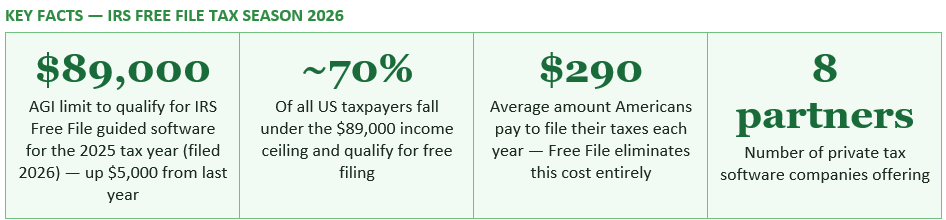
IRS Free File is a public-private partnership between the Internal Revenue Service and the Free File Alliance — a coalition of eight private tax software companies. The program allows eligible taxpayers to prepare and electronically file their federal income tax returns at no cost, using fully guided, commercial-grade tax preparation software. There is no catch, no trial period, and no upgrade required for qualifying filers. The software is the same quality as the paid versions offered by the same companies.
The program works through the official IRS website at IRS.gov — this is the only safe starting point. Never search for 'IRS Free File' or 'file taxes free' in a general internet search engine, as the top results frequently include commercial sites that lead users into paid products or scams. Always navigate directly to irs.gov and select the Free File option from there.
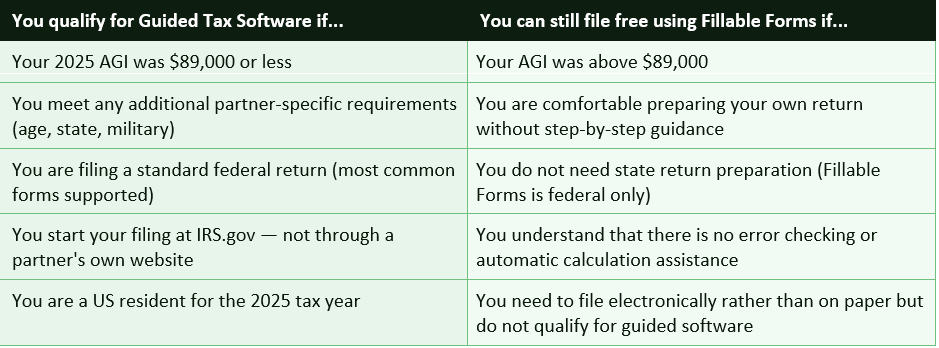
There are two versions of Free File. The first — and most useful for most qualifying taxpayers — is the Guided Tax Software option, which walks you through your return with step-by-step questions, catches common errors, and automatically calculates your refund or balance due. This option is available only to taxpayers whose Adjusted Gross Income (AGI) was $89,000 or less in 2025. The second option — Free File Fillable Forms — is available to taxpayers at any income level and provides electronic versions of the standard IRS paper forms. Fillable Forms offer no guidance, no error checking, and no state return capability, but they allow any taxpayer to file electronically rather than on paper at no cost.
IRS Free File demonstrates the IRS's commitment to providing taxpayers an easy and secure way to prepare and file their federal tax return at no cost. Free assistance and information is also available to taxpayers through other means as well, including VITA/TCE, MilTax, and IRS.gov.
— FRANK J. BISIGNANO, IRS CHIEF EXECUTIVE OFFICER (IRS PRESS RELEASE, 2026)
This limit represents one of the largest annual increases in the program's history — a $5,000 increase from the previous year's $84,000 threshold, according to Money.com. Approximately 70% of all US taxpayers fall under this income ceiling, meaning the great majority of American filers qualify for completely free guided tax preparation but many do not realise it or access it.
Beyond the overall AGI limit, individual Free File partners may have their own additional eligibility requirements. Some partners limit their free offering to taxpayers below a certain age, in specific states, or with military status. However, taxpayers who meet the overall $89,000 AGI ceiling are guaranteed to have at least one partner available to them regardless of other characteristics. The IRS Free File lookup tool at irs.gov matches you to qualifying software based on your age, income, and state of residence.
Direct File launched as a pilot in 2024 and expanded to 25 states for the 2025 filing season. User satisfaction was remarkably high: 94% of users described their experience positively, according to KOMO News. But in November 2025, the IRS informed the 25 partner states that 'Direct File will not be available in Filing Season 2026,' and no future launch date was set. Federal News Network reported that most of the IRS staff who worked on Direct File had left the government or been terminated, and former IRS Commissioner Billy Long said at a tax conference in July that Direct File is 'gone.'
The shutdown has been controversial. Consumer advocates, including Washington Consumers' Checkbook, called the decision 'mystifying' given the high satisfaction rate. Critics of the decision note that Direct File was free, ad-free, and had no conflict of interest with private tax preparation companies — unlike the Free File program, which is operated by those same companies. The Trump administration's 'Big, Beautiful Bill' signed into law in summer 2026 allocated $15 million to a Treasury task force to research alternatives to Direct File that would allow up to 70% of all taxpayers to file for free — but any new government-run tool is likely years away.
For former Direct File users: IRS Free File's guided software is the closest available substitute. It is guided, step-by-step, free for qualifying taxpayers, and covers most common tax situations. It is operated by private companies rather than the IRS itself, and those companies may attempt to upsell you to paid products — vigilance about declining paid add-ons is essential. Always start from irs.gov to access the free version.
The important limitations of Fillable Forms are equally important to understand. There is no guided interview — you must know which forms you need and how to complete them. There is no automatic error checking beyond basic mathematical calculations. There is no state return preparation capability. And there is no software to identify deductions or credits you might have missed. Fillable Forms is best suited for taxpayers who have filed their own returns before and are comfortable with the underlying tax concepts, or those whose returns are genuinely simple (W-2 income only, taking the standard deduction, no complex credits or schedules).
For taxpayers who are comfortable with the forms but above the $89,000 income limit, Fillable Forms provides a completely free federal e-filing option that avoids both the cost of commercial software and the delay and risk of paper filing. The IRS processes e-filed returns in approximately 21 days, compared with significantly longer timelines for paper returns.
VITA eligibility is generally limited to taxpayers with an AGI of $67,000 or less, people with disabilities, and individuals with limited English-speaking abilities. Some VITA sites, including the virtual option through GetYourRefund.org (covered in Section 9), use a broader $89,000 AGI threshold. The Taxpayer Advocate Service confirms the AGI limit is $67,000 or less for in-person VITA.
VITA volunteers are trained and certified by the IRS to prepare the most common federal and state tax forms. They can handle W-2 income, Earned Income Tax Credit (EITC) claims, Child Tax Credit, and most standard deductions and credits. VITA is particularly valuable for first-time filers, those whose financial situations have changed significantly during the year, and those who are eligible for the EITC (one of the most valuable credits available to low-to-moderate income workers, worth up to $7,830 for families with three or more children in 2025).
VITA sites are typically located at community centres, libraries, schools, and shopping malls. To find a VITA site near you, use the IRS VITA Locator Tool at irs.gov or call 800-906-9887. VITA sites typically operate from late January through the April 15 filing deadline, and some popular sites require advance appointments.
The AARP Foundation's Tax-Aide programme staffs the majority of TCE sites across the country, with approximately 5,000 sites and 35,000 IRS-certified volunteer tax counsellors. AARP Tax-Aide is available to taxpayers at any income level — there is no income limit for TCE/AARP Tax-Aide assistance, making it particularly valuable for moderate-income retirees whose AGI exceeds the VITA threshold but who still want free, expert assistance. To find the nearest AARP Tax-Aide site, use the AARP Foundation's Tax-Aide Site Locator at aarp.org.
Both VITA and TCE are entirely free, IRS-certified, and non-commercial — there are no upsells, no trial periods, and no paid upgrades. The volunteers prepare your return in front of you, explain what they are doing, and give you a complete copy of your filed return. For many older and lower-income taxpayers, this level of personalised, face-to-face assistance is more appropriate than navigating software independently.
MilTax covers issues specific to military tax situations that standard tax software handles poorly: combat and training pay exclusions, deployment-related deductions, housing allowance tax treatment, multi-state filing for military families who move frequently, and state income tax exemptions that vary by duty station. Military families often have tax situations that are technically more complex than their income level might suggest, and MilTax's volunteer advisers are specifically trained in these military-specific rules.
MilTax allows eligible filers to electronically file a federal tax return and up to three state returns at no cost — a particularly valuable feature given that military families often have state tax obligations in multiple states. Free one-on-one tax help is available from MilTax experts by phone at 800-342-9647, through live chat, or through in-person VITA sites on military installations. MilTax can be accessed through the Military OneSource website.
The process typically works as follows: you upload photos of your tax documents (W-2, 1099, last year's return, and other relevant documents), complete a brief questionnaire about your tax situation, and a VITA volunteer prepares your return. A second volunteer reviews it for quality. You are typically contacted several times with questions and can review the completed return before it is filed. The process takes approximately two to three weeks from document submission to filing. GetYourRefund.org uses a broader income threshold of $89,000 AGI — higher than the standard in-person VITA limit of $67,000.
GetYourRefund.org is particularly well-suited for taxpayers who qualify for free filing assistance but cannot easily reach an in-person VITA site — those with mobility limitations, those in rural areas without nearby VITA sites, or those who work standard hours and cannot attend daytime VITA appointments. The quality of preparation is identical to in-person VITA, since the same IRS-certified volunteers complete the returns.
11. 2025 Tax Year Changes That Affect Your Return
The 2025 tax year — reported on returns filed in 2026 — includes several important changes that affect how much you owe or how large your refund will be.
Standard deduction increased
The 2025 standard deduction increased to $15,750 for single filers and $31,500 for married filing jointly, under IRS Revenue Procedure 2025-32. This represents the inflation adjustment from the 2024 amounts and means that the great majority of filers have no reason to itemize — and can complete a simple, free return in minutes. The standard deduction for head of household filers is $23,625 for 2025.
Tax brackets adjusted for inflation
All seven federal income tax brackets were adjusted for inflation for 2025, meaning the same level of real income is taxed at the same effective rate as the prior year — the bracket adjustment prevents bracket creep. The top marginal rate of 37% applies to taxable income above $626,350 for single filers and $751,600 for married filing jointly in 2025.
Retirement contribution limits increased
The 401(k) and 403(b) contribution limit increased to $23,500 for 2025 (up from $23,000 in 2024). The catch-up contribution limit for those aged 50 and over remains at $7,500 (total $31,000). The IRA contribution limit remains $7,000 (or $8,000 for those 50 and over). These limits affect the deductibility of retirement contributions reported on your return.
EITC amounts adjusted
The Earned Income Tax Credit (EITC) has been adjusted for inflation for 2025. The maximum EITC for a family with three or more qualifying children is $7,830 in 2025. If you earned below approximately $63,398 (married filing jointly with three or more children), you may qualify for the EITC — one of the most valuable credits available and one that is frequently unclaimed by eligible taxpayers.
The $290 average annual tax filing cost is not a trivial amount in the context of household finances. Applied consistently over 30 years at a modest 5% investment return, it becomes approximately $19,000 of compound growth from money that was being spent on a service that is freely available. For low-to-moderate income households — precisely those who are most likely to qualify for VITA, EITC, and other credits — the combination of free filing, proper credit claiming, and direct deposit of a refund into a high-yield savings account is a meaningful annual financial optimisation with no downside.
The IRS Free File ecosystem in 2026 — even without Direct File — provides a genuinely comprehensive set of free options for the overwhelming majority of US filers. Guided software for incomes under $89,000, Fillable Forms for any income, VITA and GetYourRefund.org for lower-income households wanting personal assistance, TCE and AARP Tax-Aide for older taxpayers, and MilTax for military families. Every one of these options is free, IRS-endorsed, and secure. The only barrier to using them is awareness — and this article is designed to remove that barrier.
The most important action you can take is to start at irs.gov — and only at irs.gov. Use the 'Find Your Trusted Partner' tool to identify the right Free File partner for your situation. Decline all paid add-ons. File early for the fastest refund. Set up direct deposit. And once your refund arrives, put it somewhere it can compound — a high-yield savings account or Cash ISA, a pension contribution, or toward the debt payoff that the stability-over-status movement is rightly identifying as the most powerful financial move most Americans can make. Your taxes should be the start of your financial year, not a $290 tax on it.
IRS.gov — E-file: Do Your Taxes for Free (IRS Free File official portal) https://www.irs.gov/e-file-do-your-taxes-for-free
Money.com — IRS Free File 2026: Who Qualifies, Income Limit, How to Use It (March 2026) https://money.com/irs-free-file-income-limit-2026/
Meriwest Credit Union — File Your Taxes Free Through IRS: Complete 2026 Guide https://www.meriwest.com/file-your-taxes-free-through-irs
Federal News Network — IRS Tells States Direct File 'Will Not Be Available' in 2026 (November 2025) https://federalnewsnetwork.com/it-modernization/2025/11/irs-direct-file-will-not-be-available-in-2026-agency-tells-states/
KOMO News / Checkbook — Trump Administration Shuts Down IRS Direct File (April 2026) https://komonews.com/news/local/filing-taxes-free-preparation-and-filing-options-us-treasury-irs-direct-file-cashapp-free-file-taxes-protect-against-fraud
IndexBox — Free Tax Filing 2026: IRS Direct File Ends, Top Alternatives (February 2026) https://www.indexbox.io/blog/irs-direct-file-discontinued-for-2026-guide-to-free-tax-filing-options/
Taxpayer Advocate Service — The Filing Season: How to Get Assistance (January 2026) https://www.taxpayeradvocate.irs.gov/news/nta-blog/the-filing-season-how-to-get-assistance/2026/01/
GetYourRefund.org — Virtual Free Tax Preparation (VITA / Code for America) https://www.getyourrefund.org
AARP Foundation — Tax-Aide Free Tax Preparation for Older Adults https://www.aarp.org/money/taxes/aarp_taxaide/
TABLE OF CONTENTS
- What Is IRS Free File and How Does It Work?
- Who Qualifies for IRS Free File in 2026?
- IRS Direct File Is Gone: What Happened and Why It Matters
- The 2026 IRS Free File Partners Explained
- Free File Fillable Forms: The No-Income-Limit Option
- VITA: Free In-Person Tax Help for Qualifying Filers
- Tax Counseling for the Elderly (TCE) and AARP Tax-Aide
- MilTax: Free Filing for Military Families
- GetYourRefund.org: Virtual Free Tax Preparation
- Key Tax Dates and Deadlines for 2026
- 2025 Tax Year Changes That Affect Your Return
- Step-by-Step: How to File for Free Through IRS Free File
- Scams to Avoid When Filing Taxes Free
- Stability Over Status: Why Free Filing Is a Smart Financial Move
- Conclusion
- Frequently Asked Questions
- References
What Is IRS Free File and How Does It Work?
IRS Free File is a public-private partnership between the Internal Revenue Service and the Free File Alliance — a coalition of eight private tax software companies. The program allows eligible taxpayers to prepare and electronically file their federal income tax returns at no cost, using fully guided, commercial-grade tax preparation software. There is no catch, no trial period, and no upgrade required for qualifying filers. The software is the same quality as the paid versions offered by the same companies.The program works through the official IRS website at IRS.gov — this is the only safe starting point. Never search for 'IRS Free File' or 'file taxes free' in a general internet search engine, as the top results frequently include commercial sites that lead users into paid products or scams. Always navigate directly to irs.gov and select the Free File option from there.
There are two versions of Free File. The first — and most useful for most qualifying taxpayers — is the Guided Tax Software option, which walks you through your return with step-by-step questions, catches common errors, and automatically calculates your refund or balance due. This option is available only to taxpayers whose Adjusted Gross Income (AGI) was $89,000 or less in 2025. The second option — Free File Fillable Forms — is available to taxpayers at any income level and provides electronic versions of the standard IRS paper forms. Fillable Forms offer no guidance, no error checking, and no state return capability, but they allow any taxpayer to file electronically rather than on paper at no cost.
IRS Free File demonstrates the IRS's commitment to providing taxpayers an easy and secure way to prepare and file their federal tax return at no cost. Free assistance and information is also available to taxpayers through other means as well, including VITA/TCE, MilTax, and IRS.gov.
— FRANK J. BISIGNANO, IRS CHIEF EXECUTIVE OFFICER (IRS PRESS RELEASE, 2026)
Who Qualifies for IRS Free File in 2026?
The primary qualifying criterion for IRS Free File's guided software is your Adjusted Gross Income (AGI) for the 2025 tax year. AGI is your total income — wages, self-employment income, investment income, retirement distributions, and other sources — minus certain adjustments such as student loan interest, IRA contributions, and alimony paid. For the 2026 filing season (reporting 2025 income), the AGI limit is $89,000 or less.This limit represents one of the largest annual increases in the program's history — a $5,000 increase from the previous year's $84,000 threshold, according to Money.com. Approximately 70% of all US taxpayers fall under this income ceiling, meaning the great majority of American filers qualify for completely free guided tax preparation but many do not realise it or access it.
Beyond the overall AGI limit, individual Free File partners may have their own additional eligibility requirements. Some partners limit their free offering to taxpayers below a certain age, in specific states, or with military status. However, taxpayers who meet the overall $89,000 AGI ceiling are guaranteed to have at least one partner available to them regardless of other characteristics. The IRS Free File lookup tool at irs.gov matches you to qualifying software based on your age, income, and state of residence.
IRS Direct File Is Gone: What Happened and Why It Matters
For taxpayers who used IRS Direct File in 2024 or 2025, the most important news for 2026 is that the program has been discontinued. Direct File was the IRS's own in-house free filing tool — built and operated by the agency itself, without involving any private tax software companies — that allowed taxpayers with simple returns in participating states to file their federal return directly with the IRS at no cost.Direct File launched as a pilot in 2024 and expanded to 25 states for the 2025 filing season. User satisfaction was remarkably high: 94% of users described their experience positively, according to KOMO News. But in November 2025, the IRS informed the 25 partner states that 'Direct File will not be available in Filing Season 2026,' and no future launch date was set. Federal News Network reported that most of the IRS staff who worked on Direct File had left the government or been terminated, and former IRS Commissioner Billy Long said at a tax conference in July that Direct File is 'gone.'
The shutdown has been controversial. Consumer advocates, including Washington Consumers' Checkbook, called the decision 'mystifying' given the high satisfaction rate. Critics of the decision note that Direct File was free, ad-free, and had no conflict of interest with private tax preparation companies — unlike the Free File program, which is operated by those same companies. The Trump administration's 'Big, Beautiful Bill' signed into law in summer 2026 allocated $15 million to a Treasury task force to research alternatives to Direct File that would allow up to 70% of all taxpayers to file for free — but any new government-run tool is likely years away.
For former Direct File users: IRS Free File's guided software is the closest available substitute. It is guided, step-by-step, free for qualifying taxpayers, and covers most common tax situations. It is operated by private companies rather than the IRS itself, and those companies may attempt to upsell you to paid products — vigilance about declining paid add-ons is essential. Always start from irs.gov to access the free version.
The 2026 IRS Free File Partners Explained
For the 2026 filing season, eight companies are offering their guided tax preparation software free to qualifying taxpayers through the IRS Free File program. Each partner has different eligibility sub-requirements, supported forms, and in some cases free state return preparation. The best way to find the right partner for your specific situation is to use the 'Find Your Trusted Partner' tool at the official IRS Free File page (irs.gov/filing/free-file-do-your-federal-taxes-for-free) — it matches you to qualifying options based on your age, income, state of residence, and other factors.How to choose the right Free File partner — key considerations
- Always start from IRS.gov: Navigate to the IRS Free File page directly. Never visit a partner's own website directly to access Free File — doing so may route you to the paid version rather than the free IRS Free File version. The IRS.gov portal is the only guaranteed entry point to the free offer.
- Use the IRS lookup tool: The IRS 'Find Your Trusted Partner' tool matches you to partners based on your specific circumstances — AGI, age, state, and military status. This is faster and more reliable than manually checking each partner's eligibility requirements.
- Check whether state return preparation is included: Some Free File partners offer free state return preparation alongside the federal return; others charge for it. If your state has an income tax, check whether your chosen partner includes a free state return before starting your federal return.
- Watch for optional add-ons and upgrade prompts: Free File partners are the same commercial companies that sell paid tax products. During the preparation process, you may encounter prompts to upgrade to paid versions, add audit protection, or purchase other services. These are optional — you are not required to accept any of them to file for free. Decline all upsells and stick to the free federal filing.
- Verify your AGI before starting: Your AGI appears on line 11 of your 2024 federal tax return (Form 1040) or can be found in your IRS Online Account at irs.gov. Having this figure ready allows you to confirm your eligibility before beginning the preparation process.
- Active duty military: Several Free File partners have expanded free filing offers for military personnel regardless of income limit. MilTax (covered separately below) is specifically designed for military filers and may be a better option for service members.
Free File Fillable Forms: The No-Income-Limit Option
Free File Fillable Forms is available to all taxpayers regardless of income — there is no AGI ceiling. It provides electronic versions of the standard IRS paper forms that you can complete on-screen and submit electronically, eliminating the need to print, mail, and wait for processing of a paper return.The important limitations of Fillable Forms are equally important to understand. There is no guided interview — you must know which forms you need and how to complete them. There is no automatic error checking beyond basic mathematical calculations. There is no state return preparation capability. And there is no software to identify deductions or credits you might have missed. Fillable Forms is best suited for taxpayers who have filed their own returns before and are comfortable with the underlying tax concepts, or those whose returns are genuinely simple (W-2 income only, taking the standard deduction, no complex credits or schedules).
For taxpayers who are comfortable with the forms but above the $89,000 income limit, Fillable Forms provides a completely free federal e-filing option that avoids both the cost of commercial software and the delay and risk of paper filing. The IRS processes e-filed returns in approximately 21 days, compared with significantly longer timelines for paper returns.
VITA: Free In-Person Tax Help for Qualifying Filers
The Volunteer Income Tax Assistance (VITA) program is one of the most valuable — and least utilised — free tax preparation resources available to American taxpayers. VITA operates more than 11,000 sites nationwide through a network of IRS-certified volunteers who provide free basic tax preparation help to qualifying individuals and families.VITA eligibility is generally limited to taxpayers with an AGI of $67,000 or less, people with disabilities, and individuals with limited English-speaking abilities. Some VITA sites, including the virtual option through GetYourRefund.org (covered in Section 9), use a broader $89,000 AGI threshold. The Taxpayer Advocate Service confirms the AGI limit is $67,000 or less for in-person VITA.
VITA volunteers are trained and certified by the IRS to prepare the most common federal and state tax forms. They can handle W-2 income, Earned Income Tax Credit (EITC) claims, Child Tax Credit, and most standard deductions and credits. VITA is particularly valuable for first-time filers, those whose financial situations have changed significantly during the year, and those who are eligible for the EITC (one of the most valuable credits available to low-to-moderate income workers, worth up to $7,830 for families with three or more children in 2025).
VITA sites are typically located at community centres, libraries, schools, and shopping malls. To find a VITA site near you, use the IRS VITA Locator Tool at irs.gov or call 800-906-9887. VITA sites typically operate from late January through the April 15 filing deadline, and some popular sites require advance appointments.
Tax Counseling for the Elderly (TCE) and AARP Tax-Aide
The Tax Counseling for the Elderly (TCE) program is specifically designed to serve taxpayers aged 60 and older — though some sites also serve those in their 50s with low-to-moderate incomes. TCE volunteers specialise in pension and retirement income issues, including Social Security taxation, required minimum distributions from IRAs, pension distributions, and retirement account contributions. These are precisely the issues that standard tax software handles least intuitively for older filers.The AARP Foundation's Tax-Aide programme staffs the majority of TCE sites across the country, with approximately 5,000 sites and 35,000 IRS-certified volunteer tax counsellors. AARP Tax-Aide is available to taxpayers at any income level — there is no income limit for TCE/AARP Tax-Aide assistance, making it particularly valuable for moderate-income retirees whose AGI exceeds the VITA threshold but who still want free, expert assistance. To find the nearest AARP Tax-Aide site, use the AARP Foundation's Tax-Aide Site Locator at aarp.org.
Both VITA and TCE are entirely free, IRS-certified, and non-commercial — there are no upsells, no trial periods, and no paid upgrades. The volunteers prepare your return in front of you, explain what they are doing, and give you a complete copy of your filed return. For many older and lower-income taxpayers, this level of personalised, face-to-face assistance is more appropriate than navigating software independently.
MilTax: Free Filing for Military Families
MilTax is a Department of Defense programme that provides free tax preparation software and tax help specifically designed for the military community. Eligible users include active duty service members, National Guard and Reserve members (regardless of activation status), Coast Guard members, and veterans who have left the military within the past 365 days, as well as their immediate family members.MilTax covers issues specific to military tax situations that standard tax software handles poorly: combat and training pay exclusions, deployment-related deductions, housing allowance tax treatment, multi-state filing for military families who move frequently, and state income tax exemptions that vary by duty station. Military families often have tax situations that are technically more complex than their income level might suggest, and MilTax's volunteer advisers are specifically trained in these military-specific rules.
MilTax allows eligible filers to electronically file a federal tax return and up to three state returns at no cost — a particularly valuable feature given that military families often have state tax obligations in multiple states. Free one-on-one tax help is available from MilTax experts by phone at 800-342-9647, through live chat, or through in-person VITA sites on military installations. MilTax can be accessed through the Military OneSource website.
GetYourRefund.org: Virtual Free Tax Preparation
GetYourRefund.org is a virtual free tax preparation service operated by VITA, built in partnership with Code for America and with support from the IRS. Rather than visiting an in-person VITA site, qualifying taxpayers can upload their tax documents to the GetYourRefund.org website, provide basic information, and have an IRS-certified VITA volunteer prepare their return remotely.The process typically works as follows: you upload photos of your tax documents (W-2, 1099, last year's return, and other relevant documents), complete a brief questionnaire about your tax situation, and a VITA volunteer prepares your return. A second volunteer reviews it for quality. You are typically contacted several times with questions and can review the completed return before it is filed. The process takes approximately two to three weeks from document submission to filing. GetYourRefund.org uses a broader income threshold of $89,000 AGI — higher than the standard in-person VITA limit of $67,000.
GetYourRefund.org is particularly well-suited for taxpayers who qualify for free filing assistance but cannot easily reach an in-person VITA site — those with mobility limitations, those in rural areas without nearby VITA sites, or those who work standard hours and cannot attend daytime VITA appointments. The quality of preparation is identical to in-person VITA, since the same IRS-certified volunteers complete the returns.
Key Tax Dates and Deadlines for 2026
11. 2025 Tax Year Changes That Affect Your Return
The 2025 tax year — reported on returns filed in 2026 — includes several important changes that affect how much you owe or how large your refund will be.
Standard deduction increased
The 2025 standard deduction increased to $15,750 for single filers and $31,500 for married filing jointly, under IRS Revenue Procedure 2025-32. This represents the inflation adjustment from the 2024 amounts and means that the great majority of filers have no reason to itemize — and can complete a simple, free return in minutes. The standard deduction for head of household filers is $23,625 for 2025.
Tax brackets adjusted for inflation
All seven federal income tax brackets were adjusted for inflation for 2025, meaning the same level of real income is taxed at the same effective rate as the prior year — the bracket adjustment prevents bracket creep. The top marginal rate of 37% applies to taxable income above $626,350 for single filers and $751,600 for married filing jointly in 2025.
Retirement contribution limits increased
The 401(k) and 403(b) contribution limit increased to $23,500 for 2025 (up from $23,000 in 2024). The catch-up contribution limit for those aged 50 and over remains at $7,500 (total $31,000). The IRA contribution limit remains $7,000 (or $8,000 for those 50 and over). These limits affect the deductibility of retirement contributions reported on your return.
EITC amounts adjusted
The Earned Income Tax Credit (EITC) has been adjusted for inflation for 2025. The maximum EITC for a family with three or more qualifying children is $7,830 in 2025. If you earned below approximately $63,398 (married filing jointly with three or more children), you may qualify for the EITC — one of the most valuable credits available and one that is frequently unclaimed by eligible taxpayers.
Step-by-Step: How to File for Free Through IRS Free File
Steps
- Gather your documents: W-2 forms from all employers; 1099 forms (1099-INT for interest, 1099-DIV for dividends, 1099-NEC for freelance income, 1099-R for retirement distributions); Social Security number(s) for all household members; last year's tax return (for your prior-year AGI, needed to verify identity when e-filing); bank account routing and account numbers for direct deposit of your refund.
- Navigate to IRS Free File: Go directly to irs.gov and select 'File Your Taxes for Free' or 'Free File.' Do not use a search engine to find Free File — results often include commercial sites that will charge you fees. The official URL is irs.gov/filing/free-file-do-your-federal-taxes-for-free.
- Select your filing option: Choose 'Guided Tax Software' if your AGI was $89,000 or less. Choose 'Free File Fillable Forms' if your income was above $89,000 or if you prefer to complete forms yourself without guidance.
- Use the 'Find Your Trusted Partner' tool: Enter your AGI, age, state of residence, and other relevant information. The tool will show you the Free File partners you qualify for. Review the options and select the one that best matches your situation — paying attention to whether free state return preparation is included.
- Create your account and begin preparation: You will be redirected from the IRS website to the partner's website. Create an account and follow the step-by-step interview. Answer all questions accurately and completely. Decline any optional paid add-ons or upgrades.
- Review your completed return: Before submitting, carefully review every section of your completed return. Verify that all income sources have been included, all credits you qualify for have been claimed, and your bank account details for direct deposit are correct.
- Submit electronically and save confirmation: E-file your return. You will receive an email confirmation when the IRS accepts your return, typically within 24 to 48 hours. Save this confirmation for your records. Most e-filed refunds are processed within 21 days; track your refund at irs.gov/refunds using the 'Where's My Refund?' tool.
Scams to Avoid When Filing Taxes Free
Tax season is the most active period for financial fraud targeting American taxpayers. The shift away from IRS Direct File and the proliferation of free filing options has created additional opportunities for bad actors to confuse and exploit filers who are searching for free filing services.The most important tax-related scam warnings for 2026
- Never use a search engine to find 'free tax filing': Search results for terms like 'file taxes free' or 'IRS free file' frequently return commercial sites — including well-known tax preparation brands — that will not provide genuinely free filing. KOMO News / Checkbook explicitly warns: 'Don't search the internet using terms such as file my taxes for free — you could end up on the website of a scammer, or even a well-known tax prep brand that will charge you hefty fees.' Always navigate directly to irs.gov.
- The IRS will never contact you by phone, text, or email demanding immediate payment: Any contact claiming to be from the IRS that demands immediate payment, threatens arrest or legal action, or requests personal information via text or email is a scam. The IRS communicates primarily by postal mail. Report suspicious contacts to the IRS at phishing@irs.gov.
- Identity theft and fraudulent returns: Hundreds of thousands of Americans are victims of tax-related identity theft each year. If you receive a notice that a return has already been filed under your Social Security number, contact the IRS immediately at its Identity Protection Specialized Unit. Consider requesting an Identity Protection PIN (IP PIN) from the IRS, which prevents fraudulent returns from being filed in your name.
- Paid preparers who overcharge for Free File services: Some unscrupulous tax preparers charge fees to prepare returns that the taxpayer could have filed for free through IRS Free File or VITA. If a preparer charges you a fee for a simple return and you earned below $89,000, ask whether you were eligible to file for free — and consider reporting excessive or unnecessary charges to the IRS.
Stability Over Status: Why Free Filing Is a Smart Financial Move
The stability-over-status philosophy — the growing recognition across American and British households that financial security, debt freedom, and building genuine resilience matters more than displays of financial sophistication — applies directly to how you file your taxes. Paying $290 or more to have a commercial tax preparer or software company file a return that you could have filed for free is not a sign of financial competence. It is an unnecessary cost on a transaction that the IRS and its partners have made available at zero charge to the majority of American taxpayers.The $290 average annual tax filing cost is not a trivial amount in the context of household finances. Applied consistently over 30 years at a modest 5% investment return, it becomes approximately $19,000 of compound growth from money that was being spent on a service that is freely available. For low-to-moderate income households — precisely those who are most likely to qualify for VITA, EITC, and other credits — the combination of free filing, proper credit claiming, and direct deposit of a refund into a high-yield savings account is a meaningful annual financial optimisation with no downside.
The IRS Free File ecosystem in 2026 — even without Direct File — provides a genuinely comprehensive set of free options for the overwhelming majority of US filers. Guided software for incomes under $89,000, Fillable Forms for any income, VITA and GetYourRefund.org for lower-income households wanting personal assistance, TCE and AARP Tax-Aide for older taxpayers, and MilTax for military families. Every one of these options is free, IRS-endorsed, and secure. The only barrier to using them is awareness — and this article is designed to remove that barrier.
CONCLUSION
IRS Free File 2026 gives approximately 70% of all American taxpayers the right to file their federal income tax return for free, with full guided software support, security, and electronic filing. The average taxpayer who pays $290 to file is leaving that money on the table. The discontinuation of IRS Direct File is a real loss for consumer convenience, but the ecosystem of free alternatives — Free File partners, VITA, TCE, MilTax, and GetYourRefund.org — provides a comprehensive free filing pathway for almost every qualifying taxpayer.The most important action you can take is to start at irs.gov — and only at irs.gov. Use the 'Find Your Trusted Partner' tool to identify the right Free File partner for your situation. Decline all paid add-ons. File early for the fastest refund. Set up direct deposit. And once your refund arrives, put it somewhere it can compound — a high-yield savings account or Cash ISA, a pension contribution, or toward the debt payoff that the stability-over-status movement is rightly identifying as the most powerful financial move most Americans can make. Your taxes should be the start of your financial year, not a $290 tax on it.
Frequently Asked Questions
What is the income limit for IRS Free File in 2026?
The AGI (Adjusted Gross Income) limit for IRS Free File guided software for the 2026 tax filing season (reporting 2025 income) is $89,000 or less. This is $5,000 higher than the previous year's $84,000 limit — one of the largest annual increases in the program's history, according to Money.com. If your AGI was above $89,000, you can still file electronically for free using Free File Fillable Forms, which have no income limit but provide no guidance. Approximately 70% of all US taxpayers fall under the $89,000 threshold and qualify for guided free filing.What happened to IRS Direct File in 2026?
IRS Direct File was discontinued for the 2026 tax filing season. The IRS notified the 25 partner states in November 2025 that 'Direct File will not be available in Filing Season 2026' and that no future launch date had been set. The Trump administration shut down the program amid political pressure from private tax preparation companies, despite 94% user satisfaction during its two filing seasons. Most IRS staff who worked on Direct File have left the government or been terminated. Former IRS Commissioner Billy Long said in July 2026 the program is 'gone.' The Big, Beautiful Bill signed in summer 2026 allocated $15 million to research alternatives, but any new government-run tool is likely years away. For 2026 filers, IRS Free File partner software is the closest available substitute.How do I find my Adjusted Gross Income to check Free File eligibility?
Your AGI appears on line 11 of your most recent federal Form 1040 tax return. If you do not have last year's return, you can access your AGI through your IRS Online Account at irs.gov/account (you will need to verify your identity). You can also order a free tax transcript using Form 4506-T, which shows your AGI. For the 2026 filing season, the relevant AGI is your 2025 income — this figure is calculated during the tax preparation process itself, so you can begin preparation to determine your exact AGI if you are unsure whether you qualify.What free tax filing options are available if I earn more than $89,000?
If your AGI exceeds $89,000, you have three main free options. First, IRS Free File Fillable Forms — electronic versions of standard IRS paper forms available at irs.gov, with no income limit, no state return support, and no guidance. Second, AARP Tax-Aide through the TCE programme — available to taxpayers aged 60 and older at no income limit restriction at most sites (call 888-227-7669 or use the AARP Tax-Aide Site Locator). Third, some private tax software companies (including TurboTax and H&R Block) offer genuinely free federal filing for simple returns involving only W-2 income and the standard deduction — but always read the terms carefully, as 'simple return' definitions vary and limitations apply.How long does it take to get a tax refund after filing free through IRS Free File?
Most e-filed returns claiming a refund are processed within approximately 21 days of the IRS accepting the return, with direct deposit being the fastest payment method. Paper returns take significantly longer — typically 6 to 8 weeks or more. Returns claiming the Earned Income Tax Credit (EITC) or Additional Child Tax Credit (ACTC) are subject to additional identity verification under the PATH Act and cannot be issued before February 15, 2026, regardless of when you filed. Track your refund status using the 'Where's My Refund?' tool at irs.gov/refunds — it updates once daily.Is IRS Free File safe? How is my tax information protected?
Yes, IRS Free File is safe when accessed through the official portal at irs.gov. All Free File partners are vetted by the IRS as part of the Free File Alliance and are required to meet specific security standards for handling taxpayer data. The IRS uses secure encryption for all data transmitted through its systems. The most important security rule is to always start from irs.gov — never search for Free File in a search engine, as results can include fraudulent or fee-charging sites. You can also protect yourself from identity theft by requesting an IRS Identity Protection PIN (IP PIN) before filing, which prevents anyone from filing a federal return using your Social Security number without the PIN.References
IRS.gov — Free Options and Resources for Preparing and Filing Taxes in 2026 (Official IRS) https://www.irs.gov/newsroom/free-options-and-resources-for-preparing-and-filing-taxes-in-2026IRS.gov — E-file: Do Your Taxes for Free (IRS Free File official portal) https://www.irs.gov/e-file-do-your-taxes-for-free
Money.com — IRS Free File 2026: Who Qualifies, Income Limit, How to Use It (March 2026) https://money.com/irs-free-file-income-limit-2026/
Meriwest Credit Union — File Your Taxes Free Through IRS: Complete 2026 Guide https://www.meriwest.com/file-your-taxes-free-through-irs
Federal News Network — IRS Tells States Direct File 'Will Not Be Available' in 2026 (November 2025) https://federalnewsnetwork.com/it-modernization/2025/11/irs-direct-file-will-not-be-available-in-2026-agency-tells-states/
KOMO News / Checkbook — Trump Administration Shuts Down IRS Direct File (April 2026) https://komonews.com/news/local/filing-taxes-free-preparation-and-filing-options-us-treasury-irs-direct-file-cashapp-free-file-taxes-protect-against-fraud
IndexBox — Free Tax Filing 2026: IRS Direct File Ends, Top Alternatives (February 2026) https://www.indexbox.io/blog/irs-direct-file-discontinued-for-2026-guide-to-free-tax-filing-options/
Taxpayer Advocate Service — The Filing Season: How to Get Assistance (January 2026) https://www.taxpayeradvocate.irs.gov/news/nta-blog/the-filing-season-how-to-get-assistance/2026/01/
GetYourRefund.org — Virtual Free Tax Preparation (VITA / Code for America) https://www.getyourrefund.org
AARP Foundation — Tax-Aide Free Tax Preparation for Older Adults https://www.aarp.org/money/taxes/aarp_taxaide/
0 Comments
Be the first to share your thoughts on this article.