
Taxes
How to Reclaim Your Council Tax: Full UK Guide


Table of Contents
- The Scale of the Overpayment Problem: Key Statistics for 2026
- Part 1: Reclaiming Overpaid Council Tax Credits
- How to Check If You Are Owed a Credit
- Part 2: Challenging a Wrong Council Tax Band
- The Neighbour Comparison Method
- The Two Types of Band Challenge
- Part 3: Discounts, Reductions, and Exemptions You May Be Missing
- The Single Person Discount: The Most Widely Missed Saving
- The Council Tax Reduction: £1.7 Billion Unclaimed by Pension Credit Recipients
- The Severe Mental Impairment Disregard: Most Commonly Missed of All
- How to Claim: A Practical Step-by-Step Guide
- Conclusion
- Frequently Asked Questions (FAQ)
- External References & Further Reading
A Freedom of Information investigation by MoneySavingExpert found that £141 million in overpaid council tax is sitting unclaimed across 349 UK local authorities, owed to approximately 808,000 households. Not one of those councils has a legal obligation to return that money automatically. The credit sits on closed or active accounts, it belongs to the people who paid it, and it accumulates interest for the local authority rather than the household it came from. Getting it back requires the household to ask.
This is one of the most consistently overlooked areas of UK household finance. Average Band D council tax in England rose to £2,392 in 2026/27 — a 4.9% increase on the prior year, adding £111 to the annual bill for a typical property. At the same time, the Valuation Office Agency estimates that up to 400,000 UK homes may be in too high a council tax band, meaning those households have been systematically overpaying for years, possibly since 1993 when the current banding system was introduced. A successful band challenge is fully backdated to that original date, meaning payouts in the thousands of pounds are entirely realistic for households who have lived in an over-banded property for decades.
Beyond overpayments and wrong bands, the guide below covers every discount, exemption, and reduction available to UK households in 2026 — the single person discount that roughly half of eligible recipients have not claimed, the disabled band reduction that councils never advertise, the Council Tax Reduction scheme that Pension Credit holders are missing out on to the tune of £1.7 billion across England, and the straightforward process for reclaiming any credit balance sitting on an old or current account. Not a single one of these benefits is applied automatically. Every one requires you to initiate the process.
The Scale of the Overpayment Problem: Key Statistics for 2026
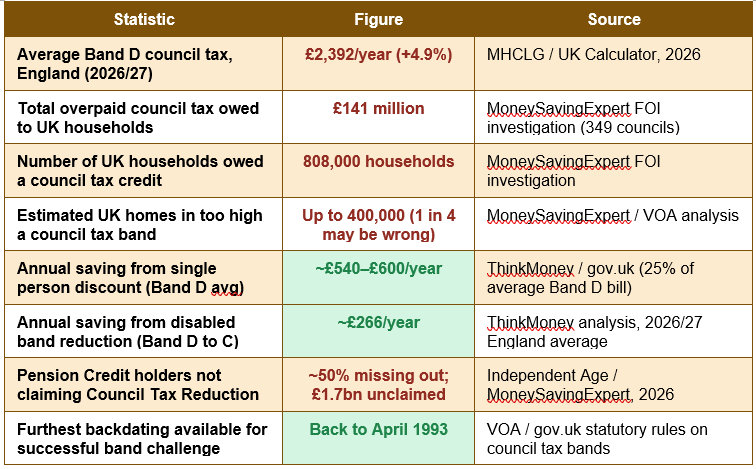
Most common reason households do not claim: They do not know the discount or route to reclaim exists — every discount and reduction in this guide requires a separate application to your local council — none are flagged, none are applied automatically, and councils are not required to tell you what you may be entitled to (ThinkMoney / MoneySavingExpert, 2026)
Part 1: Reclaiming Overpaid Council Tax Credits
A council tax account falls into credit — meaning you have paid more than you owe — in several distinct circumstances. The most common are: a direct debit payment continued running for one or two billing periods after you moved house; a bank payment was duplicated or a payment plan was not cancelled on time; a discount or exemption was granted retrospectively, creating a credit for the period it applied; or your property's council tax band was reduced after a successful challenge, including where a subsequent occupant successfully challenged the band after you moved out.The key fact to understand is that councils are not required to return these credits proactively. Your credit sits on the account until you request a refund or it is applied to your next bill. MoneySavingExpert's FOI data shows that of the 808,000 households owed money, the largest concentrations of unclaimed credits are in households where the previous resident moved out of the local authority area entirely — removing the obvious mechanism of the credit being spotted and offset against a future bill at the same address.
How to Check If You Are Owed a Credit
- For your current address: Log into your council's online portal (most UK councils have one in 2026) and check your council tax account balance. A positive credit balance means you have overpaid and can request a refund. If you do not have online access, call your council's council tax team and ask them to check the balance on your account.
- For a previous address in the same local authority: Your credit may have been automatically applied to your new account if you moved within the same council area. If not, contact the council with your old address details and account number (often found on old bills or correspondence) and ask them to check.
- For a previous address in a different local authority: This is where credits most commonly go unclaimed. Contact the council for your old address directly. You will need your old address, approximate move-out date, and ideally your previous account number. Search '[council name] council tax refund' online — approximately half of UK councils offer an online claim form; the other half require a phone call or letter.
- If your old home was subsequently rebanded: If the new occupant of your previous property successfully challenged the council tax band after you left, you may be entitled to a refund for the proportion of your tenancy that falls within the backdated correction period. Check whether your old property's band has changed using the government's Council Tax band checker at gov.uk.
How far back can you go? For credit balance reclaims (overpayments, duplicated payments, cancelled contracts), there is no single national time limit, but practical limits apply based on whether the council still holds records from that period. MoneySavingExpert's guidance indicates claims going back to moves in 1993 have been successfully paid in some cases, though the further back the move, the more likely it is that records may be incomplete. For band-related refunds from a successful challenge, the statutory rule is clear: the refund backdates to whichever is later — when you moved in or April 1993.
Part 2: Challenging a Wrong Council Tax Band
Council tax bands in England (and Scotland, using a different system) are based on the estimated value of the property in April 1991 — a valuation that is now 35 years old and was completed under significant time pressure when the council tax system was introduced. Independent analysis and MoneySavingExpert research consistently identify up to 400,000 properties that may be in too high a band relative to similar neighbouring properties. A successful band challenge does not just reduce your future bills — it produces a backdated refund to the date you moved in or April 1993, whichever is later.The Neighbour Comparison Method
The most effective approach to identifying a potential wrong band is the neighbour comparison method, consistently recommended by MoneySavingExpert and the VOA's own guidance. The principle is simple: properties of the same size, type, and construction in the same street or immediate area should generally be in the same council tax band. If similar or larger neighbouring properties are in a lower band than yours, this is the strongest possible evidence of an error in your band.To check neighbouring property bands, use the government's Council Tax band checker at gov.uk/council-tax-bands, which allows you to search any address in England and Wales. For Scotland, the Scottish Assessors' Association website provides the same function. Search five to ten nearby properties of comparable size and type. If multiple comparable neighbours are in a lower band, you have meaningful grounds for a challenge.
The Two Types of Band Challenge
- Formal proposal (strongest route): Available if you have moved into the property within the last six months, or if the VOA has changed your band recently. Submitting a formal proposal triggers a statutory review process in which the VOA must investigate and provide a reasoned decision. If the VOA declines, you can appeal to an independent Valuation Tribunal for a binding ruling.
- Informal band review (available anytime): Available at any time but does not trigger the same statutory response. You submit evidence that you believe the band is wrong, the VOA reviews it, and they respond. If they decline an informal review without the formal proposal, their decision is not automatically appealed to a tribunal — you would need to submit a fresh formal proposal or seek other grounds for escalation.
The practical recommendation from MoneySavingExpert and independent advisers is to use the neighbour comparison method to build your evidence case first, then submit a formal proposal wherever possible rather than an informal request. The formal route gives you the right to tribunal appeal if the VOA declines, whereas an informal submission does not carry the same escalation rights.
Reported real-world outcome: £7,943 backdated refund after rebanding from Band E to Band D — a MoneySavingExpert reader who challenged their band using neighbour comparison evidence received £7,943 in backdated council tax refunds covering the period back to 1993, plus an ongoing annual saving of £470 per year going forward — with the challenge completed via an online VOA submission
Part 3: Discounts, Reductions, and Exemptions You May Be Missing
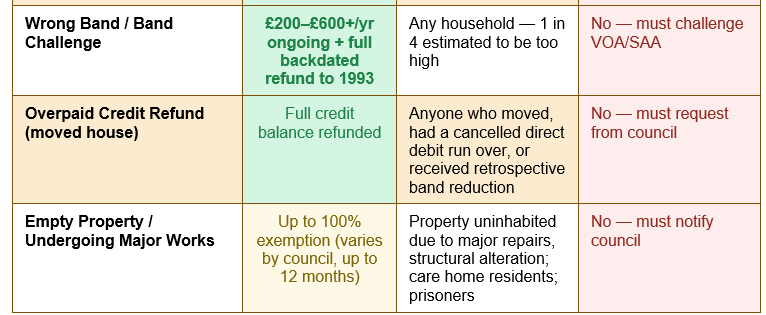
The table below covers every major council tax discount, exemption, and reduction available in England and Wales for 2026. A critical point applies to every entry in this table: none of these are applied automatically. Every single one requires the household to apply to their local council. Councils do not advertise them; they are not flagged on bills; and they are not means-tested in the same way as some benefit claims — the disabled band reduction, for example, is available to any household with qualifying disability adaptations regardless of income.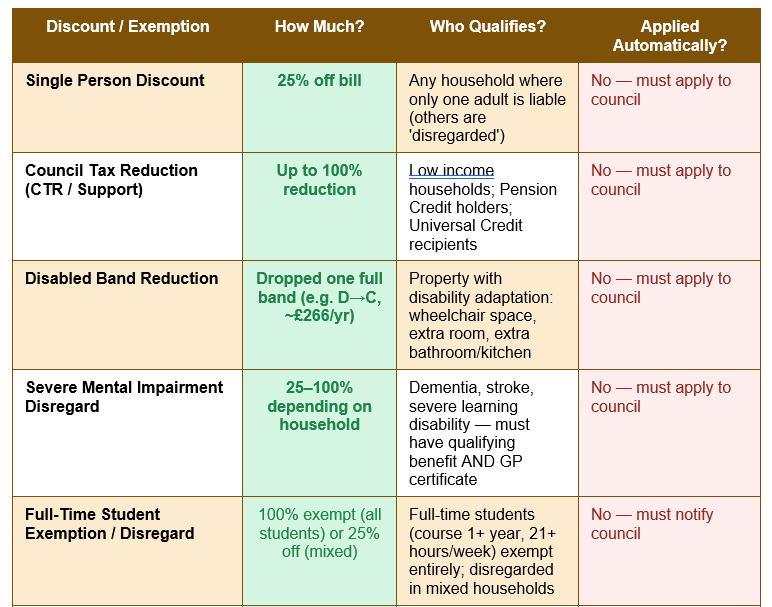
The Single Person Discount: The Most Widely Missed Saving
The single person discount is a 25% reduction on the council tax bill for any household where only one adult is counted as liable for council tax purposes — either because there is genuinely only one adult in the property, or because other adults present are 'disregarded' for council tax purposes. Disregarded people include: full-time students, apprentices, carers who provide at least 35 hours of care per week to a disabled resident, young people under 18, people with severe mental impairments, and certain foreign language assistants and visiting forces members.The Chartered Institute of Public Finance and Accountancy (CIPFA) estimates that hundreds of thousands of eligible households are not claiming this discount despite qualifying. On an average Band D bill in England in 2026/27, the 25% discount is worth approximately £598 per year. The application is typically a simple online form through your council's website and takes less than ten minutes.
The Council Tax Reduction: £1.7 Billion Unclaimed by Pension Credit Recipients
Council Tax Reduction (CTR), also known as Council Tax Support, is a means-tested reduction for low-income households. Since 2013, it has been administered by individual councils rather than centrally, which means the eligibility criteria, the maximum percentage of reduction, and the application process vary by local authority. Some councils offer up to 100% reduction for the lowest-income households; others cap support at 75% or lower.The scale of non-take-up is striking. Independent Age's research found that of Pension Credit holders in England who qualify for a Council Tax Reduction, only approximately half are currently receiving it. The unclaimed total across this group alone amounts to approximately £1.7 billion. The reason is straightforward: CTR is not automatic, even for those who receive Pension Credit, and many elderly households simply do not know it exists or assume the application process is too complex. It is typically a single form on the council's website or a phone call to the council tax team.
The Severe Mental Impairment Disregard: Most Commonly Missed of All
A person who meets the legal definition of 'severe mental impairment' — a legal term covering conditions including dementia, the effects of a stroke, severe learning disability, or Parkinson's disease affecting cognitive function — is completely disregarded for council tax purposes. This can reduce a bill by 25% (if living alone, the household receives the single person discount), or by up to 100% (if the household would otherwise be entirely exempt if the qualifying person's status is the only adult counted).To qualify, two conditions must both be met: the person must have a qualifying condition, and they must be receiving at least one qualifying benefit (such as Disability Living Allowance, Personal Independence Payment, Employment and Support Allowance, or similar). The application requires a medical certificate signed by a GP alongside the council's standard form. MoneySavingExpert describes this as among the most commonly missed council tax reductions in the country — and among the most valuable for affected families.
The disabled band reduction is completely separate from Council Tax Reduction: many households confuse the disabled band reduction (available to any household with a specific type of disability adaptation in the property, regardless of income or benefits received) with the Council Tax Reduction (means-tested for low income). A Band D household with a wheelchair space or an extra room adapted for a disabled family member can claim the disabled band reduction to be charged at Band C rates — a saving of approximately £266 per year in 2026/27 — regardless of their household income or benefit status. These two reductions can be claimed simultaneously.
How to Claim: A Practical Step-by-Step Guide
- Find your local council: Use gov.uk/find-local-council, entering your postcode. This takes you directly to your council's website, where you will find the relevant council tax pages. Most UK councils in 2026 have digital portals where you can check your account balance, submit a discount application, and request a refund online.
- Check your current account balance first: Log into (or register for) your council's online council tax portal and review your current account. A credit balance means you are owed money and can request a refund immediately. If the portal shows your balance is £0 or shows an amount owed, you are current and there is no outstanding credit to reclaim.
- Check your council tax band against neighbours: Use gov.uk/council-tax-bands to look up the bands of five to ten comparable properties nearby. If similar-sized or larger neighbouring properties are in lower bands, you have grounds for a challenge. Start with a formal proposal to the VOA at gov.uk if you have moved in within six months; use the VOA's band review process for older occupancies.
- Run through the full discount checklist: Check every discount in the table above against your household situation: single occupancy, low income, disability adaptations, student status, carer status, severe mental impairment. Apply for each applicable discount separately through your council's website or phone line.
- For Pension Credit or benefits recipients: If you or someone in your household receives Pension Credit, Universal Credit, Income Support, or similar, contact your council tax team specifically to apply for Council Tax Reduction. Do not assume that receiving one benefit automatically enrolls you in another — it does not.
- Check old addresses for credit balances: If you have moved in the last five to ten years — particularly if you moved out of a local authority area rather than within it — search for your previous council's online claims form or contact them by phone to check whether your old account is in credit. The search format '[old council name] council tax refund' typically surfaces the relevant page.
Conclusion
The core message of this entire guide can be summarised in a single sentence: council tax is a household bill that consistently overcharges people who do not actively manage it, and almost never undercharges people who do nothing. Every discount available is unclaimed until you apply for it. Every credit balance sits idle until you request it back. Every wrong band continues indefinitely until you challenge it — sometimes for decades, at a cost of thousands of pounds.The scale of the problem is clearly quantified: £141 million owed to 808,000 households across UK councils; up to 400,000 homes in bands that are too high; £1.7 billion in Council Tax Reductions unclaimed by Pension Credit holders in England alone. These are not marginal edge cases — they are the cumulative result of a system in which the entire burden of identifying overpayments and claiming entitlements falls on the household, while councils are under no obligation to identify or proactively return what is owed.
The good news is that acting on this information is genuinely straightforward. Checking your council tax band takes ten minutes using the government's free online tool. Applying for a single person discount or council tax reduction typically requires a single online form. Requesting a credit balance refund is often as simple as a phone call or clicking a button in your council's portal. The effort required is modest; the potential return — particularly for households that have been in the wrong band for years — can be substantial. Council tax is one of the few areas of UK personal finance where a small time investment consistently produces a large financial return for people who take the initiative to look.
Frequently Asked Questions (FAQ)
How do I know if I've overpaid council tax?
Log into your local council's online portal and check the balance on your council tax account. A credit balance — shown as a positive figure — means you have paid more than you owe and are entitled to a refund. For previous addresses in the same council area, the credit may have been transferred to your new account; for addresses in different council areas, you need to contact those councils directly. MoneySavingExpert found that 808,000 UK households are in credit, most of them unaware of it.Can I really challenge my council tax band?
Yes, and it is more common than most people realise. Any UK household can challenge their council tax band by comparing their property's band against similar neighbouring properties using the free gov.uk council tax band checker (England and Wales) or the Scottish Assessors' Association website (Scotland). If comparable neighbours are in lower bands, this is grounds for a formal proposal to the Valuation Office Agency. Success in a challenge means not only a lower future bill but a full backdated refund to the date you moved in or April 1993, whichever is later.What is the single person discount and how do I claim it?
The single person discount reduces your council tax bill by 25% when only one adult in the property is counted for council tax purposes. You may qualify even in a multi-adult household if other occupants are 'disregarded' — students, certain carers, young people under 18, and people with severe mental impairments among others. On average Band D rates in England in 2026/27, the saving is approximately £598 per year. Apply directly to your local council — typically via an online form on their website — as the discount is never applied automatically.I receive Pension Credit. Does that mean my council tax is automatically reduced?
No. Receiving Pension Credit does not automatically trigger a Council Tax Reduction. You need to apply for it separately from your local council. Independent Age research found that approximately half of Pension Credit holders in England who qualify for a Council Tax Reduction are not claiming it — a total of approximately £1.7 billion in support going unclaimed. Contact your council tax team directly, ask about Council Tax Reduction or Council Tax Support, and they will walk you through the application. It is typically straightforward and the reduction can be significant, potentially up to 100% of your bill in some areas.How far back can I claim a council tax refund?
It depends on the type of claim. For straightforward credit balance refunds (where you overpaid due to a continuing direct debit or a cancelled payment running over), the practical limit is how far back the council holds records — some councils have successfully processed claims going back to the early 1990s, though records from 30+ years ago may not always be retrievable. For band challenges, the statutory rule is clear: a successful challenge backdates the refund to the date you moved into the property or April 1993, whichever is later. The further back that date, the larger the potential refund — which is why challenging sooner rather than later is always advisable for households who believe they are in the wrong band.
External References
The following authoritative sources were used in researching this article and are recommended for further reading:1. MoneySavingExpert — How to Reclaim Overpaid Council Tax Credit
https://www.moneysavingexpert.com/reclaim/how-to-reclaim-council-tax-credit/
2. MoneySavingExpert — How to Check and Challenge Your Council Tax Band
https://www.moneysavingexpert.com/reclaim/council-tax-bands-change/
3. MoneySavingExpert — Council Tax Discounts
https://www.moneysavingexpert.com/family/council-tax-discounts/
4. GOV.UK — Check Your Council Tax Band
https://www.gov.uk/council-tax-bands
5. GOV.UK — Challenge Your Council Tax Band in England
https://www.gov.uk/challenge-council-tax-band
6. GOV.UK — Apply for Council Tax Reduction
https://www.gov.uk/apply-council-tax-reduction
7. Citizens Advice — Council Tax Discounts and Exemptions
https://www.citizensadvice.org.uk/benefits/help-if-on-a-low-income/help-with-your-council-tax-council-tax-reduction/
8. Age UK — Council Tax Reduction
https://www.ageuk.org.uk/information-advice/money-legal/benefits-entitlements/council-tax-reduction/
0 Comments
Be the first to share your thoughts on this article.