
Financial Literacy
7 Everyday Items Wasting Your Money — And the Swaps

Bottled water carries a markup of up to 24,000%. Branded painkillers cost 5–7× more than the identical generic. Pre-cut produce adds a 40% premium. A daily café coffee habit burns £1,500+ per year. These are not occasional luxuries — they are daily, weekly, habitual purchases that add up to thousands a year without most people noticing. Here are the seven worst offenders and the exact swap for each.

Most people assume their budget problems come from the big things: the holiday, the new sofa, the unexpectedly large car repair. In reality, much of the financial drain in most households comes from the small, daily, habitual purchases that feel too minor to examine — and that, precisely because of this, never get examined.
Consumer Affairs (May 2026) puts it plainly: ‘Convenience spending adds up fast. Small purchases like bottled water, fancy coffee, and pre-cut produce quietly drain budgets faster than most people realise.’ List25.com’s September 2026 guide to overpriced products calculates that eliminating five or six of the most common overpriced daily purchases can free up $200 to $500 per month — $2,400 to $6,000 per year — redirected toward actual financial goals.
The seven items in this guide have one thing in common: the gap between what they cost and what an equivalent alternative cost is not marginal. It is enormous. Bottled water carries markups measured in the thousands of percent. Branded painkillers cost five to seven times the price of the identical active ingredient in a generic box. Pre-cut produce carries a 40 percent convenience premium. Coffee pods cost roughly five times the equivalent ground coffee per pound. These are not edge cases. They are the routine, unremarked items in millions of shopping baskets every week.
Eliminating 5–6 of the most common overpriced daily purchases frees up $200–$500/month = $2,400–$6,000/year (List25.com, September 2026). US food at home prices: +29.4% from March 2020 to December 2025 (BLS). UK grocery shoppers switching from branded to own-brand across key staples: estimated savings of £1,500–£2,000/year (MoneySavingExpert).
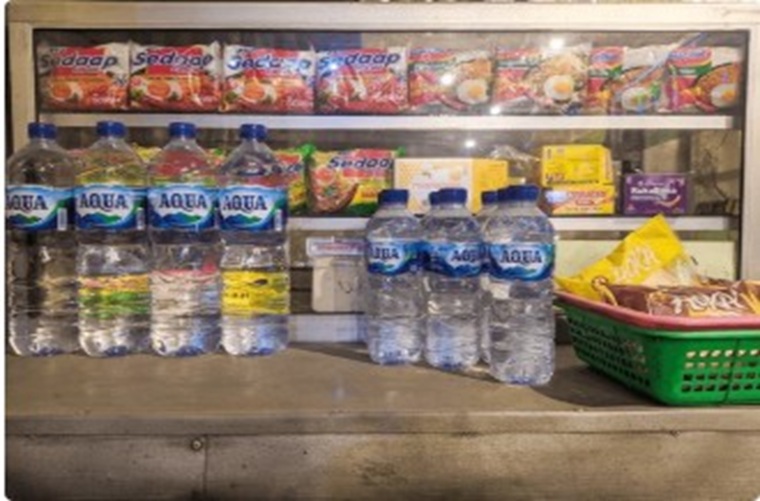
The bottled water industry has built its entire commercial model on two narratives: purity and convenience. Neither holds up to scrutiny. Multiple independent tests have found tap water in most Western cities to be subject to equal or more rigorous quality controls than bottled water. Studies repeatedly show that in blind taste tests, most people cannot reliably distinguish branded bottled water from filtered tap water. Many bottled water brands in the UK and US are, in legal terms, simply processed municipal water. The difference between what comes from your tap and what comes in a plastic bottle is the plastic bottle.
A two-bottle-per-day bottled water habit costs approximately $800 per year in the US. In the UK, buying a 500ml bottle twice a day at an average of £0.80 per bottle costs approximately £584 per year.
How much it’s burning: A $800/year ($0.005/gallon vs $1.22/gallon average) bottled water habit vs a $65–$70 one-time outlay on a reusable bottle and filter pitcher. The filter pitcher pays for itself in approximately 5–6 weeks. Annual saving: $730–$760. UK equivalent: £584/year vs approximately £40–£60 for a good reusable bottle and filter. Ongoing tap water cost: approximately £1–£2/year.
The swap: A reusable stainless steel bottle and a simple filter pitcher (or tap filter attachment) cost approximately £40/$65 combined and last for years. The filter pitcher handles the taste and perception issue — the main residual reason most people cite for preferring bottled water. At current prices, the switch pays for itself in weeks and saves hundreds per year on an ongoing basis without any sacrifice in taste or convenience.
A BBC2 ‘Trust Me I’m a Doctor’ investigation commissioned UCL’s pharmaceutics laboratory to compare branded and generic ibuprofen products directly. The scientists tested whether products contained the stated amount of ibuprofen and whether they dissolved at comparable rates (which determines how quickly the drug is absorbed). The results: no measurable difference between branded and generic products on either metric. The experiment concluded that for standard ibuprofen, there is no pharmacological basis for paying more for the branded product.
Despite this, branded OTC painkillers routinely outsell generics in every major UK and US pharmacy. The branded products are positioned at eye level, marketed with high-production packaging, and associated with credibility and reassurance. The markup for this positioning: typically, 5 to 7 times the price of the equivalent generic. A pack of branded ibuprofen at a UK pharmacy costs approximately £3.50–£5.50; the own-brand equivalent at the same pharmacy for the same quantity and dose costs £0.60–£1.00. In the US, a bottle of branded Advil costs approximately $10; generic ibuprofen with the same active ingredient costs approximately $2.
How much it’s burning: Branded ibuprofen: £4 (UK) / $10 (US). Identical generic ibuprofen from the same pharmacy: £0.65 (UK) / $2 (US). Annual saving for a household that uses ibuprofen regularly (12 packs per year): ~£40/$96. Over a lifetime, the habit of buying branded over generic OTC medication costs thousands. The UK spends approximately £1.9 billion per year on branded OTC medicines where generic equivalents exist.
The swap: The swap is identical: same active ingredient, same dose, same regulatory standard. Simply read the active ingredient on the box of any branded painkiller, then find the equivalent generic dose. In UK supermarkets and pharmacies, the own-brand version is almost always on the shelf directly next to the branded version. The only meaningful difference is the packaging.
It is worth being clear about what the premium buys. Some of it is genuine: the ambiance, the expertise of a skilled barista, the ritual of leaving the house and having a moment away from work or home. These have real value. The problem is when the daily café visit is not a considered ritual but an automatic habit — something that happens because it always happens, not because it was chosen today. The cost of the automatic daily coffee is the same as the cost of the considered daily coffee, but only one of them is actually delivering the full value being paid for.
How much it’s burning: Daily £4.50/$6 café coffee, 5 days/week, 52 weeks = £1,170/$1,560 per year. Home-brewed equivalent: £200–£250/$250–$350 per year including quality coffee and a decent brewer. Annual saving: £920–£970/$1,200–$1,310. The home espresso machine or French press pays for itself in under two weeks of savings.
The swap: The recommended swap is not abstinence. Keep one coffee shop visit per week as a deliberate, enjoyed treat. Switch the other four to home brew. That single change saves approximately £700–£800/$1,000 per year while preserving the ritual that made the coffee shop visit valuable in the first place. The daily automatic coffee that you barely registered was the expensive one.
Ever After In The Woods’ November 2025 guide to overpriced grocery items calculates the per-pound cost of coffee pods at approximately $40 per pound of coffee — roughly five times the cost of equivalent quality whole bean or ground coffee. A box of 24 K-cups retails for approximately $15–$20 in the US and makes 24 cups. The same 24 cups made from quality ground coffee in a drip machine or French press would cost approximately $3–$5. The convenience premium is 300–500 percent per cup.
Beyond the financial cost, pods generate significant non-recyclable plastic and aluminium waste. Most pod products include recyclability claims that, on closer examination, require the consumer to separate components and deliver them to specific recycling points — a process very few follow, meaning the overwhelming majority of pods go to landfill.
How much it’s burning: $15–$20 for 24 pod cups ($0.63–$0.83 per cup) vs $0.12–$0.20 per cup from quality ground coffee via drip or French press. Daily pod user (2 cups/day): approximately $460–$600/year. Daily drip/French press user: approximately $85–$150/year. Annual saving: $310–$450. Over 5 years: $1,550–$2,250.
The swap: Reusable pods are available for most major pod machine formats (Nespresso, K-cup, Dolce Gusto) and cost approximately £8–$10 for a set. Filled with any ground coffee of your choice, they produce comparable results at approximately 10–15% of the ongoing cost. Alternatively, a French press (£15/$15) or basic drip machine (£25/$25) produces excellent coffee with zero ongoing premium.
For individual items, the disparity can be even starker:
How much it’s burning: A weekly shopping basket that relies on pre-cut produce costs an average 20–40% more on the produce section alone. For a household spending £40/week on fruit and vegetables, switching from pre-cut to whole reduces the produce bill by £8–£16/week = £416–£832/year. The time cost of cutting a butternut squash: approximately 3 minutes.
The aggregate data on clothing consumption tells a similar story. The US Environmental Protection Agency estimates that the average American discards approximately 81 pounds (37 kg) of clothing per year. The Ellen MacArthur Foundation’s research on the global fashion industry found that fast fashion garments are worn on average just 7–10 times before being discarded — a significant fall from the previous generation’s usage patterns. The fashion industry now produces approximately twice the number of clothing items it did 15 years ago.
The hidden annual cost of the fast fashion habit is the constant replacement cycle. Five cheap T-shirts at £10 each, replaced annually: £50/year. One quality T-shirt at £35 lasting three years: £12/year amortised. The quality item is cheaper. This principle holds across most clothing categories: the cheap version is not a bargain if it requires replacement before the more expensive version would have worn out.
How much it’s burning: Fast fashion T-shirts: £10 × 5 per year = £50/year. Quality equivalent: £35 lasting 3 years = £12/year amortised. Annual saving per item category: ~£38. Extended across a full wardrobe replacement cycle (jeans, shirts, shoes, outerwear), the savings compound significantly. The EPA data: 81 pounds of clothing discarded per American per year — most of it fast fashion.
The swap: The swap: buy fewer items at higher quality. This is not a premium spending strategy — it is a cheaper long-term cost strategy. When evaluating a clothing purchase, divide the price by the expected number of wears (price ÷ expected wears = cost per wear). A £60 pair of jeans worn 150 times costs £0.40 per wear. A £20 pair worn 30 times costs £0.67 per wear. The expensive jeans are cheaper. Apply cost-per-wear as the evaluation metric rather than the unit price.
The Queen Zone’s July 2026 guide to expensive everyday household items notes that ‘the colourful bottles with special fragrances are seeing their prices jump higher every single month. You are literally paying extra money just for fancy packaging and a familiar television mascot.’ It identifies plain white vinegar and baking soda as capable of tackling grease and grime as effectively as expensive branded chemical sprays — at a fraction of the cost.
The markup structure of branded cleaning products:
How much it’s burning: A household spending £20/week on branded cleaning products (sprays, washing powder, washing-up liquid, fabric conditioner) vs £7/week on own-brand equivalents: annual saving of approximately £676. Across the UK, households that make this single category switch save an estimated £500–£800 per year on cleaning products alone.
The swap: The swap requires nothing beyond a willingness to pick up the product directly below the branded version on the supermarket shelf. Supermarkets place own-brand products on lower shelves by design; the branded products are at eye level. Looking down, or asking for the own-brand version, saves 60–70% on most cleaning products with zero practical difference in outcome. For the most price-conscious: white vinegar (approximately £0.60 per litre) diluted with water functions as a highly effective multi-surface cleaner for most non-specialist cleaning tasks.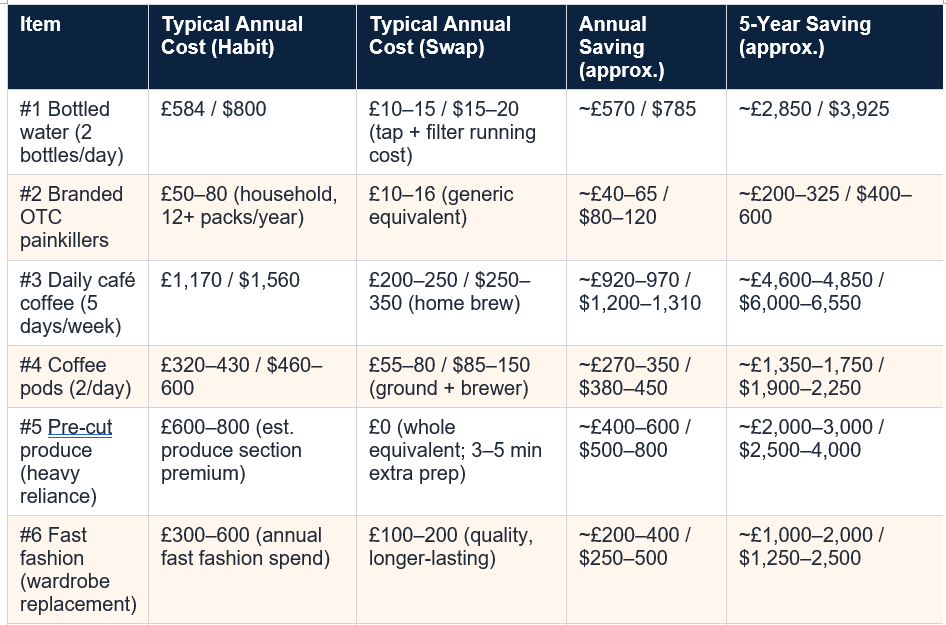

The five-year figures assume the same habits and same price differentials continue. In practice, prices tend to rise faster for branded products than for own-brand equivalents, meaning the savings gap is likely to widen over time. The figures above are conservative estimates based on current prices and typical usage patterns. Individual household savings will vary based on family size and current habits.
Practical implementation for each of the seven items:
The aggregate annual saving from making all seven swaps is conservatively estimated at £2,600–£3,950 in the UK or $3,500–$5,100 in the US, with five-year figures of £13,000–£19,750 / $17,500–$25,500. These are not savings that require any reduction in standard of living. They are savings that come entirely from buying the equivalent product at the honest price rather than the branded, marketed, or convenience-premium price.
Each swap requires one decision, made once: buy the reusable bottle, pick up the generic box, order the French press. After that, the system runs itself. The daily coffee shop autopilot is replaced by the home-brew autopilot. The branded cleaning spray autopilot is replaced by the own-brand autopilot. The behaviour is the same; only the product and the price change.
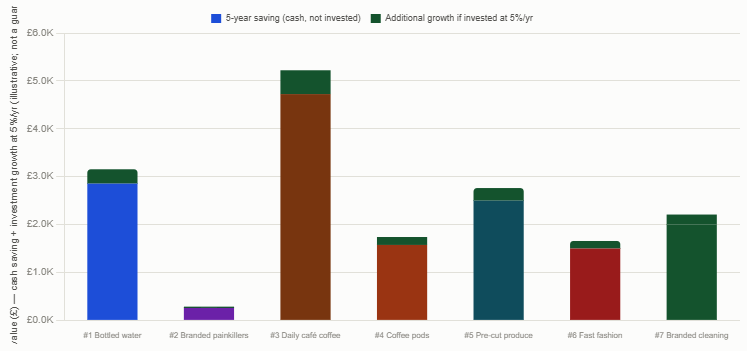
The combined saving over five years — invested at 5 percent per year — would amount to approximately £17,000–£25,000 / $22,000–$32,000. Not from a second job, a windfall, or a sacrifice. From looking at what is in the shopping basket and asking, once, whether the branded version is worth it.
No. Branded ibuprofen (Nurofen in the UK; Advil in the US) and generic ibuprofen contain exactly the same active pharmaceutical ingredient in exactly the same quantity and dose. This is a legal requirement: the MHRA in the UK and the FDA in the US require all licensed OTC medications to contain precisely the stated quantity of active ingredient, regardless of brand. A BBC2 'Trust Me I'm a Doctor' investigation commissioned UCL's pharmaceutics laboratory to test branded versus generic ibuprofen products. The results found no measurable difference in active ingredient content or dissolution rate between branded and generic products. A pack of branded ibuprofen (24 tablets, 400mg) costs approximately £3.50–£5 at a UK pharmacy; the own-brand equivalent at the same pharmacy costs approximately £0.65–£1. The saving per pack is approximately £3–£4; for a household using OTC painkillers regularly, the annual saving is typically £40–£80.
Is tap water actually safe to drink in the UK?
Yes. Tap water in the UK is subject to rigorous quality testing by water companies and regulated by the Drinking Water Inspectorate. UK tap water must meet the standards set in the Water Supply (Water Quality) Regulations, which align with European Drinking Water Directive standards. The UK consistently has some of the highest-quality tap water in the world. Tests repeatedly show that in blind taste comparisons, most people cannot reliably distinguish UK tap water from bottled water when the tap water is chilled or filtered. The cost of UK tap water is approximately £0.001 per litre (approximately one-tenth of a penny); bottled water costs approximately £0.80–£1.50 per 500ml (£1.60–£3.00 per litre). The markup is approximately 1,600–30,000%, depending on the bottled product. For those who prefer filtered tap water for taste reasons, a basic filter pitcher (such as Brita) costs approximately £15–£25 and the replacement filters cost approximately £5–£8 each, covering several hundred litres. The annual cost of filtered tap water is approximately £20–£40 per household, vs £400–£600+ for an equivalent volume of bottled water.
Do supermarket own-brand cleaning products work as well as branded ones?
In the vast majority of cases, yes. Own-brand and branded cleaning products typically contain the same core active ingredients (surfactants, disinfectants, solvents) in similar concentrations. In the UK, the home-as-we-make-it.com August 2026 guide to store brands confirms that private-label products are frequently manufactured by the same companies as branded versions, sometimes on the same production lines, often to near-identical specifications. What differs is the fragrance, packaging, and the marketing budget. Supermarkets place branded products at eye level and own-brand products lower on the shelf — not because of quality differences but because branded suppliers pay slotting fees for premium positioning. A branded multi-surface spray costs £2.50–£3.50; an own-brand equivalent costs £0.55–£1.00. Both contain comparable concentrations of the same active disinfecting or cleaning agents.
How much does a daily café coffee habit actually cost per year?
A single takeaway coffee at £4.50 (UK average for a medium latte or flat white) purchased on 5 working days per week, 52 weeks per year, costs £1,170 per year. If the habit extends to both partners in a household, the annual cost is £2,340. If one coffee per day is replaced with a home-brewed alternative — a quality French press costs approximately £15 and quality ground coffee approximately £10–£15 per 250g bag (making approximately 15–20 cups) — the annual home-brew cost is approximately £200–£300 per person. The annual saving by switching four out of five daily coffees to home brew is approximately £700–£900 per person. The French press or Aeropress pays for itself in savings within the first week.
Is fast fashion actually more expensive than buying quality clothing?
In almost all cases, yes, when measured over time using cost-per-wear analysis. Cost-per-wear = purchase price ÷ number of times worn. A £10 fast fashion T-shirt that is worn 20 times costs £0.50 per wear. A £35 quality T-shirt that is worn 150 times costs £0.23 per wear. The quality item is less than half the cost per use. This principle applies across most clothing categories: jeans, shoes, outerwear, and basic wardrobe staples. Where fast fashion makes sense is for items that will genuinely be worn only once or twice (a specific costume, a very particular event outfit). For everyday wardrobe staples, the fast fashion purchase is replaced more often, generating more total spending over time, while the quality item is replaced less frequently for a lower total spend.
What is the cheapest and most effective multi-purpose cleaner?
White vinegar diluted with water. A 50:50 solution of white vinegar and tap water in a spray bottle costs approximately £0.05–£0.10 per 500ml and is effective for most general household surface cleaning, degreasing, limescale removal, and glass cleaning. It is antibacterial. It is non-toxic. It biodegrades completely. It has no microplastics. One litre of white vinegar costs approximately £0.60–£0.80 at a UK supermarket, yielding approximately two litres of cleaning solution when diluted 1:1 with water. Limitations: white vinegar should not be used on natural stone surfaces (marble, granite) as the acidity can damage the surface; it is not recommended for cast iron cookware. For specialist cleaning tasks (oven interiors, blocked drains, disinfection of clinical surfaces), a specific product may be appropriate. For the majority of everyday surface cleaning, white vinegar in water is the lowest-cost and most environmentally benign option available.
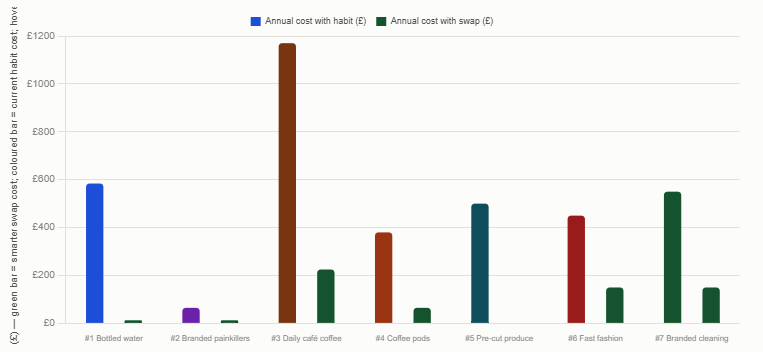
Annual Cost: Habit vs Swap
5 Years Saving If Swap Is Invested At 5%
Table of Contents
- Death by a Thousand Receipts
- Item #1: Bottled Water — The 24,000% Markup You Accept Every Day
- Item #2: Branded Painkillers — Same Drug, Wildly Different Price
- Item #3: Daily Café Coffee — The £1,500 Annual Habit
- Item #4: Coffee Pods — Paying £40 a Pound for Convenience
- Item #5: Pre-Cut and Pre-Packaged Produce — The 40% Convenience Tax
- Item #6: Fast Fashion — The Most Expensive Cheap Clothing
- Item #7: Branded Cleaning Products — Paying for the Label, Not the Clean
- The Full Picture: What All Seven Habits Cost Together
- How to Break Each Habit Without Feeling Deprived
- Conclusion: Your Budget’s Biggest Leaks Are the Smallest Receipts
- Frequently Asked Questions
Death by a Thousand Receipts
Most people assume their budget problems come from the big things: the holiday, the new sofa, the unexpectedly large car repair. In reality, much of the financial drain in most households comes from the small, daily, habitual purchases that feel too minor to examine — and that, precisely because of this, never get examined.Consumer Affairs (May 2026) puts it plainly: ‘Convenience spending adds up fast. Small purchases like bottled water, fancy coffee, and pre-cut produce quietly drain budgets faster than most people realise.’ List25.com’s September 2026 guide to overpriced products calculates that eliminating five or six of the most common overpriced daily purchases can free up $200 to $500 per month — $2,400 to $6,000 per year — redirected toward actual financial goals.
The seven items in this guide have one thing in common: the gap between what they cost and what an equivalent alternative cost is not marginal. It is enormous. Bottled water carries markups measured in the thousands of percent. Branded painkillers cost five to seven times the price of the identical active ingredient in a generic box. Pre-cut produce carries a 40 percent convenience premium. Coffee pods cost roughly five times the equivalent ground coffee per pound. These are not edge cases. They are the routine, unremarked items in millions of shopping baskets every week.
Eliminating 5–6 of the most common overpriced daily purchases frees up $200–$500/month = $2,400–$6,000/year (List25.com, September 2026). US food at home prices: +29.4% from March 2020 to December 2025 (BLS). UK grocery shoppers switching from branded to own-brand across key staples: estimated savings of £1,500–£2,000/year (MoneySavingExpert).
Item #1: Bottled Water — The 24,000% Markup You Accept Every Day
Tap water in the United States costs approximately $0.005 per gallon from a municipal supplier. Bottled water averages $1.22 per gallon in retail. That is a markup of approximately 24,000 percent — and in some branded premium formats (small plastic bottles at convenience stores and stations), it is higher still (Ever After In The Woods, November 2025; Living.alot.com, June 2026). In the UK, a 500ml bottle of branded water at a supermarket or convenience store typically costs £0.60–£1.50; the equivalent from the tap costs fractions of a penny.The bottled water industry has built its entire commercial model on two narratives: purity and convenience. Neither holds up to scrutiny. Multiple independent tests have found tap water in most Western cities to be subject to equal or more rigorous quality controls than bottled water. Studies repeatedly show that in blind taste tests, most people cannot reliably distinguish branded bottled water from filtered tap water. Many bottled water brands in the UK and US are, in legal terms, simply processed municipal water. The difference between what comes from your tap and what comes in a plastic bottle is the plastic bottle.
A two-bottle-per-day bottled water habit costs approximately $800 per year in the US. In the UK, buying a 500ml bottle twice a day at an average of £0.80 per bottle costs approximately £584 per year.
How much it’s burning: A $800/year ($0.005/gallon vs $1.22/gallon average) bottled water habit vs a $65–$70 one-time outlay on a reusable bottle and filter pitcher. The filter pitcher pays for itself in approximately 5–6 weeks. Annual saving: $730–$760. UK equivalent: £584/year vs approximately £40–£60 for a good reusable bottle and filter. Ongoing tap water cost: approximately £1–£2/year.
The swap: A reusable stainless steel bottle and a simple filter pitcher (or tap filter attachment) cost approximately £40/$65 combined and last for years. The filter pitcher handles the taste and perception issue — the main residual reason most people cite for preferring bottled water. At current prices, the switch pays for itself in weeks and saves hundreds per year on an ongoing basis without any sacrifice in taste or convenience.
Item #2: Branded Painkillers — Same Drug, Wildly Different Price
This is one of the clearest cases of paying for marketing rather than medicine. Over-the-counter branded painkillers — Nurofen and Panadol in the UK; Advil and Tylenol in the US — contain exactly the same active ingredients in the same quantities as their generic supermarket equivalents. In the UK, this is not a guess or a consumer approximation: it is a regulatory requirement. The MHRA (Medicines and Healthcare Products Regulatory Agency) requires all licensed OTC medications to contain exactly the stated quantity of active ingredient, regardless of brand. The FDA maintains identical standards in the US.A BBC2 ‘Trust Me I’m a Doctor’ investigation commissioned UCL’s pharmaceutics laboratory to compare branded and generic ibuprofen products directly. The scientists tested whether products contained the stated amount of ibuprofen and whether they dissolved at comparable rates (which determines how quickly the drug is absorbed). The results: no measurable difference between branded and generic products on either metric. The experiment concluded that for standard ibuprofen, there is no pharmacological basis for paying more for the branded product.
Despite this, branded OTC painkillers routinely outsell generics in every major UK and US pharmacy. The branded products are positioned at eye level, marketed with high-production packaging, and associated with credibility and reassurance. The markup for this positioning: typically, 5 to 7 times the price of the equivalent generic. A pack of branded ibuprofen at a UK pharmacy costs approximately £3.50–£5.50; the own-brand equivalent at the same pharmacy for the same quantity and dose costs £0.60–£1.00. In the US, a bottle of branded Advil costs approximately $10; generic ibuprofen with the same active ingredient costs approximately $2.
How much it’s burning: Branded ibuprofen: £4 (UK) / $10 (US). Identical generic ibuprofen from the same pharmacy: £0.65 (UK) / $2 (US). Annual saving for a household that uses ibuprofen regularly (12 packs per year): ~£40/$96. Over a lifetime, the habit of buying branded over generic OTC medication costs thousands. The UK spends approximately £1.9 billion per year on branded OTC medicines where generic equivalents exist.
The swap: The swap is identical: same active ingredient, same dose, same regulatory standard. Simply read the active ingredient on the box of any branded painkiller, then find the equivalent generic dose. In UK supermarkets and pharmacies, the own-brand version is almost always on the shelf directly next to the branded version. The only meaningful difference is the packaging.
Item #3: Daily Café Coffee — The £1,500 Annual Habit
A daily takeaway coffee from a high-street café or coffee chain costs between £3.50 and £5.50 in the UK, and between $4 and $7 in the US for speciality drinks. At five days per week, 52 weeks per year, a single daily coffee shop purchase at £4.50/day (UK) or $6/day (US) costs:- UK: £4.50 × 5 days × 52 weeks = £1,170 per year (weekdays only).
- US: $6 × 5 × 52 = $1,560 per year (weekdays only).
- Both figures rise significantly if the habit extends to weekends or if partners or colleagues join the routine.
It is worth being clear about what the premium buys. Some of it is genuine: the ambiance, the expertise of a skilled barista, the ritual of leaving the house and having a moment away from work or home. These have real value. The problem is when the daily café visit is not a considered ritual but an automatic habit — something that happens because it always happens, not because it was chosen today. The cost of the automatic daily coffee is the same as the cost of the considered daily coffee, but only one of them is actually delivering the full value being paid for.
How much it’s burning: Daily £4.50/$6 café coffee, 5 days/week, 52 weeks = £1,170/$1,560 per year. Home-brewed equivalent: £200–£250/$250–$350 per year including quality coffee and a decent brewer. Annual saving: £920–£970/$1,200–$1,310. The home espresso machine or French press pays for itself in under two weeks of savings.
The swap: The recommended swap is not abstinence. Keep one coffee shop visit per week as a deliberate, enjoyed treat. Switch the other four to home brew. That single change saves approximately £700–£800/$1,000 per year while preserving the ritual that made the coffee shop visit valuable in the first place. The daily automatic coffee that you barely registered was the expensive one.
Item #4: Coffee Pods — Paying £40 a Pound for Convenience
The coffee pod — K-cups in the US, Nespresso capsules in the UK — is one of the most precisely engineered products for extracting maximum revenue per cup of coffee ever devised. The pod machine was sold cheaply, often subsidised or given away as a promotional item. The pods are where the profit lives, and they are protected by proprietary formats designed to prevent substitution with cheaper alternatives.Ever After In The Woods’ November 2025 guide to overpriced grocery items calculates the per-pound cost of coffee pods at approximately $40 per pound of coffee — roughly five times the cost of equivalent quality whole bean or ground coffee. A box of 24 K-cups retails for approximately $15–$20 in the US and makes 24 cups. The same 24 cups made from quality ground coffee in a drip machine or French press would cost approximately $3–$5. The convenience premium is 300–500 percent per cup.
Beyond the financial cost, pods generate significant non-recyclable plastic and aluminium waste. Most pod products include recyclability claims that, on closer examination, require the consumer to separate components and deliver them to specific recycling points — a process very few follow, meaning the overwhelming majority of pods go to landfill.
How much it’s burning: $15–$20 for 24 pod cups ($0.63–$0.83 per cup) vs $0.12–$0.20 per cup from quality ground coffee via drip or French press. Daily pod user (2 cups/day): approximately $460–$600/year. Daily drip/French press user: approximately $85–$150/year. Annual saving: $310–$450. Over 5 years: $1,550–$2,250.
The swap: Reusable pods are available for most major pod machine formats (Nespresso, K-cup, Dolce Gusto) and cost approximately £8–$10 for a set. Filled with any ground coffee of your choice, they produce comparable results at approximately 10–15% of the ongoing cost. Alternatively, a French press (£15/$15) or basic drip machine (£25/$25) produces excellent coffee with zero ongoing premium.
Item #5: Pre-Cut and Pre-Packaged Produce — The 40% Convenience Tax
Supermarkets have become experts at identifying every point in the food preparation process at which a consumer might pay for someone else to do the work. Pre-washed salad bags. Pre-cut butternut squash. Pre-sliced mushrooms. Pre-peeled garlic. Pre-diced onions in sealed trays. Each of these products carries what A Magical Mess’s March 2026 guide (citing Finale Inventory data) calculates as an average 40 percent markup over the equivalent unprocessed whole product.For individual items, the disparity can be even starker:
- Whole butternut squash: approximately 70p–£1.20 per kg in a UK supermarket. Pre-cut butternut squash cubes in a 500g tray: approximately £1.60–£2.20. The per-kg price for the pre-cut version is approximately 2.5–3× higher.
- Whole mushrooms: approximately £1.20–£1.50 per 500g in a UK supermarket. Pre-sliced mushrooms in a 250g pack: approximately £1.30–£1.60. The per-kg price is approximately 1.5–2× higher.
- Whole cucumber vs pre-cut cucumber sticks: whole cucumber approximately 50–70p; pre-cut cucumber sticks in a 150g snack pack: approximately £0.80–£1.20. Per-kg price: 3–5× higher.
How much it’s burning: A weekly shopping basket that relies on pre-cut produce costs an average 20–40% more on the produce section alone. For a household spending £40/week on fruit and vegetables, switching from pre-cut to whole reduces the produce bill by £8–£16/week = £416–£832/year. The time cost of cutting a butternut squash: approximately 3 minutes.
Item #6: Fast Fashion — The Most Expensive Cheap Clothing
Fast fashion is cheap per unit and expensive per year. The economics of fast fashion work against the consumer in a way that is not always immediately visible: a £10 T-shirt that lasts 8 washes before the print cracks and the fabric loses its shape costs more per wear than a £35 T-shirt that lasts three years. At five wears per wash cycle, 8 cycles for the cheap version, the cost per wear is £0.25. At five wears per wash cycle, 24 cycles per year for three years, the cost per wear for the £35 version is £0.10. The expensive T-shirt is the cheaper one.The aggregate data on clothing consumption tells a similar story. The US Environmental Protection Agency estimates that the average American discards approximately 81 pounds (37 kg) of clothing per year. The Ellen MacArthur Foundation’s research on the global fashion industry found that fast fashion garments are worn on average just 7–10 times before being discarded — a significant fall from the previous generation’s usage patterns. The fashion industry now produces approximately twice the number of clothing items it did 15 years ago.
The hidden annual cost of the fast fashion habit is the constant replacement cycle. Five cheap T-shirts at £10 each, replaced annually: £50/year. One quality T-shirt at £35 lasting three years: £12/year amortised. The quality item is cheaper. This principle holds across most clothing categories: the cheap version is not a bargain if it requires replacement before the more expensive version would have worn out.
How much it’s burning: Fast fashion T-shirts: £10 × 5 per year = £50/year. Quality equivalent: £35 lasting 3 years = £12/year amortised. Annual saving per item category: ~£38. Extended across a full wardrobe replacement cycle (jeans, shirts, shoes, outerwear), the savings compound significantly. The EPA data: 81 pounds of clothing discarded per American per year — most of it fast fashion.
The swap: The swap: buy fewer items at higher quality. This is not a premium spending strategy — it is a cheaper long-term cost strategy. When evaluating a clothing purchase, divide the price by the expected number of wears (price ÷ expected wears = cost per wear). A £60 pair of jeans worn 150 times costs £0.40 per wear. A £20 pair worn 30 times costs £0.67 per wear. The expensive jeans are cheaper. Apply cost-per-wear as the evaluation metric rather than the unit price.
Item #7: Branded Cleaning Products — Paying for the Label, Not the Clean
The household cleaning aisle is one of the most reliably overpriced sections in any supermarket. Branded cleaning sprays, washing powder, washing-up liquid, fabric conditioner, and multi-surface cleaners all carry substantial premiums over supermarket own-brand equivalents that, in blind tests, perform identically.The Queen Zone’s July 2026 guide to expensive everyday household items notes that ‘the colourful bottles with special fragrances are seeing their prices jump higher every single month. You are literally paying extra money just for fancy packaging and a familiar television mascot.’ It identifies plain white vinegar and baking soda as capable of tackling grease and grime as effectively as expensive branded chemical sprays — at a fraction of the cost.
The markup structure of branded cleaning products:
- Branded multi-surface spray (e.g. Dettol, Flash): approximately £2.50–£3.50 per 500ml spray. Supermarket own-brand equivalent: approximately £0.60–£1.00 per 500ml. Branded version: 2.5–4× the price.
- Branded washing-up liquid (e.g. Fairy): approximately £2.00–£2.80 per 450ml in UK supermarkets. Own-brand equivalent: approximately £0.55–£0.85 per 500ml. Branded version: approximately 3–4× the price per ml.
- Branded washing powder (e.g. Ariel, Bold): approximately £9–£14 for a 40-wash box. Own-brand equivalent: approximately £3–£5 for the same number of washes. Branded version: 2–3× the price per wash.
How much it’s burning: A household spending £20/week on branded cleaning products (sprays, washing powder, washing-up liquid, fabric conditioner) vs £7/week on own-brand equivalents: annual saving of approximately £676. Across the UK, households that make this single category switch save an estimated £500–£800 per year on cleaning products alone.
The swap: The swap requires nothing beyond a willingness to pick up the product directly below the branded version on the supermarket shelf. Supermarkets place own-brand products on lower shelves by design; the branded products are at eye level. Looking down, or asking for the own-brand version, saves 60–70% on most cleaning products with zero practical difference in outcome. For the most price-conscious: white vinegar (approximately £0.60 per litre) diluted with water functions as a highly effective multi-surface cleaner for most non-specialist cleaning tasks.
The Full Picture: What All Seven Habits Cost Together
The five-year figures assume the same habits and same price differentials continue. In practice, prices tend to rise faster for branded products than for own-brand equivalents, meaning the savings gap is likely to widen over time. The figures above are conservative estimates based on current prices and typical usage patterns. Individual household savings will vary based on family size and current habits.
How to Break Each Habit Without Feeling Deprived
The most effective approach to replacing expensive everyday goods is not restriction — it is substitution with a specific, pre-planned equivalent. Telling yourself ‘I will not buy bottled water’ fails when you are thirsty and there is a vending machine next to you. Having a filled reusable bottle in your bag makes the decision automatically. The habit is replaced by a system, not by willpower.Practical implementation for each of the seven items:
- Bottled water: buy a quality stainless steel or glass reusable bottle (£10–25/$15–25). Buy a filter pitcher or attach a filter to the tap (£25–40/$30–40). Fill the bottle before leaving the house. The bottled water purchase is never needed.
- Branded painkillers: on your next pharmacy or supermarket visit, check the own-brand shelf (usually directly adjacent to or below the branded version). Read the active ingredient and dose. Buy that instead. Repeat for every subsequent purchase. The saving is immediate and ongoing.
- Daily café coffee: buy a French press (£12–20/$15–20) or an Aeropress (£25–35/$30–40) and invest in quality ground coffee or beans (£8–15/$10–18 for a 250g bag that makes 15–20 cups). Keep one café visit per week as a deliberate treat. The other four days: home brew.
- Coffee pods: buy a set of reusable pods for your existing machine (£8–10/$8–10). Fill with your preferred ground coffee. Cost per cup falls from 60–80p to 8–15p. If the machine breaks, replace it with a French press or drip machine and do not replace it with another pod machine.
- Pre-cut produce: buy whole. The time saving of pre-cut produce over buying and cutting whole equivalents is measured in minutes per week, not hours. Set 10 minutes aside on a Sunday to prep the week’s vegetables. Store in sealed containers in the refrigerator.
- Fast fashion: apply the cost-per-wear calculation before every clothing purchase. For any item where you cannot clearly identify at least 30 wears from it, do not buy it. Wait one week before buying any clothing item over £20/$25 that was not planned.
- Branded cleaning products: on the next supermarket shop, add the own-brand version of your usual cleaning spray, washing powder, and washing-up liquid to the basket instead of the branded version. Use them for one month. Notice whether anything is different. Almost certainly nothing will be.
Conclusion
The seven products in this guide share a common characteristic: they are purchased on autopilot. Nobody decides each day to pay a 24,000 percent markup on water, or to pay five times the going rate for ibuprofen, or to fund a £1,170 annual coffee habit without evaluating it. These purchases happen because they always happen. The habit was formed, the product was established, and the spending continued invisibly.The aggregate annual saving from making all seven swaps is conservatively estimated at £2,600–£3,950 in the UK or $3,500–$5,100 in the US, with five-year figures of £13,000–£19,750 / $17,500–$25,500. These are not savings that require any reduction in standard of living. They are savings that come entirely from buying the equivalent product at the honest price rather than the branded, marketed, or convenience-premium price.
Each swap requires one decision, made once: buy the reusable bottle, pick up the generic box, order the French press. After that, the system runs itself. The daily coffee shop autopilot is replaced by the home-brew autopilot. The branded cleaning spray autopilot is replaced by the own-brand autopilot. The behaviour is the same; only the product and the price change.
The combined saving over five years — invested at 5 percent per year — would amount to approximately £17,000–£25,000 / $22,000–$32,000. Not from a second job, a windfall, or a sacrifice. From looking at what is in the shopping basket and asking, once, whether the branded version is worth it.
Frequently Asked Questions
Is branded ibuprofen actually better than generic?No. Branded ibuprofen (Nurofen in the UK; Advil in the US) and generic ibuprofen contain exactly the same active pharmaceutical ingredient in exactly the same quantity and dose. This is a legal requirement: the MHRA in the UK and the FDA in the US require all licensed OTC medications to contain precisely the stated quantity of active ingredient, regardless of brand. A BBC2 'Trust Me I'm a Doctor' investigation commissioned UCL's pharmaceutics laboratory to test branded versus generic ibuprofen products. The results found no measurable difference in active ingredient content or dissolution rate between branded and generic products. A pack of branded ibuprofen (24 tablets, 400mg) costs approximately £3.50–£5 at a UK pharmacy; the own-brand equivalent at the same pharmacy costs approximately £0.65–£1. The saving per pack is approximately £3–£4; for a household using OTC painkillers regularly, the annual saving is typically £40–£80.
Is tap water actually safe to drink in the UK?
Yes. Tap water in the UK is subject to rigorous quality testing by water companies and regulated by the Drinking Water Inspectorate. UK tap water must meet the standards set in the Water Supply (Water Quality) Regulations, which align with European Drinking Water Directive standards. The UK consistently has some of the highest-quality tap water in the world. Tests repeatedly show that in blind taste comparisons, most people cannot reliably distinguish UK tap water from bottled water when the tap water is chilled or filtered. The cost of UK tap water is approximately £0.001 per litre (approximately one-tenth of a penny); bottled water costs approximately £0.80–£1.50 per 500ml (£1.60–£3.00 per litre). The markup is approximately 1,600–30,000%, depending on the bottled product. For those who prefer filtered tap water for taste reasons, a basic filter pitcher (such as Brita) costs approximately £15–£25 and the replacement filters cost approximately £5–£8 each, covering several hundred litres. The annual cost of filtered tap water is approximately £20–£40 per household, vs £400–£600+ for an equivalent volume of bottled water.
Do supermarket own-brand cleaning products work as well as branded ones?
In the vast majority of cases, yes. Own-brand and branded cleaning products typically contain the same core active ingredients (surfactants, disinfectants, solvents) in similar concentrations. In the UK, the home-as-we-make-it.com August 2026 guide to store brands confirms that private-label products are frequently manufactured by the same companies as branded versions, sometimes on the same production lines, often to near-identical specifications. What differs is the fragrance, packaging, and the marketing budget. Supermarkets place branded products at eye level and own-brand products lower on the shelf — not because of quality differences but because branded suppliers pay slotting fees for premium positioning. A branded multi-surface spray costs £2.50–£3.50; an own-brand equivalent costs £0.55–£1.00. Both contain comparable concentrations of the same active disinfecting or cleaning agents.
How much does a daily café coffee habit actually cost per year?
A single takeaway coffee at £4.50 (UK average for a medium latte or flat white) purchased on 5 working days per week, 52 weeks per year, costs £1,170 per year. If the habit extends to both partners in a household, the annual cost is £2,340. If one coffee per day is replaced with a home-brewed alternative — a quality French press costs approximately £15 and quality ground coffee approximately £10–£15 per 250g bag (making approximately 15–20 cups) — the annual home-brew cost is approximately £200–£300 per person. The annual saving by switching four out of five daily coffees to home brew is approximately £700–£900 per person. The French press or Aeropress pays for itself in savings within the first week.
Is fast fashion actually more expensive than buying quality clothing?
In almost all cases, yes, when measured over time using cost-per-wear analysis. Cost-per-wear = purchase price ÷ number of times worn. A £10 fast fashion T-shirt that is worn 20 times costs £0.50 per wear. A £35 quality T-shirt that is worn 150 times costs £0.23 per wear. The quality item is less than half the cost per use. This principle applies across most clothing categories: jeans, shoes, outerwear, and basic wardrobe staples. Where fast fashion makes sense is for items that will genuinely be worn only once or twice (a specific costume, a very particular event outfit). For everyday wardrobe staples, the fast fashion purchase is replaced more often, generating more total spending over time, while the quality item is replaced less frequently for a lower total spend.
What is the cheapest and most effective multi-purpose cleaner?
White vinegar diluted with water. A 50:50 solution of white vinegar and tap water in a spray bottle costs approximately £0.05–£0.10 per 500ml and is effective for most general household surface cleaning, degreasing, limescale removal, and glass cleaning. It is antibacterial. It is non-toxic. It biodegrades completely. It has no microplastics. One litre of white vinegar costs approximately £0.60–£0.80 at a UK supermarket, yielding approximately two litres of cleaning solution when diluted 1:1 with water. Limitations: white vinegar should not be used on natural stone surfaces (marble, granite) as the acidity can damage the surface; it is not recommended for cast iron cookware. For specialist cleaning tasks (oven interiors, blocked drains, disinfection of clinical surfaces), a specific product may be appropriate. For the majority of everyday surface cleaning, white vinegar in water is the lowest-cost and most environmentally benign option available.
0 Comments
Be the first to share your thoughts on this article.