

Health
8 Changes Coming to Medicare in 2027: What You Need to Know
Medicare is changing significantly for 2027. The Part D out-of-pocket cap rises to $2,400. The premium subsidy that saved enrollees $16 a month expires. Fifteen more drugs get government-negotiated lower prices. Medicare Advantage benefit cuts are widespread, with 70% of health plan leaders saying their packages will be less rich. And Star Ratings are being overhauled. Open Enrollment runs October 15 to December 7, 2026. Here is everything you need to know before then.
Medicare covers more than 65 million Americans (CMS). A 65-year-old retiring in 2026 can expect to spend an average of $185,500 on healthcare and medical expenses throughout retirement — up 7%, or $13,000, from the 2025 estimate (Fidelity; Kiplinger 2026). Against this backdrop, the annual October-to-December Open Enrollment window is not a formality. For 2027, it is an active financial decision that can save or cost thousands of dollars depending on whether an enrollee reviews their options or simply renews what they currently have.
This guide covers the eight most significant changes arriving in 2027, what each one means for your costs and coverage, and the specific actions to take before Open Enrollment closes on December 7, 2026.
Medicare: 65 million+ enrollees (CMS 2026). Medicare Advantage: ~35 million in 2026, projected to reach ~45 million by end of decade (AHA). 2027 Open Enrollment: October 15 to December 7, 2026. Part D OOP cap 2027: $2,400 (up from $2,100 in 2026). Part D national base premium 2027: $41.33 (CMS; FinanceBuzz). Premium subsidy savings being lost: ~$16/month per person. 15 drugs with negotiated prices effective January 1, 2027; $685 million in projected beneficiary savings (AHA; CMS November 2025). 70% of health plan leaders say their MA packages will be less rich in 2027 (HealthScape Advisors via Axios September 2026). UnitedHealthcare dropped ~13% of plans in 18 states (Axios September 2026). 65-year-old retiree expected lifetime healthcare cost: $185,500 average (Fidelity via Kiplinger 2026).
For 2027, that cap rises to $2,400 — up from $2,100 in 2026 (Humana; FinanceBuzz; Kiplinger; American Hospital Association, January 27, 2026). The increase means the threshold at which an enrollee’s cost-sharing drops to zero for covered drugs is $300 higher than in 2026. Once you reach $2,400 in out-of-pocket spending on covered Part D drugs, you pay nothing for those drugs for the remainder of the calendar year.
The donut hole — the coverage gap that previously left millions of beneficiaries paying a higher percentage of drug costs during a specific spending range — is permanently eliminated. The IRA replaced the complex multi-phase structure with a simpler three-phase system: a deductible phase, an initial coverage phase (25% coinsurance), and a catastrophic phase that begins at the $2,400 cap, at which point cost sharing drops to $0 for the rest of the year (PolicyRisk.com November 2025).
The rising cap is notable because it is an annual increase built into the benefit structure. The cap was designed to escalate gradually from the $2,000 starting point. The good news: the cap itself is a permanent benefit. Once reached, it provides complete relief from additional Part D cost sharing. For beneficiaries on expensive specialty drugs or multiple brand-name medications, reaching the $2,400 threshold early in the year means months of free covered prescriptions — a significant financial protection the old donut hole system never provided.
The Change: Change #1 summary: Part D out-of-pocket cap 2027 = $2,400. Up from $2,100 in 2026. Structure: (1) Deductible phase; (2) Initial coverage at 25% coinsurance; (3) After $2,400 OOP is reached: $0 cost sharing for covered drugs for the rest of the year. The donut hole is permanently eliminated (IRA). Good news: the cap structure is permanent. The cap amount increases annually. Source: CMS; AHA (January 27, 2026); Humana 2027 Part D guide; FinanceBuzz; Kiplinger 2026. Not insurance advice.
The Inflation Reduction Act included a temporary demonstration programme that provided federal support to lower Part D plan premiums. In 2026, this subsidy reduced average premiums by an estimated $16 per person per month (Kiplinger). The average standalone Part D premium in 2026 was approximately $36 per month — but without the demonstration programme, FinanceBuzz reports it could have been approximately 50% higher, or around $54 per month.
CMS announced in July that the relief would conclude at the end of 2026 to ‘transition Part D back to standard market conditions.’ The agency’s 2027 calculations put the national base beneficiary premium at $41.33, and most beneficiaries should see premium increases of less than $10 per month (FinanceBuzz). However, the base beneficiary premium is a benchmark, not what individuals actually pay. What you pay depends on your specific plan and location — and the range of plan-specific premium increases will be significantly wider than the national average suggests.
Importantly, final plan-specific premiums will not be available until September 2026. This means the full scope of premium increases will only become clear during Open Enrollment itself (October 15 to December 7). Enrollees cannot evaluate the actual cost increase until they receive their Annual Notice of Change (ANOC) in October and compare their current plan to alternatives through Medicare’s Plan Finder tool.
The end of the premium stabilisation demonstration is not a modest adjustment. The subsidy reduced premiums by an estimated 50% relative to what they would otherwise have been. The transition back to market conditions in 2027 will produce the largest year-over-year Part D premium increases for many beneficiaries since before the IRA. The impact will vary significantly by plan and location. Not reviewing your Part D plan during 2026 Open Enrollment and simply auto-renewing could mean paying substantially more than necessary in 2027. Not insurance advice. Verify with Medicare.gov.
What to do: Wait for your Annual Notice of Change (ANOC) to arrive in October 2026. Review your current plan’s new premium, deductible, and drug formulary. Use Medicare.gov’s Plan Finder tool (medicare.gov/plan-compare) to compare your plan against alternatives. Kiplinger notes that CMS’s comparison tool allows filtering by deductible, premium, or total premium plus drug costs -- use the latter to get the most accurate cost comparison. Not insurance advice.
CMS projected that Medicare Part D beneficiaries will save $685 million in out-of-pocket costs as a result of these 15 drugs’ new maximum fair prices (AHA). This is a direct, dollar-measurable benefit to beneficiaries who take any of the drugs selected in the second negotiation cycle.
The drug price negotiation programme works through a federal process in which CMS directly negotiates with pharmaceutical manufacturers to establish maximum fair prices — the highest price that a manufacturer can charge Medicare for a negotiated drug. The negotiated prices apply to Part D drug plans and, for some drugs, to Part B (physician-administered drugs). Manufacturers who do not enter agreements or exceed the maximum fair price face significant excise taxes.
Looking ahead: by February 1, 2027, CMS will announce 20 additional Part B or Part D drugs selected for the next round of negotiation, with prices expected to take effect in 2029 (Humana). The negotiation programme is expanding over time, with more drugs and larger projected savings in each successive cycle.
The Savings: The 15 newly negotiated drugs effective January 1, 2027 add to the 10 drugs from the first negotiation cycle that became effective in 2026. Medicare Part D beneficiaries on any of these 25 drugs should see lower cost-sharing because the negotiated prices reduce the total drug cost against which the 25% coinsurance is applied. The $685 million in projected savings represents a direct financial benefit to beneficiaries on the 15 new drugs. Verify whether your specific drugs are among those with newly negotiated prices by checking the CMS website or calling your Part D plan. Not insurance advice. Sources: AHA November 26, 2025; CMS; Humana.
What this means practically: the elimination of the coverage gap (donut hole), the three-phase benefit structure (deductible, initial coverage with 25% coinsurance, catastrophic with $0 cost sharing), and the removal of cost sharing in the catastrophic phase are now permanent features of the Medicare Part D benefit design. These provisions are no longer subject to annual renegotiation or revision; they are codified into the programme’s regulatory foundation.
The Manufacturer Discount Program — which replaced the Coverage Gap Discount Program and requires pharmaceutical manufacturers to provide discounts on applicable drugs in both the initial and catastrophic coverage phases — is also codified. This structure determines how manufacturer discounts are applied toward the $2,400 annual out-of-pocket threshold, reducing the effective cost to beneficiaries before the cap is reached.
What This Means: Codification of the IRA changes provides regulatory certainty for both beneficiaries and plan administrators. The three-phase benefit structure and the annual out-of-pocket cap are now stable features of Part D rather than demonstration programmes or temporary measures subject to reversal. For beneficiaries, this means long-term financial planning around prescription drug costs is more reliable than it has been at any point in Medicare’s history. The cap amount will increase annually, but the structure is secure. Not insurance advice. Sources: CMS final rule; PolicyRisk.com November 2025; PSU PORH April 2026.
The cuts are widespread across the industry. A HealthScape Advisors survey of health plan leaders from 35 Medicare Advantage plans found that nearly 70% expected their overall MA benefit packages to be less rich in 2027. Common strategies include: removing ‘giveback’ benefits that pay part of beneficiaries’ Part B premium (effectively increasing what enrollees pay for Medicare itself); cutting major dental benefits; increasing copays for specialist visits; and changing out-of-pocket drug costs (Axios September 2026).
UnitedHealthcare, one of the largest MA insurers, has dropped approximately 13% of its plans across 18 states. Humana is receiving significant negative feedback on its benefit changes, suggesting materially less generous plan designs for 2027. Some plans are even capping enrollment midway through the Open Enrollment period, meaning delayed review could result in the beneficiary’s preferred plan no longer being available when they go to enrol (Axios September 2026).
The driver of these cuts is financial: underlying medical costs rose higher than insurers anticipated post-pandemic, and Medicare Advantage plans are adjusting their benefit structures to restore profitability after several years of losses. Federal regulators have also increased scrutiny of MA plans following revelations that MA plans were paid $84 billion more than it would have cost to cover the same beneficiaries in traditional Medicare — contributing pressure for reform that is making MA plans less lucrative than they were (CedarGate April 2026; AHA).
If you are in a Medicare Advantage plan in 2026, do not assume your plan will look the same in 2027. The Annual Notice of Change (ANOC) you receive in October will detail every change to your plan’s benefits, network, and cost-sharing for 2027. Review it carefully -- specifically: has the dental coverage changed? Has the Part B premium giveback benefit been reduced or removed? Have specialist copays increased? Has the out-of-network coverage changed? If significant benefit cuts have occurred, comparing alternatives during Open Enrollment (October 15 to December 7) is essential. Not insurance advice.
The 2027 CMS final rule updates the quality measures used for Star Ratings, representing what HealthManagement.com describes as the most ‘pronounced reset’ under the current regulatory cycle. CMS finalized updates to quality measures as part of the CY 2027 policy changes (CMS final rule; PSU PORH). The specific metrics used to calculate star scores are being realigned, which can change plans’ star ratings even without any change in the actual quality of care delivered — simply because the measurement framework has shifted.
The practical implications for beneficiaries: a plan that was 4 or 5 stars in 2026 based on the old metric set may not maintain that rating in 2027 under the new measurement framework. Plans that lose a star may reduce supplemental benefits in response to the reduced bonus payment. The Star Ratings system is a useful tool but requires annual re-evaluation: the rating your current plan had when you enrolled may not be its current rating, and the rating it receives under the new 2027 methodology may shift again.
For 2027 Open Enrollment: check your current plan’s Star Rating under the new 2027 rating system at Medicare.gov/plan-compare before assuming your plan’s quality level is unchanged. The Plan Finder tool shows current star ratings and allows filtering by rating. A plan that has dropped from 4 to 3 stars may have done so because of measurement methodology changes rather than deteriorating care quality -- but the rating change may also signal reduced bonus payments and future benefit cuts. Not insurance advice.
The changes include modifications to how third-party marketing organisations (TPMOs) — the brokers, agents, and comparison websites that market Medicare plans — are defined and regulated. CMS is also modifying translation requirements, eliminating Outbound Enrollment Verification (a process that had provided some consumer protection against unwanted plan switches), and removing the approval requirement for Medicare Card images in marketing materials (PolicyRisk.com). CMS is also exploring the use of AI in marketing oversight.
The elimination of Outbound Enrollment Verification is a change that beneficiaries should note. This process previously provided a checkpoint to confirm that plan switches made through third-party agents were actually intended by the beneficiary. Its removal reduces a consumer protection that had helped guard against unauthorised or misleading enrollment changes.
The broader context: marketing of Medicare plans — particularly through online comparison tools, television advertising, and call centres — has been a significant source of beneficiary complaints, including reports of beneficiaries being enrolled in plans they did not choose or not understanding the plan they were switching to. The marketing rule changes for 2027 alter this landscape; beneficiaries should be particularly careful about which sources they use to research plan options and should always verify any enrollment action through Medicare.gov or by calling 1-800-MEDICARE directly.
For 2027 Open Enrollment: the most reliable way to compare and enrol in Medicare plans is directly through Medicare.gov/plan-compare or by calling 1-800-MEDICARE. If using an insurance broker or comparison website, verify that any plan they show you also appears in the Medicare.gov Plan Finder, and confirm any enrollment through official Medicare channels. Third-party agents can be helpful but may have financial incentives to recommend specific plans. Not insurance advice.
The consolidation of Part D plan options reflects the financial pressures on plan operators following the IRA’s restructuring of the Part D benefit, the end of the premium stabilisation demonstration, and CMS’s tighter oversight of plan operations. Plans that were viable under the old benefit structure may no longer be profitable under the new three-phase redesign, particularly given the increased cost-sharing risk that plans now carry in the catastrophic coverage phase following the elimination of the government’s previous 80% reinsurance in that phase.
For beneficiaries, fewer plan options in their area means less competition, which typically means higher premiums for remaining plans and less ability to find a plan that is well-matched to their specific drug formulary. Beneficiaries in rural or lower-competition markets are particularly exposed: in areas where only one or two Part D plans were previously available, plan exits can leave very few options during Open Enrollment.
The practical implication of plan consolidation is that even beneficiaries whose current plan still exists in 2027 may find that the combination of premium increases (from the subsidy ending), benefit changes, and formulary adjustments makes their current plan less competitive than alternatives. The only way to know is to actively compare using the Medicare Plan Finder tool during Open Enrollment.
The single most important action for 2027 Open Enrollment: use Medicare.gov/plan-compare to enter your specific drugs (name, dosage, frequency) and your pharmacy, and compare the total estimated annual cost (premium plus drug costs) across ALL available plans in your area. Kiplinger confirms CMS’s comparison tool can be filtered by total premium plus drug costs -- this is the most meaningful comparison for most beneficiaries, not the premium alone. Do this every year, but especially in 2027 when consolidation and premium changes make staying with the same plan without reviewing a potentially costly default. Not insurance advice.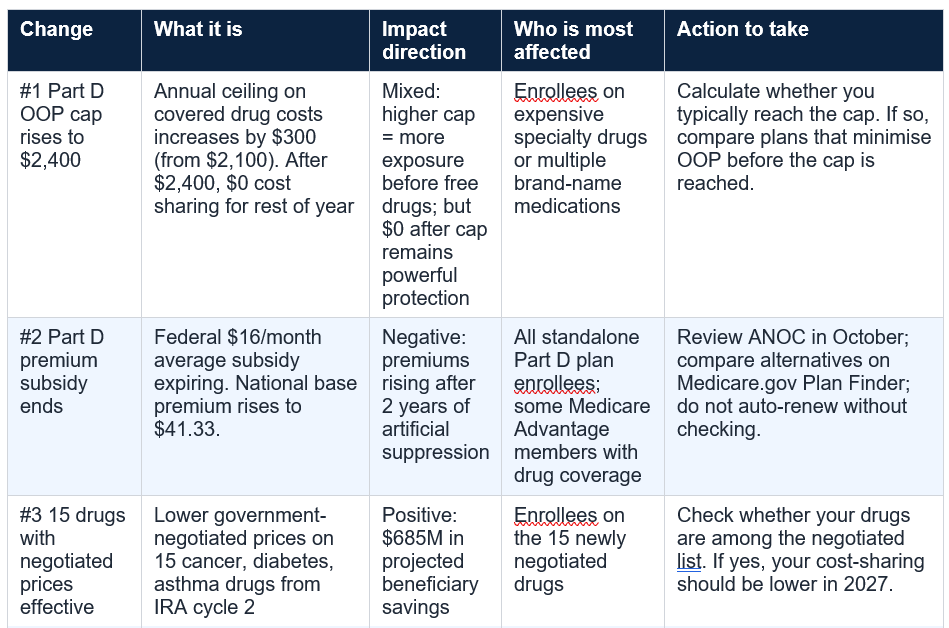
The worst default decision for 2027 is auto-renewal — assuming that your current plan will be the same, or similarly priced, or still available. Kiplinger’s summary of the 2027 changes makes this explicit: enrollees ‘can no longer rely on their current plan staying available — or remaining price-competitive — heading into next year.’
The right default decision is to use Medicare.gov/plan-compare every year during Open Enrollment, entering your specific drugs and pharmacy, and comparing total annual costs rather than premiums alone. In 2027, this exercise is more likely than in any recent year to reveal that your current plan is no longer the best available option. The work of reviewing takes an hour. The potential savings or benefit protection makes it the highest-value hour in any Medicare enrollee’s annual calendar. Not insurance advice — always verify with Medicare.gov or by calling 1-800-MEDICARE.
The Medicare Part D out-of-pocket cap for 2027 is $2,400. This means that once you have spent $2,400 out of pocket on covered Part D prescription drugs during the calendar year, you pay nothing for covered drugs for the remainder of that year. The cap was $2,000 in 2025 (the first year it took effect) and $2,100 in 2026. The annual out-of-pocket cap is a permanent benefit introduced by the Inflation Reduction Act, replacing the old coverage gap (donut hole) system with a simpler three-phase structure: deductible, initial coverage (25% coinsurance), and catastrophic ($0 cost sharing after the annual cap is reached). The cap amount is expected to increase annually. Sources: AHA (January 27, 2026); Humana 2027 Part D guide; CMS; FinanceBuzz. Not insurance advice. Always verify with Medicare.gov.
Why is my Medicare Part D premium going up in 2027?
The primary reason Part D premiums are rising in 2027 is the expiration of the federal Part D Premium Stabilisation Demonstration — a temporary subsidy programme under the Inflation Reduction Act that artificially lowered Part D premiums in 2025 and 2026. In 2026, the subsidy reduced average premiums by an estimated $16 per person per month. Without it, the average standalone Part D premium could have been approximately 50% higher. The demonstration is ending on January 1, 2027, as CMS transitions Part D back to standard market conditions. CMS’s 2027 national base beneficiary premium is $41.33. Most beneficiaries are expected to see increases of less than $10 per month, though the impact varies significantly by plan and location. Final plan-specific premiums are not available until September 2026. Review your Annual Notice of Change (ANOC) in October and compare alternatives during Open Enrollment (October 15 to December 7, 2026) at Medicare.gov/plan-compare. Sources: Kiplinger 2026; FinanceBuzz; CMS. Not insurance advice.
Is Medicare Advantage getting worse in 2027?
For many enrollees, yes. A HealthScape Advisors survey of health plan leaders from 35 Medicare Advantage plans found that nearly 70% expected their overall benefit packages to be less rich in 2027. Common changes include removing giveback benefits that pay part of the Part B premium, cutting major dental coverage, increasing copays for specialist care, and changing drug cost-sharing. UnitedHealthcare has dropped approximately 13% of plans across 18 states. Humana is implementing significant benefit reductions. The driver is financial: underlying medical costs rose faster than expected post-pandemic, making many MA plans unprofitable at their prior benefit levels. Additionally, CMS is increasing scrutiny of MA plan payments following analysis showing MA plans were paid $84 billion more than traditional Medicare would have cost for equivalent beneficiaries. If you are in a Medicare Advantage plan, review your Annual Notice of Change (ANOC) in October 2026 carefully before deciding whether to keep your current plan. Sources: Axios (September 10, 2026); HealthScape Advisors via Axios; CedarGate April 2026; AHA. Not insurance advice.
What drugs have negotiated prices in 2027?
As of January 1, 2027, 15 additional Medicare Part D drugs have government-negotiated lower prices as a result of the second cycle of the IRA’s Medicare Drug Price Negotiation Program. These drugs treat cancer, diabetes, asthma, and other chronic conditions. CMS announced these prices on November 25, 2025, projecting $685 million in out-of-pocket savings for beneficiaries. These 15 drugs add to the 10 drugs from the first negotiation cycle. CMS will announce 20 additional drugs selected for the next round of negotiation by February 1, 2027, with prices expected in 2029. The specific list of negotiated drugs is available at the CMS website (cms.gov) and changes as additional drugs are added to the programme. To find out whether your specific prescription is among the negotiated drugs, check the CMS list or call your Part D plan. Sources: AHA (November 26, 2025); Humana; CMS. Not insurance advice.
When is Medicare Open Enrollment for 2027?
Medicare Open Enrollment for 2027 plans runs October 15 to December 7, 2026. During this period, you can switch between Medicare Advantage and traditional Medicare, change Part D prescription drug plans, and switch between Medicare Advantage plans. Any changes made during Open Enrollment take effect January 1, 2027. Your Annual Notice of Change (ANOC) will arrive in October, detailing all changes to your current plan for 2027. For the most comprehensive plan comparison, use Medicare.gov/plan-compare, which allows you to enter your specific drugs, dosage, and pharmacy to compare total estimated annual costs. If your current plan is exiting your area for 2027, you have a Special Enrollment Period and should contact Medicare directly at 1-800-MEDICARE (1-800-633-4227). Free local counselling is available through your State Health Insurance Assistance Program (SHIP) at shiphelp.org. Not insurance advice.
Table of Contents
- Why 2027 Is a Big Year for Medicare
- Change #1: The Part D Out-of-Pocket Cap Rises to $2,400
- Change #2: The Part D Premium Stabilisation Subsidy Ends
- Change #3: Fifteen More Drugs Get Government-Negotiated Prices
- Change #4: The IRA’s Part D Benefit Redesign Becomes Permanent
- Change #5: Medicare Advantage Benefit Cuts and Plan Exits
- Change #6: Star Ratings Overhauled
- Change #7: Marketing and Agent Rules Change for Open Enrollment
- Change #8: Fewer Part D Plan Options Available
- How These 8 Changes Affect You: A Summary Table
- What to Do Before Open Enrollment Closes December 7
- Conclusion: 2027 Is Not the Year to Auto-Renew
- Frequently Asked Questions
- External References and Further Reading
Why 2027 Is a Big Year for Medicare
Every year brings Medicare adjustments. But 2027 brings a concentration of changes that make it one of the most consequential enrollment years in recent memory. A major federal subsidy that has been artificially holding down Part D drug plan premiums for two years is expiring. The ceiling on how much you pay out of pocket for prescription drugs is rising for the second consecutive year. Fifteen additional drugs now have government-negotiated lower prices taking effect. Medicare Advantage plans across the country are cutting benefits and exiting markets. The Star Ratings system that guides plan quality comparisons is being restructured. And Part D plan options are shrinking, making it harder to stay with last year’s plan and expect the same value.Medicare covers more than 65 million Americans (CMS). A 65-year-old retiring in 2026 can expect to spend an average of $185,500 on healthcare and medical expenses throughout retirement — up 7%, or $13,000, from the 2025 estimate (Fidelity; Kiplinger 2026). Against this backdrop, the annual October-to-December Open Enrollment window is not a formality. For 2027, it is an active financial decision that can save or cost thousands of dollars depending on whether an enrollee reviews their options or simply renews what they currently have.
This guide covers the eight most significant changes arriving in 2027, what each one means for your costs and coverage, and the specific actions to take before Open Enrollment closes on December 7, 2026.
Medicare: 65 million+ enrollees (CMS 2026). Medicare Advantage: ~35 million in 2026, projected to reach ~45 million by end of decade (AHA). 2027 Open Enrollment: October 15 to December 7, 2026. Part D OOP cap 2027: $2,400 (up from $2,100 in 2026). Part D national base premium 2027: $41.33 (CMS; FinanceBuzz). Premium subsidy savings being lost: ~$16/month per person. 15 drugs with negotiated prices effective January 1, 2027; $685 million in projected beneficiary savings (AHA; CMS November 2025). 70% of health plan leaders say their MA packages will be less rich in 2027 (HealthScape Advisors via Axios September 2026). UnitedHealthcare dropped ~13% of plans in 18 states (Axios September 2026). 65-year-old retiree expected lifetime healthcare cost: $185,500 average (Fidelity via Kiplinger 2026).
Change #1: The Part D Out-of-Pocket Cap Rises to $2,400
One of the most significant long-term improvements to Medicare in a generation was the Inflation Reduction Act’s introduction of an annual out-of-pocket spending cap on Part D prescription drug costs. For the first time in Medicare’s history, beneficiaries gained a ceiling on what they could be required to pay for covered Part D medications in a given calendar year. The cap was $2,000 in 2025, the first year it took effect.For 2027, that cap rises to $2,400 — up from $2,100 in 2026 (Humana; FinanceBuzz; Kiplinger; American Hospital Association, January 27, 2026). The increase means the threshold at which an enrollee’s cost-sharing drops to zero for covered drugs is $300 higher than in 2026. Once you reach $2,400 in out-of-pocket spending on covered Part D drugs, you pay nothing for those drugs for the remainder of the calendar year.
The donut hole — the coverage gap that previously left millions of beneficiaries paying a higher percentage of drug costs during a specific spending range — is permanently eliminated. The IRA replaced the complex multi-phase structure with a simpler three-phase system: a deductible phase, an initial coverage phase (25% coinsurance), and a catastrophic phase that begins at the $2,400 cap, at which point cost sharing drops to $0 for the rest of the year (PolicyRisk.com November 2025).
The rising cap is notable because it is an annual increase built into the benefit structure. The cap was designed to escalate gradually from the $2,000 starting point. The good news: the cap itself is a permanent benefit. Once reached, it provides complete relief from additional Part D cost sharing. For beneficiaries on expensive specialty drugs or multiple brand-name medications, reaching the $2,400 threshold early in the year means months of free covered prescriptions — a significant financial protection the old donut hole system never provided.
The Change: Change #1 summary: Part D out-of-pocket cap 2027 = $2,400. Up from $2,100 in 2026. Structure: (1) Deductible phase; (2) Initial coverage at 25% coinsurance; (3) After $2,400 OOP is reached: $0 cost sharing for covered drugs for the rest of the year. The donut hole is permanently eliminated (IRA). Good news: the cap structure is permanent. The cap amount increases annually. Source: CMS; AHA (January 27, 2026); Humana 2027 Part D guide; FinanceBuzz; Kiplinger 2026. Not insurance advice.
Change #2: The Part D Premium Stabilisation Subsidy Ends
This is the most significant financial change for many Part D enrollees in 2027: the federal government’s premium stabilisation demonstration that has been artificially holding down Part D premiums for the past two years is ending. The subsidy will not be extended to 2027 (Kiplinger 2026; FinanceBuzz).The Inflation Reduction Act included a temporary demonstration programme that provided federal support to lower Part D plan premiums. In 2026, this subsidy reduced average premiums by an estimated $16 per person per month (Kiplinger). The average standalone Part D premium in 2026 was approximately $36 per month — but without the demonstration programme, FinanceBuzz reports it could have been approximately 50% higher, or around $54 per month.
CMS announced in July that the relief would conclude at the end of 2026 to ‘transition Part D back to standard market conditions.’ The agency’s 2027 calculations put the national base beneficiary premium at $41.33, and most beneficiaries should see premium increases of less than $10 per month (FinanceBuzz). However, the base beneficiary premium is a benchmark, not what individuals actually pay. What you pay depends on your specific plan and location — and the range of plan-specific premium increases will be significantly wider than the national average suggests.
Importantly, final plan-specific premiums will not be available until September 2026. This means the full scope of premium increases will only become clear during Open Enrollment itself (October 15 to December 7). Enrollees cannot evaluate the actual cost increase until they receive their Annual Notice of Change (ANOC) in October and compare their current plan to alternatives through Medicare’s Plan Finder tool.
The end of the premium stabilisation demonstration is not a modest adjustment. The subsidy reduced premiums by an estimated 50% relative to what they would otherwise have been. The transition back to market conditions in 2027 will produce the largest year-over-year Part D premium increases for many beneficiaries since before the IRA. The impact will vary significantly by plan and location. Not reviewing your Part D plan during 2026 Open Enrollment and simply auto-renewing could mean paying substantially more than necessary in 2027. Not insurance advice. Verify with Medicare.gov.
What to do: Wait for your Annual Notice of Change (ANOC) to arrive in October 2026. Review your current plan’s new premium, deductible, and drug formulary. Use Medicare.gov’s Plan Finder tool (medicare.gov/plan-compare) to compare your plan against alternatives. Kiplinger notes that CMS’s comparison tool allows filtering by deductible, premium, or total premium plus drug costs -- use the latter to get the most accurate cost comparison. Not insurance advice.
Change #3: Fifteen More Drugs Get Government-Negotiated Prices
The Inflation Reduction Act’s Medicare Drug Price Negotiation Program continues to expand. On November 25, 2025, CMS announced lower prices for 15 Medicare Part D drugs selected for the second cycle of negotiations. These drugs treat cancer, diabetes, asthma, and other chronic conditions. The new pricing takes effect January 1, 2027 (AHA, November 26, 2025).CMS projected that Medicare Part D beneficiaries will save $685 million in out-of-pocket costs as a result of these 15 drugs’ new maximum fair prices (AHA). This is a direct, dollar-measurable benefit to beneficiaries who take any of the drugs selected in the second negotiation cycle.
The drug price negotiation programme works through a federal process in which CMS directly negotiates with pharmaceutical manufacturers to establish maximum fair prices — the highest price that a manufacturer can charge Medicare for a negotiated drug. The negotiated prices apply to Part D drug plans and, for some drugs, to Part B (physician-administered drugs). Manufacturers who do not enter agreements or exceed the maximum fair price face significant excise taxes.
Looking ahead: by February 1, 2027, CMS will announce 20 additional Part B or Part D drugs selected for the next round of negotiation, with prices expected to take effect in 2029 (Humana). The negotiation programme is expanding over time, with more drugs and larger projected savings in each successive cycle.
The Savings: The 15 newly negotiated drugs effective January 1, 2027 add to the 10 drugs from the first negotiation cycle that became effective in 2026. Medicare Part D beneficiaries on any of these 25 drugs should see lower cost-sharing because the negotiated prices reduce the total drug cost against which the 25% coinsurance is applied. The $685 million in projected savings represents a direct financial benefit to beneficiaries on the 15 new drugs. Verify whether your specific drugs are among those with newly negotiated prices by checking the CMS website or calling your Part D plan. Not insurance advice. Sources: AHA November 26, 2025; CMS; Humana.
Change #4: The IRA’s Part D Benefit Redesign Becomes Permanent
When the Inflation Reduction Act’s Part D changes took effect in 2025, they were implemented through a combination of statutory requirements and regulatory implementation. The 2027 CMS final rule codifies the IRA’s Part D benefit redesign into permanent Medicare regulations (CMS final rule; PSU Penn State Office of Rural Health; PolicyRisk.com November 2025).What this means practically: the elimination of the coverage gap (donut hole), the three-phase benefit structure (deductible, initial coverage with 25% coinsurance, catastrophic with $0 cost sharing), and the removal of cost sharing in the catastrophic phase are now permanent features of the Medicare Part D benefit design. These provisions are no longer subject to annual renegotiation or revision; they are codified into the programme’s regulatory foundation.
The Manufacturer Discount Program — which replaced the Coverage Gap Discount Program and requires pharmaceutical manufacturers to provide discounts on applicable drugs in both the initial and catastrophic coverage phases — is also codified. This structure determines how manufacturer discounts are applied toward the $2,400 annual out-of-pocket threshold, reducing the effective cost to beneficiaries before the cap is reached.
What This Means: Codification of the IRA changes provides regulatory certainty for both beneficiaries and plan administrators. The three-phase benefit structure and the annual out-of-pocket cap are now stable features of Part D rather than demonstration programmes or temporary measures subject to reversal. For beneficiaries, this means long-term financial planning around prescription drug costs is more reliable than it has been at any point in Medicare’s history. The cap amount will increase annually, but the structure is secure. Not insurance advice. Sources: CMS final rule; PolicyRisk.com November 2025; PSU PORH April 2026.
Change #5: Medicare Advantage Benefit Cuts and Plan Exits
For the approximately 35 million Americans enrolled in Medicare Advantage plans, 2027 brings the most significant wave of benefit reductions since Medicare Advantage’s current structure was established. The Axios reporting from September 10, 2026, based on insurance broker commentary and a Leerink analyst note, is direct: ‘2027 sets up as another year of broad-based industry benefit reductions.’The cuts are widespread across the industry. A HealthScape Advisors survey of health plan leaders from 35 Medicare Advantage plans found that nearly 70% expected their overall MA benefit packages to be less rich in 2027. Common strategies include: removing ‘giveback’ benefits that pay part of beneficiaries’ Part B premium (effectively increasing what enrollees pay for Medicare itself); cutting major dental benefits; increasing copays for specialist visits; and changing out-of-pocket drug costs (Axios September 2026).
UnitedHealthcare, one of the largest MA insurers, has dropped approximately 13% of its plans across 18 states. Humana is receiving significant negative feedback on its benefit changes, suggesting materially less generous plan designs for 2027. Some plans are even capping enrollment midway through the Open Enrollment period, meaning delayed review could result in the beneficiary’s preferred plan no longer being available when they go to enrol (Axios September 2026).
The driver of these cuts is financial: underlying medical costs rose higher than insurers anticipated post-pandemic, and Medicare Advantage plans are adjusting their benefit structures to restore profitability after several years of losses. Federal regulators have also increased scrutiny of MA plans following revelations that MA plans were paid $84 billion more than it would have cost to cover the same beneficiaries in traditional Medicare — contributing pressure for reform that is making MA plans less lucrative than they were (CedarGate April 2026; AHA).
If you are in a Medicare Advantage plan in 2026, do not assume your plan will look the same in 2027. The Annual Notice of Change (ANOC) you receive in October will detail every change to your plan’s benefits, network, and cost-sharing for 2027. Review it carefully -- specifically: has the dental coverage changed? Has the Part B premium giveback benefit been reduced or removed? Have specialist copays increased? Has the out-of-network coverage changed? If significant benefit cuts have occurred, comparing alternatives during Open Enrollment (October 15 to December 7) is essential. Not insurance advice.
Change #6: Star Ratings Overhauled
Medicare Advantage plans are rated on a 1-to-5-star quality scale based on performance metrics covering care quality, customer service, and beneficiary experience. The Star Ratings system matters to beneficiaries because it provides a quality signal when comparing plans, and to plan operators because high-rated plans receive bonus payments that fund supplemental benefits. To plans, the quality bonus is material: only 4-star and 5-star plans receive the full bonus payment that has funded many of the extra benefits (dental, vision, hearing, meals) that made Medicare Advantage attractive.The 2027 CMS final rule updates the quality measures used for Star Ratings, representing what HealthManagement.com describes as the most ‘pronounced reset’ under the current regulatory cycle. CMS finalized updates to quality measures as part of the CY 2027 policy changes (CMS final rule; PSU PORH). The specific metrics used to calculate star scores are being realigned, which can change plans’ star ratings even without any change in the actual quality of care delivered — simply because the measurement framework has shifted.
The practical implications for beneficiaries: a plan that was 4 or 5 stars in 2026 based on the old metric set may not maintain that rating in 2027 under the new measurement framework. Plans that lose a star may reduce supplemental benefits in response to the reduced bonus payment. The Star Ratings system is a useful tool but requires annual re-evaluation: the rating your current plan had when you enrolled may not be its current rating, and the rating it receives under the new 2027 methodology may shift again.
For 2027 Open Enrollment: check your current plan’s Star Rating under the new 2027 rating system at Medicare.gov/plan-compare before assuming your plan’s quality level is unchanged. The Plan Finder tool shows current star ratings and allows filtering by rating. A plan that has dropped from 4 to 3 stars may have done so because of measurement methodology changes rather than deteriorating care quality -- but the rating change may also signal reduced bonus payments and future benefit cuts. Not insurance advice.
Change #7: Marketing and Agent Rules Change for Open Enrollment
CMS revised its marketing and communications rules for Medicare Advantage and Part D plans, with the new rules applicable to contract year 2027 plans and taking effect October 1, 2026 — the start of the 2027 plan marketing period (PolicyRisk.com November 2025). For beneficiaries, the most important practical implication of these marketing rule changes is what to watch for during Open Enrollment.The changes include modifications to how third-party marketing organisations (TPMOs) — the brokers, agents, and comparison websites that market Medicare plans — are defined and regulated. CMS is also modifying translation requirements, eliminating Outbound Enrollment Verification (a process that had provided some consumer protection against unwanted plan switches), and removing the approval requirement for Medicare Card images in marketing materials (PolicyRisk.com). CMS is also exploring the use of AI in marketing oversight.
The elimination of Outbound Enrollment Verification is a change that beneficiaries should note. This process previously provided a checkpoint to confirm that plan switches made through third-party agents were actually intended by the beneficiary. Its removal reduces a consumer protection that had helped guard against unauthorised or misleading enrollment changes.
The broader context: marketing of Medicare plans — particularly through online comparison tools, television advertising, and call centres — has been a significant source of beneficiary complaints, including reports of beneficiaries being enrolled in plans they did not choose or not understanding the plan they were switching to. The marketing rule changes for 2027 alter this landscape; beneficiaries should be particularly careful about which sources they use to research plan options and should always verify any enrollment action through Medicare.gov or by calling 1-800-MEDICARE directly.
For 2027 Open Enrollment: the most reliable way to compare and enrol in Medicare plans is directly through Medicare.gov/plan-compare or by calling 1-800-MEDICARE. If using an insurance broker or comparison website, verify that any plan they show you also appears in the Medicare.gov Plan Finder, and confirm any enrollment through official Medicare channels. Third-party agents can be helpful but may have financial incentives to recommend specific plans. Not insurance advice.
Change #8: Fewer Part D Plan Options Available
The eighth change is less a regulatory action and more a market consequence of the combined pressures described above. Kiplinger’s 2026 guide to Medicare changes states directly: because options are consolidating rapidly, ‘enrollees can no longer rely on their current plan staying available — or remaining price-competitive — heading into next year.’The consolidation of Part D plan options reflects the financial pressures on plan operators following the IRA’s restructuring of the Part D benefit, the end of the premium stabilisation demonstration, and CMS’s tighter oversight of plan operations. Plans that were viable under the old benefit structure may no longer be profitable under the new three-phase redesign, particularly given the increased cost-sharing risk that plans now carry in the catastrophic coverage phase following the elimination of the government’s previous 80% reinsurance in that phase.
For beneficiaries, fewer plan options in their area means less competition, which typically means higher premiums for remaining plans and less ability to find a plan that is well-matched to their specific drug formulary. Beneficiaries in rural or lower-competition markets are particularly exposed: in areas where only one or two Part D plans were previously available, plan exits can leave very few options during Open Enrollment.
The practical implication of plan consolidation is that even beneficiaries whose current plan still exists in 2027 may find that the combination of premium increases (from the subsidy ending), benefit changes, and formulary adjustments makes their current plan less competitive than alternatives. The only way to know is to actively compare using the Medicare Plan Finder tool during Open Enrollment.
The single most important action for 2027 Open Enrollment: use Medicare.gov/plan-compare to enter your specific drugs (name, dosage, frequency) and your pharmacy, and compare the total estimated annual cost (premium plus drug costs) across ALL available plans in your area. Kiplinger confirms CMS’s comparison tool can be filtered by total premium plus drug costs -- this is the most meaningful comparison for most beneficiaries, not the premium alone. Do this every year, but especially in 2027 when consolidation and premium changes make staying with the same plan without reviewing a potentially costly default. Not insurance advice.
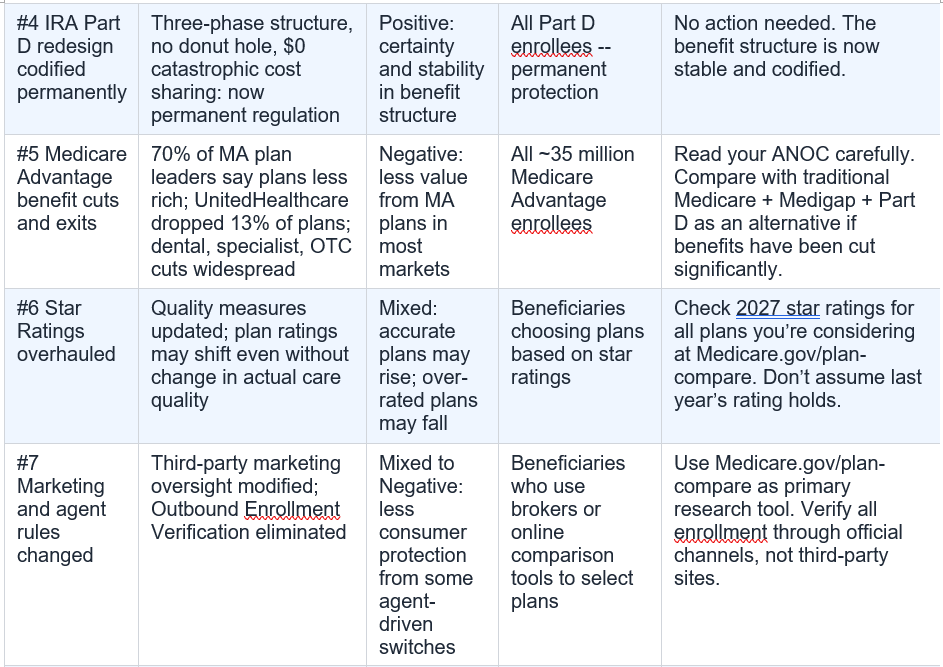
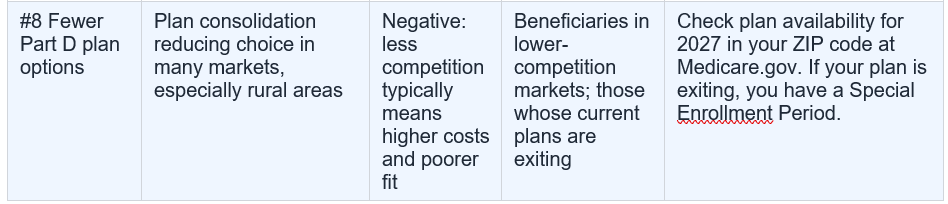
How These 8 Changes Affect You: A Summary Table
What to Do Before Open Enrollment Closes December 7
Open Enrollment for 2027 plans runs October 15 to December 7, 2026. During this window, you can switch between Medicare Advantage and traditional Medicare, change Part D prescription drug plans, and change Medicare Advantage plans. Decisions made during Open Enrollment take effect January 1, 2027. Here is the specific action sequence recommended by CMS and Medicare guidance sources for 2027.- September 2026: Note that final plan-specific premiums and plan changes for 2027 will not be publicly available until September. Watch for news about plan options in your area and note the overall direction of changes described in this guide.
- October 2026: Watch for your Annual Notice of Change (ANOC). Every Medicare Advantage and Part D plan enrollee should receive an ANOC in October detailing all changes to their plan for 2027. Read it carefully: look specifically for changes to premiums, deductibles, covered drugs (formulary), pharmacy network, specialist copays, and any supplemental benefits (dental, vision, hearing, OTC). If the changes are significant or negative, this is your trigger to compare alternatives.
- October 15 – December 7, 2026 (Open Enrollment): Use Medicare.gov/plan-compare. Enter your current drugs (with dosage and frequency) and pharmacy. Compare plans by total estimated annual cost (premium plus drug costs) rather than premium alone. This is the most accurate cost comparison for most beneficiaries. Review star ratings for plans you are considering under the new 2027 rating system.
- Consider traditional Medicare alternatives: if your Medicare Advantage plan has cut significant benefits in 2027, this Open Enrollment period is the right time to evaluate whether a combination of traditional Medicare Part A and Part B, a Medigap (Medicare Supplement) policy, and a separate Part D plan would serve you better. This comparison is more complex but may be appropriate if your MA plan’s benefit cuts are extensive.
- If your current plan is exiting: you will have a Special Enrollment Period (SEP) even outside the standard October 15 to December 7 window. Contact your plan or Medicare directly to confirm your rights and options. Do not wait passively for automatic reassignment.
- Call 1-800-MEDICARE (1-800-633-4227): for personalised, free guidance from Medicare’s official help line. You can also contact your State Health Insurance Assistance Program (SHIP) for free local counselling by trained volunteer advisers. SHIP contact information is available at shiphelp.org.
Conclusion: 2027 Is Not the Year to Auto-Renew
The eight changes arriving in 2027 collectively make the Open Enrollment window from October 15 to December 7, 2026 one of the most consequential in recent years. The end of the Part D premium subsidy will raise drug plan costs. The broader Part D out-of-pocket cap will make some beneficiaries pay more before free coverage kicks in. Medicare Advantage plans are cutting benefits across the board, with 70% of health plan leaders acknowledging their packages will be less rich. Star Ratings are being recalibrated, changing the reliability of quality signals. And plan options are consolidating, leaving fewer alternatives in many markets.The worst default decision for 2027 is auto-renewal — assuming that your current plan will be the same, or similarly priced, or still available. Kiplinger’s summary of the 2027 changes makes this explicit: enrollees ‘can no longer rely on their current plan staying available — or remaining price-competitive — heading into next year.’
The right default decision is to use Medicare.gov/plan-compare every year during Open Enrollment, entering your specific drugs and pharmacy, and comparing total annual costs rather than premiums alone. In 2027, this exercise is more likely than in any recent year to reveal that your current plan is no longer the best available option. The work of reviewing takes an hour. The potential savings or benefit protection makes it the highest-value hour in any Medicare enrollee’s annual calendar. Not insurance advice — always verify with Medicare.gov or by calling 1-800-MEDICARE.
Frequently Asked Questions
What is the Medicare Part D out-of-pocket cap for 2027?The Medicare Part D out-of-pocket cap for 2027 is $2,400. This means that once you have spent $2,400 out of pocket on covered Part D prescription drugs during the calendar year, you pay nothing for covered drugs for the remainder of that year. The cap was $2,000 in 2025 (the first year it took effect) and $2,100 in 2026. The annual out-of-pocket cap is a permanent benefit introduced by the Inflation Reduction Act, replacing the old coverage gap (donut hole) system with a simpler three-phase structure: deductible, initial coverage (25% coinsurance), and catastrophic ($0 cost sharing after the annual cap is reached). The cap amount is expected to increase annually. Sources: AHA (January 27, 2026); Humana 2027 Part D guide; CMS; FinanceBuzz. Not insurance advice. Always verify with Medicare.gov.
Why is my Medicare Part D premium going up in 2027?
The primary reason Part D premiums are rising in 2027 is the expiration of the federal Part D Premium Stabilisation Demonstration — a temporary subsidy programme under the Inflation Reduction Act that artificially lowered Part D premiums in 2025 and 2026. In 2026, the subsidy reduced average premiums by an estimated $16 per person per month. Without it, the average standalone Part D premium could have been approximately 50% higher. The demonstration is ending on January 1, 2027, as CMS transitions Part D back to standard market conditions. CMS’s 2027 national base beneficiary premium is $41.33. Most beneficiaries are expected to see increases of less than $10 per month, though the impact varies significantly by plan and location. Final plan-specific premiums are not available until September 2026. Review your Annual Notice of Change (ANOC) in October and compare alternatives during Open Enrollment (October 15 to December 7, 2026) at Medicare.gov/plan-compare. Sources: Kiplinger 2026; FinanceBuzz; CMS. Not insurance advice.
Is Medicare Advantage getting worse in 2027?
For many enrollees, yes. A HealthScape Advisors survey of health plan leaders from 35 Medicare Advantage plans found that nearly 70% expected their overall benefit packages to be less rich in 2027. Common changes include removing giveback benefits that pay part of the Part B premium, cutting major dental coverage, increasing copays for specialist care, and changing drug cost-sharing. UnitedHealthcare has dropped approximately 13% of plans across 18 states. Humana is implementing significant benefit reductions. The driver is financial: underlying medical costs rose faster than expected post-pandemic, making many MA plans unprofitable at their prior benefit levels. Additionally, CMS is increasing scrutiny of MA plan payments following analysis showing MA plans were paid $84 billion more than traditional Medicare would have cost for equivalent beneficiaries. If you are in a Medicare Advantage plan, review your Annual Notice of Change (ANOC) in October 2026 carefully before deciding whether to keep your current plan. Sources: Axios (September 10, 2026); HealthScape Advisors via Axios; CedarGate April 2026; AHA. Not insurance advice.
What drugs have negotiated prices in 2027?
As of January 1, 2027, 15 additional Medicare Part D drugs have government-negotiated lower prices as a result of the second cycle of the IRA’s Medicare Drug Price Negotiation Program. These drugs treat cancer, diabetes, asthma, and other chronic conditions. CMS announced these prices on November 25, 2025, projecting $685 million in out-of-pocket savings for beneficiaries. These 15 drugs add to the 10 drugs from the first negotiation cycle. CMS will announce 20 additional drugs selected for the next round of negotiation by February 1, 2027, with prices expected in 2029. The specific list of negotiated drugs is available at the CMS website (cms.gov) and changes as additional drugs are added to the programme. To find out whether your specific prescription is among the negotiated drugs, check the CMS list or call your Part D plan. Sources: AHA (November 26, 2025); Humana; CMS. Not insurance advice.
When is Medicare Open Enrollment for 2027?
Medicare Open Enrollment for 2027 plans runs October 15 to December 7, 2026. During this period, you can switch between Medicare Advantage and traditional Medicare, change Part D prescription drug plans, and switch between Medicare Advantage plans. Any changes made during Open Enrollment take effect January 1, 2027. Your Annual Notice of Change (ANOC) will arrive in October, detailing all changes to your current plan for 2027. For the most comprehensive plan comparison, use Medicare.gov/plan-compare, which allows you to enter your specific drugs, dosage, and pharmacy to compare total estimated annual costs. If your current plan is exiting your area for 2027, you have a Special Enrollment Period and should contact Medicare directly at 1-800-MEDICARE (1-800-633-4227). Free local counselling is available through your State Health Insurance Assistance Program (SHIP) at shiphelp.org. Not insurance advice.

0 Comments Comments