
Investing
Alphabet and Amazon: Two Monster Stocks to Hold for 20 Years

Alphabet Q3 2026: revenue $127.6 billion (+25%); Google Cloud $30.7 billion (+103%); Search & other +12%; capex $51.4 billion (vs $24 billion); free cash flow −$9.1 billion (second straight negative quarter); 2026 capex guidance $195–$205 billion; stock −12% on Oct 29, its worst day by percentage. Amazon Q3 2026 (Oct 29): AWS $46 billion (+39%, fastest since late 2021; about $184 billion run rate); capex $77.3 billion (vs $35.1 billion; estimate $58.7 billion); free cash flow reported at −$42.4 billion; 2026 capex about $220 billion, “meaningfully more” in 2027; AWS backlog $578 billion; stock closed at $243.79 on Oct 29, down 4.3%, then fell further after hours. My arithmetic: Alphabet’s Q3 capex was about 40% of revenue; Amazon’s 2026 capex is about 1.2 times AWS’s annual run rate; a 12% drop needs a 13.6% gain to recover; $10,000 grows to about $32,100, $46,600 or $67,300 in 20 years at 6%, 8% or 10% a year; two 10% positions that both fall 50% cost 10% of a portfolio.
The reason is the same for both: money. Both are spending enormous sums on AI infrastructure and burning cash to do it, and the question is whether that is the price of becoming an AI winner or the start of a very expensive mistake. This guide lays out both cases with the numbers, then asks the harder question: what would you have to believe, and how should you size it, to hold either for 20 years?
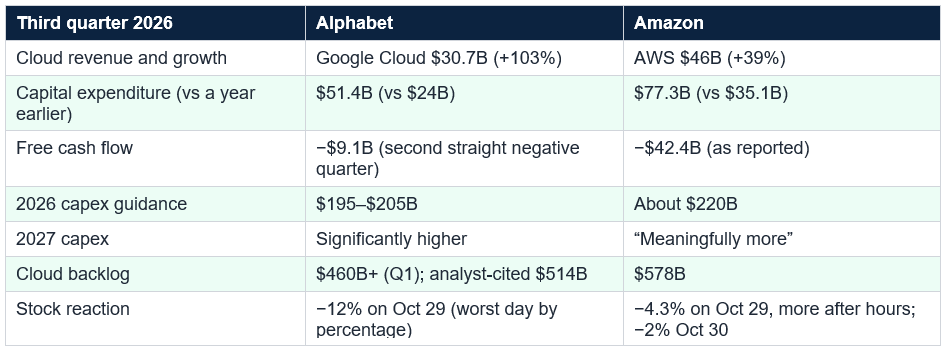
Alphabet reported on October 28. Revenue was $127.6 billion, roughly in line with the $127.9 billion analysts expected, and Google Cloud accelerated to $30.7 billion. But capital expenditures hit a record $51.4 billion, against $24 billion a year earlier, and free cash flow was negative $9.1 billion, its second straight negative quarter after negative $5.9 billion. Earnings per share fell to $2.12 from $2.87. The company kept 2026 capex guidance at $195 billion to $205 billion and said spending would rise significantly in 2027, having raised $84.8 billion of equity in June, including $10 billion from Berkshire Hathaway, to fund the buildout.
Amazon reported on October 29. Earnings per share of $1.89 missed expectations, partly because the year-earlier quarter included a $9.5 billion gain on its Anthropic investment. Capital expenditures were $77.3 billion against $35.1 billion a year earlier and an estimated $58.7 billion, and the company reported free cash flow of negative $42.4 billion. It held its 2026 capex forecast at about $220 billion, and CEO Andy Jassy said spending would be “meaningfully more” next year while forecasting AWS growth above 40% in 2027 and 2028. Amazon closed at $243.79 on October 29, down 4.3%, then fell more after hours, in a wider tech selloff; with Meta and Microsoft, the four plan more than $740 billion of capex this year.
The numbers: Alphabet Q3 2026: revenue $127.6B (+25%), Google Cloud $30.7B (+103%), capex $51.4B (vs $24B), free cash flow −$9.1B, stock −12% on Oct 29. Amazon Q3 2026: AWS $46B (+39%), capex $77.3B (vs $35.1B), free cash flow reported at −$42.4B, 2026 capex about $220B. Big four capex plans: more than $740B this year.
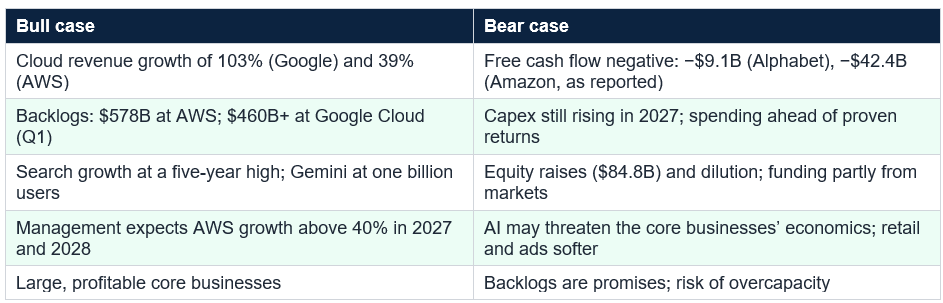
Amazon’s bull case rests on AWS. Revenue rose 39% to $46 billion, an annual run rate of about $184 billion and the fastest growth in nearly five years. The AWS backlog reached $578 billion, about three years of current revenue, and management expects growth above 40% in each of the next two years, with margins at records. One analyst says AWS could eventually be a $1 trillion revenue business, a view, not a fact. In both cases the argument is that today’s spending buys capacity customers have already committed to buy.
Then there is funding. Alphabet raised $84.8 billion of equity in June, including a $10 billion Berkshire placement at about $348 to $352 a share, and set up a $40 billion at-the-market program, which dilutes existing shareholders. Coverage notes AI could also threaten the economics of the core businesses that used to produce overflowing cash, Amazon’s retail and advertising results were softer and several analysts cut price targets. And backlogs are promises, not cash: if AI customers slow down, the buildout could leave overcapacity.
History is a warning. The list of the largest companies changes over decades, and in my general knowledge many once-dominant firms faded, a pattern rather than a retrieved statistic. Hendrik Bessembinder found the best 4.3% of stocks created all the market’s net wealth, which means picking future winners is hard but holding the whole market captures them without choosing. Two stocks can win, but you cannot know in advance.
Behavior matters as much as the stock. DALBAR found the average investor earned about 6.8% a year over 30 years against 10.2% for the S&P 500, largely from badly timed trades, and JPMorgan found missing the 10 best days over 20 years cut the S&P 500’s annualized return from about 10.6% to about 6.4%. A buy-and-hold plan you abandon in the next drop is not a plan; if you cannot sit through a 40% decline, size accordingly.
A stock that fell sharply is not necessarily cheap, and a great company is not always a great investment at every price. I did not retrieve valuations, so nothing here says these stocks are a bargain.
A reasonable approach is core-satellite: most of your money in low-cost, diversified funds and a small slice, perhaps 10% to 20%, in individual stocks you have researched, spread across several names rather than two. Buy in stages so a further drop is a chance, not a disaster, write down why you own each stock and what would make you sell, and review once or twice a year. This is general education, not personal advice.

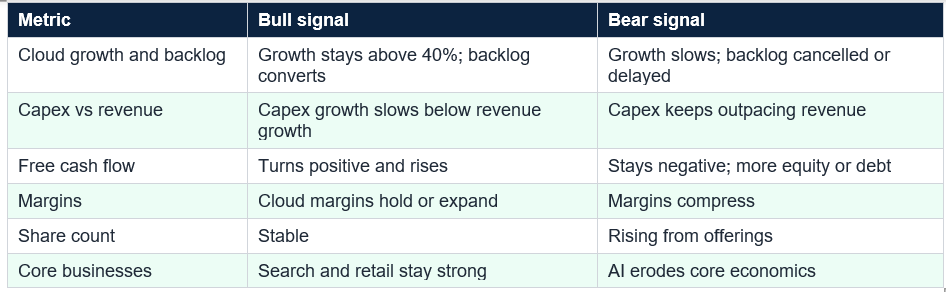
One caveat: Amazon’s negative $42.4 billion of free cash flow is described in some coverage as a quarterly outflow and may reflect a different period, and an aggregator’s figures can differ from the filings, so check the companies’ own reports. If cloud growth stays near or above 40% while capex growth slows, the bull case strengthens; if capex keeps rising while growth slows, the bear case gains ground.
Whether either is a monster stock for the next 20 years depends on things nobody can know today. If you want exposure, size it so a 50% decline would not hurt, buy in stages, keep an index fund as your core and track cloud growth, capex, free cash flow and dilution. Twenty years is a very long time, and a qualified adviser can help you decide whether any individual stock belongs in your plan.
Both reported strong AI-related growth but also huge spending and negative free cash flow. Alphabet’s Google Cloud revenue more than doubled to $30.7 billion, yet capex hit $51.4 billion, free cash flow was negative $9.1 billion and the stock fell 12% on October 29, its worst day ever by percentage. Amazon’s AWS grew 39%, its fastest since late 2021, but capex of $77.3 billion and a large cash outflow sent shares down.
Is AI spending a risk or an opportunity for these companies?
Both. Cloud backlogs, reported at $578 billion at AWS and in the hundreds of billions at Google Cloud, suggest strong demand, and management expects AWS growth above 40% in 2027 and 2028. But the spending is consuming cash, Alphabet raised $84.8 billion of equity in June to fund it and returns are not guaranteed. The outcome depends on whether the demand converts into profitable revenue.
Is it wise to buy and hold two stocks for 20 years?
Holding any individual stock for 20 years is risky, because company leadership changes and few stocks create most of the market’s wealth. For most people, a diversified index fund should be the core, and individual stocks a small, researched slice. If you do buy, size the position so a 50% decline would not derail you. This is general education, not personal advice.
Should I buy after a big drop?
A drop alone is not a reason. Price falls when expectations change, and the question is whether the business’s long-term value has changed. Check the cash flow, the spending plans and the valuation, which I did not retrieve here, and consider buying in stages instead of all at once.
What should I watch to judge these stocks over time?
Cloud growth and backlog conversion, capital spending relative to revenue, free cash flow turning positive, operating margins, share count (dilution) and how AI affects the core businesses, such as Search and retail. If AI revenue grows faster than capex and cash flow recovers, the bull case strengthens; if capex rises while growth slows, the bear case does.
Table of Contents
- The Worst Day and the Best Quarter
- The Short Answer
- What Happened This Week
- The Bull Case: Spending as Investment
- The Bear Case: Spending That Eats the Cash
- Side by Side: Alphabet and Amazon
- What Would Have to Go Right Over 20 Years
- The Math of a 20-Year Hold
- How to Size It
- What to Watch
- Common Mistakes
- Conclusion
- Frequently Asked Questions
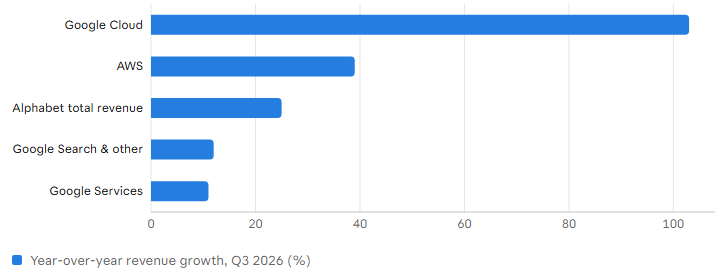
The growth is real: cloud and search growth, Q3 2026 (% year over year)
Growth (%) by Alphabet Form 8-K (Oct 28, 2026) and CNBC/Reuters coverage of Amazon (Oct 29, 2026)
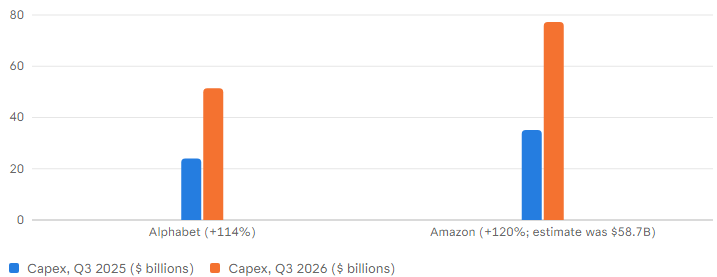
But so is the spending: quarterly capital expenditure, Q3 2025 vs Q3 2026 ($ billions)
Capital expenditure ($ billions) by Fortune and Alphabet filings; CNBC (FactSet estimate); growth rates are the author's arithmetic
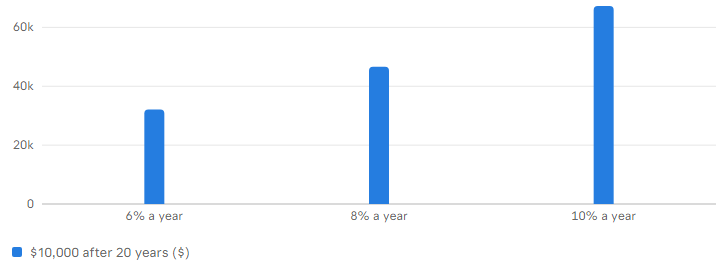
What a 20-year hold could look like: $10,000 at 6%, 8% and 10% a year ($)
Ending value ($) by Author's hypothetical illustration, not a forecast; a single stock can fall 50% along the way, which needs a 100% gain to recover
The Worst Day and the Best Quarter
Here is a strange sentence: Alphabet had its worst single-day percentage drop ever after reporting that Google Cloud revenue had more than doubled. On October 28, Alphabet reported third-quarter revenue of $127.6 billion, up 25%, with Google Cloud up 103% to $30.7 billion and search query growth at its highest in five years. The next day, October 29, its shares fell 12% in regular trading, and that evening Amazon reported its fastest AWS growth since late 2021, up 39% to $46 billion, and its shares sank too.The reason is the same for both: money. Both are spending enormous sums on AI infrastructure and burning cash to do it, and the question is whether that is the price of becoming an AI winner or the start of a very expensive mistake. This guide lays out both cases with the numbers, then asks the harder question: what would you have to believe, and how should you size it, to hold either for 20 years?
The Short Answer
The bull case is that both companies are building the infrastructure of the AI economy and have the customers, backlogs and cash-generating core businesses to pay for it. The bear case is that capital spending is outrunning cash flow, equity and debt are filling the gap and AI returns are unproven. Both can be partly true. A 20-year hold is a bet that the winners stay winners, which is far from certain, so for most people a diversified index fund should be the core, with any individual stock a small, researched position sized so a large loss would not hurt.Alphabet reported on October 28. Revenue was $127.6 billion, roughly in line with the $127.9 billion analysts expected, and Google Cloud accelerated to $30.7 billion. But capital expenditures hit a record $51.4 billion, against $24 billion a year earlier, and free cash flow was negative $9.1 billion, its second straight negative quarter after negative $5.9 billion. Earnings per share fell to $2.12 from $2.87. The company kept 2026 capex guidance at $195 billion to $205 billion and said spending would rise significantly in 2027, having raised $84.8 billion of equity in June, including $10 billion from Berkshire Hathaway, to fund the buildout.
Amazon reported on October 29. Earnings per share of $1.89 missed expectations, partly because the year-earlier quarter included a $9.5 billion gain on its Anthropic investment. Capital expenditures were $77.3 billion against $35.1 billion a year earlier and an estimated $58.7 billion, and the company reported free cash flow of negative $42.4 billion. It held its 2026 capex forecast at about $220 billion, and CEO Andy Jassy said spending would be “meaningfully more” next year while forecasting AWS growth above 40% in 2027 and 2028. Amazon closed at $243.79 on October 29, down 4.3%, then fell more after hours, in a wider tech selloff; with Meta and Microsoft, the four plan more than $740 billion of capex this year.
The numbers: Alphabet Q3 2026: revenue $127.6B (+25%), Google Cloud $30.7B (+103%), capex $51.4B (vs $24B), free cash flow −$9.1B, stock −12% on Oct 29. Amazon Q3 2026: AWS $46B (+39%), capex $77.3B (vs $35.1B), free cash flow reported at −$42.4B, 2026 capex about $220B. Big four capex plans: more than $740B this year.
The Bull Case: Spending as Investment
Start with Alphabet. Google Cloud more than doubled, led by enterprise AI infrastructure and solutions, with sales of its TPU chip systems a meaningful contributor. Search grew 12% with query growth at a five-year high, countering the fear that AI would hurt search. The Gemini app reached one billion users, and the company said it is on a half-trillion-dollar revenue run rate, about $510 billion a year on my arithmetic. Cloud is about 24% of revenue, and its backlog was above $460 billion in the first quarter, with an analyst citing about $514 billion more recently.Amazon’s bull case rests on AWS. Revenue rose 39% to $46 billion, an annual run rate of about $184 billion and the fastest growth in nearly five years. The AWS backlog reached $578 billion, about three years of current revenue, and management expects growth above 40% in each of the next two years, with margins at records. One analyst says AWS could eventually be a $1 trillion revenue business, a view, not a fact. In both cases the argument is that today’s spending buys capacity customers have already committed to buy.
The Bear Case: Spending That Eats the Cash
The bear case starts with cash. Alphabet’s free cash flow was negative for two quarters in a row, and Amazon’s reported negative $42.4 billion shows operations generated plenty of cash that capex then swallowed, as one analyst put it. That would be fine if the spending were temporary, but both companies say it will rise in 2027. Alphabet’s Q3 capex was about 40% of its revenue, and Amazon’s 2026 capex of about $220 billion is about 1.2 times AWS’s annual run rate.Then there is funding. Alphabet raised $84.8 billion of equity in June, including a $10 billion Berkshire placement at about $348 to $352 a share, and set up a $40 billion at-the-market program, which dilutes existing shareholders. Coverage notes AI could also threaten the economics of the core businesses that used to produce overflowing cash, Amazon’s retail and advertising results were softer and several analysts cut price targets. And backlogs are promises, not cash: if AI customers slow down, the buildout could leave overcapacity.
Side by Side: Alphabet and Amazon
The businesses differ: Alphabet is dominated by advertising with a fast-growing cloud, while Amazon is dominated by retail with a cloud that, in my general knowledge, generates much of its profit. But the AI story is the same: the cloud arm is accelerating while capex races ahead of cash flow, and both have signalled more spending to come.
What Would Have to Go Right Over 20 Years
A 20-year hold is a bet on several things at once. AI demand would need to keep growing and convert into profitable revenue; returns on this capex would need to exceed the cost of capital as competitors build capacity; free cash flow would need to turn positive and grow; the core businesses, search and advertising for Alphabet and retail for Amazon, would need to stay strong despite AI and regulation; and the share count would need to stay under control.History is a warning. The list of the largest companies changes over decades, and in my general knowledge many once-dominant firms faded, a pattern rather than a retrieved statistic. Hendrik Bessembinder found the best 4.3% of stocks created all the market’s net wealth, which means picking future winners is hard but holding the whole market captures them without choosing. Two stocks can win, but you cannot know in advance.
The Math of a 20-Year Hold
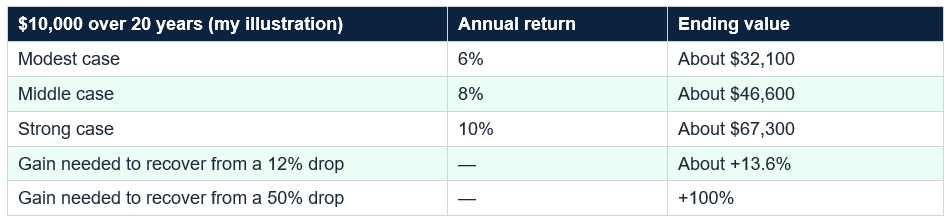
To turn $10,000 into five times as much in 20 years takes about 8.4% a year; ten times takes about 12.2%. In my illustration, $10,000 grows to about $32,100 at 6% a year, $46,600 at 8% and $67,300 at 10%. Those are hypothetical returns, not forecasts, and a single stock’s path can be far bumpier: recovering from a 50% loss needs a 100% gain, and even a 12% drop, like Alphabet’s one-day move, needs about 13.6%.Behavior matters as much as the stock. DALBAR found the average investor earned about 6.8% a year over 30 years against 10.2% for the S&P 500, largely from badly timed trades, and JPMorgan found missing the 10 best days over 20 years cut the S&P 500’s annualized return from about 10.6% to about 6.4%. A buy-and-hold plan you abandon in the next drop is not a plan; if you cannot sit through a 40% decline, size accordingly.
A stock that fell sharply is not necessarily cheap, and a great company is not always a great investment at every price. I did not retrieve valuations, so nothing here says these stocks are a bargain.
How to Size It
Position size is the most important decision you control. With $100,000 and 10% in each of two stocks, a 50% fall in both costs $10,000, or 10% of the portfolio; at 25% each, the same fall costs 25%. Large companies like these are, in my general knowledge, big weights in broad index funds, so an index fund may already give you meaningful exposure to both, and adding more is a concentration decision, not a diversification one.A reasonable approach is core-satellite: most of your money in low-cost, diversified funds and a small slice, perhaps 10% to 20%, in individual stocks you have researched, spread across several names rather than two. Buy in stages so a further drop is a chance, not a disaster, write down why you own each stock and what would make you sell, and review once or twice a year. This is general education, not personal advice.
What to Watch
A few measures tell you more than the daily price. Watch cloud growth and whether the backlog converts to revenue on schedule, capex relative to revenue, free cash flow turning positive, cloud margins, the share count, since dilution quietly reduces your slice, and how AI affects the core: search queries and ads for Alphabet, retail and advertising for Amazon.One caveat: Amazon’s negative $42.4 billion of free cash flow is described in some coverage as a quarterly outflow and may reflect a different period, and an aggregator’s figures can differ from the filings, so check the companies’ own reports. If cloud growth stays near or above 40% while capex growth slows, the bull case strengthens; if capex keeps rising while growth slows, the bear case gains ground.
Common Mistakes
Common mistakes include buying only because the price fell, treating a big company as a safe one, ignoring cash flow because revenue is growing, going all in on two stocks, selling in a panic at the next drop and believing a headline thesis without asking what price is already in the stock, which I have not retrieved. Many people also overlook that they may already own both through an index fund. Before buying either stock, write down your thesis in two sentences, the evidence that would prove you wrong and the maximum percentage of your portfolio you are willing to lose on it.Conclusion
Alphabet and Amazon are both great companies in the middle of a very expensive bet. Google Cloud grew 103% and AWS 39% in the third quarter, with backlogs in the hundreds of billions, and both expect higher spending in 2027. But quarterly capex of $51.4 billion at Alphabet and $77.3 billion at Amazon turned free cash flow negative, Alphabet raised $84.8 billion of equity and the stocks fell sharply, Alphabet by 12% in its worst day by percentage. The same spending that could make them AI winners could leave them with too much capacity and too little cash.Whether either is a monster stock for the next 20 years depends on things nobody can know today. If you want exposure, size it so a 50% decline would not hurt, buy in stages, keep an index fund as your core and track cloud growth, capex, free cash flow and dilution. Twenty years is a very long time, and a qualified adviser can help you decide whether any individual stock belongs in your plan.
Frequently Asked Questions
Why did Alphabet and Amazon stocks fall after earnings?Both reported strong AI-related growth but also huge spending and negative free cash flow. Alphabet’s Google Cloud revenue more than doubled to $30.7 billion, yet capex hit $51.4 billion, free cash flow was negative $9.1 billion and the stock fell 12% on October 29, its worst day ever by percentage. Amazon’s AWS grew 39%, its fastest since late 2021, but capex of $77.3 billion and a large cash outflow sent shares down.
Is AI spending a risk or an opportunity for these companies?
Both. Cloud backlogs, reported at $578 billion at AWS and in the hundreds of billions at Google Cloud, suggest strong demand, and management expects AWS growth above 40% in 2027 and 2028. But the spending is consuming cash, Alphabet raised $84.8 billion of equity in June to fund it and returns are not guaranteed. The outcome depends on whether the demand converts into profitable revenue.
Is it wise to buy and hold two stocks for 20 years?
Holding any individual stock for 20 years is risky, because company leadership changes and few stocks create most of the market’s wealth. For most people, a diversified index fund should be the core, and individual stocks a small, researched slice. If you do buy, size the position so a 50% decline would not derail you. This is general education, not personal advice.
Should I buy after a big drop?
A drop alone is not a reason. Price falls when expectations change, and the question is whether the business’s long-term value has changed. Check the cash flow, the spending plans and the valuation, which I did not retrieve here, and consider buying in stages instead of all at once.
What should I watch to judge these stocks over time?
Cloud growth and backlog conversion, capital spending relative to revenue, free cash flow turning positive, operating margins, share count (dilution) and how AI affects the core businesses, such as Search and retail. If AI revenue grows faster than capex and cash flow recovers, the bull case strengthens; if capex rises while growth slows, the bear case does.
0 Comments
Be the first to share your thoughts on this article.