

Investing
The Only 5 Investment Funds Most People Really Need

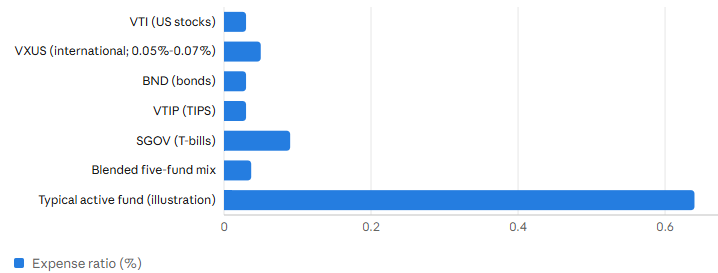
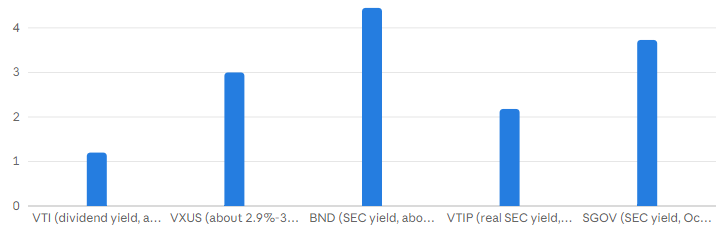
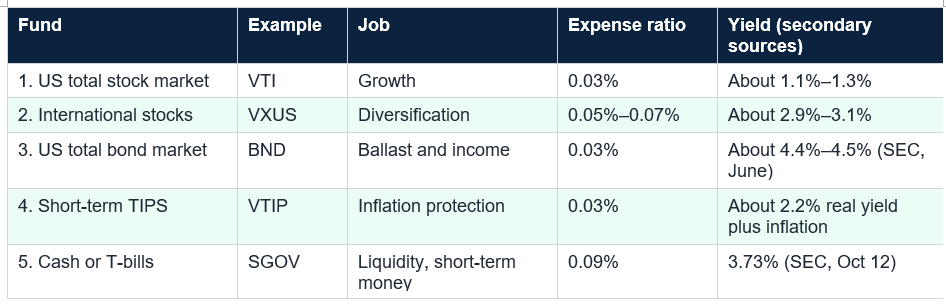
Costs and yields: VTI 0.03% (yield about 1.1%–1.3%); VXUS 0.05%–0.07% (yield about 2.9%–3.1%); BND 0.03% (30-day SEC yield about 4.4%–4.5% in June); VTIP 0.03%; SGOV 0.09% (30-day SEC yield 3.73% on Oct 12); blended cost of a five-fund mix about 0.04% ($37–$41 per $100,000). Performance: 10-year annualized returns as of February 2026 of about 14.25% (VTI), 8.55% (VXUS) and 1.98% (BND); VXUS +26.8% over the year to June; VTIP +2.16% year to date (below inflation); Treasury funds with longer duration lost 1.65% to 5.93% year to date. Why simple: 79% of active large-cap funds trailed the S&P 500 in 2025; the average investor earned 6.8% vs 10.2% over 30 years (DALBAR); $500 a month for 30 years at 7% grows to about $606,000 at a 0.037% blended cost vs about $538,000 at 0.64%.
This guide uses that menu with two practical additions. The famous three-fund portfolio holds US stocks, international stocks and bonds; I add inflation-protected bonds and a cash or Treasury bill fund, which cover problems the first three do not. For each fund I give the role, the cost, what the 2026 data show and the main risk, then show how to combine them. The tickers are examples, not recommendations.
The evidence for broad, cheap funds is strong. S&P Dow Jones Indices found 79% of active large-cap funds trailed the S&P 500 in 2025. Hendrik Bessembinder found the best 4.3% of stocks created all the market’s net wealth, so owning the whole market means owning the winners without finding them. And DALBAR research found the average investor earned about 6.8% a year over 30 years against 10.2% for the S&P 500, largely because of badly timed trades. Fewer funds mean fewer decisions to get wrong.
The role is growth. The risk is that stocks can fall sharply: US stocks have had drawdowns of 30% or more than once this century, and the index today is heavily weighted toward a handful of large technology names. With the S&P 500 up about 11.4% this year, valuations are not cheap. Size the fund to your time horizon and pair it with the others so a fall in stocks does not force you to sell.
The 2026 numbers show why. One source reports VXUS returning about 26.8% over the year to June, while another shows its 10-year annualized return at about 8.6% against about 14.3% for VTI as of February: international led recently but lagged for a decade. Nobody knows which comes next, which is the point of owning both. Many guides suggest international stocks as roughly 20% to 40% of the stock portion, though there is no single right answer.

As of February 2026 (QuantFlowLab): 10-year annualized returns of about 14.25% for VTI, 8.55% for VXUS and 1.98% for BND. VXUS returned about 26.8% over the year to June 2026 (Claritx). Past returns do not predict future returns.
Bonds are not risk-free. When rates rise, prices fall, and the longer the maturity, the bigger the fall: ETF Beacon data as of October 27 showed Treasury funds down 1.65% for the year for one-to-three-year maturities, 4.23% for intermediate and 5.93% for longer ones. A total bond fund sits in the intermediate range, so it carries real interest-rate risk, which is why the next two funds exist. Hold bonds for stability, not as a cash substitute.
A warning from the data: VTIP’s year-to-date return was 2.16% as of October 29, below inflation, because TIPS adjust with a lag and prices can fall when real yields rise. TIPS hedge sustained inflation; they do not guarantee a good year. A modest slice, perhaps 5% to 15% of a portfolio, can balance a bond fund and protect purchasing power, but the fund is optional and many investors skip it.
Cash is not a long-run strategy, but it is part of one. Bankrate found only 46% of Americans could cover three months of expenses, and investors without a cushion are often forced to sell stocks at bad moments. Keep your emergency fund in insured savings or a T-bill fund, separate from the other four, and top it up before you invest more. A small cash or T-bill slice inside a portfolio can also fund rebalancing without selling stocks in a downturn.
Those costs are tiny. At 0.037%, a five-fund mix costs about $37 a year on $100,000, against $640 at a 0.64% active fund, and in my illustration $500 a month for 30 years at 7% before fees grows to about $605,600 versus about $538,300, a difference of roughly $67,300. Rebalance yearly or when a fund drifts more than five points from target, and use tax-advantaged accounts first: the 2026 limits are $24,500 for a 401(k) and $7,500 for an IRA.
There is a one-fund alternative as well: a target-date fund bundles stocks and bonds in one product and shifts toward bonds as the target year approaches. Its fees vary, but for people who want a single decision it can be reasonable. I describe it from general knowledge; if you invest through a 401(k), check what is available and compare costs.
The fix is a written plan: decide your mix, automate contributions, rebalance on a schedule and write down what you will not do in a panic. Review once or twice a year, not daily. Your age, income, goals and risk tolerance matter, and a qualified adviser can tailor the plan.
Write down which of the five you already own, what each costs and what job it does. If two do the same job, consolidate. If a job is missing, such as a cash cushion, fill that first.
You do not need all five at once, and many people do well with three. What you do need is a plan you can hold through a 30% drop, low costs, an emergency fund and automatic contributions. The fewer the funds, the fewer the decisions, and the fewer the chances to get them wrong. This is general education, not personalized advice, and a qualified adviser can help you choose the mix that fits.
No single list exists. What many advisers and index-fund advocates converge on is a short menu of broad, cheap funds, most famously the three-fund portfolio of US stocks, international stocks and bonds. The five used here add inflation-protected bonds and a cash or Treasury bill fund. They are widely used building blocks, not an official expert consensus.
Is a three-fund portfolio enough?
For many investors, yes. A total US stock fund, a total international stock fund and a total bond fund cover thousands of securities at a blended cost of roughly 0.04% a year. The extra two funds in this guide, TIPS and Treasury bills, are optional tools for inflation protection and short-term money. Fewer funds are easier to manage and harder to mess up.
Why own international stocks as well as US stocks?
Because leadership rotates. One source shows the Vanguard Total International Stock ETF returning about 26.8% over the year to June 2026, while another shows its 10-year annualized return was about 8.6% against about 14.3% for the Total Stock Market ETF as of February. Owning both means you do not have to guess which region leads next. This is general education, not personal advice.
Should I buy an S&P 500 fund as well as a total market fund?
Usually not. An S&P 500 fund is already a large part of a total US market fund, so holding both adds overlap, not diversification. Pick one for your US stock slice. Many investors choose the total market fund because it also includes mid-size and small companies.
What if my 401(k) does not offer these funds?
Look for the closest low-cost equivalents: a total or large-cap US index fund, an international index fund and a bond index fund, or a target-date fund that bundles them. Check the expense ratios, since 401(k) options vary widely, and capture any employer match first. The 2026 401(k) limit is $24,500.
Table of Contents
- Why “The Only Five” Is an Honest Question
- The Short Answer: Five Funds
- Why So Few Funds Work
- Fund 1: US Total Stock Market
- Fund 2: International Stocks
- Fund 3: US Total Bond Market
- Fund 4: Inflation-Protected Bonds (TIPS)
- Fund 5: Cash and Treasury Bills
- Putting the Five Together
- What You Do Not Need
- Common Mistakes
- Conclusion
- Frequently Asked Questions
What the five funds cost: expense ratios vs. a typical active fund (%)
Annual cost (%) by Secondary sources 2026 (QuantFlowLab, U.S. News, Vanguard, Motley Fool); blended cost is the author's arithmetic at 50/20/20/5/5; VXUS also appears at 0.07%
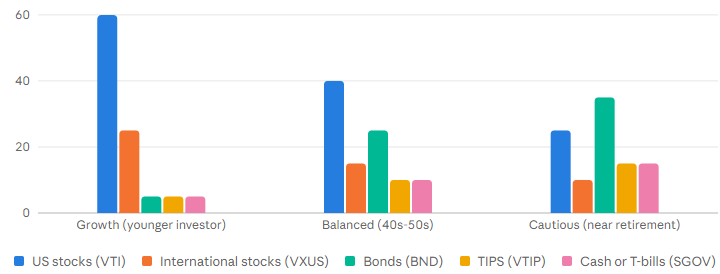
Three illustrative mixes of the same five funds (% of portfolio)
% of portfolio by Author's illustrations, not advice; each mix has a blended expense ratio of about 0.04%
What each fund pays: approximate yields (%)
Yield (%) by Midpoints of secondary-source ranges (MyETFJourney, U.S. News, Claritx, KoalaGains) and Motley Fool; yields change and are not guarantees
Why “The Only Five” Is an Honest Question
The financial industry sells complexity: thousands of funds, themes and strategies, each promising to be the one you cannot do without. So it is natural to ask the opposite question: what is the shortest list that really covers what an investor needs? People often phrase it as what Wall Street experts would say, and I want to be upfront: Wall Street does not agree on one list. What many advisers, index-fund pioneers and portfolio guides do converge on is a short menu of broad, cheap funds.This guide uses that menu with two practical additions. The famous three-fund portfolio holds US stocks, international stocks and bonds; I add inflation-protected bonds and a cash or Treasury bill fund, which cover problems the first three do not. For each fund I give the role, the cost, what the 2026 data show and the main risk, then show how to combine them. The tickers are examples, not recommendations.
The Short Answer: Five Funds
The five are a total US stock fund, a total international stock fund, a total US bond fund, a short-term inflation-protected bond fund and a cash or Treasury bill fund. Together they own thousands of securities for a blended cost of about 0.04% a year, roughly $37 to $41 per $100,000, and each does a different job: growth, diversification, ballast, inflation protection and liquidity. You do not need all five at every stage of life, and many people do well with the first three.
Why So Few Funds Work
Owning many funds is not the same as being diversified. A total market fund already holds about 3,600 US stocks and the total international fund roughly 8,000 more, so two tickers cover most of the investable stock universe. Adding a dozen more usually duplicates what you own, raises costs and makes rebalancing harder. Simplicity keeps costs low and behavior steady.The evidence for broad, cheap funds is strong. S&P Dow Jones Indices found 79% of active large-cap funds trailed the S&P 500 in 2025. Hendrik Bessembinder found the best 4.3% of stocks created all the market’s net wealth, so owning the whole market means owning the winners without finding them. And DALBAR research found the average investor earned about 6.8% a year over 30 years against 10.2% for the S&P 500, largely because of badly timed trades. Fewer funds mean fewer decisions to get wrong.
Fund 1: US Total Stock Market
The core of most portfolios is a fund that owns the entire US stock market. The Vanguard Total Stock Market ETF (VTI) holds about 3,600 to 3,700 companies, from giants to small caps, at a 0.03% expense ratio, or $30 a year on $100,000. Its yield is around 1.1% to 1.3%, and one source shows a 10-year annualized return of about 14.25% as of February 2026. The Schwab and Fidelity total-market funds are close equivalents.The role is growth. The risk is that stocks can fall sharply: US stocks have had drawdowns of 30% or more than once this century, and the index today is heavily weighted toward a handful of large technology names. With the S&P 500 up about 11.4% this year, valuations are not cheap. Size the fund to your time horizon and pair it with the others so a fall in stocks does not force you to sell.
Fund 2: International Stocks
The second fund owns everything outside the US. The Vanguard Total International Stock ETF (VXUS) holds roughly 8,000 to 8,700 stocks across developed and emerging markets, with an expense ratio of 0.05% in some sources and 0.07% in others and a yield of about 3%. Its role is diversification: the US is a large share of the world’s market value but not all of it, and leadership rotates.The 2026 numbers show why. One source reports VXUS returning about 26.8% over the year to June, while another shows its 10-year annualized return at about 8.6% against about 14.3% for VTI as of February: international led recently but lagged for a decade. Nobody knows which comes next, which is the point of owning both. Many guides suggest international stocks as roughly 20% to 40% of the stock portion, though there is no single right answer.
As of February 2026 (QuantFlowLab): 10-year annualized returns of about 14.25% for VTI, 8.55% for VXUS and 1.98% for BND. VXUS returned about 26.8% over the year to June 2026 (Claritx). Past returns do not predict future returns.
Fund 3: US Total Bond Market
Bonds are the shock absorbers. The Vanguard Total Bond Market ETF (BND) holds thousands of US investment-grade bonds, Treasuries, mortgage-backed securities and corporate bonds, for a 0.03% expense ratio. Its 30-day SEC yield was about 4.4% to 4.5% in June, according to two sources, and its 10-year annualized return was about 2.0% as of February, which reflects the long period of low rates followed by the rate rises. The role is to dampen swings and provide income.Bonds are not risk-free. When rates rise, prices fall, and the longer the maturity, the bigger the fall: ETF Beacon data as of October 27 showed Treasury funds down 1.65% for the year for one-to-three-year maturities, 4.23% for intermediate and 5.93% for longer ones. A total bond fund sits in the intermediate range, so it carries real interest-rate risk, which is why the next two funds exist. Hold bonds for stability, not as a cash substitute.
Fund 4: Inflation-Protected Bonds (TIPS)
Inflation was 3.7% in September, and an ordinary bond fund does nothing special about it. Treasury Inflation-Protected Securities adjust their principal with inflation. The Vanguard Short-Term Inflation-Protected Securities ETF (VTIP) holds TIPS with maturities under five years at a 0.03% expense ratio. Its real 30-day SEC yield was about 2.18% in one secondary source, with inflation adjustments added on top over time.A warning from the data: VTIP’s year-to-date return was 2.16% as of October 29, below inflation, because TIPS adjust with a lag and prices can fall when real yields rise. TIPS hedge sustained inflation; they do not guarantee a good year. A modest slice, perhaps 5% to 15% of a portfolio, can balance a bond fund and protect purchasing power, but the fund is optional and many investors skip it.
Fund 5: Cash and Treasury Bills
The fifth fund is the money you may need soon. The iShares 0-3 Month Treasury Bond ETF (SGOV) holds Treasury bills with a 0.09% expense ratio and showed a 30-day SEC yield of 3.73% on October 12, according to the Motley Fool. A 52-week Treasury bill yielded about 4.46% and top savings accounts 4.34% to 4.50% in October. Its role is liquidity and stability, not growth: it is where your emergency fund and near-term goals can live, earning something while staying stable.Cash is not a long-run strategy, but it is part of one. Bankrate found only 46% of Americans could cover three months of expenses, and investors without a cushion are often forced to sell stocks at bad moments. Keep your emergency fund in insured savings or a T-bill fund, separate from the other four, and top it up before you invest more. A small cash or T-bill slice inside a portfolio can also fund rebalancing without selling stocks in a downturn.
Putting the Five Together
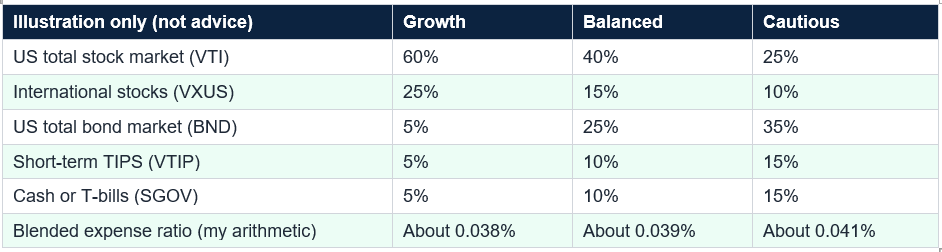
How much of each depends on your age, goals and nerves, and I cannot answer it for you, but here are three illustrations of my own: a growth-oriented younger investor might hold 60% US stocks, 25% international, 5% bonds, 5% TIPS and 5% cash; a balanced investor in their forties or fifties 40%, 15%, 25%, 10% and 10%; and a cautious investor nearing retirement 25%, 10%, 35%, 15% and 15%. Each costs about 0.04% blended.Those costs are tiny. At 0.037%, a five-fund mix costs about $37 a year on $100,000, against $640 at a 0.64% active fund, and in my illustration $500 a month for 30 years at 7% before fees grows to about $605,600 versus about $538,300, a difference of roughly $67,300. Rebalance yearly or when a fund drifts more than five points from target, and use tax-advantaged accounts first: the 2026 limits are $24,500 for a 401(k) and $7,500 for an IRA.
What You Do Not Need
Most investors can skip a long list of products. You do not need overlapping US stock funds, since an S&P 500 fund is already a large part of a total market fund. You do not need sector or thematic funds, which concentrate risk in whatever is fashionable, or leveraged and inverse funds, which are built for short-term trading and can lose money quickly. And you do not need to chase last year’s winners: NerdWallet’s data showed Dell up 163.5% over the year to October 1, which is history, not a forecast.There is a one-fund alternative as well: a target-date fund bundles stocks and bonds in one product and shifts toward bonds as the target year approaches. Its fees vary, but for people who want a single decision it can be reasonable. I describe it from general knowledge; if you invest through a 401(k), check what is available and compare costs.
Common Mistakes
The most common mistake with a simple portfolio is abandoning it: selling after a drop, buying more of whatever has risen or never rebalancing. Another is overlap, buying five funds that hold the same large companies and calling it diversification. A third is ignoring costs, since 0.64% instead of 0.03% quietly takes tens of thousands of dollars over decades, and a fourth is holding no cushion, which forces sales at the wrong time.The fix is a written plan: decide your mix, automate contributions, rebalance on a schedule and write down what you will not do in a panic. Review once or twice a year, not daily. Your age, income, goals and risk tolerance matter, and a qualified adviser can tailor the plan.
Write down which of the five you already own, what each costs and what job it does. If two do the same job, consolidate. If a job is missing, such as a cash cushion, fill that first.
Conclusion
The shortest honest answer to “the only five funds you need” is that no list is official, but five broad, cheap building blocks cover most of what an investor needs: US stocks for growth, international stocks for diversification, a total bond fund for ballast, short-term TIPS for inflation protection and cash or Treasury bills for liquidity. Together they cost about 0.04% a year, against 0.64% for a typical active fund, and the 2026 data show why each is there: international returned about 26.8% in a year but only about 8.6% a year over a decade, bonds lost ground as rates rose and TIPS trailed inflation this year.You do not need all five at once, and many people do well with three. What you do need is a plan you can hold through a 30% drop, low costs, an emergency fund and automatic contributions. The fewer the funds, the fewer the decisions, and the fewer the chances to get them wrong. This is general education, not personalized advice, and a qualified adviser can help you choose the mix that fits.
Frequently Asked Questions
Do Wall Street experts agree on five funds?No single list exists. What many advisers and index-fund advocates converge on is a short menu of broad, cheap funds, most famously the three-fund portfolio of US stocks, international stocks and bonds. The five used here add inflation-protected bonds and a cash or Treasury bill fund. They are widely used building blocks, not an official expert consensus.
Is a three-fund portfolio enough?
For many investors, yes. A total US stock fund, a total international stock fund and a total bond fund cover thousands of securities at a blended cost of roughly 0.04% a year. The extra two funds in this guide, TIPS and Treasury bills, are optional tools for inflation protection and short-term money. Fewer funds are easier to manage and harder to mess up.
Why own international stocks as well as US stocks?
Because leadership rotates. One source shows the Vanguard Total International Stock ETF returning about 26.8% over the year to June 2026, while another shows its 10-year annualized return was about 8.6% against about 14.3% for the Total Stock Market ETF as of February. Owning both means you do not have to guess which region leads next. This is general education, not personal advice.
Should I buy an S&P 500 fund as well as a total market fund?
Usually not. An S&P 500 fund is already a large part of a total US market fund, so holding both adds overlap, not diversification. Pick one for your US stock slice. Many investors choose the total market fund because it also includes mid-size and small companies.
What if my 401(k) does not offer these funds?
Look for the closest low-cost equivalents: a total or large-cap US index fund, an international index fund and a bond index fund, or a target-date fund that bundles them. Check the expense ratios, since 401(k) options vary widely, and capture any employer match first. The 2026 401(k) limit is $24,500.
0 Comments
Be the first to share your thoughts on this article.