
AI Tools
Best AI Video Platforms for Content Creators 2026

AI video generation has moved from novelty to professional tool in less than three years — and 2026 is the year the category matured. OpenAI Sora is gone, discontinued in April 2026. The landscape has reorganised around a new set of leaders: Kling 3.0 for quality-to-value, Runway Gen-4.5 for creative control, Google Veo 3.1 for cinematic quality, HeyGen for avatar-based business video, and a strong field of specialised tools for every creator use case. This guide cuts through the noise with tested, current comparisons.
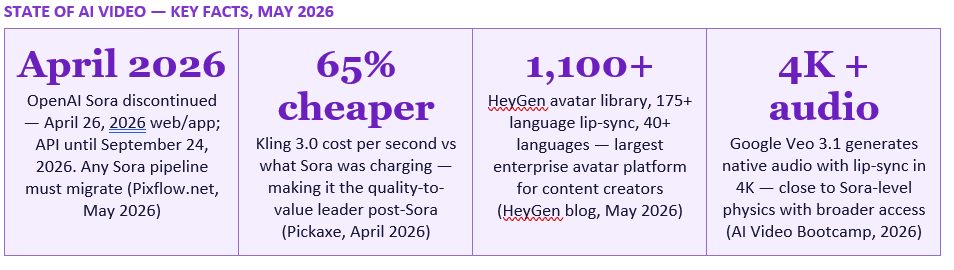
Beyond Sora's exit, the broader shift in 2026 is from short experimental clips to functional production tools. The AI Video Bootcamp's ranked analysis notes that in 2026, the industry has 'shifted from simple text-to-video clips to full-scale multimodal production suites that allow creators to generate 4K content with granular control over lighting, camera movement, and character consistency.' Three capabilities that were inconsistent or absent a year ago are now standard at the top tier: Identity Locking (keeping a character's appearance consistent across different shots from a single reference image), native audio generation with lip-sync, and camera control that allows precise pan, tilt, zoom, and dolly movements.
The market has also bifurcated clearly into two categories: generative text-to-video and image-to-video tools (Runway, Kling, Veo, Pika, Luma) and avatar-based presenter tools (HeyGen, Synthesia). These are different products serving different needs, and the guide covers both — because the best AI video platform for a corporate training team is genuinely not the same product as the best platform for a social media content creator.
With Sora 2's discontinuation in March 2026, Kling 3.0 has emerged as the quality-to-value leader. For avatar videos, HeyGen wins on features and translation. Synthesia wins on enterprise compliance. Test two or three options with your actual use case before committing.
— MINILOOP.AI — BEST AI VIDEO GENERATORS IN 2026: SORA, RUNWAY AND MORE (MAY 2026)
Generative text-to-video and image-to-video platforms (Runway, Kling, Veo, Pika, Luma) create original video footage from a written description or a reference image. The output looks like real filmed video, stylised animation, or cinematic content. These tools are best for B-roll footage, creative marketing visuals, social media content, artistic projects, and any use case where you want to generate video that looks as if it was filmed rather than recorded from a presentation. The quality has improved to the point where short clips are often indistinguishable from real footage to casual viewers.
Avatar-based presenter tools (HeyGen, Synthesia) place an AI avatar — a photorealistic digital human — in front of your script and produce a talking-head video. The output looks like a recorded presenter video. These are not generative in the same sense; they are not creating footage from nothing but assembling a scripted presentation using a customisable AI presenter. They are best for corporate training content, product explainers, multilingual marketing videos, and any use case where a credible human presenter adds value but filming a human presenter is impractical or expensive.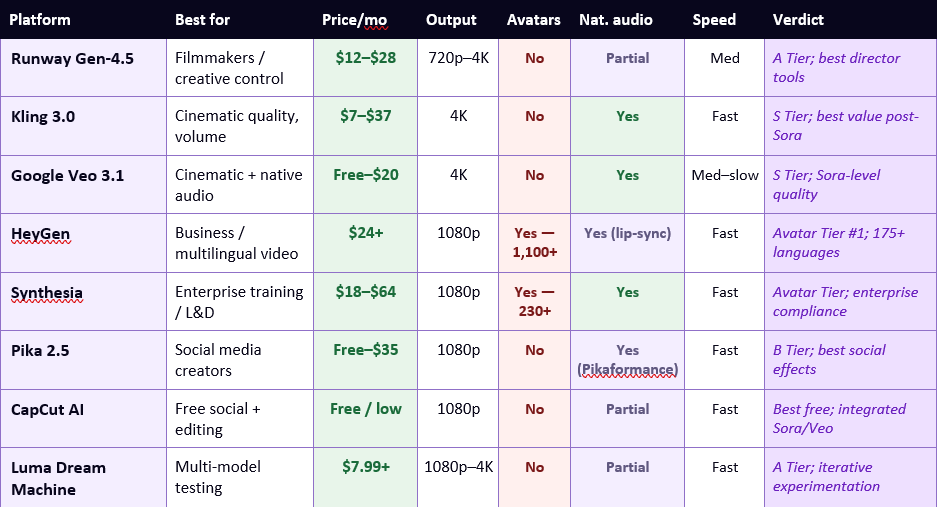
Sources: AI Video Bootcamp (2026 tier rankings), HeyGen blog (May 2026), Pickaxe (April 2026), Miniloop.ai (May 2026), Pixflow.net (May 2026), Manus.im (May 2026). Prices approximate and may vary. Always verify current pricing at provider websites.
Runway Gen-4.5 offers advanced camera controls — precise pan, tilt, zoom, and dolly movements — that allow filmmakers and video directors to specify exact cinematographic behaviour. Its Motion Brush tool lets users paint motion onto specific elements within an image, determining how individual parts of the frame move when animated. These tools have no equivalent on most competing platforms. Analytics Insight's March 2026 review notes: 'Runway processed 30-second videos in approximately 3 minutes on standard GPU settings.' Output quality is consistent and Runway is considered the reference implementation for image-to-video with reference image support.
The trade-off is that Runway is the most complex platform to learn and its pricing — $12 to $28 per month on standard paid plans — while reasonable is not the cheapest in the market. For creators who need cinematic-grade control and are willing to invest time in learning the platform, Runway remains the professional benchmark. For social media content creators who need fast, good-enough output with minimal learning curve, Kling or Pika are more appropriate.
Kling 3.0 Omni leads the market on native audio generation, offering lip-sync in five languages and a shared audio timeline across multi-shot sequences — features that Pixflow.net's May 2026 review identifies as class-leading. AI researchers including Ethan Mollick have praised Kling's output quality specifically for generating realistic human faces and movements, according to Pickaxe's testing. The platform also supports video generation up to two minutes — significantly longer than most competitors that cap at 10 to 20 seconds.
The AI Video Bootcamp places Kling 3.0 in S Tier alongside Veo 3.1, confirming 'good macro physics' with occasional limitations on small object interactions. For creators who need cinematic-quality B-roll at scale — social media content production, marketing visuals, high-volume advertising — Kling 3.0 represents the best combination of quality, capacity, speed, and cost available in May 2026.
Veo 3.1's standout feature is native audio generation in 4K resolution — it generates realistic ambient sound, dialogue, and music-style audio alongside the video, not as a separate post-production step. This represents a meaningful workflow simplification for creators producing short-form content where audio-visual synchronisation matters. Pixflow.net's May 2026 guide confirms: 'Veo 3.1 is the quality alternative when you want ultra-clean vertical output with native audio' — making it particularly suited to Instagram Reels, TikTok, and YouTube Shorts format content requiring high production quality.
Access to Veo 3.1 is available through Google's AI tools and integrations, including via platforms like CapCut that have incorporated Veo models into their free and paid tiers. For creators who want Sora-level quality without Sora's costs or its now-discontinued status, Veo 3.1 is the recommended alternative.
HeyGen's library of over 1,100 stock avatar presenters — along with the ability to create a custom avatar from a short video of yourself — covers every conceivable presenter type, style, and demographic. Its translation and lip-sync capability in 175+ languages with 40+ supported languages is particularly valuable for creators and businesses producing content for international audiences: a single English-language script can be translated and lip-synced into French, Spanish, German, Japanese, and dozens of other languages without re-recording. The AI Video Bootcamp's review names it the winner in the avatar category: 'HeyGen Avatar IV — 40+ languages, natural lip sync, up to 5-minute clips at $29/month.'
The use cases where HeyGen specifically outperforms any text-to-video tool are presenter-driven explainers (product demos, how-to guides), personalised sales outreach videos (using its personalization API to generate customised videos at scale), and multilingual content production at high volume. For YouTube content creators who appear on camera, HeyGen enables them to extend their presence to multiple language markets without filming separately in each language.
Synthesia's pricing at $18 to $64 per month on standard plans, with enterprise pricing above that, reflects its position as a professional B2B tool rather than a consumer creator platform. The template library is described by Pickaxe as 'deepest for structured training content' — covering HR onboarding, compliance training, product knowledge, and IT security awareness in prebuilt formats that accelerate production. For content creators in the enterprise training space — instructional designers, L&D professionals, internal communications teams — Synthesia is the most purpose-built and most fully featured tool available.
Pika 2.5's generation speed is a genuine advantage for high-volume social content — VibrantSnap's February 2026 review notes it is 'the fastest path from idea to video for most users,' generating clips in 10 to 15 seconds compared with Runway's 30 to 60 seconds. For TikTok, Instagram Reels, and YouTube Shorts creators who are publishing multiple short-form clips per day and need to move fast without compromising on engaging creative effects, Pika's balance of speed, creative tools, and free tier accessibility is hard to match.
CapCut's AI features go beyond simple video generation. Its suite includes AI-powered auto-captioning (with strong accuracy in multiple languages), background removal, noise suppression, auto-editing based on music tempo, and the standard text-to-video and image-to-video generation features. The combination of all these tools in a single free mobile and desktop app, without watermarks on exports, makes it the default recommendation for creators who are testing AI video for the first time or who primarily operate on a budget.
The limitation worth noting is the integration of CapCut within ByteDance's broader ecosystem — creators who have concerns about data privacy in the context of ByteDance-owned products should factor this into their decision. For pure functionality at zero cost, however, CapCut AI has no comparable free alternative in 2026.
Luma's particular strength is in stylised, mood-driven content — Manus.im's review notes it is 'strong for cinematic, stylized image-to-video exploration when mood and natural motion matter more than strict production controls.' For creators who want to explore different aesthetic approaches to a visual idea — testing the same composition in naturalistic, stylised, and animated modes to find the right look — Luma's platform allows rapid model switching that is less available on more focused competitors. It is also identified as 'best for 3D/Product' use cases in Miniloop.ai's comparison, making it relevant for product marketers who want to present products in rendered 3D-style video contexts.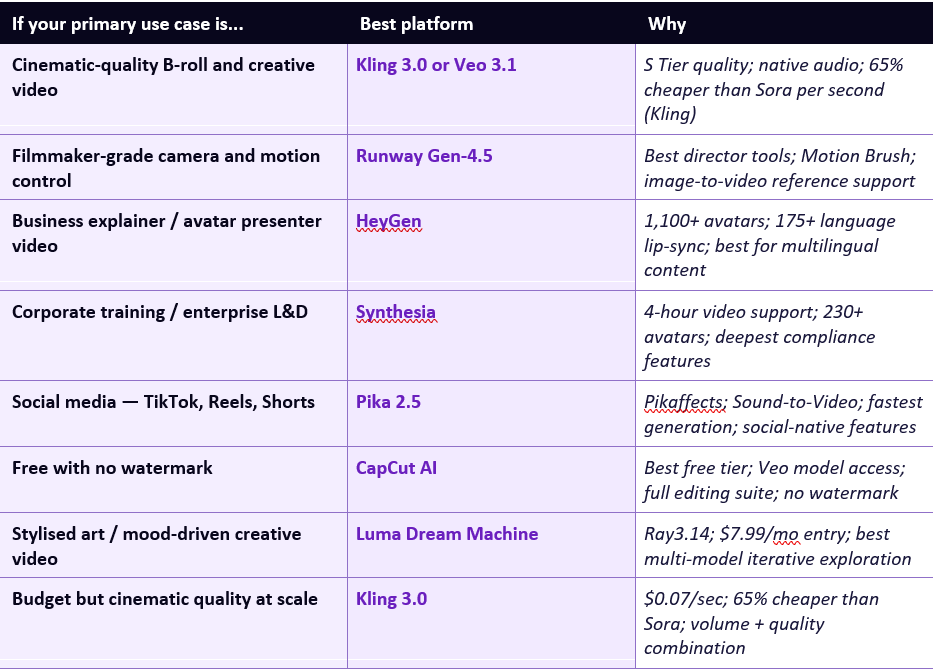
The practical advice from every testing review in this space is consistent: test before committing. Free tiers are generous enough to evaluate real production quality. The platform that produces the best results for your specific type of content — your subject matter, your aesthetic, your publishing format — is the right one for you, regardless of where it ranks in an aggregate comparison. Start with CapCut for free, trial Kling 3.0 or Pika for paid social, and evaluate Runway if you need filmmaker-level control. And check back in three months — because in AI video, the landscape in September 2026 will look meaningfully different again.
Pixflow.net — Best AI Video Generator in 2026: Runway, Veo, Seedance, Kling and More (May 2026) https://pixflow.net/blog/best-ai-video-generator/
HeyGen — Best AI Video Generators 2026: 12 Tools Tested and Ranked (May 2026) https://www.heygen.com/blog/best-ai-video-generators-tested-and-reviewed
Pickaxe — Top 12 AI Video Generators in 2026 (Tested and Compared) (April 2026) https://pickaxe.co/post/top-ai-video-generators
Miniloop.ai — Best AI Video Generators in 2026: Sora, Runway and More (May 2026) https://www.miniloop.ai/blog/best-ai-video-generators-2026
Pixteller — AI Video Generators Ranked: 7 Best Platforms for 2026 (May 2026) https://pixteller.com/blog/ai-video-generators-ranked-7-best-platforms-for-2026-555
Analytics Insight — Best AI Video Generation Platforms in 2026: In-Depth Review (March 2026) https://www.analyticsinsight.net/artificial-intelligence/best-ai-video-generation-platforms-in-2026-in-depth-review
TABLE OF CONTENTS
- The 2026 AI Video Landscape: What Changed
- How to Read This Guide: Two Types of AI Video Tool
- The Full Comparison: All Eight Platforms Side-by-Side
- Platform 1: Runway Gen-4.5 — Best for Filmmakers and Creative Control
- Platform 2: Kling 3.0 — Best Quality-to-Value After Sora
- Platform 3: Google Veo 3.1 — Best Cinematic Quality
- Platform 4: HeyGen — Best for Avatar-Based Business Video
- Platform 5: Synthesia — Best for Enterprise and Training
- Platform 6: Pika 2.5 — Best for Social Media Creators
- Platform 7: CapCut AI — Best Free Option
- Platform 8: Luma Dream Machine — Best for Multi-Model Experimentation
- How to Choose: A Use-Case Decision Framework
- What to Look for Before You Subscribe
- Conclusion
- Frequently Asked Questions
- References
The 2026 AI Video Landscape: What Changed
The AI video market in 2026 looks meaningfully different from even six months ago. The single biggest change is the discontinuation of OpenAI Sora. OpenAI announced in March 2026 that the Sora web and app experiences would be discontinued on April 26, 2026, with the API following on September 24, 2026. According to Pixflow.net's May 2026 analysis: 'Any production pipeline that depends on Sora should plan a migration to Veo, Kling, Runway, or Seedance.' Sora's departure has reshuffled the market and created a clear new quality-to-value leader in Kling 3.0.Beyond Sora's exit, the broader shift in 2026 is from short experimental clips to functional production tools. The AI Video Bootcamp's ranked analysis notes that in 2026, the industry has 'shifted from simple text-to-video clips to full-scale multimodal production suites that allow creators to generate 4K content with granular control over lighting, camera movement, and character consistency.' Three capabilities that were inconsistent or absent a year ago are now standard at the top tier: Identity Locking (keeping a character's appearance consistent across different shots from a single reference image), native audio generation with lip-sync, and camera control that allows precise pan, tilt, zoom, and dolly movements.
The market has also bifurcated clearly into two categories: generative text-to-video and image-to-video tools (Runway, Kling, Veo, Pika, Luma) and avatar-based presenter tools (HeyGen, Synthesia). These are different products serving different needs, and the guide covers both — because the best AI video platform for a corporate training team is genuinely not the same product as the best platform for a social media content creator.
With Sora 2's discontinuation in March 2026, Kling 3.0 has emerged as the quality-to-value leader. For avatar videos, HeyGen wins on features and translation. Synthesia wins on enterprise compliance. Test two or three options with your actual use case before committing.
— MINILOOP.AI — BEST AI VIDEO GENERATORS IN 2026: SORA, RUNWAY AND MORE (MAY 2026)
How to Read This Guide: Two Types of AI Video Tool
Before comparing specific platforms, it is useful to understand the two fundamentally different types of AI video tool covered in this guide, because the best choice for your use case depends on which category you actually need.Generative text-to-video and image-to-video platforms (Runway, Kling, Veo, Pika, Luma) create original video footage from a written description or a reference image. The output looks like real filmed video, stylised animation, or cinematic content. These tools are best for B-roll footage, creative marketing visuals, social media content, artistic projects, and any use case where you want to generate video that looks as if it was filmed rather than recorded from a presentation. The quality has improved to the point where short clips are often indistinguishable from real footage to casual viewers.
Avatar-based presenter tools (HeyGen, Synthesia) place an AI avatar — a photorealistic digital human — in front of your script and produce a talking-head video. The output looks like a recorded presenter video. These are not generative in the same sense; they are not creating footage from nothing but assembling a scripted presentation using a customisable AI presenter. They are best for corporate training content, product explainers, multilingual marketing videos, and any use case where a credible human presenter adds value but filming a human presenter is impractical or expensive.
The Full Comparison: All Eight Platforms Side-by-Side
Sources: AI Video Bootcamp (2026 tier rankings), HeyGen blog (May 2026), Pickaxe (April 2026), Miniloop.ai (May 2026), Pixflow.net (May 2026), Manus.im (May 2026). Prices approximate and may vary. Always verify current pricing at provider websites.
Platform 1: Runway Gen-4.5 — Best for Filmmakers and Creative Control
Runway is the platform most frequently described as the best option for creators who want granular control over their video output — precise camera movement, style consistency across shots, and advanced motion control that other platforms cannot match. Manus.im's tested review calls it 'best overall' for its 'unparalleled balance of creative control, high-quality output, and advanced features,' and the AI Video Bootcamp places it in A Tier.Runway Gen-4.5 offers advanced camera controls — precise pan, tilt, zoom, and dolly movements — that allow filmmakers and video directors to specify exact cinematographic behaviour. Its Motion Brush tool lets users paint motion onto specific elements within an image, determining how individual parts of the frame move when animated. These tools have no equivalent on most competing platforms. Analytics Insight's March 2026 review notes: 'Runway processed 30-second videos in approximately 3 minutes on standard GPU settings.' Output quality is consistent and Runway is considered the reference implementation for image-to-video with reference image support.
The trade-off is that Runway is the most complex platform to learn and its pricing — $12 to $28 per month on standard paid plans — while reasonable is not the cheapest in the market. For creators who need cinematic-grade control and are willing to invest time in learning the platform, Runway remains the professional benchmark. For social media content creators who need fast, good-enough output with minimal learning curve, Kling or Pika are more appropriate.
Platform 2: Kling 3.0 — Best Quality-to-Value After Sora
Kling 3.0, developed by Chinese AI company Kuaishou, has emerged as the strongest overall value proposition in the AI video market after Sora's discontinuation. Pickaxe's April 2026 analysis quantifies the advantage: 'At $0.07 per second of generated video, Kling is 65% cheaper than what Sora was charging and 44% cheaper than Runway. For high-volume social media production where you need quantity alongside quality, Kling is hard to beat.'Kling 3.0 Omni leads the market on native audio generation, offering lip-sync in five languages and a shared audio timeline across multi-shot sequences — features that Pixflow.net's May 2026 review identifies as class-leading. AI researchers including Ethan Mollick have praised Kling's output quality specifically for generating realistic human faces and movements, according to Pickaxe's testing. The platform also supports video generation up to two minutes — significantly longer than most competitors that cap at 10 to 20 seconds.
The AI Video Bootcamp places Kling 3.0 in S Tier alongside Veo 3.1, confirming 'good macro physics' with occasional limitations on small object interactions. For creators who need cinematic-quality B-roll at scale — social media content production, marketing visuals, high-volume advertising — Kling 3.0 represents the best combination of quality, capacity, speed, and cost available in May 2026.
Platform 3: Google Veo 3.1 — Best Cinematic Quality
Google Veo 3.1, available through Google's AI offerings and integrated into some third-party platforms, is the closest replacement for Sora's physics-accurate, cinematic output quality. The AI Video Bootcamp's testing places Veo 3.1 in S Tier alongside Kling 3.0, and notes it as 'close second' on physics accuracy: 'Occasional drift in complex multi-object scenes' but otherwise delivering benchmark-quality outputs. Miniloop.ai's May 2026 analysis recommends it as the top choice for 'quality-first' use cases.Veo 3.1's standout feature is native audio generation in 4K resolution — it generates realistic ambient sound, dialogue, and music-style audio alongside the video, not as a separate post-production step. This represents a meaningful workflow simplification for creators producing short-form content where audio-visual synchronisation matters. Pixflow.net's May 2026 guide confirms: 'Veo 3.1 is the quality alternative when you want ultra-clean vertical output with native audio' — making it particularly suited to Instagram Reels, TikTok, and YouTube Shorts format content requiring high production quality.
Access to Veo 3.1 is available through Google's AI tools and integrations, including via platforms like CapCut that have incorporated Veo models into their free and paid tiers. For creators who want Sora-level quality without Sora's costs or its now-discontinued status, Veo 3.1 is the recommended alternative.
Platform 4: HeyGen — Best for Avatar-Based Business Video
HeyGen is the leading platform for AI avatar-based video creation — a category that is genuinely distinct from text-to-video generation and serves a different creator population. The HeyGen blog's tested review (May 2026) places it first in overall business use: 'It combines avatar-driven video creation, 175+ language translation with lip sync, Video Agent automation, and pricing that starts at $24/month.'HeyGen's library of over 1,100 stock avatar presenters — along with the ability to create a custom avatar from a short video of yourself — covers every conceivable presenter type, style, and demographic. Its translation and lip-sync capability in 175+ languages with 40+ supported languages is particularly valuable for creators and businesses producing content for international audiences: a single English-language script can be translated and lip-synced into French, Spanish, German, Japanese, and dozens of other languages without re-recording. The AI Video Bootcamp's review names it the winner in the avatar category: 'HeyGen Avatar IV — 40+ languages, natural lip sync, up to 5-minute clips at $29/month.'
The use cases where HeyGen specifically outperforms any text-to-video tool are presenter-driven explainers (product demos, how-to guides), personalised sales outreach videos (using its personalization API to generate customised videos at scale), and multilingual content production at high volume. For YouTube content creators who appear on camera, HeyGen enables them to extend their presence to multiple language markets without filming separately in each language.
Platform 5: Synthesia — Best for Enterprise Training and L&D
Synthesia occupies the enterprise end of the avatar video market, distinguished from HeyGen by its focus on compliance, governance, and the specific needs of Learning and Development (L&D) teams in large organisations. Manus.im's review is definitive: 'Synthesia is the undisputed leader for creating professional, avatar-based videos for corporate training and communication.' Its library of 230+ avatars, its support for video lengths up to four hours (vs HeyGen's five-minute limit on standard plans), and its compliance-grade features make it the default recommendation for enterprise L&D.Synthesia's pricing at $18 to $64 per month on standard plans, with enterprise pricing above that, reflects its position as a professional B2B tool rather than a consumer creator platform. The template library is described by Pickaxe as 'deepest for structured training content' — covering HR onboarding, compliance training, product knowledge, and IT security awareness in prebuilt formats that accelerate production. For content creators in the enterprise training space — instructional designers, L&D professionals, internal communications teams — Synthesia is the most purpose-built and most fully featured tool available.
Platform 6: Pika 2.5 — Best for Social Media Creators
Pika has carved out a distinctive position in the AI video market through its focus on creative effects and social media-native features rather than pure visual realism. eWeek highlighted in May 2026 that Pika's 'Sound-to-Video' feature allows the AI to sync character movements with an uploaded audio track — making it valuable for music video and social content where rhythm matters. This was confirmed by the AI Video Bootcamp's 2026 guide, which rates it in B Tier on pure generative quality but identifies it as 'strongest pick for social creators thanks to Pikaffects, Pikaswaps, Pikadditions, and Pikaformance lip-sync.'Pika 2.5's generation speed is a genuine advantage for high-volume social content — VibrantSnap's February 2026 review notes it is 'the fastest path from idea to video for most users,' generating clips in 10 to 15 seconds compared with Runway's 30 to 60 seconds. For TikTok, Instagram Reels, and YouTube Shorts creators who are publishing multiple short-form clips per day and need to move fast without compromising on engaging creative effects, Pika's balance of speed, creative tools, and free tier accessibility is hard to match.
Platform 7: CapCut AI — Best Free Option
CapCut AI, owned by ByteDance (TikTok's parent company), is the strongest free option in the AI video space for 2026. Pickaxe's April 2026 guide recommends it specifically for 'social media content (especially with that free tier),' and importantly notes that it has integrated Sora 2 and Veo models before or alongside the broader market shift — making access to these generation models available at the free tier for creators who cannot justify paid subscriptions.CapCut's AI features go beyond simple video generation. Its suite includes AI-powered auto-captioning (with strong accuracy in multiple languages), background removal, noise suppression, auto-editing based on music tempo, and the standard text-to-video and image-to-video generation features. The combination of all these tools in a single free mobile and desktop app, without watermarks on exports, makes it the default recommendation for creators who are testing AI video for the first time or who primarily operate on a budget.
The limitation worth noting is the integration of CapCut within ByteDance's broader ecosystem — creators who have concerns about data privacy in the context of ByteDance-owned products should factor this into their decision. For pure functionality at zero cost, however, CapCut AI has no comparable free alternative in 2026.
Platform 8: Luma Dream Machine — Best for Multi-Model Experimentation
Luma Dream Machine, now running on the Ray3.14 model, occupies a distinctive position as a platform optimised for iterative experimentation across multiple generation styles. AI Video Bootcamp places it in A Tier with Runway Gen-4.5, and Pickaxe recommends it for 'iterative multi-model experimentation.' The Ray3.14 Lite tier at $7.99/month is one of the lowest entry prices for genuinely quality AI video generation.Luma's particular strength is in stylised, mood-driven content — Manus.im's review notes it is 'strong for cinematic, stylized image-to-video exploration when mood and natural motion matter more than strict production controls.' For creators who want to explore different aesthetic approaches to a visual idea — testing the same composition in naturalistic, stylised, and animated modes to find the right look — Luma's platform allows rapid model switching that is less available on more focused competitors. It is also identified as 'best for 3D/Product' use cases in Miniloop.ai's comparison, making it relevant for product marketers who want to present products in rendered 3D-style video contexts.
How to Choose: A Use-Case Decision Framework
What to Look for Before You Subscribe
Five things to check before committing to an AI video platform
- Commercial use rights on your plan tier: Most AI video platforms restrict commercial use to paid plans. Free tiers often do not grant commercial rights to the generated content. If you are creating content for a client, a brand, or any monetised channel, verify explicitly that your plan tier includes commercial licensing before generating content you intend to sell or publish commercially.
- Video length limits: Most platforms cap video generation at 5 to 20 seconds per clip. Kling 3.0 is the standout exception with support for up to two-minute clips. Synthesia supports up to four-hour videos for training content. If your use case requires longer videos, match this requirement against the platform's limits before subscribing.
- Credit usage and burn rate: Several platforms charge by credit rather than by flat subscription, and credits deplete faster than new users expect. Pixteller's May 2026 review notes that 'a single 8-second video can consume over 25 credits, and users on standard plans report running through their monthly allowance after just a few generations.' Calculate your expected monthly video volume and map it against the plan's credit allocation before subscribing.
- Identity consistency across shots: If your content requires the same character or person to appear consistently across multiple clips — essential for narrative content, branded characters, or presenter-style content — verify that the platform supports Identity Locking with a reference image. This is now a standard feature at the top tier (Kling 3.0, Runway Gen-4.5) but absent or inconsistent on some lower-tier tools.
- The speed of platform change: The AI video market is moving faster than almost any other software category. Pickaxe's April 2026 guide warns: 'It's a reminder that the AI video space is moving incredibly fast. Tools that are dominant today might not exist tomorrow, and new entrants keep raising the bar.' Test two or three platforms with your actual production workflow on a short free trial or monthly subscription before committing to an annual plan.
CONCLUSION
The AI video platform market in May 2026 is more capable, more competitive, and more confusing than it has ever been. Sora's departure has created real redistribution at the top: Kling 3.0 and Veo 3.1 are the new quality leaders for generative content, Runway Gen-4.5 remains the professional standard for creative control, and HeyGen and Synthesia continue to dominate the avatar-based business video category they created. For most content creators, the choice comes down to use case first: generative B-roll or avatar presenter; social media or cinematic; budget or professional.The practical advice from every testing review in this space is consistent: test before committing. Free tiers are generous enough to evaluate real production quality. The platform that produces the best results for your specific type of content — your subject matter, your aesthetic, your publishing format — is the right one for you, regardless of where it ranks in an aggregate comparison. Start with CapCut for free, trial Kling 3.0 or Pika for paid social, and evaluate Runway if you need filmmaker-level control. And check back in three months — because in AI video, the landscape in September 2026 will look meaningfully different again.
Frequently Asked Questions
Is OpenAI Sora still available in 2026?
No. OpenAI announced in March 2026 that the Sora web and app experience would be discontinued on April 26, 2026, with the Sora API following on September 24, 2026. As Pixflow.net's May 2026 guide states: 'Any production pipeline that depends on Sora should plan a migration to Veo, Kling, Runway, or Seedance.' Sora 2 is available through ChatGPT Plus ($20/month) and higher tiers according to AI Video Bootcamp, but the standalone Sora product and the primary API access that many creators relied on are being phased out. Kling 3.0 is the most commonly recommended post-Sora quality-to-value replacement, with Veo 3.1 as the closest alternative on pure cinematic quality.What is the best AI video generator for content creators in 2026?
The best AI video generator depends on your use case. For cinematic quality at the best cost: Kling 3.0 (S Tier, AI Video Bootcamp; 65% cheaper per second than Sora, Pickaxe April 2026). For maximum creative and camera control: Runway Gen-4.5 (A Tier; best director tools and Motion Brush). For Google's cinematic quality with native audio: Veo 3.1 (S Tier; 4K + native audio generation). For social media content: Pika 2.5 (fastest generation; Pikaffects; Sound-to-Video). For avatar-based business video: HeyGen (1,100+ avatars; 175+ language lip-sync). For free use with no watermark: CapCut AI (Veo model access included). Manus.im's tested recommendation is Runway Gen-4.5 as 'best overall' for creative control, with Kling 3.0 as 'best for realism' and Synthesia as 'best for business.'What AI video platforms offer a free tier in 2026?
Several AI video platforms offer meaningful free tiers in 2026. CapCut AI is the most generous — it provides no-watermark exports, integrated Sora and Veo model access, and a full editing suite at no cost, making it the strongest free option for social media creators. Pika 2.5 offers a free tier that AI Video Bootcamp identifies as 'genuinely useful for testing and light use.' Kling 3.0 and Luma Dream Machine also offer free tiers with limited credits. Runway provides a free trial. HeyGen and Synthesia offer limited free access for testing. Veo 3.1 is accessible for free through some Google AI integrations and through CapCut. For paid professional use, most creators will want a $10 to $30 per month subscription — Luma Dream Machine's Ray3.14 Lite at $7.99 per month is the lowest-cost entry to genuine paid-tier quality.What is Identity Locking and which platforms support it?
Identity Locking is the ability to maintain a consistent character appearance across multiple different video shots, generated from a single reference image. Without Identity Locking, AI video generators typically produce a different-looking face or character for each clip, making multi-shot storytelling impossible. AI Video Bootcamp's 2026 analysis describes it as a 'standard feature' that 'has become essential in 2026': 'By uploading a single reference image, users can generate 50 different shots of the same person in different environments.' The platforms with the strongest Identity Locking implementations in 2026 are Kling 3.0 and Runway Gen-4.5 among generative tools, and HeyGen and Synthesia among avatar tools (which maintain identity through their avatar library rather than reference images).What is the difference between HeyGen and Synthesia?
Both HeyGen and Synthesia are AI avatar video platforms — they create talking-head presenter videos using AI digital humans rather than generating footage from scratch. The key differences are scale, feature focus, and audience. HeyGen leads on multilingual capability (175+ language translation with natural lip-sync, 40+ supported languages) and is better suited to marketing content, personalised outreach video, and social creators who want a professional presenter. Synthesia leads on enterprise compliance, longer video support (up to four hours vs HeyGen's five-minute standard plan limit), and Learning and Development template depth. The AI Video Bootcamp's review summarises it as: 'HeyGen wins on features and translation. Synthesia wins on enterprise compliance.' Both start around $24 to $29 per month for standard plans.References
AI Video Bootcamp — Best AI Video Generators Ranked 2026: The Definitive Comparison (May 2026) https://aivideobootcamp.com/blog/ai-video-generators-ranked-2026/Pixflow.net — Best AI Video Generator in 2026: Runway, Veo, Seedance, Kling and More (May 2026) https://pixflow.net/blog/best-ai-video-generator/
HeyGen — Best AI Video Generators 2026: 12 Tools Tested and Ranked (May 2026) https://www.heygen.com/blog/best-ai-video-generators-tested-and-reviewed
Pickaxe — Top 12 AI Video Generators in 2026 (Tested and Compared) (April 2026) https://pickaxe.co/post/top-ai-video-generators
Miniloop.ai — Best AI Video Generators in 2026: Sora, Runway and More (May 2026) https://www.miniloop.ai/blog/best-ai-video-generators-2026
Pixteller — AI Video Generators Ranked: 7 Best Platforms for 2026 (May 2026) https://pixteller.com/blog/ai-video-generators-ranked-7-best-platforms-for-2026-555
Analytics Insight — Best AI Video Generation Platforms in 2026: In-Depth Review (March 2026) https://www.analyticsinsight.net/artificial-intelligence/best-ai-video-generation-platforms-in-2026-in-depth-review
0 Comments
Be the first to share your thoughts on this article.