
Credits
Credit Card Traps to Avoid In Holiday Season.
Holiday spending is expected to surpass $1 trillion for the first time in 2025. 21% of US adults borrowed to cover 2025 Christmas expenses. Average holiday debt hit $1,223 per person — and 70% of credit card users planned to carry that balance into 2026. Store cards charge up to 30.45% APR. Deferred interest plans can add $430 to a $2,500 purchase retroactively. BNPL debt is building up invisibly across multiple apps. This guide names every trap, shows you the real cost, and tells you exactly how to avoid each one.

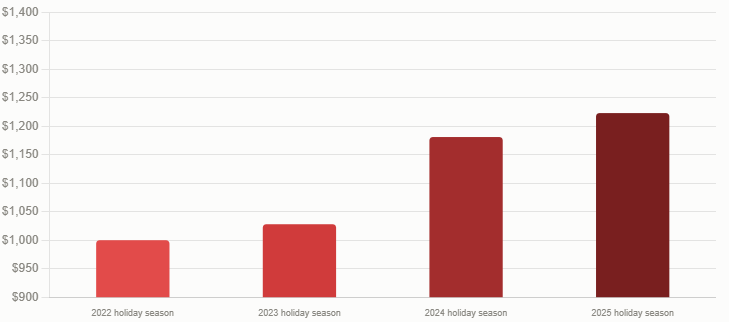
The scale of the cycle is growing. The 2025 holiday season was expected to produce retail sales surpassing $1 trillion for the first time (CNBC, December 2025). According to a LendingTree survey of 2,032 US consumers, average holiday debt for 2025 rose to $1,223 per person. 21% of US adults borrowed money specifically for their 2025 Christmas expenses (YouGov, January 2026). And they did so into a consumer debt environment already at historic levels: average credit card balance per consumer was $6,523 as of Q3 2025 (TransUnion), and total US credit card debt reached $1.17 trillion (Federal Reserve Bank of New York).
The debt itself is only part of the cost. The traps embedded in the credit products used to finance holiday spending — deferred interest store cards, minimum payment structures, BNPL stacking, credit utilisation spikes — ensure that what was spent in December is paid for at rates many consumers did not notice or understand. This guide identifies every major credit card trap in the holiday spending cycle, explains the real cost of each, and gives you the specific tools to avoid them.
Record holiday retail sales: expected $1 trillion+ in 2025 (CNBC Dec 2025). Average holiday debt 2025: $1,223/person (LendingTree Dec 2025). 21% of US adults borrowed for 2025 Christmas (YouGov Jan 2026). 70% planned to carry holiday balance into 2026; 18% still paying in June 2026+ (Affirm/Talker Research Nov 2025). 31% of 2024 holiday credit card users still hadn't paid off by Nov 2025 (NerdWallet Dec 2025). Store card average APR: 30.45% record high (Bankrate Sep 2025). Total US credit card debt: $1.17 trillion (NY Fed Q3 2024).
Of particular concern is who is borrowing. Only 44% of those who took on holiday debt in 2024 had actually planned to (LendingTree, December 2024). The other 56% went into debt without intending to. Parents of young children were the most likely to take on unplanned holiday debt, with 48% doing so. Among those who did incur debt, 60% were stressed about it and 42% regretted spending as much as they did — yet the average amount rose again the following year.
The YouGov survey of 1,262 US adults (January 12–13, 2026) found that 21% of US adults borrowed for their 2025 Christmas expenses. Of those who borrowed, 77% did so for gifts, 38% for food and drink, and 32% to cover everyday bills during the holiday period — meaning a significant number of holiday borrowers were using credit not to fund celebration but to cover routine expenses that their cash flow could not support.
The NerdWallet December 2025 holiday spending report added the crucial persistence statistic: 31% of 2024 holiday credit card users still had not paid off their balances by November 2025 — meaning they entered the 2025 holiday season already carrying debt from the previous one. Bankrate senior industry analyst Ted Rossman put it directly (Marketplace.org, November 2025): ‘The problem is that a lot of people already have a lot of credit card debt. Just think about how much everything else in our lives has gone up. Your rent payment is up, your grocery bill is up, utilities, insurance — all these other things. There will be less fat to trim in household budgets come January, so it could take longer to catch up.’
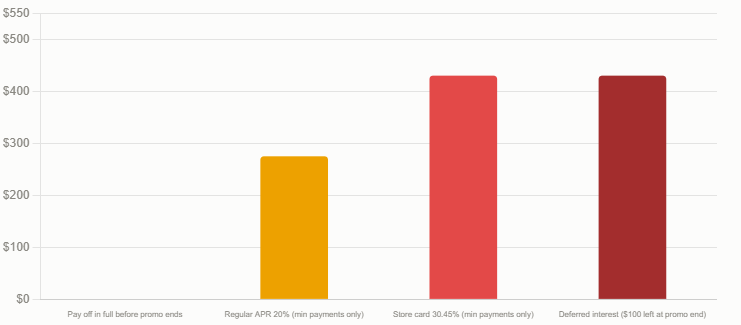
The National Consumer Law Center (NCLC) published a specific example in November 2025: ‘If a consumer buys a $2,500 laptop on November 29, 2025, using a one-year 31% APR deferred interest plan, then pays off all but $100 by November 29, 2026, the lender will add to the next bill about $430 in interest on the entire $2,500 dating back one year.’ The consumer paid off $2,400 of the $2,500. They had $100 remaining. They owe $430 in retroactive interest on the full $2,500.
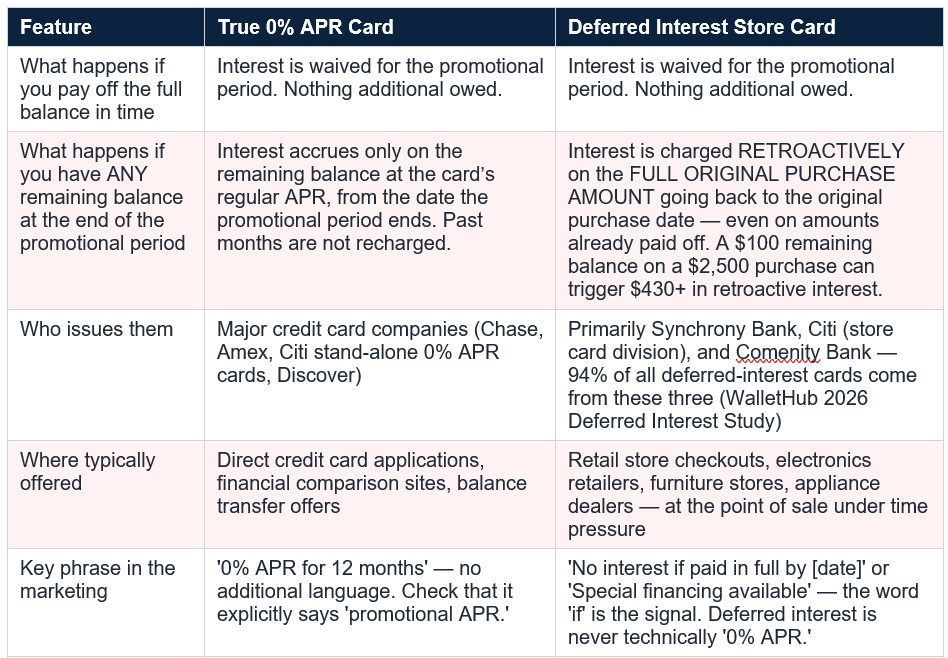
This is the defining feature of deferred interest that makes it categorically different from a true 0% APR offer. With a true 0% APR card, interest is waived during the promotional period — if the balance is not paid off, interest accrues only on the remaining balance from that point forward. With deferred interest, the interest has always been accruing in the background; it is simply not billed until the promotional period ends. The distinction is buried in the fine print.
WalletHub’s 2026 Deferred Interest Study (November 2025) found that 94% of all deferred-interest credit cards are issued by just three banks: Synchrony, Citi, and Comenity — meaning most retail store card financing goes through this narrow system. Store card APRs averaged a record 30.45% in September 2025 (Bankrate, cited NBC News January 2025). Bankrate senior analyst Ted Rossman on the Consumerpedia podcast: ‘There are a lot of gotchas with store cards. You really need to be careful at the checkout counter.’
Avoid any 'no interest' or 'special financing' store credit card offer at checkout unless you can confirm in writing that it is a true 0% APR (not deferred interest) AND you are certain you can pay off the entire balance — to zero — before the promotional period ends. Even $0.01 remaining at the end of the period triggers the full retroactive interest charge. If you cannot guarantee both conditions, do not sign up. Use a standard credit card instead, or pay cash.
The mathematics of minimum payments on high-interest credit card debt are unambiguous and alarming. On a $1,223 balance (the 2025 average holiday debt) at the average credit card APR of 22.15% for revolving balances (Federal Reserve G.19 Q2 2026), making only the typical minimum payment of approximately 2% of the balance or $25 (whichever is greater) results in: approximately $785 in total interest paid before the balance is cleared, and approximately 5–6 years to pay off a single season’s holiday debt.
LendingTree’s December 2024 survey found that 20% of holiday debtors were making only minimum payments. 21% expected it would take five months or longer to pay off. The ConsumerCredit.com analysis (January 2026) explains the structural dynamic: ‘Any unpaid balance carries over from month to month, meaning your debt doesn’t disappear just because the holidays are over.’ And at store card rates of 30.45%, the minimum payment trap is even more acute.
Calculate the true cost of your holiday balance before January. The Credit Card Repayment Calculator at consumer.gov or any credit card issuer's website shows exactly how long payoff takes and total interest costs at minimum payments vs. higher fixed monthly payments. A commitment to paying $100/month on a $1,200 balance at 22% APR clears the debt in approximately 14 months and costs around $155 in interest. The same balance at minimum payments could take 5+ years and cost $785+. The difference is one decision made in January.
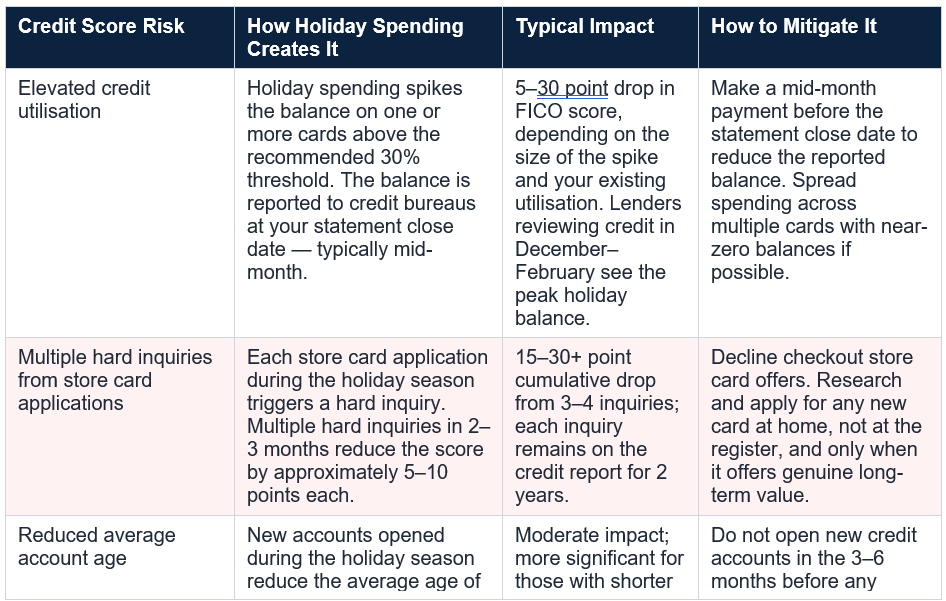
Opening new credit accounts during the holiday season affects your credit score through two simultaneous mechanisms. First, each credit card application triggers a hard inquiry — a record of a credit application that remains on your credit report for two years and reduces your credit score by approximately 5–10 points per inquiry. Multiple hard inquiries in a short period compound the impact. Second, new accounts reduce the average age of your credit accounts, which is a significant factor in credit scoring models — the longer your average account history, the better for your score.
The trade-off is almost always unfavourable. A 15% discount on a $200 purchase saves $30. The same store card at 30.45% APR charges $30 in interest in approximately one month on a $1,200 holiday balance. The discount is consumed by a single month’s interest charge on debt that takes five years to clear at minimum payments. For most shoppers, the net financial effect of accepting checkout discounts is negative.
Example: A 2025 real-world pattern observed by consumer finance advocates: shoppers who open three or four store cards between Black Friday and Christmas for the signup discounts can see their credit score drop 30–50 points from the combination of hard inquiries and reduced average account age. The drop can affect mortgage applications, auto loan rates, and apartment rental approvals for the following 12–24 months. The cumulative cost of the reduced credit score can far exceed the cumulative discounts received.
Politely decline store credit card offers at checkout. A simple 'No thank you' is sufficient — no explanation required. If a store card genuinely offers long-term value (a retailer you shop at frequently with no-fee rewards), research it at home before applying, not at a crowded checkout counter in December. Never open a credit card for a one-time discount.
Credit utilisation — the percentage of your available revolving credit that you are using at any given time — is one of the most heavily weighted factors in credit scores, typically accounting for approximately 30% of a FICO score. The generally recommended maximum is 30% of available credit; below 10% is considered excellent. Holiday spending routinely pushes utilisation well above 30% for consumers who do not have high credit limits or who have already been carrying balances.
The ccfcu.org December 2025 holiday debt guide notes: ‘Credit card balances tend to spike during the holidays, and if you’re not able to pay off these balances in full, it can negatively affect your score in several ways — credit utilisation being one of the first areas where holiday debt can make an impact.’ The timing matters: if your card issuer reports your balance to credit bureaus in mid-December (when holiday spending is at its peak), that high-utilisation snapshot is what credit bureaus see — even if you pay it down in January.
Track your credit utilisation in real time during the holiday season using your card issuer's app or a free credit monitoring tool. If you anticipate significant holiday spending, consider making a mid-month payment before your statement closes — before the balance is reported to credit bureaus. Spreading holiday spending across multiple cards (if you have them and they already have balances near zero) can also lower the utilisation on any single card. And if you receive a large refund or bonus in January, prioritise paying down balances before buying anything else.
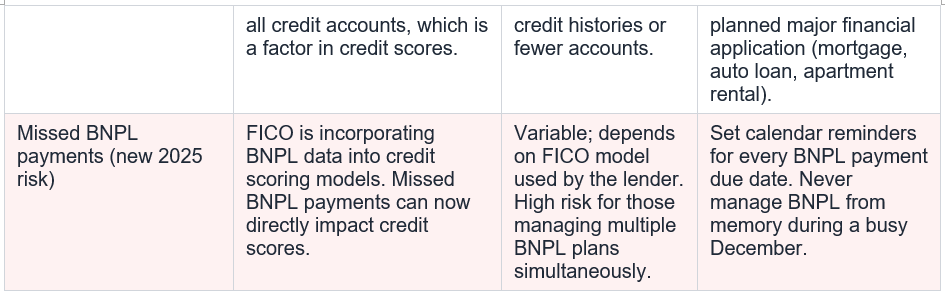
BNPL services spent $18.2 billion in online holiday purchases in November–December 2024, up from $16.6 billion in 2023 and $14.5 billion in 2022 — the trajectory is consistently upward (Adobe Analytics; NBC News, January 2025). About 18% of 2025 holiday shoppers planned to use BNPL for gift purchases (NerdWallet, December 2025). At the same time, FICO announced it would begin incorporating BNPL data into some credit score models, meaning missed BNPL payments could now directly affect credit scores.
The specific risk of BNPL during the holiday season is stacking: holding multiple simultaneous plans with different providers and different payment schedules. The NCLC warned in November 2025: ‘Managing several BNPL plans at once can be equally hazardous. With different due dates across multiple providers, shoppers may inadvertently trigger overdraft or nonsufficient-fund fees, compounding their financial strain.’ Bankrate analyst Ted Rossman: ‘You may feel like it’s $20 here, $50 there, or $100 there, but buy now, pay later can add up.’
Additionally, while standard BNPL plans (typically ‘pay in four’ over six weeks) are genuinely interest-free if paid on time, BNPL has expanded into longer-term products. As KOMO News reported in November 2025: ‘BNPL loans for big-ticket items can last six months or longer and come with credit-card-like interest rates of 15 to 20 percent or higher.’ The interest-free assumption does not apply to all BNPL products.
Before using BNPL during the holiday season: (1) list every active BNPL plan and upcoming payment on a single piece of paper or spreadsheet — total the committed monthly BNPL payment across all plans; (2) if the total BNPL payment, added to your existing bills, exceeds what you can reliably cover with your income, do not add another; (3) set calendar reminders for each due date to avoid missed payment fees and credit score damage; (4) treat BNPL as debt — because it is — not as 'free money with time to pay.'
The LendingTree data is unambiguous on unplanned holiday debt: only 44% of 2024 holiday debtors had planned to take on debt. The other 56% exceeded their own intentions without a firm prior plan. A holiday budget that exists as a number in your head rather than a written list of specific recipients, specific gift amounts, and a running total is not a budget — it is an aspiration, and aspirations do not constrain spending.
A written holiday budget performs three specific functions that a mental one does not. First, it creates a hard cap for total spending that is visible and testable throughout the season. Second, it distributes the total across specific items so you can track progress in real time. Third, it prevents gift creep — the gradual addition of presents, extras, and impulse additions that are individually small and collectively significant.
Consumer finance research consistently finds that the gap between intended and actual spending is largest in categories with high emotional salience and high social pressure — gift-giving is both. NerdWallet’s 2025 holiday spending report found that 74% of holiday shoppers expected tariffs to increase prices, yet most were still planning to spend similar amounts — meaning the budget was expected to absorb higher prices without reducing quantities, which is only possible with debt.
Before November 1st, write a holiday budget in the following format: (1) list every person you plan to buy for; (2) assign a specific dollar amount to each; (3) total the list — if it exceeds your available cash, reduce individual amounts until it fits; (4) add 10% buffer for extras (wrapping, cards, forgotten names); (5) treat the total as a hard ceiling, not a guideline. Spending is tracked in real time against this list throughout the season. When any individual category is exhausted, spending in that category stops.
Emotional and social pressure spending is one of the most powerful drivers of holiday credit card debt, and one of the least discussed. The YouGov January 2026 survey found that 32% of holiday borrowers used credit to cover everyday bills during the holiday period — suggesting that the standard of living maintained during the season was itself unsustainable from cash flow. The pressure to maintain appearances during December — in gifts, parties, decorations, and food — creates spending that exceeds income, regardless of the credit cost.
NerdWallet’s December 2025 report captures the self-perpetuating nature of this trap: 31% of 2024 holiday shoppers were still carrying their holiday credit card debt in November 2025. They entered the 2025 holiday season with existing holiday debt, added new holiday debt on top, and the cycle extended. The emotional logic of the season — generosity, celebration, family obligations — is real and valuable. The trap is when that logic is funded by credit at 22–30% APR without a plan for repayment.
The most effective single counter-measure for emotional spending is a pre-committed list. When a gift has been decided in advance and assigned a specific budget in writing, a higher-priced alternative triggers comparison against the pre-committed amount rather than evaluation in isolation. The alternative does not feel generous — it feels over-budget. The list provides the psychological structure that makes 'no' feel like discipline rather than deprivation. Without it, each spending decision is evaluated fresh against the emotional logic of the season.
Carrying holiday debt without a repayment plan is the mechanism that converts a seasonal overspend into a year-long financial drag. The 2025 Affirm/Talker Research survey (2,000 Americans, November 2025) found that 18% of credit card users expected to still be paying off holiday purchases into June 2026 or later. The LendingTree December 2024 survey found that 21% expected five months or longer; 20% were making only minimum payments.
At 22.15% average APR for revolving balances (Federal Reserve G.19 Q2 2026), a $1,223 balance (average 2025 holiday debt) accrues approximately $22.60 per month in interest at the minimum payment level. Each month without a specific payoff plan is $22–30 in interest that funds nothing new. The interest compounds: the next month’s interest accrues on a slightly higher effective balance because the minimum payment barely covered the previous month’s interest charge.
In the first week of January, do three things: (1) List every outstanding holiday balance with its interest rate and minimum payment. (2) Choose a payoff method: avalanche (highest APR first — minimises total interest) or snowball (smallest balance first — maximises motivation). (3) Set a hard payoff target date and calculate the fixed monthly payment required to hit it. A $1,223 balance at 22% APR paid off in 6 months requires approximately $226/month and costs approximately $75 in interest. The same balance at minimum payments takes 5+ years and costs $785+. Set the standing order in January, before the emotional resolution to deal with debt fades.

The traps in this guide are not hypothetical. A $2,500 laptop purchase under deferred interest with $100 remaining at year-end generates $430 in retroactive interest — documented by the NCLC in November 2025. A $1,223 average holiday balance paid at minimum payments generates $785 in interest and 5+ years of payments. Four store card applications for checkout discounts can drop a credit score 30–50 points, affecting financial decisions for two years.
Every one of these outcomes is avoidable with prior information and a plan. The information is in this guide. The plan is a piece of paper and a standing order. The season is for celebration, not for a January that starts with debt regret. You can have both by making the decisions now — before the advertisements, the checkout counters, and the emotional logic of December make them for you.
Deferred interest is a financing structure used primarily by store credit cards where interest accrues on your purchase from day one but is not charged to you until the end of a promotional period — typically 6, 12, or 24 months. If you pay off the entire balance (to zero) before the period ends, no interest is charged. If any balance remains — even $0.01 — the lender charges retroactive interest on the full original purchase amount, going all the way back to the original purchase date. The NCLC November 2025 example: a $2,500 laptop on a 31% APR deferred interest plan, paid down to $100 remaining by the end of the promotional year, triggers $430 in retroactive interest on the full $2,500. This is different from a true 0% APR credit card, where interest only begins accruing on any remaining balance after the promotional period ends, not retroactively. The key phrase to watch for is 'no interest if paid in full by [date]' — the word 'if' signals deferred interest, not a true 0% APR.
How much holiday debt does the average American carry?
According to a LendingTree survey of 2,032 US consumers (December 10–15, 2025), average holiday debt for the 2025 season was $1,223 per person. This is up from $1,181 in 2024 and $1,028 in 2023. 21% of US adults borrowed specifically for their 2025 Christmas expenses (YouGov, January 2026), and 70% of credit card users who incurred holiday debt expected to carry it into 2026. 18% expected to still be repaying it in June 2026 or later (Affirm/Talker Research, November 2025). 31% of 2024 holiday credit card users had still not paid off their balance by November 2025, meaning they entered the 2025 holiday season already carrying 2024 holiday debt (NerdWallet, December 2025).
Does opening a store credit card at Christmas hurt my credit score?
Yes, in multiple ways. Each credit card application triggers a hard inquiry, which reduces your credit score by approximately 5–10 points and remains on your credit report for two years. Opening multiple store cards in a short period compounds this impact. Additionally, new credit accounts reduce the average age of your credit history, which is a factor in credit scoring models. Consumer finance advocates warn that opening three or four store cards over a holiday shopping period for signup discounts can result in a cumulative credit score drop of 30–50 points — far exceeding the value of any discounts received. For anyone planning a mortgage, auto loan, or apartment rental application in the next 12–24 months, declining checkout store card offers entirely is strongly recommended.
What is the difference between BNPL and a credit card for holiday shopping?
Buy Now, Pay Later (BNPL) services split purchases into equal instalments, typically four payments over six weeks, often at 0% interest if paid on time. Credit cards are revolving debt — unpaid balances carry over month to month and accrue compound interest at the card's APR (averaging 22.15% for revolving balances as of Q2 2026). The primary risk of BNPL is stacking: managing multiple simultaneous plans across different providers (Klarna, Afterpay, Affirm) with different due dates can trigger missed payments, overdraft fees, and, increasingly, credit score damage as FICO incorporates BNPL data into scoring models. Some BNPL products for larger purchases carry interest rates of 15–20% or higher. The primary risk of credit cards is revolving interest compounding month to month. The NCLC November 2025 guidance: treat BNPL as debt, keep careful track of all payment dates, and avoid multiple BNPL purchases per month.
What should I do about credit card debt left over from last holiday season?
If you are carrying credit card debt from a previous holiday season, begin with the avalanche or snowball method. The avalanche method directs all available extra payment to the highest APR balance first while paying minimums on others — it minimises total interest paid. The snowball method pays off the smallest balance first regardless of rate — it maximises the psychological benefit of completing payoffs. NBC News (January 2025) also notes 0% balance transfer cards as an option: transferring a high-interest holiday balance to a 0% introductory APR card (not deferred interest — a true 0% APR) can pause interest accumulation for 12–18 months, allowing faster principal reduction. Check for balance transfer fees (typically 3–5% of the transferred amount) and ensure you can clear the balance before the promotional period ends.
How do I avoid going into credit card debt this holiday season?
Five specific actions prevent holiday credit card debt: (1) Write a holiday budget in October — list every person and every amount before spending begins; total it and cap it. (2) Start saving in January: a monthly automated deposit of 1/12th of last year's holiday spend means you arrive at November with the budget in cash. (3) Decline all deferred interest store card offers at checkout — the discount is never worth the retroactive interest risk. (4) Limit BNPL to one active plan at a time and set calendar reminders for all payment dates. (5) Use a credit card that offers rewards on spending only if you know with certainty you will pay the full balance in January — set the full payoff as a standing order before December begins.
Table of Contents
- The Holiday Debt Cycle
- The Scale of the Problem: What the 2025–2026 Data Shows
- Trap #1: The Deferred Interest Store Card
- Trap #2: Only Making Minimum Payments
- Trap #3: Opening Multiple Store Cards at Checkout
- Trap #4: Ignoring Your Credit Utilisation Ratio
- Trap #5: The Buy Now, Pay Later Debt Stack
- Trap #6: Spending Without a Holiday Budget
- Trap #7: Emotional and Social Pressure Spending
- Trap #8: Carrying Holiday Debt into the New Year Without a Plan
- How Holiday Debt Damages Your Credit Score
- The Deferred Interest vs True 0% APR Comparison
- Your Holiday Credit Card Survival Plan
- Conclusion: Enjoy the Season Without the January Regret
- Frequently Asked Questions
Holiday Debt Carried Into The New Year
Deferred Interest: The True Cost vs Regular APR
8 Holiday Credit card Traps - Risk Level
The Holiday Debt Cycle
Every December, a predictable financial cycle plays out across tens of millions of American households. Spending builds from Thanksgiving through Christmas, credit cards absorb the overflow, and by January the bills arrive. The debt that follows is not a one-month problem. According to a Talker Research survey commissioned by Affirm, 70% of credit card users expected to carry their 2025 holiday credit card balance into 2026, and 18% expected to still be paying it off in June 2026 or later. That is six months of compounding interest on spending that was done in six weeks.The scale of the cycle is growing. The 2025 holiday season was expected to produce retail sales surpassing $1 trillion for the first time (CNBC, December 2025). According to a LendingTree survey of 2,032 US consumers, average holiday debt for 2025 rose to $1,223 per person. 21% of US adults borrowed money specifically for their 2025 Christmas expenses (YouGov, January 2026). And they did so into a consumer debt environment already at historic levels: average credit card balance per consumer was $6,523 as of Q3 2025 (TransUnion), and total US credit card debt reached $1.17 trillion (Federal Reserve Bank of New York).
The debt itself is only part of the cost. The traps embedded in the credit products used to finance holiday spending — deferred interest store cards, minimum payment structures, BNPL stacking, credit utilisation spikes — ensure that what was spent in December is paid for at rates many consumers did not notice or understand. This guide identifies every major credit card trap in the holiday spending cycle, explains the real cost of each, and gives you the specific tools to avoid them.
Record holiday retail sales: expected $1 trillion+ in 2025 (CNBC Dec 2025). Average holiday debt 2025: $1,223/person (LendingTree Dec 2025). 21% of US adults borrowed for 2025 Christmas (YouGov Jan 2026). 70% planned to carry holiday balance into 2026; 18% still paying in June 2026+ (Affirm/Talker Research Nov 2025). 31% of 2024 holiday credit card users still hadn't paid off by Nov 2025 (NerdWallet Dec 2025). Store card average APR: 30.45% record high (Bankrate Sep 2025). Total US credit card debt: $1.17 trillion (NY Fed Q3 2024).
The Scale of the Problem: What the 2025–2026 Data Shows
The data on holiday credit card debt paints a clear picture of a cycle that most consumers enter optimistically and exit reluctantly. LendingTree’s December 2025 survey of 2,032 US consumers found average holiday debt of $1,223 per person — up from $1,181 in 2024 and $1,028 in 2023. The trajectory is consistent: each year, average holiday debt exceeds the year before.Of particular concern is who is borrowing. Only 44% of those who took on holiday debt in 2024 had actually planned to (LendingTree, December 2024). The other 56% went into debt without intending to. Parents of young children were the most likely to take on unplanned holiday debt, with 48% doing so. Among those who did incur debt, 60% were stressed about it and 42% regretted spending as much as they did — yet the average amount rose again the following year.
The YouGov survey of 1,262 US adults (January 12–13, 2026) found that 21% of US adults borrowed for their 2025 Christmas expenses. Of those who borrowed, 77% did so for gifts, 38% for food and drink, and 32% to cover everyday bills during the holiday period — meaning a significant number of holiday borrowers were using credit not to fund celebration but to cover routine expenses that their cash flow could not support.
The NerdWallet December 2025 holiday spending report added the crucial persistence statistic: 31% of 2024 holiday credit card users still had not paid off their balances by November 2025 — meaning they entered the 2025 holiday season already carrying debt from the previous one. Bankrate senior industry analyst Ted Rossman put it directly (Marketplace.org, November 2025): ‘The problem is that a lot of people already have a lot of credit card debt. Just think about how much everything else in our lives has gone up. Your rent payment is up, your grocery bill is up, utilities, insurance — all these other things. There will be less fat to trim in household budgets come January, so it could take longer to catch up.’
Trap #1: The Deferred Interest Store Card
Trap #1: 'No Interest for 12 Months' — The Hidden Retroactive Charge. You sign up for a store credit card at checkout because it offers '0% interest for 12 months' on your purchase. You make regular monthly payments but don't quite pay off the entire balance before the promotional period ends. When the period closes, the lender charges you interest on the entire original purchase amount — going all the way back to the day you bought it. Every dollar you paid off during the year is irrelevant. The interest is calculated retroactively on the full original balance.The National Consumer Law Center (NCLC) published a specific example in November 2025: ‘If a consumer buys a $2,500 laptop on November 29, 2025, using a one-year 31% APR deferred interest plan, then pays off all but $100 by November 29, 2026, the lender will add to the next bill about $430 in interest on the entire $2,500 dating back one year.’ The consumer paid off $2,400 of the $2,500. They had $100 remaining. They owe $430 in retroactive interest on the full $2,500.
This is the defining feature of deferred interest that makes it categorically different from a true 0% APR offer. With a true 0% APR card, interest is waived during the promotional period — if the balance is not paid off, interest accrues only on the remaining balance from that point forward. With deferred interest, the interest has always been accruing in the background; it is simply not billed until the promotional period ends. The distinction is buried in the fine print.
WalletHub’s 2026 Deferred Interest Study (November 2025) found that 94% of all deferred-interest credit cards are issued by just three banks: Synchrony, Citi, and Comenity — meaning most retail store card financing goes through this narrow system. Store card APRs averaged a record 30.45% in September 2025 (Bankrate, cited NBC News January 2025). Bankrate senior analyst Ted Rossman on the Consumerpedia podcast: ‘There are a lot of gotchas with store cards. You really need to be careful at the checkout counter.’
Avoid any 'no interest' or 'special financing' store credit card offer at checkout unless you can confirm in writing that it is a true 0% APR (not deferred interest) AND you are certain you can pay off the entire balance — to zero — before the promotional period ends. Even $0.01 remaining at the end of the period triggers the full retroactive interest charge. If you cannot guarantee both conditions, do not sign up. Use a standard credit card instead, or pay cash.
Trap #2: Only Making Minimum Payments
Trap #2: The Minimum Payment That Keeps the Debt Alive for Years . Your holiday credit card statement arrives in January showing the minimum payment due — perhaps $35 on a $1,200 balance. You pay the minimum because cash is tight after the holidays. The next month, the balance has barely moved. The month after, the same. Each month, the interest charge consumes most of your payment before any principal is reduced.The mathematics of minimum payments on high-interest credit card debt are unambiguous and alarming. On a $1,223 balance (the 2025 average holiday debt) at the average credit card APR of 22.15% for revolving balances (Federal Reserve G.19 Q2 2026), making only the typical minimum payment of approximately 2% of the balance or $25 (whichever is greater) results in: approximately $785 in total interest paid before the balance is cleared, and approximately 5–6 years to pay off a single season’s holiday debt.
LendingTree’s December 2024 survey found that 20% of holiday debtors were making only minimum payments. 21% expected it would take five months or longer to pay off. The ConsumerCredit.com analysis (January 2026) explains the structural dynamic: ‘Any unpaid balance carries over from month to month, meaning your debt doesn’t disappear just because the holidays are over.’ And at store card rates of 30.45%, the minimum payment trap is even more acute.
Calculate the true cost of your holiday balance before January. The Credit Card Repayment Calculator at consumer.gov or any credit card issuer's website shows exactly how long payoff takes and total interest costs at minimum payments vs. higher fixed monthly payments. A commitment to paying $100/month on a $1,200 balance at 22% APR clears the debt in approximately 14 months and costs around $155 in interest. The same balance at minimum payments could take 5+ years and cost $785+. The difference is one decision made in January.
Trap #3: Opening Multiple Store Cards at Checkout
Trap #3: The Discount That Costs More Than It Saves. You're at Target's checkout. The cashier offers you 15% off your purchase today if you apply for a store credit card. The purchase is $200, so 15% is $30 off. You apply, get approved, and save $30. Three more stores that week offer you the same deal. By Christmas, you have opened four new store credit cards. Your credit score has dropped by 30–50 points from multiple hard inquiries and reduced average account age, and you are managing four cards with different due dates and high APRs.Opening new credit accounts during the holiday season affects your credit score through two simultaneous mechanisms. First, each credit card application triggers a hard inquiry — a record of a credit application that remains on your credit report for two years and reduces your credit score by approximately 5–10 points per inquiry. Multiple hard inquiries in a short period compound the impact. Second, new accounts reduce the average age of your credit accounts, which is a significant factor in credit scoring models — the longer your average account history, the better for your score.
The trade-off is almost always unfavourable. A 15% discount on a $200 purchase saves $30. The same store card at 30.45% APR charges $30 in interest in approximately one month on a $1,200 holiday balance. The discount is consumed by a single month’s interest charge on debt that takes five years to clear at minimum payments. For most shoppers, the net financial effect of accepting checkout discounts is negative.
Example: A 2025 real-world pattern observed by consumer finance advocates: shoppers who open three or four store cards between Black Friday and Christmas for the signup discounts can see their credit score drop 30–50 points from the combination of hard inquiries and reduced average account age. The drop can affect mortgage applications, auto loan rates, and apartment rental approvals for the following 12–24 months. The cumulative cost of the reduced credit score can far exceed the cumulative discounts received.
Politely decline store credit card offers at checkout. A simple 'No thank you' is sufficient — no explanation required. If a store card genuinely offers long-term value (a retailer you shop at frequently with no-fee rewards), research it at home before applying, not at a crowded checkout counter in December. Never open a credit card for a one-time discount.
Trap #4: Ignoring Your Credit Utilisation Ratio
Trap #4: The Holiday Spending Spike That Damages Your Credit Score . Your total credit limit across all cards is $10,000. Before the holiday season, you carry a $2,000 balance — 20% utilisation, which is good. You spend $2,500 on holiday gifts and travel across December, pushing your total balance to $4,500. Your credit utilisation is now 45% — well above the recommended 30% threshold. Your credit score drops, sometimes significantly.Credit utilisation — the percentage of your available revolving credit that you are using at any given time — is one of the most heavily weighted factors in credit scores, typically accounting for approximately 30% of a FICO score. The generally recommended maximum is 30% of available credit; below 10% is considered excellent. Holiday spending routinely pushes utilisation well above 30% for consumers who do not have high credit limits or who have already been carrying balances.
The ccfcu.org December 2025 holiday debt guide notes: ‘Credit card balances tend to spike during the holidays, and if you’re not able to pay off these balances in full, it can negatively affect your score in several ways — credit utilisation being one of the first areas where holiday debt can make an impact.’ The timing matters: if your card issuer reports your balance to credit bureaus in mid-December (when holiday spending is at its peak), that high-utilisation snapshot is what credit bureaus see — even if you pay it down in January.
Track your credit utilisation in real time during the holiday season using your card issuer's app or a free credit monitoring tool. If you anticipate significant holiday spending, consider making a mid-month payment before your statement closes — before the balance is reported to credit bureaus. Spreading holiday spending across multiple cards (if you have them and they already have balances near zero) can also lower the utilisation on any single card. And if you receive a large refund or bonus in January, prioritise paying down balances before buying anything else.
Trap #5: The Buy Now, Pay Later Debt Stack
Trap #5: Multiple BNPL Plans Across Different Apps That Add Up Invisibly . You use Klarna for the PlayStation, Afterpay for the clothes, Affirm for the laptop, and your credit card for everything else. Each BNPL plan seems manageable — $25 here, $50 there. But across four simultaneous plans with different due dates, different apps, and different billing cycles, you have committed $400 in BNPL payments for the next six weeks — on top of your regular credit card payment, rent, and bills.BNPL services spent $18.2 billion in online holiday purchases in November–December 2024, up from $16.6 billion in 2023 and $14.5 billion in 2022 — the trajectory is consistently upward (Adobe Analytics; NBC News, January 2025). About 18% of 2025 holiday shoppers planned to use BNPL for gift purchases (NerdWallet, December 2025). At the same time, FICO announced it would begin incorporating BNPL data into some credit score models, meaning missed BNPL payments could now directly affect credit scores.
The specific risk of BNPL during the holiday season is stacking: holding multiple simultaneous plans with different providers and different payment schedules. The NCLC warned in November 2025: ‘Managing several BNPL plans at once can be equally hazardous. With different due dates across multiple providers, shoppers may inadvertently trigger overdraft or nonsufficient-fund fees, compounding their financial strain.’ Bankrate analyst Ted Rossman: ‘You may feel like it’s $20 here, $50 there, or $100 there, but buy now, pay later can add up.’
Additionally, while standard BNPL plans (typically ‘pay in four’ over six weeks) are genuinely interest-free if paid on time, BNPL has expanded into longer-term products. As KOMO News reported in November 2025: ‘BNPL loans for big-ticket items can last six months or longer and come with credit-card-like interest rates of 15 to 20 percent or higher.’ The interest-free assumption does not apply to all BNPL products.
Before using BNPL during the holiday season: (1) list every active BNPL plan and upcoming payment on a single piece of paper or spreadsheet — total the committed monthly BNPL payment across all plans; (2) if the total BNPL payment, added to your existing bills, exceeds what you can reliably cover with your income, do not add another; (3) set calendar reminders for each due date to avoid missed payment fees and credit score damage; (4) treat BNPL as debt — because it is — not as 'free money with time to pay.'
Trap #6: Spending Without a Holiday Budget
Trap #6: Gift Creep — The Amount That Grows Without a Plan . You know roughly what you want to spend, but you have not written it down. One gift leads to another. Stocking stuffers, wrapping paper, extra cards, the colleague whose gift you forgot, the party host present, the school fundraiser. By December 26th, you have spent $400 more than you estimated — because the estimate was never a real number, and it had no list attached to it.The LendingTree data is unambiguous on unplanned holiday debt: only 44% of 2024 holiday debtors had planned to take on debt. The other 56% exceeded their own intentions without a firm prior plan. A holiday budget that exists as a number in your head rather than a written list of specific recipients, specific gift amounts, and a running total is not a budget — it is an aspiration, and aspirations do not constrain spending.
A written holiday budget performs three specific functions that a mental one does not. First, it creates a hard cap for total spending that is visible and testable throughout the season. Second, it distributes the total across specific items so you can track progress in real time. Third, it prevents gift creep — the gradual addition of presents, extras, and impulse additions that are individually small and collectively significant.
Consumer finance research consistently finds that the gap between intended and actual spending is largest in categories with high emotional salience and high social pressure — gift-giving is both. NerdWallet’s 2025 holiday spending report found that 74% of holiday shoppers expected tariffs to increase prices, yet most were still planning to spend similar amounts — meaning the budget was expected to absorb higher prices without reducing quantities, which is only possible with debt.
Before November 1st, write a holiday budget in the following format: (1) list every person you plan to buy for; (2) assign a specific dollar amount to each; (3) total the list — if it exceeds your available cash, reduce individual amounts until it fits; (4) add 10% buffer for extras (wrapping, cards, forgotten names); (5) treat the total as a hard ceiling, not a guideline. Spending is tracked in real time against this list throughout the season. When any individual category is exhausted, spending in that category stops.
Trap #7: Emotional and Social Pressure Spending
Trap #7: The Gift You Can't Afford Because the Situation Demands It . Your child mentions the toy all their friends have. Your in-laws arrive with expensive gifts and you feel you need to reciprocate. A social event requires a host gift you cannot budget for. The cultural narrative of the season — 'it's Christmas, you deserve it' — overrides the budget you set in October. The guilt or embarrassment of spending less than others feels more immediate than the debt that arrives in January.Emotional and social pressure spending is one of the most powerful drivers of holiday credit card debt, and one of the least discussed. The YouGov January 2026 survey found that 32% of holiday borrowers used credit to cover everyday bills during the holiday period — suggesting that the standard of living maintained during the season was itself unsustainable from cash flow. The pressure to maintain appearances during December — in gifts, parties, decorations, and food — creates spending that exceeds income, regardless of the credit cost.
NerdWallet’s December 2025 report captures the self-perpetuating nature of this trap: 31% of 2024 holiday shoppers were still carrying their holiday credit card debt in November 2025. They entered the 2025 holiday season with existing holiday debt, added new holiday debt on top, and the cycle extended. The emotional logic of the season — generosity, celebration, family obligations — is real and valuable. The trap is when that logic is funded by credit at 22–30% APR without a plan for repayment.
The most effective single counter-measure for emotional spending is a pre-committed list. When a gift has been decided in advance and assigned a specific budget in writing, a higher-priced alternative triggers comparison against the pre-committed amount rather than evaluation in isolation. The alternative does not feel generous — it feels over-budget. The list provides the psychological structure that makes 'no' feel like discipline rather than deprivation. Without it, each spending decision is evaluated fresh against the emotional logic of the season.
Trap #8: Carrying Holiday Debt into the New Year Without a Plan
Trap #8: The January Balance Without a Payoff Date. The holiday bills arrive in January. You know you owe money. You make the minimum payment, intend to do better, but do not set a specific payoff target, a monthly payment amount, or a completion date. The balance persists. February passes. March. By summer, 18% of holiday credit card users are still paying (Affirm/Talker Research November 2025).Carrying holiday debt without a repayment plan is the mechanism that converts a seasonal overspend into a year-long financial drag. The 2025 Affirm/Talker Research survey (2,000 Americans, November 2025) found that 18% of credit card users expected to still be paying off holiday purchases into June 2026 or later. The LendingTree December 2024 survey found that 21% expected five months or longer; 20% were making only minimum payments.
At 22.15% average APR for revolving balances (Federal Reserve G.19 Q2 2026), a $1,223 balance (average 2025 holiday debt) accrues approximately $22.60 per month in interest at the minimum payment level. Each month without a specific payoff plan is $22–30 in interest that funds nothing new. The interest compounds: the next month’s interest accrues on a slightly higher effective balance because the minimum payment barely covered the previous month’s interest charge.
In the first week of January, do three things: (1) List every outstanding holiday balance with its interest rate and minimum payment. (2) Choose a payoff method: avalanche (highest APR first — minimises total interest) or snowball (smallest balance first — maximises motivation). (3) Set a hard payoff target date and calculate the fixed monthly payment required to hit it. A $1,223 balance at 22% APR paid off in 6 months requires approximately $226/month and costs approximately $75 in interest. The same balance at minimum payments takes 5+ years and costs $785+. Set the standing order in January, before the emotional resolution to deal with debt fades.
How Holiday Debt Damages Your Credit Score
Beyond the direct financial cost of interest, holiday credit card spending creates specific credit score risks that persist well beyond the season. The three primary mechanisms:
The Deferred Interest vs True 0% APR Comparison
The most important financial literacy distinction in holiday credit card offers is between deferred interest and a true 0% introductory APR. They appear nearly identical in marketing. They function completely differently.
Your Holiday Credit Card Survival Plan
The following seven-point plan converts the avoidance of every trap in this guide into a practical sequence:- Before the season (October): write your holiday budget. List every person, assign a specific amount, total it, add 10% buffer. Set this as your hard ceiling. Do not overshoot it.
- Before Black Friday: pay down existing credit card balances as much as possible. Starting the season with lower utilisation gives you headroom for holiday spending without crossing the 30% threshold.
- At checkout: decline all store credit card offers and deferred interest financing plans unless you have verified it is a true 0% APR AND you have a specific plan to clear the full balance to zero before the promotional period ends.
- During the season: track actual spending in real time against your budget list. If a category is exhausted, spending in that category is done. Use a notes app, a spreadsheet, or a simple list to track.
- For BNPL: if you use it, limit yourself to one active plan at a time. Set a calendar reminder for every payment due date. Total your BNPL commitments and add them to your January budget before you take on any new plan.
- First week of January: list all outstanding balances with their APRs. Choose avalanche or snowball payoff method. Calculate the fixed monthly payment required to clear all balances by a specific target date. Set the standing order immediately.
- For future holidays: open a separate savings account in January, label it ‘Holiday Fund,’ and set a standing order of 1/12th of last year’s total holiday spend each month. By November you will have the year’s holiday budget in cash, ready to spend without credit.
Conclusion
The 2025–2026 holiday debt data tells a story that has repeated for years with only the numbers changing: more spending, more debt, higher average balances, and the same share of consumers still paying in June. The credit products that enable this cycle — deferred interest store cards, minimum payment structures, BNPL stacks, and emotionally driven overspending — are designed to be difficult to understand and easy to accept under the social and commercial pressure of the holiday season.The traps in this guide are not hypothetical. A $2,500 laptop purchase under deferred interest with $100 remaining at year-end generates $430 in retroactive interest — documented by the NCLC in November 2025. A $1,223 average holiday balance paid at minimum payments generates $785 in interest and 5+ years of payments. Four store card applications for checkout discounts can drop a credit score 30–50 points, affecting financial decisions for two years.
Every one of these outcomes is avoidable with prior information and a plan. The information is in this guide. The plan is a piece of paper and a standing order. The season is for celebration, not for a January that starts with debt regret. You can have both by making the decisions now — before the advertisements, the checkout counters, and the emotional logic of December make them for you.
Frequently Asked Questions
What is deferred interest on a store credit card and why is it dangerous?Deferred interest is a financing structure used primarily by store credit cards where interest accrues on your purchase from day one but is not charged to you until the end of a promotional period — typically 6, 12, or 24 months. If you pay off the entire balance (to zero) before the period ends, no interest is charged. If any balance remains — even $0.01 — the lender charges retroactive interest on the full original purchase amount, going all the way back to the original purchase date. The NCLC November 2025 example: a $2,500 laptop on a 31% APR deferred interest plan, paid down to $100 remaining by the end of the promotional year, triggers $430 in retroactive interest on the full $2,500. This is different from a true 0% APR credit card, where interest only begins accruing on any remaining balance after the promotional period ends, not retroactively. The key phrase to watch for is 'no interest if paid in full by [date]' — the word 'if' signals deferred interest, not a true 0% APR.
How much holiday debt does the average American carry?
According to a LendingTree survey of 2,032 US consumers (December 10–15, 2025), average holiday debt for the 2025 season was $1,223 per person. This is up from $1,181 in 2024 and $1,028 in 2023. 21% of US adults borrowed specifically for their 2025 Christmas expenses (YouGov, January 2026), and 70% of credit card users who incurred holiday debt expected to carry it into 2026. 18% expected to still be repaying it in June 2026 or later (Affirm/Talker Research, November 2025). 31% of 2024 holiday credit card users had still not paid off their balance by November 2025, meaning they entered the 2025 holiday season already carrying 2024 holiday debt (NerdWallet, December 2025).
Does opening a store credit card at Christmas hurt my credit score?
Yes, in multiple ways. Each credit card application triggers a hard inquiry, which reduces your credit score by approximately 5–10 points and remains on your credit report for two years. Opening multiple store cards in a short period compounds this impact. Additionally, new credit accounts reduce the average age of your credit history, which is a factor in credit scoring models. Consumer finance advocates warn that opening three or four store cards over a holiday shopping period for signup discounts can result in a cumulative credit score drop of 30–50 points — far exceeding the value of any discounts received. For anyone planning a mortgage, auto loan, or apartment rental application in the next 12–24 months, declining checkout store card offers entirely is strongly recommended.
What is the difference between BNPL and a credit card for holiday shopping?
Buy Now, Pay Later (BNPL) services split purchases into equal instalments, typically four payments over six weeks, often at 0% interest if paid on time. Credit cards are revolving debt — unpaid balances carry over month to month and accrue compound interest at the card's APR (averaging 22.15% for revolving balances as of Q2 2026). The primary risk of BNPL is stacking: managing multiple simultaneous plans across different providers (Klarna, Afterpay, Affirm) with different due dates can trigger missed payments, overdraft fees, and, increasingly, credit score damage as FICO incorporates BNPL data into scoring models. Some BNPL products for larger purchases carry interest rates of 15–20% or higher. The primary risk of credit cards is revolving interest compounding month to month. The NCLC November 2025 guidance: treat BNPL as debt, keep careful track of all payment dates, and avoid multiple BNPL purchases per month.
What should I do about credit card debt left over from last holiday season?
If you are carrying credit card debt from a previous holiday season, begin with the avalanche or snowball method. The avalanche method directs all available extra payment to the highest APR balance first while paying minimums on others — it minimises total interest paid. The snowball method pays off the smallest balance first regardless of rate — it maximises the psychological benefit of completing payoffs. NBC News (January 2025) also notes 0% balance transfer cards as an option: transferring a high-interest holiday balance to a 0% introductory APR card (not deferred interest — a true 0% APR) can pause interest accumulation for 12–18 months, allowing faster principal reduction. Check for balance transfer fees (typically 3–5% of the transferred amount) and ensure you can clear the balance before the promotional period ends.
How do I avoid going into credit card debt this holiday season?
Five specific actions prevent holiday credit card debt: (1) Write a holiday budget in October — list every person and every amount before spending begins; total it and cap it. (2) Start saving in January: a monthly automated deposit of 1/12th of last year's holiday spend means you arrive at November with the budget in cash. (3) Decline all deferred interest store card offers at checkout — the discount is never worth the retroactive interest risk. (4) Limit BNPL to one active plan at a time and set calendar reminders for all payment dates. (5) Use a credit card that offers rewards on spending only if you know with certainty you will pay the full balance in January — set the full payoff as a standing order before December begins.

0 Comments Comments