
Savings
Fixing Your Energy Price: Pros and Cons: UK Complete Guide


Table of Contents
- How Fixed and Variable Energy Tariffs Work
- The Advantages of Fixing Your Energy Price
- 1. Total Budget Certainty
- 2. Protection From Further Price Rises
- 3. Encouraging Active Energy Management
- 4. Potential to Beat the Market
- The Disadvantages of Fixing Your Energy Price
- 1. You Cannot Benefit If Prices Fall
- 2. Exit Fees Create Genuine Inflexibility
- 3. Risk of Locking In at an Unfavourable Rate
- 4. Fixed Tariffs Are Not Covered by the Ofgem Price Cap
- Fixed vs Variable: Side-by-Side Comparison
- Who Should Fix — and Who Should Stay Variable
- Fix your energy price if:
- Stay on a variable tariff if:
- Conclusion
- Frequently Asked Questions (FAQ)
- External References
The UK energy price cap rose 13.5% on 1 July 2026, pushing the typical dual-fuel household bill from £1,641 to £1,862 per year for those on standard variable tariffs. The cause was a sharp rise in wholesale gas prices, itself driven by escalating conflict in the Middle East and the resulting disruption to global liquefied natural gas supplies. Gas unit rates on variable tariffs jumped approximately 24% in a single quarter. For the roughly 19 million UK households still on variable or default tariffs, the July rise translated directly into higher energy bills with 28 days' notice.
For the 21 million households that had already fixed their energy price — up from around seven million as recently as 2024, according to Ofgem's latest data — the July rise changed nothing. Their unit rates and standing charges remained exactly where they were when they signed their fixed contract, regardless of what happened in wholesale markets or what Ofgem announced for the cap. As of July 2026, the cheapest available 12-month fixed deals are priced at approximately £1,381 to £1,602 per year for a typical dual-fuel household, representing a saving of £260 to £481 compared with staying on the standard variable tariff, according to Uswitch's market comparison.
Whether fixing is right for any given household depends on a set of considerations that go well beyond the current headline numbers. This guide covers both sides of the argument completely: the genuine, substantive advantages of fixing your energy price, the real disadvantages and risks that most promotional content glosses over, the specific circumstances in which each approach makes more sense, and a practical decision framework to help you apply this to your own situation.
How Fixed and Variable Energy Tariffs Work
Before examining the advantages and disadvantages, it is important to understand precisely what each tariff type actually locks in — because this is a point of frequent confusion.A fixed energy tariff locks the unit rate you pay for each kilowatt hour (kWh) of gas and electricity, and usually the daily standing charge, for a set contract period. Typical contract lengths are 12 or 24 months. What is not fixed is your total bill: if you use more energy in a cold winter, your bill will be higher; if you install insulation and use less, it will be lower. The unit rate itself does not change, but your monthly spending still varies with your consumption. Fixed tariffs sit outside the Ofgem price cap — they are not covered by it, which means neither the protections nor the restrictions of the cap apply to a household on a fixed deal.
A variable (or standard variable) tariff, often called an SVT or default tariff, is covered by the Ofgem price cap. The cap sets a maximum unit rate and maximum daily standing charge that suppliers can charge for each quarter; Ofgem reviews and updates these limits every three months based on wholesale energy costs. Your total bill on a variable tariff will change both when you use more or less energy and when the quarterly cap level changes — upward or downward. Variable tariffs typically carry no exit fees, which means you can switch to a fixed deal, change supplier, or move house without financial penalty.
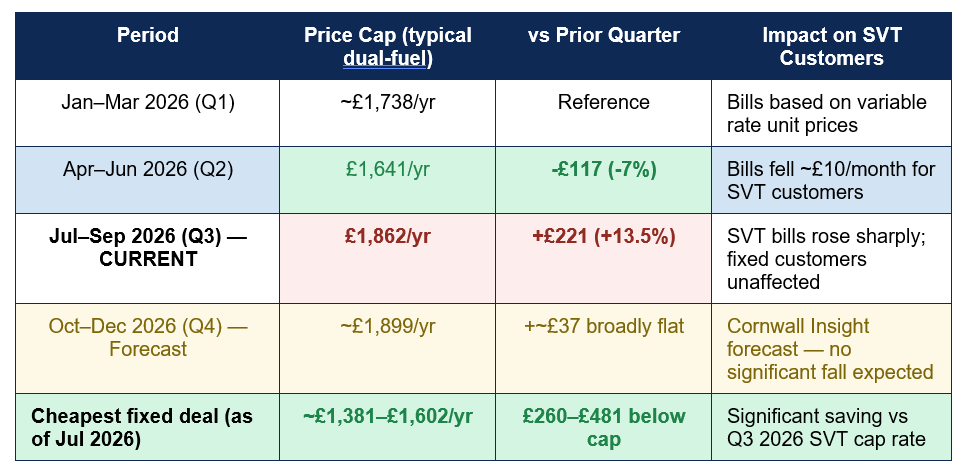
The July 2026 rise in context: The Q3 2026 price cap increase was driven primarily by wholesale gas markets responding to the Middle East conflict, not by a change in domestic energy supply or demand. Gas unit rates on variable tariffs rose around 24% in a single quarter, while electricity rose roughly 5%, reflecting the UK's heavy reliance on gas for both direct heating and electricity generation. Households with gas central heating were disproportionately affected. Cornwall Insight, the energy markets forecasting firm, currently predicts the Q4 2026 (October-December) cap at approximately £1,899 per year — broadly flat rather than a clear fall, meaning there is currently no compelling 'wait for prices to come down' argument for households considering fixing.
The Advantages of Fixing Your Energy Price
1. Total Budget Certainty
The most compelling and consistently cited advantage of a fixed tariff is the certainty it provides for household budgeting. When you know your unit rate will not change for 12 or 24 months, you can calculate your likely annual energy spend based on your consumption pattern and factor it reliably into your household budget. Quarterly adjustments — the surprise letters from your energy supplier announcing a price change from a specific date — simply stop arriving. For households managing tight monthly budgets, planning finances around significant debt repayments, or living on a fixed income such as a pension, this predictability has genuine practical value beyond just the headline cost comparison.For households with a direct debit set up for energy, fixing also reduces the risk of direct debit under-collection. On a variable tariff, if the unit rate rises mid-contract, your energy company may need to increase your monthly direct debit with relatively short notice to catch up with higher costs — a cash-flow surprise that can cause real difficulty for some households. On a fixed tariff, direct debits typically remain stable for the full contract length barring significant changes in consumption.
2. Protection From Further Price Rises
If you fix your energy price and wholesale costs subsequently rise — as they did between April and July 2026 — you pay the same locked unit rate regardless of how high the cap climbs. This protection is particularly valuable for households signing a fixed deal in a period where market conditions suggest further price rises are more likely than falls. With the Q4 2026 cap forecast at approximately £1,899 and no clear downward trajectory on wholesale gas prices while Middle East tensions persist, fixing in summer 2026 secures a rate below both the Q3 and forecast Q4 cap levels for the full contract period.The mathematical logic is straightforward: the cheapest 12-month fixed deals in July 2026 are priced at approximately £1,381 to £1,602 per year, meaningfully below the £1,862 variable cap. A household fixing at £1,500 per year and facing a Q4 cap of £1,899 saves a further £399 for the October-December quarter alone, in addition to the savings on the Q3 cap period already locked in.
3. Encouraging Active Energy Management
A less frequently cited but genuine advantage of fixed tariffs is the behavioural effect they can have on household energy management. When you know you are paying a set unit rate, there is a cleaner incentive to monitor your consumption and reduce it where possible — because reducing consumption directly and proportionally reduces your bill with no offsetting factor. On a variable tariff, the tendency to monitor consumption can be undermined by the sense that the 'real' driver of your bill is external market movements rather than your own usage decisions, which can subtly discourage active engagement with energy management.4. Potential to Beat the Market
At the right market moment — when fixed deals are priced well below both the current cap and reasonably foreseeable future cap levels — fixing provides the opportunity to lock in a rate that proves materially cheaper than remaining on a variable tariff across the entire contract period. This is exactly the position that households locking in before the July 2026 cap rise found themselves in: those who fixed at £1,500 or below in May or June 2026 entered a 12-month contract at a rate approximately 19-24% below the Q3 2026 variable cap level.The Disadvantages of Fixing Your Energy Price
1. You Cannot Benefit If Prices Fall
The most significant disadvantage of a fixed tariff is a direct mirror of its greatest advantage: the rate is locked regardless of what happens in either direction. If wholesale energy prices fall sharply during your fixed contract period — as they did in the final quarter of 2025 and into early 2026, when the Q2 2026 cap dropped 7% — you remain on your higher locked rate while variable tariff customers automatically benefit from lower bills. The April 2026 cap reduction of £117 translated to approximately £10 per month savings for variable households; fixed customers received no equivalent benefit.The historical pattern over 2021-2026 illustrates this risk clearly. Households that fixed at the height of the energy crisis in 2021-2022, when prices were at extraordinary peaks, paid above-market rates for 12 or 24 months as wholesale prices subsequently moderated. Timing a fixed tariff decision is inherently a bet on the future direction of energy prices — a bet that professional forecasters, with far more market data than most consumers, routinely get wrong.
2. Exit Fees Create Genuine Inflexibility
Most fixed tariffs carry exit fees for terminating the contract before the end date, typically ranging from £25 to £50 per fuel (£50 to £100 total for dual-fuel). For a household facing an unexpected move — a new job, a relationship change, or simply an opportunity to take a better deal — these exit fees are a real cost that can partially or fully offset the savings achieved from fixing in the first place. This makes fixed tariffs less well-suited to households whose housing situation may change within the contract period.It is worth noting, however, that a meaningful and growing share of fixed tariffs in the 2026 market come with no exit fees. Octopus Energy, for example, offers fixed products with no exit fee, and this is an increasingly common feature among competitive fixed deals. When comparing fixed tariffs, the exit fee terms are one of the most important variables to evaluate alongside the unit rate itself — a slightly higher unit rate on a no-exit-fee fix may offer better overall value than a lower rate with exit fee exposure.
3. Risk of Locking In at an Unfavourable Rate
Fixed tariffs carry the risk of locking in at a unit rate that proves higher than the market over the contract period. EnergyPlus notes this as the 'risk of overpaying: if you lock in at the wrong time, you may pay above market rates' for the full duration. This risk is highest when fixed deals are priced above or significantly above the current variable rate — which can happen when energy companies buy forward contracts at prices reflecting anticipated future price rises that do not materialise, or when competitive pressure in the fixed market is low.Checking whether a prospective fixed deal is priced below or above both the current variable cap and reasonable cap forecasts is the essential due diligence before signing. A fixed tariff priced above the current cap is almost never a good deal; one priced below the current cap but above the forecast rate is a bet that the forecast is wrong; one priced below both current and forecast cap levels is the target scenario for fixing.
4. Fixed Tariffs Are Not Covered by the Ofgem Price Cap
This is both a feature and a potential risk. On the upside, it means your fixed rate cannot be increased under the cap mechanism. On the downside, it means the Ofgem price cap's protections — specifically the unit rate ceiling that prevents variable tariffs from rising above a regulated maximum — do not apply to you. In a theoretical scenario where fixed deals were set above the variable cap and the market became anti-competitive, fixed customers would have less regulatory protection than variable ones. In practice, competitive market pressure keeps fixed deals in check, but the absence of cap coverage is a structural point worth understanding.Fixed vs Variable: Side-by-Side Comparison
The table below provides a complete, structured comparison of fixed and variable tariffs across every dimension that matters for a real-world decision: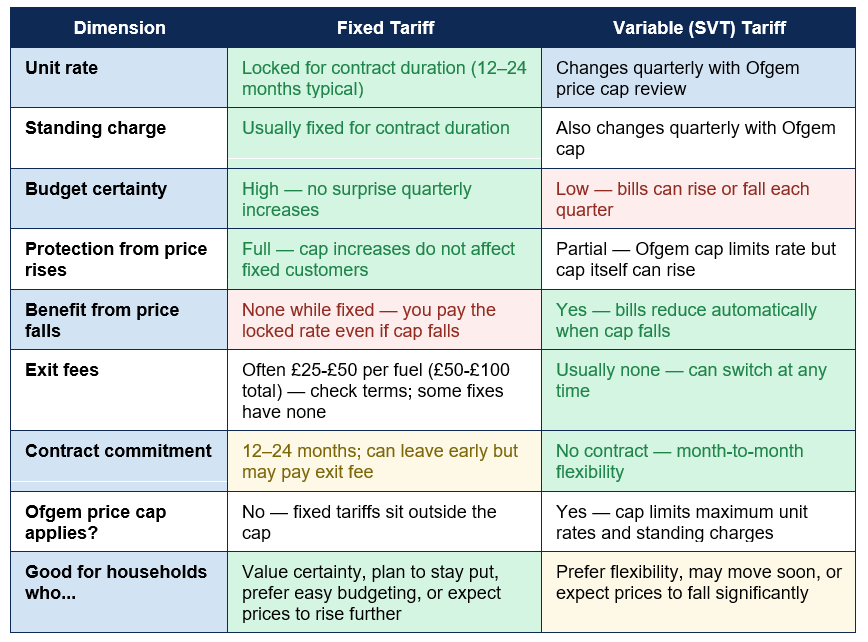
Households on fixed tariffs in the UK: 21 million — up from ~7 million in 2024 — the surge in fixed tariff adoption reflects both the July 2026 cap rise and growing consumer awareness that competitive fixed deals can now offer savings of £260–£481 against the standard variable rate (EDF / Ofgem data, February 2026 and July 2026)
Who Should Fix — and Who Should Stay Variable
Based on the market data and the structural analysis above, the following decision framework applies to most UK households making this decision in the second half of 2026:Fix your energy price if:
- You are currently on a variable or default tariff and a fixed deal priced below the current cap of £1,862 is available at your postcode — saving up to £481 per year against the July 2026 variable rate.
- Budget certainty matters to you — you manage monthly finances carefully, live on a fixed income, or find quarterly bill surprises genuinely disruptive.
- You have no plans to move in the next 12 months and are comfortable with the contract commitment.
- You can find a no-exit-fee fixed deal at a competitive rate, which eliminates the inflexibility risk while retaining the rate-lock advantage.
- You expect wholesale energy prices to remain high or rise further — currently the consensus view based on the October 2026 forecast of ~£1,899.
Stay on a variable tariff if:
- You expect to move house within 12 months and want to avoid any risk of exit fees.
- You believe wholesale prices will fall significantly before October 2026 — note that current forecasts suggest a broadly flat Q4 cap rather than a meaningful fall.
- You are renting and your tenancy terms make switching tariffs complex or require landlord involvement.
- You are already on a variable tariff priced below the best available fixed deals, which can occasionally be the case for customers on tracker tariffs tied directly to wholesale prices.
The no-exit-fee fix argument: EnergyPlus explicitly recommends considering a no-exit-fee fixed deal as a way to get the best of both worlds — you lock in a rate below the current July cap, protect against the October review, and retain the freedom to switch again if wholesale prices fall sharply. Several major suppliers including Octopus offer no-exit-fee fixed products. Always verify the specific terms before signing, as product availability and terms change frequently in the energy market.
Conclusion
The decision to fix your energy price is not a binary right or wrong — it is a risk-and-benefit calculation that depends on the current market, your household circumstances, and how you weigh the value of certainty against the value of flexibility. In the specific context of summer 2026, following a 13.5% cap rise in July and with the Q4 October forecast showing no meaningful reduction, the balance of evidence tilts fairly strongly toward fixing for most households on a standard variable tariff, provided they can access a deal priced below the £1,862 variable cap — and in July 2026, several deals are priced £260 to £481 below that level.The advantages of fixing are most powerful when: the fixed rate is genuinely below the current and forecast variable rate; the household values budget certainty; and the contract terms, particularly exit fees, are acceptable for the household's circumstances. The disadvantages are most material when: the fixed rate is set at or above the market; prices subsequently fall; or the household faces an unexpected need to leave the contract early.
The key practical step before making any decision is running a comparison using your actual postcode, meter type, and consumption level — because headline national figures for the price cap and 'cheapest available deals' can both be misleading for individual households. Uswitch, MoneySavingExpert, and energy company websites all offer postcode-based comparisons. The 21 million UK households that have already fixed are the largest signal yet that the British public is increasingly treating energy tariff decisions as an active, informed financial choice rather than a default — and the data currently available suggests that instinct is, in aggregate, correctly applied.
Frequently Asked Questions (FAQ)
What is the current UK energy price cap in 2026?
The Ofgem energy price cap for Q3 2026 (1 July to 30 September 2026) is £1,862 per year for a typical dual-fuel household paying by direct debit. This was a 13.5% increase (£221) from the Q2 2026 cap of £1,641. The cap applies only to standard variable tariff customers — households on fixed tariffs are not affected by cap changes. The cap was cut by 7% (£117) in Q2 2026 before rising again in Q3, driven by higher wholesale gas prices linked to Middle East tensions.Does a fixed tariff mean my energy bill stays the same every month?
No — this is a common misunderstanding. A fixed tariff locks your unit rate and standing charge for the contract period, but your total bill still varies depending on how much energy you consume. In cold winter months you will use more energy and pay more; in warm summer months you will use less and pay less. What does not change is the price per kilowatt hour you pay. British Gas, EDF, and Ofgem all clarify this point in their tariff documentation: it is the cost per unit that is fixed, not the total amount you spend.What happens if I want to leave a fixed energy contract early?
Most fixed tariffs include exit fees for leaving before the contract end date, typically £25 to £50 per fuel (£50 to £100 for dual fuel). These fees are designed to cover the supplier's cost of having purchased forward energy contracts on your behalf. However, some fixed deals — including products from Octopus Energy and some other suppliers — are available with no exit fee, allowing you to leave at any point without penalty. Always check the tariff information label for exit fee terms before signing. Most suppliers allow you to switch tariffs in the final 28-49 days of your contract without an exit fee.What are price cap predictions for late 2026?
Cornwall Insight, the UK's most widely cited independent energy markets forecaster, predicts the Q4 2026 (October to December) price cap at approximately £1,899 per year for a typical dual-fuel household — broadly flat compared with the Q3 2026 cap of £1,862, rather than a clear downward move. Ofgem will announce the Q4 2026 cap by late August 2026. These forecasts are subject to significant change depending on global wholesale energy markets, particularly developments in the Middle East conflict that has driven recent price rises. Ofgem's cap predictions page and Cornwall Insight's published forecasts are updated regularly.How do I find the best fixed energy deal for my home?
The most effective method is using a whole-of-market energy comparison service with your actual postcode, meter type (single-rate, Economy 7, smart meter, or prepayment), and typical annual consumption. Uswitch, MoneySavingExpert's energy tool, and EnergyPlus all offer postcode-based comparisons. When comparing, look beyond the headline annual cost to check: whether the exit fee is acceptable for your circumstances, whether the standing charge is included in the quoted price, the contract length, and the payment method required. A slightly higher unit rate on a no-exit-fee deal may be better value than a cheaper rate tied to an exit fee you may eventually need to pay.External References
The following authoritative sources were used in researching this article and are recommended for further reading:1. Ofgem — Changes to Energy Price Cap 1 April to 30 June 2026
https://www.ofgem.gov.uk/news/changes-energy-price-cap-between-1-april-and-30-june-2026
2. EDF Energy — Should I Fix My Energy Tariff? (Updated July 2026)
https://www.edfenergy.com/energywise/should-i-fix-my-energy-tariff
3. British Gas — Fixed vs Variable Energy Tariffs Explained
https://www.britishgas.co.uk/energy/guides/fixed-vs-variable-tariffs.html
4. Octopus Energy — Should I Fix Before the July 2026 Price Cap? (May 2026)
https://octopus.energy/blog/should-I-fix-before-july-2026-price-cap/
5. Uswitch — Compare Energy: Gas and Electricity Comparison July 2026
https://www.uswitch.com/gas-electricity/
6. EnergyPlus — Fixed vs Variable Energy Tariffs UK (July 2026)
https://www.energyplus.co.uk/fixed-vs-variable-energy-tariffs
7. MoneySavingExpert — How to Get Cheap Gas and Electricity
https://www.moneysavingexpert.com/utilities/cheap-energy/
8. Cornwall Insight — Energy Price Cap Forecasts 2026
https://www.cornwall-insight.com/cornwall-insight-response-to-ofgems-2026-27-draft-determinations/
Pv Anbieter in meiner Nahe <a href=https://moypvdom.com/>Photovoltaik Prezi </a>