
Credits
Monzo Aura Auto-Invest Cashback Credit Card Review
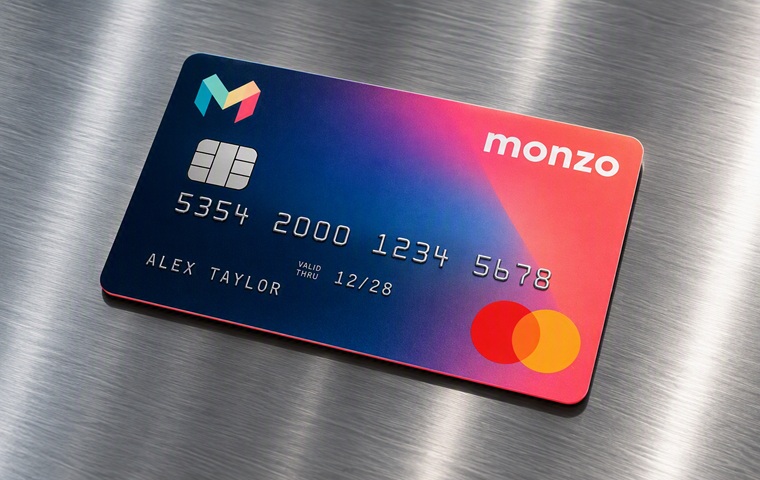
Monzo launched the UK’s first auto-invest cashback credit card on 16 September 2026. The Aura card earns 1% on groceries and 0.5% on everything else, automatically routing cashback into BlackRock-managed ETFs before you have a chance to spend it. The metal card costs £15 a month and comes with perks Monzo values at over £360 a year. But is it worth the fee? And can other cashback cards on the UK market match or beat it?
There is a particular kind of small financial leak that most people never fix. You earn cashback. It arrives as a credit on your statement, or sits in a rewards balance, and then it dissolves into ordinary spending. A few pounds here. A tenner there. Over a year, it adds up to something meaningful that leaves no trace.
Monzo’s answer to this leak is Aura, launched on 16 September 2026 and described by the bank as the UK’s first credit card that auto-invests cashback. Rather than crediting the money back to your account where it blends into your current balance, Aura routes it directly into Monzo Investments — ETFs tracking major global indices and commodities — before you have a chance to spend it again. Luke Enock, Monzo’s general manager for borrowing, framed it as: “Aura turns each trip to the shop into investing for the future.”
The mechanism is genuinely new in the UK. What it is not new is a premium cashback credit card with a monthly fee, a metal finish, and a perks bundle. Those have existed for years. The question this guide addresses is whether the auto-invest feature — plus the 1% grocery cashback and the stated £360+ of annual perks — justifies the £15 monthly fee (the same £180 a year as, say, an Amazon Prime membership and a Netflix subscription combined), and whether UK consumers might be better served by free-to-hold alternatives that offer comparable or superior cashback rates without the recurring cost.
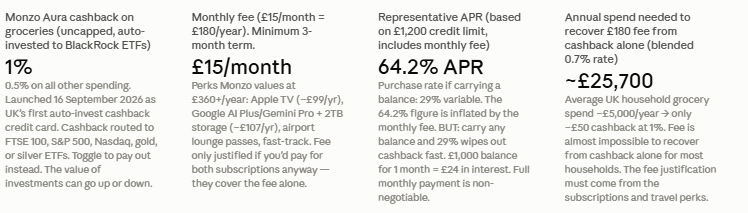
Monzo Aura launched: 16 September 2026 (Tech.eu; The Paypers; MoneyWeek). Fee: £15/month (£180/year). Cashback: 1% groceries / 0.5% everything else (uncapped). Investment: cashback auto-routed to BlackRock ETFs (FTSE 100, S&P 500, Nasdaq, gold, silver). Platform fee: none (BlackRock underlying fee deducted from fund value). Representative APR: 64.2% variable. Purchase rate: 29% variable. Credit limit: up to £15,000. 0% interest: 3 months on purchases over £100. Perks stated value: over £360/year (Apple TV, Google AI Plus/Gemini Pro + 2TB storage, airport lounge, fast-track). Monzo customers: 16 million. Must have a Monzo current account to apply.
The card charges £15 a month, billed monthly, with a three-month minimum term. The annual equivalent cost is £180. Customers who wish to cancel must give notice and can do so after the three-month minimum. There is a credit limit of up to £15,000, subject to credit and affordability assessment. The card offers three months of 0% interest on purchases above £100, which provides a short window to spread larger costs interest-free before the 29% variable purchase rate applies.
The cashback structure is tiered: 1% back on grocery spending (uncapped) and 0.5% back on all other spending (uncapped). Both rates are earned automatically on eligible transactions. The cashback is then either auto-invested into Monzo’s investment platform — which the customer can toggle on or off in the Monzo app — or paid out directly to the customer as a credit. The investment route is the novel proposition; the payout route makes it a more conventional cashback card by any measure.
The perks package is where Monzo is pitching the card’s immediate value proposition. The stated package includes an Apple TV subscription (valued at approximately £99/year), Google AI Plus with Gemini Pro and 2TB of Google One storage (approximately £107/year), airport lounge passes, and airport fast-track passes. Monzo values the total package at over £360 a year, more than double the £180 annual fee. The perks value is genuine only if the cardholder would otherwise pay for those services. Someone already paying for Apple TV separately sees a real saving; someone who does not want it does not.
The investment options available are ETFs — exchange-traded funds — tracking major market indices: the FTSE 100 (the UK’s 100 largest listed companies), the S&P 500 (the 500 largest US-listed companies), and the Nasdaq (the US technology-heavy index). Alongside these equity trackers, customers can also route cashback into exchange-traded commodities: gold and silver. The underlying funds are managed by BlackRock, one of the world’s largest asset managers. Monzo charges no platform fee on investments made through the Aura cashback mechanism. BlackRock charges an underlying fund management fee, which is deducted from fund value rather than charged as a separate line item. This is standard practice for index funds but worth understanding — as Capwolf’s September 2026 Aura review notes: “It is also easy to forget you are paying it.”
The auto-invest toggle in the Monzo app allows customers to switch the mechanism on or off. When off, cashback is credited directly to the card balance. Customers can also choose which fund their cashback is directed into. This gives a level of personalisation that is relatively unusual for embedded investment features in financial products.
The real value of the auto-invest mechanism is behavioural, not financial. By routing cashback into an investment fund before the customer sees it as spendable cash, Aura exploits the well-documented behavioural tendency to spend money that appears available in a current account. The forced friction of investing first — and requiring an active decision to retrieve the money — is likely to result in more cashback being retained as long-term savings than a manual transfer model would produce. The amounts involved are modest (a typical household might generate £50-£100 in annual grocery cashback at 1%), but the habit-building value may be larger than the numbers suggest. The value of investments can go up or down.
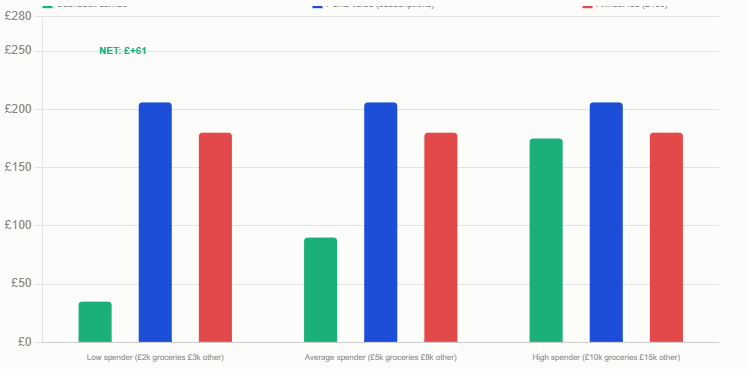
The Maths: Break-even analysis: Monzo Aura at £15/month. Annual fee to recover: £180. At 1% grocery cashback only: GBP 18,000 in grocery spend required (£1,500/month). Average UK household grocery spend: approximately £4,900-5,200/year, generating £49-52 in grocery cashback at 1%. At 0.5% on all other spending: GBP 36,000 in non-grocery spend required. At a blended effective rate of approximately 0.7% (assuming 40% grocery spend, 60% general): approximately GBP 25,700 total annual card spend required to break even on cashback alone. That is over GBP 2,140 per month on the card to cover the fee from cashback only. Most households will NOT recover the fee from cashback alone. The fee justification must therefore come from perks value — specifically, the Apple TV and Google AI Plus subscriptions and the airport access passes. Not financial advice. Illustrative calculations only.
The perks route to break-even is more achievable. If a customer is already paying for Apple TV (£99/year) and Google AI Plus (£107/year), those two subscriptions alone account for approximately £206 of the £360 stated perks value — leaving only £26 of ‘profit’ from the perks before cashback earnings are counted. Adding a grocery-only cashback earning of £50 per year, the total net benefit for a customer who uses both included subscriptions is roughly £256 in value against £180 in fees — a £76 annual net gain, before any value placed on the airport perks.
The perks proposition becomes harder to justify for customers who do not want Apple TV or Google AI Plus, who rarely fly, or who are disciplined enough to manually transfer their cashback into investments without the automated mechanism. For those customers, a no-fee cashback card generates positive value from the first pound spent.
The representative APR of 64.2% variable is a statutory disclosure figure that appears alarming because the monthly fee is included in its calculation as though it were an interest charge. The actual purchase rate if you carry a balance is 29% variable — consistent with many premium credit cards but still extremely expensive. The Capwolf review is explicit: “Clearing the balance every single month will be essential, because interest charges could wipe out the benefits of the cashback offer.” A single missed month of full payment at 29% on a £1,000 balance costs approximately £24 in interest — half a month’s cashback on most spending levels. The card only works as a value proposition for those who pay in full every month without exception.
The Apple TV and Google AI Plus inclusions are the clearest cashable value items — assuming the customer wants both services. Apple TV provides access to original programming including Ted Lasso, Severance, and The Morning Show. Google AI Plus provides access to Google’s Gemini Pro AI model and 2TB of Google One cloud storage, which is genuinely useful for anyone who stores photos, documents, or work files in the Google ecosystem. For customers currently paying for both separately, the saving is real and measurable: approximately £206/year.
The airport perks — lounge access and fast-track security — have value that varies enormously by frequency of travel. A customer who flies twice a year for leisure may use one or two lounge passes per year. The same lounge pass can cost £20-£40 at most UK airports. For frequent travellers or business flyers, the lounge and fast-track passes represent meaningful value. For infrequent flyers, they may rarely be used.
The perks package also joins Monzo Aura to other Monzo credit card products in having partner benefits linked to ‘big-name brands,’ though the specific partner list beyond Apple and Google is not detailed in the September 2026 launch materials reviewed. Customers should check the current Monzo Aura terms page (monzo.com/credit-cards/aura) for the complete and up-to-date perks list before applying.
At 29% annual interest, carrying even a modest balance erases the cashback value rapidly. Carrying £1,000 for a full month costs approximately £24 in interest. Carrying £2,000 for a full month costs approximately £48 in interest. A customer earning £8-12 per month in cashback on typical household spending who carries any balance from one month to the next will find the interest charge significantly exceeds the cashback earned.
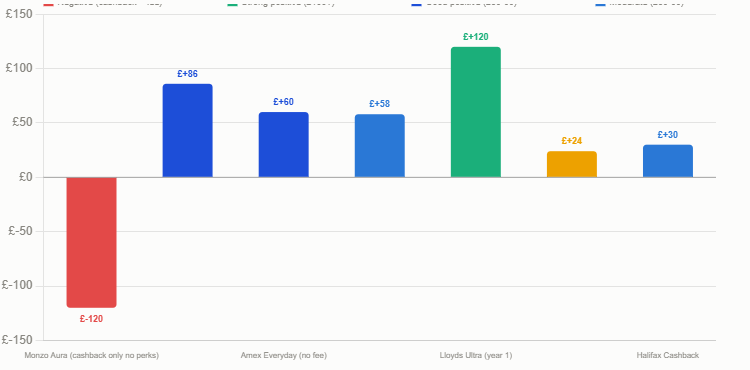
This is not unique to Monzo Aura — it is the fundamental rule of cashback credit card economics. But the 29% purchase rate is at the higher end of the premium card market. The Lloyds Ultra Credit Card has a representative APR of 12.9% variable. The Santander Rewards Credit Card runs at 24.9% variable. The Amex Platinum Cashback Everyday sits at approximately 29.1% variable. The Monzo Aura purchase rate, while in line with Amex, is significantly higher than Lloyds.
The clear operational requirement: Monzo Aura must only be used by customers who pay the full balance every month without exception. The card works as designed for the financially disciplined full payer. It becomes expensive for anyone who carries a balance, even occasionally.
The American Express Platinum Cashback Everyday Credit Card is the most widely recommended fee-free cashback card in the UK. It earns 5% cashback on purchases for the first three months (up to £125 total), then 0.5% ongoing, stepping up to 1% when annual spending exceeds £10,000. There is no annual fee. The limitation is acceptance: Amex is accepted at approximately 85% of UK merchants compared to 99%+ for Visa and Mastercard. It earns the same 1% grocery rate as Aura on very high spending, and the 0.5% general rate matches Aura’s general rate, but without the £180 annual cost.
The Santander Rewards Credit Card offers 3% cashback on everyday travel, petrol, EV charging, eating out and takeaways in the first year — significantly exceeding Aura’s 1% grocery rate for customers who spend heavily on travel and dining. The ongoing rate drops to 0.25% on all spending after year one, but at no annual fee, the first year value is exceptional for the right spending profile.
The Lloyds Ultra Credit Card earns 1% cashback for the first 12 months on all spending — matching Aura’s grocery rate and doubling its general rate — with no annual fee, no cap, and the added benefit of zero foreign transaction fees. The rate falls to 0.25% after the first year. The 12.9% representative APR makes it the most forgiving of the group for occasional balance-carriers. It is a Which? Recommended Provider.
The Santander All In One Credit Card offers 0.5% cashback capped at £10 per month, alongside 15 months 0% on purchases and 15 months 0% on balance transfers, plus no foreign transaction fees — all for a £3/month (£36/year) fee. The cashback rate is modest and capped, but for customers who want a balance transfer offer alongside modest cashback, it is worth considering.
The platform fee is zero for cashback invested via Aura — an unusual and genuinely attractive feature. Most retail investment platforms charge 0.25-0.45% annually in platform fees. Monzo’s fee-free arrangement means the only ongoing cost is the BlackRock underlying fund management charge, which on standard index ETFs typically runs at 0.07-0.20% of fund value. This is a low-cost investment structure, comparable to using a direct-index fund with a major low-cost provider.
The practical reality of how much cashback gets invested, however, is modest for most households. A UK household spending £450/month on groceries (slightly above the national average) earns approximately £54/year at 1%. At 0.5% on £800/month of other card spending, that is an additional £48/year. Total annual cashback: approximately £102. Invested in a FTSE 100 tracker at 7% average annual return over 10 years: approximately £141. The investment component of the Aura proposition is not transformative in isolation. But it is money that, under a conventional cashback model, would almost certainly have been spent rather than saved.
The strongest argument for Aura’s investment mechanism is the one least often made explicitly: it is not about the amount. It is about normalising the habit of investing automatically, repeatedly, from everyday activity. A customer who has never invested before and who builds an investment account over two or three years of Aura use — even with modest cashback amounts — is more likely to make additional investment decisions and to continue investing than someone who has never opened an investment account. The behavioural value of the auto-invest mechanism may exceed the financial value of the cashback itself. The value of investments can go up or down.
On cashback rate: Amex earns 0.5% on all spending (rising to 1% above £10,000 annual spend) with no annual fee. Aura earns 1% on groceries and 0.5% on everything else with a £180 annual fee. For a customer spending £5,000/year on the card with £2,000 on groceries and £3,000 elsewhere: Amex earns £25. Aura earns £20 on groceries + £15 on other spending = £35. Aura earns £10 more in raw cashback. But Aura costs £180 more in fees. Net: Amex wins by £170 for a customer at this spending level unless the perks are valuable to them.
On acceptance: Amex is accepted at approximately 85% of UK merchants compared to 99%+ for Mastercard. Some supermarkets and smaller retailers do not accept Amex. For the 1% grocery cashback to actually be earned on a Monzo Aura card, the supermarket must accept Mastercard, which is essentially universal. Amex acceptance at supermarkets is improving but not universal — Aldi and Lidl, for example, accept Amex, but some smaller independent grocers may not.
On purchase protection: both offer Section 75 Consumer Credit Act protection on purchases between £100 and £30,000. This protection covers the customer if a retailer fails to deliver goods or services of satisfactory quality and applies equally to both cards. The Amex fee-free card also has a strong reputation for purchase protection and customer service.
For most UK consumers who are existing Monzo users, pay their balance in full monthly, and already pay for Apple TV and Google AI Plus: Monzo Aura is a genuinely positive proposition in the first year, delivering real net value from the subscription saving and the auto-invest behaviour change. For everyone else — particularly those who are fee-averse, who do not want those specific subscriptions, who are not Monzo current account customers, or who want maximum cashback without conditions — the American Express Platinum Cashback Everyday, the Lloyds Ultra Credit Card, or the Santander Rewards Card all offer competitive cashback at zero or much lower annual cost. Not financial advice. Always compare directly with providers before applying.
But the card is not for everyone — and its limitations are clearly defined. The £180 annual fee requires active management to justify. The 29% purchase rate is punishing for anyone who carries a balance. The Monzo current account requirement limits the addressable audience. And the headline cashback rates (1% groceries, 0.5% general) are matched or beaten by fee-free alternatives at specific spend levels.
The UK cashback card market in September 2026 is genuinely competitive. Amex’s fee-free card offers the same 0.5% general rate with no annual cost and a welcome bonus. Santander’s Rewards Card offers 3% on travel and dining in year one. Lloyds Ultra offers 1% on everything for the first year at no cost and the lowest APR of the group. None of these auto-invest your cashback. If that behavioural nudge matters to you — and the evidence from behavioural finance suggests it does for people who struggle to invest manually — Aura has a genuine advantage. If it does not, the fee is harder to justify.
Apply with honesty about which camp you are in. Not financial advice — always compare directly with providers and check your eligibility before applying. The value of investments can go up or down.
Monzo Aura is a premium metal credit card launched by UK digital bank Monzo on 16 September 2026. It is described as the UK's first credit card to auto-invest cashback. The card charges £15 per month (£180 per year) with a three-month minimum term. It earns 1% cashback on groceries and 0.5% on all other spending (both uncapped), which is automatically routed into Monzo Investments — BlackRock-managed ETFs tracking the FTSE 100, S&P 500, and Nasdaq, alongside gold and silver exchange-traded commodities. Customers can toggle the auto-invest feature on or off, and can alternatively take cashback as a direct credit. The card also includes partner perks Monzo values at over £360/year, including Apple TV, Google AI Plus (Gemini Pro + 2TB Google One storage), airport lounge passes, and airport fast-track passes. It is available exclusively to existing Monzo current account holders aged 18 and over in the UK, subject to credit and affordability checks. Representative APR is 64.2% variable (based on a £1,200 credit limit). Purchase rate if carrying a balance: 29% variable. Not financial advice.
Is the Monzo Aura credit card worth the £15 monthly fee?
Whether Monzo Aura is worth £15 per month depends on how much value you extract from the included perks and cashback. From cashback alone, recovering the £180 annual fee requires approximately £25,000 of annual card spend at a blended effective rate of around 0.7% — which is very high for most households. However, if you already pay for Apple TV (approximately £99/year) and Google AI Plus (approximately £107/year) separately, those two subscriptions together are worth approximately £206 — already covering more than the £180 annual fee before a single pound of cashback is earned. Adding grocery cashback (approximately £50 per year for an average household) and any airport lounge or fast-track value, the total net benefit can clearly exceed the fee for the right customer. For customers who do not want Apple TV or Google AI Plus and travel infrequently, the fee is harder to justify against fee-free alternatives. Not financial advice.
What happens if I carry a balance on the Monzo Aura card?
The Monzo Aura purchase rate if you carry a balance is 29% variable — a high rate that will rapidly erase the cashback earnings if you do not pay the full statement balance each month. The representative APR of 64.2% variable is a statutory disclosure figure that includes the monthly fee in the calculation, making it appear higher than the actual purchase interest rate; the relevant number for balance-carrying is 29% variable. At that rate, carrying a £1,000 balance for one month costs approximately £24 in interest — substantially more than most customers earn in monthly cashback at 1% on groceries and 0.5% on general spending. The card is only financially appropriate for customers who pay the full statement balance every month without exception. If you sometimes carry a balance, the Lloyds Ultra Credit Card (representative APR 12.9% variable, no annual fee) is a significantly more forgiving alternative. Not financial advice.
How does the auto-invest cashback feature work?
When cashback is earned on eligible spending on the Monzo Aura card, instead of being credited to your card balance, it is automatically transferred into your Monzo Investments account without any action required. Within Monzo Investments, you can choose which fund receives your cashback: options include FTSE 100, S&P 500, and Nasdaq index ETFs, plus gold and silver exchange-traded commodities. The funds are managed by BlackRock. Monzo does not charge a platform fee on cashback invested this way; BlackRock’s underlying fund management charge is deducted from fund value. You can toggle auto-invest on or off in the Monzo app. When off, cashback is credited directly to your card balance. This mechanism is described by Monzo and multiple financial media outlets as the UK’s first auto-invest cashback feature in a credit card. The value of investments can go up or down and you may get back less than you put in.
What are the best cashback credit cards in the UK in 2026 if I do not want to pay a monthly fee?
The leading fee-free cashback credit cards in the UK in September 2026, based on Which? (July 2026 table), MoneytotheMasses, and Finder.com, are: American Express Platinum Cashback Everyday (5% for first 3 months up to £125, then 0.5% / 1% above £10k annual spend; no fee; accepted at ~85% of UK merchants); Santander Rewards Credit Card (3% on travel, dining, petrol in year 1; 0.25% thereafter; no fee); Lloyds Ultra Credit Card (1% for first 12 months all spending; 0.25% thereafter; no fee; no forex fees; 12.9% representative APR — lowest of the group; Which? Recommended Provider); and Halifax Cashback Credit Card (0.25% flat; no fee; simple and reliable). All of these require full monthly payment to be worthwhile. None offer the auto-invest feature of Monzo Aura. Always check directly with card providers for current rates and eligibility before applying. Not financial advice. Credit subject to status.
Table of Contents
- The Idea Behind Monzo Aura
- What Is the Monzo Aura Card? Full Product Details
- How the Auto-Invest Cashback Mechanism Works
- The Fee: Is £15 a Month Worth Paying?
- The Perks Package: What You Actually Get
- The Representative APR: The Number That Matters Most
- Who Is Monzo Aura Best Suited For?
- Who Should Probably Look Elsewhere?
- The UK Cashback Card Alternatives
- Side-by-Side Comparison: Monzo Aura vs the Market
- The Investment Angle: Cashback into ETFs — Is It Worth It?
- Monzo Aura vs American Express: The Head-to-Head
- Conclusion: Unique Feature, Niche Fit
- Frequently Asked Questions
Monzo Aura: fee Break-even And Cashback Maths
UK cashback card comparison: rates vs fees
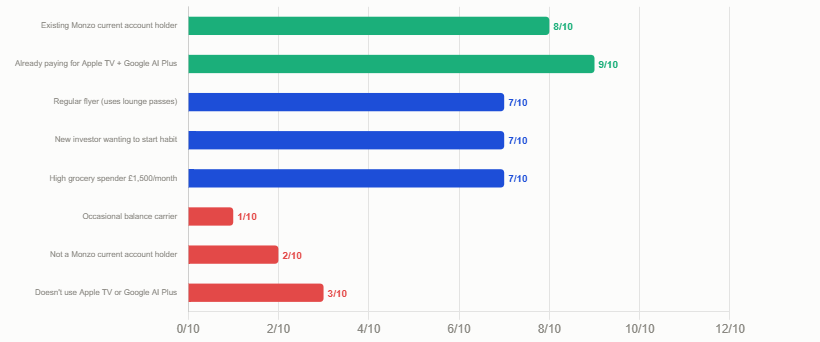
Is Aura right for you? Suitability by profile
The Idea Behind Monzo Aura
There is a particular kind of small financial leak that most people never fix. You earn cashback. It arrives as a credit on your statement, or sits in a rewards balance, and then it dissolves into ordinary spending. A few pounds here. A tenner there. Over a year, it adds up to something meaningful that leaves no trace.Monzo’s answer to this leak is Aura, launched on 16 September 2026 and described by the bank as the UK’s first credit card that auto-invests cashback. Rather than crediting the money back to your account where it blends into your current balance, Aura routes it directly into Monzo Investments — ETFs tracking major global indices and commodities — before you have a chance to spend it again. Luke Enock, Monzo’s general manager for borrowing, framed it as: “Aura turns each trip to the shop into investing for the future.”
The mechanism is genuinely new in the UK. What it is not new is a premium cashback credit card with a monthly fee, a metal finish, and a perks bundle. Those have existed for years. The question this guide addresses is whether the auto-invest feature — plus the 1% grocery cashback and the stated £360+ of annual perks — justifies the £15 monthly fee (the same £180 a year as, say, an Amazon Prime membership and a Netflix subscription combined), and whether UK consumers might be better served by free-to-hold alternatives that offer comparable or superior cashback rates without the recurring cost.
Monzo Aura launched: 16 September 2026 (Tech.eu; The Paypers; MoneyWeek). Fee: £15/month (£180/year). Cashback: 1% groceries / 0.5% everything else (uncapped). Investment: cashback auto-routed to BlackRock ETFs (FTSE 100, S&P 500, Nasdaq, gold, silver). Platform fee: none (BlackRock underlying fee deducted from fund value). Representative APR: 64.2% variable. Purchase rate: 29% variable. Credit limit: up to £15,000. 0% interest: 3 months on purchases over £100. Perks stated value: over £360/year (Apple TV, Google AI Plus/Gemini Pro + 2TB storage, airport lounge, fast-track). Monzo customers: 16 million. Must have a Monzo current account to apply.
What Is the Monzo Aura Card? Full Product Details
Monzo Aura is a premium iridescent metal credit card available exclusively to existing Monzo current account holders aged 18 and over in the UK. It launched on 16 September 2026 and is being rolled out gradually — eligible customers will be contacted when their invitation to apply arrives. It sits alongside Monzo’s existing credit products: Flex Purchase (for spreading costs over monthly payments) and Flex Build (a credit-builder for customers who do not qualify for Flex).The card charges £15 a month, billed monthly, with a three-month minimum term. The annual equivalent cost is £180. Customers who wish to cancel must give notice and can do so after the three-month minimum. There is a credit limit of up to £15,000, subject to credit and affordability assessment. The card offers three months of 0% interest on purchases above £100, which provides a short window to spread larger costs interest-free before the 29% variable purchase rate applies.
The cashback structure is tiered: 1% back on grocery spending (uncapped) and 0.5% back on all other spending (uncapped). Both rates are earned automatically on eligible transactions. The cashback is then either auto-invested into Monzo’s investment platform — which the customer can toggle on or off in the Monzo app — or paid out directly to the customer as a credit. The investment route is the novel proposition; the payout route makes it a more conventional cashback card by any measure.
The perks package is where Monzo is pitching the card’s immediate value proposition. The stated package includes an Apple TV subscription (valued at approximately £99/year), Google AI Plus with Gemini Pro and 2TB of Google One storage (approximately £107/year), airport lounge passes, and airport fast-track passes. Monzo values the total package at over £360 a year, more than double the £180 annual fee. The perks value is genuine only if the cardholder would otherwise pay for those services. Someone already paying for Apple TV separately sees a real saving; someone who does not want it does not.
How the Auto-Invest Cashback Mechanism Works
The auto-invest feature is straightforward in concept and relatively frictionless in practice. When cashback is earned on eligible spending, instead of being credited back to the card account, it is automatically transferred into the customer’s Monzo Investments account. This happens without any manual transfer, form completion, or active decision. The investing occurs in the background.The investment options available are ETFs — exchange-traded funds — tracking major market indices: the FTSE 100 (the UK’s 100 largest listed companies), the S&P 500 (the 500 largest US-listed companies), and the Nasdaq (the US technology-heavy index). Alongside these equity trackers, customers can also route cashback into exchange-traded commodities: gold and silver. The underlying funds are managed by BlackRock, one of the world’s largest asset managers. Monzo charges no platform fee on investments made through the Aura cashback mechanism. BlackRock charges an underlying fund management fee, which is deducted from fund value rather than charged as a separate line item. This is standard practice for index funds but worth understanding — as Capwolf’s September 2026 Aura review notes: “It is also easy to forget you are paying it.”
The auto-invest toggle in the Monzo app allows customers to switch the mechanism on or off. When off, cashback is credited directly to the card balance. Customers can also choose which fund their cashback is directed into. This gives a level of personalisation that is relatively unusual for embedded investment features in financial products.
The real value of the auto-invest mechanism is behavioural, not financial. By routing cashback into an investment fund before the customer sees it as spendable cash, Aura exploits the well-documented behavioural tendency to spend money that appears available in a current account. The forced friction of investing first — and requiring an active decision to retrieve the money — is likely to result in more cashback being retained as long-term savings than a manual transfer model would produce. The amounts involved are modest (a typical household might generate £50-£100 in annual grocery cashback at 1%), but the habit-building value may be larger than the numbers suggest. The value of investments can go up or down.
The Fee: Is £15 a Month Worth Paying?
The £15 monthly fee is the lens through which the entire Monzo Aura proposition must be evaluated. Paid regardless of whether the card is used, it represents a fixed annual cost of £180. To break even on the fee from cashback earnings alone — ignoring the perks entirely — requires a specific level of annual card spend.The Maths: Break-even analysis: Monzo Aura at £15/month. Annual fee to recover: £180. At 1% grocery cashback only: GBP 18,000 in grocery spend required (£1,500/month). Average UK household grocery spend: approximately £4,900-5,200/year, generating £49-52 in grocery cashback at 1%. At 0.5% on all other spending: GBP 36,000 in non-grocery spend required. At a blended effective rate of approximately 0.7% (assuming 40% grocery spend, 60% general): approximately GBP 25,700 total annual card spend required to break even on cashback alone. That is over GBP 2,140 per month on the card to cover the fee from cashback only. Most households will NOT recover the fee from cashback alone. The fee justification must therefore come from perks value — specifically, the Apple TV and Google AI Plus subscriptions and the airport access passes. Not financial advice. Illustrative calculations only.
The perks route to break-even is more achievable. If a customer is already paying for Apple TV (£99/year) and Google AI Plus (£107/year), those two subscriptions alone account for approximately £206 of the £360 stated perks value — leaving only £26 of ‘profit’ from the perks before cashback earnings are counted. Adding a grocery-only cashback earning of £50 per year, the total net benefit for a customer who uses both included subscriptions is roughly £256 in value against £180 in fees — a £76 annual net gain, before any value placed on the airport perks.
The perks proposition becomes harder to justify for customers who do not want Apple TV or Google AI Plus, who rarely fly, or who are disciplined enough to manually transfer their cashback into investments without the automated mechanism. For those customers, a no-fee cashback card generates positive value from the first pound spent.
The representative APR of 64.2% variable is a statutory disclosure figure that appears alarming because the monthly fee is included in its calculation as though it were an interest charge. The actual purchase rate if you carry a balance is 29% variable — consistent with many premium credit cards but still extremely expensive. The Capwolf review is explicit: “Clearing the balance every single month will be essential, because interest charges could wipe out the benefits of the cashback offer.” A single missed month of full payment at 29% on a £1,000 balance costs approximately £24 in interest — half a month’s cashback on most spending levels. The card only works as a value proposition for those who pay in full every month without exception.
The Perks Package: What You Actually Get
Monzo values the Aura perks package at over £360 annually, which it describes as more than double the annual fee. The headline inclusions are: an Apple TV subscription (currently priced at approximately £99/year for new subscribers in the UK); Google AI Plus with Gemini Pro and 2TB of Google One storage (currently priced at approximately £107/year in the UK); airport lounge access passes; and airport fast-track security passes.The Apple TV and Google AI Plus inclusions are the clearest cashable value items — assuming the customer wants both services. Apple TV provides access to original programming including Ted Lasso, Severance, and The Morning Show. Google AI Plus provides access to Google’s Gemini Pro AI model and 2TB of Google One cloud storage, which is genuinely useful for anyone who stores photos, documents, or work files in the Google ecosystem. For customers currently paying for both separately, the saving is real and measurable: approximately £206/year.
The airport perks — lounge access and fast-track security — have value that varies enormously by frequency of travel. A customer who flies twice a year for leisure may use one or two lounge passes per year. The same lounge pass can cost £20-£40 at most UK airports. For frequent travellers or business flyers, the lounge and fast-track passes represent meaningful value. For infrequent flyers, they may rarely be used.
The perks package also joins Monzo Aura to other Monzo credit card products in having partner benefits linked to ‘big-name brands,’ though the specific partner list beyond Apple and Google is not detailed in the September 2026 launch materials reviewed. Customers should check the current Monzo Aura terms page (monzo.com/credit-cards/aura) for the complete and up-to-date perks list before applying.
The Representative APR: The Number That Matters Most
The representative APR of 64.2% variable is the most important number on the Monzo Aura product page for one specific reason: it tells you what happens if you carry a balance. The 64.2% figure is calculated by combining the monthly fee with the 29% purchase interest rate into a single annual percentage rate, as required by FCA disclosure rules. The purchase rate itself — the rate applied to any balance you do not pay off in full each month — is 29% variable.At 29% annual interest, carrying even a modest balance erases the cashback value rapidly. Carrying £1,000 for a full month costs approximately £24 in interest. Carrying £2,000 for a full month costs approximately £48 in interest. A customer earning £8-12 per month in cashback on typical household spending who carries any balance from one month to the next will find the interest charge significantly exceeds the cashback earned.
This is not unique to Monzo Aura — it is the fundamental rule of cashback credit card economics. But the 29% purchase rate is at the higher end of the premium card market. The Lloyds Ultra Credit Card has a representative APR of 12.9% variable. The Santander Rewards Credit Card runs at 24.9% variable. The Amex Platinum Cashback Everyday sits at approximately 29.1% variable. The Monzo Aura purchase rate, while in line with Amex, is significantly higher than Lloyds.
The clear operational requirement: Monzo Aura must only be used by customers who pay the full balance every month without exception. The card works as designed for the financially disciplined full payer. It becomes expensive for anyone who carries a balance, even occasionally.
Who Is Monzo Aura Best Suited For?
The Monzo Aura card is a genuine proposition — not a gimmick — for a specific type of customer. It is best suited for:- Existing Monzo customers who already use the Monzo app as their primary current account and who value the single-app visibility of spending, cashback, and investments in one place. The Aura card is designed to be deeply embedded in the Monzo ecosystem, and customers who do not use Monzo’s current account cannot apply.
- Monthly full payers who are confident they will never carry a balance. The 29% purchase rate destroys the value proposition for anyone who regularly or occasionally misses full payment. This discipline is the non-negotiable prerequisite.
- Customers who already pay for Apple TV and Google AI Plus (or Gemini Pro + Google One 2TB storage) separately, who would genuinely see those subscription costs eliminated by the card. For these customers, the fee payback from perks alone is approximately £26 net positive before any cashback is counted.
- Regular flyers who will use the airport lounge and fast-track passes more than once or twice a year, extracting further genuine value from the included travel perks.
- New investors who want to start investing but have never opened an investment account and who benefit from the automatic, frictionless mechanism that removes the need to actively transfer money. The behavioural default of auto-investing cashback may build an investment habit that a manual process would not.
- Grocery-heavy spenders who put a large proportion of their monthly spending through a single card. At 1% on groceries, a household spending £600/month on groceries earns £72/year in grocery cashback alone — contributing meaningfully to fee recovery alongside the perks value.
Who Should Probably Look Elsewhere?
Monzo Aura is not the right card for every consumer. Customers who fall into the following categories will likely get better value from a fee-free alternative:- Customers who do not have or do not want a Monzo current account. The Aura card is available exclusively to existing Monzo account holders. If you bank elsewhere and do not wish to switch, the card is simply not available to you.
- Customers who occasionally carry a balance. The 29% purchase rate makes Aura inappropriate for anyone who is not certain they will pay in full every month. A 0% purchase period of three months on purchases above £100 is available but limited in duration.
- High spenders who want maximum cashback rate. The Amex Platinum Cashback Credit Card (fee card) earns 1.25% on spending above £10,000 per year — exceeding Aura’s 0.5% general rate on non-grocery spending, at a lower annual fee of £25.
- Customers who do not use Apple TV or Google AI Plus and do not travel frequently. Without extracting value from the included subscriptions and travel perks, the £180 annual fee must be recovered almost entirely from cashback — which requires very high annual card spend (over £25,000 at a blended 0.7% effective rate).
- Customers who want the freedom to choose where their cashback goes. Aura invests cashback in BlackRock ETFs via Monzo Investments. Customers who want to invest in specific stocks, different funds, a Stocks and Shares ISA, or a different provider’s platform would need to redirect cashback manually by toggling auto-invest off.
- Customers outside the Monzo ecosystem entirely, or those who prefer traditional high-street banks. The Lloyds Ultra Credit Card offers 1% cashback for the first year with no monthly fee, no cap, and a notably low 12.9% representative APR — making it more forgiving for those who occasionally carry small balances.
The UK Cashback Card Alternatives
The UK cashback credit card market in September 2026 offers several strong alternatives to Monzo Aura, particularly for customers who are fee-sensitive or who do not need the auto-invest mechanism. The main options reviewed below are drawn from Which?’s July 2026 cashback card table, MoneytotheMasses, and Finder.com.The American Express Platinum Cashback Everyday Credit Card is the most widely recommended fee-free cashback card in the UK. It earns 5% cashback on purchases for the first three months (up to £125 total), then 0.5% ongoing, stepping up to 1% when annual spending exceeds £10,000. There is no annual fee. The limitation is acceptance: Amex is accepted at approximately 85% of UK merchants compared to 99%+ for Visa and Mastercard. It earns the same 1% grocery rate as Aura on very high spending, and the 0.5% general rate matches Aura’s general rate, but without the £180 annual cost.
The Santander Rewards Credit Card offers 3% cashback on everyday travel, petrol, EV charging, eating out and takeaways in the first year — significantly exceeding Aura’s 1% grocery rate for customers who spend heavily on travel and dining. The ongoing rate drops to 0.25% on all spending after year one, but at no annual fee, the first year value is exceptional for the right spending profile.
The Lloyds Ultra Credit Card earns 1% cashback for the first 12 months on all spending — matching Aura’s grocery rate and doubling its general rate — with no annual fee, no cap, and the added benefit of zero foreign transaction fees. The rate falls to 0.25% after the first year. The 12.9% representative APR makes it the most forgiving of the group for occasional balance-carriers. It is a Which? Recommended Provider.
The Santander All In One Credit Card offers 0.5% cashback capped at £10 per month, alongside 15 months 0% on purchases and 15 months 0% on balance transfers, plus no foreign transaction fees — all for a £3/month (£36/year) fee. The cashback rate is modest and capped, but for customers who want a balance transfer offer alongside modest cashback, it is worth considering.
Side-by-Side Comparison: Monzo Aura vs the Market
| Card | Monthly / annual fee | Cashback rate | Key benefit | Purchase APR | Acceptance | Investment feature | Best for |
| Monzo Aura | £15/month (£180/year) | 1% groceries / 0.5% all other (uncapped) | Auto-invest cashback; Apple TV; Google AI Plus; lounge access | 29% variable (rep APR 64.2% inc fee) | Mastercard (99%+ merchants) | Yes — BlackRock ETFs, auto-invested via Monzo Investments | Monzo account holders who pay in full monthly and want auto-invested cashback |
| Amex Platinum Cashback Everyday | £0 (no fee) | 5% for 3 months (max £125); then 0.5% / 1% above £10k | No fee; welcome cashback; strong purchase protection | ~29.1% variable | Amex (~85% merchants) | No | Fee-avoiders; those not wanting Amex occasionally rejected |
| Amex Platinum Cashback (fee card) | £25/year | 5% for 3 months (max £125); 0.75% up to £10k; 1.25% above £10k | Higher earn rate for high spenders; welcome cashback | ~34.6% variable | Amex (~85% merchants) | No | High annual spenders (£10k+ on card) who want maximum cashback |
| Santander Rewards Credit Card | £0 (no fee) | 3% on travel/dining/petrol (year 1); 0.25% thereafter | Highest introductory rate; no fee | 24.9% variable | Mastercard (99%+) | No | Commuters; frequent restaurant/takeaway spenders in year 1 |
| Lloyds Ultra Credit Card | £0 (no fee) | 1% for 12 months (all spending); then 0.25% | No fee; no cap; no forex fees; lowest APR of the group | 12.9% variable | Visa (99%+) | No | Those wanting 1% on all spending; occasional balance-carriers (lowest APR) |
| Santander All In One | £3/month (£36/year) | 0.5% (capped £10/month) | 15 months 0% on purchases and balance transfers; no forex fees | 29.8% variable | Mastercard (99%+) | No | Balance transferers who also want modest cashback and no forex fees |
| Halifax Cashback | £0 (no fee) | 0.25% flat | Simplest flat-rate no-fee option | 23.9% variable | Visa (99%+) | No | Those who want a simple no-fee card; not cashback-optimising |
The Investment Angle: Cashback into ETFs — Is It Worth It?
The auto-invest mechanism is the genuinely distinctive element of Monzo Aura, and it is worth evaluating the investment proposition on its own terms. The funds available are index-tracking ETFs managed by BlackRock — the same type of passive funds that financial advisers have recommended for decades as the most cost-efficient route for retail investors into equity markets. FTSE 100, S&P 500, and Nasdaq trackers are standard, diversified, long-term investment vehicles. The inclusion of gold and silver ETCs offers commodity exposure for those who want it.The platform fee is zero for cashback invested via Aura — an unusual and genuinely attractive feature. Most retail investment platforms charge 0.25-0.45% annually in platform fees. Monzo’s fee-free arrangement means the only ongoing cost is the BlackRock underlying fund management charge, which on standard index ETFs typically runs at 0.07-0.20% of fund value. This is a low-cost investment structure, comparable to using a direct-index fund with a major low-cost provider.
The practical reality of how much cashback gets invested, however, is modest for most households. A UK household spending £450/month on groceries (slightly above the national average) earns approximately £54/year at 1%. At 0.5% on £800/month of other card spending, that is an additional £48/year. Total annual cashback: approximately £102. Invested in a FTSE 100 tracker at 7% average annual return over 10 years: approximately £141. The investment component of the Aura proposition is not transformative in isolation. But it is money that, under a conventional cashback model, would almost certainly have been spent rather than saved.
The strongest argument for Aura’s investment mechanism is the one least often made explicitly: it is not about the amount. It is about normalising the habit of investing automatically, repeatedly, from everyday activity. A customer who has never invested before and who builds an investment account over two or three years of Aura use — even with modest cashback amounts — is more likely to make additional investment decisions and to continue investing than someone who has never opened an investment account. The behavioural value of the auto-invest mechanism may exceed the financial value of the cashback itself. The value of investments can go up or down.
Monzo Aura vs American Express: The Head-to-Head
The most direct comparison for Monzo Aura among the UK cashback market is the American Express Platinum Cashback Everyday Credit Card. Both are aimed at full payers who want to earn on everyday spending. Both have strong brand recognition in the premium card space. The differences are significant enough to determine which is appropriate for most customers.On cashback rate: Amex earns 0.5% on all spending (rising to 1% above £10,000 annual spend) with no annual fee. Aura earns 1% on groceries and 0.5% on everything else with a £180 annual fee. For a customer spending £5,000/year on the card with £2,000 on groceries and £3,000 elsewhere: Amex earns £25. Aura earns £20 on groceries + £15 on other spending = £35. Aura earns £10 more in raw cashback. But Aura costs £180 more in fees. Net: Amex wins by £170 for a customer at this spending level unless the perks are valuable to them.
On acceptance: Amex is accepted at approximately 85% of UK merchants compared to 99%+ for Mastercard. Some supermarkets and smaller retailers do not accept Amex. For the 1% grocery cashback to actually be earned on a Monzo Aura card, the supermarket must accept Mastercard, which is essentially universal. Amex acceptance at supermarkets is improving but not universal — Aldi and Lidl, for example, accept Amex, but some smaller independent grocers may not.
On purchase protection: both offer Section 75 Consumer Credit Act protection on purchases between £100 and £30,000. This protection covers the customer if a retailer fails to deliver goods or services of satisfactory quality and applies equally to both cards. The Amex fee-free card also has a strong reputation for purchase protection and customer service.
For most UK consumers who are existing Monzo users, pay their balance in full monthly, and already pay for Apple TV and Google AI Plus: Monzo Aura is a genuinely positive proposition in the first year, delivering real net value from the subscription saving and the auto-invest behaviour change. For everyone else — particularly those who are fee-averse, who do not want those specific subscriptions, who are not Monzo current account customers, or who want maximum cashback without conditions — the American Express Platinum Cashback Everyday, the Lloyds Ultra Credit Card, or the Santander Rewards Card all offer competitive cashback at zero or much lower annual cost. Not financial advice. Always compare directly with providers before applying.
Conclusion
Monzo Aura is a well-constructed credit card built for a specific customer. The auto-invest mechanism is genuinely new in the UK market and solves a real problem — cashback that disappears into everyday spending rather than building toward a financial goal. The BlackRock ETF selection is solid. The platform fee waiver is attractive. The Apple TV and Google AI Plus perks, for customers who want them, cover more than the annual fee on their own.But the card is not for everyone — and its limitations are clearly defined. The £180 annual fee requires active management to justify. The 29% purchase rate is punishing for anyone who carries a balance. The Monzo current account requirement limits the addressable audience. And the headline cashback rates (1% groceries, 0.5% general) are matched or beaten by fee-free alternatives at specific spend levels.
The UK cashback card market in September 2026 is genuinely competitive. Amex’s fee-free card offers the same 0.5% general rate with no annual cost and a welcome bonus. Santander’s Rewards Card offers 3% on travel and dining in year one. Lloyds Ultra offers 1% on everything for the first year at no cost and the lowest APR of the group. None of these auto-invest your cashback. If that behavioural nudge matters to you — and the evidence from behavioural finance suggests it does for people who struggle to invest manually — Aura has a genuine advantage. If it does not, the fee is harder to justify.
Apply with honesty about which camp you are in. Not financial advice — always compare directly with providers and check your eligibility before applying. The value of investments can go up or down.
Frequently Asked Questions
What is the Monzo Aura credit card?Monzo Aura is a premium metal credit card launched by UK digital bank Monzo on 16 September 2026. It is described as the UK's first credit card to auto-invest cashback. The card charges £15 per month (£180 per year) with a three-month minimum term. It earns 1% cashback on groceries and 0.5% on all other spending (both uncapped), which is automatically routed into Monzo Investments — BlackRock-managed ETFs tracking the FTSE 100, S&P 500, and Nasdaq, alongside gold and silver exchange-traded commodities. Customers can toggle the auto-invest feature on or off, and can alternatively take cashback as a direct credit. The card also includes partner perks Monzo values at over £360/year, including Apple TV, Google AI Plus (Gemini Pro + 2TB Google One storage), airport lounge passes, and airport fast-track passes. It is available exclusively to existing Monzo current account holders aged 18 and over in the UK, subject to credit and affordability checks. Representative APR is 64.2% variable (based on a £1,200 credit limit). Purchase rate if carrying a balance: 29% variable. Not financial advice.
Is the Monzo Aura credit card worth the £15 monthly fee?
Whether Monzo Aura is worth £15 per month depends on how much value you extract from the included perks and cashback. From cashback alone, recovering the £180 annual fee requires approximately £25,000 of annual card spend at a blended effective rate of around 0.7% — which is very high for most households. However, if you already pay for Apple TV (approximately £99/year) and Google AI Plus (approximately £107/year) separately, those two subscriptions together are worth approximately £206 — already covering more than the £180 annual fee before a single pound of cashback is earned. Adding grocery cashback (approximately £50 per year for an average household) and any airport lounge or fast-track value, the total net benefit can clearly exceed the fee for the right customer. For customers who do not want Apple TV or Google AI Plus and travel infrequently, the fee is harder to justify against fee-free alternatives. Not financial advice.
What happens if I carry a balance on the Monzo Aura card?
The Monzo Aura purchase rate if you carry a balance is 29% variable — a high rate that will rapidly erase the cashback earnings if you do not pay the full statement balance each month. The representative APR of 64.2% variable is a statutory disclosure figure that includes the monthly fee in the calculation, making it appear higher than the actual purchase interest rate; the relevant number for balance-carrying is 29% variable. At that rate, carrying a £1,000 balance for one month costs approximately £24 in interest — substantially more than most customers earn in monthly cashback at 1% on groceries and 0.5% on general spending. The card is only financially appropriate for customers who pay the full statement balance every month without exception. If you sometimes carry a balance, the Lloyds Ultra Credit Card (representative APR 12.9% variable, no annual fee) is a significantly more forgiving alternative. Not financial advice.
How does the auto-invest cashback feature work?
When cashback is earned on eligible spending on the Monzo Aura card, instead of being credited to your card balance, it is automatically transferred into your Monzo Investments account without any action required. Within Monzo Investments, you can choose which fund receives your cashback: options include FTSE 100, S&P 500, and Nasdaq index ETFs, plus gold and silver exchange-traded commodities. The funds are managed by BlackRock. Monzo does not charge a platform fee on cashback invested this way; BlackRock’s underlying fund management charge is deducted from fund value. You can toggle auto-invest on or off in the Monzo app. When off, cashback is credited directly to your card balance. This mechanism is described by Monzo and multiple financial media outlets as the UK’s first auto-invest cashback feature in a credit card. The value of investments can go up or down and you may get back less than you put in.
What are the best cashback credit cards in the UK in 2026 if I do not want to pay a monthly fee?
The leading fee-free cashback credit cards in the UK in September 2026, based on Which? (July 2026 table), MoneytotheMasses, and Finder.com, are: American Express Platinum Cashback Everyday (5% for first 3 months up to £125, then 0.5% / 1% above £10k annual spend; no fee; accepted at ~85% of UK merchants); Santander Rewards Credit Card (3% on travel, dining, petrol in year 1; 0.25% thereafter; no fee); Lloyds Ultra Credit Card (1% for first 12 months all spending; 0.25% thereafter; no fee; no forex fees; 12.9% representative APR — lowest of the group; Which? Recommended Provider); and Halifax Cashback Credit Card (0.25% flat; no fee; simple and reliable). All of these require full monthly payment to be worthwhile. None offer the auto-invest feature of Monzo Aura. Always check directly with card providers for current rates and eligibility before applying. Not financial advice. Credit subject to status.

0 Comments Comments