

Real Estate
Paid Off My 2.875% Mortgage — Dave Ramsey Was Right

The spreadsheet said I was wrong. The rate was 2.875%. The S&P 500 historically returns 10%. Every finance podcast I listened to, every Reddit thread I read, every friend with a Bloomberg terminal told me the same thing: keeping the mortgage and investing the difference was the mathematically superior choice. They were right about the maths. But I paid off the mortgage anyway — and Dave Ramsey’s non-mathematical argument turned out to be the one that mattered. Here is the full, honest accounting of why.
For this cohort, Dave Ramsey’s Baby Step 6 — ‘pay off your home early’ — creates a direct confrontation with conventional financial mathematics. The S&P 500 has returned approximately 10% per year historically (Dimensional Fund Advisors; Hartford Funds). A mortgage at 2.875% costs 2.875% per year. The arithmetic spread is 7.125% per year in favour of investing rather than paying down the mortgage. On a $200,000 remaining mortgage, that 7.125% annual advantage compounds to an enormous terminal value difference over 20 or 30 years. The spreadsheet is unambiguous.
And yet millions of people who have followed Dave Ramsey’s advice to pay off their mortgages report not just financial satisfaction but something closer to life transformation. The absence of a mortgage payment is not just a financial event; it is a psychological one. This article takes both sides seriously, does the full maths, and arrives at a conclusion that the spreadsheet alone cannot reach: the right answer depends on who you actually are, not on what the optimal mathematical strategy is in theory. Not financial advice.
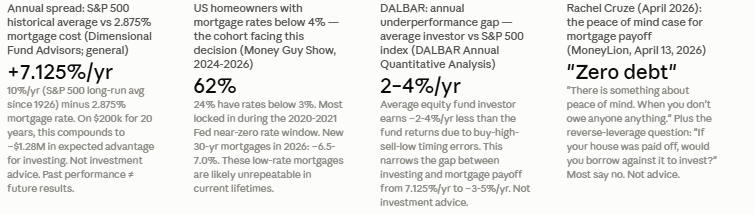
62% of US homeowners have mortgages below 4%. 24% have mortgages below 3% (Money Guy Show, 2024-2026). S&P 500 historical average: ~10%/year since 1926. 2.875% mortgage: opportunity cost spread vs S&P 500 = ~7.125%/year. DALBAR: average equity investor underperforms the S&P 500 by 2-4%/yr due to timing behaviour. Rachel Cruze (Ramsey's daughter, April 2026): 'There is something about peace of mind. When you don't owe anyone anything.' Sources: Money Guy Show; Dimensional Fund Advisors; DALBAR; MoneyLion. Not financial advice.
Ramsey’s core argument for paying off the mortgage is what he calls the guarantee argument. When you pay down a mortgage at 2.875%, you earn a guaranteed, risk-free return of 2.875% on every dollar applied to the principal. There is no market risk, no sequencing risk, no volatility, no uncertainty. The return is mathematically locked. Compare this to investing in the stock market, where the 10% historical average includes years of -37%, -20%, and -43% returns that can permanently impair a portfolio if they occur at the wrong time in a financial life.
Ramsey also makes a behavioural argument that is distinct from the mathematical one: most people are not disciplined enough to actually invest the difference. Money that is not going toward the mortgage is not always, or even usually, going into a Vanguard index fund and staying there untouched for 30 years. It gets spent. It gets pulled out during market corrections. It funds lifestyle inflation. The guaranteed return of debt payoff has the additional advantage of being automatic and irreversible — every dollar sent to the mortgage actually reduces the balance.
Dave Says: Dave Ramsey's Baby Step 6 logic: (1) Guarantee argument: 2.875% risk-free return on every dollar applied to principal -- no market risk. (2) Behavioural argument: most people don't actually invest the difference consistently. (3) Peace of mind argument: the mortgage payment is the largest monthly obligation for most families; eliminating it is liberating. (4) Rachel Cruze's question: 'If your house was paid off, would you borrow on your house to invest in the market?' -- if the answer is no, then keeping the mortgage to invest is doing exactly that, just in reverse. (5) 'Don't take financial advice from broke people' -- Ramsey dismisses conventional financial opinion by noting most people giving advice to keep the mortgage are not building wealth effectively. Sources: Nasdaq/GoFundMe; Yahoo Finance; MoneyLion April 2026. Not financial advice.
At 2.875% mortgage rate versus 10% historical stock return, the annual spread is 7.125%. Every dollar deployed to the mortgage earns 2.875% (guaranteed). Every dollar deployed to an S&P 500 index fund has historically earned 10% (not guaranteed). The decision to pay off the mortgage rather than invest is equivalent, in expected value terms, to choosing the lower-return asset. Over 20 or 30 years, this compounds into a very large number.
The Money Guy Show makes this argument explicitly with specific 2026 data. Noting that 62% of homeowners have sub-4% mortgages and 24% have sub-3%, they argue: if a caller has a $1 million portfolio and a 2.5% or 2.875% mortgage, pulling that money out of the portfolio to pay off the debt — especially if the money is in retirement accounts where withdrawal triggers income tax and potentially early withdrawal penalties — is difficult to justify mathematically. The friction costs (tax, penalties, opportunity cost) make the payoff even more expensive than the simple interest rate comparison suggests.
The Counter-Argument: The mathematical counter-argument at 2.875%: at 10% S&P 500 historical average minus 2.875% mortgage cost = 7.125% annual advantage in favour of investing. On $200,000 for 20 years: investing produces approximately $1,345,000 (FV = $200,000 × 1.10^20). Paying off mortgage saves approximately $65,000 in interest over 20 years. Difference: approximately $1,280,000 in expected terminal value. Additional factors favouring investing: (1) inflation erodes the real value of fixed mortgage debt over time (a 2.875% mortgage is BELOW recent inflation rates of 3-6%, effectively making the borrowing free in real terms); (2) home equity is illiquid until sold or refinanced; (3) mortgage interest tax deduction for itemisers; (4) the guaranteed nature of a 5%+ Treasury yield provides an even simpler risk-free alternative to the mortgage that outperforms 2.875%. Sources: Money Guy Show; Right Attitudes; Dimensional. Not financial advice.
By 2026, the average new 30-year fixed mortgage rate is approximately 6.5–7.0%, more than double the rates that millions of homeowners locked in. This creates an ironic inversion: homeowners with 2.875% mortgages are effectively borrowing money more cheaply than the US government can borrow (10-year Treasury yields are approximately 4.0–4.5% in 2026). They are locked into a borrowing rate that will almost certainly never be replicated in their lifetimes.
This context changes the Ramsey debate in a specific way. In a normal interest rate environment — where a mortgage rate of 6%, 7%, or 8% is standard — Ramsey’s guarantee argument is stronger because the cost of the debt is higher and the gap between the mortgage rate and expected investment returns is smaller. But at 2.875%, the gap is so large that the mathematical case against payoff is unusually strong. The people debating this decision are in an unusual and possibly unrepeatable financial situation. Not financial advice.
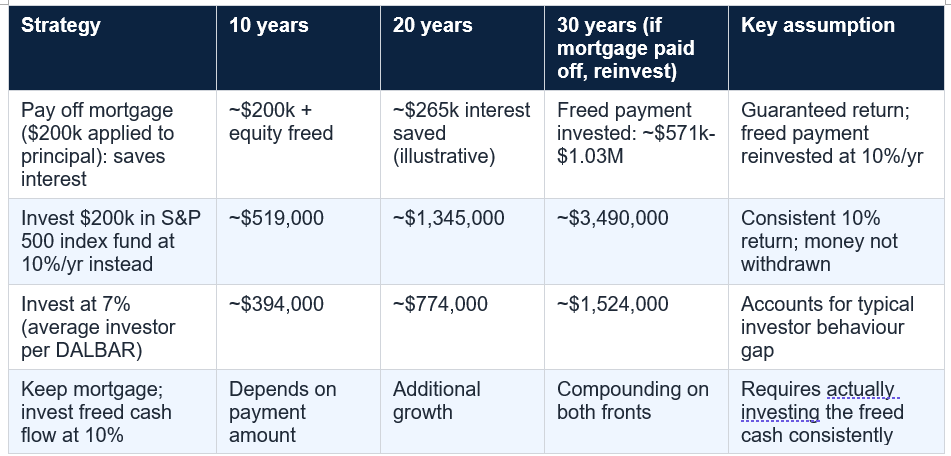
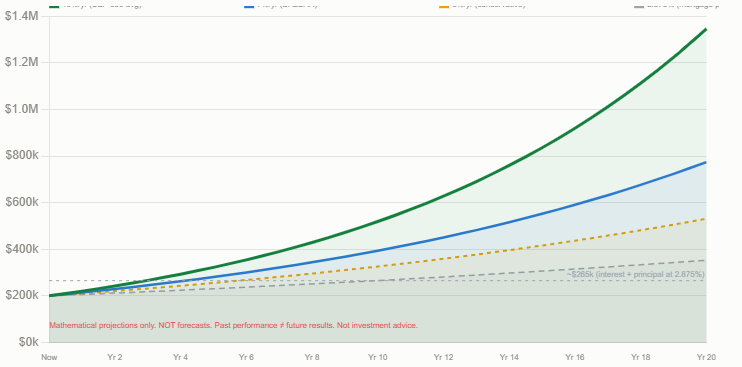
All projections use FV = P × (1+r)^n. Not forecasts or guarantees. The critical variable is not the return rate; it is whether the money that is NOT going to the mortgage is actually consistently invested and never touched. Sources: illustrative calculations; Dimensional Fund Advisors (10%/yr historical); DALBAR (average investor behaviour). Not financial advice.
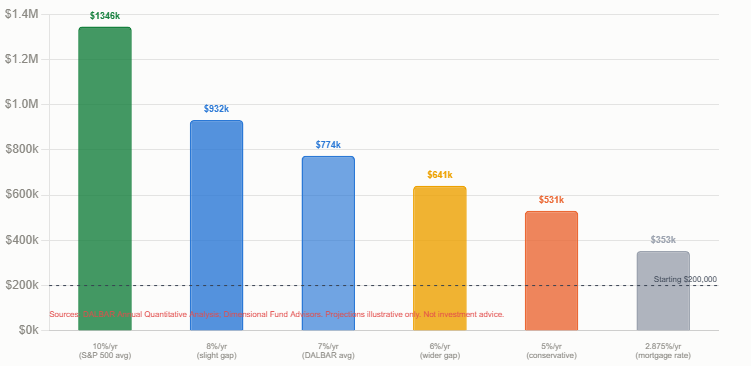
The critical maths: on $200,000 at 10%/yr for 20 years (S&P 500 historical average): $200,000 × (1.10)^20 = approximately $1,345,000. Interest saved by paying off $200,000 at 2.875% over 20 years: approximately $64,500 (simplified). Gap in expected terminal value: approximately $1,280,000 in favour of investing. But: at the DALBAR average investor return of 7%/yr (accounting for typical buy-high-sell-low behaviour): $200,000 × (1.07)^20 = approximately $774,000. The DALBAR-adjusted gap shrinks to approximately $710,000. And at 5%/yr (conservative, accounting for risk and taxes): $200,000 × (1.05)^20 = approximately $531,000. Which is still more than the ~$65,000 in saved interest. So purely mathematically, the investment case holds at most reasonable return assumptions. Not financial advice.
Consider what the ‘invest the difference’ strategy actually requires in practice. Every month, instead of applying extra money to the mortgage, you must deposit it into an investment account and leave it invested through every market correction, every job loss, every recession, every year when your portfolio drops 20% or 30%. You must not spend it when the roof needs replacing, when you need a new car, when a medical bill arrives, when inflation erodes your purchasing power and the temptation to liquidate and ‘buy back in later’ becomes overwhelming.
DALBAR’s Annual Quantitative Analysis of Investor Behaviour — the most comprehensive ongoing study of what real investors actually do with their money — consistently finds that the average equity fund investor earns 2–4 percentage points less per year than the funds they are invested in, specifically because of poor entry and exit timing. They sell during corrections and buy after recoveries. The 10% S&P 500 historical average assumes you stay invested through every single one of those corrections. Most people do not. The guaranteed 2.875% return from debt payoff does not require any discipline beyond writing the check. Not financial advice.
Over 20 years, a 2–4 percentage point gap dramatically changes the terminal value calculation. At 10%/yr, $200,000 becomes $1,345,000. At 7%/yr (10% minus 3% DALBAR gap), $200,000 becomes $774,000. At 6%/yr, $200,000 becomes $642,000. The mortgage payoff is still not the superior strategy even at the lower DALBAR-adjusted rates — the maths favours investing even at 5% or 6% annual returns over 20 years. But the gap between the strategies narrows substantially, and the guaranteed return of debt payoff becomes more competitive.
There is also the tax question. Investment returns in a taxable brokerage account are subject to capital gains tax when realised and dividend tax annually. In a Roth IRA, they are permanently tax-free. Whether the ‘invest the difference’ money is in a tax-sheltered account — and whether the retirement account maximum has already been reached before the extra cash is available for the mortgage vs invest decision — materially affects the post-tax comparison. Ramsey’s system addresses this by requiring Baby Step 4 (15% retirement investing in tax-advantaged accounts) to be complete before Baby Step 6 (mortgage payoff) begins. Not financial advice.
The mortgage payment is, for most families, the single largest fixed monthly expense. Eliminating it does not just free up money; it fundamentally changes the risk profile of the household. A household with no mortgage can survive on dramatically lower income during a job loss, a health crisis, or an economic downturn. The emergency fund requirement drops.
The anxiety about market volatility drops. The sensitivity to interest rate changes drops to zero. These are not sentimental benefits; they are structural changes in financial resilience.
Rachel Cruze (April 13, 2026, MoneyLion) articulates this from the Ramsey perspective: ‘There is something about peace of mind. When you don’t owe anyone anything.’ Cruze explicitly acknowledges the mathematical argument for investing (‘it seems to make sense if you locked in a low-rate mortgage for 2% or 3%’) and then asks the question that reframes the entire debate: ‘If your house was paid off, would you borrow on your house to go invest in the market? The answer is usually no.’ This rhetorical move is decisive for many people because it exposes the logical inconsistency of feeling comfortable carrying a mortgage while feeling uncomfortable about borrowing to invest — when the two are economically equivalent.
The psychological benefit in financial terms: (1) Reduced fixed obligations: eliminating a $1,500/month mortgage changes the household's monthly break-even point by $1,500 — dramatically improving resilience during income disruption. (2) Stress reduction: financial stress is a leading contributor to relationship breakdown, health problems, and poor decision-making. A paid-off home removes the largest source of financial anxiety for most families. (3) Behavioural improvement: people with no mortgage are more likely to stay invested during market corrections because they are not also anxious about losing their home. (4) Flexibility: a mortgage-free household can take more career risks, negotiate from strength, and make more deliberate financial choices. Not financial advice — consult a qualified adviser.
Almost nobody answers yes. The idea of taking out a home equity loan or cash-out refinance specifically to invest in equities — to deliberately add a mortgage obligation to their balance sheet in order to put the proceeds in an index fund — feels intuitively dangerous to most homeowners. It feels like speculation. It feels like leverage. It feels risky.
But this is precisely what keeping a 2.875% mortgage while investing is doing, in reverse. You are maintaining a debt against your house — a liability secured by your home — in order to keep money invested in the market rather than eliminating the debt. The only difference between this and taking out a new mortgage to invest is the direction of the transaction. Economically, they are equivalent: in both cases, you are using debt secured by your home to fund market investments.
For most people, the discomfort of Cruze’s question — the immediate, visceral ‘no’ to borrowing against the house to invest — reveals a genuine risk preference that the spreadsheet does not capture. If you would not voluntarily take the risk in the direction of new mortgage to invest, the intellectual consistency of maintaining the existing mortgage to invest deserves scrutiny. Not financial advice.
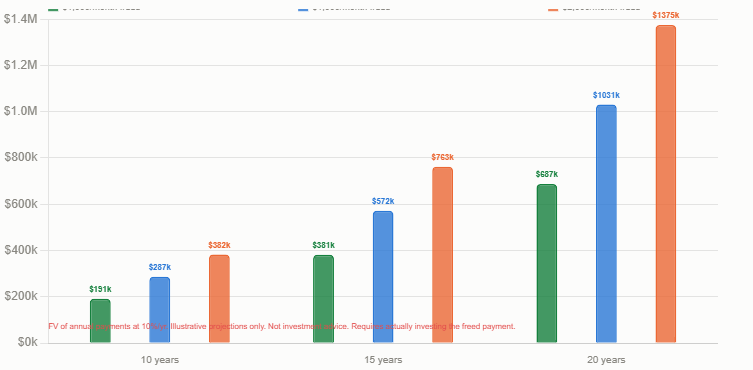
$18,000 per year invested at the S&P 500’s historical 10% annual return, starting at age 50 and running to age 65, produces approximately $571,000 (FV of $18,000/year annuity at 10% for 15 years). Starting at age 45 and running to age 65: approximately $1,030,000. This is Ramsey’s counter to the opportunity cost argument: yes, you give up some investment return during the payoff years, but you then unleash the mortgage payment itself as a powerful investment tool for the remaining working years. The mortgage payoff is not the end of wealth building; it is the beginning of the most aggressive wealth-building phase.
The cash flow liberation also means that in the post-payoff years, the household can invest the full former mortgage payment without any financial sacrifice — the money is already not being spent on consumption; it was going to the mortgage. This removes one of the most common barriers to consistent investing: the feeling of choosing between present consumption and future investment. The freed mortgage payment is, psychologically, already ‘gone’ from the monthly budget; it simply redirects to investments rather than housing costs.
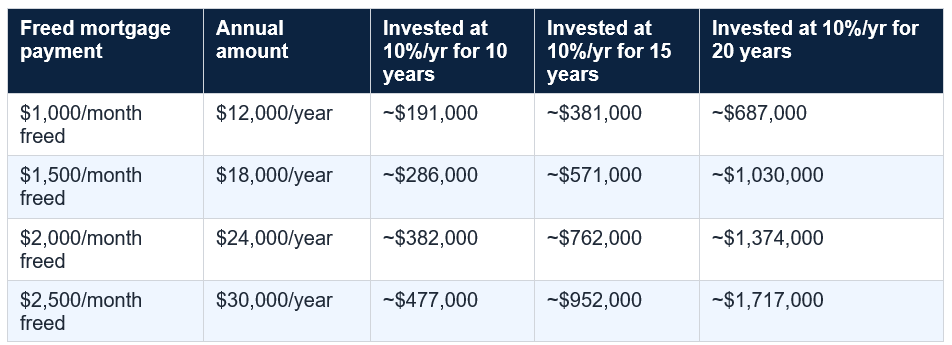
FV of annual payments = annual amount × ((1+r)^n - 1) / r at r = 10%/yr. Not forecasts or guarantees. Illustrative calculations only. Actual returns will vary. Not financial advice.
Sequence of returns risk is the danger that poor investment returns in the years immediately before or after retirement can permanently impair portfolio survival, even if the long-run average return eventually recovers. A 40% portfolio loss at age 60 combined with a $1,500/month mortgage payment creates a genuinely dangerous financial situation: the need to sell assets at depressed prices to service the mortgage accelerates portfolio depletion in exactly the wrong way. A paid-off home eliminates this specific vulnerability.
For people approaching retirement with a low-rate mortgage, the guarantee argument becomes stronger — not because 2.875% is a high return, but because eliminating the mortgage payment reduces the amount the portfolio must support each month during the retirement drawdown phase. A portfolio supporting $3,000/month of retirement expenses is structurally different from one supporting $4,500/month (with a $1,500 mortgage included). The lower withdrawal rate dramatically improves the probability of portfolio survival over a 30-year retirement.
If your mortgage payoff timeline extends into retirement — meaning you will be making mortgage payments during the drawdown phase of your investment portfolio — the risk calculation changes significantly. Sequence of returns risk combined with mandatory fixed mortgage payments in a down market creates a vulnerability that the simple 'invest vs pay off' comparison at working-age rates does not capture. For near-retirees, the guaranteed elimination of the mortgage obligation has additional value beyond the interest saved. Not financial advice. Consult a qualified financial adviser.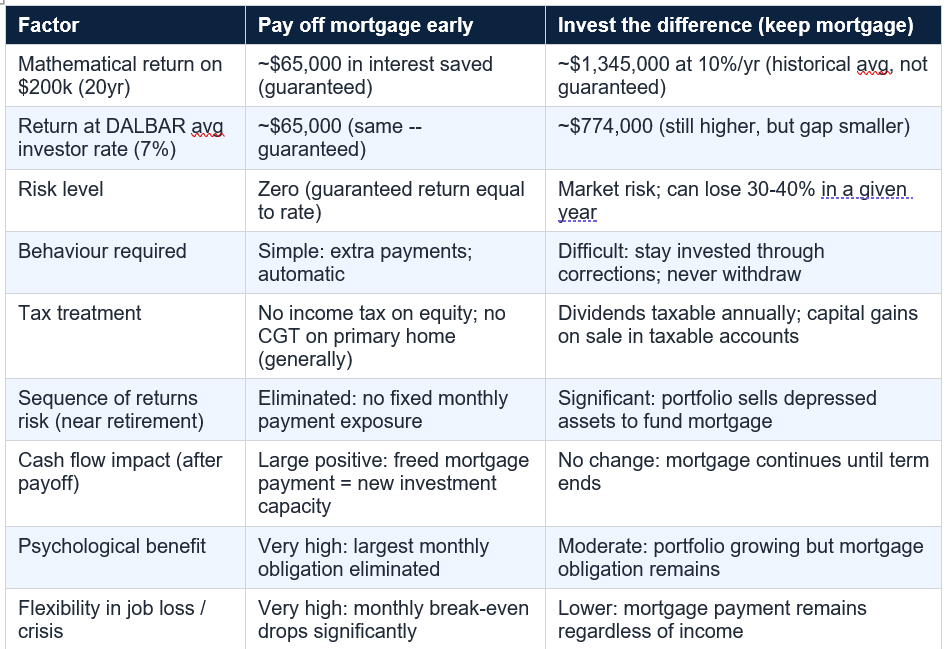
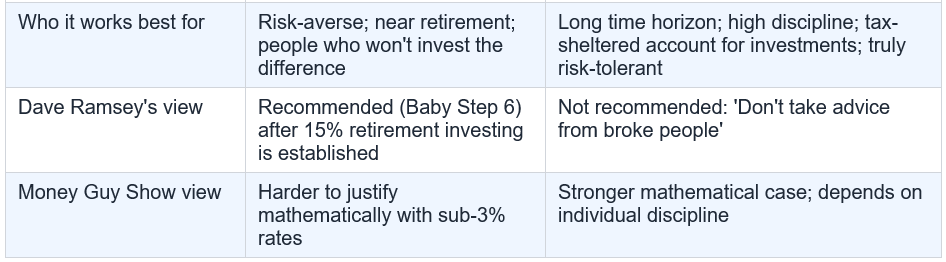
But Ramsey’s advice is not designed for the mathematically optimal investor who will consistently invest the difference in a low-cost index fund, never panic-sell, tax-optimise, and make perfectly rational decisions for 30 years. It is designed for the financially anxious household that is spending too much, carrying consumer debt, underinvesting, and looking for a clear, simple framework to change direction. For this audience — which is the overwhelming majority of people calling in to the Ramsey Show — the strict, simple, anti-debt framework works because it eliminates the scope for rationalisation.
The person who follows Ramsey’s Baby Steps faithfully, pays off all consumer debt, builds a 3–6 month emergency fund, invests 15% of income in tax-advantaged retirement accounts, and then uses extra income to pay off the mortgage, will have a financial outcome that is extremely good by any real-world standard. Not theoretically optimal. Not the highest possible NPV. But genuinely, practically excellent in terms of financial security, psychological well-being, and retirement readiness. That is a harder thing to model in a spreadsheet than it is to observe in the lives of people who have done it.
But the spreadsheet is not the whole story. The spreadsheet assumes you will actually invest the difference consistently, at market returns, without behavioural errors, through every market correction, for decades. It does not account for the psychological benefit of eliminating the largest monthly obligation in the household budget. It does not account for sequence of returns risk for near-retirees. It does not account for the cash flow liberation that allows more aggressive investing after the mortgage is gone. And it does not account for what Rachel Cruze correctly identifies: that maintaining a mortgage to invest is economically equivalent to borrowing against your house to invest — something most people would never voluntarily do.
Dave Ramsey was right, not because the maths favour him — they don’t, at 2.875% — but because the decision to pay off the mortgage early is the right decision for most people given who most people actually are and how they actually behave. For the exceptional investor who will reliably execute the invest-the-difference strategy with discipline and patience, the maths point clearly to keeping the mortgage. For everyone else — which is most people — the guaranteed return, the psychological dividend, and the cash flow liberation of being mortgage-free are real and substantial advantages that the spreadsheet systematically undervalues. Not financial advice. Consult a qualified independent financial adviser.
Mathematically, keeping a 2.875% mortgage and investing the difference in an S&P 500 index fund (historical average ~10%/year) is the superior strategy in most scenarios. The 7.125% annual spread in expected returns, compounded over 20-30 years, produces a significantly higher terminal value than the interest saved from early payoff. However, the invest-the-difference strategy requires you to consistently invest the freed cash at market returns, stay invested through corrections, and never withdraw the money — which DALBAR research shows most investors fail to do consistently (average investor return trails the S&P 500 by 2-4%/year due to timing errors). Dave Ramsey's guaranteed return argument has psychological and behavioural advantages that the mathematical comparison underweights. Whether early payoff is 'smart' depends on your time horizon, risk tolerance, investment discipline, and proximity to retirement. Not financial advice. Consult a qualified adviser.
What is Dave Ramsey's position on paying off a mortgage?
Dave Ramsey's Baby Step 6 is 'pay off your home early.' This comes after Baby Steps 1-5, which include building a starter emergency fund, paying off all consumer debt (debt snowball), saving 3-6 months of expenses, investing 15% of household income in tax-advantaged retirement accounts, and saving for children's college. Ramsey's core arguments for early mortgage payoff are: (1) the guarantee argument (every dollar applied to the mortgage earns a guaranteed, risk-free return equal to the mortgage rate); (2) the behavioural argument (most people don't actually invest the difference consistently); (3) the peace of mind argument (eliminating the mortgage liberates cash flow and eliminates financial stress). Rachel Cruze (Ramsey's daughter) adds the 'reverse leverage' question: 'If your house was paid off, would you borrow on your house to invest in the market?' Most people answer no — which challenges the logic of maintaining a mortgage to invest. Sources: Nasdaq; Yahoo Finance; MoneyLion (April 2026). Not financial advice.
What percentage of homeowners have mortgage rates below 4%?
Approximately 62% of US homeowners have mortgage rates below 4%, and 24% have rates below 3%, according to data cited by the Money Guy Show (2024-2026). These are primarily homeowners who refinanced or purchased during the 2020-2021 period when the Federal Reserve's near-zero interest rate policy pushed 30-year fixed mortgage rates to historic lows, with some borrowers locking in rates as low as 2.5%-2.875%. By 2026, new 30-year fixed mortgage rates are approximately 6.5%-7.0%, making these legacy low-rate mortgages an unusually advantageous liability that complicates the standard Ramsey mortgage payoff advice. Sources: Money Guy Show; general 2026 mortgage market data. Not financial advice.
What is the opportunity cost of paying off a 2.875% mortgage?
The opportunity cost is the difference between what the money could have earned if invested versus the interest saved by paying off the mortgage. At 2.875% mortgage rate versus 10% S&P 500 historical average, the annual spread is approximately 7.125%. On $200,000 for 20 years: investing would theoretically produce approximately $1,345,000 (FV = $200,000 × 1.10^20), while early mortgage payoff saves approximately $65,000 in interest — a difference of approximately $1,280,000 in expected terminal value in favour of investing. However, this calculation assumes consistent investment at the 10% historical rate with no withdrawals, no behavioural errors, and no taxes on returns — assumptions that DALBAR research suggests significantly overstate what average investors actually achieve. Not financial advice. Consult a qualified financial adviser.
Should I pay off my mortgage before investing?
Dave Ramsey's framework explicitly says no: Baby Step 4 (invest 15% of income in retirement accounts) comes before Baby Step 6 (pay off the mortgage). Ramsey does not recommend stopping retirement investing to pay off even a low-rate mortgage. The most widely endorsed order: (1) max any employer 401(k) match (free money), (2) pay off all high-interest consumer debt, (3) build 3-6 month emergency fund, (4) max Roth IRA ($7,000/year in 2026) and 401(k) ($24,500/year), (5) then consider whether extra cash goes to mortgage payoff or taxable investing. At a 2.875% mortgage rate, with all retirement accounts maxed and no other debt, the decision between mortgage payoff and taxable investing is genuinely close and depends on individual risk tolerance, time horizon, and investment discipline. Not financial advice. Consult a qualified financial adviser.
Table of Contents
- The Mortgage That Divided the Personal Finance World
- Dave Ramsey’s Position: Baby Step 6 and the Guarantee Argument
- The Mathematical Case Against Paying Off a 2.875% Mortgage
- Why 62% of Homeowners Have This Exact Problem
- The Opportunity Cost: What the Spreadsheet Says
- Why the Spreadsheet Argument Has a Hidden Assumption
- The DALBAR Problem: What People Actually Do With Extra Money
- The Psychological Dividend: Peace of Mind Is Not Woo-Woo
- Rachel Cruze’s Question That Silenced Every Counter-Argument
- The Cash Flow Liberation: What Happens When the Mortgage Is Gone
- Risk, Sequence, and Why 2.875% Looks Different in Retirement
- The Honest Side-by-Side: Pay Off vs Invest
- Dave Ramsey’s Imperfect Advice and Why It Still Works
- Who Should NOT Pay Off a Low-Rate Mortgage Early
- Conclusion: The Right Answer Depends on Who You Actually Are
- Frequently Asked Questions
Opportunity cost — the maths of pay off vs invest
The DALBAR gap — what real investors actually earn
Cash flow liberation — investing the freed payment
The Mortgage That Divided the Personal Finance World
Few financial decisions generate more passionate disagreement than whether to pay off a low-rate mortgage early. The debate intensified after 2020–2021, when the Federal Reserve’s near-zero interest rate policy produced a wave of mortgage refinancings at historically low rates. Millions of American homeowners locked in 30-year fixed mortgages at rates of 2.5%, 2.875%, and 3.0% — rates that looked extraordinary at the time and look even more extraordinary now, when new mortgages are running at 6.5–7.0%. By 2024–2026, approximately 62% of US homeowners had mortgage rates below 4%, and 24% had rates below 3%, according to data cited by the Money Guy Show.For this cohort, Dave Ramsey’s Baby Step 6 — ‘pay off your home early’ — creates a direct confrontation with conventional financial mathematics. The S&P 500 has returned approximately 10% per year historically (Dimensional Fund Advisors; Hartford Funds). A mortgage at 2.875% costs 2.875% per year. The arithmetic spread is 7.125% per year in favour of investing rather than paying down the mortgage. On a $200,000 remaining mortgage, that 7.125% annual advantage compounds to an enormous terminal value difference over 20 or 30 years. The spreadsheet is unambiguous.
And yet millions of people who have followed Dave Ramsey’s advice to pay off their mortgages report not just financial satisfaction but something closer to life transformation. The absence of a mortgage payment is not just a financial event; it is a psychological one. This article takes both sides seriously, does the full maths, and arrives at a conclusion that the spreadsheet alone cannot reach: the right answer depends on who you actually are, not on what the optimal mathematical strategy is in theory. Not financial advice.
62% of US homeowners have mortgages below 4%. 24% have mortgages below 3% (Money Guy Show, 2024-2026). S&P 500 historical average: ~10%/year since 1926. 2.875% mortgage: opportunity cost spread vs S&P 500 = ~7.125%/year. DALBAR: average equity investor underperforms the S&P 500 by 2-4%/yr due to timing behaviour. Rachel Cruze (Ramsey's daughter, April 2026): 'There is something about peace of mind. When you don't owe anyone anything.' Sources: Money Guy Show; Dimensional Fund Advisors; DALBAR; MoneyLion. Not financial advice.
Dave Ramsey’s Position: Baby Step 6 and the Guarantee Argument
Dave Ramsey’s mortgage payoff philosophy sits inside his Seven Baby Steps framework, which is the central organising structure of his financial advice. Baby Step 6 specifically is ‘Pay off your home early,’ and it comes after Baby Steps 1 through 5 which cover the emergency fund, debt payoff (using the debt snowball), retirement investing at 15% of income, and college savings for children. This sequencing is important: Ramsey does not tell people to pay off their mortgage before investing for retirement. He tells them to do both, in order, and then after the retirement investing is established, to accelerate the mortgage.Ramsey’s core argument for paying off the mortgage is what he calls the guarantee argument. When you pay down a mortgage at 2.875%, you earn a guaranteed, risk-free return of 2.875% on every dollar applied to the principal. There is no market risk, no sequencing risk, no volatility, no uncertainty. The return is mathematically locked. Compare this to investing in the stock market, where the 10% historical average includes years of -37%, -20%, and -43% returns that can permanently impair a portfolio if they occur at the wrong time in a financial life.
Ramsey also makes a behavioural argument that is distinct from the mathematical one: most people are not disciplined enough to actually invest the difference. Money that is not going toward the mortgage is not always, or even usually, going into a Vanguard index fund and staying there untouched for 30 years. It gets spent. It gets pulled out during market corrections. It funds lifestyle inflation. The guaranteed return of debt payoff has the additional advantage of being automatic and irreversible — every dollar sent to the mortgage actually reduces the balance.
Dave Says: Dave Ramsey's Baby Step 6 logic: (1) Guarantee argument: 2.875% risk-free return on every dollar applied to principal -- no market risk. (2) Behavioural argument: most people don't actually invest the difference consistently. (3) Peace of mind argument: the mortgage payment is the largest monthly obligation for most families; eliminating it is liberating. (4) Rachel Cruze's question: 'If your house was paid off, would you borrow on your house to invest in the market?' -- if the answer is no, then keeping the mortgage to invest is doing exactly that, just in reverse. (5) 'Don't take financial advice from broke people' -- Ramsey dismisses conventional financial opinion by noting most people giving advice to keep the mortgage are not building wealth effectively. Sources: Nasdaq/GoFundMe; Yahoo Finance; MoneyLion April 2026. Not financial advice.
The Mathematical Case Against Paying Off a 2.875% Mortgage
The mathematical case for keeping a 2.875% mortgage and investing the payment difference is compelling and should be honestly stated before being challenged. The S&P 500’s historical average annual return since 1926 is approximately 10%, and since the 1970s when low-cost index funds became available, capturing this return has been accessible to ordinary investors through Vanguard, Fidelity, and Schwab at essentially zero cost.At 2.875% mortgage rate versus 10% historical stock return, the annual spread is 7.125%. Every dollar deployed to the mortgage earns 2.875% (guaranteed). Every dollar deployed to an S&P 500 index fund has historically earned 10% (not guaranteed). The decision to pay off the mortgage rather than invest is equivalent, in expected value terms, to choosing the lower-return asset. Over 20 or 30 years, this compounds into a very large number.
The Money Guy Show makes this argument explicitly with specific 2026 data. Noting that 62% of homeowners have sub-4% mortgages and 24% have sub-3%, they argue: if a caller has a $1 million portfolio and a 2.5% or 2.875% mortgage, pulling that money out of the portfolio to pay off the debt — especially if the money is in retirement accounts where withdrawal triggers income tax and potentially early withdrawal penalties — is difficult to justify mathematically. The friction costs (tax, penalties, opportunity cost) make the payoff even more expensive than the simple interest rate comparison suggests.
The Counter-Argument: The mathematical counter-argument at 2.875%: at 10% S&P 500 historical average minus 2.875% mortgage cost = 7.125% annual advantage in favour of investing. On $200,000 for 20 years: investing produces approximately $1,345,000 (FV = $200,000 × 1.10^20). Paying off mortgage saves approximately $65,000 in interest over 20 years. Difference: approximately $1,280,000 in expected terminal value. Additional factors favouring investing: (1) inflation erodes the real value of fixed mortgage debt over time (a 2.875% mortgage is BELOW recent inflation rates of 3-6%, effectively making the borrowing free in real terms); (2) home equity is illiquid until sold or refinanced; (3) mortgage interest tax deduction for itemisers; (4) the guaranteed nature of a 5%+ Treasury yield provides an even simpler risk-free alternative to the mortgage that outperforms 2.875%. Sources: Money Guy Show; Right Attitudes; Dimensional. Not financial advice.
Why 62% of Homeowners Have This Exact Problem
The 2020–2021 refinancing window produced a once-in-a-generation opportunity for homeowners. The Federal Reserve’s near-zero interest rate policy in response to the COVID-19 pandemic pushed 30-year fixed mortgage rates to record lows. Rates dipped below 3% for the first time in decades — in some cases, creditworthy borrowers locked in 30-year mortgages at 2.625%, 2.75%, or 2.875%. For homeowners who refinanced in this window, their mortgage is now a fixed liability at a cost that is below current inflation targets, well below current Treasury yields, and drastically below new mortgage rates.By 2026, the average new 30-year fixed mortgage rate is approximately 6.5–7.0%, more than double the rates that millions of homeowners locked in. This creates an ironic inversion: homeowners with 2.875% mortgages are effectively borrowing money more cheaply than the US government can borrow (10-year Treasury yields are approximately 4.0–4.5% in 2026). They are locked into a borrowing rate that will almost certainly never be replicated in their lifetimes.
This context changes the Ramsey debate in a specific way. In a normal interest rate environment — where a mortgage rate of 6%, 7%, or 8% is standard — Ramsey’s guarantee argument is stronger because the cost of the debt is higher and the gap between the mortgage rate and expected investment returns is smaller. But at 2.875%, the gap is so large that the mathematical case against payoff is unusually strong. The people debating this decision are in an unusual and possibly unrepeatable financial situation. Not financial advice.
The Opportunity Cost: What the Spreadsheet Says
The most rigorous version of the opportunity cost argument uses actual numbers rather than generalisations. For a homeowner with $200,000 remaining on a 2.875% mortgage with 20 years left on the loan, the two strategies produce very different mathematical outcomes.All projections use FV = P × (1+r)^n. Not forecasts or guarantees. The critical variable is not the return rate; it is whether the money that is NOT going to the mortgage is actually consistently invested and never touched. Sources: illustrative calculations; Dimensional Fund Advisors (10%/yr historical); DALBAR (average investor behaviour). Not financial advice.
The critical maths: on $200,000 at 10%/yr for 20 years (S&P 500 historical average): $200,000 × (1.10)^20 = approximately $1,345,000. Interest saved by paying off $200,000 at 2.875% over 20 years: approximately $64,500 (simplified). Gap in expected terminal value: approximately $1,280,000 in favour of investing. But: at the DALBAR average investor return of 7%/yr (accounting for typical buy-high-sell-low behaviour): $200,000 × (1.07)^20 = approximately $774,000. The DALBAR-adjusted gap shrinks to approximately $710,000. And at 5%/yr (conservative, accounting for risk and taxes): $200,000 × (1.05)^20 = approximately $531,000. Which is still more than the ~$65,000 in saved interest. So purely mathematically, the investment case holds at most reasonable return assumptions. Not financial advice.
Why the Spreadsheet Argument Has a Hidden Assumption
The spreadsheet case for investing over paying off the mortgage rests on one assumption that is almost never stated explicitly: that you will actually invest the money that is not going toward the mortgage, at the market’s long-run average return rate, and not touch it for the full period of the comparison. This assumption is not trivial. It is, in fact, the hardest part of the entire strategy.Consider what the ‘invest the difference’ strategy actually requires in practice. Every month, instead of applying extra money to the mortgage, you must deposit it into an investment account and leave it invested through every market correction, every job loss, every recession, every year when your portfolio drops 20% or 30%. You must not spend it when the roof needs replacing, when you need a new car, when a medical bill arrives, when inflation erodes your purchasing power and the temptation to liquidate and ‘buy back in later’ becomes overwhelming.
DALBAR’s Annual Quantitative Analysis of Investor Behaviour — the most comprehensive ongoing study of what real investors actually do with their money — consistently finds that the average equity fund investor earns 2–4 percentage points less per year than the funds they are invested in, specifically because of poor entry and exit timing. They sell during corrections and buy after recoveries. The 10% S&P 500 historical average assumes you stay invested through every single one of those corrections. Most people do not. The guaranteed 2.875% return from debt payoff does not require any discipline beyond writing the check. Not financial advice.
The DALBAR Problem: What People Actually Do With Extra Money
The DALBAR problem — the persistent gap between fund returns and investor returns — is the most important empirical argument in the Ramsey camp, and it is almost never cited in the invest-the-difference debates. The S&P 500 returned approximately 10% per year since 1926. But the average equity fund investor, according to DALBAR’s annual research, has consistently earned 2–4 percentage points less per year over most measured periods, because they make timing mistakes: buying high after markets recover, selling low when markets correct.Over 20 years, a 2–4 percentage point gap dramatically changes the terminal value calculation. At 10%/yr, $200,000 becomes $1,345,000. At 7%/yr (10% minus 3% DALBAR gap), $200,000 becomes $774,000. At 6%/yr, $200,000 becomes $642,000. The mortgage payoff is still not the superior strategy even at the lower DALBAR-adjusted rates — the maths favours investing even at 5% or 6% annual returns over 20 years. But the gap between the strategies narrows substantially, and the guaranteed return of debt payoff becomes more competitive.
There is also the tax question. Investment returns in a taxable brokerage account are subject to capital gains tax when realised and dividend tax annually. In a Roth IRA, they are permanently tax-free. Whether the ‘invest the difference’ money is in a tax-sheltered account — and whether the retirement account maximum has already been reached before the extra cash is available for the mortgage vs invest decision — materially affects the post-tax comparison. Ramsey’s system addresses this by requiring Baby Step 4 (15% retirement investing in tax-advantaged accounts) to be complete before Baby Step 6 (mortgage payoff) begins. Not financial advice.
The Psychological Dividend: Peace of Mind Is Not Woo-Woo
The most frequently dismissed argument in the Ramsey camp is the psychological one: paying off the mortgage feels good. Critics rightly point out that feelings are not a basis for financial decisions — you cannot spend feelings on groceries. But the psychological benefit of mortgage freedom is not as irrational as the dismissal implies, and there is a growing body of research connecting financial security and reduced indebtedness to measurable well-being outcomes.The mortgage payment is, for most families, the single largest fixed monthly expense. Eliminating it does not just free up money; it fundamentally changes the risk profile of the household. A household with no mortgage can survive on dramatically lower income during a job loss, a health crisis, or an economic downturn. The emergency fund requirement drops.
The anxiety about market volatility drops. The sensitivity to interest rate changes drops to zero. These are not sentimental benefits; they are structural changes in financial resilience.
Rachel Cruze (April 13, 2026, MoneyLion) articulates this from the Ramsey perspective: ‘There is something about peace of mind. When you don’t owe anyone anything.’ Cruze explicitly acknowledges the mathematical argument for investing (‘it seems to make sense if you locked in a low-rate mortgage for 2% or 3%’) and then asks the question that reframes the entire debate: ‘If your house was paid off, would you borrow on your house to go invest in the market? The answer is usually no.’ This rhetorical move is decisive for many people because it exposes the logical inconsistency of feeling comfortable carrying a mortgage while feeling uncomfortable about borrowing to invest — when the two are economically equivalent.
The psychological benefit in financial terms: (1) Reduced fixed obligations: eliminating a $1,500/month mortgage changes the household's monthly break-even point by $1,500 — dramatically improving resilience during income disruption. (2) Stress reduction: financial stress is a leading contributor to relationship breakdown, health problems, and poor decision-making. A paid-off home removes the largest source of financial anxiety for most families. (3) Behavioural improvement: people with no mortgage are more likely to stay invested during market corrections because they are not also anxious about losing their home. (4) Flexibility: a mortgage-free household can take more career risks, negotiate from strength, and make more deliberate financial choices. Not financial advice — consult a qualified adviser.
Rachel Cruze’s Question That Silenced Every Counter-Argument
The most elegant and decisive argument in the entire mortgage payoff debate comes not from Dave Ramsey himself but from his daughter Rachel Cruze. Her reframing question is simple: ‘If your house was paid off right now, would you go borrow against it to invest in the stock market?’Almost nobody answers yes. The idea of taking out a home equity loan or cash-out refinance specifically to invest in equities — to deliberately add a mortgage obligation to their balance sheet in order to put the proceeds in an index fund — feels intuitively dangerous to most homeowners. It feels like speculation. It feels like leverage. It feels risky.
But this is precisely what keeping a 2.875% mortgage while investing is doing, in reverse. You are maintaining a debt against your house — a liability secured by your home — in order to keep money invested in the market rather than eliminating the debt. The only difference between this and taking out a new mortgage to invest is the direction of the transaction. Economically, they are equivalent: in both cases, you are using debt secured by your home to fund market investments.
For most people, the discomfort of Cruze’s question — the immediate, visceral ‘no’ to borrowing against the house to invest — reveals a genuine risk preference that the spreadsheet does not capture. If you would not voluntarily take the risk in the direction of new mortgage to invest, the intellectual consistency of maintaining the existing mortgage to invest deserves scrutiny. Not financial advice.
The Cash Flow Liberation: What Happens When the Mortgage Is Gone
One of Ramsey’s most compelling arguments for mortgage payoff that gets less attention than the guarantee argument is the cash flow liberation argument. The month after a mortgage is paid off, every dollar that was going to the mortgage payment becomes available for investing, spending, gifting, or any other purpose. For a household with a $1,500 monthly mortgage payment, payoff liberates $18,000 per year.$18,000 per year invested at the S&P 500’s historical 10% annual return, starting at age 50 and running to age 65, produces approximately $571,000 (FV of $18,000/year annuity at 10% for 15 years). Starting at age 45 and running to age 65: approximately $1,030,000. This is Ramsey’s counter to the opportunity cost argument: yes, you give up some investment return during the payoff years, but you then unleash the mortgage payment itself as a powerful investment tool for the remaining working years. The mortgage payoff is not the end of wealth building; it is the beginning of the most aggressive wealth-building phase.
The cash flow liberation also means that in the post-payoff years, the household can invest the full former mortgage payment without any financial sacrifice — the money is already not being spent on consumption; it was going to the mortgage. This removes one of the most common barriers to consistent investing: the feeling of choosing between present consumption and future investment. The freed mortgage payment is, psychologically, already ‘gone’ from the monthly budget; it simply redirects to investments rather than housing costs.
FV of annual payments = annual amount × ((1+r)^n - 1) / r at r = 10%/yr. Not forecasts or guarantees. Illustrative calculations only. Actual returns will vary. Not financial advice.
Risk, Sequence, and Why 2.875% Looks Different in Retirement
The invest-the-difference argument is most compelling for a 35-year-old with 30 years until retirement, a stable income, and a high tolerance for portfolio volatility. It is least compelling for a 55-year-old with 10 years to retirement who would be withdrawing from the investment portfolio at the same time as paying the mortgage — because sequence of returns risk becomes a dominant factor.Sequence of returns risk is the danger that poor investment returns in the years immediately before or after retirement can permanently impair portfolio survival, even if the long-run average return eventually recovers. A 40% portfolio loss at age 60 combined with a $1,500/month mortgage payment creates a genuinely dangerous financial situation: the need to sell assets at depressed prices to service the mortgage accelerates portfolio depletion in exactly the wrong way. A paid-off home eliminates this specific vulnerability.
For people approaching retirement with a low-rate mortgage, the guarantee argument becomes stronger — not because 2.875% is a high return, but because eliminating the mortgage payment reduces the amount the portfolio must support each month during the retirement drawdown phase. A portfolio supporting $3,000/month of retirement expenses is structurally different from one supporting $4,500/month (with a $1,500 mortgage included). The lower withdrawal rate dramatically improves the probability of portfolio survival over a 30-year retirement.
If your mortgage payoff timeline extends into retirement — meaning you will be making mortgage payments during the drawdown phase of your investment portfolio — the risk calculation changes significantly. Sequence of returns risk combined with mandatory fixed mortgage payments in a down market creates a vulnerability that the simple 'invest vs pay off' comparison at working-age rates does not capture. For near-retirees, the guaranteed elimination of the mortgage obligation has additional value beyond the interest saved. Not financial advice. Consult a qualified financial adviser.
The Honest Side-by-Side: Pay Off vs Invest
Dave Ramsey’s Imperfect Advice and Why It Still Works
Dave Ramsey is not an economist, and his advice is not always mathematically optimal. Critics rightly note that his categorical positions — always pay off the mortgage, never carry debt — do not account for individual circumstances, tax situations, and genuinely advantageous borrowing rates. At 2.875%, the mathematical case for keeping the mortgage is legitimate and substantive. Nagesh Belludi (Right Attitudes, November 2021) is correct that ‘Dave Ramsey’s advice just doesn’t make as much sense today with how low interest rates are comparatively.’But Ramsey’s advice is not designed for the mathematically optimal investor who will consistently invest the difference in a low-cost index fund, never panic-sell, tax-optimise, and make perfectly rational decisions for 30 years. It is designed for the financially anxious household that is spending too much, carrying consumer debt, underinvesting, and looking for a clear, simple framework to change direction. For this audience — which is the overwhelming majority of people calling in to the Ramsey Show — the strict, simple, anti-debt framework works because it eliminates the scope for rationalisation.
The person who follows Ramsey’s Baby Steps faithfully, pays off all consumer debt, builds a 3–6 month emergency fund, invests 15% of income in tax-advantaged retirement accounts, and then uses extra income to pay off the mortgage, will have a financial outcome that is extremely good by any real-world standard. Not theoretically optimal. Not the highest possible NPV. But genuinely, practically excellent in terms of financial security, psychological well-being, and retirement readiness. That is a harder thing to model in a spreadsheet than it is to observe in the lives of people who have done it.
Who Should NOT Pay Off a Low-Rate Mortgage Early
Intellectual honesty requires acknowledging the cases where keeping the 2.875% mortgage is the genuinely better strategy. Not everyone should follow Ramsey’s Baby Step 6 without qualification.- Investors with long time horizons and demonstrated investment discipline: if you are under 40, have a stable income, have maxed your Roth IRA and 401(k), have no consumer debt, and have a genuine track record of staying invested through market corrections without panic-selling, the mathematical case for investing rather than paying off a 2.875% mortgage is strong and your individual profile supports the strategy.
- Those with tax-advantaged space still available: if you have not yet maxed your Roth IRA ($7,000/year in 2026) or 401(k) ($24,500/year in 2026), filling tax-advantaged space before paying down a 2.875% mortgage is almost certainly superior, because the tax benefit on those accounts adds to the effective return gap.
- Homeowners with very short remaining mortgage terms: if you have only 3–5 years remaining on the mortgage anyway, the interest saving from early payoff is small and the opportunity cost of accelerating is low. Investing the extra cash produces more meaningful returns.
- High-net-worth individuals with sophisticated tax situations: for investors in the highest marginal tax brackets where mortgage interest is deductible against 37% federal tax, the effective after-tax cost of a 2.875% mortgage may be as low as 1.8%, making the investment spread even more compelling.
- People with the investment infrastructure already built: if you have a fully funded emergency fund, no other debt, all retirement accounts maxed, and the extra money would genuinely go into a brokerage account and stay invested, keeping the mortgage is defensible and the mathematical case supports it.
Conclusion
The spreadsheet is correct: keeping a 2.875% mortgage and investing the difference is mathematically superior to early payoff, at most reasonable return assumptions, for most time horizons. The S&P 500’s long-run average of 10% per year dwarfs the 2.875% guaranteed return on debt payoff. The gap is large enough that even at the DALBAR-adjusted average investor return of 7% per year, the investment strategy outperforms in expected terminal value.But the spreadsheet is not the whole story. The spreadsheet assumes you will actually invest the difference consistently, at market returns, without behavioural errors, through every market correction, for decades. It does not account for the psychological benefit of eliminating the largest monthly obligation in the household budget. It does not account for sequence of returns risk for near-retirees. It does not account for the cash flow liberation that allows more aggressive investing after the mortgage is gone. And it does not account for what Rachel Cruze correctly identifies: that maintaining a mortgage to invest is economically equivalent to borrowing against your house to invest — something most people would never voluntarily do.
Dave Ramsey was right, not because the maths favour him — they don’t, at 2.875% — but because the decision to pay off the mortgage early is the right decision for most people given who most people actually are and how they actually behave. For the exceptional investor who will reliably execute the invest-the-difference strategy with discipline and patience, the maths point clearly to keeping the mortgage. For everyone else — which is most people — the guaranteed return, the psychological dividend, and the cash flow liberation of being mortgage-free are real and substantial advantages that the spreadsheet systematically undervalues. Not financial advice. Consult a qualified independent financial adviser.
Frequently Asked Questions
Is it smart to pay off a 2.875% mortgage early?Mathematically, keeping a 2.875% mortgage and investing the difference in an S&P 500 index fund (historical average ~10%/year) is the superior strategy in most scenarios. The 7.125% annual spread in expected returns, compounded over 20-30 years, produces a significantly higher terminal value than the interest saved from early payoff. However, the invest-the-difference strategy requires you to consistently invest the freed cash at market returns, stay invested through corrections, and never withdraw the money — which DALBAR research shows most investors fail to do consistently (average investor return trails the S&P 500 by 2-4%/year due to timing errors). Dave Ramsey's guaranteed return argument has psychological and behavioural advantages that the mathematical comparison underweights. Whether early payoff is 'smart' depends on your time horizon, risk tolerance, investment discipline, and proximity to retirement. Not financial advice. Consult a qualified adviser.
What is Dave Ramsey's position on paying off a mortgage?
Dave Ramsey's Baby Step 6 is 'pay off your home early.' This comes after Baby Steps 1-5, which include building a starter emergency fund, paying off all consumer debt (debt snowball), saving 3-6 months of expenses, investing 15% of household income in tax-advantaged retirement accounts, and saving for children's college. Ramsey's core arguments for early mortgage payoff are: (1) the guarantee argument (every dollar applied to the mortgage earns a guaranteed, risk-free return equal to the mortgage rate); (2) the behavioural argument (most people don't actually invest the difference consistently); (3) the peace of mind argument (eliminating the mortgage liberates cash flow and eliminates financial stress). Rachel Cruze (Ramsey's daughter) adds the 'reverse leverage' question: 'If your house was paid off, would you borrow on your house to invest in the market?' Most people answer no — which challenges the logic of maintaining a mortgage to invest. Sources: Nasdaq; Yahoo Finance; MoneyLion (April 2026). Not financial advice.
What percentage of homeowners have mortgage rates below 4%?
Approximately 62% of US homeowners have mortgage rates below 4%, and 24% have rates below 3%, according to data cited by the Money Guy Show (2024-2026). These are primarily homeowners who refinanced or purchased during the 2020-2021 period when the Federal Reserve's near-zero interest rate policy pushed 30-year fixed mortgage rates to historic lows, with some borrowers locking in rates as low as 2.5%-2.875%. By 2026, new 30-year fixed mortgage rates are approximately 6.5%-7.0%, making these legacy low-rate mortgages an unusually advantageous liability that complicates the standard Ramsey mortgage payoff advice. Sources: Money Guy Show; general 2026 mortgage market data. Not financial advice.
What is the opportunity cost of paying off a 2.875% mortgage?
The opportunity cost is the difference between what the money could have earned if invested versus the interest saved by paying off the mortgage. At 2.875% mortgage rate versus 10% S&P 500 historical average, the annual spread is approximately 7.125%. On $200,000 for 20 years: investing would theoretically produce approximately $1,345,000 (FV = $200,000 × 1.10^20), while early mortgage payoff saves approximately $65,000 in interest — a difference of approximately $1,280,000 in expected terminal value in favour of investing. However, this calculation assumes consistent investment at the 10% historical rate with no withdrawals, no behavioural errors, and no taxes on returns — assumptions that DALBAR research suggests significantly overstate what average investors actually achieve. Not financial advice. Consult a qualified financial adviser.
Should I pay off my mortgage before investing?
Dave Ramsey's framework explicitly says no: Baby Step 4 (invest 15% of income in retirement accounts) comes before Baby Step 6 (pay off the mortgage). Ramsey does not recommend stopping retirement investing to pay off even a low-rate mortgage. The most widely endorsed order: (1) max any employer 401(k) match (free money), (2) pay off all high-interest consumer debt, (3) build 3-6 month emergency fund, (4) max Roth IRA ($7,000/year in 2026) and 401(k) ($24,500/year), (5) then consider whether extra cash goes to mortgage payoff or taxable investing. At a 2.875% mortgage rate, with all retirement accounts maxed and no other debt, the decision between mortgage payoff and taxable investing is genuinely close and depends on individual risk tolerance, time horizon, and investment discipline. Not financial advice. Consult a qualified financial adviser.
0 Comments
Be the first to share your thoughts on this article.