

Real Estate
UK Mortgage Borrowers Urged to Lock In Deals Before Rates Rise

The Bank of England held its base rate at 3.75% on 30 July — but three of its nine rate-setters voted to raise it to 4%. Average two-year fixed mortgage rates stand at 5.59% on 2 September 2026, up sharply from a 2025 low of 3.93%. 1.8 million fixed deals expire in 2026. And market pricing implies rates rising to 4.2% by late 2027. For anyone approaching remortgage, the window to act may be narrowing.

A Middle East conflict that disrupted Strait of Hormuz oil and gas supply in early 2026 drove energy prices sharply higher. UK CPI inflation — which the Bank of England had been nursing toward its 2 percent target — rebounded to 2.9 percent in July 2026, up from a 2.6 percent reading in June and moving in the wrong direction. On 30 July, the Bank’s Monetary Policy Committee held the base rate at 3.75 percent, but three of its nine members voted to raise it immediately to 4 percent. Market pricing now implies the base rate rising to approximately 4.2 percent by the second half of 2027.
Simultaneously, 1.8 million fixed-rate mortgage deals are due to expire in 2026, many of them carrying rates of 1.5 to 2.5 percent agreed during the pandemic era of cheap money. For these borrowers, and for the hundreds of thousands approaching renewal in 2027, the question is the same: should they act now, fix a rate while they still can, and protect against the risk of higher rates ahead? This guide sets out the full picture as it stands in September 2026, including the key rate figures, the forecasts, the risks, and exactly what borrowers should do.
Bank of England base rate: 3.75% (held 30 July 2026, 6–3 vote). Average 2-year fixed: 5.59% (2 Sep 2026, Moneyfacts/Bright Savings). Average 5-year fixed: 5.63% (2 Sep 2026, Moneyfacts). Average SVR: ~7.15%–7.35%. 1.8 million fixed deals expiring in 2026. Market pricing: base rate to ~4.2% by H2 2027. Next BoE decision: 17 September 2026.
This is a significant rise from the 2025 lows. Mojo Mortgages reports that the average two-year fixed rate fell to 3.93 percent at its 2025 low, and the five-year fixed rate fell to 4.0 percent at its equivalent trough. Both have now risen by approximately 1.6 percentage points from those lows, reflecting the repricing triggered by energy market disruption, the revised inflation outlook, and the shift in the Bank of England’s signalling.
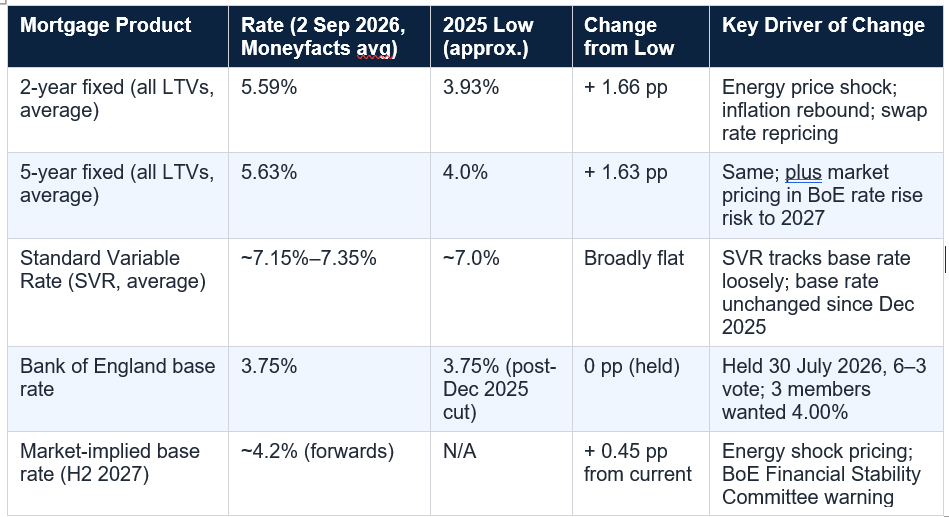
The divergence between the base rate (3.75 percent) and average fixed mortgage rates (5.59 to 5.63 percent) reflects the mechanics of mortgage pricing: fixed-rate products are primarily driven by swap rates — the rates at which financial institutions exchange fixed for variable interest payments in the wholesale market — rather than by the Bank of England base rate alone. Swap rates move in anticipation of future central bank decisions, meaning that market expectations of a future base rate rise are already embedded in current mortgage pricing, even before the Bank has acted.
The sequence:
The three members who voted for an immediate rise — Megan Greene, Catherine Mann, and Huw Pill (the Bank’s Chief Economist) — represent a meaningful minority of the nine-member committee. Huw Pill’s vote is particularly significant: as Chief Economist, his views carry institutional weight. His preference for an immediate 25 basis point rise signals that, from within the Bank’s own technical framework, the current rate of 3.75 percent may already be too low given the inflation trajectory.
The implications for mortgage borrowers:
For these borrowers, the transition from their current deal to a new one represents a significant payment shock regardless of what rates do from here. OneShekel’s comprehensive 2026 mortgage analysis models the payment change on a £200,000 repayment mortgage over 25 years: moving from a 2 percent rate to the current 5.59 percent average adds approximately £510 per month to the mortgage payment. The Bank of England’s own estimate is that 750,000 homeowners paying less than 3 percent on current deals will see an average increase of £170 per month when they come off those rates.
UK Finance projects that external remortgaging will reach £77 billion in 2026 (up 10 percent from 2025), alongside £261 billion in product transfers, where borrowers remain with their existing lender but move to a new rate. Both figures reflect the scale of the 2026 remortgage cycle. For borrowers in this wave, the decision is not whether to remortgage but when and to what.
1.8 million fixed-rate deals expiring in 2026 (UK Finance; Forbes Advisor UK). Many from 2021–22 at 1.5%–2.5%. Payment shock on £200,000 mortgage (2% → 5.59%): ~+£510/month (OneShekel). 750,000 homeowners paying under 3%: average +£170/month (Bank of England estimate). UK Finance: external remortgaging projected £77bn in 2026 (+10%); product transfers £261bn (+2%). 5.2 million households face mortgage cost increases by 2028 (BoE Financial Stability Committee, April 2026).
As of September 2026, the average SVR across UK lenders is approximately 7.15 to 7.35 percent, according to Uswitch and The World Data. The Bank of England’s own measure of the weighted average revert-to-rate was 6.59 percent in February 2026. Some lenders charge above 8 percent on their SVR. At these rates, the SVR is 1.3 to 2.3 percentage points higher than the average two-year fixed deal (5.59 percent) and roughly 3 to 3.4 percentage points above the best available tracker products.
On a £250,000 mortgage with 20 years remaining, the difference between a two-year fixed at 5.59 percent and an SVR at 7.25 percent is approximately £250 per month — £3,000 per year in unnecessary additional interest. For borrowers who sit on the SVR for six months while ‘keeping an eye on rates,’ that passive decision can easily cost £1,500 in avoidable interest charges.
The SVR is the single worst standard mortgage outcome for the vast majority of borrowers. It has no benefit beyond flexibility of exit without early repayment charges. For borrowers who need that flexibility, a tracker mortgage (which is also variable but priced significantly below the SVR) is almost always a better alternative. The SVR is not a deliberate choice for any financially informed borrower; it is what happens when a deal expires and the borrower does not act.
In a normal rate environment, a two-year fix is cheaper than a five-year fix, reflecting the additional certainty the five-year product provides. Borrowers who expected rates to fall would choose the two-year deal: pay a lower rate for 24 months, then remortgage to an even lower rate when the fixed period ends. This strategy worked well for borrowers who took two-year deals in mid-2023 and remortgaged in 2025, when rates had fallen from their peak.
The 2026 environment inverts this logic. OneShekel’s May 2026 analysis summarises the case: ‘For the majority of UK homeowners — especially those with tight monthly budgets or remortgaging after a cheap deal — fixing for five years is the lower-risk move right now. The minimal premium over two-year deals and the genuine upside risk to interest rates makes certainty cheap to buy.’
The current forecasts can be summarised as follows:
The purpose of locking in a mortgage rate is not to predict what rates will do. It is to remove the financial exposure to the uncertainty about what rates will do. A borrower who fixes at 5.59% for five years knows exactly what their monthly payment will be for 60 months, regardless of whether the base rate goes to 4.2% or falls to 3.25%. The value of certainty is not in being right about the forecast — it is in not having to be right about the forecast.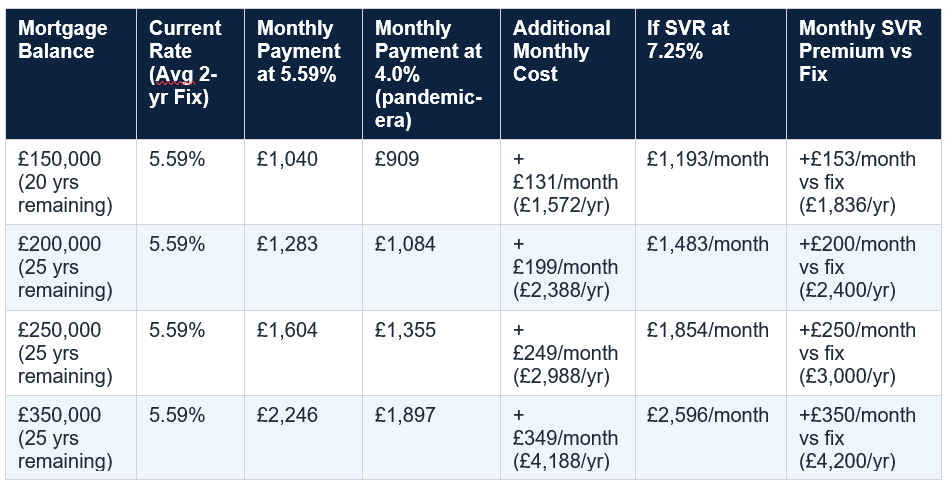
The figures above illustrate the scale of payment differences at different rate levels. Monthly payment figures are calculated using a standard repayment mortgage formula for illustrative purposes only; actual payments depend on the specific rate, term, and any fees. The critical figure for most borrowers approaching remortgage is the middle column: this is approximately what they will pay on a new deal at current average rates, compared with the rates many of them are currently paying.
For a borrower with a £250,000 mortgage at 2 percent (a common 2021 deal), the transition to a current average two-year fix at 5.59 percent adds approximately £249 per month. That £2,988 annual increase is unavoidable for borrowers whose 2021 deals are now expiring. The decision that remains in the borrower’s control is whether to add the SVR premium on top of that increase by failing to act.
The UK housing market in September 2026 provides a broadly stable backdrop. Forbes Advisor UK notes that house price indices collectively point to modest growth of 2 to 4 percent in 2026, with the Nationwide index reporting annual house price growth of 1.8 percent in July (putting the typical home at £277,542). Affordability remains the key challenge, with current mortgage rates still well above pre-2022 levels, but the market is not the rapidly declining environment of early 2023.
For first-time buyers actively purchasing:
Overpaying is generally a sound financial strategy, and the two approaches are not mutually exclusive. The considerations:
Neither of these facts means that borrowers who fix today are guaranteed to have made the right call. If inflation falls back quickly, if the Middle East energy shock resolves, if the Bank of England resumes cutting — any of these outcomes could see mortgage rates fall materially from current levels within 12 to 18 months. The borrower who fixed a five-year deal in September 2026 would, in this scenario, be paying more than the rate available in 2027 or 2028.
But the mortgage market is not an investment game in which the goal is to time the lowest possible rate. It is a commitment management exercise in which the goal is to avoid the highest possible cost. The SVR at 7.25 percent is the highest cost. The rate uncertainty described in this guide is the risk. The available tools — a six-month mortgage offer, the ability to switch before completion if rates fall, an independent broker comparing 60+ lenders — are the ways to manage that risk without betting the household budget on a macroeconomic forecast.
HomeOwners Alliance’ September 2026 guidance to any borrower whose deal ends in the next six months is direct: ‘Consider locking in a rate now to protect against the risk of mortgage rates rising further.’ That advice has never been more clearly supported by the data.
As of 2 September 2026, Moneyfacts data shows the average two-year fixed mortgage rate in the UK at 5.59% and the average five-year fixed rate at 5.63% (Bright Savings UK, September 2026). These are averages across all lenders and loan-to-value ratios; best-buy rates from competitive lenders, particularly for borrowers with larger equity stakes (60% LTV or lower), are available below these averages. The standard variable rate (SVR) averages 7.15%–7.35% across lenders, making it significantly more expensive than any available fixed or tracker deal. Note that rates change frequently and can move materially in a short period; always verify current rates with a broker or comparison tool before making decisions.
Will UK mortgage rates go up or down from here?
The honest answer is that nobody knows, and the recent history of mortgage rate forecasting illustrates exactly why. At the start of 2026, market consensus expected two-year fixed rates to fall below 3.5% by year end; they have instead risen above 5.5%. The current balance of forecasts: market pricing (Bank of England Monetary Policy Report, July 2026) implies the base rate rising from 3.75% to approximately 4.2% by H2 2027; Bank of England survey medians (June 2026) suggest 3.63% at one year ahead and 3.25% at two to three years. The 30 July MPC vote (6–3 for holding, with three members favouring an immediate rise) confirms that the risk of further rate increases is credible and near-term. What experts agree on is that the tools for managing this uncertainty — locking in a rate early, using the six-month offer validity period, being able to switch if rates fall — are available to borrowers right now.
How far ahead can I lock in a mortgage rate?
In practice, you can typically apply for a new mortgage rate up to six months before your current deal expires and receive a binding mortgage offer that is valid for six months. Some lenders offer mortgage offer validity of up to 12 months. This means you can secure today's rate in September 2026 without committing to it until your deal ends in March 2027 (or later, if a 12-month offer). Critically, you are not locked into the offer: if rates fall between now and your completion date, you can withdraw from the offer and apply at a lower rate, with no penalty (assuming your existing deal has not yet ended). This approach provides protection against rate rises while preserving the ability to benefit if rates fall.
What is the SVR and why is it so expensive?
The Standard Variable Rate (SVR) is the default rate that UK mortgage borrowers revert to when their fixed-rate deal expires, if they do not actively remortgage or switch products. The SVR is set entirely at the lender's discretion and is typically significantly higher than any fixed or tracker deal the same lender offers to new customers. In September 2026, the average SVR is approximately 7.15%–7.35%, compared with an average two-year fixed rate of 5.59%. On a £250,000 mortgage over 25 years, the SVR costs approximately £250 more per month than the average two-year fix — £3,000 per year in avoidable additional interest. The SVR has no benefit for borrowers other than flexibility of exit without early repayment charges. For borrowers who need that flexibility, a tracker mortgage (also variable but priced approximately 3 percentage points below the SVR) is almost always better. Any borrower who has lapsed onto the SVR without choosing to should remortgage immediately.
Should I choose a 2-year or 5-year fixed mortgage in September 2026?
In September 2026, the two-year and five-year fixed rates are almost identical (5.59% vs 5.63%, a difference of 0.04 percentage points). This near-identical pricing means the five-year fix provides five years of payment certainty for approximately £4–£6 per month additional cost on a typical mortgage. Given that market pricing implies rates rising to approximately 4.2% by 2027 (which would push fixed mortgage rates above current levels), and given that three of nine MPC members voted for an immediate rate rise on 30 July, the five-year fix is the lower-risk choice for most borrowers in this environment. The two-year fix is appropriate if the borrower expects to move, sell, or significantly restructure their mortgage within two years, or if they have income flexibility and are confident they could absorb higher payments at remortgage in 2028. Consult an independent mortgage broker before deciding.
What if I just had my mortgage deal expire — what should I do?
If your fixed deal has already expired and you are on the SVR, you are likely paying 7.15%–7.35% when the average fixed rate available is 5.59%. The priority is to remortgage as quickly as possible. Because you are on the SVR, there are no early repayment charges — you can switch at any time with no penalty. Contact an independent mortgage broker (who will compare 60+ lenders at no cost to you) or use a comparison tool to find the best available rate for your loan-to-value and income profile. Apply for a formal mortgage offer and complete the switch as quickly as possible. Every month you remain on the SVR versus a fixed deal is likely costing you £100–£400 in unnecessary interest depending on your mortgage balance. Do not wait.
Table of Contents
- The Moment Borrowers Face in September 2026
- Where UK Mortgage Rates Stand Right Now
- What Drove Rates Higher Again in 2026
- The Three Rate-Setters Who Voted to Raise: Why It Matters
- The Remortgage Wave: 1.8 Million Deals Expiring in 2026
- The SVR Trap: What Happens If You Do Nothing
- 2 vs 5-Year Fix: The Case for Certainty Right Now
- What the Rate Forecasts Say — and Why Uncertainty Is the Point
- How to Lock In a Rate Before It Rises
- What You Can Do If Rates Fall After You’ve Fixed
- The Monthly Payment Reality: What Rate Changes Mean in Pounds
- First-Time Buyers: A Different Calculus
- Should You Overpay Instead of Fixing?
- Conclusion: Certainty Has a Price. Right Now It Is Worth Paying.
- Frequently Asked Questions
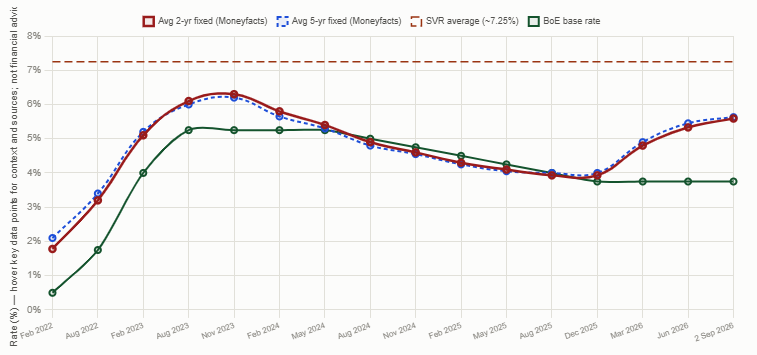
UK Fixed Mortage Rate2: Setember- 2022 to January - 2026
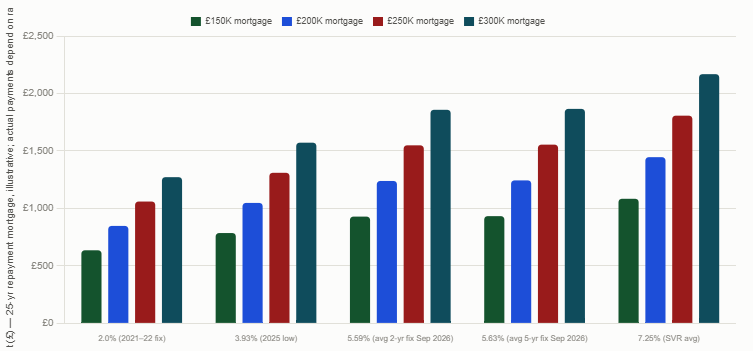
Monthly Paymanet Impact: Rate vs Balance
The Moment Borrowers Face in September 2026
The UK mortgage market enters September 2026 in a state of genuine and unusual uncertainty. At the start of the year, economists broadly expected the Bank of England to continue cutting interest rates, and mortgage borrowers were told to expect rates of 3.20 to 3.30 percent on two-year fixed deals by the end of 2026, with some speculation about sub-3 percent deals becoming available. That outlook has been comprehensively revised.A Middle East conflict that disrupted Strait of Hormuz oil and gas supply in early 2026 drove energy prices sharply higher. UK CPI inflation — which the Bank of England had been nursing toward its 2 percent target — rebounded to 2.9 percent in July 2026, up from a 2.6 percent reading in June and moving in the wrong direction. On 30 July, the Bank’s Monetary Policy Committee held the base rate at 3.75 percent, but three of its nine members voted to raise it immediately to 4 percent. Market pricing now implies the base rate rising to approximately 4.2 percent by the second half of 2027.
Simultaneously, 1.8 million fixed-rate mortgage deals are due to expire in 2026, many of them carrying rates of 1.5 to 2.5 percent agreed during the pandemic era of cheap money. For these borrowers, and for the hundreds of thousands approaching renewal in 2027, the question is the same: should they act now, fix a rate while they still can, and protect against the risk of higher rates ahead? This guide sets out the full picture as it stands in September 2026, including the key rate figures, the forecasts, the risks, and exactly what borrowers should do.
Bank of England base rate: 3.75% (held 30 July 2026, 6–3 vote). Average 2-year fixed: 5.59% (2 Sep 2026, Moneyfacts/Bright Savings). Average 5-year fixed: 5.63% (2 Sep 2026, Moneyfacts). Average SVR: ~7.15%–7.35%. 1.8 million fixed deals expiring in 2026. Market pricing: base rate to ~4.2% by H2 2027. Next BoE decision: 17 September 2026.
Where UK Mortgage Rates Stand Right Now
As of 2 September 2026, Moneyfacts data shows the average two-year fixed mortgage rate at 5.59 percent and the average five-year fixed rate at 5.63 percent (Bright Savings UK, September 2026). These figures represent average rates across all lenders and loan-to-value (LTV) ratios. For borrowers with strong equity positions (60 percent LTV or lower), best-buy rates from competitive lenders are available below these averages — but the average figures provide the correct reference for the majority of borrowers.This is a significant rise from the 2025 lows. Mojo Mortgages reports that the average two-year fixed rate fell to 3.93 percent at its 2025 low, and the five-year fixed rate fell to 4.0 percent at its equivalent trough. Both have now risen by approximately 1.6 percentage points from those lows, reflecting the repricing triggered by energy market disruption, the revised inflation outlook, and the shift in the Bank of England’s signalling.
The divergence between the base rate (3.75 percent) and average fixed mortgage rates (5.59 to 5.63 percent) reflects the mechanics of mortgage pricing: fixed-rate products are primarily driven by swap rates — the rates at which financial institutions exchange fixed for variable interest payments in the wholesale market — rather than by the Bank of England base rate alone. Swap rates move in anticipation of future central bank decisions, meaning that market expectations of a future base rate rise are already embedded in current mortgage pricing, even before the Bank has acted.
What Drove Rates Higher Again in 2026
The 2026 mortgage rate reversal is the product of a specific sequence of events, not a general return to the high-rate environment of 2023. Understanding what drove rates higher helps borrowers assess whether the current elevated levels are likely to persist, moderate, or rise further.The sequence:
- December 2025: the Bank of England cut the base rate from 4.0 percent to 3.75 percent, its fifth consecutive cut since August 2024. Fixed mortgage rates, which had already anticipated the cut, briefly fell to multi-year lows. Two-year fixes reached a 2025 low of approximately 3.93 percent.
- Early 2026: geopolitical conflict in the Middle East disrupted energy supply through the Strait of Hormuz, a chokepoint for roughly one-fifth of the world’s oil and gas supply. Energy prices spiked globally.
- Spring 2026: UK CPI inflation, which had been approaching the Bank’s 2 percent target, rebounded. By July 2026 it stood at 2.9 percent, above target and rising. The Willow Private Finance’s May 2026 market overview describes the result: ‘Lenders that had begun cautiously reducing mortgage rates have instead repriced upwards in several waves during the first half of the year.’
- July 2026: the Bank of England held the base rate at 3.75 percent but the closeness of the vote — three of nine members preferring an immediate rise — provided a clear signal that the cutting cycle has stalled. Fixed rates rose further in response.
- September 2026: swap rate volatility is continuing. Bright Savings UK’s September 2026 update notes that ‘mortgage pricing is currently more volatile than it was in July.’
The Three Rate-Setters Who Voted to Raise: Why It Matters
The 30 July Monetary Policy Committee vote — 6 in favour of holding at 3.75 percent, 3 in favour of an immediate rise to 4.0 percent — is one of the most market-significant mortgage developments of 2026. A 6-3 vote in favour of holding is not the same as a unanimous hold. It is a clear signal from within the Bank’s own rate-setting body that the balance of risk has shifted toward higher rates.The three members who voted for an immediate rise — Megan Greene, Catherine Mann, and Huw Pill (the Bank’s Chief Economist) — represent a meaningful minority of the nine-member committee. Huw Pill’s vote is particularly significant: as Chief Economist, his views carry institutional weight. His preference for an immediate 25 basis point rise signals that, from within the Bank’s own technical framework, the current rate of 3.75 percent may already be too low given the inflation trajectory.
The implications for mortgage borrowers:
- A 4.0 percent base rate is now a live scenario for the 17 September 2026 MPC meeting, when the vote could tip the other way if the August inflation data (due before the meeting) shows further upward movement.
- Mortgage lenders price in future rate expectations. If the market assigns even a 50 percent probability to a September rate rise, that expectation will be embedded in fixed mortgage rates before the decision is announced.
- Deutsche Bank economist Sanjay Raja, quoted by HomeOwners Alliance (September 2026): ‘We stick to our call for no change in Bank Rate this year. But the odds of a rate rise are increasing.’ This represents the consensus view: hold most likely, but a rise is genuinely on the table.
The Remortgage Wave: 1.8 Million Deals Expiring in 2026
The structural backdrop to the 2026 mortgage market is what analysts have called the Great Remortgage Reset. UK Finance data shows that 1.8 million fixed-rate mortgage deals are due to expire in 2026, following 1.6 million that expired in 2025. Many of the 2026 maturities represent deals taken out in 2021 and 2022 — years when the Bank of England base rate was 0.1 percent and two-year fixed rates were available below 1.5 percent.For these borrowers, the transition from their current deal to a new one represents a significant payment shock regardless of what rates do from here. OneShekel’s comprehensive 2026 mortgage analysis models the payment change on a £200,000 repayment mortgage over 25 years: moving from a 2 percent rate to the current 5.59 percent average adds approximately £510 per month to the mortgage payment. The Bank of England’s own estimate is that 750,000 homeowners paying less than 3 percent on current deals will see an average increase of £170 per month when they come off those rates.
UK Finance projects that external remortgaging will reach £77 billion in 2026 (up 10 percent from 2025), alongside £261 billion in product transfers, where borrowers remain with their existing lender but move to a new rate. Both figures reflect the scale of the 2026 remortgage cycle. For borrowers in this wave, the decision is not whether to remortgage but when and to what.
1.8 million fixed-rate deals expiring in 2026 (UK Finance; Forbes Advisor UK). Many from 2021–22 at 1.5%–2.5%. Payment shock on £200,000 mortgage (2% → 5.59%): ~+£510/month (OneShekel). 750,000 homeowners paying under 3%: average +£170/month (Bank of England estimate). UK Finance: external remortgaging projected £77bn in 2026 (+10%); product transfers £261bn (+2%). 5.2 million households face mortgage cost increases by 2028 (BoE Financial Stability Committee, April 2026).
The SVR Trap: What Happens If You Do Nothing
Every fixed-rate mortgage in the UK has a scheduled end date. When that date passes without the borrower taking action, the mortgage automatically moves onto the lender’s Standard Variable Rate (SVR) — a revert-to rate that the lender can change at will and that is almost always significantly higher than any fixed deal available from the same or other lenders.As of September 2026, the average SVR across UK lenders is approximately 7.15 to 7.35 percent, according to Uswitch and The World Data. The Bank of England’s own measure of the weighted average revert-to-rate was 6.59 percent in February 2026. Some lenders charge above 8 percent on their SVR. At these rates, the SVR is 1.3 to 2.3 percentage points higher than the average two-year fixed deal (5.59 percent) and roughly 3 to 3.4 percentage points above the best available tracker products.
On a £250,000 mortgage with 20 years remaining, the difference between a two-year fixed at 5.59 percent and an SVR at 7.25 percent is approximately £250 per month — £3,000 per year in unnecessary additional interest. For borrowers who sit on the SVR for six months while ‘keeping an eye on rates,’ that passive decision can easily cost £1,500 in avoidable interest charges.
The SVR is the single worst standard mortgage outcome for the vast majority of borrowers. It has no benefit beyond flexibility of exit without early repayment charges. For borrowers who need that flexibility, a tracker mortgage (which is also variable but priced significantly below the SVR) is almost always a better alternative. The SVR is not a deliberate choice for any financially informed borrower; it is what happens when a deal expires and the borrower does not act.
2 vs 5-Year Fix: The Case for Certainty Right Now
The choice between a two-year and five-year fixed rate is the central product decision for most remortgaging borrowers in September 2026. As Moneyfacts data shows, the current rate differential between the two products is almost negligible — 5.59 percent (two-year) versus 5.63 percent (five-year) — which fundamentally changes the calculus that would normally apply.In a normal rate environment, a two-year fix is cheaper than a five-year fix, reflecting the additional certainty the five-year product provides. Borrowers who expected rates to fall would choose the two-year deal: pay a lower rate for 24 months, then remortgage to an even lower rate when the fixed period ends. This strategy worked well for borrowers who took two-year deals in mid-2023 and remortgaged in 2025, when rates had fallen from their peak.
The 2026 environment inverts this logic. OneShekel’s May 2026 analysis summarises the case: ‘For the majority of UK homeowners — especially those with tight monthly budgets or remortgaging after a cheap deal — fixing for five years is the lower-risk move right now. The minimal premium over two-year deals and the genuine upside risk to interest rates makes certainty cheap to buy.’
- Case for the five-year fix: locks in a rate through to 2031 at a premium of only 0.04 percentage points above the two-year equivalent; protects against the scenario where rates rise to 4.2 percent or above (as market pricing implies for 2027); removes the risk of having to remortgage again in 2028 at potentially higher rates; eliminates the psychological and administrative burden of another remortgage cycle in two years.
- Case for the two-year fix: if rates fall significantly from current levels — as the Bank of England survey median suggests, with market participants expecting 3.25 percent at a two-to-three year horizon — a borrower on a two-year fix remortgages in 2028 to a potentially lower rate. The downside: if rates do not fall, the borrower is back in the same position in 2028 with no savings from the shorter term.
- Case for a tracker: a base rate tracker at, say, base rate + 0.5 percent currently costs 4.25 percent — over one percentage point cheaper than either fixed product. The risk: if the base rate rises, monthly payments rise immediately and without notice. For borrowers who have income flexibility and a meaningful emergency fund, a tracker carries rate risk but lower initial cost.
What the Rate Forecasts Say — and Why Uncertainty Is the Point
Forecasting the Bank of England base rate is genuinely difficult, and the track record of market predictions over the past four years illustrates why borrowers should not base decisions on any single forecast. At the start of 2026, the market consensus was for continued cuts, with some analysts forecasting two-year fixes below 3.5 percent by year end. Those predictions have been overtaken by events. The lesson from the 2022 to 2026 rate cycle is that external shocks — a pandemic, a European war, a Middle East conflict — produce rate movements that no forecast anticipated.The current forecasts can be summarised as follows:
- Market pricing (July 2026 Bank of England Monetary Policy Report): implies the base rate rising from 3.75 percent to approximately 4.2 percent by the second half of 2027, then remaining broadly flat. This path sits five basis points higher than at the April 2026 report, reflecting the persistence of the energy-driven repricing.
- Bank of England June 2026 survey of market participants: median expected base rate of 3.63 percent at one year ahead and 3.25 percent at both the two and three year horizons — a lower path than the forward rates market. The gap between the two measures is attributed by respondents to asymmetric risk premia (traders paying to hedge against upside risk, not centrally expecting it).
- Oxford Economics: expects the base rate to be held at 3.75 percent for the rest of 2026. JP Morgan: forecasts a rise to 4.0 percent in late 2026. Deutsche Bank: no change this year but acknowledges rising odds of a rise.
The purpose of locking in a mortgage rate is not to predict what rates will do. It is to remove the financial exposure to the uncertainty about what rates will do. A borrower who fixes at 5.59% for five years knows exactly what their monthly payment will be for 60 months, regardless of whether the base rate goes to 4.2% or falls to 3.25%. The value of certainty is not in being right about the forecast — it is in not having to be right about the forecast.
How to Lock In a Rate Before It Rises
The mechanics of locking in a mortgage rate before potential further increases are straightforward, and several features of the UK mortgage market work in the borrower’s favour:- Mortgage offers typically valid for six months: once issued, a mortgage offer from a UK lender is typically valid for six months, with some lenders offering up to 12 months. This means a borrower whose fixed rate ends in December 2026 can apply for a new rate today (September 2026) and hold the offer while their existing deal continues.
- No financial commitment until completion: securing a mortgage offer does not commit the borrower to the deal. If rates fall before the completion date, the borrower can withdraw from the offer (with no cost, as long as no fees are attached) and apply for a lower rate. This asymmetry is one of the most valuable and least understood features of the UK mortgage application process.
- Product transfer vs external remortgage: borrowers can switch products with their existing lender (a product transfer) without a formal remortgage application, legal work, or valuation. Product transfers are typically faster and involve less paperwork. The downside is that the borrower does not compare the full market; the existing lender’s best rate may not be the market’s best rate. UK Finance projects £261 billion in product transfers in 2026, suggesting many borrowers prefer this route for its simplicity.
- Use an independent mortgage broker: a broker with access to 60 or more lenders can compare the full market at no cost to the borrower (brokers are typically paid a fee by the lender on successful completion). The benefit of an independent broker over a bank’s direct mortgage application is access to lender-exclusive deals, broker-only rates, and the full picture of what the market offers at the borrower’s specific LTV and income profile.
What You Can Do If Rates Fall After You’ve Fixed
A common concern for borrowers considering fixing now is that rates will subsequently fall, leaving them locked into a higher rate than necessary. This concern is legitimate — but the practical tools available mean it should not prevent action.- Most fixed-rate mortgages in the UK have early repayment charges (ERCs) if you exit before the fixed period ends. A typical ERC on a five-year fix is 5 percent of the outstanding balance in year one, declining to 1 percent in year five. On a £250,000 mortgage, that is £12,500 in year one — a material barrier to switching if rates fall significantly.
- However, the pre-application strategy avoids this problem entirely. If you apply for a new rate before your existing fixed deal ends — which is fully possible up to six months before expiry — the existing deal runs to its natural end with no ERC, and you move to the new rate on the deal end date. No penalty applies.
- For borrowers who are already past their deal end date and on the SVR: there are no ERCs on the SVR, so switching to a fixed deal at any time carries no penalty. The sooner you switch, the sooner you stop paying the SVR premium.
- If you lock in a rate before your deal ends and rates subsequently fall: most lenders allow borrowers to withdraw from an offer and reapply at a lower rate, as long as the original deal has not yet completed. This is standard practice and typically costs nothing. Mortgage Advice Bureau and other major brokers offer rate-watching services that alert borrowers when better deals become available and assist with the switch.
The Monthly Payment Reality: What Rate Changes Mean in Pounds
The figures above illustrate the scale of payment differences at different rate levels. Monthly payment figures are calculated using a standard repayment mortgage formula for illustrative purposes only; actual payments depend on the specific rate, term, and any fees. The critical figure for most borrowers approaching remortgage is the middle column: this is approximately what they will pay on a new deal at current average rates, compared with the rates many of them are currently paying.
For a borrower with a £250,000 mortgage at 2 percent (a common 2021 deal), the transition to a current average two-year fix at 5.59 percent adds approximately £249 per month. That £2,988 annual increase is unavoidable for borrowers whose 2021 deals are now expiring. The decision that remains in the borrower’s control is whether to add the SVR premium on top of that increase by failing to act.
First-Time Buyers: A Different Calculus
For first-time buyers, the September 2026 mortgage market presents a different set of considerations from existing borrowers approaching remortgage. The urgency of locking in a rate before it rises applies equally — perhaps more so, since first-time buyers do not have the fallback of a product transfer with an existing lender and face the full consequences of any rate movement on their house purchase.The UK housing market in September 2026 provides a broadly stable backdrop. Forbes Advisor UK notes that house price indices collectively point to modest growth of 2 to 4 percent in 2026, with the Nationwide index reporting annual house price growth of 1.8 percent in July (putting the typical home at £277,542). Affordability remains the key challenge, with current mortgage rates still well above pre-2022 levels, but the market is not the rapidly declining environment of early 2023.
For first-time buyers actively purchasing:
- Secure a mortgage in principle (MIP) from a broker covering the full market. An MIP takes one to two hours and is valid for 90 days, with no binding commitment. Use it to understand your maximum borrowing and current rate options before making an offer.
- Apply for a formal mortgage offer as quickly as possible after an offer is accepted. This locks in the rate while the transaction progresses through conveyancing.
- Consider government-backed schemes: the Mortgage Guarantee Scheme (which allows 95 percent LTV mortgages) and First Homes (which provides discounted new-build properties for first-time buyers) remain available. Higher LTV mortgages carry higher rates, so these schemes specifically help with the deposit barrier.
Should You Overpay Instead of Fixing?
A question that sometimes arises in elevated rate environments is whether, instead of fixing a rate and accepting the current pricing, borrowers should focus on aggressively overpaying their existing mortgage to reduce the balance before the forced remortgage event.Overpaying is generally a sound financial strategy, and the two approaches are not mutually exclusive. The considerations:
- Overpaying reduces the mortgage balance, which improves the loan-to-value ratio and, at threshold crossings (85%, 80%, 75%, 60% LTV), can unlock significantly better rates at remortgage. On a £250,000 property with a £200,000 mortgage (80% LTV), reducing the balance to £187,500 (75% LTV) before remortgaging can access rates 0.3 to 0.5 percentage points below the 80% LTV product.
- Most fixed-rate mortgages allow overpayments of up to 10 percent of the outstanding balance per year without triggering early repayment charges. Overpaying within this allowance before a deal ends is almost always financially beneficial.
- However, overpaying does not protect against the rate at which the remaining balance is remortgaged. The rate risk on the remaining balance still exists, regardless of how much has been overpaid. Fixing and overpaying are complementary, not alternatives.
Conclusion
The September 2026 mortgage market is defined by two simultaneous facts that each demand attention. The first is that rates have already risen significantly from their 2025 lows — by approximately 1.6 percentage points on both two and five-year fixed deals. The second is that the balance of risk from here is tilted toward further rises rather than falls, based on the current inflation trajectory, the 6-3 MPC vote, and market pricing for 2027.Neither of these facts means that borrowers who fix today are guaranteed to have made the right call. If inflation falls back quickly, if the Middle East energy shock resolves, if the Bank of England resumes cutting — any of these outcomes could see mortgage rates fall materially from current levels within 12 to 18 months. The borrower who fixed a five-year deal in September 2026 would, in this scenario, be paying more than the rate available in 2027 or 2028.
But the mortgage market is not an investment game in which the goal is to time the lowest possible rate. It is a commitment management exercise in which the goal is to avoid the highest possible cost. The SVR at 7.25 percent is the highest cost. The rate uncertainty described in this guide is the risk. The available tools — a six-month mortgage offer, the ability to switch before completion if rates fall, an independent broker comparing 60+ lenders — are the ways to manage that risk without betting the household budget on a macroeconomic forecast.
HomeOwners Alliance’ September 2026 guidance to any borrower whose deal ends in the next six months is direct: ‘Consider locking in a rate now to protect against the risk of mortgage rates rising further.’ That advice has never been more clearly supported by the data.
Frequently Asked Questions
What is the current average mortgage rate in the UK?As of 2 September 2026, Moneyfacts data shows the average two-year fixed mortgage rate in the UK at 5.59% and the average five-year fixed rate at 5.63% (Bright Savings UK, September 2026). These are averages across all lenders and loan-to-value ratios; best-buy rates from competitive lenders, particularly for borrowers with larger equity stakes (60% LTV or lower), are available below these averages. The standard variable rate (SVR) averages 7.15%–7.35% across lenders, making it significantly more expensive than any available fixed or tracker deal. Note that rates change frequently and can move materially in a short period; always verify current rates with a broker or comparison tool before making decisions.
Will UK mortgage rates go up or down from here?
The honest answer is that nobody knows, and the recent history of mortgage rate forecasting illustrates exactly why. At the start of 2026, market consensus expected two-year fixed rates to fall below 3.5% by year end; they have instead risen above 5.5%. The current balance of forecasts: market pricing (Bank of England Monetary Policy Report, July 2026) implies the base rate rising from 3.75% to approximately 4.2% by H2 2027; Bank of England survey medians (June 2026) suggest 3.63% at one year ahead and 3.25% at two to three years. The 30 July MPC vote (6–3 for holding, with three members favouring an immediate rise) confirms that the risk of further rate increases is credible and near-term. What experts agree on is that the tools for managing this uncertainty — locking in a rate early, using the six-month offer validity period, being able to switch if rates fall — are available to borrowers right now.
How far ahead can I lock in a mortgage rate?
In practice, you can typically apply for a new mortgage rate up to six months before your current deal expires and receive a binding mortgage offer that is valid for six months. Some lenders offer mortgage offer validity of up to 12 months. This means you can secure today's rate in September 2026 without committing to it until your deal ends in March 2027 (or later, if a 12-month offer). Critically, you are not locked into the offer: if rates fall between now and your completion date, you can withdraw from the offer and apply at a lower rate, with no penalty (assuming your existing deal has not yet ended). This approach provides protection against rate rises while preserving the ability to benefit if rates fall.
What is the SVR and why is it so expensive?
The Standard Variable Rate (SVR) is the default rate that UK mortgage borrowers revert to when their fixed-rate deal expires, if they do not actively remortgage or switch products. The SVR is set entirely at the lender's discretion and is typically significantly higher than any fixed or tracker deal the same lender offers to new customers. In September 2026, the average SVR is approximately 7.15%–7.35%, compared with an average two-year fixed rate of 5.59%. On a £250,000 mortgage over 25 years, the SVR costs approximately £250 more per month than the average two-year fix — £3,000 per year in avoidable additional interest. The SVR has no benefit for borrowers other than flexibility of exit without early repayment charges. For borrowers who need that flexibility, a tracker mortgage (also variable but priced approximately 3 percentage points below the SVR) is almost always better. Any borrower who has lapsed onto the SVR without choosing to should remortgage immediately.
Should I choose a 2-year or 5-year fixed mortgage in September 2026?
In September 2026, the two-year and five-year fixed rates are almost identical (5.59% vs 5.63%, a difference of 0.04 percentage points). This near-identical pricing means the five-year fix provides five years of payment certainty for approximately £4–£6 per month additional cost on a typical mortgage. Given that market pricing implies rates rising to approximately 4.2% by 2027 (which would push fixed mortgage rates above current levels), and given that three of nine MPC members voted for an immediate rate rise on 30 July, the five-year fix is the lower-risk choice for most borrowers in this environment. The two-year fix is appropriate if the borrower expects to move, sell, or significantly restructure their mortgage within two years, or if they have income flexibility and are confident they could absorb higher payments at remortgage in 2028. Consult an independent mortgage broker before deciding.
What if I just had my mortgage deal expire — what should I do?
If your fixed deal has already expired and you are on the SVR, you are likely paying 7.15%–7.35% when the average fixed rate available is 5.59%. The priority is to remortgage as quickly as possible. Because you are on the SVR, there are no early repayment charges — you can switch at any time with no penalty. Contact an independent mortgage broker (who will compare 60+ lenders at no cost to you) or use a comparison tool to find the best available rate for your loan-to-value and income profile. Apply for a formal mortgage offer and complete the switch as quickly as possible. Every month you remain on the SVR versus a fixed deal is likely costing you £100–£400 in unnecessary interest depending on your mortgage balance. Do not wait.
0 Comments
Be the first to share your thoughts on this article.