

Real Estate
3 Big Things Stopping You Getting a Mortgage

Key Statistics: A meaningful share of UK adults who experienced financial difficulty in 2022–2024 are now current on all commitments but still fall below mainstream lender score thresholds (UK Finance, 2025). DTI ratio above 40% is a key red flag: most UK mortgage lenders prefer total debt commitments below 40–43% of gross income. Bank of England base rate held at 3.75% (April 2026); average 2-year fixed rate approximately 4.3–4.8% (August 2026). Typical minimum deposit: 5% (Help to Buy / 95% LTV products); 10% for competitive rates; 15–25% for best rates. CCJs remain on credit files for 6 years. Gambling transactions on bank statements are a lender red flag. BNPL (Buy Now Pay Later) debt now appears on Equifax, Experian, and TransUnion files. ONS 2025: wage growth outpaced inflation for several consecutive quarters — improving real affordability. UK Finance Q4 2025: lenders stress-test applications at typically 3% above the current pay rate. Number of first-time buyers in the UK declined in 2023–2024 partly due to affordability constraints.
Being declined for a mortgage feels catastrophic, especially when you have been saving for years and have finally found the property you want. But mortgage lenders are not making a judgement about you as a person. They are applying a set of risk criteria to your financial file. Understanding what those criteria are, why they matter, and how to address them is the difference between a rejection that takes years to overcome and one that takes months.
This article focuses on the three biggest mortgage blockers in the UK — the ones that account for the overwhelming majority of declines — and provides specific, actionable guidance on how to address each one. Everything here is based on the current lending environment in August 2026, with the Bank of England base rate at 3.75 percent and the mortgage market adjusting to a rate environment significantly higher than the near-zero period of 2020 to 2022.
Mortgage 123, May 2026: The important thing to understand is that being declined by one lender does not always mean you cannot get a mortgage. Different lenders use different affordability models. One mortgage lender may decide the application is too stretched, while another may take a more flexible approach based on the wider circumstances. This is why preparation matters.
Credit history affects mortgage applications in two ways. First, it directly influences your credit score, which many mainstream lenders use as an automated first filter. A score below a lender’s threshold will trigger an automatic decline before a human underwriter ever looks at your application. Second, specific items in your credit history — missed payments, defaults, CCJs, IVAs — are individually assessed for severity, recency, and value.
The important point documented by Manor Mortgages Direct’s April 2026 analysis is that credit scores are backward-looking. A meaningful share of UK adults who experienced financial difficulty during the 2022 to 2024 period — a period of sharply rising costs and energy prices — are now current on all commitments but still fall below mainstream lender score thresholds because the historic difficulty is still registering on their files.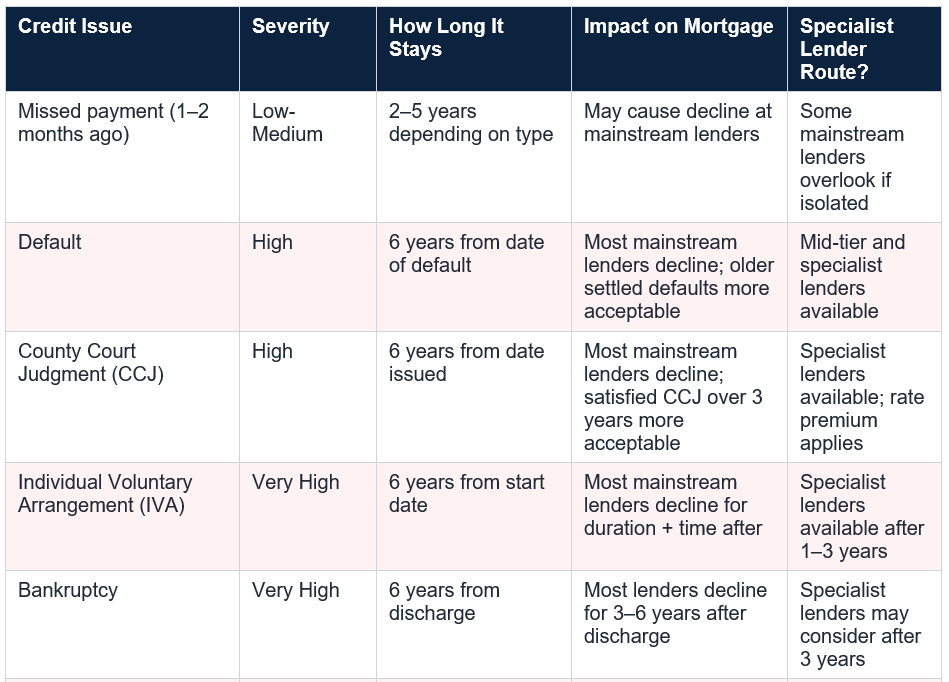
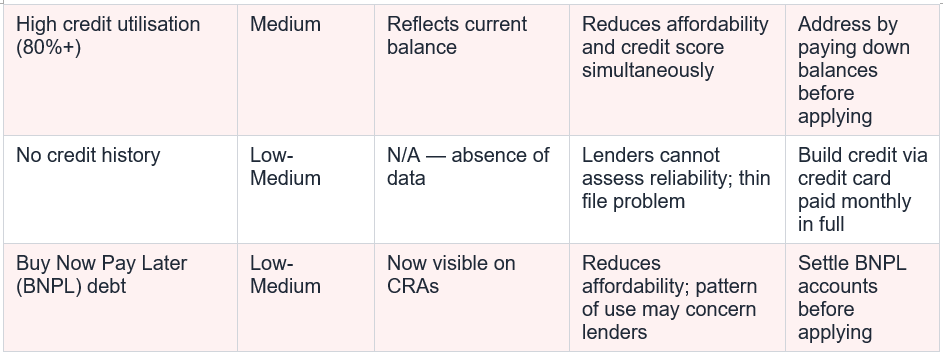
BNPL deserves specific attention in 2026. Products like Klarna, Clearpay, and Laybuy now report to Experian, Equifax, and TransUnion. Missed BNPL payments register as missed payments. Active BNPL balances reduce assessed affordability. A pattern of heavy BNPL use may suggest to an underwriter that the applicant is relying on deferred payment schemes to manage regular spending — a red flag for mortgage affordability.
MoneySuperMarket’s March 2026 analysis puts it clearly: affordability often matters more than your credit score. Lenders assess debt levels and spending habits, not just your credit rating. A high-earner with multiple loans, car finance, student debt, and childcare costs may have far less disposable income after commitments than a more modest earner with no debt and low outgoings — and will face a more difficult affordability assessment as a result.
The Pauzible December 2025 analysis adds a further dimension: bank statements give lenders insight into how you manage money. Regular overdraft usage, gambling transactions, or high discretionary spending can all be red flags even where the headline DTI appears acceptable.
This means that a borrower taking a 2-year fixed-rate mortgage at 4.5 percent will be stress-tested against a rate of approximately 7.5 percent. At 7.5 percent, a £250,000 mortgage over 25 years costs approximately £1,845 per month rather than the £1,390 at 4.5 percent. If £1,845 per month is not affordable within the lender’s DTI model (including all other debt and expenditure), the application may be declined despite the actual rate being significantly lower.
The stress test is a consumer protection measure: it is designed to ensure that borrowers do not take on mortgages that would become unaffordable if economic conditions change. But it also means that the maximum mortgage available to most borrowers is lower than the income multiple alone would suggest. This is particularly important for first-time buyers, who typically have the highest loan-to-income ratios and the least buffer between their income and their total debt commitments.
The minimum deposit for most residential mortgages in the UK is 5 percent of the property purchase price (available through 95 percent loan-to-value products). However, 5 percent LTV products typically carry the highest interest rates and have strict eligibility requirements. The practical deposit targets in 2026 are: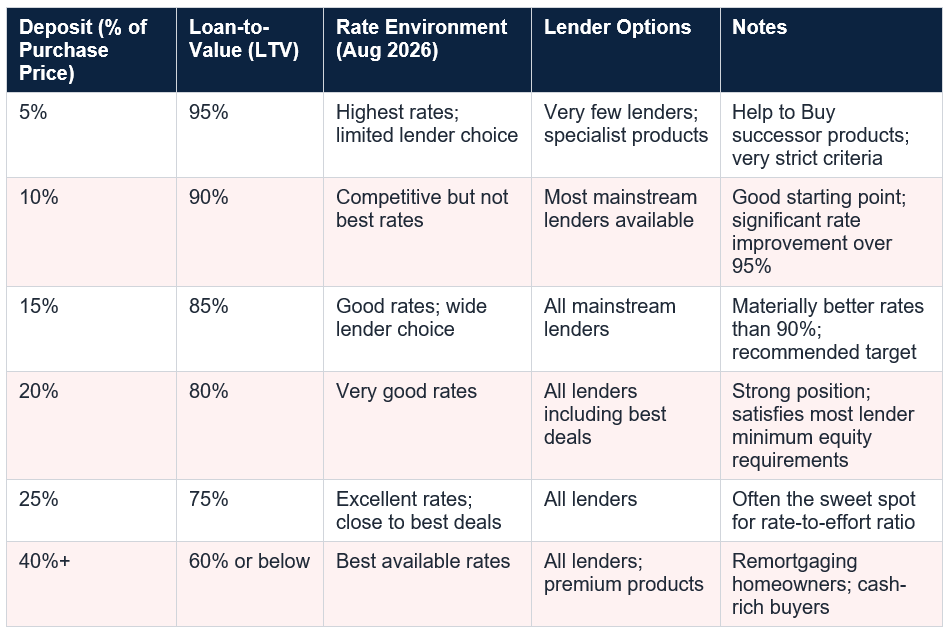
The difference in monthly payment between a 90 percent LTV mortgage and an 80 percent LTV mortgage at typical August 2026 rates can be £100 to £200 per month on a £250,000 mortgage — a significant long-term saving that justifies the additional saving time required to reach a larger deposit.
The critical mistake that most declined applicants make is applying again immediately to a different lender without addressing the underlying reason for the original decline. Each application involves a hard credit check. Each hard check reduces the score. The cycle of declined applications and falling credit scores compounds the original problem rather than solving it.
The better path is to understand the specific reason for the decline, make a plan with a qualified mortgage broker to address it, execute the plan consistently for the required timeframe, and then apply with the lender best suited to your now-improved profile. Most mortgage problems are temporary. The timeline to fix them is in your hands.
The most common reasons are poor credit history (missed payments, defaults, CCJs, or bankruptcy), failed affordability checks (where the lender determines you cannot sustainably afford the repayments, particularly under the stress test), and deposit issues (size, source, or inability to evidence the origin of funds). Additional factors include unstable or self-employed income, not being on the electoral roll, property issues, age at the end of the term, and financial associations with someone who has adverse credit.
How does a CCJ affect my mortgage application?
A County Court Judgment (CCJ) remains on your credit file for 6 years from the date it was issued. Most mainstream UK lenders will decline an application with an active (unsatisfied) CCJ. A satisfied (paid) CCJ is more acceptable and, if it is over 3 years old and below a certain value, some mid-tier lenders will consider applications. Working with a whole-of-market mortgage broker is strongly recommended for applicants with CCJs, as specialist lenders have criteria that accommodate adverse credit history that mainstream lenders automatically decline.
Can Buy Now Pay Later (BNPL) affect my mortgage application?
Yes. BNPL products like Klarna, Clearpay, and Laybuy now report to UK credit reference agencies including Experian and Equifax. Missed BNPL payments are recorded as missed payments on your credit file. Active BNPL balances reduce your assessed affordability by increasing your monthly debt commitments in the lender’s DTI calculation. A pattern of heavy BNPL use may also concern underwriters. Settle any active BNPL balances and ensure there are no missed BNPL payments in the three months before applying.
What is the minimum deposit I need for a UK mortgage in 2026?
The minimum deposit for most residential mortgage products is 5% of the purchase price (a 95% LTV mortgage). However, 5% deposit products are typically available from a limited number of lenders and carry the highest interest rates. A 10% deposit significantly improves both the rate available and the range of lenders. A 15% deposit is a recommended target for most applicants, and a 25% deposit typically accesses the most competitive rate tiers. The Lifetime ISA provides a government bonus of 25% (up to £1,000/year) on deposits saved for a first property purchase of up to £450,000.
Why do lenders check three months of bank statements?
Bank statements allow lenders to verify that your declared income matches what actually arrives in your account, to identify any undisclosed financial commitments, to assess your spending patterns and financial discipline, and to flag risk indicators such as gambling transactions, regular overdraft use, or unexplained large deposits. Under anti-money laundering regulations, lenders must also trace the source of your deposit. Three months of statements is the typical minimum; some lenders request six months.
Can I get a mortgage if I am self-employed?
Yes, but self-employed applicants face additional requirements. Most lenders require two to three years of trading accounts and SA302 tax calculation documents from HMRC (or accountant’s certificates). Self-employed income is typically averaged over two to three years, which can disadvantage applicants whose income has been rising. Some specialist lenders will consider one year of accounts. Using a broker with experience in self-employed mortgage applications significantly improves outcomes, as different lenders treat self-employed income (particularly retained profits versus salary and dividends) very differently.
What should I do in the six months before applying for a mortgage?
Register on the electoral roll at your current address. Check your credit report from all three UK credit reference agencies and address any errors. Reduce credit card balances to below 30% of your limit, ideally below 10%. Pay off any Buy Now Pay Later balances. Set up direct debits for minimum payments on all credit accounts so no payments can be missed. Avoid applying for any other credit products. Remove gambling transactions from your bank activity. Reduce irregular spending patterns. Do not change jobs if possible, particularly not from PAYE to self-employed. Start collecting evidence of your deposit source (bank statements, gift letters, asset sale documents).
Table of Contents
- Being Declined Is Not the End
- How UK Mortgage Lenders Assess You
- BIG THING 1: Your Credit History
- What Goes Wrong: Specific Credit Problems and Their Severity
- How to Fix Your Credit History Before Applying
- BIG THING 2: Affordability — The Check That Catches Even High Earners
- How Lenders Calculate Affordability in 2026
- The Stress Test: The Hidden Hurdle
- What Your Bank Statements Reveal
- How to Fix an Affordability Problem
- BIG THING 3: Your Deposit — Size, Source, and Evidence
- How Deposit Size Affects the Rate You Receive
- Where Your Deposit Came From Matters
- How to Build and Evidence Your Deposit
- The Other Blockers: Things Beyond the Big Three
- What to Do If You Have Been Declined
- Conclusion: The Problems Are Fixable. The Timeline Is Yours.
- Frequently Asked Questions
Being Declined Is Not the End
Every year in the UK, thousands of mortgage applications are declined — not because the applicant cannot afford a home, and not because they are financially reckless. They are declined because something in their credit history, their affordability profile, or the size or source of their deposit did not meet the specific criteria of the specific lender they applied to. A different lender, different timing, or different preparation might have produced a completely different outcome.Being declined for a mortgage feels catastrophic, especially when you have been saving for years and have finally found the property you want. But mortgage lenders are not making a judgement about you as a person. They are applying a set of risk criteria to your financial file. Understanding what those criteria are, why they matter, and how to address them is the difference between a rejection that takes years to overcome and one that takes months.
This article focuses on the three biggest mortgage blockers in the UK — the ones that account for the overwhelming majority of declines — and provides specific, actionable guidance on how to address each one. Everything here is based on the current lending environment in August 2026, with the Bank of England base rate at 3.75 percent and the mortgage market adjusting to a rate environment significantly higher than the near-zero period of 2020 to 2022.
How UK Mortgage Lenders Assess You
Before diving into the three big blockers, it is useful to understand how mortgage lenders actually make their decisions. Every UK mortgage application is assessed against three dimensions simultaneously:- Can you afford the repayments now? This is the income and expenditure assessment: your income versus your outgoings, with specific attention to existing debt commitments, regular spending, and childcare costs.
- Can you afford the repayments if rates rise? This is the stress test: lenders calculate whether you could still afford the mortgage if interest rates were significantly higher than they are now.
- Have you managed money responsibly in the past? This is the credit history assessment: your credit score, your payment history across all financial products, and any adverse events (missed payments, defaults, CCJs, IVAs, or bankruptcy).
Mortgage 123, May 2026: The important thing to understand is that being declined by one lender does not always mean you cannot get a mortgage. Different lenders use different affordability models. One mortgage lender may decide the application is too stretched, while another may take a more flexible approach based on the wider circumstances. This is why preparation matters.
BIG THING 1: Your Credit History
Your credit history is the record of how you have managed every financial product — credit cards, loans, mobile phone contracts, overdrafts, utility bills — over the past six years. It is held by three main credit reference agencies in the UK: Experian, Equifax, and TransUnion. Mortgage lenders access this data when you apply and use it to assess your reliability as a borrower.Credit history affects mortgage applications in two ways. First, it directly influences your credit score, which many mainstream lenders use as an automated first filter. A score below a lender’s threshold will trigger an automatic decline before a human underwriter ever looks at your application. Second, specific items in your credit history — missed payments, defaults, CCJs, IVAs — are individually assessed for severity, recency, and value.
The important point documented by Manor Mortgages Direct’s April 2026 analysis is that credit scores are backward-looking. A meaningful share of UK adults who experienced financial difficulty during the 2022 to 2024 period — a period of sharply rising costs and energy prices — are now current on all commitments but still fall below mainstream lender score thresholds because the historic difficulty is still registering on their files.
What Goes Wrong: Specific Credit Problems and Their Severity
BNPL deserves specific attention in 2026. Products like Klarna, Clearpay, and Laybuy now report to Experian, Equifax, and TransUnion. Missed BNPL payments register as missed payments. Active BNPL balances reduce assessed affordability. A pattern of heavy BNPL use may suggest to an underwriter that the applicant is relying on deferred payment schemes to manage regular spending — a red flag for mortgage affordability.
How to Fix Your Credit History Before Applying
The good news is that most credit problems are fixable with time and deliberate action. Here is what works:- Get your credit reports from all three agencies: Experian (free via MSE Credit Club), Equifax (free via ClearScore), and TransUnion (free via Credit Karma). Check all three, because different lenders access different agencies and errors can differ across files.
- Register on the electoral roll: not being on the electoral roll at your current address suppresses your credit score significantly. Register at gov.uk/register-to-vote. This is one of the fastest and easiest credit score improvements available.
- Correct errors immediately: if you find an error — a payment marked as missed that was paid, a debt listed at the wrong amount, or a financial link to a former partner who now has adverse credit — dispute it with the credit reference agency. Correcting a significant error can improve your score substantially and quickly.
- Reduce credit card balances: credit utilisation (the percentage of your available credit limit that you are using) has a significant impact on your score. Reducing balances below 30 percent, and ideally below 10 percent, of your available limit improves your score. If you have two cards, spreading the balance across both to lower the utilisation on each is a practical strategy.
- Pay everything on time without exception: set up direct debits for at least the minimum payment on every credit account. One missed payment in the three months before a mortgage application can cause a decline even if your wider financial position is strong.
- Settle or satisfy any CCJs: a satisfied CCJ is significantly more acceptable to a wider range of lenders than an unsatisfied one. If you have an outstanding CCJ, paying it off and obtaining the satisfaction certificate gives you more lender options.
BIG THING 2: Affordability — The Check That Catches Even High Earners
Affordability is the most commonly misunderstood mortgage rejection reason. People assume that if they earn a high enough salary to cover the mortgage payment, they will pass. This is wrong. Affordability is not just about whether you can meet the repayment. It is about the ratio of the repayment to your income after all existing financial commitments are accounted for — and whether you could meet it if rates were significantly higher.MoneySuperMarket’s March 2026 analysis puts it clearly: affordability often matters more than your credit score. Lenders assess debt levels and spending habits, not just your credit rating. A high-earner with multiple loans, car finance, student debt, and childcare costs may have far less disposable income after commitments than a more modest earner with no debt and low outgoings — and will face a more difficult affordability assessment as a result.
How Lenders Calculate Affordability in 2026
UK mortgage lenders use two parallel assessments for affordability:Income Multiple
Most lenders will lend a maximum of 4 to 4.5 times a single income or joint income. Some lenders offer up to 5.5 times income for specific applicants (high earners, certain professions, or where the loan-to-value ratio is low). However, the income multiple is a ceiling, not a guarantee — passing the income multiple test does not mean you will automatically be approved. You must also pass the expenditure assessment.Debt-to-Income Ratio (DTI)
The DTI ratio is your total monthly debt commitments divided by your gross monthly income. A DTI above 40 to 43 percent is a significant concern for most UK lenders. The calculation includes mortgage repayment plus all existing debt: car finance, personal loans, credit card minimum payments, student loan repayments (where applicable), and BNPL balances. A borrower earning £3,000 per month with £900 in existing monthly debt commitments and a proposed mortgage payment of £700 would have a DTI of 53 percent (£1,600 / £3,000) — above most lenders’ comfortable threshold even before their other living costs are considered.The Pauzible December 2025 analysis adds a further dimension: bank statements give lenders insight into how you manage money. Regular overdraft usage, gambling transactions, or high discretionary spending can all be red flags even where the headline DTI appears acceptable.
The Stress Test: The Hidden Hurdle
The stress test is the aspect of mortgage affordability assessment that surprises most applicants. When you apply for a mortgage, lenders do not just check whether you can afford the repayments at today’s rate. They check whether you could still afford the repayments if interest rates were significantly higher — typically 3 percentage points above the current pay rate, per UK Finance Q4 2025 data.This means that a borrower taking a 2-year fixed-rate mortgage at 4.5 percent will be stress-tested against a rate of approximately 7.5 percent. At 7.5 percent, a £250,000 mortgage over 25 years costs approximately £1,845 per month rather than the £1,390 at 4.5 percent. If £1,845 per month is not affordable within the lender’s DTI model (including all other debt and expenditure), the application may be declined despite the actual rate being significantly lower.
The stress test is a consumer protection measure: it is designed to ensure that borrowers do not take on mortgages that would become unaffordable if economic conditions change. But it also means that the maximum mortgage available to most borrowers is lower than the income multiple alone would suggest. This is particularly important for first-time buyers, who typically have the highest loan-to-income ratios and the least buffer between their income and their total debt commitments.
What Your Bank Statements Reveal
Every UK mortgage lender now reviews at least three months of bank statements as a standard part of the application. What they are looking for is more nuanced than most applicants expect:- Consistent income: your bank statements should show regular salary credits that match your declared income. Inconsistencies between the salary you declare and what appears on your statements are a significant concern and can cause an immediate decline.
- No gambling transactions: any deposits to or withdrawals from gambling accounts — regardless of size — are a red flag for many lenders. This includes online casino deposits, betting apps, and fantasy sports platforms. Lenders view gambling as a risk indicator regardless of whether it has affected your finances materially.
- No regular overdraft use: regularly entering arranged or unarranged overdraft suggests that your current income does not comfortably cover your current spending. Lenders will note how frequently you go into overdraft and whether the pattern has been improving or worsening.
- No large unexplained cash deposits: deposits that do not correspond to your declared income sources are questioned. If you have received a gift, been paid for freelance work, or received a property sale proceeds, be prepared to explain and evidence it.
How to Fix an Affordability Problem
Unlike credit history problems, affordability problems can often be addressed relatively quickly with targeted action:- Pay off consumer debt before applying: every £100 of monthly debt repayment you eliminate improves your DTI and your affordable mortgage amount. A £5,000 personal loan at £120 per month is reducing your available mortgage by significantly more than its face value.
- Clear or close unused credit accounts: available but unused credit still counts in some lenders’ affordability models. Closing accounts you do not use and reducing your available credit limits can improve affordability assessments.
- Settle or reduce Buy Now Pay Later balances: active BNPL balances now appear in affordability calculations. Settle these completely before the three months of bank statements that the lender will review.
- Address your bank statement: three months before applying, be deliberate about your bank statement behaviour. Minimise overdraft use. Remove gambling transactions. Reduce discretionary spending. You are not trying to deceive the lender — you are demonstrating the financial behaviour that supports your mortgage application.
- Consider the right product: longer-term fixed rates have lower monthly payments than shorter fixes at similar or lower rates, which can improve the initial affordability calculation. A 5-year fix may have a slightly lower monthly repayment than a 2-year fix at the same interest rate because of how some lenders calculate affordability.
BIG THING 3: Your Deposit — Size, Source, and Evidence
Your deposit is the third major mortgage blocker — and it operates on two dimensions that applicants often conflate. The first is the size of the deposit relative to the property price. The second is where the deposit came from and whether you can evidence it to the lender’s satisfaction.The minimum deposit for most residential mortgages in the UK is 5 percent of the property purchase price (available through 95 percent loan-to-value products). However, 5 percent LTV products typically carry the highest interest rates and have strict eligibility requirements. The practical deposit targets in 2026 are:
How Deposit Size Affects the Rate You Receive
The difference in monthly payment between a 90 percent LTV mortgage and an 80 percent LTV mortgage at typical August 2026 rates can be £100 to £200 per month on a £250,000 mortgage — a significant long-term saving that justifies the additional saving time required to reach a larger deposit.
Where Your Deposit Came From Matters
The source of your deposit is as important as its size. UK mortgage lenders and their solicitors are legally required to conduct anti-money laundering (AML) checks on all deposit sources. They need to trace every pound of your deposit back to its legitimate origin.Gifted Deposits
A deposit that has been given to you as a gift — most commonly from parents or family members — is acceptable to most lenders but requires a signed gift letter from the donor confirming that the money is a gift, not a loan, and that the donor has no stake in the property. The gift letter must typically confirm the donor’s name, address, relationship to the applicant, the amount of the gift, and an explicit statement that repayment is not required and that the donor will have no beneficial interest in the property.Savings
The most straightforward source. You will need to evidence three to six months of bank statements showing the savings building up over time (not appearing as a single large deposit). Lenders are looking for the gradual accumulation of savings from income, not a single large transfer whose origin is unclear.Sale of Assets
If your deposit comes from selling a car, investments, cryptocurrency, or other assets, you need to evidence both the sale and the original ownership. Cryptocurrency deposits in particular are subject to significant scrutiny, with many lenders requiring detailed transaction histories.Inheritance
Inheritance is generally acceptable but requires a letter from the estate solicitor confirming the inheritance amount and the grant of probate or letters of administration.How to Build and Evidence Your Deposit
For first-time buyers building a deposit from scratch, several tools specifically support deposit accumulation in 2026:- Lifetime ISA (LISA): available to adults aged 18 to 39. You can save up to £4,000 per tax year and the government adds a 25 percent bonus — up to £1,000 per year. For a first-time buyer who uses the LISA toward a property purchase, the bonus significantly accelerates deposit accumulation. The property must be priced at £450,000 or below.
- Help to Buy ISA (closed to new entrants but existing accounts continue): 25 percent government bonus on savings of up to £200 per month (up to £3,000 total bonus). Only usable at completion, not exchange.
- Regular savings accounts: the Santander Regular Saver in August 2026 pays 8.00 percent AER on up to £200 per month. Other linked savings accounts from major banks pay competitive rates for regular monthly savers. Automating a fixed monthly transfer to a high-rate savings account on payday is the most effective deposit-building method for most people.
- Shared Ownership: for those who cannot accumulate a full deposit for outright ownership, Shared Ownership allows purchase of a share (typically 25 to 75 percent) of a property, with a smaller deposit required on the share rather than the full value. The deposit on a 25 percent share of a £300,000 property is calculated on £75,000, not £300,000.
15. The Other Blockers: Things Beyond the Big Three
Beyond credit history, affordability, and deposit, several additional factors can cause a mortgage decline or require specific planning:- Employment type and stability: lenders prefer PAYE employment of at least three to six months. Self-employed applicants typically need two to three years of accounts and SA302 tax calculations. Someone who has recently changed jobs — even to a higher-paying role — may face additional scrutiny if they are still in their probationary period.
- Property issues: if the property itself has problems — a non-standard construction (timber frame, thatched roof, prefabricated concrete), above-threshold flood risk, a short lease (below 85 years for some lenders), or a valuation below the agreed purchase price — the lender may decline or reduce the loan, even if the applicant is financially strong.
- Age at end of term: some lenders have maximum age caps at the end of the mortgage term (typically 70 to 75). An older applicant taking a 25-year mortgage may find fewer lenders available or need to take a shorter term with higher monthly repayments.
- Financial associations: if you are financially linked to another person on your credit file (a former partner, a flatmate from a joint account) and they have adverse credit, their history can affect your application. Disassociate from any financial links that are no longer current by contacting the credit reference agencies.
- Not on the electoral roll: this is a surprisingly common problem and one of the easiest to fix. Lenders use the electoral roll to verify address. Not being registered suppresses your credit score immediately.
What to Do If You Have Been Declined
If your mortgage application has been declined, these are the specific steps to take:- Ask the lender for the reason: lenders are required to give you a reason for declining your application. This is the starting point for understanding exactly what needs to be fixed.
- Do not immediately re-apply to another lender: every full mortgage application involves a hard credit check. Multiple hard searches in a short period reduce your credit score further and signal to lenders that you have recently been declined elsewhere. Get advice before re-applying.
- Use a whole-of-market mortgage broker: a broker with access to the whole market including mid-tier and specialist lenders can identify the lender whose specific criteria match your situation. This is particularly valuable for applicants with credit history issues, self-employed income, or unusual deposit sources. The difference between being declined by a mainstream auto-decisioning system and being approved by a lender whose manual underwriters see the full picture can be a matter of months.
- Address the specific reason before re-applying: if the decline was for credit reasons, give the fix time to improve your file. If it was for affordability, pay down the specific debt that was identified. If it was for deposit-related reasons, address the evidencing gap.
Conclusion
The three big things that stop people getting a mortgage — credit history, affordability, and deposit — are not permanent barriers. They are problems with specific causes, specific fixes, and specific timelines. A CCJ that was registered three years ago becomes less of a barrier every month. A DTI that is currently above 43 percent can be brought below it by clearing £5,000 of consumer debt. A deposit that is currently at 8 percent of the target property value becomes 10 percent with six more months of savings.The critical mistake that most declined applicants make is applying again immediately to a different lender without addressing the underlying reason for the original decline. Each application involves a hard credit check. Each hard check reduces the score. The cycle of declined applications and falling credit scores compounds the original problem rather than solving it.
The better path is to understand the specific reason for the decline, make a plan with a qualified mortgage broker to address it, execute the plan consistently for the required timeframe, and then apply with the lender best suited to your now-improved profile. Most mortgage problems are temporary. The timeline to fix them is in your hands.
Frequently Asked Questions
What are the most common reasons for a mortgage being declined in the UK?The most common reasons are poor credit history (missed payments, defaults, CCJs, or bankruptcy), failed affordability checks (where the lender determines you cannot sustainably afford the repayments, particularly under the stress test), and deposit issues (size, source, or inability to evidence the origin of funds). Additional factors include unstable or self-employed income, not being on the electoral roll, property issues, age at the end of the term, and financial associations with someone who has adverse credit.
How does a CCJ affect my mortgage application?
A County Court Judgment (CCJ) remains on your credit file for 6 years from the date it was issued. Most mainstream UK lenders will decline an application with an active (unsatisfied) CCJ. A satisfied (paid) CCJ is more acceptable and, if it is over 3 years old and below a certain value, some mid-tier lenders will consider applications. Working with a whole-of-market mortgage broker is strongly recommended for applicants with CCJs, as specialist lenders have criteria that accommodate adverse credit history that mainstream lenders automatically decline.
Can Buy Now Pay Later (BNPL) affect my mortgage application?
Yes. BNPL products like Klarna, Clearpay, and Laybuy now report to UK credit reference agencies including Experian and Equifax. Missed BNPL payments are recorded as missed payments on your credit file. Active BNPL balances reduce your assessed affordability by increasing your monthly debt commitments in the lender’s DTI calculation. A pattern of heavy BNPL use may also concern underwriters. Settle any active BNPL balances and ensure there are no missed BNPL payments in the three months before applying.
What is the minimum deposit I need for a UK mortgage in 2026?
The minimum deposit for most residential mortgage products is 5% of the purchase price (a 95% LTV mortgage). However, 5% deposit products are typically available from a limited number of lenders and carry the highest interest rates. A 10% deposit significantly improves both the rate available and the range of lenders. A 15% deposit is a recommended target for most applicants, and a 25% deposit typically accesses the most competitive rate tiers. The Lifetime ISA provides a government bonus of 25% (up to £1,000/year) on deposits saved for a first property purchase of up to £450,000.
Why do lenders check three months of bank statements?
Bank statements allow lenders to verify that your declared income matches what actually arrives in your account, to identify any undisclosed financial commitments, to assess your spending patterns and financial discipline, and to flag risk indicators such as gambling transactions, regular overdraft use, or unexplained large deposits. Under anti-money laundering regulations, lenders must also trace the source of your deposit. Three months of statements is the typical minimum; some lenders request six months.
Can I get a mortgage if I am self-employed?
Yes, but self-employed applicants face additional requirements. Most lenders require two to three years of trading accounts and SA302 tax calculation documents from HMRC (or accountant’s certificates). Self-employed income is typically averaged over two to three years, which can disadvantage applicants whose income has been rising. Some specialist lenders will consider one year of accounts. Using a broker with experience in self-employed mortgage applications significantly improves outcomes, as different lenders treat self-employed income (particularly retained profits versus salary and dividends) very differently.
What should I do in the six months before applying for a mortgage?
Register on the electoral roll at your current address. Check your credit report from all three UK credit reference agencies and address any errors. Reduce credit card balances to below 30% of your limit, ideally below 10%. Pay off any Buy Now Pay Later balances. Set up direct debits for minimum payments on all credit accounts so no payments can be missed. Avoid applying for any other credit products. Remove gambling transactions from your bank activity. Reduce irregular spending patterns. Do not change jobs if possible, particularly not from PAYE to self-employed. Start collecting evidence of your deposit source (bank statements, gift letters, asset sale documents).
0 Comments
Be the first to share your thoughts on this article.