

Real Estate
Short Sale vs Foreclosure: Key Differences Guide

Table of Contents
- Two Paths Out of Mortgage Default -- and Why the Difference Matters
- What Is a Short Sale? And What Is a Foreclosure?
- What Is a Short Sale?
- What Is a Foreclosure?
- Short Sale vs Foreclosure: 9 Key Differences
- Credit Score Impact: The Numbers Side by Side
- Short Sale Credit Impact
- Foreclosure Credit Impact
- Mortgage Waiting Periods: How Long Before You Can Buy Again?
- How a Short Sale Works: The Step-by-Step Process
- The Foreclosure Path: The Passive Alternative
- For Buyers: Short Sale or Foreclosure -- Which Is the Better Purchase?
- Tax Implications: The Debt Forgiveness Trap Both Carry
- Short Sale or Foreclosure: Which Is Right for Your Situation?
- Conclusion
- Frequently Asked Questions (FAQ)
Two Paths Out of Mortgage Default -- and Why the Difference Matters
When a homeowner falls significantly behind on their mortgage and cannot get back on track, two outcomes become increasingly probable: a short sale or a foreclosure. Both involve losing the home. Both damage credit. Both end the mortgage. But the differences between them -- in credit impact, in the waiting period before a new mortgage, in who controls the process, in the financial recovery available to the lender, and in the long-term consequences for the former homeowner -- are significant enough that choosing one over the other, where a choice remains possible, can affect a family's financial trajectory for a decade.Real Estate News (July 17, 2026 -- 1 week ago): 'Foreclosures jumped over 20% in the first half of 2026 while short-sale transactions increased 16% in Q1, according to new data from ATTOM and Realtor.com.' In the same article, Realtor.com Chief Economist Danielle Hale: 'A short sale can be complicated and requires borrowers to act before the bank forces their hand; however, it benefits them by shortening the waiting period before they can qualify for a future mortgage. Foreclosures are the more common outcome, but borrowers facing difficulty should consider all of their options.'
National Mortgage News (1 week ago) adds a counter-argument that deserves honest acknowledgment: Realtor.com economist Glen Morgenstern noted that 'a foreclosure lets them stay in the home without paying for 592 days on average. That free housing is worth more than any credit or timeline advantage a short sale offers.' This guide presents both perspectives, because the right answer genuinely depends on individual circumstances. For some homeowners, the credit recovery advantage of a short sale is the decisive factor. For others, the financial value of remaining in the home during a lengthy foreclosure process is more significant. Both calculations are legitimate -- if made with accurate information.
What Is a Short Sale? And What Is a Foreclosure?
What Is a Short Sale?
A short sale is when a homeowner sells their property for less than the outstanding mortgage balance, with the lender's approval. The 'short' refers to the shortfall -- the gap between the sale price and the amount owed. The homeowner must apply to the lender for permission to proceed with a short sale, provide financial hardship documentation, find a buyer, and have the lender approve the sale price before the transaction can close. AmeriSave (May 2026): 'You still have a lot of control during a short sale. You pick your real estate agent, decide whether to accept offers, negotiate terms with buyers, and play an active role in reaching a resolution. You are in charge of the process, but your lender has the final say.'A short sale is voluntary -- the homeowner initiates it. It is a negotiated resolution to a default situation rather than a legally enforced one. The lender agrees to accept less than the full mortgage balance as settlement of the debt (sometimes with a deficiency waiver; sometimes without). For the buyer, a short sale property is typically occupied and maintained, available for inspection, and purchased through a standard transaction process -- just with an additional lender approval layer and extended timeline.
What Is a Foreclosure?
A foreclosure is the lender-initiated legal process by which the lender takes ownership of a property after a borrower defaults on their mortgage. AmeriSave (May 2026): 'Foreclosures are lender-initiated. Once the loan is far enough in default and loss mitigation has been declined or has failed, the lender is the party that files the notice of default, hires the foreclosure attorney, and schedules the auction. Control sits in different places, and that single fact drives most of the other differences.' The homeowner is a respondent in the foreclosure process, not its initiator. The property is ultimately sold at a public auction or listed as REO (Real Estate Owned -- bank-owned) property. The homeowner receives no proceeds from the sale.Short sale vs foreclosure in 2026 -- the key data: Short sales +16% in Q1 2026. Foreclosures +21% in H1 2026. Short sales yield 9% more for lenders. Foreclosure: 592 average days of free housing. — Real Estate News (July 17, 2026 -- 1 week ago): 'Foreclosures jumped over 20% in the first half of 2026 while short-sale transactions increased 16% in Q1, according to ATTOM and Realtor.com.' National Mortgage News (1 week ago): 'Short sales yield 9% more than foreclosures now.' Glen Morgenstern, Realtor.com: 'A foreclosure lets them stay in the home without paying for 592 days on average.' AmeriSave (May 2026): 'FICO: foreclosure drops score roughly 85-160 points; short sale drops roughly 50-150 points.'
Short Sale vs Foreclosure: 9 Key Differences
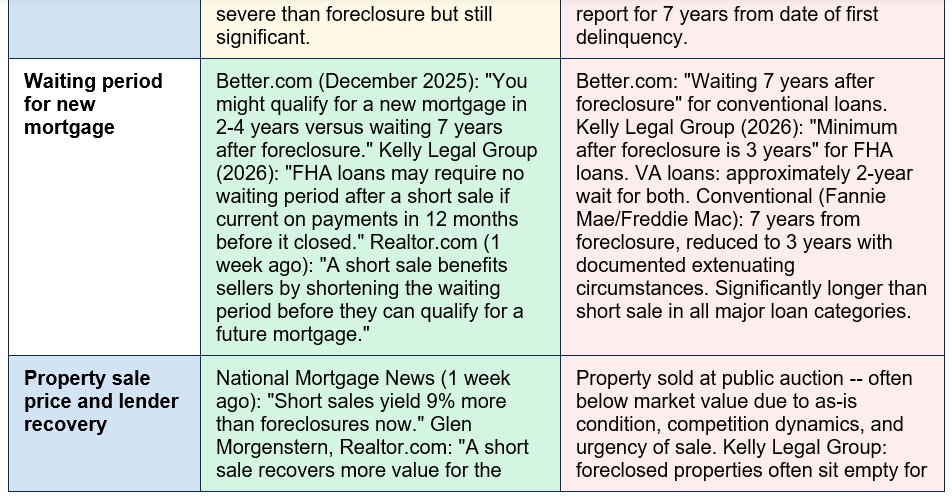
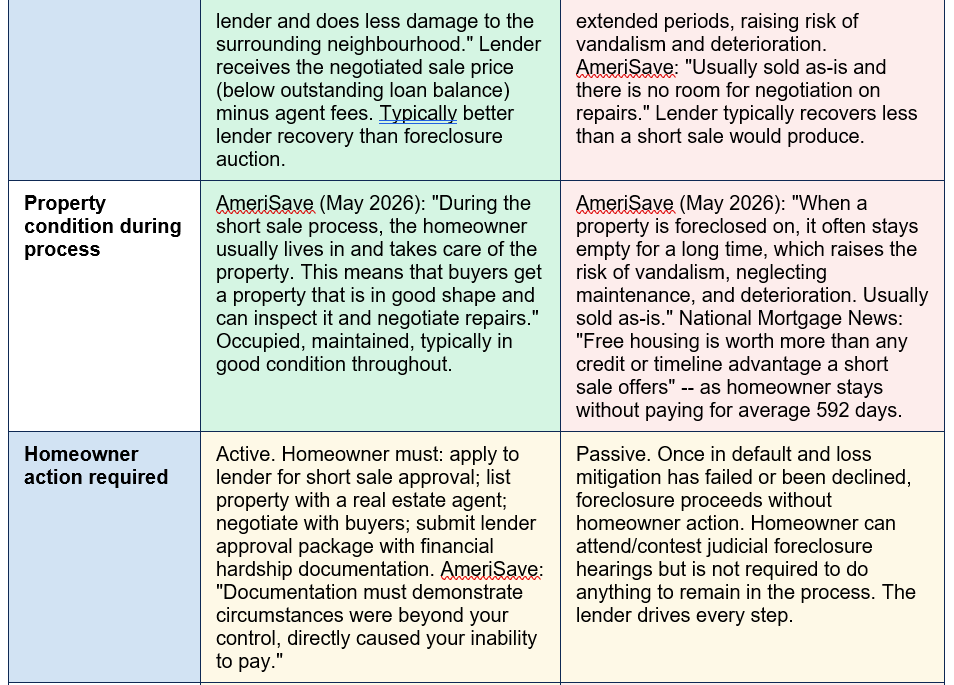
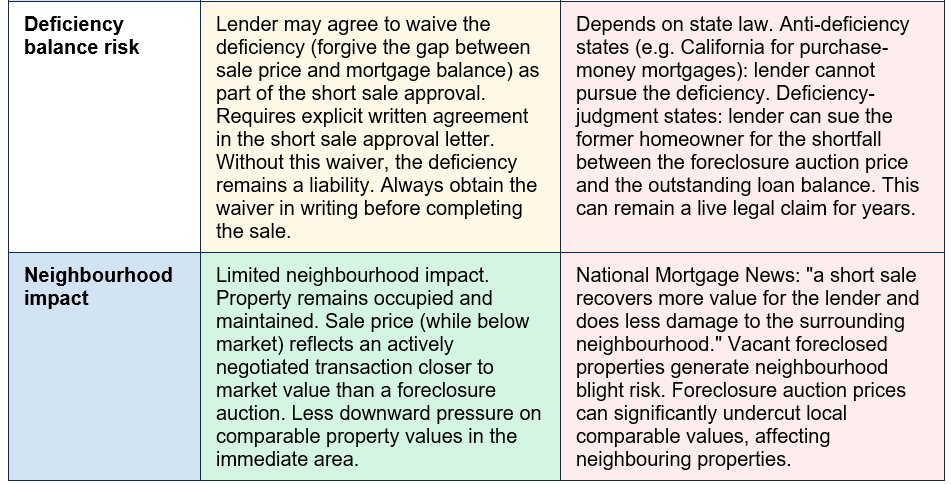
The following table maps every major dimension of comparison between short sales and foreclosures, using the most current available 2026 data: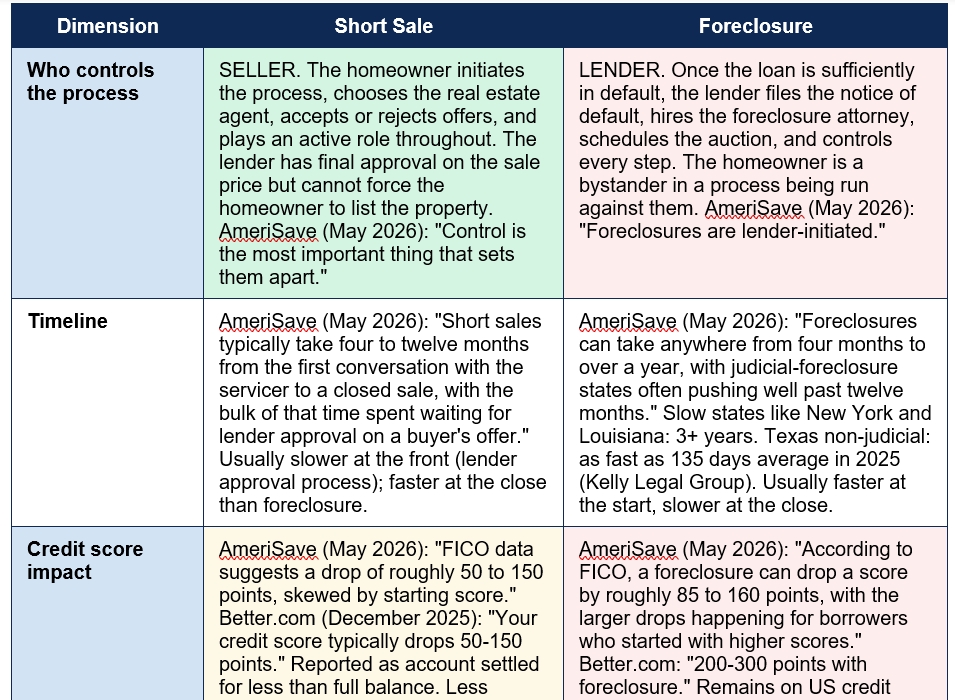
Credit Score Impact: The Numbers Side by Side
Both a short sale and a foreclosure cause significant credit damage. But the nature, magnitude, and duration of that damage differ in important ways. Understanding exactly what each event does to a credit file is essential for anyone weighing the options:Short Sale Credit Impact
A short sale is recorded on the credit file as the mortgage account being 'settled for less than the full amount owed' or with a similar status code. AmeriSave (May 13, 2026): 'FICO data suggests a drop of roughly 50 to 150 points, again skewed by starting score.' Better.com (December 2025): 'Your credit score typically drops 50-150 points.' The key variable is the starting score -- a borrower with a 780 credit score who completes a short sale can drop more points in absolute terms than a borrower with a 620 score, because the higher-score borrower has more to lose. However, the relative damage is more contained for the higher-score borrower compared to foreclosure. Importantly, late payment entries and the missed mortgage payments that typically precede any short sale will have already damaged the credit score before the short sale itself is recorded -- the total credit damage must account for the arrears period plus the short sale notation.Foreclosure Credit Impact
AmeriSave (May 2026): 'According to FICO, a foreclosure can drop a score by roughly 85 to 160 points, with the larger drops happening for borrowers who started with higher scores.' Better.com: 'Your credit score typically drops 200-300 points with foreclosure.' The higher figures in Better.com may reflect the cumulative effect of the entire delinquency period plus the foreclosure notation, whereas the FICO figures may isolate the impact of the foreclosure event itself. The foreclosure notation remains on the US credit report for 7 years from the date of first delinquency. During this period, it is one of the most visible and negatively weighted items a lender will see.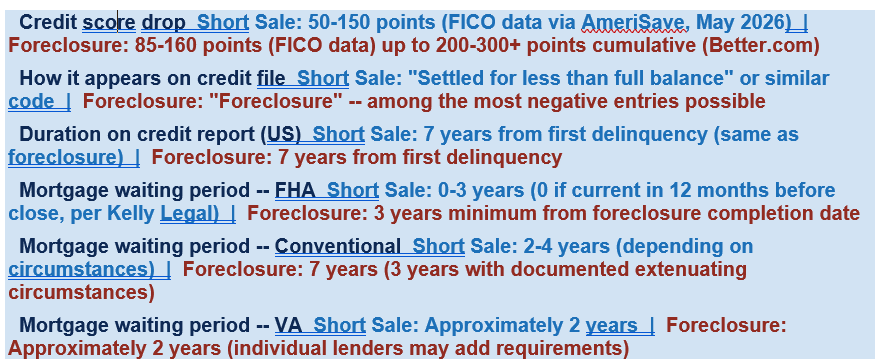
The credit score debate: are short sales really better than foreclosures? Real Estate News (July 17, 2026): 'While short sales are believed to be easier on a seller's credit than a foreclosure, many credit bureaus score them similarly.' This is an important nuance. The theoretical difference between short sale and foreclosure credit damage is meaningful -- the different notation codes carry different FICO weights, and the shorter mortgage waiting period for short sales is a documented advantage. However, by the time either event occurs, the borrower has typically missed many mortgage payments -- and those missed payments have already caused substantial credit damage regardless of which path follows. The practical difference between a 50-150 point drop (short sale) and an 85-160 point drop (foreclosure) matters most for borrowers who were in relatively good financial shape before the crisis and who want to minimise their recovery timeline. For borrowers whose credit was already significantly damaged by arrears, the difference in the event itself may be less decisive than the difference in the waiting period for a new mortgage.
Mortgage Waiting Periods: How Long Before You Can Buy Again?
The difference in waiting periods for a new mortgage after a short sale versus a foreclosure is one of the clearest and most consequential distinctions between the two outcomes. Realtor.com Chief Economist Danielle Hale (Real Estate News, July 17, 2026): 'A short sale benefits them by shortening the waiting period before they can qualify for a future mortgage.' Better.com (December 2025): 'You might qualify for a new mortgage in 2-4 years versus waiting 7 years after foreclosure.' Kelly Legal Group (2026): the precise waiting periods under current 2026 Fannie Mae, Freddie Mac, FHA, and VA guidelines are:- FHA loans (Federal Housing Administration): Short sale: may require no waiting period if the borrower was current on all payments in the 12 months before the short sale closed. Standard waiting period: 3 years if there were late payments in that period. Foreclosure: minimum 3 years from the completion date of the foreclosure. FHA loans are often the first re-entry point for borrowers with recent credit events because of their more flexible underwriting standards.
- Conventional loans (Fannie Mae/Freddie Mac): Short sale: 2-4 years depending on circumstances (typically 4 years, reduced to 2 years with documented extenuating circumstances). Foreclosure: 7 years from the completion date of the foreclosure, reduced to 3 years with documented extenuating circumstances. The 7-year standard waiting period after conventional foreclosure is one of the most significant long-term financial consequences of foreclosure -- it prevents access to the most common and competitively priced mortgage product for most of a decade.
- VA loans (Department of Veterans Affairs): Kelly Legal Group (2026): 'VA loans apply roughly a 2-year wait for both, though individual lenders sometimes add requirements on the foreclosure side.' This relative parity between short sale and foreclosure for VA-eligible borrowers is worth noting -- for veterans, the foreclosure vs short sale choice may be less defined by the mortgage waiting period difference than for conventional loan borrowers.
- USDA loans: Typically a 3-year waiting period after either a short sale or foreclosure, similar to FHA. Borrowers in eligible rural areas may find USDA loans accessible before conventional loans after either event.
How a Short Sale Works: The Step-by-Step Process
Understanding the short sale process is essential for anyone considering it as an alternative to foreclosure. AmeriSave (May 2026) outlines the key steps and documentation requirements:- Step 1 -- Confirm eligibility and hardship: Lenders will only approve a short sale if the homeowner can demonstrate genuine financial hardship. AmeriSave (May 2026): 'Accepted events include involuntary job loss due to downsizing or company closure, serious illness or injury creating significant medical expenses, death of a primary wage earner, divorce or legal separation, and natural disasters affecting your property or income.' Documentation must demonstrate that the circumstances were beyond the borrower's control, directly caused the inability to pay, and -- in some cases -- that financial recovery has since occurred. 'Simply stating that you lost your job is insufficient. You need employment records, unemployment documentation, and evidence of subsequent stable reemployment.'
- Step 2 -- Contact the lender and get pre-approval for the short sale process: Before listing the property, contact the mortgage servicer to begin the short sale application. Provide the hardship letter, financial documentation (bank statements, tax returns, pay stubs), and an explanation of why a short sale is the appropriate resolution. Many servicers have dedicated loss mitigation departments for this purpose. Getting lender pre-approval for the short sale process (not the specific offer price) before marketing the property prevents wasted time on a sale the lender will not approve.
- Step 3 -- List and market the property: Work with a real estate agent experienced in short sales -- not all agents are. The listing must disclose that it is a short sale and that offers are subject to lender approval. Buyers must understand this upfront; uninformed buyers who do not understand the extended timeline often withdraw offers during the lender approval wait. Price the property competitively to attract offers quickly, as the lender will conduct their own valuation (BPO -- Broker Price Opinion) when reviewing any offer.
- Step 4 -- Submit the buyer's offer for lender approval: When a buyer's offer is received and accepted by the seller, the complete offer package (purchase agreement, buyer pre-approval letter, HUD-1 settlement statement, and all supporting documents) is submitted to the lender for approval. AmeriSave: 'The bulk of the short sale timeline is spent waiting for lender approval on a buyer's offer.' This can take 30-90 days. During this period, the buyer must be willing to wait with no certainty of approval.
- Step 5 -- Negotiate deficiency waiver: This is the most critical negotiation of the short sale. If the lender approves the sale at a price below the outstanding balance, the difference (the deficiency) remains a debt unless the lender explicitly agrees to waive it in the approval letter. ALWAYS require that the short sale approval letter explicitly states the lender will not pursue the deficiency balance. Without this written waiver, completing the short sale does not eliminate the debt.
- Step 6 -- Close the sale: Once lender approval is received (with deficiency waiver confirmed), the sale proceeds to close in the standard manner. The homeowner vacates; the sale proceeds go to the lender. The mortgage account is closed with the settled-for-less notation on the credit file.
The Foreclosure Path: The Passive Alternative
Foreclosure is not a choice so much as a default outcome -- what happens when a short sale does not occur and loss mitigation fails or is not pursued. But it is worth understanding what the foreclosure path looks like from the homeowner's perspective, because the extended timeline has financial implications that are more significant than many people appreciate.National Mortgage News (July 17, 2026): Glen Morgenstern of Realtor.com stated the counterintuitive argument clearly: 'The homeowner controls the outcome, and a foreclosure lets them stay in the home without paying for 592 days on average. That free housing is worth more than any credit or timeline advantage a short sale offers.' The logic: if the average foreclosure takes 592 days from default to eviction, and the homeowner is not making mortgage payments during that time, the financial value of the free housing (at, say, $2,000/month in equivalent rent) is $39,467 over those 592 days. Compared to a short sale that might save 3-5 years on the mortgage waiting period but requires active engagement, documentation, and negotiation -- for some homeowners, particularly those with no desire to own a home again soon and no significant credit score to protect, the foreclosure math is actually more favourable.
This is an honest presentation of the tradeoff. The short sale is better for homeowners who want to minimise credit damage, return to homeownership sooner, maintain their dignity and control in the exit, and potentially avoid a deficiency judgment. The foreclosure is effectively better for homeowners who need the extended period of free housing, have no realistic path to future homeownership within 10 years, and whose credit is already significantly damaged by the arrears period. Both calculations depend heavily on individual circumstances, and neither is universally correct.
The 592-day free housing calculation: the counterintuitive foreclosure advantage. National Mortgage News (1 week ago): Glen Morgenstern at Realtor.com: 'A foreclosure lets them stay in the home without paying for 592 days on average. That free housing is worth more than any credit or timeline advantage a short sale offers.' At $1,800/month in equivalent rental value: 592 days (19.7 months) x $1,800 = $35,420 in free housing. At $2,500/month: $49,200. This calculation does not advocate for foreclosure -- it presents the honest financial arithmetic that some homeowners in severe financial distress will find decisive. For a homeowner with children in school, no savings, and no prospect of homeownership for 10+ years, the free housing period of foreclosure may genuinely outweigh the credit and timeline advantages of a short sale. For a homeowner with a 700+ credit score, a desire to buy again in 3-4 years, and savings for a rental deposit, the short sale is almost certainly the better choice. The right answer requires knowing which profile applies.
For Buyers: Short Sale or Foreclosure -- Which Is the Better Purchase?
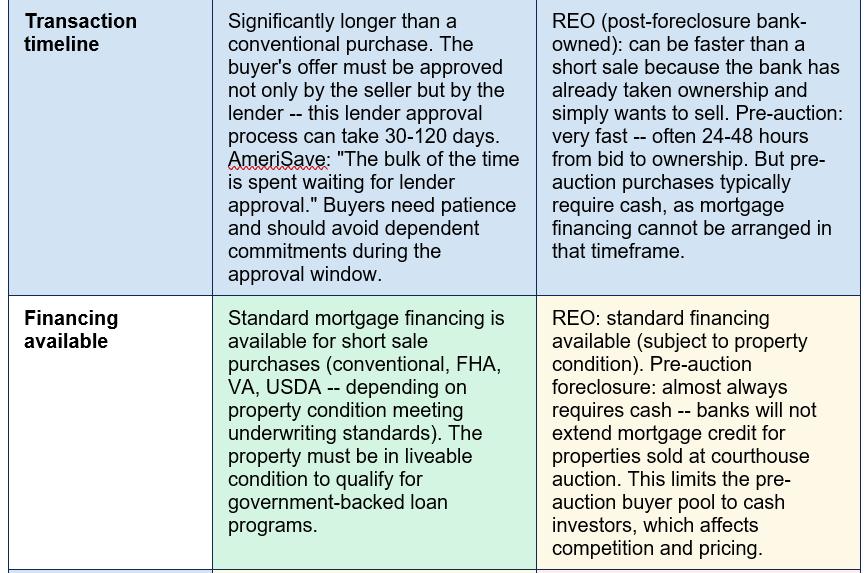
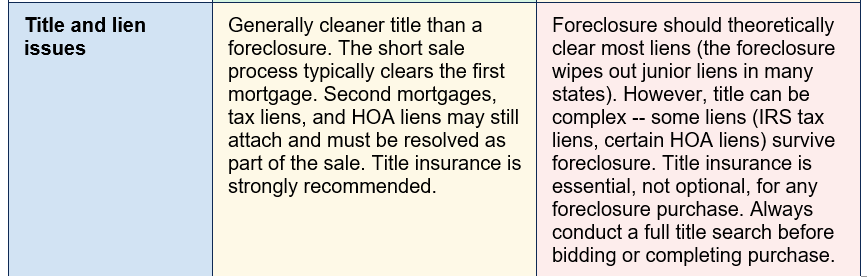
For buyers seeking a property at below-market prices, both short sales and foreclosures represent potential opportunities -- but with very different risk profiles, timelines, and financing considerations. The following table maps the buyer's perspective: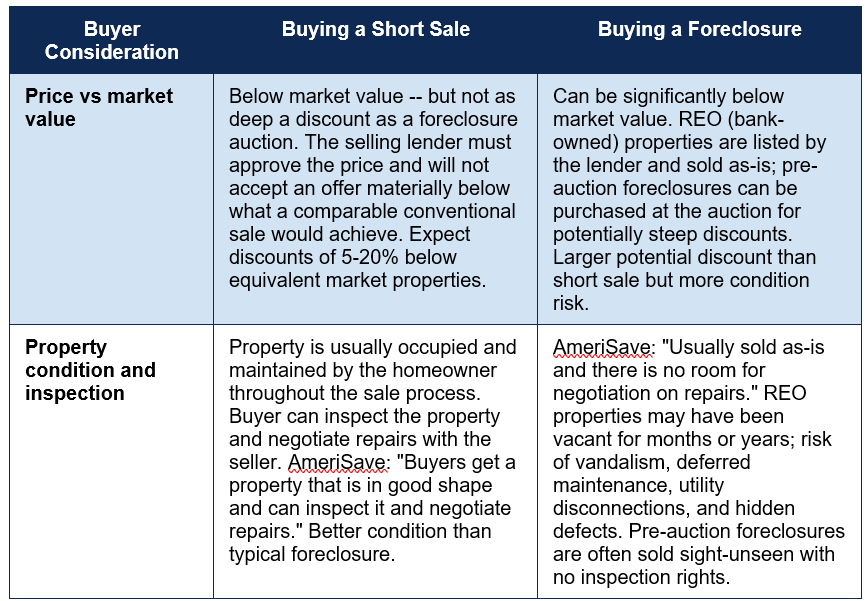
Tax Implications: The Debt Forgiveness Trap Both Carry
Both short sales and foreclosures carry a potential tax consequence that many homeowners do not anticipate: when a lender forgives or writes off a debt (such as the deficiency balance after a short sale or the shortfall after a foreclosure), the IRS may treat the forgiven amount as taxable income to the former homeowner. This is called Cancellation of Debt (COD) income.Better.com (December 2025): 'Forgiven debt might be considered taxable income by the IRS.' If a homeowner owed $250,000 on their mortgage and the property was sold (via short sale or foreclosure) for $200,000, the $50,000 difference may be treated as income. At a marginal tax rate of 22%, that could create a $11,000 tax liability in the year of the event. However, significant exemptions exist: the Mortgage Forgiveness Debt Relief Act (extended multiple times) has provided exemptions for discharged mortgage debt on a primary residence; insolvency exceptions mean that taxpayers who were insolvent at the time of the forgiveness (liabilities exceed assets) may be able to exclude COD income; and bankruptcy discharges also exclude COD income.
The critical action: consult a qualified tax adviser before completing either a short sale or a foreclosure. The tax consequences are specific to the individual's financial position at the time of the event and require professional analysis. This is not optional advice -- a significant and unexpected tax bill on forgiven debt can extend the financial recovery period by years.
Short Sale or Foreclosure: Which Is Right for Your Situation?
The decision between pursuing a short sale and allowing a foreclosure to proceed is one of the most consequential financial decisions a distressed homeowner faces. The following framework helps identify which path is likely to serve each situation better:- 11. Choose a short sale if: you want to be eligible for a new conventional mortgage in 4 years or less; you have a credit score of 650+ that you want to protect for future financial access; you are employed and have the capacity to engage actively in the process; your property has enough value to attract a buyer at or near the outstanding balance; you have documented financial hardship that a lender will accept; and you want to negotiate a deficiency waiver to eliminate the remaining debt. Realtor.com's Danielle Hale (July 17, 2026): 'A short sale benefits them by shortening the waiting period before they can qualify for a future mortgage.'
- 12. Foreclosure may be the realistic outcome if: you cannot engage actively with the short sale process; your property is significantly underwater (worth far less than the mortgage) and no lender will approve a short sale at the available market price; you need the extended period of housing without payment to save money for rental deposits and moving costs; you have no realistic path to homeownership in the next decade due to other financial factors; or you have already received foreclosure notices and the timeline for a short sale has closed. National Mortgage News (July 2026): 'A foreclosure lets them stay in the home without paying for 592 days on average.'
- 13. Neither option is permanent: Both a short sale and a foreclosure are recoverable. Credit scores recover. Waiting periods end. The 10-year horizon that feels permanent at the point of a financial crisis is not permanent in reality. Quality Properties Cash Buyer (February 2026): 'For most people, a short sale does less damage to your credit score and allows you to buy another home much sooner than a foreclosure would.' The key is making the decision with accurate information rather than under misinformation, panic, or inaction.
SHORT SALE vs FORECLOSURE -- THE DECISION CHECKLIST: STEP 1 -- CONTACT A HUD-APPROVED HOUSING COUNSELLOR (FREE): 1-800-569-4287 before making any decision. A HUD counsellor assesses your full financial picture and identifies all available options including loss mitigation, loan modification, forbearance, short sale assistance, and foreclosure alternatives. STEP 2 -- ASSESS YOUR TIMELINE: How long before foreclosure proceedings begin or advance significantly? A short sale requires 4-12 months. If you have only 60-90 days before a foreclosure sale date, a short sale may not be achievable. STEP 3 -- ASSESS YOUR FUTURE HOMEOWNERSHIP GOALS: Do you want to buy a home again in 3-5 years? SHORT SALE strongly preferred (shorter waiting period). Do you have no homeownership plans for 10+ years? The foreclosure vs short sale credit difference matters less over that horizon. STEP 4 -- GET DEFICIENCY WAIVER IN WRITING: If you pursue a short sale, NEVER close without a written deficiency waiver in the lender approval letter. Without it, completing the short sale does not eliminate the remaining debt. STEP 5 -- CONSULT A TAX ADVISER: Both a short sale and a foreclosure can generate a taxable COD (Cancellation of Debt) income event. Know the tax consequence before completing either process. STEP 6 -- GET LEGAL ADVICE ON STATE DEFICIENCY LAWS: Your state law determines whether a lender can pursue a deficiency judgment after foreclosure. In anti-deficiency states, this risk is eliminated. Knowing your state law affects the relative risk calculation. Free legal help: lawhelp.org | Legal Aid in your area.
FIVE SHORT SALE MISTAKES THAT UNDERMINE THE PROCESS: (1) NOT GETTING A DEFICIENCY WAIVER IN WRITING. The most costly short sale mistake. If the lender approval letter does not explicitly state that the remaining balance is forgiven, the homeowner owes the deficiency despite completing the sale. Always require written confirmation that the lender will not pursue the shortfall before closing. (2) ASSUMING THE SHORT SALE WILL BE APPROVED BECAUSE THE LENDER AGREED TO REVIEW IT. Lender agreement to review a short sale is not approval. The lender can decline any offer they consider inadequate and will conduct their own valuation (BPO) of the property. If the buyer's offer is below what the lender's BPO shows the property is worth, the offer will be rejected and the process must restart. (3) WORKING WITH AN AGENT UNFAMILIAR WITH SHORT SALES. Short sale transactions are significantly more complex than standard sales. An agent without short sale experience will not know how to structure the lender approval package, manage the extended timeline with the buyer, or negotiate the deficiency waiver. Verify short sale experience before listing. (4) IGNORING THE TAX CONSEQUENCES. Better.com: 'Forgiven debt might be considered taxable income by the IRS.' An unexpected $10,000-$30,000 tax bill on forgiven mortgage debt can eliminate any financial benefit gained from avoiding the foreclosure. Consult a tax adviser before completing the sale. (5) WAITING TOO LONG TO BEGIN THE SHORT SALE PROCESS. AmeriSave: 'A short sale requires borrowers to act before the bank forces their hand.' A short sale typically takes 4-12 months. If foreclosure proceedings are already advanced, the window for a short sale may close before the sale can complete. Begin the short sale process as early as possible -- ideally at the first signs of payment difficulty.
Conclusion
A short sale and a foreclosure are both exits from a mortgage that cannot be sustained -- but they are fundamentally different exits in terms of who controls the process, what happens to credit, how quickly homeownership becomes available again, and what the financial consequences are for both the homeowner and the lender. In 2026, short-sale transactions have risen 16% year-over-year and foreclosures have risen 21%, reflecting a housing market in which more homeowners are facing this choice than at any point since the pandemic-era protections expired.The financial case for a short sale, for homeowners who can pursue it: better credit outcome (50-150 point drop vs 85-160+ for foreclosure); significantly shorter mortgage waiting period (2-4 years vs 7 years for conventional loans); maintained control over the exit process; better lender recovery (short sales yield 9% more than foreclosures, per National Mortgage News); and potential for a deficiency waiver. The honest counter-case for foreclosure: 592 days of free housing on average (National Mortgage News), with no required engagement, at a time when saving for rental deposits and rebuilding finances may be the priority.
Realtor.com's Danielle Hale (July 17, 2026) captures the right framing: 'Foreclosures are the more common outcome, but borrowers facing difficulty should consider all of their options.' The most important action for any homeowner in mortgage difficulty is to seek free professional advice from a HUD-approved housing counsellor (1-800-569-4287) before the window for a short sale closes. Both options are recoverable. The goal is to make the choice that best fits the individual circumstances -- with full information, professional guidance, and a clear view of the long-term consequences of each path.
Frequently Asked Questions (FAQ)
What is the main difference between a short sale and a foreclosure?The most fundamental difference is control. AmeriSave (May 2026): 'Control is the most important thing that sets them apart.' In a short sale, the homeowner voluntarily initiates the process, chooses the real estate agent, accepts or rejects offers from buyers, and plays an active role in the resolution -- though the lender has final approval on the sale price. In a foreclosure, the lender initiates and controls everything. AmeriSave: 'Foreclosures are lender-initiated. Once the loan is far enough in default and loss mitigation has been declined or has failed, the lender is the party that files the notice of default, hires the foreclosure attorney, and schedules the auction.' A short sale is a negotiated exit; a foreclosure is an enforced one. A short sale is also voluntary (the homeowner must apply and be approved); a foreclosure is what happens when no other resolution is reached. Other key differences: short sales typically produce better credit outcomes (50-150 point drop vs 85-160+ for foreclosure per FICO data), shorter mortgage waiting periods (2-4 years vs 7 years for conventional loans), better lender recovery (short sales yield 9% more than foreclosures per National Mortgage News, July 2026), and better property condition at point of sale (occupied and maintained vs often vacant and deteriorating). Foreclosure offers the advantage of extended free housing -- an average of 592 days according to Realtor.com (National Mortgage News, July 2026).
Does a short sale hurt your credit less than a foreclosure?
Generally yes, but the difference is more nuanced than often presented. AmeriSave (May 13, 2026): 'According to FICO, a foreclosure can drop a score by roughly 85 to 160 points, with the larger drops happening for borrowers who started with higher scores. A short sale is reported on a credit file as the account being settled for less than the full balance, and FICO data suggests a drop of roughly 50 to 150 points.' Better.com (December 2025) puts the foreclosure damage higher at 200-300 points cumulatively. Real Estate News (July 17, 2026) provides an important caveat: 'While short sales are believed to be easier on a seller's credit than a foreclosure, many credit bureaus score them similarly.' The difference in the event itself (30-50 points in some scenarios) matters more in terms of the mortgage waiting period than in the raw score impact. The practical advantage of a short sale in credit terms is primarily the shorter waiting period for a new mortgage: 2-4 years for a conventional loan after a short sale vs 7 years after a foreclosure (Kelly Legal Group, 2026). Both events are preceded by missed mortgage payments that have already caused significant credit damage by the time either event completes.
How long does a short sale take?
A short sale typically takes 4-12 months from the first contact with the mortgage servicer to a completed sale. AmeriSave (May 2026): 'Short sales typically take four to twelve months from the first conversation with the servicer to a closed sale, with the bulk of that time spent waiting for lender approval on a buyer's offer.' The timeline breaks down as follows: gathering and submitting hardship documentation to the lender (2-4 weeks); receiving lender pre-approval to proceed with listing (1-3 months); marketing the property and receiving a buyer's offer (1-4 months, depending on market conditions); submitting the buyer's offer to the lender for approval (30-90 days); and closing the approved sale (2-4 weeks after lender approval). The extended timeline creates a significant challenge for buyers, who must wait for lender approval with no certainty of outcome. Buyers who are not prepared for this wait often withdraw their offers, restarting the process. Real multiple-offer scenarios can further extend the timeline if the lender declines an initial offer and the property must be relisted. The key planning implication: begin a short sale as early as possible in the arrears period, as 4-12 months may exceed the available window if foreclosure proceedings are already advancing.
Can a lender still sue me for the remaining balance after a short sale?
Yes -- unless you obtain a written deficiency waiver in the lender's short sale approval letter. The 'deficiency' is the gap between the short sale price and the outstanding mortgage balance. Without an explicit waiver, the lender retains the right to pursue this balance as an unsecured debt claim, even after the short sale is complete. This is the single most important negotiation in the short sale process. The deficiency waiver must appear explicitly in the lender's written approval letter before the sale closes. Never complete a short sale relying on a verbal assurance that the deficiency will be waived -- verbal assurances are not enforceable. In foreclosure, the deficiency risk varies by state law. Anti-deficiency states (including California for purchase-money mortgages) prohibit lenders from pursuing a deficiency judgment after foreclosure. In deficiency-judgment states, the lender can sue the former homeowner for the shortfall between the foreclosure auction price and the outstanding loan balance. The applicable state law is therefore an important input to the short sale vs foreclosure decision -- in an anti-deficiency state, the foreclosure deficiency risk is eliminated, which changes the relative risk calculation. Consult a real estate attorney to determine your state's specific rules.
How soon can I buy a home after a short sale or foreclosure?
The waiting period before you can qualify for a new mortgage depends on the loan type and your specific circumstances. For the major loan types under current 2026 guidelines (Kelly Legal Group, 2026): FHA loans: short sale -- no waiting period if current on all payments in the 12 months before the short sale close; 3 years if there were late payments. Foreclosure: minimum 3 years from the foreclosure completion date. Conventional loans (Fannie Mae/Freddie Mac): short sale -- typically 4 years (2 years with documented extenuating circumstances). Foreclosure: 7 years (3 years with documented extenuating circumstances). VA loans: short sale -- approximately 2 years. Foreclosure: approximately 2 years, though individual lenders sometimes add requirements. Better.com (December 2025): 'You might qualify for a new mortgage in 2-4 years versus waiting 7 years after foreclosure.' Real Estate News (July 17, 2026): Danielle Hale, Realtor.com: 'A short sale benefits them by shortening the waiting period before they can qualify for a future mortgage.' The waiting period difference -- particularly the 7-year conventional loan wait after foreclosure compared to 2-4 years after a short sale -- is the single most compelling financial argument for pursuing a short sale over allowing foreclosure to proceed, for homeowners who want to own a home again within a decade.

0 Comments Comments