
Real Estate
What Is a Foreclosure? UK & US: Accountan Explains

Table of Contents
- The Word That Strikes Fear -- and What It Actually Means
- What Is Foreclosure? The Core Definition
- The US Foreclosure Process: Step by Step
- The UK Mortgage Repossession Process: Step by Step
- UK vs US: The Foreclosure Process Compared
- The 2026 Foreclosure Landscape: Why Numbers Are Rising
- How Foreclosure Affects Your Credit Score and Financial Future
- Alternatives to Foreclosure: What to Do Before It Is Too Late
- What to Do Right Now If You Are Facing Mortgage Arrears
- Conclusion
- Frequently Asked Questions (FAQ)
The Word That Strikes Fear -- and What It Actually Means
Foreclosure is one of the most feared words in personal finance -- and one of the least understood. For most homeowners, it exists somewhere between abstract dread and something that happens to other people. Until it does not. In the first half of 2026, ATTOM data reported that 227,548 US properties carried a foreclosure filing -- up 21% from the same period a year earlier. In the UK, Ministry of Justice data analysed by LandlordBuyer showed mortgage repossessions rising 9% year-on-year in Q3 2025. Foreclosure and its UK equivalent, mortgage repossession, are not rare edge-case events. They are a documented, rising feature of the 2026 housing landscape.Nolo (July 2026, updated 3 days ago): 'Foreclosure rates surged dramatically at the end of 2025 and into 2026, with Florida, Delaware, Nevada, Indiana, and South Carolina emerging as foreclosure hot spots across the United States.' ATTOM (1 week ago): lenders repossessed 4,773 properties in June 2026 alone -- up 23% from a year ago. These are not abstractions. They represent families who lost their homes, primarily because of a combination of elevated mortgage costs, economic pressures, and -- in many cases -- a failure to understand their rights and options before the process reached its final stages.
This guide explains what foreclosure and mortgage repossession actually are -- the legal definitions, the step-by-step processes in both the UK and the US, the timelines involved, the credit consequences, and crucially the alternatives available at every stage. Nolo (January 2026): 'Understanding how foreclosure works, your legal rights, and available alternatives can help you stop foreclosure proceedings and potentially save your home.' The most important thing most people do not know about foreclosure is how much time and how many intervention points exist before the worst outcome -- the loss of the home -- actually occurs.
What Is Foreclosure? The Core Definition
Foreclosure is the legal process by which a mortgage lender takes ownership of a property when the borrower -- the homeowner -- defaults on their mortgage payments and fails to resolve the default. The term is primarily used in the United States. In the United Kingdom, the equivalent process is called mortgage repossession. In both cases, the fundamental mechanism is the same: the lender, who has a legal charge (UK) or lien (US) on the property as security for the mortgage loan, exercises that security interest to recover the property and sell it to recoup the outstanding loan balance.The mortgage agreement, signed at the point of taking out the home loan, gives the lender this right explicitly. When a borrower takes a mortgage, they are not simply borrowing money -- they are granting the lender a secured interest in their property. That security interest is the legal foundation of foreclosure. If the loan is not repaid according to its terms, the lender has the legal right (subject to the procedural requirements described below) to enforce their security by taking the property. This is not a punitive action or a last resort chosen out of spite -- it is the exercise of a contractual and legal right that the borrower agreed to at mortgage origination.
The critical point that most homeowners do not know: foreclosure and repossession are processes with multiple defined stages, each providing an opportunity to intervene. They are not events that happen overnight, and they are not inevitable once arrears begin. Nolo (January 2026): Federal law requires lenders to wait at least 120 days before officially starting the foreclosure process in most cases. In the UK, FCA mortgage conduct of business rules (MCOB 13) require lenders to engage with borrowers, consider forbearance options, and exhaust reasonable alternatives before initiating court action. From the first missed payment to the actual loss of a home typically takes 12-24 months in the US (depending on state) and approximately 12-18 months in the UK. That is a significant window for action.
Foreclosure in 2026 -- the defining data: 227,548 US properties had foreclosure filings in H1 2026 (up 21% from H1 2025). 4,773 US properties repossessed in June 2026 alone. UK: 9% rise in repossessions Q3 2025. — Nolo (July 21, 2026 -- 3 days ago): 'For the first six months of 2026, according to ATTOM, a total of 227,548 properties had a foreclosure filing, which is an increase of 21% from a year ago.' ATTOM (July 17, 2026 -- 1 week ago): 'Lenders repossessed 4,773 properties in June 2026, up 17% from the previous month and up 23% from a year ago.' LandlordBuyer (November 2025): 'Landlord repossessions jumped 9% year-on-year; mortgage repossessions: median time from claim to repossession climbed to 46.1 weeks.' MagicDoor (April 2026): 'ATTOM reported 140,006 foreclosure starts in H1 2025, up 7% from the previous year.'
The US Foreclosure Process: Step by Step
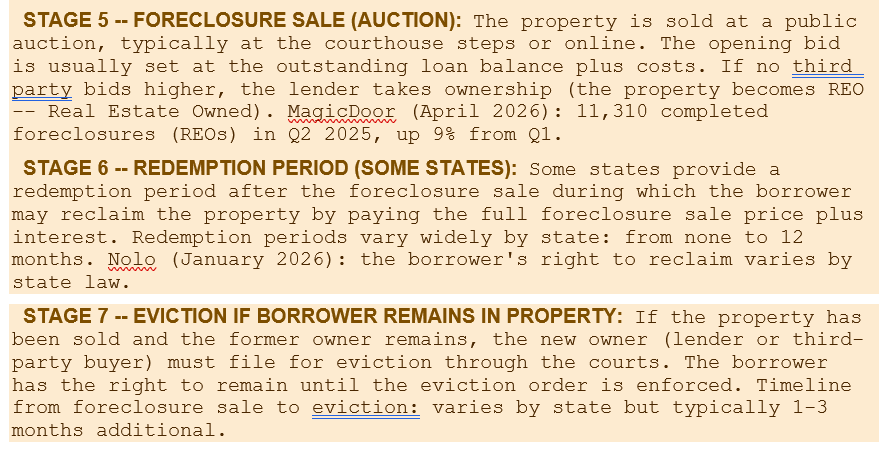
The US foreclosure process follows a defined sequence of legal steps. The exact steps, timelines, and borrower rights vary significantly by state -- some states require court supervision of every foreclosure (judicial states); others allow lenders to foreclose without court proceedings (non-judicial states). The following describes the general federal and common-law framework: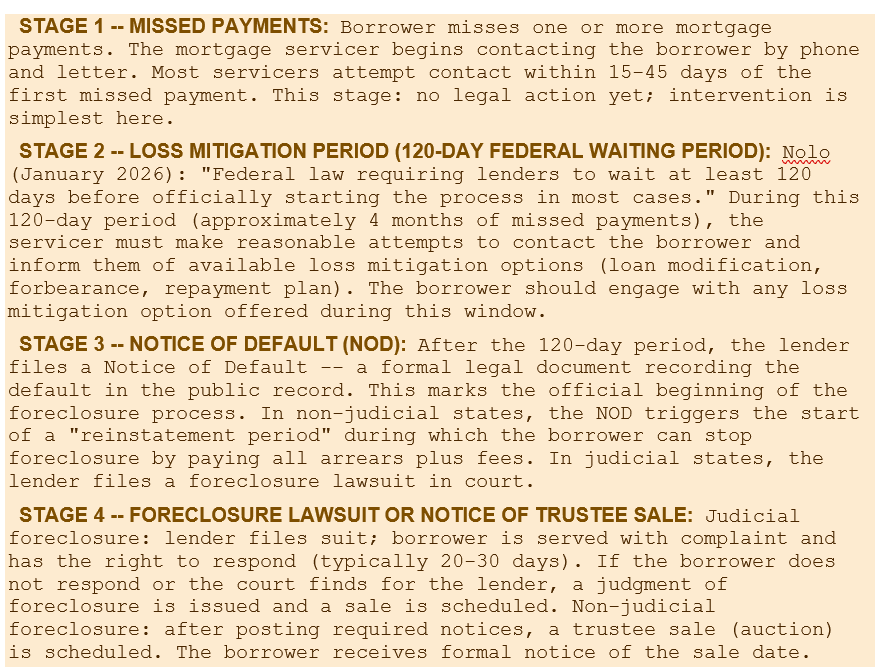
The UK Mortgage Repossession Process: Step by Step
The UK mortgage repossession process is court-supervised in virtually all cases and governed by FCA mortgage conduct rules that provide significant borrower protections throughout. The process is slower than many US non-judicial foreclosures and provides multiple formal opportunities to intervene: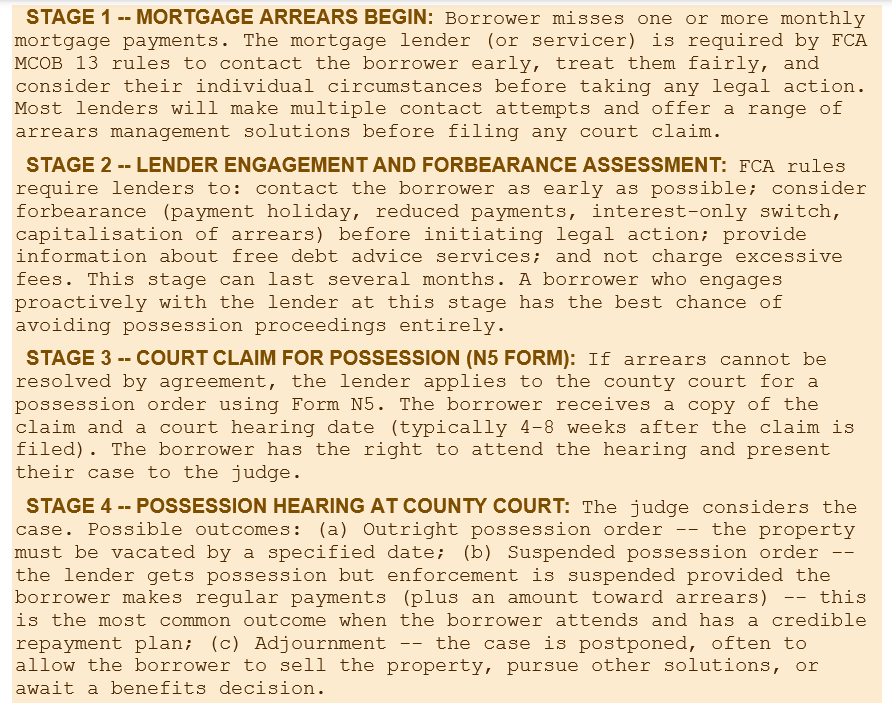
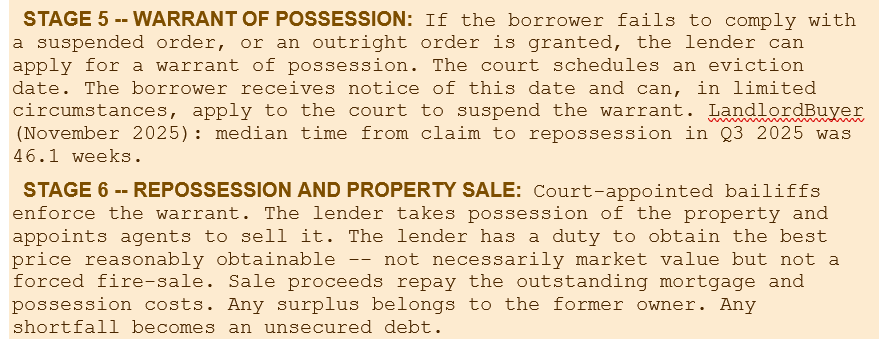
The most important thing to know about both the US and UK processes: the loss of the home is almost never inevitable at the point where most people first begin to worry about it. From the first missed mortgage payment, there are typically 12-18 months before a family must leave the property -- and multiple defined intervention points exist throughout. In the UK, a judge at a possession hearing can adjourn or suspend a possession order if the borrower attends with a credible repayment plan. In the US, the 120-day mandatory waiting period plus loss mitigation requirements create a structured opportunity for resolution. The critical factor: engage early, engage proactively, and seek free professional advice immediately. Nolo (January 2026): 'Understanding how foreclosure works, your legal rights, and available alternatives can help you stop foreclosure proceedings and potentially save your home.'
UK vs US: The Foreclosure Process Compared
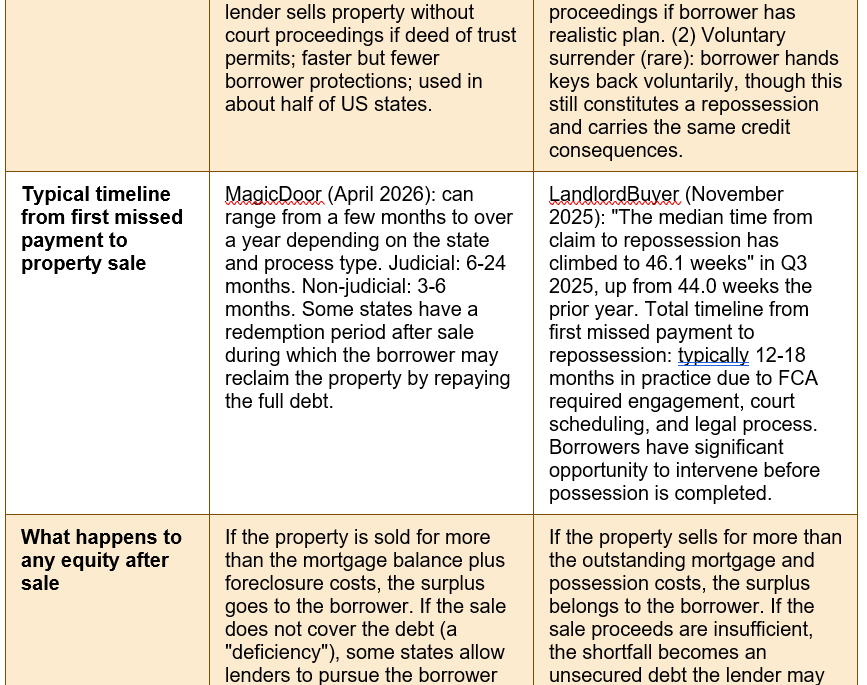
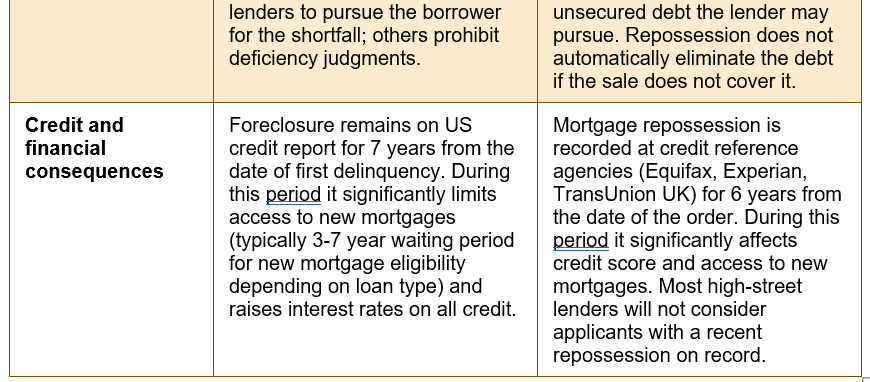
The US and UK systems share the same fundamental mechanism but differ significantly in procedure, timeline, and borrower protections. The following table maps every key dimension: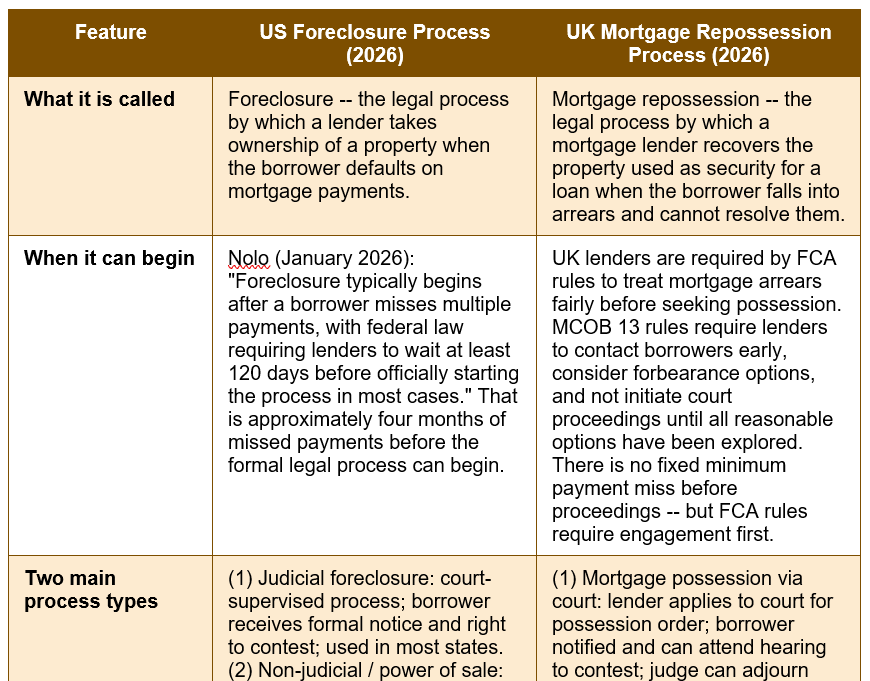
The 2026 Foreclosure Landscape: Why Numbers Are Rising
The increase in foreclosure activity in 2026 reflects a convergence of economic pressures that accumulated through 2022-2025. Nolo (July 2026): 'Beginning in 2022, throughout 2023, and into 2024, foreclosure rates began to climb again as pandemic-era protections expired and economic pressures -- like inflation, rising interest rates, and high insurance costs -- increased for homeowners. In 2025, there was a marked, sustained increase in both foreclosure starts and completions. According to a June 2026 report from ATTOM, foreclosure filings in the first quarter of the year have risen 21% from a year ago.'MagicDoor (April 2026), citing ATTOM Q2 2025 data: '95,349 U.S. properties in Q2 2025 carried a foreclosure filing -- a 6% increase from the previous quarter and a 13% jump compared to Q2 2024. The total number of foreclosure starts hit 55,172 in Q2 2025, up 7% quarter-over-quarter and 15% year-over-year, suggesting lenders are becoming more aggressive in resuming activity.' The states most affected in 2026: Florida (1 in every 2,106 housing units in June 2026, per ATTOM); South Carolina; Nevada; Delaware; and Indiana. California and Texas account for the highest absolute numbers of foreclosure filings due to their large populations.
In the UK, the Ministry of Justice Q3 2025 data showed a pattern of declining possession claims but increasing actual repossessions -- LandlordBuyer (November 2025): 'What we are seeing is a market where fewer claims are being issued, but more of them are ending in repossession. That suggests rising financial stress among tenants and landlords, and a higher conversion rate of cases moving all the way through the courts.' The median time from mortgage repossession claim to actual repossession reached 46.1 weeks in Q3 2025, reflecting both court backlogs and the extended engagement period FCA rules require. The practical implication: a borrower who engages with the legal process from the point of the initial court claim has, on average, nearly a year before the worst outcome occurs.
How Foreclosure Affects Your Credit Score and Financial Future
A completed foreclosure or mortgage repossession is among the most significant negative events that can appear on a credit file. Understanding the credit consequences is important both for those currently facing the process and for those planning a financial recovery:- US credit consequences: A foreclosure is recorded on the credit report for 7 years from the date of the first delinquency (not the date of the foreclosure sale). During this period, it severely limits access to new mortgage finance. Waiting periods for a new mortgage after foreclosure: FHA loan -- 3 years from foreclosure completion date; Conventional (Fannie Mae/Freddie Mac) loan -- 7 years (reduced to 3 years with documented extenuating circumstances); VA loan -- 2 years; USDA loan -- 3 years. During the waiting period, credit scores typically recover gradually as other positive credit behaviour is maintained, but mortgage access specifically remains restricted.
- UK credit consequences: A mortgage repossession is recorded at credit reference agencies for 6 years from the date of the court order or repossession event. During this period, most high-street lenders will decline mortgage applications from applicants with a repossession on record. Some specialist lenders may consider applications sooner, typically 3-4 years after repossession, though at significantly higher interest rates. The repossession also triggers a default on the mortgage account itself, which is recorded separately. Both the repossession and any associated default entries are visible to all lenders conducting credit checks.
- The deficiency judgment risk: In both the UK and the US, if the property sells for less than the outstanding mortgage balance plus costs, the former owner may remain liable for the shortfall. In the US, some states prohibit 'deficiency judgments' after foreclosure (anti-deficiency states); others allow them. In the UK, the shortfall becomes an unsecured debt that the lender can pursue through the courts. Former homeowners should establish whether a deficiency exists and whether the lender has formally pursued it, as unpursued deficiency claims can remain active for 6-12 years depending on jurisdiction.
Alternatives to Foreclosure: What to Do Before It Is Too Late
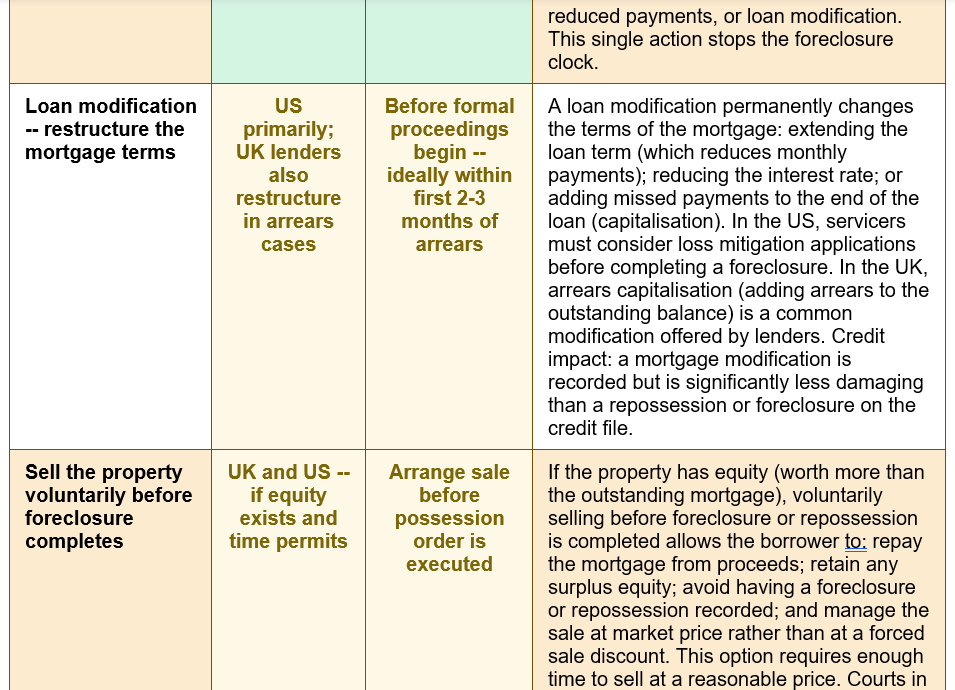
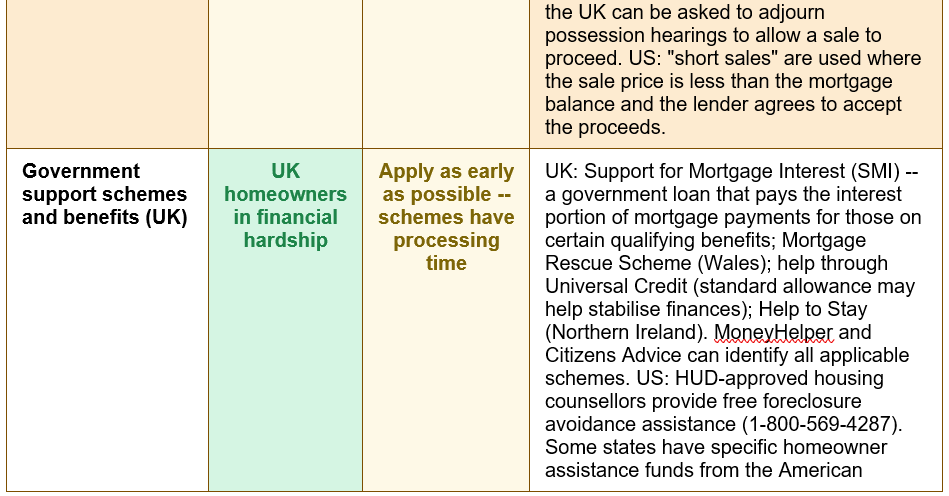
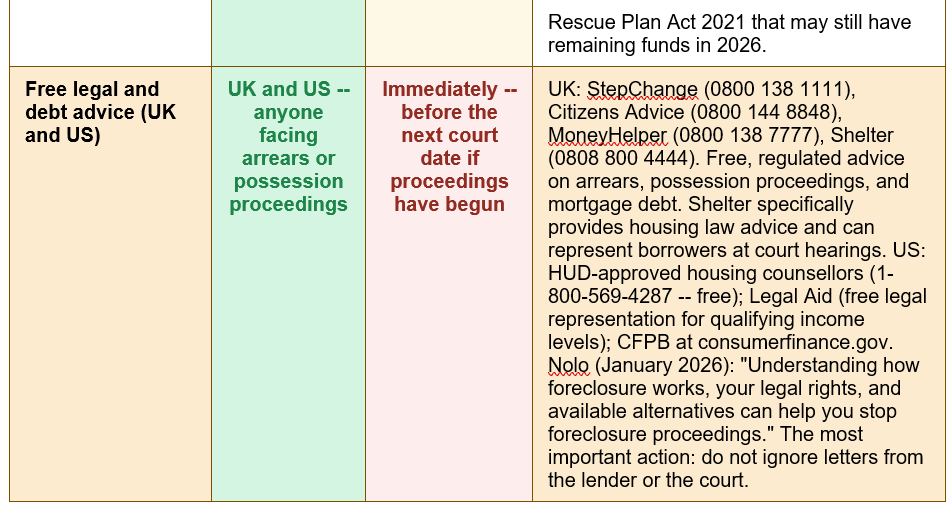
The most important message in any guide to foreclosure is this: alternatives almost always exist, and almost always require action before the process has advanced to its final stages. The following table maps every major alternative with the timeline for accessing it and the practical steps involved: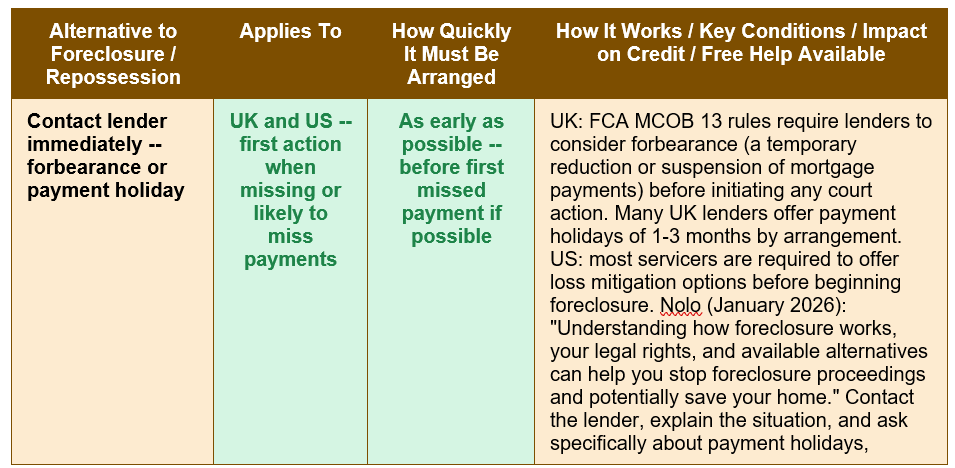
What to Do Right Now If You Are Facing Mortgage Arrears
If you have missed mortgage payments or believe you are about to, the following sequence of actions represents the most effective response, in order of priority:- Act immediately -- do not wait for the lender to contact you first: The earlier you engage, the more options are available. Contact your mortgage lender or servicer before the first missed payment if possible. Explain your situation, ask what forbearance options are available, and request a payment plan. Lenders in both the UK and US are required by their regulatory obligations to engage fairly with borrowers facing genuine financial hardship. Most would prefer to reach a payment arrangement than initiate the expensive and time-consuming foreclosure process.
- Seek free professional advice immediately: UK: Shelter (0808 800 4444) -- specialist housing law advice and court representation; StepChange (0800 138 1111) -- free debt and mortgage arrears advice; MoneyHelper (0800 138 7777); Citizens Advice (0800 144 8848). US: HUD-approved housing counsellors (1-800-569-4287) -- free foreclosure avoidance assistance; CFPB at consumerfinance.gov; Legal Aid for qualifying income levels. These services are free, regulated, and exist specifically to help people navigate arrears and possession proceedings. They are not a last resort -- they are the first call to make.
- Do not ignore any correspondence from the lender or the court: Ignoring a possession claim (UK) or a foreclosure summons (US) does not make it go away -- it makes the outcome worse. In the UK, failing to attend a possession hearing means the judge makes their decision without the borrower's input, almost always resulting in an outright possession order rather than a suspended one. In the US, failing to respond to a judicial foreclosure lawsuit within the deadline results in a default judgment in favour of the lender. Every piece of correspondence has a response deadline that matters.
- Explore whether you can sell voluntarily: If the property has equity (worth more than the mortgage balance), a voluntary sale before foreclosure completes protects that equity, avoids the worst credit consequences, and gives you control over the outcome. Courts in the UK regularly adjourn possession hearings to allow a sale to proceed. In the US, a voluntary sale before the foreclosure sale is almost always better than losing the property at auction.
- Apply for any available government support: UK: check eligibility for Support for Mortgage Interest (SMI); Universal Credit; any local authority housing assistance. US: check for remaining Homeowner Assistance Fund (HAF) money in your state; HUD counsellors can identify all available assistance. These programmes exist specifically for this situation and are significantly underused because homeowners in crisis often do not know they exist.
FORECLOSURE AND REPOSSESSION -- EMERGENCY CONTACT NUMBERS: UK HOUSING HELP (ALL FREE): Shelter: 0808 800 4444 (housing law advice; can represent you at possession hearings). MoneyHelper: 0800 138 7777 (mortgage arrears and debt guidance). StepChange: 0800 138 1111 (free debt advice including mortgage debt). Citizens Advice: 0800 144 8848 (rights, benefits, and debt). US HOUSING HELP (ALL FREE): HUD-Approved Housing Counsellors: 1-800-569-4287 (free foreclosure avoidance advice; find local counsellors). CFPB: consumerfinance.gov (official guidance on mortgage rights and loss mitigation). Legal Aid: find local offices at lawhelp.org (free legal representation for qualifying income levels). NATIONAL FOUNDATION FOR CREDIT COUNSELLING: 1-800-388-2227 (free debt and housing counselling). IF COURT PROCEEDINGS HAVE ALREADY BEGUN: attend every hearing; do not assume a missed hearing can be rescheduled; contact Shelter (UK) or Legal Aid (US) for representation before your first hearing date.
FIVE FORECLOSURE MISTAKES THAT MAKE A BAD SITUATION WORSE: (1) IGNORING LETTERS FROM THE LENDER OR COURT. This is the single most damaging thing a homeowner can do when facing arrears. Lender letters in early arrears offer options; court documents have response deadlines. Ignoring either eliminates options and hardens outcomes. Every document received must be read, dated, and acted upon. (2) ASSUMING THAT BECAUSE YOU CANNOT PAY, NOTHING CAN BE DONE. Nolo (January 2026): 'Understanding how foreclosure works, your legal rights, and available alternatives can help you stop foreclosure proceedings and potentially save your home.' Forbearance, loan modification, repayment plans, government support, and voluntary sale are all options that can stop or redirect the process -- but only if explored before the process reaches its final stages. (3) NOT ATTENDING A UK POSSESSION HEARING. When a judge hears a possession claim without the borrower present, the outcome is almost always an outright possession order rather than a suspended one (which allows the borrower to remain while making an agreed payment). Attending the hearing -- especially with a Shelter or Citizens Advice adviser -- produces dramatically better outcomes than not attending. Free representation is available. (4) STOPPING MORTGAGE PAYMENTS WITHOUT COMMUNICATING WITH THE LENDER. Some homeowners, believing foreclosure is inevitable, stop engaging with the lender entirely. This accelerates the process and eliminates every softening mechanism (forbearance, suspension orders, adjournments) that requires lender cooperation to access. The lender is not the enemy -- they have regulatory obligations to engage and financial incentives to prefer resolution over foreclosure. (5) TAKING EQUITY FROM THE HOME TO PAY OTHER DEBTS BEFORE ADDRESSING MORTGAGE ARREARS. In situations of financial crisis, some homeowners prioritise paying credit cards or personal loans over the mortgage. The mortgage is the most important debt to prioritise -- losing the home has consequences (homelessness, long-term credit damage, potential deficiency liability) that are categorically more severe than those from unsecured debt arrears.
Conclusion
Foreclosure in the US and mortgage repossession in the UK are the legal processes by which mortgage lenders enforce their security interest in a property when a borrower defaults on their loan and fails to resolve the arrears. In 2026, both are rising: US foreclosure filings in H1 2026 reached 227,548 -- up 21% from a year ago, with lenders repossessing 4,773 properties in June 2026 alone (ATTOM, July 2026). UK mortgage repossessions rose 9% year-on-year in Q3 2025, with the median time from claim to repossession reaching 46.1 weeks (LandlordBuyer, November 2025).The most important thing this guide establishes is how much time and how many intervention points exist between the first missed payment and the loss of the home. US federal law requires lenders to wait at least 120 days before formally beginning foreclosure. FCA rules in the UK require lenders to engage with borrowers and consider forbearance before any court action. From first missed payment to actual eviction, the typical timeline is 12-24 months in the US and 12-18 months in the UK. That is a significant window -- if it is used.
The alternatives to foreclosure -- forbearance agreements, loan modifications, voluntary sales, government support schemes, debt management plans, and free professional legal advice -- exist at every stage of this timeline. The single most effective action available to any homeowner facing mortgage arrears is to engage immediately: with the lender, with a free housing advice service, and with the legal process when it begins. Nolo (January 2026): 'Understanding how foreclosure works, your legal rights, and available alternatives can help you stop foreclosure proceedings and potentially save your home.' Do not ignore the letters. Do not assume the worst is inevitable. Seek free advice today.
Frequently Asked Questions (FAQ)
What is foreclosure and how is it different from repossession?Foreclosure is the US term for the legal process by which a mortgage lender takes ownership of a property when the borrower defaults on their mortgage payments. In the UK, the equivalent process is called mortgage repossession. Both terms describe the same fundamental mechanism: the lender, who holds a legal charge or lien on the property as security for the mortgage loan, exercises that security interest to recover the property and sell it to recoup the outstanding loan amount. Nolo (January 2026): 'Foreclosure typically begins after a borrower misses multiple payments, with federal law requiring lenders to wait at least 120 days before officially starting the process in most cases.' In the UK, FCA mortgage conduct rules (MCOB 13) require lenders to contact borrowers early and consider forbearance options before initiating court proceedings. The key differences between the two systems: the US has both judicial (court-supervised) and non-judicial (power of sale) foreclosure processes, and the timeline varies significantly by state from 3 to 24 months. The UK process is almost always court-supervised, with the median time from claim to repossession reaching 46.1 weeks in Q3 2025 (LandlordBuyer, November 2025).
How long does the foreclosure process take in the US?
The timeline varies significantly by state and by whether the state uses a judicial or non-judicial foreclosure process. As a general framework: the US federal 120-day waiting period before foreclosure can formally begin means that a minimum of approximately four months of missed payments must pass before the legal process starts. After the formal process begins: judicial foreclosure (court-supervised, used in most eastern states) typically takes 6-24 months depending on court scheduling and whether the borrower contests the case; non-judicial foreclosure (used in states including California, Texas, and Arizona) can proceed in 3-6 months once the notice of default has been filed. MagicDoor (April 2026): 'The timeline can range from a few months to over a year depending on the state and process type.' Some states provide a redemption period after the foreclosure sale during which the former homeowner can reclaim the property by repaying the full debt plus costs -- adding additional months before the situation is finalised. The total time from first missed payment to eviction in most cases: 12-24 months. In some states with extended court timelines (New York, New Jersey), the process has historically taken 3 years or more. Nolo (January 2026): active foreclosure legislation and state-specific rules mean borrowers should check their specific state's laws.
How long does mortgage repossession take in the UK?
UK mortgage repossession is almost always a court-supervised process with a timeline significantly longer than most homeowners expect. The process in practice: from first missed payment to an initial court hearing typically takes 3-6 months (including the lender's mandatory FCA-required engagement period before filing a claim, then the 4-8 week period between claim filing and the first court hearing). From the court hearing to actual repossession depends on what order the judge makes -- a suspended possession order (the most common outcome when the borrower attends with a repayment plan) can remain in place for months or years before breach. An outright possession order gives the borrower a specified date to vacate, typically 28 days. LandlordBuyer (November 2025): 'The median time from claim to repossession has climbed to 46.1 weeks' in Q3 2025 -- approximately 11 months from the point of the court claim to the actual loss of the property. Total time from first missed payment: typically 12-18 months in practice. This reflects both the FCA-required engagement period before the claim can be filed and the court scheduling backlog. The key message: a borrower who engages with the process at any stage has significant time to find an alternative outcome.
What are the main alternatives to foreclosure?
Multiple alternatives to foreclosure exist at various stages of the process, and the earlier they are accessed, the more options remain available. The main alternatives are: (1) Forbearance -- a temporary reduction or suspension of mortgage payments agreed with the lender; available before formal proceedings begin; requires lender cooperation; in the UK, FCA rules require lenders to consider forbearance before initiating court action; in the US, federal servicer rules require loss mitigation options to be offered during the 120-day waiting period. (2) Loan modification -- a permanent change to the mortgage terms (extended loan term, reduced rate, capitalisation of arrears) that reduces the monthly payment to an affordable level; US servicers must consider loss mitigation applications before completing a foreclosure. (3) Voluntary sale -- if the property has equity, selling before foreclosure completes protects that equity, avoids the worst credit consequences, and gives control of the outcome; UK courts regularly adjourn possession hearings to allow a sale. (4) Government support -- UK: Support for Mortgage Interest; US: Homeowner Assistance Fund (HAF) where state funds remain available. (5) Free professional advice -- UK: Shelter 0808 800 4444; MoneyHelper 0800 138 7777. US: HUD-approved housing counsellors 1-800-569-4287; CFPB consumerfinance.gov. Nolo (January 2026): 'Understanding how foreclosure works, your legal rights, and available alternatives can help you stop foreclosure proceedings and potentially save your home.'
What happens to my credit score after foreclosure or repossession?
Foreclosure (US) and mortgage repossession (UK) carry significant and long-lasting credit consequences. In the US: a foreclosure is recorded on the credit report for 7 years from the date of the first delinquency. During this period, it significantly limits access to new mortgage finance -- the waiting period before a new mortgage can be obtained is typically 3 years for FHA loans, 7 years for conventional Fannie Mae/Freddie Mac loans (3 years with documented extenuating circumstances), 2 years for VA loans, and 3 years for USDA loans. Credit scores typically begin recovering during the waiting period as other positive credit behaviour is maintained, but the foreclosure entry itself remains visible to all lenders. In the UK: a mortgage repossession is recorded at credit reference agencies for 6 years from the date of the court order or repossession event. During this period, most high-street lenders will decline new mortgage applications. Some specialist lenders may consider applications 3-4 years after repossession at significantly higher rates. The associated default on the mortgage account is also recorded separately for the same 6-year period. In both countries, if the property sale proceeds are insufficient to cover the outstanding mortgage and costs, the resulting shortfall may become a separate unsecured debt claim that the lender can pursue -- adding a further financial consequence beyond the loss of the property and the credit damage.

0 Comments Comments