

Real Estate
UK Home Buying Reforms 2026: What You Need to Know

Table of Contents
- Why Reform Was Needed: The Scale of the Current Problem
- What's Changing: Mandatory Upfront Sales Packs
- What's Changing: Earlier Binding Agreements
- What's Changing: Digital Property Logbooks and AI-Assisted Conveyancing
- What's Changing: Estate Agent Standards and Qualifications
- The Full Reform Package at a Glance
- The Implementation Timeline: What Happens and When
- What It Means for You: Buyers, Sellers, and First-Time Buyers
- Conclusion
- Frequently Asked Questions (FAQ)
- External References & Further Reading
On 19 June 2026, the UK Government published what it has described as the biggest overhaul of the home buying and selling process in decades. Announced jointly by the Ministry of Housing, Communities and Local Government (MHCLG), Prime Minister Keir Starmer, Housing Secretary Steve Reed, and Chancellor Rachel Reeves, the reforms aim to address a system that has barely changed in structure for generations, despite handling around 1.2 million residential transactions and underpinning roughly £100 billion of economic activity in the UK every year.
The scale of the problem the reforms are designed to solve is striking. The average home purchase currently takes between 120 and 170 days from offer to completion. As many as one in three transactions collapse before reaching completion, costing sellers an estimated £400 million annually and the wider economy up to £1.5 billion a year in wasted fees, lost stamp duty, and abandoned legal and survey work. For a process most people will go through only a handful of times in their life, the financial and emotional stakes of getting it wrong are enormous.
This guide breaks down exactly what the Government has announced, what changes for buyers and sellers at each stage of a transaction, the phased timetable for implementation, and what remains uncertain as the reforms move from announcement to legislation over the course of this Parliament. Whether you are planning to buy or sell in the near future, or simply want to understand how the system you will eventually use is set to change, this guide covers everything confirmed so far.
Why Reform Was Needed: The Scale of the Current Problem
The Government's case for reform rests on a body of data showing just how inefficient and costly the existing system has become. The table below summarises the key figures underpinning the announcement: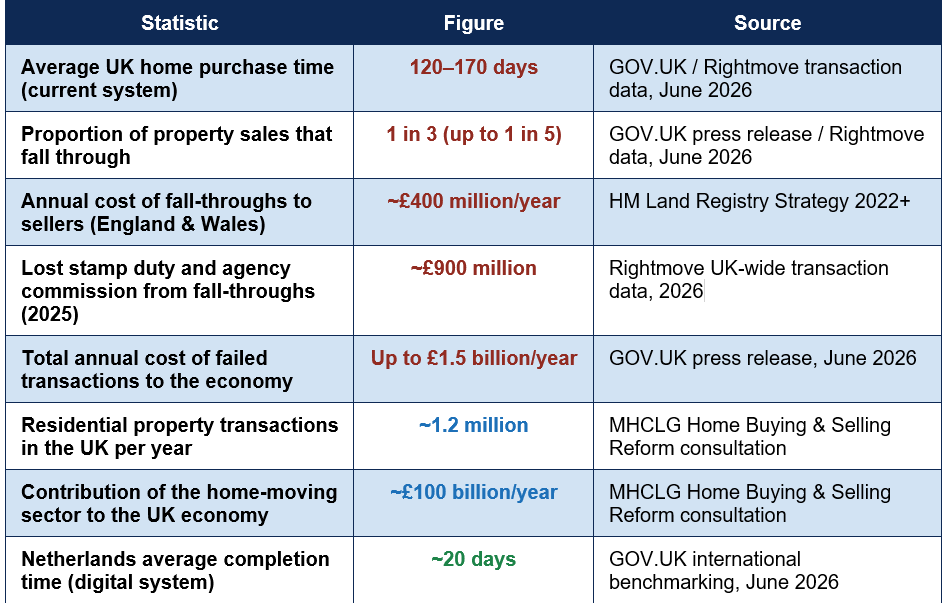
Average transaction time today: 120–170 days — compared with around 20 days in the Netherlands, where a live digital tracking system already gives buyers and sellers real-time visibility of progress (GOV.UK international benchmarking, June 2026)
Why fall-throughs matter so much: A collapsed sale is not simply an inconvenience. By the time a transaction falls through, both parties have often already paid for surveys, searches, and legal work that delivers no benefit if the deal does not complete. Rightmove estimates that fall-throughs cost the UK economy approximately £900 million in lost stamp duty receipts and agency commission in 2025 alone — money that disappears entirely rather than simply being delayed.
What's Changing: Mandatory Upfront Sales Packs
The centrepiece of the reform package is a requirement for sellers and their estate agents to compile and publish a 'sales pack' at the point a property is listed for sale — not weeks or months later, as is currently typical. The pack will include a property condition report, details of leasehold charges where applicable, the property's position in any chain, and confirmation of known legal issues or defects, alongside existing requirements such as the Energy Performance Certificate.The logic behind this change is straightforward: under the current system, buyers frequently make an offer and only discover significant problems — undisclosed leasehold costs, structural issues, or chain complications — weeks into the legal process, by which point both parties have already incurred costs. By forcing this information to the surface before an offer is even made, the Government's stated aim is to let buyers make genuinely informed decisions earlier and allow conveyancers, mortgage lenders, and surveyors to begin their work sooner rather than waiting for information to trickle through.
Housing Secretary Steve Reed described the current process as turning what should be one of life's great moments into 'a drawn-out nightmare of delays, hidden costs, and failed deals.' The sales pack requirement is designed to directly target the hidden-costs and information-asymmetry problems that have made the current system so unpredictable for both buyers and sellers.
What's Changing: Earlier Binding Agreements
Perhaps the most structurally significant change in the package is the introduction of earlier binding agreements. Under the current system in England, neither party is legally committed to a sale until exchange of contracts — a point that often comes weeks or months after an offer is accepted, leaving both buyer and seller exposed to the other walking away at any point up to that moment without consequence.Under the new proposals, a legally binding conditional contract would be created much earlier — at the point an offer is accepted, rather than at exchange. These agreements set out clear terms that both parties commit to meeting in order to progress and complete the transaction. If either party breaks those terms by withdrawing without a valid reason or failing to meet agreed obligations, they would face a financial penalty.
Important caveat for buyers: The Government has explicitly stated that earlier binding agreements will not come into effect until after sales packs are fully embedded in the system. This sequencing is deliberate — ministers want to ensure buyers are not legally bound to a transaction before they have access to the upfront property information the sales pack reforms are designed to guarantee. Further work is also planned with industry to set fair penalty levels, define legitimate exception clauses (such as a failed mortgage application or an adverse survey finding), and establish a clear dispute resolution process before this element of the reform takes legal effect.
The Government's own modelling suggests that earlier binding agreements, combined with the upfront information from sales packs, could roughly halve the number of transactions that collapse partway through — directly addressing the one-in-three fall-through rate that has become one of the most cited frustrations with the current system.
What's Changing: Digital Property Logbooks and AI-Assisted Conveyancing
The reform package places significant emphasis on replacing the UK's traditionally paper-heavy, fragmented property transaction process with secure digital infrastructure. Digital property logbooks will allow trusted information — title details, survey results, searches, and the sales pack itself — to be created once, shared securely between all professionals involved in a transaction, and accessed by buyers and sellers in real time, cutting out much of the repetitive back-and-forth currently required between estate agents, conveyancers, and lenders.The Government has also confirmed it will back digital identity verification, electronic signatures, and AI-assisted conveyancing tools as part of the wider modernisation effort. This builds on the recently established AI Growth Lab, a government initiative supporting responsible AI-driven innovation, whose first sector focus will be legal services, including conveyancing. Applications for law-tech and conveyancing firms to participate in the AI Growth Lab are expected to open later in summer 2026.
Lloyds Banking Group has already launched a digital homebuying pilot in partnership with Connells and LMS, described by the bank's Homes Director Andrew Asaam as 'a real game changer' for cutting the administrative back-and-forth that currently slows transactions. The Government has pointed to international precedents — the Netherlands' live transaction tracking system, which has helped achieve average completion times of around 20 days, and Norway's digitalisation programme, projected to deliver savings of up to £1.4 billion over ten years — as evidence that this kind of digital-first approach can deliver measurable results at scale.
What's Changing: Estate Agent Standards and Qualifications
The reforms also target the professional standards of estate agents, a sector that has historically operated in the UK without mandatory qualifications, unlike comparable professions such as conveyancing or surveying. A new Code of Practice, due to be introduced later in 2026, will set minimum standards for property agents and provide guidance to improve the quality and consistency of information in property listings.From 2027, the Government plans to consult on mandatory qualifications for estate agents — a more far-reaching change that, if implemented, would represent a significant shift for an industry that has long faced criticism for inconsistent service quality and variable professional competence. Nathan Emerson, CEO of Propertymark, the industry body for estate and letting agents, welcomed the focus on professional standards, noting that a lack of upfront and timely information has long been cited as a major cause of transactional delays and costly fall-throughs.
Industry bodies including the Royal Institution of Chartered Surveyors (RICS) and the Law Society have broadly welcomed this aspect of the reforms, while also cautioning that the sector — including smaller firms — will need adequate support and lead time to build the capacity and skills required to meet new standards consistently.
The Full Reform Package at a Glance
The table below summarises all of the major elements of the announced reform package, what changes under each, and the benefit the Government expects each element to deliver: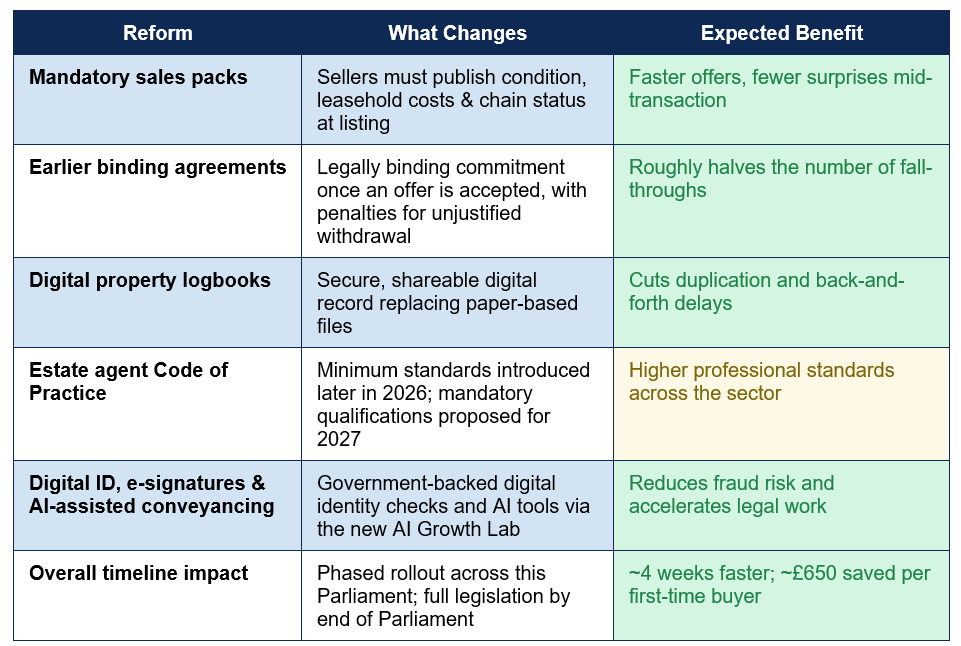
The Implementation Timeline: What Happens and When
Crucially, none of these reforms are law yet. The Government has been explicit that this is the beginning of a phased roadmap to be delivered across the remainder of this Parliament, not a set of rules that take effect immediately. The confirmed sequencing is as follows:- Later in 2026: Introduction of the Code of Practice setting minimum standards for property agents, alongside guidance to improve the quality of information published in property listings.
- From 2027: Public consultation on mandatory estate agent qualifications and on the expansion of digital tools across the transaction process, including the AI Growth Lab's work on conveyancing applications.
- By the end of this Parliament: Comprehensive legislation to formally require sales packs, introduce binding contracts with defined penalty and dispute resolution frameworks, and mandate the digital systems needed to support secure, trusted sharing of property information across the transaction chain.
What It Means for You: Buyers, Sellers, and First-Time Buyers
For prospective first-time buyers, the Government's own estimate is that the combined reforms will save an average of £650 per transaction once fully implemented, factoring in reduced conveyancing and search costs, the per-transaction savings from fewer fall-throughs, and new costs that will arise from the reforms themselves, such as purchasing a digital logbook. Combined with an estimated four-week reduction in typical transaction times, the changes are explicitly targeted at making it easier for younger buyers and those without significant financial cushion to compete in a system that has historically rewarded those able to absorb the risk and cost of a transaction falling through.For sellers, the upfront sales pack requirement means more preparation work is needed before a property can be listed — arranging a condition report and gathering leasehold and legal documentation in advance, rather than during the sale process. While this front-loads some effort and cost, the Government's expectation is that this is more than offset by faster sales, fewer collapsed transactions, and reduced risk of a buyer withdrawing after months of stalled negotiation.
For those currently mid-transaction or planning to move in the near term, it is important to understand that none of these changes are in force yet. The current rules — including exchange of contracts as the binding point — remain in place until the relevant legislation is passed, likely over the next one to three years. Buyers and sellers transacting in 2026 and into 2027 should continue to follow existing processes while monitoring the rollout of the Code of Practice and any voluntary digital pilots, such as the Lloyds, Connells, and LMS partnership, which may offer an early preview of how the reformed system will work in practice.
Conclusion
The reforms unveiled by the UK Government on 19 June 2026 represent the most significant attempt in a generation to modernise a home buying and selling system that has changed remarkably little despite the scale of disruption and cost it imposes every year. Mandatory upfront sales packs, earlier binding agreements with financial penalties for unjustified withdrawal, digital property logbooks, AI-assisted conveyancing, and new professional standards for estate agents together target the core causes of the delays and fall-throughs that have made buying and selling a home in England one of the most stressful financial transactions most people will ever undertake.The breadth of stakeholder support announced alongside the reforms — spanning major lenders, portals including Rightmove and Zoopla, professional bodies such as RICS and the Law Society, and consumer groups including the HomeOwners Alliance — suggests a genuine, broad-based appetite for change across an industry that has faced years of criticism for its inefficiency. At the same time, virtually every stakeholder statement included a note of caution about implementation: the success of these reforms will depend entirely on how carefully the phased rollout is managed, and whether the sector — including smaller firms with less capacity to adapt quickly — is given the support needed to deliver consistent, reliable change.
For now, the most important thing for prospective buyers and sellers to understand is that these are proposals on a roadmap, not rules in force today. The Code of Practice expected later in 2026 will be the first tangible sign of the reforms taking effect, with the more structurally significant changes — binding contracts and mandatory sales packs — not arriving in full legislative form until later in this Parliament. Anyone transacting in the near term should follow the existing process, while keeping an eye on the rollout for the faster, more transparent system the Government has committed to delivering.
Frequently Asked Questions (FAQ)
Are these reforms law yet, or just proposals?
These are confirmed government policy commitments following a public consultation that closed in December 2025, but they are not yet law. The roadmap sets out a phased timetable: a Code of Practice for estate agents later in 2026, consultation on agent qualifications and digital tools from 2027, and comprehensive legislation covering sales packs and binding contracts by the end of this Parliament. Existing rules, including exchange of contracts as the legally binding point in a sale, remain in force until that legislation is passed.What exactly will be in a 'sales pack'?
Based on the Government's announcement, a sales pack will include a property condition report, details of any leasehold charges, the property's position in a chain, known legal issues or defects, and existing requirements such as the Energy Performance Certificate. The precise legal requirements will be finalised as legislation is developed, with input from industry bodies including RICS, the Law Society, and the Council of Licensed Conveyancers.Will I be penalised for pulling out of a house purchase once these reforms are in place?
Under the proposed earlier binding agreements, withdrawing without a valid reason after the binding point (likely once an offer is accepted, rather than at exchange as is currently the case) could trigger a financial penalty. However, the Government has been clear that fair exception clauses — for situations such as a failed mortgage application or a problematic survey result — will be defined as part of the legislative process, and that this requirement will not take effect until sales packs are fully embedded, giving buyers access to key information before being bound to a transaction.How much money could these reforms actually save me?
The Government's own estimate is an average saving of £650 per transaction for first-time buyers once the reforms are fully implemented, derived from reduced conveyancing and search costs and lower per-transaction losses from fall-throughs, offset against new costs such as digital logbook fees. Savings will vary depending on individual circumstances, property type, and how quickly the phased reforms are adopted across the industry.Where can I follow updates on these reforms as they progress?
The most reliable source is the GOV.UK Homebuying topic page maintained by the Ministry of Housing, Communities and Local Government, which will be updated as the Code of Practice, qualification consultations, and legislation are published. Major property portals (Rightmove, Zoopla) and industry bodies (Propertymark, RICS, the Law Society, the Council of Licensed Conveyancers) are also expected to provide ongoing commentary and practical guidance as each phase of the roadmap is delivered.
External References
The following official and authoritative sources were used in researching this article and are recommended for further reading:1. GOV.UK — Homebuying Shake-Up to Slash Delays, Cut Costs and Stop Sales Falling Through (Official Press Release, 18 June 2026)
https://www.gov.uk/government/news/homebuying-shake-up-to-slash-delays-cut-costs-and-stop-sales-falling-through
2. GOV.UK — Home Buying and Selling Reform Roadmap
https://www.gov.uk/government/consultations/home-buying-and-selling-reform/outcome/home-buying-and-selling-reform-roadmap
3. MHCLG Consultation Portal — Home Buying and Selling Reform Consultation
https://consult.communities.gov.uk/home-buying-and-selling/home-buying-and-selling-reform
4. Rightmove — What the Proposed Homebuying Reforms Could Mean for You
https://www.rightmove.co.uk/news/articles/property-news/government-homebuying-rule-change-proposals
5. HomeOwners Alliance — UK Home Buying Reforms to Save Buyers Hundreds and Cut Purchase Time
https://hoa.org.uk/news/uk-home-buying-selling-reforms/
6. HM Land Registry — HMLR Strategy 2022+ (Fall-Through Cost Research)
https://assets.publishing.service.gov.uk/media/630f70da8fa8f5448a3836d7/HMLR_Strategy_2022+.pdf
7. Royal Institution of Chartered Surveyors (RICS) — Property Standards and Professional Guidance
https://www.rics.org/
8. Propertymark — Industry Commentary on Home Buying and Selling Reform
https://www.propertymark.co.uk/
0 Comments
Be the first to share your thoughts on this article.