
Real Estate
How to Find the Right Mortgage in the UK: Accountant Explains

Table of Contents
- The Biggest Financial Decision of Most Lives
- The UK Mortgage Market in July 2026: Where Rates Stand
- UK Mortgage Types Explained: The Complete July 2026 Comparison
- How Much Can You Borrow? The Income Multiple Framework
- Loan-to-Value (LTV): How Your Deposit Determines Your Rate
- How to Find the Right Mortgage: The 7-Step Process
- Broker vs Direct: Which Route Should You Take?
- First-Time Buyer Mortgages: What You Need to Know in 2026
- Conclusion
- Frequently Asked Questions (FAQ)

The Biggest Financial Decision of Most Lives
For the vast majority of UK home buyers, a mortgage is the largest financial commitment they will ever make. On a typical 25-year repayment mortgage, the total amount paid back -- principal plus interest -- will exceed the property purchase price by tens or hundreds of thousands of pounds depending on the interest rate secured at the outset. The difference between the right mortgage and the wrong one, measured over the life of the loan, is not trivial. The difference between the best available fixed rate in July 2026 (4.13%) and the average standard variable rate (7.13%) on a £200,000 mortgage over 25 years is more than £100,000 in total interest paid.Yet despite its financial significance, the UK mortgage market is genuinely complex: multiple product types, hundreds of lenders, thousands of individual deals, rates that change daily, government schemes aimed at specific buyer types, loan-to-value tiers that reward larger deposits with substantially lower rates, and fee structures that make headline rate comparisons misleading without a full total cost calculation. HomeOwners Alliance (21 July 2026): "The best mortgage depends on your personal circumstances." That is both true and, without a framework to evaluate those circumstances, not very useful.
This guide provides that framework. It covers the current UK mortgage rate environment as of 21 July 2026 -- with live data from HomeOwners Alliance, Which?, Tembo Money, Compare the Market, MoneySuperMarket, and Forbes Advisor -- explains each mortgage type and when it is appropriate, maps the complete loan-to-value rate tier system, walks through the step-by-step process of finding and securing a mortgage, explains when to use a broker versus going direct, and addresses the specific considerations for first-time buyers, home movers, and those remortgaging.
The UK Mortgage Market in July 2026: Where Rates Stand
The UK mortgage market in July 2026 is characterised by rates that have moderated significantly from their 2023 peaks but remain higher than the ultra-low environment of 2020-2021. The Bank of England held its base rate at 3.75% at its June 2026 meeting -- having cut it from 4% to 3.75% in December 2025. Tembo Money (2 weeks ago): 'The Bank of England held the base rate at 3.75% at its June 2026 meeting, but a rise later in the year remains on the table.' Compare the Market (19 July 2026): 'After a few weeks of mortgage price cuts, the latest news in the Middle East has led some big lenders to start reversing that trend and making slight increases to their fixed rates. If you are currently exploring deals, it is worth keeping a close eye on the market as conditions continue to change.'The market has bifurcated sharply between deal rates and the standard variable rate. HomeOwners Alliance (21 July 2026): "The average standard variable rate in July 2026 in the UK is 7.13%" -- with Newcastle Building Society at 6.31% and Aldermore at 8.38%. Against this, the best fixed rates are substantially lower: the best 2-year fixed at 4.13% (Danske Bank, 60% LTV), the lowest tracker at 3.96%, and the best 5-year fixed at 4.23% (both 60% LTV). Forbes Advisor: "With 96% of all new mortgage lending last year taken on a fixed rate according to UK Finance" -- confirming that the overwhelming majority of borrowers are correctly choosing fixed products over the SVR.
The volatility of rates in July 2026 is real and significant. Compare the Market's July 15 data from L&C confirms that rates have been moving in both directions within short periods as market participants respond to geopolitical events and economic data. This makes the timing and process of mortgage application more consequential than in stable rate environments -- and makes the role of a fee-free, whole-of-market broker more valuable.
UK mortgage rates -- July 2026 key data: Best 2-yr fixed: 4.13%. Avg 2-yr fixed: 4.45%. Avg SVR: 7.13%. BoE base rate: 3.75%. Lowest tracker: 3.96%. — HomeOwners Alliance (21 July 2026): 'The best rate on a 2-year fixed rate mortgage in July 2026 is from Danske Bank at 4.13% (Max LTV 60%, fee £1,124). The average 2-year fixed rate: 4.45% (Rightmove). Average SVR: 7.13%.' Which? (21 July 2026): 'Average two-year fixed: 5.68%; average five-year fixed: 5.63%.' Tembo Money: lowest tracker 3.96% (2-year, 60% LTV); lowest 5-year fixed 4.23% (60% LTV). Compare the Market (data from L&C, 15 July 2026): BoE base rate 3.75%; SVR average 6.83%.
UK Mortgage Types Explained: The Complete July 2026 Comparison
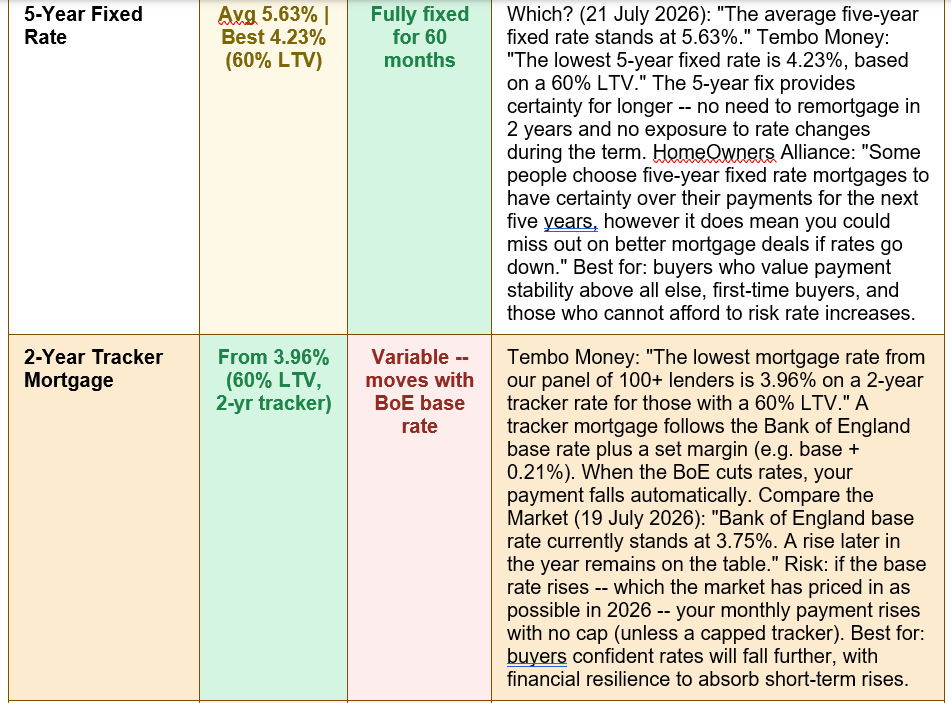
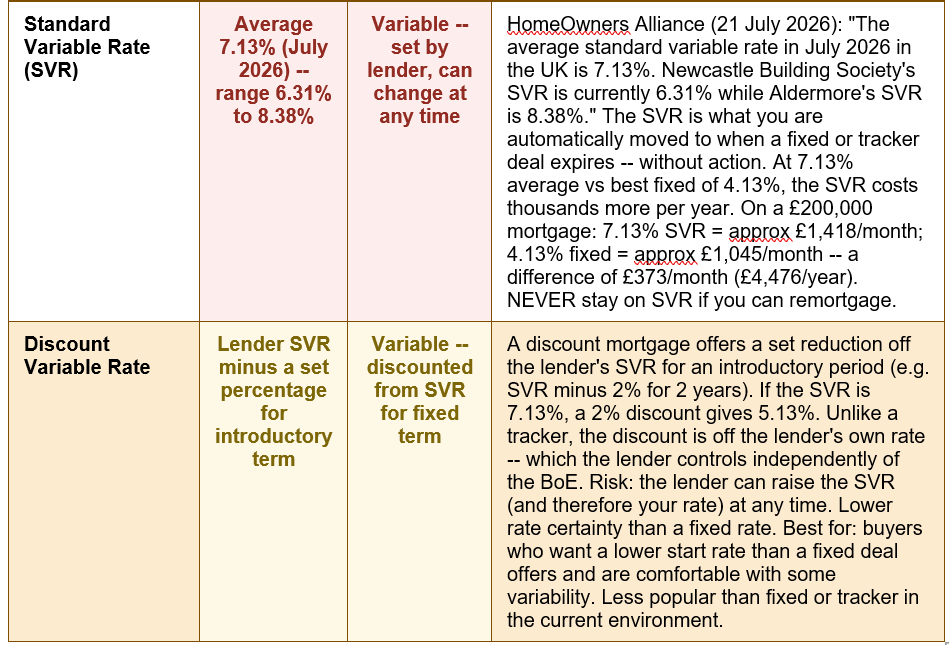
Choosing the right mortgage type is the most fundamental decision in the mortgage process. Each product type suits different circumstances, risk tolerances, and views on the direction of interest rates. The following table covers every major mortgage product available in the UK in July 2026: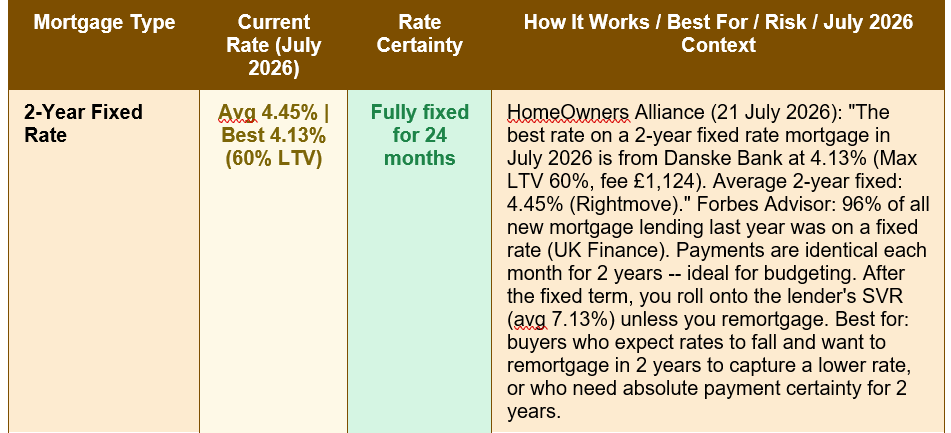
How Much Can You Borrow? The Income Multiple Framework
Before comparing mortgage deals, the first practical question is: how much will lenders actually offer? The answer is determined primarily by your income, with other factors including credit score, existing debts, monthly commitments, and the number of financial dependants all influencing the final offer.Tembo Money: 'Typically, lenders like banks and building societies will let you borrow between 4 and 4.5 times your household income for a mortgage. So on a joint income of £60,000, that's typically a maximum of £240,000-£270,000. But that figure is not fixed, and is influenced by factors like your credit score, your spending habits and if you have dependants.' Some specialist lenders offer up to 5 or 5.5 times income for specific professions (doctors, lawyers, accountants) or under specific schemes (First Homes, Key Worker mortgages). However, the 4-4.5x income multiple is the benchmark across the mainstream market.
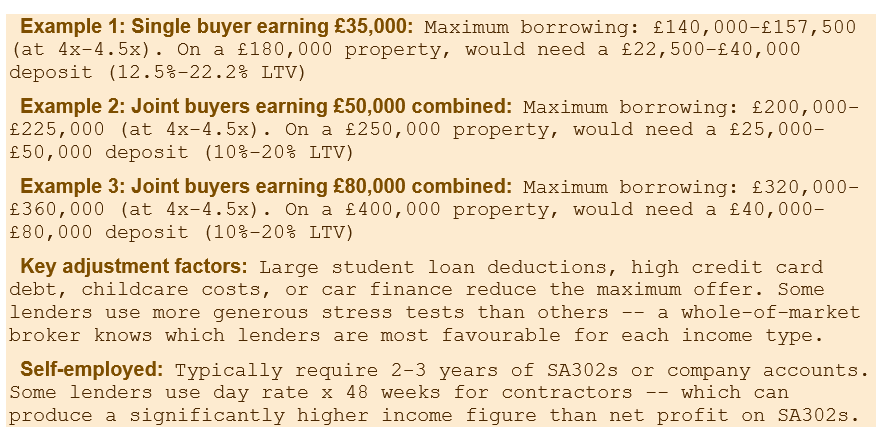
The income multiple is a maximum, not a target. It is important to stress-test affordability at higher interest rates before committing -- particularly given Tembo Money's note that a BoE rate rise later in 2026 remains possible. If your maximum mortgage at 4.13% produces a monthly payment that becomes unaffordable at 5%, a tracker mortgage or variable product carries real risk.
Loan-to-Value (LTV): How Your Deposit Determines Your Rate
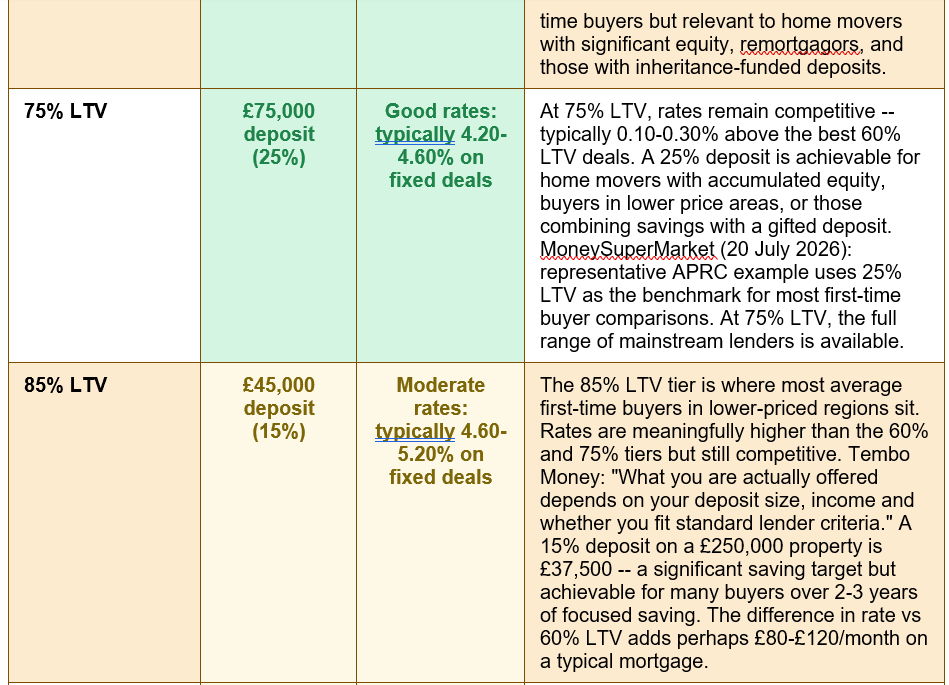
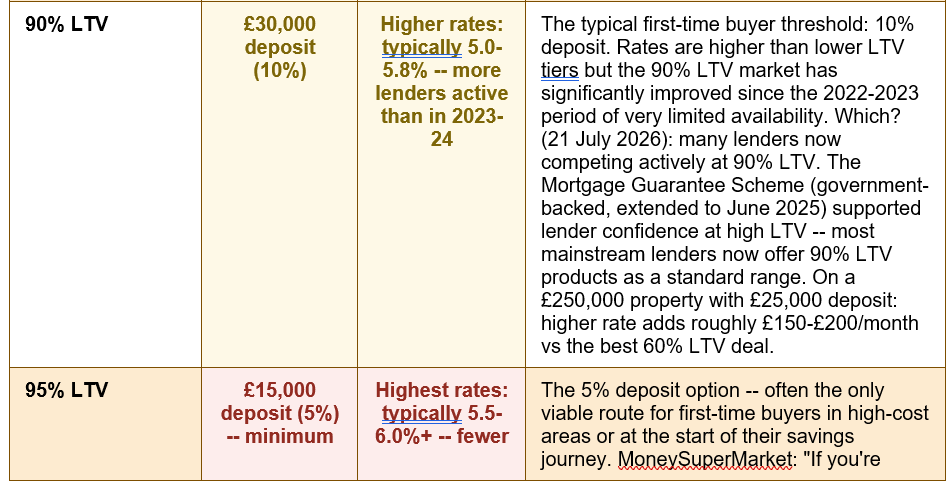
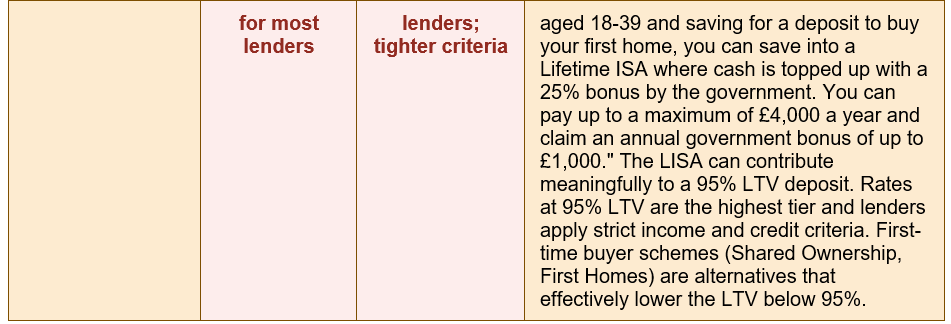
Loan-to-value (LTV) is the mortgage amount as a percentage of the property value. LTV is the single most powerful factor in determining the rate you are offered. The larger your deposit relative to the property price, the lower your LTV and the better the rates available to you. The following table maps every major LTV tier with its rate implications in July 2026: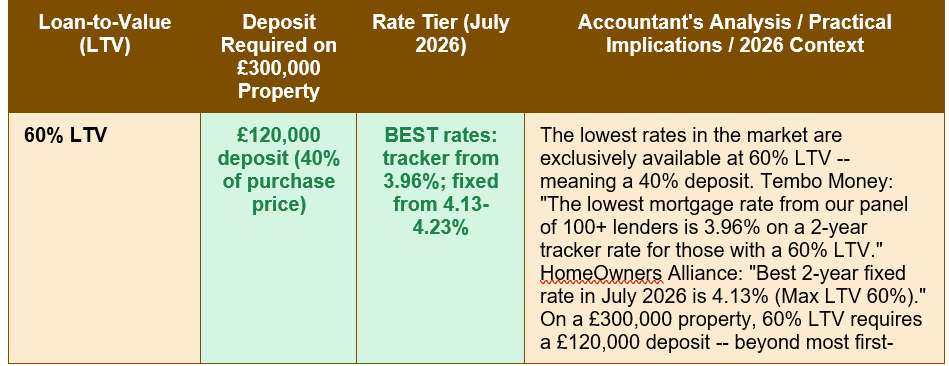
How to Find the Right Mortgage: The 7-Step Process
- Step 1 -- Know your credit score before any application: Check your full credit report at all three UK agencies: Equifax (equifax.co.uk), Experian (experian.co.uk/consumer), and TransUnion (transunion.co.uk) -- all free. Dispute any errors immediately, as they can significantly reduce both the rate offered and the amount lenders will advance. Which? (21 July 2026) notes that your credit score is one of the core factors lenders assess. Missed payments from the last 3-6 years are particularly damaging. If your score needs improvement, a 6-12 month period of consistent payment history, reduced credit utilisation, and no new credit applications can materially improve it.
- Step 2 -- Calculate your deposit and LTV: Use the LTV table above to identify which rate tier your deposit places you in. If your deposit puts you at 91% LTV, consider whether a small additional sum could take you below 90% -- a significant threshold where lender product availability and rate improve meaningfully. Similarly, 75% is a key threshold where rates drop substantially vs 80% LTV. Every 5% improvement in LTV typically reduces the available rate by 0.1-0.3%.
- Step 3 -- Get an Agreement in Principle (AIP): An Agreement in Principle (also called a Decision in Principle or Mortgage in Principle) is a preliminary assessment from a lender confirming they would be willing to lend you a specified amount, subject to full application and valuation. Most estate agents require an AIP before they will accept an offer. AIPs typically use a soft credit search (no footprint on your credit file) and are valid for 30-90 days. Having an AIP before viewing properties demonstrates credibility to sellers and speeds up the formal application once an offer is accepted.
- Step 4 -- Use a whole-of-market mortgage broker: Which? (21 July 2026): 'If you want to make sure you are really getting the best deal, it is advisable to use a whole-of-market broker who will be able to look at every mortgage on the market (including direct-only ones) and recommend the right option for you.' A whole-of-market fee-free broker (L&C Mortgages, Habito, Trussle, Mortgage Advice Bureau) searches the entire market including deals not available direct. They know which lenders are most favourable for specific income structures (self-employed, contractors, complex income) and which apply the most generous stress tests. Fee-free brokers earn commission from the lender -- you pay nothing directly.
- Step 5 -- Compare the total cost, not just the headline rate: Compare the Market (19 July 2026): 'The interest rate is just one factor to consider when comparing deals. The best mortgage for you will depend on several things, including fees, APRC, the type and duration of the deal, and more.' The Annual Percentage Rate of Charge (APRC) blends the interest rate with all fees spread over the mortgage term. A 4.13% rate with a £1,124 fee may cost more total than a 4.25% rate with no fee on a smaller mortgage over a 2-year term. Always compare: (monthly payment x months in deal) + arrangement fee = total cost. A broker will do this calculation for you across multiple deals simultaneously.
- Step 6 -- Submit the formal application and prepare documentation: Once you have an offer accepted and a mortgage deal selected, submit the full application. Required documentation: last 3 months payslips (employed) or last 2-3 years SA302s (self-employed); last 3 months bank statements; photo ID (passport or driving licence); proof of address (utility bill, bank statement); evidence of deposit source (bank statements showing savings, gift letter if using a gifted deposit). Forbes Advisor: 'Approval times, from mortgage application submission to offer, are also competitive at 10 days.' Lenders will instruct a valuation of the property -- either a basic mortgage valuation or a more detailed HomeBuyer Survey or Full Structural Survey.
- Step 7 -- Lock in your rate and plan for renewal: HomeOwners Alliance (21 July 2026): 'Most lenders allow you to lock in a new rate 3-6 months before your current deal expires.' Once your mortgage offer is issued, it is typically valid for 6 months -- allowing time for legal completion. After the fixed or tracker period ends, act immediately: do not allow yourself to roll onto the SVR at 7.13% average. Begin reviewing remortgage options 3-6 months before your deal expires. Set a calendar reminder the day your mortgage completes.
Broker vs Direct: Which Route Should You Take?
Going direct to a bank means accessing that bank's mortgage products only. In return, some banks offer direct-only deals not available through brokers, and the process can be faster if you are an existing customer with all accounts in one place. The major high-street lenders (Barclays, HSBC, NatWest, Lloyds, Nationwide, Santander) all offer direct mortgage applications online or in branch.A whole-of-market broker searches every lender simultaneously -- including those without high-street branches, specialist lenders, and building societies. Which? (21 July 2026): a whole-of-market broker can look at 'every mortgage on the market (including direct-only ones) and recommend the right option for you.' The advantage is comprehensive market coverage. Many specialist lenders -- including those most favourable for self-employed borrowers, buyers with complex income, or those with impaired credit -- only work through brokers rather than accepting direct applications.
The accountant's verdict on broker vs direct: For straightforward applications -- employed, standard income, good credit, conventional deposit -- going direct to a comparison site and then applying to the lender offering the best total cost can work well. For anything more complex -- self-employed, contractor, multiple income sources, gifted deposit, unusual property type, prior credit issues -- a whole-of-market broker is almost always the better choice. The fee-free broker model means there is no financial disincentive to using one even for simple cases. The only cost is time. And for the largest financial commitment most people will ever make, that time is almost always well spent.
First-Time Buyer Mortgages: What You Need to Know in 2026
First-time buyers in 2026 face a market that is more accessible than in 2023 at the height of the rate cycle, but still materially more challenging than the pre-2022 environment. The specific options and schemes available to first-time buyers:- Standard 90-95% LTV mortgages: The most widely used route. Most major lenders offer 90% LTV (10% deposit) products as standard. 95% LTV products are available from a narrower range of lenders and carry the highest rates -- but they represent the only viable route for buyers in areas where even a 10% deposit requires many years of savings. Rates at 95% LTV in July 2026 range from approximately 5.5-6.0%.
- Lifetime ISA (LISA): MoneySuperMarket (20 July 2026): 'If you are aged 18-39 and are saving up for a deposit to buy your first home, you can save into a Lifetime ISA where cash is topped up with a 25% bonus by the government. You can pay up to a maximum of £4,000 a year into the account and claim an annual government bonus of up to £1,000.' The LISA is the most powerful deposit-building tool available to first-time buyers. On a 5-year savings plan, £4,000/year plus government bonus of £1,000/year = £25,000 saved with £5,000 free from the government. Maximum property price: £450,000.
- Shared Ownership: Buy a share (25-75%) of a property and pay rent on the remainder. Allows buyers to get onto the property ladder with a smaller deposit on a smaller share of the property value. The LTV of the mortgage applies to the share purchased, not the full property value -- making the deposit requirement much smaller. Available on both new-build and resale properties through registered housing associations.
- First Homes scheme: Properties sold at a minimum 30% discount to market value to local first-time buyers, key workers, and military veterans. The discount is preserved in perpetuity when the property is resold. Available on selected new-build sites. The discounted price significantly reduces the deposit and mortgage required.
THE FOUR MOST EXPENSIVE MORTGAGE MISTAKES UK BUYERS MAKE IN 2026: (1) ROLLING ONTO THE SVR WHEN A DEAL EXPIRES. At 7.13% average SVR vs 4.13% best fixed -- the difference on a £200,000 mortgage is approximately £373/month. Every month on SVR unnecessarily costs hundreds of pounds. Begin remortgage research 3-6 months before your deal ends and never allow automatic SVR default. (2) COMPARING ONLY HEADLINE RATES WITHOUT INCLUDING FEES. A 3.99% deal with a £1,999 fee can cost more total than a 4.15% deal with no fee on a smaller mortgage over 2 years. Always calculate: (monthly payment x deal months) + fees = true total cost. (3) APPLYING TO MULTIPLE LENDERS SIMULTANEOUSLY WITHOUT USING SOFT SEARCHES FIRST. Each full mortgage application generates a hard credit search visible to other lenders and reducing your credit score. Use eligibility checkers (soft searches) before any formal application. A broker handles this correctly. (4) NOT SECURING A RATE 3-6 MONTHS BEFORE COMPLETION ON A NEW BUILD. New builds have extended completion timelines -- rates agreed early can often be locked in, protecting against rate rises during the construction period. On new builds, discuss the rate lock period with your broker at the outset.
Conclusion
Finding the right mortgage in July 2026 means navigating a market that is more dynamic, more rate-sensitive, and more product-varied than at any point in the previous decade. The best deals are genuinely significant: the best 2-year fixed rate at 4.13% and the best tracker at 3.96% (both at 60% LTV) represent rates that reward larger deposits substantially -- while the average SVR at 7.13% demonstrates the severe cost of inaction when a deal expires.The framework for finding the right mortgage is consistent regardless of buyer type: know your credit score before applying; calculate your deposit and LTV; understand the income multiple framework and stress-test affordability at higher rates; use a whole-of-market, fee-free broker to access the full market including specialist lenders; compare total cost (rate plus fees) not just headline rate; secure an Agreement in Principle before making an offer; and set a calendar reminder the day your mortgage completes for remortgage research 3-6 months before your deal expires.
The right mortgage is not necessarily the one with the lowest headline rate -- it is the one that provides the right balance of payment certainty, total cost, flexibility, and access to better deals in the future that matches your specific income profile, deposit level, credit history, and risk tolerance. With a volatile rate environment and rates changing daily as of July 2026, the role of an expert, fee-free, whole-of-market broker is more valuable than it has been for many years. Use one.
Frequently Asked Questions (FAQ)
What are the best mortgage rates in the UK in July 2026?
As of 21 July 2026, the best mortgage rates available in the UK are: Best 2-year fixed rate: 4.13% from Danske Bank (maximum LTV 60%, arrangement fee £1,124) -- source HomeOwners Alliance updated 21 July 2026. Average 2-year fixed rate across all LTV tiers: 4.45% (Rightmove data via HomeOwners Alliance). Average 5-year fixed rate: 5.63% (Which?). Best 5-year fixed rate: 4.23% (60% LTV) -- source Tembo Money. Best 2-year tracker: 3.96% (60% LTV) -- source Tembo Money. Average standard variable rate (SVR): 7.13% -- HomeOwners Alliance, ranging from Newcastle Building Society at 6.31% to Aldermore at 8.38%. The Bank of England base rate stands at 3.75% (held at June 2026 meeting). Rates are changing daily as geopolitical events and economic data drive lender pricing decisions. Compare the Market (19 July 2026): lenders began increasing some fixed rates in mid-July 2026 following Middle East news. Always verify the latest rates through a whole-of-market broker or comparison site using live data before applying.Should I choose a 2-year or 5-year fixed mortgage in 2026?
HomeOwners Alliance (21 July 2026): 'Some people choose five-year fixed rate mortgages to have certainty over their payments for the next five years, however it does mean you could miss out on better mortgage deals in the meantime if rates go down. What is right for you will depend on your circumstances so it is a good idea to chat through your options with an expert mortgage adviser.' The decision comes down to your view on rate direction and your priority between certainty and flexibility. The 2-year fix (current best 4.13%) is lower than the 5-year fix (best 4.23%) by a small margin in July 2026 -- but more importantly, the 2-year gives you the ability to remortgage in 2028 if rates have fallen further by then. The 5-year fix guarantees your rate until 2031 regardless of what happens to market rates. If rates fall sharply in 2026-2027 (which some market forecasters expect as the BoE responds to economic conditions), the 2-year fix leaves you free to capture those lower rates in 2028. If rates stay elevated or rise, the 5-year provides protection. Neither choice is objectively wrong -- the right answer depends on your financial resilience (can you afford higher payments if rates rise?) and your view of the rate outlook. A whole-of-market broker can help model both scenarios for your specific mortgage amount.
0 Comments
Be the first to share your thoughts on this article.