

Real Estate
What to Know Before a Cash-Out Refinance in 2026

Key Statistics: Average 30-year fixed cash-out refinance rate: 7.95% (March 2026; top-tier borrowers). Rate range: 7.49% to 8.75% depending on lender and credit profile. Year-over-year drop: 1–1.5% from March 2025 (when rates peaked at 9%+). Fannie Mae projects $812 billion in refinances in 2026 (up 26% from 2025). Closing costs: 2–6% of loan amount ($3,000–$6,000 typical). Minimum equity required: 20% (LTV capped at 80%); VA loans may allow up to 90% LTV. Minimum credit score (conventional): 620–680; best rates at 740+. FHA minimum: 580 (with mortgage insurance). Debt-to-income ratio cap: 43%. Six months mortgage seasoning typically required. Federal Reserve research: roughly 1 in 10 cash-out refi dollars used for debt consolidation. Between 2020–2021, homeowners gained average $55,000 in equity as home values rose 18%.
A cash-out refinance is one of the most popular methods for accessing that wealth. It replaces your existing mortgage with a new, larger loan, with the difference paid to you in cash. In 2026, Fannie Mae projects $812 billion in total refinance volume — up 26 percent from 2025 — as mortgage rates have declined from their 2025 peak of above 9 percent to a more manageable range of 7.5 to 8.5 percent. For homeowners with significant equity, this is one of the most affordable ways to borrow large sums.
But cash-out refinancing is not without substantial risks and costs. It extends your mortgage, resets your amortisation schedule, increases your monthly payment, and uses your home as collateral. Understanding every aspect of the transaction before signing is not optional. It is the difference between a financial tool that works for you and one that compounds financial pressure. This article covers everything you need to know.
Example: you currently owe $250,000 on your home. Your home is now worth $400,000, giving you $150,000 in equity. You take out a new mortgage for $320,000. Of that $320,000, $250,000 pays off your existing mortgage and $70,000 (minus closing costs) is paid to you in cash. You now have a $320,000 mortgage instead of a $250,000 mortgage, at whatever rate the new loan carries.
This is different from a rate-and-term refinance, which simply replaces your existing mortgage with a new one at a different interest rate or for a different loan term, without extracting any cash. It is also different from a Home Equity Line of Credit (HELOC) or a home equity loan, which are second mortgages that sit alongside your existing mortgage rather than replacing it.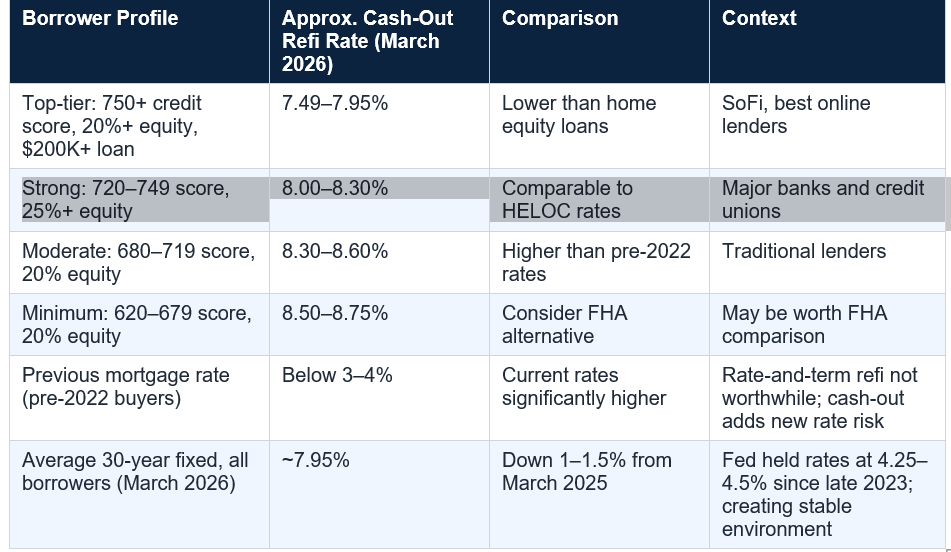
WalletGrower, April 2026: As of March 2026, the average 30-year fixed cash-out refinance rate is 7.95% for a borrower with a 750+ credit score, 20% equity, and a loan amount over $200,000. Rates range from 7.49% (top-tier borrowers with SoFi) to 8.75% (traditional banks). This represents a year-over-year drop of 1% to 1.5% from March 2025, when rates peaked at 9%+.
The critical rate comparison for most homeowners considering a cash-out refinance in 2026: if your current mortgage was originated before 2022, your rate is almost certainly between 3 and 4.5 percent. Refinancing to a new loan at 7.5 to 8.5 percent on your entire balance — not just the new cash portion — means paying the higher rate on money you already borrowed at a lower rate. This is the primary financial trade-off in the 2026 rate environment.
Formula: (Home Appraised Value x 80%) minus Existing Mortgage Balance minus Closing Costs = Maximum Cash Available.
Example: Home value $500,000. Existing mortgage $280,000. Maximum new loan: $400,000 (80% of $500,000). Less existing mortgage: $400,000 minus $280,000 = $120,000 gross cash. Less closing costs (estimated 3% of $400,000 = $12,000). Net cash received: approximately $108,000.
The actual cash depends on the appraised value, which may be lower or higher than your estimate. If the appraisal comes in lower than expected, the maximum loan amount and cash available shrink proportionally. This is why the appraisal is a critical moment in the cash-out refi process.
The break-even analysis: if a rate-and-term refinance (not cash-out) lowers your monthly payment by $200 and costs $6,000 in closing costs, the break-even point is 30 months (6,000 divided by 200). For a cash-out refinance, the analysis is more complex because you are also comparing the all-in cost of the mortgage cash against alternative borrowing options. Amerisave’s 2026 analysis recommends a formal break-even calculation before proceeding with any refinance.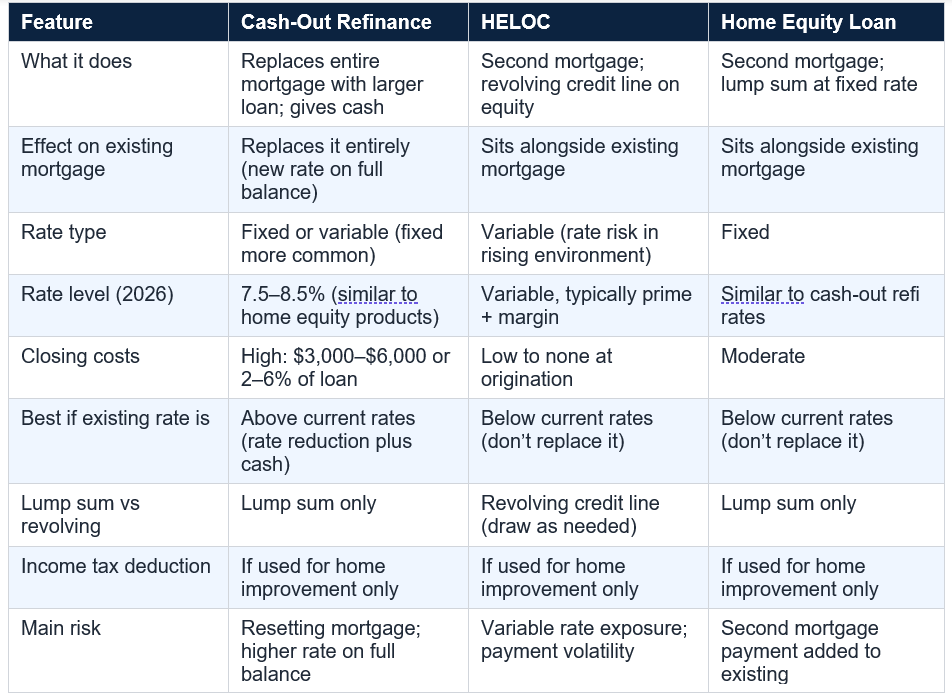
The key 2026 decision rule: if your existing mortgage rate is above 7 percent, a cash-out refinance (which resets your entire loan at a similar or lower rate) makes sense. If your existing rate is below 6 percent — and particularly if it is below 5 percent — you should seriously consider a HELOC or home equity loan to access equity without replacing your low-rate first mortgage.
The 2026 rate environment makes the analysis more complex than it was in 2020 or 2021. With average rates at 7.95 percent and a significant portion of existing homeowners holding mortgages below 4.5 percent, the decision to replace an entire mortgage at a higher rate requires careful mathematical assessment, not just the appeal of accessible cash. Fannie Mae’s projection of $812 billion in refinance volume in 2026 suggests many borrowers are making this trade-off — but making it thoughtfully, with a clear plan for the cash and a complete understanding of the costs, is what separates a smart financial decision from a costly one.
The home is your largest asset and your primary security. Cash-out refinancing converts part of that asset into debt. Do it with full awareness of the terms, the costs, the risks, and the alternatives. It is a tool. Use it deliberately.
A cash-out refinance replaces your existing mortgage with a new, larger mortgage and pays you the difference in cash. For example, if you owe $250,000 on a home worth $400,000, you could refinance into a $320,000 loan and receive approximately $70,000 in cash (minus closing costs). The new loan pays off the old mortgage, and you now have a single, larger mortgage at the new loan’s interest rate and terms.
What are the current cash-out refinance rates in 2026?
As of March 2026, the average 30-year fixed cash-out refinance rate is approximately 7.95% for top-tier borrowers (750+ credit score, 20%+ equity, $200,000+ loan amount). Rates range from 7.49% at the best online lenders to 8.75% at traditional banks. This is down 1 to 1.5% from March 2025, when rates peaked above 9%. The Federal Reserve has held rates steady at 4.25 to 4.50% since late 2023, creating a relatively stable mortgage rate environment.
How much equity do I need for a cash-out refinance?
Most conventional lenders require at least 20% equity to remain in the home after the refinance, meaning the maximum loan-to-value (LTV) ratio is 80%. VA loans for eligible veterans may allow up to 90% LTV. This means you cannot access all of your equity — the lender retains a 20% buffer. In practice, your maximum cash equals (Home Value x 80%) minus your existing mortgage balance, minus closing costs.
What credit score do I need for a cash-out refinance?
For conventional cash-out refinances, most lenders require a minimum credit score of 620 to 680. The best rates are reserved for borrowers with scores of 740 or above. FHA cash-out refinances may accept scores as low as 580, but require mortgage insurance premiums. VA loans for eligible veterans have more flexible credit requirements but require a VA funding fee.
What are the closing costs on a cash-out refinance?
Closing costs for a cash-out refinance typically range from 2 to 6% of the total new loan amount, or approximately $3,000 to $6,000 for most borrowers (more for larger loans). Costs include origination fees, appraisal ($300–$600), title insurance, recording fees, and prepaid items. These can be paid upfront at closing or rolled into the new loan (though rolling them in means you pay interest on the costs for the life of the loan).
Should I do a cash-out refinance or a HELOC in 2026?
The key determinant is your existing mortgage rate. If your current rate is above 7%, a cash-out refinance that consolidates everything into one new loan at a similar or lower rate makes sense. If your current rate is below 5 or 6%, you should strongly consider a HELOC or home equity loan instead, which sit alongside your existing mortgage and do not require replacing it at a higher rate. This preserves your low-rate first mortgage while still giving you access to equity.
What are the risks of a cash-out refinance?
Key risks include: your home becomes collateral for the larger loan amount, meaning missed payments can lead to foreclosure; you reset the amortisation clock, potentially adding years to your mortgage; if your existing rate is below current rates, you pay the higher rate on your entire balance; closing costs of $3,000 to $6,000 reduce the net benefit; and reducing home equity reduces your net worth and limits flexibility for future financial needs.
Table of Contents
- Tapping Your Biggest Asset
- What Is a Cash-Out Refinance?
- How It Works: Step by Step
- The 2026 Rate Environment: What You Are Actually Paying
- Qualification Requirements: What You Need to Qualify
- How Much Cash Can You Actually Get?
- What Can You Use the Cash For?
- The Real Costs: Closing Fees and the Break-Even Analysis
- The Pros of a Cash-Out Refinance
- The Cons and Risks You Must Understand
- Cash-Out Refi vs. HELOC vs. Home Equity Loan
- When a Cash-Out Refinance Makes Sense
- When It Probably Does Not
- The 10 Questions to Answer Before You Apply
- Conclusion: Equity Is a Tool, Not Free Money
- Frequently Asked Questions
Tapping Your Biggest Asset
For most Americans, the equity in their home is the single largest store of wealth they own. As home values rose dramatically over the past decade, and specifically during the 2020 to 2022 run-up when the average homeowner gained approximately $55,000 in equity as values climbed 18 percent, millions of homeowners found themselves sitting on wealth that was technically theirs but practically inaccessible.A cash-out refinance is one of the most popular methods for accessing that wealth. It replaces your existing mortgage with a new, larger loan, with the difference paid to you in cash. In 2026, Fannie Mae projects $812 billion in total refinance volume — up 26 percent from 2025 — as mortgage rates have declined from their 2025 peak of above 9 percent to a more manageable range of 7.5 to 8.5 percent. For homeowners with significant equity, this is one of the most affordable ways to borrow large sums.
But cash-out refinancing is not without substantial risks and costs. It extends your mortgage, resets your amortisation schedule, increases your monthly payment, and uses your home as collateral. Understanding every aspect of the transaction before signing is not optional. It is the difference between a financial tool that works for you and one that compounds financial pressure. This article covers everything you need to know.
What Is a Cash-Out Refinance?
A cash-out refinance is a type of mortgage refinancing transaction in which you take out a new mortgage loan for a larger amount than you currently owe, pay off the existing mortgage with the proceeds, and receive the difference in cash.Example: you currently owe $250,000 on your home. Your home is now worth $400,000, giving you $150,000 in equity. You take out a new mortgage for $320,000. Of that $320,000, $250,000 pays off your existing mortgage and $70,000 (minus closing costs) is paid to you in cash. You now have a $320,000 mortgage instead of a $250,000 mortgage, at whatever rate the new loan carries.
This is different from a rate-and-term refinance, which simply replaces your existing mortgage with a new one at a different interest rate or for a different loan term, without extracting any cash. It is also different from a Home Equity Line of Credit (HELOC) or a home equity loan, which are second mortgages that sit alongside your existing mortgage rather than replacing it.
How It Works: Step by Step
- Step 1: Apply with a lender. You provide financial documentation including income verification (pay stubs, W-2s, tax returns), bank statements, proof of employment, and consent for a credit check.
- Step 2: The lender orders an appraisal. An independent appraiser assesses the current market value of your home. This determines how much equity you have and therefore how much cash you can access.
- Step 3: Underwriting. The lender reviews your complete financial profile: credit score, debt-to-income ratio, loan-to-value ratio, and employment stability. This process typically takes two to six weeks.
- Step 4: Closing. You sign the new mortgage documents at a closing. Closing costs (typically 2 to 6 percent of the loan amount) are either paid upfront or rolled into the new loan. The lender pays off your old mortgage and issues you the cash proceeds.
- Step 5: Three-day right of rescission. Federal law gives you three business days after closing to cancel the transaction without penalty for a primary residence refinance. After this window, the transaction is final.
The 2026 Rate Environment: What You Are Actually Paying
WalletGrower, April 2026: As of March 2026, the average 30-year fixed cash-out refinance rate is 7.95% for a borrower with a 750+ credit score, 20% equity, and a loan amount over $200,000. Rates range from 7.49% (top-tier borrowers with SoFi) to 8.75% (traditional banks). This represents a year-over-year drop of 1% to 1.5% from March 2025, when rates peaked at 9%+.
The critical rate comparison for most homeowners considering a cash-out refinance in 2026: if your current mortgage was originated before 2022, your rate is almost certainly between 3 and 4.5 percent. Refinancing to a new loan at 7.5 to 8.5 percent on your entire balance — not just the new cash portion — means paying the higher rate on money you already borrowed at a lower rate. This is the primary financial trade-off in the 2026 rate environment.
Qualification Requirements: What You Need to Qualify
Cash-out refinancing has specific qualification requirements that are typically more stringent than a standard purchase mortgage. Reliance Financial’s April 2026 analysis confirms the key criteria:Minimum Equity
Most conventional lenders require at least 20 percent equity to remain in the home after the refinance. This means the maximum loan-to-value (LTV) ratio for a conventional cash-out refinance is 80 percent of the home’s appraised value. You cannot access all of your equity — the lender keeps a 20 percent buffer as protection.Credit Score
Conventional loans typically require a minimum credit score of 620 to 680. The best rates are available to borrowers with scores of 740 or above. FHA cash-out refinances may accept scores as low as 580 but require mortgage insurance premium (MIP) payments. VA loans for eligible veterans may allow higher LTVs (up to 90 percent) but require a VA funding fee.Debt-to-Income Ratio (DTI)
The DTI ratio is your total monthly debt obligations (including the proposed new mortgage payment) divided by your gross monthly income. Most lenders cap this at 43 percent for conventional loans. Including the new, higher mortgage payment in the calculation may push some borrowers above this threshold even if they qualified before.Mortgage Seasoning
Most lenders require six months of mortgage payment history on the existing loan before allowing a cash-out refinance. You typically cannot do a cash-out refinance immediately after purchasing a home.Proof of Income and Employment
W-2s, pay stubs, and tax returns (typically two years). Self-employed borrowers typically need two years of business and personal tax returns showing consistent income.How Much Cash Can You Actually Get?
The maximum cash available is determined by your home’s current appraised value, your existing mortgage balance, and the 80 percent LTV cap (for conventional loans).Formula: (Home Appraised Value x 80%) minus Existing Mortgage Balance minus Closing Costs = Maximum Cash Available.
Example: Home value $500,000. Existing mortgage $280,000. Maximum new loan: $400,000 (80% of $500,000). Less existing mortgage: $400,000 minus $280,000 = $120,000 gross cash. Less closing costs (estimated 3% of $400,000 = $12,000). Net cash received: approximately $108,000.
The actual cash depends on the appraised value, which may be lower or higher than your estimate. If the appraisal comes in lower than expected, the maximum loan amount and cash available shrink proportionally. This is why the appraisal is a critical moment in the cash-out refi process.
What Can You Use the Cash For?
One of the key advantages of a cash-out refinance versus some other financing products is that the cash can generally be used for any purpose. The most common uses documented in 2026 include:- Home improvements and renovations: one of the most financially logical uses, as improvements can increase the property’s value and may be tax-deductible (consult a tax professional for your specific situation).
- Debt consolidation: paying off high-interest credit cards, personal loans, or auto loans with mortgage-rate money. Federal Reserve research shows roughly 1 in 10 cash-out refi dollars is used for debt consolidation. The key caveat: you are converting unsecured debt (which cannot result in losing your home) into secured debt (which can).
- Education costs: college tuition or other educational expenses, particularly where the mortgage rate is significantly lower than student loan rates.
- Medical bills: large, unavoidable medical expenses that would otherwise carry high-interest medical financing or credit card debt.
- Major life events: weddings, adoption costs, or other significant one-time expenses.
- Investment: purchasing an investment property, funding a business, or building a financial cushion. These carry additional risk because you are leveraging your home for potentially volatile returns.
The Real Costs: Closing Fees and the Break-Even Analysis
The Mortgage Reports’ February 2026 analysis confirms that closing costs for a cash-out refinance average between 2 and 6 percent of the total loan amount, or $3,000 to $6,000 for most borrowers (with higher amounts for larger loans). These costs include:- Origination fee (lender fee): typically 0.5 to 1.5 percent of the loan
- Appraisal fee: $300 to $600
- Title insurance and search: $500 to $1,500
- Recording fees: varies by state, typically $50 to $250
- Attorney fees (required in some states): $500 to $1,500
- Prepaid items: property taxes, homeowners insurance, and prepaid mortgage interest
The break-even analysis: if a rate-and-term refinance (not cash-out) lowers your monthly payment by $200 and costs $6,000 in closing costs, the break-even point is 30 months (6,000 divided by 200). For a cash-out refinance, the analysis is more complex because you are also comparing the all-in cost of the mortgage cash against alternative borrowing options. Amerisave’s 2026 analysis recommends a formal break-even calculation before proceeding with any refinance.
The Pros of a Cash-Out Refinance
- • Access to large sums at relatively low rates: mortgage rates, even in the 7.5 to 8.5 percent range of 2026, are significantly lower than credit card APRs (typically 20 to 29 percent) or personal loan rates (typically 12 to 35 percent). For homeowners with strong equity, this is the cheapest source of unsecured-equivalent borrowing available.
- • Single monthly payment: replacing multiple high-interest debts with one mortgage payment simplifies personal finance management and reduces total interest cost where the rate differential is significant.
- • Potential tax deduction: mortgage interest on a primary or secondary residence may be tax-deductible under IRS rules if the cash is used to buy, build, or substantially improve the home. This does not apply to cash used for debt consolidation or other purposes. Consult a qualified tax professional.
- • Fixed rate and predictable payment: unlike a HELOC, which has a variable interest rate, a cash-out refinance can be structured as a fixed-rate loan, providing payment certainty for the life of the loan.
- • May improve cash flow: if you consolidate high-rate debt, the reduction in total monthly debt payments can improve short-term cash flow even as the mortgage itself increases.
The Cons and Risks You Must Understand
- • Your home is the collateral: unlike credit card debt or personal loans, a cash-out refinance uses your home as security. If you cannot make payments, foreclosure is a genuine risk. Converting unsecured debt to secured debt is a fundamental change in your financial risk profile.
- • You restart the amortisation clock: if you had 20 years left on a 30-year mortgage and you take a new 30-year cash-out refinance, you now have 30 years remaining. Amerisave’s 2026 analysis notes this is a significant long-term cost that is easy to underestimate.
- • Higher interest rate on your entire balance: in the current rate environment, if your existing mortgage was originated below 4.5 percent, a new loan at 7.5 to 8.5 percent means you pay the higher rate on your entire outstanding balance, not just the new cash portion.
- • Closing costs: $3,000 to $6,000 or more in upfront or rolled-in costs reduce the net benefit of the transaction.
- • Reduced home equity: taking cash out reduces your equity stake in the home, affecting your net worth and your ability to benefit from future price appreciation.
- • Mortgage insurance risk: if the new loan pushes your LTV above 80 percent (which does not apply under conventional rules but can happen with FHA), you may be required to pay private mortgage insurance.
Cash-Out Refi vs. HELOC vs. Home Equity Loan
The key 2026 decision rule: if your existing mortgage rate is above 7 percent, a cash-out refinance (which resets your entire loan at a similar or lower rate) makes sense. If your existing rate is below 6 percent — and particularly if it is below 5 percent — you should seriously consider a HELOC or home equity loan to access equity without replacing your low-rate first mortgage.
When a Cash-Out Refinance Makes Sense
- Your existing mortgage rate is at or above current market rates (7.5 percent or higher in 2026): in this case, refinancing the full balance at the new rate has a neutral or positive rate impact, and the cash-out portion adds further value.
- You need a large lump sum (over $50,000) that would otherwise require high-cost borrowing: for amounts this large, the rate differential between mortgage rates and credit card or personal loan rates justifies the closing costs.
- You are using the cash for home improvements that will meaningfully increase the property value or qualify for tax deduction: this is the most financially defensible use of cash-out refinancing proceeds.
- You have significant high-interest debt and the combined payment reduction makes the total financial position meaningfully better: this requires a careful comparison of total interest paid, not just monthly payment amounts.
- You have a long time horizon in the home: the upfront closing costs are recovered over time through the financial benefits of the cash. If you plan to move in two to three years, the closing costs may not be recovered.
When It Probably Does Not
- Your existing mortgage rate is below 5 percent: replacing a $300,000 mortgage at 3.5 percent with a $400,000 mortgage at 7.95 percent costs significantly more in lifetime interest on the original balance, even with the $100,000 in cash proceeds.
- You are late in your mortgage term: if you have 10 years left on a 30-year mortgage, refinancing into a new 30-year loan resets 20 years of amortisation progress. Amerisave’s analysis specifically flags late-term refinancing as rarely serving long-term financial interests despite monthly payment relief.
- You intend to use the cash for consumer spending or discretionary items: accessing home equity to fund consumption converts the asset into debt. The equity does not return unless the property appreciates.
- You cannot comfortably afford the new, higher monthly payment: the new mortgage payment, plus existing debts, plus living expenses, must fit within a sustainable budget. Stretching to qualify is a warning sign, not a plan.
- Your credit score or DTI means you can only qualify at 8.5 percent or higher: at those rates, a personal loan or HELOC may be more cost-effective for smaller amounts, or the underlying financial situation requires addressing rather than financing.
The 10 Questions to Answer Before You Apply
- What is my current mortgage rate, and how does it compare to today’s cash-out refinance rates?
- How much equity do I have, based on a realistic estimate of my home’s current value?
- Exactly how much cash do I need, and what will I use it for?
- What will my new monthly mortgage payment be, and can I comfortably afford it?
- How long do I plan to stay in this home? (Critical for break-even analysis on closing costs.)
- Have I compared a HELOC or home equity loan as alternatives that would not replace my existing mortgage?
- What are the total closing costs, and whether I am rolling them into the loan?
- If I am consolidating debt, am I also addressing the spending that created that debt?
- Has a qualified mortgage professional reviewed my complete financial picture and confirmed this is the right product for my situation?
- Am I comfortable with the risk that my home is now collateral for the new, larger loan amount?
Conclusion
A cash-out refinance can be a highly effective financial tool in the right circumstances. It provides access to large sums at mortgage rates that are typically lower than any other unsecured borrowing option, and it can serve genuinely valuable purposes: funding significant home improvements, consolidating high-rate debt in a way that meaningfully improves the total financial picture, or covering major unavoidable expenses.The 2026 rate environment makes the analysis more complex than it was in 2020 or 2021. With average rates at 7.95 percent and a significant portion of existing homeowners holding mortgages below 4.5 percent, the decision to replace an entire mortgage at a higher rate requires careful mathematical assessment, not just the appeal of accessible cash. Fannie Mae’s projection of $812 billion in refinance volume in 2026 suggests many borrowers are making this trade-off — but making it thoughtfully, with a clear plan for the cash and a complete understanding of the costs, is what separates a smart financial decision from a costly one.
The home is your largest asset and your primary security. Cash-out refinancing converts part of that asset into debt. Do it with full awareness of the terms, the costs, the risks, and the alternatives. It is a tool. Use it deliberately.
Frequently Asked Questions
What is a cash-out refinance?A cash-out refinance replaces your existing mortgage with a new, larger mortgage and pays you the difference in cash. For example, if you owe $250,000 on a home worth $400,000, you could refinance into a $320,000 loan and receive approximately $70,000 in cash (minus closing costs). The new loan pays off the old mortgage, and you now have a single, larger mortgage at the new loan’s interest rate and terms.
What are the current cash-out refinance rates in 2026?
As of March 2026, the average 30-year fixed cash-out refinance rate is approximately 7.95% for top-tier borrowers (750+ credit score, 20%+ equity, $200,000+ loan amount). Rates range from 7.49% at the best online lenders to 8.75% at traditional banks. This is down 1 to 1.5% from March 2025, when rates peaked above 9%. The Federal Reserve has held rates steady at 4.25 to 4.50% since late 2023, creating a relatively stable mortgage rate environment.
How much equity do I need for a cash-out refinance?
Most conventional lenders require at least 20% equity to remain in the home after the refinance, meaning the maximum loan-to-value (LTV) ratio is 80%. VA loans for eligible veterans may allow up to 90% LTV. This means you cannot access all of your equity — the lender retains a 20% buffer. In practice, your maximum cash equals (Home Value x 80%) minus your existing mortgage balance, minus closing costs.
What credit score do I need for a cash-out refinance?
For conventional cash-out refinances, most lenders require a minimum credit score of 620 to 680. The best rates are reserved for borrowers with scores of 740 or above. FHA cash-out refinances may accept scores as low as 580, but require mortgage insurance premiums. VA loans for eligible veterans have more flexible credit requirements but require a VA funding fee.
What are the closing costs on a cash-out refinance?
Closing costs for a cash-out refinance typically range from 2 to 6% of the total new loan amount, or approximately $3,000 to $6,000 for most borrowers (more for larger loans). Costs include origination fees, appraisal ($300–$600), title insurance, recording fees, and prepaid items. These can be paid upfront at closing or rolled into the new loan (though rolling them in means you pay interest on the costs for the life of the loan).
Should I do a cash-out refinance or a HELOC in 2026?
The key determinant is your existing mortgage rate. If your current rate is above 7%, a cash-out refinance that consolidates everything into one new loan at a similar or lower rate makes sense. If your current rate is below 5 or 6%, you should strongly consider a HELOC or home equity loan instead, which sit alongside your existing mortgage and do not require replacing it at a higher rate. This preserves your low-rate first mortgage while still giving you access to equity.
What are the risks of a cash-out refinance?
Key risks include: your home becomes collateral for the larger loan amount, meaning missed payments can lead to foreclosure; you reset the amortisation clock, potentially adding years to your mortgage; if your existing rate is below current rates, you pay the higher rate on your entire balance; closing costs of $3,000 to $6,000 reduce the net benefit; and reducing home equity reduces your net worth and limits flexibility for future financial needs.
0 Comments
Be the first to share your thoughts on this article.