
Sports
Ronaldo Leaving Portugal's Training Camp: Good or Bad?

He is 41 years old. He has 234 caps and 146 international goals — 21 more than any player in history. He scored at a record six consecutive World Cups and captained Portugal to their first, second, and third major trophies. Then Portugal lost to Spain in the 2026 World Cup Round of 16, Ronaldo cried on the pitch, posted ‘Portugal Forever’ online, told Vogue it was ‘probably’ his last year of football — and then got called up for the Nations League by new coach Jorge Jesus and started against Wales at 41. Is it time to go? Is it the right time? And what happens to Portugal when he does? The debate nobody agrees on.
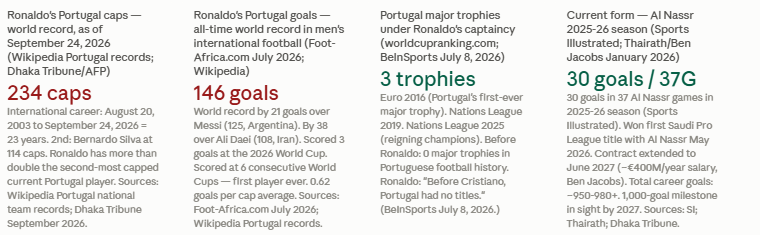
These are not career-of-the-century numbers in relative terms — they are literally the best numbers any international footballer has ever produced in the history of the game. And they are not ancient history. Ronaldo scored 3 goals at the 2026 World Cup in the summer just passed, including the goal that put Portugal through in the Round of 32. His Al Nassr 2025–26 season produced 30 goals in 37 games (Sports Illustrated). He won the Saudi Pro League title with Al Nassr in May 2026. Not a fading star; a productive one.
Ronaldo Portugal career (as of September 24, 2026): 234 caps (world record), 146 goals (world record). Gap over Messi: 21 goals. Gap over Daei: 38 goals. International career span: 23 years (August 2003 — present). World Cup appearances: 6 (record). World Cup goals: 2026 total: 3 in 4 matches. Portugal titles under Ronaldo: UEFA Euro 2016 (Portugal's first ever major trophy); UEFA Nations League 2019; UEFA Nations League 2025.
The tournament itself was a mixed story for Ronaldo. He scored three goals in four matches, including the crucial Round of 32 winner against Croatia in Toronto — described by Bleacher Report as ‘the first knockout goal of his World Cup career.’ At 41, he was contributing. But Portugal fell 1–0 to Spain in the Round of 16 in Dallas on July 6, 2026 (BeInSports July 7, 2026), and the images of Ronaldo in tears at the final whistle became one of the tournament’s defining photographs. Coach Roberto Martínez, who had consistently backed Ronaldo throughout his tenure, was subsequently replaced by Jorge Jesus.
Portugal’s exit was a last-16 elimination — the same stage they reached in 2022. For a squad with Bernardo Silva, Bruno Fernandes, Rafael Leão, and a constellation of elite-club players, it felt like underperformance. Whether Ronaldo’s presence at the expense of a more dynamic forward was a factor in that underperformance is the central question of the current debate. Not editorial advice — informational analysis.
August 2026: tells Vogue ‘This is probably my last year of football, and I want to leave a spectacular legacy.’ Described by Dubai Eye/AFP as having ‘already announced his retirement from international football after the 2026 World Cup’ but ‘not closed the door on making future appearances.’ September 18, 2026: named in Portugal’s Nations League squad by new coach Jorge Jesus. September 24, 2026: starts against Wales, earning his 234th cap. Tells reporters: ‘Yes I did [consider retiring after the World Cup]. I’m a thinker... I still believe I’m able to help the national team.’ (Irish News/AFP; K24 Digital.)
This is not indecision for its own sake. Ronaldo’s cautious, incremental approach to his own ending reflects both the genuine difficulty of stepping away from the only identity he has known for 41 years and a real, unsentimental assessment that he can still contribute. The question is whether ‘can still contribute’ is the same as ‘should still be here.’
In His Words: Ronaldo, September 24, 2026 (Irish News/AFP): 'I still believe that I’m able to help the national team to reach what they want, and will finish when I feel like I’m not doing anything here. They are dying for me not to come to the national team any more, but I can still move away from it.'
Portugal’s new coach, Jorge Jesus, knows Ronaldo better than most: he just spent a season managing him at Al Nassr, winning the Saudi Pro League title in May 2026 before coming to the national team job. Jesus called him up immediately, confirming he would start against Wales. That is a coaching decision, not a political one. Jesus has no history of sentimentality in football — his squad selections at Al Nassr were pragmatic. If Jesus thinks Ronaldo starts, the argument that Ronaldo cannot function at this level is harder to sustain.
There is also the leadership dimension. The Vogue interview makes clear that Ronaldo himself understands his role has expanded beyond pure goal-scoring: ‘I think I can give the national team my support, not only through the goals, but also outside of football.’ In a squad undergoing a generational transition, the experience, the standard, and the presence of the greatest scorer in international history is not nothing. Not a recommendation, an analysis.
Arguments for staying: (1) 30 goals in 37 Al Nassr games in 2025-26 — still world-class output. (2) 3 World Cup 2026 goals including the decisive Round of 32 winner vs Croatia. (3) New coach Jorge Jesus — who managed him at Al Nassr — selected him immediately and confirmed him as a starter. (4) 146 international goals; still adding to the record. (5) Leadership and standard-setting in a squad undergoing generational transition. (6) 'I’m able to help the national team' — his own unsentimental assessment. Sources: Sports Illustrated; Bleacher Report; K24 Digital; Dhaka Tribune.
The argument is that Portugal play differently without Ronaldo — they press higher, move more fluidly, and require less of the ball to sit in wide positions waiting for a cross to the back post. Ronaldo at 41 does not press with his 2014 intensity. The spaces his movement creates are not the same as they were. The opposition’s defensive shape against Portugal is built, in part, around neutralising Ronaldo specifically — which means that when Ronaldo is on the pitch, Portugal face an opponent that has planned for him, which shapes the entire structure of the game in ways that may not serve Portugal’s other talents.
Martinez also faced scrutiny for ‘continuing to back his ageing captain’ — that exact phrase appears in multiple reports (Dhaka Tribune; K24 Digital) describing the criticism that led to Martinez’s replacement after the World Cup. The implicit criticism in Martinez’s exit: the unconditional Ronaldo commitment was part of the problem. Not a conclusion — a presented perspective.
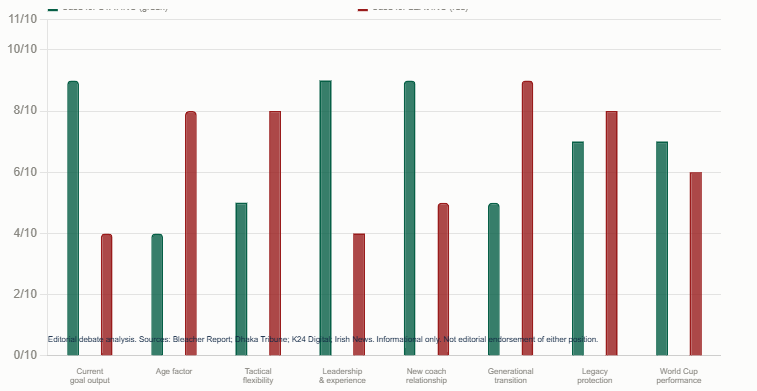
Arguments for leaving: (1) Portugal exited in the Round of 16 in 2022 AND 2026 with Ronaldo as the central figure. (2) Bernardo Silva, Bruno Fernandes, and Rafael Leão have a different tactical style that may be better served without a fixed Ronaldo role. (3) Martinez’s criticism for 'continuing to back his ageing captain' was cited as a reason for his exit — the captain's age and status were contested. (4) Portugal need a clean generational transition, not a gradual one. (5) At 41 in the Nations League, every competitive game risks injury that would overshadow a storied career. (6) Europe and South America are sending younger, faster, higher-pressing squads. Sources: Dhaka Tribune; K24 Digital; K24 Digital September 24, 2026; Bleacher Report.
Ronaldo put it plainly after the 2026 World Cup exit: ‘I’ve won three titles with Portugal. Before Cristiano, Portugal had no titles. The greatest title I won with the national team was Euro 2016; for me, it has the same value as a World Cup.’ (BeInSports July 8, 2026.) This is not a boast — it is a fact. The generation of Portuguese football that produced Bernardo Silva, Fernandes, Leão, and the talent that critics argue would be ‘liberated’ by Ronaldo’s departure was assembled in an era shaped by the standards, expectations, and infrastructure of success that Ronaldo’s trophies built.
The Legacy: Ronaldo’s Portugal trophy record: (1) UEFA Euro 2016 — Portugal’s FIRST EVER major international trophy. Ronaldo injured in the final vs France; captained from the sidelines. (2) UEFA Nations League 2019 — hat-trick vs Switzerland in the semi-final. (3) UEFA Nations League 2025 — reigning champions; beat Spain on penalties in the final. Before Ronaldo: zero major trophies in Portuguese football history. Ronaldo’s post-World Cup statement (BeInSports July 8, 2026): 'Before Cristiano, Portugal had no titles.' Sources: worldcupranking.com; foot-africa.com; BeInSports July 7-8, 2026.
The honest analysis: 45 is almost certainly beyond the point where international tournament football is realistic, even for the most extraordinary athlete in the sport’s history. But the qualification is almost: if Ronaldo is still playing at Al Nassr in 2028–29 and still scoring, the emotional and political pull of a 2030 home World Cup is a force that will be very difficult to resist. The 2028 European Championship, which falls when Ronaldo would be 43, is a more realistic question. The 1,000 career goal milestone, discussed below, changes the timeline further.
The more likely scenario: Ronaldo’s Nations League 2026-27 campaign is his farewell tour. If Jorge Jesus’s Portugal — a team that knows Ronaldo intimately from their Al Nassr collaboration — builds a new system around the next generation, Ronaldo contributes to the transition and steps back gracefully. That is the best-case scenario for the legacy. Not a prediction — an analysis.
The implicit message from Jesus’s selection: Ronaldo is still useful to this Portugal team. Jesus’s system at Al Nassr clearly accommodated Ronaldo’s 2025–26 output of 30 goals in 37 games. If Jesus can replicate a tactical framework where Ronaldo functions as a high-quality, goal-scoring presence without requiring the entire team to be structured around him, the concerns about Ronaldo’s presence limiting Portugal’s flexibility become less acute.
The Jesus era will be the real test of whether Ronaldo can transition from the protagonist of Portugal’s generation to a contributing senior figure in a team being rebuilt around the Fernandes-Silva-Leão axis. If that transition works, it extends both Ronaldo’s career and Portugal’s quality. If it does not, the data will show it quickly. Jesus, unlike Martinez, has managed Ronaldo close enough to make that call without sentiment. Not a recommendation — an analysis.
International goals count toward the total. Every goal Ronaldo scores for Portugal accelerates the milestone’s arrival. At 146 international goals and approximately 800–830 club goals (sources vary), the path to 1,000 runs through both channels. This is not a cynical observation — it is a reality of elite sport that milestone chasing influences late-career decisions. Ronaldo has never hidden his awareness of statistical landmarks; his celebration of every goal record, every cap record, is a documented part of his career identity.
If the 1,000-goal milestone is achievable in 2027 and Ronaldo’s contract at Al Nassr runs to that point, the question of continuing with Portugal becomes partly a question of whether international appearances help or hinder that pursuit. At 146 international goals with 88 club goals still needed (approximately), the calculus is clear: club football generates more goals per game than international football for a 41-year-old who is not guaranteed to play every minute for Portugal. But the prestige of a 1,000th international goal, if it arrived for Portugal, would be staggering. Not a prediction — a contextual analysis.
What is not in dispute is the legacy. Three major trophies where there were zero before him. 146 goals in a record 234 appearances. The first player to score at six World Cups. The all-time leading international goalscorer by a margin of 21. Ronaldo’s own words after the World Cup say everything about how he sees it: ‘Before Cristiano, Portugal had no titles.’ It is not arrogance. It is history. However and whenever this ends — Nations League campaign, farewell match, or a quiet step back after the next set of fixtures — the right time will only be visible in retrospect. The right time for Ronaldo was always going to be the time that felt wrong in the moment.
As of September 24, 2026 (his appearance vs Wales in the Nations League), Cristiano Ronaldo has 234 caps and 146 international goals for Portugal — both world records for men's international football. His international career spans from August 20, 2003 to the present, making it a 23-year career. His 146 goals are 21 clear of Lionel Messi's 125 (Argentina) and 38 clear of Ali Daei's 108 (Iran). He scored 3 goals at the 2026 World Cup before Portugal were eliminated in the Round of 16 by Spain. Sources: Wikipedia Portugal national football team records (updated September 24, 2026); Foot-Africa.com July 2026; Dhaka Tribune / AFP September 2026.
Has Ronaldo retired from the Portugal national team?
Not fully, as of October 2026. The situation is nuanced. Ronaldo confirmed after the 2026 World Cup that it was 'most likely' his final World Cup, but stopped short of formally retiring from international football (BeInSports July 7, 2026). He then posted 'Portugal Forever' on X (BeInSports July 8, 2026). In August 2026, Vogue reported he 'already announced his retirement from international football after the 2026 World Cup but did not close the door on making future appearances.' In September 2026, new coach Jorge Jesus named him in the Nations League squad; Ronaldo started against Wales on September 24, earning his 234th cap, and confirmed he had 'considered' retiring but chose to continue. The 2026-27 Nations League campaign appears to be an ongoing extension of his international career. Sources: BeInSports; Dubai Eye/AFP; Irish News/AFP; K24 Digital; Dhaka Tribune.
What trophies has Ronaldo won with Portugal?
Cristiano Ronaldo captained Portugal to three major international trophies: (1) UEFA Euro 2016 — Portugal's first ever major international trophy; (2) UEFA Nations League 2019; (3) UEFA Nations League 2025 — Portugal beat Spain on penalties in the 2025 final, meaning Portugal were reigning Nations League champions going into the 2026 World Cup. Ronaldo's post-World Cup assessment (BeInSports July 8, 2026): 'I've won three titles with Portugal. Before Cristiano, Portugal had no titles. The greatest title I won with the national team was Euro 2016; for me, it has the same value as a World Cup.' Sources: worldcupranking.com; BeInSports July 8, 2026; Dhaka Tribune.
Who is the new Portugal coach and did he pick Ronaldo?
Jorge Jesus was appointed Portugal head coach after Roberto Martínez's exit following Portugal's Round of 16 elimination at the 2026 World Cup. Jesus, 72, previously managed Ronaldo at Al Nassr in Saudi Arabia, winning the Saudi Pro League title in May 2026 before leaving the club to take the Portugal job. In his first squad announcement (September 18, 2026), Jesus named Ronaldo in the Portugal Nations League squad. Jesus confirmed Ronaldo would start against Wales on September 24, 2026 — his 234th cap. Sources: Dhaka Tribune / AFP September 2026; citizen.digital; K24 Digital September 2026.
What is Ronaldo’s career goal total and when will he reach 1,000?
Ronaldo's total career goals across club and international football are approximately 950-980+ as of mid-2026, depending on the source and exact calculation methodology. Dhaka Tribune / AFP (September 2026) stated he had 'scored more than 950 goals for club and country.' Sports Illustrated (in 2026 World Cup coverage) reported 30 goals in 37 Al Nassr games in the 2025-26 season. His Al Nassr contract runs to June 2027. His Portugal record stands at 146 international goals (September 24, 2026). The 1,000-goal milestone is widely discussed as achievable by 2027 if his current form continues. He already announced 2026-27 is 'probably' his final season of football (Dubai Eye/AFP citing Vogue interview, August 2026). Sources: Dhaka Tribune; Dubai Eye/AFP; Sports Illustrated; Wikipedia Portugal records.
Table of Contents
- The Numbers: What Ronaldo Means to Portugal in Data
- The World Cup 2026: What Actually Happened
- The Decision Spiral: A Timeline of Mixed Signals
- The Case FOR Ronaldo Staying: He Still Delivers
- The Case FOR Ronaldo Leaving: Portugal Need to Move On
- The New Era: What Portugal Looks Like Without Him
- The Legacy: Three Trophies Before Ronaldo, Zero Without Him
- The 2030 World Cup Question: Could He Make It to Six… Plus One?
- Jorge Jesus and the Continuity Decision
- The 1,000 Goals Question: Does It Change the Calculation?
- Conclusion: The Right Time Is Never Right Until It Has Passed
- Frequently Asked Questions
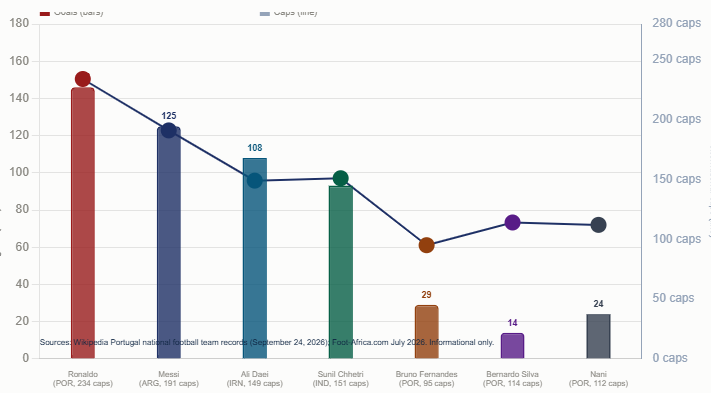
The all-time records — Ronaldo vs the world's top international scorers
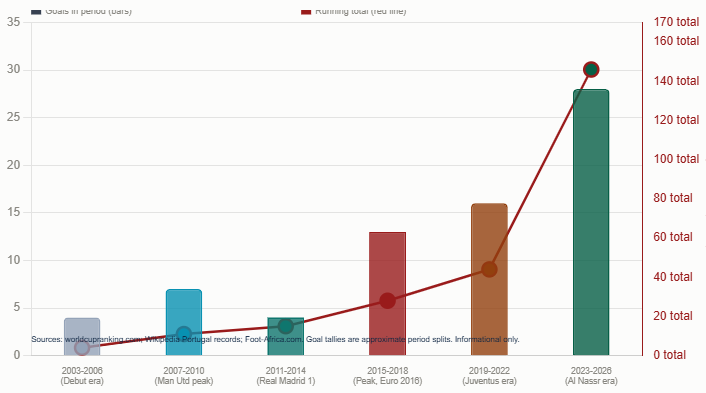
Portugal career arc — goals and caps by era
The debate scorecard — case for staying vs leaving
The Numbers: What Ronaldo Means to Portugal in Data
Start with the facts, because they are extraordinary and they are being forgotten in the rush to declare Ronaldo finished. As of September 24, 2026, Cristiano Ronaldo has played 234 times for Portugal — the most of any player in men’s international football history. He has scored 146 goals — also the world record, 21 more than Lionel Messi’s 125, which is itself 17 more than Ali Daei’s 108. He scored in a record six consecutive World Cups. His international career spans exactly 23 years, from August 20, 2003 to the present. At 41, he is still being named in the national squad and starting.These are not career-of-the-century numbers in relative terms — they are literally the best numbers any international footballer has ever produced in the history of the game. And they are not ancient history. Ronaldo scored 3 goals at the 2026 World Cup in the summer just passed, including the goal that put Portugal through in the Round of 32. His Al Nassr 2025–26 season produced 30 goals in 37 games (Sports Illustrated). He won the Saudi Pro League title with Al Nassr in May 2026. Not a fading star; a productive one.
Ronaldo Portugal career (as of September 24, 2026): 234 caps (world record), 146 goals (world record). Gap over Messi: 21 goals. Gap over Daei: 38 goals. International career span: 23 years (August 2003 — present). World Cup appearances: 6 (record). World Cup goals: 2026 total: 3 in 4 matches. Portugal titles under Ronaldo: UEFA Euro 2016 (Portugal's first ever major trophy); UEFA Nations League 2019; UEFA Nations League 2025.
The World Cup 2026: What Actually Happened
Portugal entered the 2026 World Cup — hosted by the United States, Mexico, and Canada — as one of the tournament’s most talked-about squads. The debate before a ball was kicked was familiar: is a 41-year-old Ronaldo an asset or a liability? Ronaldo’s sister Katia had publicly said this was his ‘last dance’ with the team, a claim that Ronaldo himself publicly pushed back on, saying ‘I don’t make reckless decisions — I will decide after the tournament, not now.’ (Fabrizio Romano, via Bleacher Report.)The tournament itself was a mixed story for Ronaldo. He scored three goals in four matches, including the crucial Round of 32 winner against Croatia in Toronto — described by Bleacher Report as ‘the first knockout goal of his World Cup career.’ At 41, he was contributing. But Portugal fell 1–0 to Spain in the Round of 16 in Dallas on July 6, 2026 (BeInSports July 7, 2026), and the images of Ronaldo in tears at the final whistle became one of the tournament’s defining photographs. Coach Roberto Martínez, who had consistently backed Ronaldo throughout his tenure, was subsequently replaced by Jorge Jesus.
Portugal’s exit was a last-16 elimination — the same stage they reached in 2022. For a squad with Bernardo Silva, Bruno Fernandes, Rafael Leão, and a constellation of elite-club players, it felt like underperformance. Whether Ronaldo’s presence at the expense of a more dynamic forward was a factor in that underperformance is the central question of the current debate. Not editorial advice — informational analysis.
The Decision Spiral: A Timeline of Mixed Signals
The Ronaldo retirement question has produced more mixed signals than almost any retirement story in sports. Here is the actual timeline. Before the 2026 World Cup: Ronaldo’s sister says it’s the last dance. Ronaldo says he will decide after. During the tournament: Ronaldo declines to confirm, says he will decide later. July 7, 2026, post-elimination: ‘Most likely’ his final World Cup but does not formally retire from international football (BeInSports July 7, 2026). July 8, 2026: posts ‘Portugal Forever’ on X, suggests his door remains open (BeInSports July 8, 2026).August 2026: tells Vogue ‘This is probably my last year of football, and I want to leave a spectacular legacy.’ Described by Dubai Eye/AFP as having ‘already announced his retirement from international football after the 2026 World Cup’ but ‘not closed the door on making future appearances.’ September 18, 2026: named in Portugal’s Nations League squad by new coach Jorge Jesus. September 24, 2026: starts against Wales, earning his 234th cap. Tells reporters: ‘Yes I did [consider retiring after the World Cup]. I’m a thinker... I still believe I’m able to help the national team.’ (Irish News/AFP; K24 Digital.)
This is not indecision for its own sake. Ronaldo’s cautious, incremental approach to his own ending reflects both the genuine difficulty of stepping away from the only identity he has known for 41 years and a real, unsentimental assessment that he can still contribute. The question is whether ‘can still contribute’ is the same as ‘should still be here.’
In His Words: Ronaldo, September 24, 2026 (Irish News/AFP): 'I still believe that I’m able to help the national team to reach what they want, and will finish when I feel like I’m not doing anything here. They are dying for me not to come to the national team any more, but I can still move away from it.'
The Case FOR Ronaldo Staying: He Still Delivers
The case for Ronaldo continuing with Portugal is not primarily sentimental. It is practical. He scored 30 goals in 37 games for Al Nassr in the 2025–26 season (Sports Illustrated). He scored three times at the 2026 World Cup, including the decisive goal that got Portugal out of the group stage. He has 146 international goals. He is still, empirically, scoring. The fact that he is 41 and still outscoring players who are half his age is not a legacy argument — it is a current-form argument.Portugal’s new coach, Jorge Jesus, knows Ronaldo better than most: he just spent a season managing him at Al Nassr, winning the Saudi Pro League title in May 2026 before coming to the national team job. Jesus called him up immediately, confirming he would start against Wales. That is a coaching decision, not a political one. Jesus has no history of sentimentality in football — his squad selections at Al Nassr were pragmatic. If Jesus thinks Ronaldo starts, the argument that Ronaldo cannot function at this level is harder to sustain.
There is also the leadership dimension. The Vogue interview makes clear that Ronaldo himself understands his role has expanded beyond pure goal-scoring: ‘I think I can give the national team my support, not only through the goals, but also outside of football.’ In a squad undergoing a generational transition, the experience, the standard, and the presence of the greatest scorer in international history is not nothing. Not a recommendation, an analysis.
Arguments for staying: (1) 30 goals in 37 Al Nassr games in 2025-26 — still world-class output. (2) 3 World Cup 2026 goals including the decisive Round of 32 winner vs Croatia. (3) New coach Jorge Jesus — who managed him at Al Nassr — selected him immediately and confirmed him as a starter. (4) 146 international goals; still adding to the record. (5) Leadership and standard-setting in a squad undergoing generational transition. (6) 'I’m able to help the national team' — his own unsentimental assessment. Sources: Sports Illustrated; Bleacher Report; K24 Digital; Dhaka Tribune.
The Case FOR Ronaldo Leaving: Portugal Need to Move On
The case for Ronaldo departing is also legitimate and also not primarily sentimental — it is tactical. Portugal’s 2026 World Cup exit in the Round of 16, falling 1–0 to Spain, was not a crisis but it was a ceiling. A squad containing Bernardo Silva (114 caps), Bruno Fernandes (95 caps, 29 goals), Rafael Leão, and Gonçalo Ramos had the talent to go further. Whether that talent was fully liberated or partially constrained by the structural commitment to Ronaldo as the central figure of every attack is the tactical debate that Portugal’s football community has been having since 2022.The argument is that Portugal play differently without Ronaldo — they press higher, move more fluidly, and require less of the ball to sit in wide positions waiting for a cross to the back post. Ronaldo at 41 does not press with his 2014 intensity. The spaces his movement creates are not the same as they were. The opposition’s defensive shape against Portugal is built, in part, around neutralising Ronaldo specifically — which means that when Ronaldo is on the pitch, Portugal face an opponent that has planned for him, which shapes the entire structure of the game in ways that may not serve Portugal’s other talents.
Martinez also faced scrutiny for ‘continuing to back his ageing captain’ — that exact phrase appears in multiple reports (Dhaka Tribune; K24 Digital) describing the criticism that led to Martinez’s replacement after the World Cup. The implicit criticism in Martinez’s exit: the unconditional Ronaldo commitment was part of the problem. Not a conclusion — a presented perspective.
Arguments for leaving: (1) Portugal exited in the Round of 16 in 2022 AND 2026 with Ronaldo as the central figure. (2) Bernardo Silva, Bruno Fernandes, and Rafael Leão have a different tactical style that may be better served without a fixed Ronaldo role. (3) Martinez’s criticism for 'continuing to back his ageing captain' was cited as a reason for his exit — the captain's age and status were contested. (4) Portugal need a clean generational transition, not a gradual one. (5) At 41 in the Nations League, every competitive game risks injury that would overshadow a storied career. (6) Europe and South America are sending younger, faster, higher-pressing squads. Sources: Dhaka Tribune; K24 Digital; K24 Digital September 24, 2026; Bleacher Report.
The Legacy: Three Trophies Before Ronaldo, Zero Without Him
The cornerstone of the 'Ronaldo should stay' argument is historical and irrefutable. Before Cristiano Ronaldo captained Portugal to their first major trophy, Portugal had won nothing — not in decades of trying. The generation of Figo, Rui Costa, and Pauleta in 2004 lost the European Championship final at home in Lisbon. The 2006 World Cup team was brilliant and finished fourth. In 2010 and 2014: early exits. And then: Euro 2016. Nations League 2019. Nations League 2025.Ronaldo put it plainly after the 2026 World Cup exit: ‘I’ve won three titles with Portugal. Before Cristiano, Portugal had no titles. The greatest title I won with the national team was Euro 2016; for me, it has the same value as a World Cup.’ (BeInSports July 8, 2026.) This is not a boast — it is a fact. The generation of Portuguese football that produced Bernardo Silva, Fernandes, Leão, and the talent that critics argue would be ‘liberated’ by Ronaldo’s departure was assembled in an era shaped by the standards, expectations, and infrastructure of success that Ronaldo’s trophies built.
The Legacy: Ronaldo’s Portugal trophy record: (1) UEFA Euro 2016 — Portugal’s FIRST EVER major international trophy. Ronaldo injured in the final vs France; captained from the sidelines. (2) UEFA Nations League 2019 — hat-trick vs Switzerland in the semi-final. (3) UEFA Nations League 2025 — reigning champions; beat Spain on penalties in the final. Before Ronaldo: zero major trophies in Portuguese football history. Ronaldo’s post-World Cup statement (BeInSports July 8, 2026): 'Before Cristiano, Portugal had no titles.' Sources: worldcupranking.com; foot-africa.com; BeInSports July 7-8, 2026.
The 2030 World Cup Question: Could He Make It to Six… Plus One?
The 2030 World Cup is co-hosted by Spain, Portugal, and Morocco (centenary edition with some matches in South America). Portugal’s co-hosting status makes this tournament uniquely emotionally significant — Ronaldo would be playing World Cup football, potentially at the Estadio da Luz or the Estadio Jose Alvalade, in his home country. He would be 45 years old. Bleacher Report put it plainly: ‘While Ronaldo plans to continue his international career, it’s fair to assume he won’t play in another World Cup. By the time the 2030 World Cup arrives, Ronaldo will be 45 years old.’The honest analysis: 45 is almost certainly beyond the point where international tournament football is realistic, even for the most extraordinary athlete in the sport’s history. But the qualification is almost: if Ronaldo is still playing at Al Nassr in 2028–29 and still scoring, the emotional and political pull of a 2030 home World Cup is a force that will be very difficult to resist. The 2028 European Championship, which falls when Ronaldo would be 43, is a more realistic question. The 1,000 career goal milestone, discussed below, changes the timeline further.
The more likely scenario: Ronaldo’s Nations League 2026-27 campaign is his farewell tour. If Jorge Jesus’s Portugal — a team that knows Ronaldo intimately from their Al Nassr collaboration — builds a new system around the next generation, Ronaldo contributes to the transition and steps back gracefully. That is the best-case scenario for the legacy. Not a prediction — an analysis.
Jorge Jesus and the Continuity Decision
The appointment of Jorge Jesus as Portugal coach is the most underrated factor in the Ronaldo debate. Jesus, 72, is not a sentimental manager. He won the Saudi Pro League with Al Nassr in May 2026, managed Ronaldo closely, and knows exactly what the 41-year-old can and cannot do. His immediate selection of Ronaldo for the September 2026 Nations League squad and his confirmation that Ronaldo would start against Wales is a decision rooted in knowledge, not reverence.The implicit message from Jesus’s selection: Ronaldo is still useful to this Portugal team. Jesus’s system at Al Nassr clearly accommodated Ronaldo’s 2025–26 output of 30 goals in 37 games. If Jesus can replicate a tactical framework where Ronaldo functions as a high-quality, goal-scoring presence without requiring the entire team to be structured around him, the concerns about Ronaldo’s presence limiting Portugal’s flexibility become less acute.
The Jesus era will be the real test of whether Ronaldo can transition from the protagonist of Portugal’s generation to a contributing senior figure in a team being rebuilt around the Fernandes-Silva-Leão axis. If that transition works, it extends both Ronaldo’s career and Portugal’s quality. If it does not, the data will show it quickly. Jesus, unlike Martinez, has managed Ronaldo close enough to make that call without sentiment. Not a recommendation — an analysis.
The 1,000 Goals Question: Does It Change the Calculation?
There is an elephant in the calculation that almost nobody discusses honestly: the 1,000 career goals. As of mid-2026, Ronaldo has scored approximately 950–980+ goals across club and international competition (sources vary slightly). Sports Illustrated cited 30 goals in 37 games for Al Nassr in 2025–26. His Al Nassr contract runs until June 2027 (with extension to 2026–27 season). The 1,000-goal milestone, at his current scoring rate, is achievable by 2027.International goals count toward the total. Every goal Ronaldo scores for Portugal accelerates the milestone’s arrival. At 146 international goals and approximately 800–830 club goals (sources vary), the path to 1,000 runs through both channels. This is not a cynical observation — it is a reality of elite sport that milestone chasing influences late-career decisions. Ronaldo has never hidden his awareness of statistical landmarks; his celebration of every goal record, every cap record, is a documented part of his career identity.
If the 1,000-goal milestone is achievable in 2027 and Ronaldo’s contract at Al Nassr runs to that point, the question of continuing with Portugal becomes partly a question of whether international appearances help or hinder that pursuit. At 146 international goals with 88 club goals still needed (approximately), the calculus is clear: club football generates more goals per game than international football for a 41-year-old who is not guaranteed to play every minute for Portugal. But the prestige of a 1,000th international goal, if it arrived for Portugal, would be staggering. Not a prediction — a contextual analysis.
Conclusion: The Right Time Is Never Right Until It Has Passed
The honest answer to whether Ronaldo’s departure from Portugal is ‘good, bad, or right time’ is: it depends entirely on the timescale. Right now, in October 2026, the departure has not happened. Ronaldo has 234 caps, 146 goals, started against Wales last week, and scored three goals at the World Cup this summer. The question is hypothetical in practice and genuinely contested in analysis. The case for staying is grounded in real, current-form evidence: goals at the World Cup, goals for Al Nassr, a new coach who selected him immediately. The case for going is grounded in tactical analysis and the generational transition argument: Portugal have the talent to build a new identity and the window for that transition may be shortened by every month Ronaldo stays.What is not in dispute is the legacy. Three major trophies where there were zero before him. 146 goals in a record 234 appearances. The first player to score at six World Cups. The all-time leading international goalscorer by a margin of 21. Ronaldo’s own words after the World Cup say everything about how he sees it: ‘Before Cristiano, Portugal had no titles.’ It is not arrogance. It is history. However and whenever this ends — Nations League campaign, farewell match, or a quiet step back after the next set of fixtures — the right time will only be visible in retrospect. The right time for Ronaldo was always going to be the time that felt wrong in the moment.
Frequently Asked Questions
How many caps and goals does Ronaldo have for Portugal?As of September 24, 2026 (his appearance vs Wales in the Nations League), Cristiano Ronaldo has 234 caps and 146 international goals for Portugal — both world records for men's international football. His international career spans from August 20, 2003 to the present, making it a 23-year career. His 146 goals are 21 clear of Lionel Messi's 125 (Argentina) and 38 clear of Ali Daei's 108 (Iran). He scored 3 goals at the 2026 World Cup before Portugal were eliminated in the Round of 16 by Spain. Sources: Wikipedia Portugal national football team records (updated September 24, 2026); Foot-Africa.com July 2026; Dhaka Tribune / AFP September 2026.
Has Ronaldo retired from the Portugal national team?
Not fully, as of October 2026. The situation is nuanced. Ronaldo confirmed after the 2026 World Cup that it was 'most likely' his final World Cup, but stopped short of formally retiring from international football (BeInSports July 7, 2026). He then posted 'Portugal Forever' on X (BeInSports July 8, 2026). In August 2026, Vogue reported he 'already announced his retirement from international football after the 2026 World Cup but did not close the door on making future appearances.' In September 2026, new coach Jorge Jesus named him in the Nations League squad; Ronaldo started against Wales on September 24, earning his 234th cap, and confirmed he had 'considered' retiring but chose to continue. The 2026-27 Nations League campaign appears to be an ongoing extension of his international career. Sources: BeInSports; Dubai Eye/AFP; Irish News/AFP; K24 Digital; Dhaka Tribune.
What trophies has Ronaldo won with Portugal?
Cristiano Ronaldo captained Portugal to three major international trophies: (1) UEFA Euro 2016 — Portugal's first ever major international trophy; (2) UEFA Nations League 2019; (3) UEFA Nations League 2025 — Portugal beat Spain on penalties in the 2025 final, meaning Portugal were reigning Nations League champions going into the 2026 World Cup. Ronaldo's post-World Cup assessment (BeInSports July 8, 2026): 'I've won three titles with Portugal. Before Cristiano, Portugal had no titles. The greatest title I won with the national team was Euro 2016; for me, it has the same value as a World Cup.' Sources: worldcupranking.com; BeInSports July 8, 2026; Dhaka Tribune.
Who is the new Portugal coach and did he pick Ronaldo?
Jorge Jesus was appointed Portugal head coach after Roberto Martínez's exit following Portugal's Round of 16 elimination at the 2026 World Cup. Jesus, 72, previously managed Ronaldo at Al Nassr in Saudi Arabia, winning the Saudi Pro League title in May 2026 before leaving the club to take the Portugal job. In his first squad announcement (September 18, 2026), Jesus named Ronaldo in the Portugal Nations League squad. Jesus confirmed Ronaldo would start against Wales on September 24, 2026 — his 234th cap. Sources: Dhaka Tribune / AFP September 2026; citizen.digital; K24 Digital September 2026.
What is Ronaldo’s career goal total and when will he reach 1,000?
Ronaldo's total career goals across club and international football are approximately 950-980+ as of mid-2026, depending on the source and exact calculation methodology. Dhaka Tribune / AFP (September 2026) stated he had 'scored more than 950 goals for club and country.' Sports Illustrated (in 2026 World Cup coverage) reported 30 goals in 37 Al Nassr games in the 2025-26 season. His Al Nassr contract runs to June 2027. His Portugal record stands at 146 international goals (September 24, 2026). The 1,000-goal milestone is widely discussed as achievable by 2027 if his current form continues. He already announced 2026-27 is 'probably' his final season of football (Dubai Eye/AFP citing Vogue interview, August 2026). Sources: Dhaka Tribune; Dubai Eye/AFP; Sports Illustrated; Wikipedia Portugal records.
0 Comments
Be the first to share your thoughts on this article.