

Business
Small Business Strategy: Build Your Competitive Moat

A competitive moat is the set of durable advantages that makes your business hard to copy and hard to beat. Most small businesses win short-term on price or luck. The ones that endure win on capabilities. This guide shows you exactly how to identify, build, and protect yours.
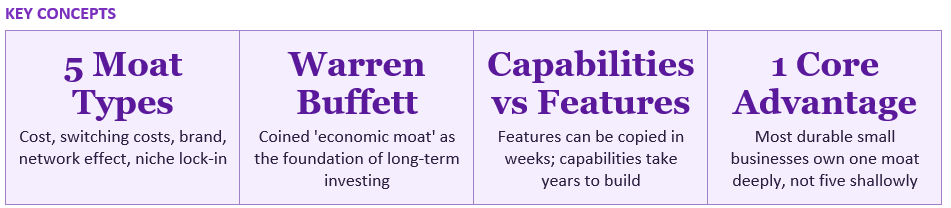
For a small business, the concept of a competitive moat is more urgent, not less, than for a large corporation. Large companies can weather competitive attacks through sheer financial resilience. A small business cannot. When a better-funded competitor enters your market, when a tech platform disrupts your industry, or when a customer switches to a cheaper alternative, a small business without a moat simply loses that customer and often struggles to win them back.
The good news is that the most durable moats are not built with money alone. Many of the most powerful competitive advantages a small business can develop — deep customer relationships, specialist expertise, proprietary processes, a trusted brand in a niche community, or switching costs embedded in the customer experience — are built through consistency, skill, and strategic intention over time. They require focus more than capital, and they compound in value the longer they are sustained.
This guide will show you how to identify which type of moat is most achievable and appropriate for your business, what specific capabilities you need to build to create and protect it, and how to avoid the common mistakes that allow moats to erode over time.
Features can be copied. If you launch same-day delivery and it attracts customers, your competitor can offer the same thing next month. If you drop your price, they can drop theirs. Features compete in the market; capabilities build the moat that defends your position regardless of what competitors do.
A capability is typically the combination of processes, systems, knowledge, relationships, and culture that allows your business to do something consistently well. An Amazon-like customer experience is not a feature — it is the result of a capability built over years through relentless process improvement, data analysis, and organisational discipline. A local independent estate agent that consistently sells properties faster than competitors has not just posted better listings — it has built capabilities in pricing judgment, vendor communication, buyer qualification, and local market knowledge that a competitor cannot replicate by running a few better adverts.
The essence of strategy is choosing what not to do. A competitive moat is built not by doing more things, but by doing a few things so consistently well that they become genuinely hard to replicate.
— MICHAEL PORTER, HARVARD BUSINESS SCHOOL — WHAT IS STRATEGY?
The practical question to ask about any capability you are considering building is: if a well-funded competitor spent two years trying to copy this, could they? If the answer is yes, it is a feature. If the answer is 'yes, but it would take them five years and require significant organisational changes they are unlikely to make', you are approaching a genuine capability.
Use a simple 2x2 framework: plot your current competitive advantages on two axes — how hard they are to copy (low to high) and how much customers value them (low to high). The advantages in the top-right quadrant (highly valued, hard to copy) are the ones worth doubling down on. The ones in the top-left (highly valued, easy to copy) are the most urgent vulnerabilities. These are moat candidates — they drive customer choice now but are at risk of being eroded by a sufficiently motivated competitor.
The most durable form of cost advantage for a small business is operational efficiency that has been built through years of refinement, combined with a cost structure that is genuinely lower than what a new entrant would face. If you have owned your commercial premises for ten years, your rent equivalent is zero while a competitor starting today would need to budget for market-rate rents. If you have supplier relationships built over a decade that include preferential pricing, a new entrant cannot replicate that quickly regardless of how hard they try.
Cost advantage as a moat strategy is most effective in markets where customers are highly price-sensitive and switching costs are low — commodity-style markets where product differentiation is limited. It is a fragile moat if it depends purely on current economies of scale, because a larger competitor can always undercut you. It is a durable moat when it is built into the structure of the business in ways that are genuinely hard to replicate.
A brand moat for a small business is not built by a logo or a marketing campaign. It is built by consistently delivering what you promise, handling problems generously when things go wrong, communicating with customers in ways that make them feel valued and understood, and developing a reputation in your community or niche that precedes you. When a potential customer Googles your business and finds 200 detailed, recent, positive reviews describing specific experiences that match their own needs, the persuasive power of that social proof is something a new competitor cannot replicate by simply launching better marketing.
The capability required to build a brand moat is operational consistency — the ability to deliver a reliably excellent experience every time, not just when conditions are ideal. This requires documented processes, trained and empowered staff, a feedback loop that identifies and corrects failures quickly, and a genuine cultural commitment to customer outcomes rather than just transactions. Businesses that build this capability find that their marketing spend decreases over time as referrals and reputation do more of the work.
Switching costs come in several forms. Contractual switching costs are explicit — a customer on an annual retainer or a long-term service contract faces a direct financial cost to leave early. Learning or integration switching costs arise when the customer has invested significant time integrating your product or service into their workflow — a business that has trained its entire team to use your software platform and built its processes around your reporting will face significant disruption and retraining costs in switching to an alternative, even if the alternative is marginally better.
Relational switching costs are perhaps the most powerful for service businesses. When a customer has built a genuine working relationship with you — when you know their history, their preferences, their quirks, and their strategic objectives — switching to a new provider means starting from scratch and accepting a period of reduced service quality while the new provider learns. Many customers will tolerate a supplier who is not perfect rather than absorb the switching cost of finding and onboarding a new one.
To deliberately build switching costs into your business model, look for opportunities to deepen integration with your customers' workflows, to accumulate proprietary knowledge of their situation that would be lost on switching, and to create value that is specific to your relationship rather than generic to your industry. Annual contracts with strong renewal incentives, proprietary client portals, bespoke reporting, and dedicated account management all create switching costs while also genuinely improving the customer experience.
The logic of niche lock-in is simple: when you know more about your customers' specific needs, regulations, workflows, and challenges than any competitor, you can solve their problems faster, more reliably, and with less friction. A solicitor who specialises exclusively in franchise law knows more relevant case precedents, has more relevant templates, and can give more precise advice than a general commercial solicitor — and a franchisee with a complex matter will pay a premium for that specific expertise rather than risk an expensive mistake with a generalist.
Building a niche lock-in moat requires the discipline to say no to opportunities outside your defined focus. Every time you take on work outside your niche for short-term revenue, you dilute the depth of expertise and reputation that makes the niche strategy valuable. The moat gets wider as you accumulate more niche-specific knowledge, case studies, client relationships, and reputation. It gets narrower if you spread your attention across multiple markets.
Small businesses that have successfully built niche moats often describe a tipping point — a moment when their reputation in the niche reaches critical mass and the best prospects in that niche seek them out specifically rather than comparing them against generalist competitors. At that point, the competitive dynamic has fundamentally changed in their favour.
A business that depends on one or two exceptional individuals to maintain its quality standard is vulnerable. If those individuals leave, become ill, or simply cannot scale their time, the business's competitive advantage goes with them. A business that has embedded its quality standards into well-documented processes, supported by training, technology, and measurement, is far more resilient. The capability exists in the organisation, not just in specific people.
Building process capabilities starts with documentation: writing down exactly how the best work gets done in your business, in enough detail that a well-trained new hire could replicate it. It continues with systematisation: using technology, templates, and checklists to make the right way the easiest way. And it compounds with continuous improvement: building feedback loops that identify where processes break down and creating a culture where those breakdowns are reported rather than hidden and fixed rather than repeated.
This compounding dynamic is why strategy is a long game. Most small businesses get knocked off course by short-term pressures — a difficult month, a tempting but off-strategy client, a competitor move that prompts a reactive price cut. Each of these deviations is understandable in isolation; cumulatively, they prevent the consistent investment in capabilities that creates a durable competitive position.
The businesses that build wide moats over time share a common discipline: they define their strategic position clearly, they invest consistently in the capabilities that build that position, and they resist the temptation to chase short-term opportunities that pull them away from it. Every new customer in your niche adds to your reference base and deepens your expertise. Every positive review compounds your brand equity. Every process improvement makes your operations more efficient and your quality more reliable. The moat grows wider every year — but only if you keep digging.
A useful annual exercise is to ask: at the end of this year, will our competitive moat be wider or narrower than it was at the start? What specific investments are we making this year that will make us harder to compete with twelve months from now? If you cannot answer these questions clearly, you are not building a moat — you are simply operating.
The most important thing you can do today is to be honest about where your current competitive advantages come from, which of them are genuinely hard to copy, and what would happen to your business if a well-funded competitor entered your market tomorrow and did everything you do, but slightly better. If your answer reveals significant vulnerability, that is not a reason for alarm — it is a call to action. Start building. Choose your moat type, identify the capabilities it requires, and invest in them consistently. The best time to build a competitive moat is before you need it.
Harvard Business Review — The Five Competitive Forces That Shape Strategy https://hbr.org/2008/01/the-five-competitive-forces-that-shape-strategy
Investopedia — Economic Moat: Definition and Examples (Warren Buffett concept) https://www.investopedia.com/terms/e/economicmoat.asp
Harvard Business Review — Building Your Company's Vision (Collins & Porras) https://hbr.org/1996/09/building-your-companys-vision
McKinsey & Company — Competitive Advantage: Creating and Sustaining Superior Performance https://www.mckinsey.com/capabilities/strategy-and-corporate-finance/our-insights
Entrepreneur — How Small Businesses Can Build a Competitive Advantage https://www.entrepreneur.com/growing-a-business/how-small-businesses-build-competitive-advantage/
Forbes — The Strategic Importance of the Economic Moat for Small Businesses https://www.forbes.com/sites/forbesbusinesscouncil/
US Small Business Administration — Building a Business Strategy https://www.sba.gov/business-guide/plan-your-business/write-your-business-plan
Strategyzer — Business Model Canvas (Alexander Osterwalder) https://www.strategyzer.com/library/the-business-model-canvas
GOV.UK — Business Plan Guidance for Small Businesses https://www.gov.uk/write-business-plan
TABLE OF CONTENTS
- What Is a Competitive Moat and Why Small Businesses Need One
- The Five Sources of Competitive Moat
- Capabilities vs Features: The Critical Distinction
- How to Diagnose Your Current Competitive Position
- Building a Cost Advantage Moat
- Building a Brand and Trust Moat
- Building Switching Costs Into Your Business Model
- Building a Niche Lock-In Moat
- Building Operational Process Capabilities
- Compounding Your Moat Over Time
- Common Mistakes That Erode a Competitive Moat
- Conclusion
- Frequently Asked Questions
- References
What Is a Competitive Moat and Why Small Businesses Need One
The term 'economic moat' was popularised by Warren Buffett to describe a durable competitive advantage — the business equivalent of the water-filled trench that surrounded a medieval castle. A moat makes it difficult, expensive, or simply unattractive for competitors to attack your position. A wide, deep moat means your business can sustain above-average profitability for years or even decades without being easily displaced by a well-funded rival or a cheaper alternative.For a small business, the concept of a competitive moat is more urgent, not less, than for a large corporation. Large companies can weather competitive attacks through sheer financial resilience. A small business cannot. When a better-funded competitor enters your market, when a tech platform disrupts your industry, or when a customer switches to a cheaper alternative, a small business without a moat simply loses that customer and often struggles to win them back.
The good news is that the most durable moats are not built with money alone. Many of the most powerful competitive advantages a small business can develop — deep customer relationships, specialist expertise, proprietary processes, a trusted brand in a niche community, or switching costs embedded in the customer experience — are built through consistency, skill, and strategic intention over time. They require focus more than capital, and they compound in value the longer they are sustained.
This guide will show you how to identify which type of moat is most achievable and appropriate for your business, what specific capabilities you need to build to create and protect it, and how to avoid the common mistakes that allow moats to erode over time.
The Five Sources of Competitive Moat
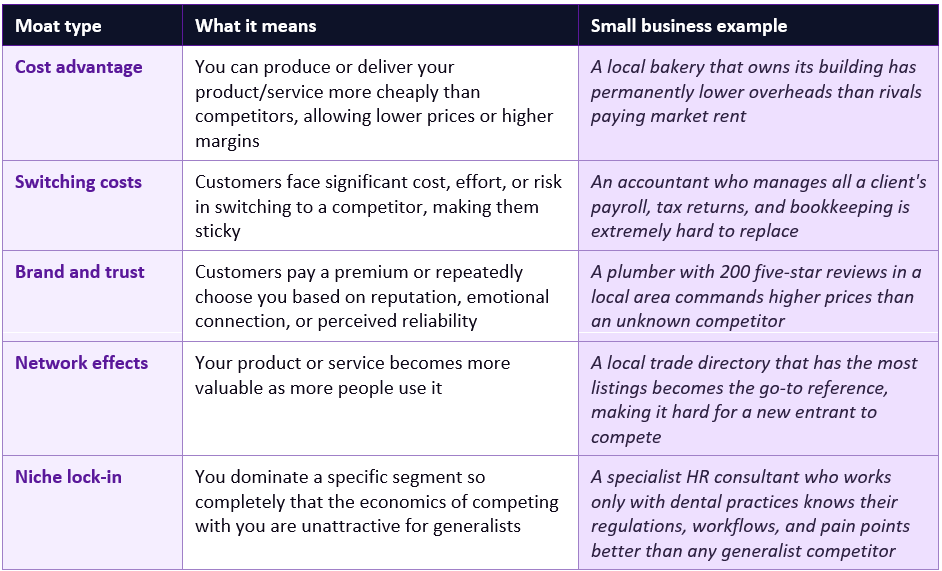
Business strategy researchers, most notably Michael Porter and Pat Dorsey (author of The Little Book That Builds Wealth), have identified five primary sources of durable competitive advantage. Understanding each one helps you identify which is most relevant to your business and where to focus your capability-building investment.Capabilities vs Features: The Critical Distinction
One of the most common strategic mistakes small businesses make is confusing features with capabilities. A feature is something you offer — fast delivery, a friendly team, competitive pricing, a nice website. A capability is something you are consistently able to do that is difficult for others to replicate.Features can be copied. If you launch same-day delivery and it attracts customers, your competitor can offer the same thing next month. If you drop your price, they can drop theirs. Features compete in the market; capabilities build the moat that defends your position regardless of what competitors do.
A capability is typically the combination of processes, systems, knowledge, relationships, and culture that allows your business to do something consistently well. An Amazon-like customer experience is not a feature — it is the result of a capability built over years through relentless process improvement, data analysis, and organisational discipline. A local independent estate agent that consistently sells properties faster than competitors has not just posted better listings — it has built capabilities in pricing judgment, vendor communication, buyer qualification, and local market knowledge that a competitor cannot replicate by running a few better adverts.
The essence of strategy is choosing what not to do. A competitive moat is built not by doing more things, but by doing a few things so consistently well that they become genuinely hard to replicate.
— MICHAEL PORTER, HARVARD BUSINESS SCHOOL — WHAT IS STRATEGY?
The practical question to ask about any capability you are considering building is: if a well-funded competitor spent two years trying to copy this, could they? If the answer is yes, it is a feature. If the answer is 'yes, but it would take them five years and require significant organisational changes they are unlikely to make', you are approaching a genuine capability.
How to Diagnose Your Current Competitive Position
Before you can build a moat, you need to understand the terrain. This means honestly assessing why customers choose you today, how durable those reasons are, and where you are most exposed to competitive attack.The three key diagnostic questions
Start by asking three questions about your current business. First: why do customers choose you over alternatives? Write down every reason customers give, explicitly or implicitly — price, convenience, quality, relationships, speed, specialisation, trust, habit. Second: which of those reasons are genuinely hard to copy? Go through each one and honestly assess how much effort it would take a motivated, well-resourced competitor to replicate it. Third: where are your biggest vulnerabilities? Identify the scenarios in which you could lose significant customers — a better-priced competitor, a platform that disintermediates you, a technology change that makes your current approach obsolete.Use a simple 2x2 framework: plot your current competitive advantages on two axes — how hard they are to copy (low to high) and how much customers value them (low to high). The advantages in the top-right quadrant (highly valued, hard to copy) are the ones worth doubling down on. The ones in the top-left (highly valued, easy to copy) are the most urgent vulnerabilities. These are moat candidates — they drive customer choice now but are at risk of being eroded by a sufficiently motivated competitor.
Porter's Five Forces for small businesses
Michael Porter's Five Forces framework — competitive rivalry, threat of new entrants, threat of substitutes, buyer power, and supplier power — provides a useful lens for assessing your strategic environment. For a small business, the most important forces are usually the threat of new entrants (how easy is it for a new competitor to enter your market?) and buyer power (how easily can your customers switch to an alternative?). Building a moat specifically addresses both: a strong moat raises barriers to entry and reduces buyer power by making switching costly or unattractive.Building a Cost Advantage Moat
For most small businesses, a sustainable cost advantage does not come from being bigger than competitors — they are rarely the lowest-cost producer in absolute terms. It comes from structural advantages: owning rather than renting key assets, operating in a geography or niche where overheads are lower, or having a business model that requires less cost to deliver the same outcome.The most durable form of cost advantage for a small business is operational efficiency that has been built through years of refinement, combined with a cost structure that is genuinely lower than what a new entrant would face. If you have owned your commercial premises for ten years, your rent equivalent is zero while a competitor starting today would need to budget for market-rate rents. If you have supplier relationships built over a decade that include preferential pricing, a new entrant cannot replicate that quickly regardless of how hard they try.
Cost advantage as a moat strategy is most effective in markets where customers are highly price-sensitive and switching costs are low — commodity-style markets where product differentiation is limited. It is a fragile moat if it depends purely on current economies of scale, because a larger competitor can always undercut you. It is a durable moat when it is built into the structure of the business in ways that are genuinely hard to replicate.
Building a Brand and Trust Moat
For most small businesses serving local or niche markets, brand and trust is the most achievable and most powerful source of competitive moat. A business that is genuinely and demonstrably trusted by its customers can command higher prices, retain customers for longer, and generate referrals that cost nothing — all of which compound over time into a significant competitive advantage.A brand moat for a small business is not built by a logo or a marketing campaign. It is built by consistently delivering what you promise, handling problems generously when things go wrong, communicating with customers in ways that make them feel valued and understood, and developing a reputation in your community or niche that precedes you. When a potential customer Googles your business and finds 200 detailed, recent, positive reviews describing specific experiences that match their own needs, the persuasive power of that social proof is something a new competitor cannot replicate by simply launching better marketing.
The capability required to build a brand moat is operational consistency — the ability to deliver a reliably excellent experience every time, not just when conditions are ideal. This requires documented processes, trained and empowered staff, a feedback loop that identifies and corrects failures quickly, and a genuine cultural commitment to customer outcomes rather than just transactions. Businesses that build this capability find that their marketing spend decreases over time as referrals and reputation do more of the work.
Practical steps to build a brand and trust moat
- Make customer reviews a systematic process: ask every satisfied customer for a review at the right moment, respond to every review (positive and negative), and address negative feedback visibly and generously.
- Create a service recovery standard: decide in advance how you will respond when things go wrong, and make your recovery so generous that it turns a disappointed customer into a loyal advocate.
- Build a communication rhythm: regular, valuable, non-pushy communication (newsletters, useful content, timely follow-ups) keeps you top of mind and signals professionalism and reliability.
- Document and defend your standards: write down exactly what good looks like in your business, train everyone on it, and hold it consistently even when it is inconvenient or expensive to do so.
- Invest in community presence: sponsoring local events, participating in trade associations, speaking at industry forums, and writing useful content positions you as an authority and builds recognition that is very hard for a new entrant to replicate quickly.
Building Switching Costs Into Your Business Model
Switching costs are one of the most underappreciated sources of competitive moat for small businesses. They do not require the business to be the cheapest or even the best — they simply make leaving more costly, in time, money, risk, or disruption, than staying.Switching costs come in several forms. Contractual switching costs are explicit — a customer on an annual retainer or a long-term service contract faces a direct financial cost to leave early. Learning or integration switching costs arise when the customer has invested significant time integrating your product or service into their workflow — a business that has trained its entire team to use your software platform and built its processes around your reporting will face significant disruption and retraining costs in switching to an alternative, even if the alternative is marginally better.
Relational switching costs are perhaps the most powerful for service businesses. When a customer has built a genuine working relationship with you — when you know their history, their preferences, their quirks, and their strategic objectives — switching to a new provider means starting from scratch and accepting a period of reduced service quality while the new provider learns. Many customers will tolerate a supplier who is not perfect rather than absorb the switching cost of finding and onboarding a new one.
To deliberately build switching costs into your business model, look for opportunities to deepen integration with your customers' workflows, to accumulate proprietary knowledge of their situation that would be lost on switching, and to create value that is specific to your relationship rather than generic to your industry. Annual contracts with strong renewal incentives, proprietary client portals, bespoke reporting, and dedicated account management all create switching costs while also genuinely improving the customer experience.
Building a Niche Lock-In Moat
One of the most effective moat strategies available to a small business is extreme specialisation in a well-defined niche. Rather than trying to serve everyone, a business that goes deeper than anyone else in serving a specific type of customer, industry vertical, or problem domain can build a position that is very difficult for a generalist competitor to attack economically.The logic of niche lock-in is simple: when you know more about your customers' specific needs, regulations, workflows, and challenges than any competitor, you can solve their problems faster, more reliably, and with less friction. A solicitor who specialises exclusively in franchise law knows more relevant case precedents, has more relevant templates, and can give more precise advice than a general commercial solicitor — and a franchisee with a complex matter will pay a premium for that specific expertise rather than risk an expensive mistake with a generalist.
Building a niche lock-in moat requires the discipline to say no to opportunities outside your defined focus. Every time you take on work outside your niche for short-term revenue, you dilute the depth of expertise and reputation that makes the niche strategy valuable. The moat gets wider as you accumulate more niche-specific knowledge, case studies, client relationships, and reputation. It gets narrower if you spread your attention across multiple markets.
Small businesses that have successfully built niche moats often describe a tipping point — a moment when their reputation in the niche reaches critical mass and the best prospects in that niche seek them out specifically rather than comparing them against generalist competitors. At that point, the competitive dynamic has fundamentally changed in their favour.
Building Operational Process Capabilities
Across all types of competitive moat, the underlying capability that makes the moat defensible is operational process excellence — the ability to consistently deliver high quality through documented, trained, and continuously improved processes rather than through individual heroics or luck.A business that depends on one or two exceptional individuals to maintain its quality standard is vulnerable. If those individuals leave, become ill, or simply cannot scale their time, the business's competitive advantage goes with them. A business that has embedded its quality standards into well-documented processes, supported by training, technology, and measurement, is far more resilient. The capability exists in the organisation, not just in specific people.
Building process capabilities starts with documentation: writing down exactly how the best work gets done in your business, in enough detail that a well-trained new hire could replicate it. It continues with systematisation: using technology, templates, and checklists to make the right way the easiest way. And it compounds with continuous improvement: building feedback loops that identify where processes break down and creating a culture where those breakdowns are reported rather than hidden and fixed rather than repeated.
The four-stage capability building framework
- Stage 1 — Document: Write down exactly what good looks like for every core process. What does the best version of each service or product delivery look like from the customer's perspective? What steps, in what sequence, produce that outcome reliably?
- Stage 2 — Systematise: Use technology, templates, and automation to make the documented process the path of least resistance. CRM systems, project management tools, standardised reporting formats, and automated follow-up sequences all reduce the reliance on individual memory and discipline.
- Stage 3 — Measure: Define the key indicators that tell you whether each core process is working. Customer satisfaction scores, on-time delivery rates, error rates, and repeat purchase frequency all measure whether your processes are producing the outcomes you intend.
- Stage 4 — Improve: Create a regular rhythm for reviewing process performance, identifying failure points, and making targeted improvements. The businesses with the strongest process moats are not those that got it right first time — they are those that failed faster, learned more quickly, and improved more consistently than competitors.
Compounding Your Moat Over Time
The most important strategic insight about competitive moats is that they compound. A brand that has been consistently built for five years is exponentially more valuable than one built for one year. A body of niche expertise accumulated over a decade cannot be caught by a competitor who starts building theirs today. A set of customer relationships deepened over years is worth more than the sum of individual transactions.This compounding dynamic is why strategy is a long game. Most small businesses get knocked off course by short-term pressures — a difficult month, a tempting but off-strategy client, a competitor move that prompts a reactive price cut. Each of these deviations is understandable in isolation; cumulatively, they prevent the consistent investment in capabilities that creates a durable competitive position.
The businesses that build wide moats over time share a common discipline: they define their strategic position clearly, they invest consistently in the capabilities that build that position, and they resist the temptation to chase short-term opportunities that pull them away from it. Every new customer in your niche adds to your reference base and deepens your expertise. Every positive review compounds your brand equity. Every process improvement makes your operations more efficient and your quality more reliable. The moat grows wider every year — but only if you keep digging.
A useful annual exercise is to ask: at the end of this year, will our competitive moat be wider or narrower than it was at the start? What specific investments are we making this year that will make us harder to compete with twelve months from now? If you cannot answer these questions clearly, you are not building a moat — you are simply operating.
Common Mistakes That Erode a Competitive Moat
Building a moat is hard. Eroding one is surprisingly easy. These are the most common mistakes small business owners make that undermine strategic advantage over time.Moat-eroding mistakes to avoid
- Competing on price instead of value: Winning customers by being the cheapest is the opposite of building a moat. Price competition attracts the most price-sensitive customers — the ones with the lowest loyalty — and trains the market to expect your pricing floor as the starting point for negotiations.
- Failing to reinvest in capability: Many businesses harvest the financial returns of their early competitive advantages without continuing to invest in deepening them. The moat that made you successful five years ago needs continuous investment to stay relevant. Complacency is the most common cause of moat erosion.
- Scope creep away from your niche: Every time you accept work outside your defined focus for short-term revenue, you dilute the specialist reputation that makes your niche position valuable. Say no to off-strategy clients and projects, however tempting in the short term.
- Neglecting staff and culture: Your team is the primary delivery mechanism for most of your competitive capabilities. High staff turnover destroys institutional knowledge, disrupts customer relationships, and degrades operational consistency. Investing in staff retention and development is directly investing in your moat.
- Ignoring the competitive environment: A moat that was wide ten years ago may be narrowing due to technology change, new entrants, or shifting customer preferences. Review your competitive position annually and honestly. The question is not just 'are we doing well?' but 'are we still differentiating effectively?'
- Over-relying on one moat dimension: The most resilient businesses have reinforcing advantages — a strong brand in a niche, combined with switching costs, combined with superior processes. A single-dimension moat is more vulnerable to disruption than one supported by multiple mutually reinforcing advantages.
CONCLUSION
A competitive moat is not something that happens to a business. It is something a business builds deliberately, through sustained investment in specific capabilities over time. For a small business, the moat sources most worth pursuing are typically brand and trust, niche specialisation, switching costs, and operational process excellence — sources that compound with consistency and do not require the financial firepower of a large corporation to build.The most important thing you can do today is to be honest about where your current competitive advantages come from, which of them are genuinely hard to copy, and what would happen to your business if a well-funded competitor entered your market tomorrow and did everything you do, but slightly better. If your answer reveals significant vulnerability, that is not a reason for alarm — it is a call to action. Start building. Choose your moat type, identify the capabilities it requires, and invest in them consistently. The best time to build a competitive moat is before you need it.
Frequently Asked Questions
What is a competitive moat in business?
A competitive moat is a durable advantage that makes a business hard to compete with and hard to copy over time. The term was coined by Warren Buffett to describe businesses that could sustain above-average profitability because their core competitive position was protected from erosion. For a small business, a moat might be a trusted brand in a niche community, deeply embedded customer relationships, specialist expertise that takes years to accumulate, or operational processes that consistently deliver a better experience than competitors can match.Can a small business really build a competitive moat?
Absolutely — and small businesses often have structural advantages in building certain types of moat that large companies do not. Deep customer relationships, community trust, specialist niche expertise, and responsive service quality are all areas where a focused small business can outperform a large, bureaucratic competitor. The key is choosing a moat type that matches your market and business model, then investing in the underlying capabilities consistently over time.What is the difference between a competitive advantage and a competitive moat?
A competitive advantage is anything that allows you to outperform competitors — better pricing, faster delivery, a stronger product. A competitive moat is a specific type of advantage that is durable and self-reinforcing: it does not just help you win today but becomes harder for competitors to close over time. Not all competitive advantages are moats. Being cheapest today is an advantage; it is not a moat because any competitor can match or beat your price tomorrow. Being trusted in a niche you have served for ten years is both an advantage and a moat, because that trust cannot be quickly replicated.Which moat type is best for a small service business?
For most small service businesses, the most achievable and durable moats are brand and trust combined with niche specialisation. Building a reputation as the most trusted and knowledgeable provider for a specific type of customer — a specific industry, geography, problem type, or customer profile — creates a self-reinforcing competitive position. Switching costs also tend to be naturally high in service businesses where the provider accumulates significant knowledge of the client's situation. The most resilient service businesses combine all three: deep niche expertise, a trusted brand built on consistent delivery, and client relationships with high switching costs.How long does it take to build a competitive moat?
There is no fixed timeline, but meaningful moats typically take three to five years of consistent effort to become genuinely defensible — and they continue to strengthen for many years beyond that. The compound nature of moat-building means that early progress can feel slow: a brand being built, expertise being accumulated, and processes being refined may not be visibly impacting competitive outcomes in year one. By year three to five, the compounding effect becomes more apparent, as reputation precedes the business, referrals reduce acquisition costs, and competitors find it increasingly difficult to attract the customers who have built relationships with you.What is Porter's Five Forces and how does it help with moat strategy?
Porter's Five Forces is a framework developed by Harvard Business School professor Michael Porter for analysing the competitive intensity and structural attractiveness of an industry. The five forces are: the intensity of rivalry among existing competitors, the threat of new entrants, the threat of substitute products or services, the bargaining power of buyers (customers), and the bargaining power of suppliers. For moat strategy, the most relevant forces are typically threat of new entrants (your moat raises barriers to entry) and buyer power (your switching costs and brand loyalty reduce customers' ability to play competitors off against each other). Understanding which forces are strongest in your market helps you identify which moat type to prioritise.References
Harvard Business Review — What Is Strategy? (Michael Porter, 1996) https://hbr.org/1996/11/what-is-strategyHarvard Business Review — The Five Competitive Forces That Shape Strategy https://hbr.org/2008/01/the-five-competitive-forces-that-shape-strategy
Investopedia — Economic Moat: Definition and Examples (Warren Buffett concept) https://www.investopedia.com/terms/e/economicmoat.asp
Harvard Business Review — Building Your Company's Vision (Collins & Porras) https://hbr.org/1996/09/building-your-companys-vision
McKinsey & Company — Competitive Advantage: Creating and Sustaining Superior Performance https://www.mckinsey.com/capabilities/strategy-and-corporate-finance/our-insights
Entrepreneur — How Small Businesses Can Build a Competitive Advantage https://www.entrepreneur.com/growing-a-business/how-small-businesses-build-competitive-advantage/
Forbes — The Strategic Importance of the Economic Moat for Small Businesses https://www.forbes.com/sites/forbesbusinesscouncil/
US Small Business Administration — Building a Business Strategy https://www.sba.gov/business-guide/plan-your-business/write-your-business-plan
Strategyzer — Business Model Canvas (Alexander Osterwalder) https://www.strategyzer.com/library/the-business-model-canvas
GOV.UK — Business Plan Guidance for Small Businesses https://www.gov.uk/write-business-plan
0 Comments
Be the first to share your thoughts on this article.