

Finance
Social Security Electronic Repayment 2026 Guide

Key Statistics & Facts (August 2026): SSA announced new electronic repayment option via Pay.gov: July 14–16, 2026. SSA blog post: ‘Go Digital: Repay Your Overpayment Online Quickly and Securely’ (July 16, 2026). Over 80% of people who receive an overpayment notice now choose to pay online (SSA). Paper checks are 16x more likely to be lost, stolen, altered, or returned undeliverable than electronic payments (SSA). SSA overpayments issued 2022: $6.5 billion in Social Security retirement/disability; $4.6 billion in SSI overpayments (Congressional Research Service). Starting March 27, 2026: default withholding rate = 100% of monthly benefits for new overpayments (reversed from Biden-era 10% cap). For notices issued after April 25, 2025: SSA will withhold up to 50% of monthly Title II benefits if no waiver/reconsideration/rate reduction is requested within 90 days. SSI overpayment withholding: 10% of monthly payment (capped ~$96.70/month in 2025 — unchanged). Simplified waiver threshold: $2,000 (both SSI and Title II). Appeal deadline: request reconsideration within 10 days of receiving notice to continue receiving benefits during review. Remittance ID: 10-digit alphanumeric number — do NOT enter your SSN. Executive Order 14247 (March 2025): required federal benefits to be paid electronically by September 30, 2025. SSA contact: 1-800-772-1213. Pay.gov portal: pay.gov.
For many recipients, particularly those living on fixed incomes, this kind of notice can feel devastating. The debt itself may not be their fault. The amount can be difficult or impossible to repay all at once. And the bureaucratic process of responding correctly — understanding your rights, your appeal options, your waiver eligibility, and your repayment choices — is genuinely complex.
In July 2026, the Social Security Administration took a meaningful step to make one part of this process significantly easier. The SSA published a blog post on July 16, 2026 — ‘Go Digital: Repay Your Overpayment Online Quickly and Securely’ — and issued a formal notice to advocates on July 14 explaining that it was expanding secure digital payment options as part of Executive Order 14247. Beneficiaries who receive an overpayment notice can now repay the debt quickly and securely online through the federal Pay.gov payment platform, using a bank account, debit card, or credit card. They no longer need to mail a check or visit a Social Security office to make a payment.
This guide explains everything you need to know: how the new electronic repayment option works, step by step; what the Remittance ID in your notice is and why it matters; what the current overpayment withholding rules mean for your monthly check; and critically, what rights you have if you believe the overpayment notice is wrong or the amount is unaffordable.
Disclaimer: This article is for general informational and educational purposes only. It is not legal or benefits advice. Social Security rules, repayment policies, and overpayment withholding rates change frequently. Always verify current information directly with the Social Security Administration at ssa.gov or by calling 1-800-772-1213.
The SSA calculates what a beneficiary should have received and compares it to what was actually paid. If actual payments exceed what should have been paid, the difference is treated as an overpayment debt that the beneficiary is required to repay, regardless of whether the overpayment was the beneficiary’s fault.
Congressional Research Service (cited by Informer News, January 2026): In 2022 alone, the SSA issued $6.5 billion in Social Security retirement and disability (OASDI) overpayments — approximately 0.5% of total benefits paid — and a further $4.6 billion in SSI overpayments, representing 8% of total SSI benefits paid. Overpayments are a systemic and recurring feature of the Social Security system, not an exceptional event.
The SSA’s July 14 notice — ‘Social Security Transitions to Electronic Remittances’ — stated directly: ‘We are updating our notices to include electronic repayment options for individuals and will no longer ask individuals to mail checks or credit card forms to repay their debts. Mailed payments can be lost, delayed, or intercepted, which may put personal and financial information at risk.’
The practical changes as of August 2026:
Step 1: Locate your Remittance ID. It is a 10-digit alphanumeric number printed on the first page of your overpayment letter and on the payment stub at the end of the notice. This number is used instead of your Social Security number for online payments. Do NOT enter your Social Security number in the Remittance ID field.
Step 2: Visit Pay.gov. Go directly to pay.gov or use the link printed in your overpayment notice. In the search box, type ‘Social Security’ to locate the correct payment form.
Step 3: Click ‘Continue’ under the ‘Repay Your Social Security Overpayment Online’ section. Then click ‘Continue to the Form.’
Step 4: Enter your Remittance ID and the repayment amount. Enter your name, address, and phone number in the required fields.
Step 5: Select your payment method: bank account (ACH / checking or savings), debit card, or credit card. Enter your payment information following the on-screen prompts.
Step 6: Submit your payment. Allow up to five business days for processing. You will receive an email receipt confirming your payment.
Important: Use your Remittance ID, not your Social Security number. Entering the wrong number may cause the payment to be misapplied or rejected. If you receive more than one overpayment notice with a Remittance ID, ensure you use the ID from the specific notice you intend to pay. Only eligible individuals with a Remittance ID on their notice should use this form.
How to use online bill pay:
Step 1: Sign in to your bank or financial institution’s online banking portal.
Step 2: Navigate to the bill pay section and search for ‘Social Security Administration’ as the payee.
Step 3: Enter your Remittance ID (found on your billing notice) as the account number. Also enter your Social Security mailing address as provided.
Step 4: Enter the repayment amount. If you want to set up a recurring payment, indicate this preference. If not, enter the desired amount each time you receive a notice until the balance is paid in full.
Step 5: Submit the payment. Payments made via bank bill pay are typically applied to your overpayment balance the next business day.
Action: Bank bill pay is only available to individuals who are NOT currently receiving Social Security or SSI benefits. If you are currently an active beneficiary receiving monthly payments, use Pay.gov instead. Using the wrong payment channel may result in delays in the payment being applied to your balance.
If paying by paper check or money order:
Key facts about the Remittance ID:
The foundational change: Executive Order 14247, signed in March 2025 and titled ‘Modernizing Payments To and From America’s Bank Account,’ directed all federal agencies to transition from paper checks to electronic payments. As of September 30, 2025, federal law required that virtually all federal benefit payments — including Social Security and SSI — be made electronically. The SSA published its own blog post on June 2, 2026 confirming the full transition and urging any remaining paper check recipients to switch to direct deposit immediately.
The SSA’s June 2, 2026 blog post underlined the security rationale with a specific statistic that has since been widely reported: paper checks are 16 times more likely to be lost, stolen, altered, or returned undeliverable than electronic payments. For recipients still receiving benefits by check in 2026, the instruction is clear: create or sign in to your my Social Security account at ssa.gov/myaccount and add your bank account information for direct deposit.
The July 2026 announcement extending electronic options to overpayment repayment is the reverse side of this same modernisation: just as benefits are now sent electronically, the SSA wants overpayment repayments received electronically too. The circular logic is sound: a fully electronic payment ecosystem is faster, more secure, and cheaper to administer than one that still relies on paper checks in either direction.
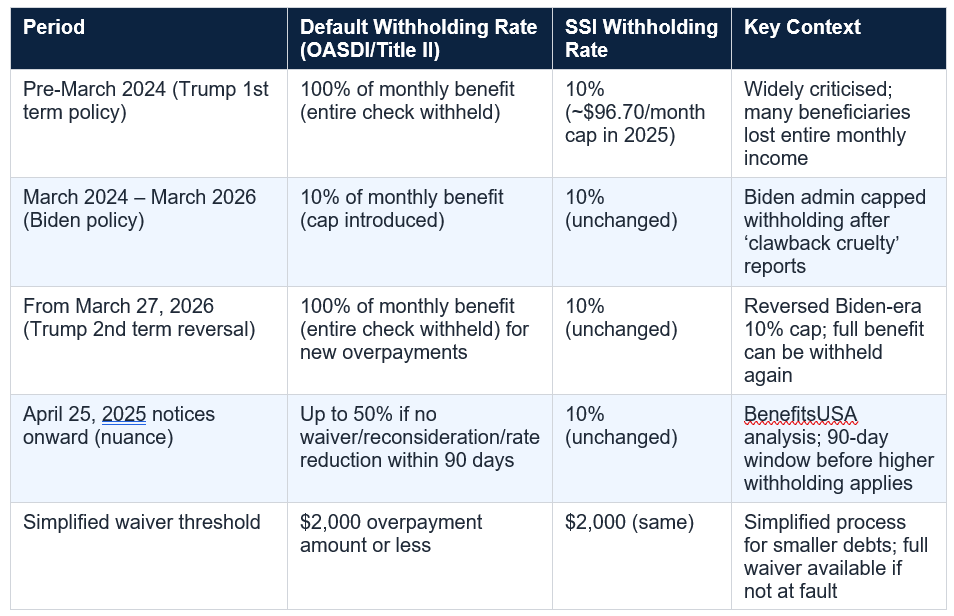
The practical consequence of the March 2026 change is stark: a beneficiary who receives a new overpayment notice and does not act within the specified window may see their entire monthly Social Security check withheld to repay the debt. The BenefitsUSA April 2026 analysis confirms that for notices issued after April 25, 2025, the SSA will withhold up to 50 percent of monthly Title II benefits if no waiver, reconsideration, or rate reduction request is submitted within 90 days. Acting immediately on any overpayment notice is therefore not optional. It is financially critical.
Important: If you receive a Social Security overpayment notice in 2026, act within 10 days of receipt to avoid benefit suspension during any appeal. If the full withholding rate would cause financial hardship, request a reduced repayment rate immediately. Do not wait and do not assume the SSA will be lenient about the timeline.
How to request reconsideration:
Key waiver facts:
You will need to demonstrate that the proposed withholding rate would prevent you from meeting ordinary living expenses. The SSA will review your request and mail you a notice of its decision. Until a decision is made, the original withholding rate applies, so request promptly.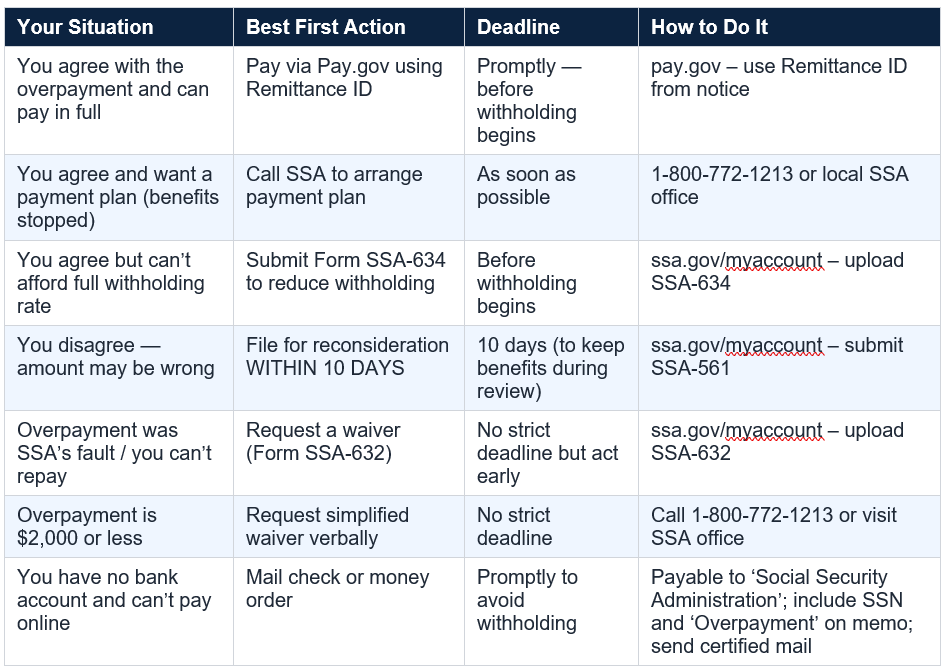
But the electronic payment option is the easy part of overpayment resolution. The harder part — and the part that is genuinely critical for beneficiaries to understand — is what happens to your monthly check if you do not act promptly and correctly. The March 2026 restoration of 100 percent withholding for new overpayments means that an uncontested overpayment notice can result in an entire monthly benefit check being withheld. For someone living on Social Security as their primary or sole income, this is a financial emergency, not an administrative inconvenience.
The message of this article is simple: if you receive a Social Security overpayment notice, take three immediate steps. First, read it carefully and understand whether you believe the overpayment is correct. Second, if you disagree, file a reconsideration appeal within 10 days to protect your benefits during the review. Third, if you agree but cannot afford full repayment, request a waiver or a reduced withholding rate before the SSA begins collecting. The electronic repayment option makes paying easier. Your legal rights make challenging or reducing an overpayment possible. Use whichever applies to your situation — and always keep written records of everything you submit.
If your overpayment notice includes a Remittance ID (a 10-digit alphanumeric number), you can repay online at Pay.gov. Visit pay.gov, search for ‘Social Security,’ click ‘Continue’ under the repayment section, enter your Remittance ID and the amount, provide your name and address, and complete payment using a bank account, debit card, or credit card. You will receive an email receipt. Allow up to five business days for processing. Do not enter your Social Security number in the Remittance ID field.
What is the Remittance ID on my Social Security overpayment notice?
The Remittance ID is a 10-digit alphanumeric number unique to your overpayment notice. It appears on the first page of your letter and on the payment stub at the end. It is used instead of your Social Security number for online payments to protect your personal information. If you have received multiple overpayment notices, each has its own Remittance ID; use the one corresponding to the specific notice you are paying. Do not confuse it with your Social Security number.
Can I still pay a Social Security overpayment by check?
Yes. Paper checks and money orders are still accepted. Make the check payable to the ‘Social Security Administration,’ write your Social Security number and ‘Overpayment’ on the memo line, and mail to the address on your notice. However, the SSA notes that paper checks are 16 times more likely to be lost, stolen, or delayed than electronic payments and strongly recommends Pay.gov or bank bill pay instead. If mailing, use USPS certified mail with return receipt.
What happens if I don’t repay my Social Security overpayment?
As of March 27, 2026, the default SSA policy is to withhold 100% of your monthly OASDI (Title II) benefit to recover new overpayments if no appeal, waiver, or rate reduction is requested. BenefitsUSA’s April 2026 analysis confirms that for notices issued after April 25, 2025, up to 50% may be withheld if no action is taken within 90 days. SSI overpayments are recovered at 10% of the monthly SSI payment (capped at approximately $96.70/month). The SSA may also refer unpaid debts to the Treasury Department’s offset program, which can intercept federal tax refunds.
How do I appeal a Social Security overpayment I think is wrong?
Submit Form SSA-561 (Request for Reconsideration) online via your my Social Security account at ssa.gov/myaccount, or call 1-800-772-1213, or visit a local SSA office. If you file within 10 days of receiving the notice, the SSA is required to continue paying your full benefit while the reconsideration is pending. Gather any documents that support your position: records of changes you reported, pay stubs, bank statements, or evidence of SSA errors.
How do I request a waiver for a Social Security overpayment?
Submit Form SSA-632 (Request for Waiver of Overpayment Recovery) at ssa.gov/myaccount. You must show that the overpayment was not your fault and that repaying it would cause financial hardship or be against equity and good conscience. For overpayments of $2,000 or less, a simplified waiver applies: contact SSA by phone (1-800-772-1213) or in person and state your request; you do not need to complete Form SSA-632. You can request a waiver at any time — even after repayment has begun.
Who can use the bank online bill pay option to repay Social Security?
Bank online bill pay for Social Security overpayments is only available to individuals who are NOT currently receiving Social Security or SSI benefits. If you are currently an active beneficiary, use Pay.gov instead. To use bank bill pay, log in to your bank’s online portal, add ‘Social Security Administration’ as the payee, enter your Remittance ID as the account number, and enter the repayment amount. Payments are typically applied to your balance the next business day.
Table of Contents
- The Letter Nobody Wants to Receive
- What Is a Social Security Overpayment?
- Why Overpayments Happen: The Most Common Causes
- The New Electronic Repayment Option: What Changed in July 2026
- Option 1: Repaying via Pay.gov — Step-by-Step
- Option 2: Repaying via Your Bank’s Online Bill Pay
- Option 3: Paper Check (Still Available)
- The Remittance ID: What It Is and Why It Matters
- The Bigger Picture: SSA’s Full Transition to Electronic Payments
- The 2026 Overpayment Withholding Rules: Critical Changes
- What to Do If You Disagree With the Overpayment
- How to Request a Waiver
- How to Request a Payment Plan or Reduced Rate
- Rights You Have When Facing a Social Security Overpayment
- A Summary Comparison: All Your Options at a Glance
- Conclusion: A Faster System — But Know Your Rights
- Frequently Asked Questions
The Letter Nobody Wants to Receive
Few letters create more immediate anxiety for Social Security beneficiaries than an overpayment notice. It arrives without warning. It states that the Social Security Administration has determined you received more money than you were entitled to. It names a specific dollar amount — sometimes hundreds of dollars, sometimes thousands — that the SSA says must be repaid. And it sets out the consequences if it is not: your monthly benefits may be reduced or withheld entirely to recover the debt.For many recipients, particularly those living on fixed incomes, this kind of notice can feel devastating. The debt itself may not be their fault. The amount can be difficult or impossible to repay all at once. And the bureaucratic process of responding correctly — understanding your rights, your appeal options, your waiver eligibility, and your repayment choices — is genuinely complex.
In July 2026, the Social Security Administration took a meaningful step to make one part of this process significantly easier. The SSA published a blog post on July 16, 2026 — ‘Go Digital: Repay Your Overpayment Online Quickly and Securely’ — and issued a formal notice to advocates on July 14 explaining that it was expanding secure digital payment options as part of Executive Order 14247. Beneficiaries who receive an overpayment notice can now repay the debt quickly and securely online through the federal Pay.gov payment platform, using a bank account, debit card, or credit card. They no longer need to mail a check or visit a Social Security office to make a payment.
This guide explains everything you need to know: how the new electronic repayment option works, step by step; what the Remittance ID in your notice is and why it matters; what the current overpayment withholding rules mean for your monthly check; and critically, what rights you have if you believe the overpayment notice is wrong or the amount is unaffordable.
Disclaimer: This article is for general informational and educational purposes only. It is not legal or benefits advice. Social Security rules, repayment policies, and overpayment withholding rates change frequently. Always verify current information directly with the Social Security Administration at ssa.gov or by calling 1-800-772-1213.
What Is a Social Security Overpayment?
A Social Security overpayment occurs when the SSA pays a beneficiary more money than they were legally entitled to receive for a given period. Overpayments can occur in any Social Security programme: Old-Age, Survivors, and Disability Insurance (OASDI), which includes retirement, survivor, and disability benefits; and Supplemental Security Income (SSI), which serves low-income individuals who are aged, blind, or disabled.The SSA calculates what a beneficiary should have received and compares it to what was actually paid. If actual payments exceed what should have been paid, the difference is treated as an overpayment debt that the beneficiary is required to repay, regardless of whether the overpayment was the beneficiary’s fault.
Congressional Research Service (cited by Informer News, January 2026): In 2022 alone, the SSA issued $6.5 billion in Social Security retirement and disability (OASDI) overpayments — approximately 0.5% of total benefits paid — and a further $4.6 billion in SSI overpayments, representing 8% of total SSI benefits paid. Overpayments are a systemic and recurring feature of the Social Security system, not an exceptional event.
Why Overpayments Happen: The Most Common Causes
Understanding why overpayments occur helps beneficiaries recognise when they might be at risk and take preventive action. The Informer News January 2026 analysis identifies the three primary causes:- Unreported changes in income, work, or living situation: Social Security benefits — particularly disability benefits and SSI — are sensitive to changes in the recipient’s circumstances. If a disability beneficiary returns to work, or an SSI recipient’s income or household composition changes, the benefit amount is supposed to be adjusted. If the beneficiary does not report these changes promptly, or if the report is delayed, the SSA may continue paying the old benefit level, generating an overpayment.
- Administrative delays or SSA errors: even when beneficiaries report changes correctly and on time, the SSA’s administrative processing may lag behind the effective date of the change. Benefits may continue at the old rate for additional weeks or months while the SSA processes the update. In these cases, the overpayment is entirely the SSA’s fault — a fact that is relevant to waiver eligibility.
- Incorrect application of rules or data entry mistakes: complex eligibility rules, particularly in the disability programme, can be applied incorrectly by SSA staff. Data entry errors, coordination failures between SSA systems, or incorrect integration of information from other government agencies (such as the IRS or state unemployment systems) can all generate overpayments.
The New Electronic Repayment Option: What Changed in July 2026
Before July 2026, Social Security beneficiaries who needed to repay an overpayment had limited options: mail a check or money order to the SSA, visit a local Social Security office in person, or in some cases use an existing bank bill pay option. The SSA’s formal notice to advocates published on July 14, 2026 announced a significant expansion of this framework.The SSA’s July 14 notice — ‘Social Security Transitions to Electronic Remittances’ — stated directly: ‘We are updating our notices to include electronic repayment options for individuals and will no longer ask individuals to mail checks or credit card forms to repay their debts. Mailed payments can be lost, delayed, or intercepted, which may put personal and financial information at risk.’
The practical changes as of August 2026:
- All new overpayment notices now include Pay.gov website information and a unique Remittance ID for online payment.
- Eligible beneficiaries can repay using a bank account (ACH), debit card, or credit card through Pay.gov — no SSA office visit or mailed check required.
- A second option — bank online bill pay — is also available for beneficiaries who are no longer actively receiving Social Security or SSI payments.
- Over 80 percent of recipients who receive an overpayment notice now choose to pay online, according to the SSA’s July 16 blog post.
- Paper checks and money orders remain accepted for those who cannot pay electronically, but the SSA’s direction is clearly toward digital repayment.
Option 1: Repaying via Pay.gov — Step-by-Step
Pay.gov is the official secure payment portal of the US Department of the Treasury. It is the primary recommended repayment method for Social Security overpayments as of July 2026. You will need the Remittance ID from your overpayment notice to use this option.Step 1: Locate your Remittance ID. It is a 10-digit alphanumeric number printed on the first page of your overpayment letter and on the payment stub at the end of the notice. This number is used instead of your Social Security number for online payments. Do NOT enter your Social Security number in the Remittance ID field.
Step 2: Visit Pay.gov. Go directly to pay.gov or use the link printed in your overpayment notice. In the search box, type ‘Social Security’ to locate the correct payment form.
Step 3: Click ‘Continue’ under the ‘Repay Your Social Security Overpayment Online’ section. Then click ‘Continue to the Form.’
Step 4: Enter your Remittance ID and the repayment amount. Enter your name, address, and phone number in the required fields.
Step 5: Select your payment method: bank account (ACH / checking or savings), debit card, or credit card. Enter your payment information following the on-screen prompts.
Step 6: Submit your payment. Allow up to five business days for processing. You will receive an email receipt confirming your payment.
Important: Use your Remittance ID, not your Social Security number. Entering the wrong number may cause the payment to be misapplied or rejected. If you receive more than one overpayment notice with a Remittance ID, ensure you use the ID from the specific notice you intend to pay. Only eligible individuals with a Remittance ID on their notice should use this form.
Option 2: Repaying via Your Bank’s Online Bill Pay
A second electronic repayment option is available for people who are not currently receiving Social Security or SSI benefits but need to repay an overpayment from a previous period. This option uses your bank or credit union’s existing online bill pay service.How to use online bill pay:
Step 1: Sign in to your bank or financial institution’s online banking portal.
Step 2: Navigate to the bill pay section and search for ‘Social Security Administration’ as the payee.
Step 3: Enter your Remittance ID (found on your billing notice) as the account number. Also enter your Social Security mailing address as provided.
Step 4: Enter the repayment amount. If you want to set up a recurring payment, indicate this preference. If not, enter the desired amount each time you receive a notice until the balance is paid in full.
Step 5: Submit the payment. Payments made via bank bill pay are typically applied to your overpayment balance the next business day.
Action: Bank bill pay is only available to individuals who are NOT currently receiving Social Security or SSI benefits. If you are currently an active beneficiary receiving monthly payments, use Pay.gov instead. Using the wrong payment channel may result in delays in the payment being applied to your balance.
Option 3: Paper Check (Still Available)
The SSA has confirmed that paper checks and money orders remain accepted for those who cannot or choose not to pay electronically. However, the SSA’s official notices as of July 2026 no longer ask recipients to mail checks or credit card forms as the primary repayment method — this is a deliberate policy shift in line with Executive Order 14247.If paying by paper check or money order:
- Make the check or money order payable to the ‘Social Security Administration.’
- Write your Social Security number and the word ‘Overpayment’ on the memo line.
- Mail to the address provided on your overpayment notice. This address varies by region.
- Keep the tracking or certified mail receipt as proof of mailing. Mailed checks, as the SSA notes in its own guidance, can be lost, delayed, or intercepted.
The Remittance ID: What It Is and Why It Matters
The Remittance ID is one of the most important pieces of information on your overpayment notice, and one that many recipients overlook or confuse with their Social Security number. Understanding exactly what it is protects you from payment errors.Key facts about the Remittance ID:
- It is a 10-digit alphanumeric number — a combination of letters and digits, not a purely numeric code like a Social Security number.
- It appears on the first page of your overpayment letter and on the payment stub at the end of the notice.
- It is used instead of your Social Security number for online payments, specifically to protect your personal information. The SSA deliberately designed the system around the Remittance ID rather than the SSN to reduce the risk of identity theft or payment interception.
- Each Remittance ID is associated with a specific overpayment notice. If you have received more than one notice, each has its own Remittance ID. Ensure you use the correct one for the specific debt you are paying.
- Do NOT enter your Social Security number in the Remittance ID field on Pay.gov. The SSA’s official instructions are explicit on this point.
The Bigger Picture: SSA’s Full Transition to Electronic Payments
The July 2026 electronic repayment announcement is part of a much broader transformation of how the Social Security Administration handles all payments — both incoming and outgoing.The foundational change: Executive Order 14247, signed in March 2025 and titled ‘Modernizing Payments To and From America’s Bank Account,’ directed all federal agencies to transition from paper checks to electronic payments. As of September 30, 2025, federal law required that virtually all federal benefit payments — including Social Security and SSI — be made electronically. The SSA published its own blog post on June 2, 2026 confirming the full transition and urging any remaining paper check recipients to switch to direct deposit immediately.
The SSA’s June 2, 2026 blog post underlined the security rationale with a specific statistic that has since been widely reported: paper checks are 16 times more likely to be lost, stolen, altered, or returned undeliverable than electronic payments. For recipients still receiving benefits by check in 2026, the instruction is clear: create or sign in to your my Social Security account at ssa.gov/myaccount and add your bank account information for direct deposit.
The July 2026 announcement extending electronic options to overpayment repayment is the reverse side of this same modernisation: just as benefits are now sent electronically, the SSA wants overpayment repayments received electronically too. The circular logic is sound: a fully electronic payment ecosystem is faster, more secure, and cheaper to administer than one that still relies on paper checks in either direction.
The 2026 Overpayment Withholding Rules: Critical Changes
Understanding the electronic repayment option is only part of the picture. The much larger and more financially consequential development for Social Security beneficiaries in 2026 is the change in how the SSA withholds monthly benefits to recover overpayments when they are not proactively repaid.The practical consequence of the March 2026 change is stark: a beneficiary who receives a new overpayment notice and does not act within the specified window may see their entire monthly Social Security check withheld to repay the debt. The BenefitsUSA April 2026 analysis confirms that for notices issued after April 25, 2025, the SSA will withhold up to 50 percent of monthly Title II benefits if no waiver, reconsideration, or rate reduction request is submitted within 90 days. Acting immediately on any overpayment notice is therefore not optional. It is financially critical.
Important: If you receive a Social Security overpayment notice in 2026, act within 10 days of receipt to avoid benefit suspension during any appeal. If the full withholding rate would cause financial hardship, request a reduced repayment rate immediately. Do not wait and do not assume the SSA will be lenient about the timeline.
What to Do If You Disagree With the Overpayment
Receiving an overpayment notice does not mean the SSA is correct. The amount may be wrong. The overpayment may have been caused entirely by SSA error. Or the circumstances that led to the overpayment may have been outside your control and may qualify for a full waiver.Request Reconsideration (Appeal)
If you believe you were not overpaid, or that the amount stated is incorrect, you have the right to request a reconsideration — the first stage of SSA’s appeals process. Critically, if you request a reconsideration within 10 days of receiving the overpayment notice, the SSA is required to continue paying your benefits at their current level until a determination is made on the appeal. This protection disappears after 10 days.How to request reconsideration:
- Call SSA at 1-800-772-1213 or visit your local Social Security office.
- Submit Form SSA-561 (Request for Reconsideration). This can be submitted online through your my Social Security account at ssa.gov/myaccount.
- Gather any documents that support your position: pay stubs, bank statements, medical records, records of any changes you reported to SSA, correspondence with SSA, or any other evidence that challenges the overpayment amount or the period it covers.
Request a Waiver
A waiver is different from an appeal. An appeal challenges whether the overpayment is correct. A waiver accepts that the overpayment occurred but asks the SSA to forgive all or part of the debt because it was not your fault and you cannot afford to repay it.How to Request a Waiver
The waiver process requires meeting two conditions: (1) the overpayment was not your fault; and (2) repaying it would cause financial hardship or would be against equity and good conscience. If both conditions are met, the SSA can waive the overpayment in full or in part, meaning you do not have to repay it.Key waiver facts:
- You can request a waiver at any time — there is no strict deadline, though acting early is always better to prevent withholding from beginning.
- Submit Form SSA-632 (Request for Waiver of Overpayment Recovery). This form can be completed and submitted online at ssa.gov/myaccount.
- Simplified waiver: for overpayments of $2,000 or less, a simplified waiver process applies. You do not need to submit Form SSA-632; instead, contact the SSA and state your request verbally or in writing. The $2,000 threshold applies to both Title II (OASDI) and SSI overpayments.
- Financial hardship evidence: the form asks about your income, expenses, assets, and financial obligations. Be thorough and honest. The SSA uses this information to determine whether repayment would prevent you from meeting basic living expenses (rent, food, utilities, medical costs).
How to Request a Payment Plan or Reduced Rate
If you agree the overpayment is correct but cannot afford to repay it all at once or at the SSA’s default withholding rate, you can request a payment plan (for the full balance) or a reduced monthly withholding rate (if you are currently receiving benefits and the SSA is proposing to reduce your monthly check to recover the debt).Payment Plan (Not Currently Receiving Benefits)
If you are no longer receiving benefits, contact the SSA by phone at 1-800-772-1213 and ask to set up a repayment plan for overpaid benefits. The representative will work with you to establish a monthly payment amount you can manage. This option is not available through Pay.gov; it requires a phone call or office visit.Reduced Withholding Rate (Currently Receiving Benefits)
If you are currently receiving benefits and the SSA proposes to reduce your monthly check to recover the overpayment, you can request a lower withholding rate by submitting Form SSA-634 (Request for Change in Overpayment Recovery Rate). As of August 2026, this form can be completed and uploaded online through your my Social Security account following sign-in prompts.You will need to demonstrate that the proposed withholding rate would prevent you from meeting ordinary living expenses. The SSA will review your request and mail you a notice of its decision. Until a decision is made, the original withholding rate applies, so request promptly.
Rights You Have When Facing a Social Security Overpayment
Many beneficiaries do not know they have specific legal rights in the overpayment process. The SSA is required by federal law to:- Notify you in writing before any withholding begins, with enough information to understand the basis of the overpayment, the amount, and your rights.
- Continue paying your full benefit during a reconsideration appeal if you file the appeal within 10 days of receiving the notice.
- Allow you to request a waiver at any time, even if you have already begun repaying.
- Consider a reduced repayment rate if you demonstrate financial hardship.
- Give you the opportunity to dispute the overpayment amount through multiple levels of appeal: reconsideration, hearing before an Administrative Law Judge, Appeals Council review, and federal court review.
A Summary Comparison: All Your Options at a Glance
Conclusion
The Social Security Administration’s July 2026 expansion of electronic repayment options is a genuinely positive development. Replacing mailed checks with secure online payments via Pay.gov reduces the risk of interception, accelerates processing, provides immediate confirmation of payment, and makes the repayment process accessible from anywhere at any time. The fact that over 80 percent of recipients who receive an overpayment notice already choose to pay online is a clear signal that the demand for this convenience has always been there; the infrastructure has finally caught up.But the electronic payment option is the easy part of overpayment resolution. The harder part — and the part that is genuinely critical for beneficiaries to understand — is what happens to your monthly check if you do not act promptly and correctly. The March 2026 restoration of 100 percent withholding for new overpayments means that an uncontested overpayment notice can result in an entire monthly benefit check being withheld. For someone living on Social Security as their primary or sole income, this is a financial emergency, not an administrative inconvenience.
The message of this article is simple: if you receive a Social Security overpayment notice, take three immediate steps. First, read it carefully and understand whether you believe the overpayment is correct. Second, if you disagree, file a reconsideration appeal within 10 days to protect your benefits during the review. Third, if you agree but cannot afford full repayment, request a waiver or a reduced withholding rate before the SSA begins collecting. The electronic repayment option makes paying easier. Your legal rights make challenging or reducing an overpayment possible. Use whichever applies to your situation — and always keep written records of everything you submit.
Frequently Asked Questions
How do I pay a Social Security overpayment online?If your overpayment notice includes a Remittance ID (a 10-digit alphanumeric number), you can repay online at Pay.gov. Visit pay.gov, search for ‘Social Security,’ click ‘Continue’ under the repayment section, enter your Remittance ID and the amount, provide your name and address, and complete payment using a bank account, debit card, or credit card. You will receive an email receipt. Allow up to five business days for processing. Do not enter your Social Security number in the Remittance ID field.
What is the Remittance ID on my Social Security overpayment notice?
The Remittance ID is a 10-digit alphanumeric number unique to your overpayment notice. It appears on the first page of your letter and on the payment stub at the end. It is used instead of your Social Security number for online payments to protect your personal information. If you have received multiple overpayment notices, each has its own Remittance ID; use the one corresponding to the specific notice you are paying. Do not confuse it with your Social Security number.
Can I still pay a Social Security overpayment by check?
Yes. Paper checks and money orders are still accepted. Make the check payable to the ‘Social Security Administration,’ write your Social Security number and ‘Overpayment’ on the memo line, and mail to the address on your notice. However, the SSA notes that paper checks are 16 times more likely to be lost, stolen, or delayed than electronic payments and strongly recommends Pay.gov or bank bill pay instead. If mailing, use USPS certified mail with return receipt.
What happens if I don’t repay my Social Security overpayment?
As of March 27, 2026, the default SSA policy is to withhold 100% of your monthly OASDI (Title II) benefit to recover new overpayments if no appeal, waiver, or rate reduction is requested. BenefitsUSA’s April 2026 analysis confirms that for notices issued after April 25, 2025, up to 50% may be withheld if no action is taken within 90 days. SSI overpayments are recovered at 10% of the monthly SSI payment (capped at approximately $96.70/month). The SSA may also refer unpaid debts to the Treasury Department’s offset program, which can intercept federal tax refunds.
How do I appeal a Social Security overpayment I think is wrong?
Submit Form SSA-561 (Request for Reconsideration) online via your my Social Security account at ssa.gov/myaccount, or call 1-800-772-1213, or visit a local SSA office. If you file within 10 days of receiving the notice, the SSA is required to continue paying your full benefit while the reconsideration is pending. Gather any documents that support your position: records of changes you reported, pay stubs, bank statements, or evidence of SSA errors.
How do I request a waiver for a Social Security overpayment?
Submit Form SSA-632 (Request for Waiver of Overpayment Recovery) at ssa.gov/myaccount. You must show that the overpayment was not your fault and that repaying it would cause financial hardship or be against equity and good conscience. For overpayments of $2,000 or less, a simplified waiver applies: contact SSA by phone (1-800-772-1213) or in person and state your request; you do not need to complete Form SSA-632. You can request a waiver at any time — even after repayment has begun.
Who can use the bank online bill pay option to repay Social Security?
Bank online bill pay for Social Security overpayments is only available to individuals who are NOT currently receiving Social Security or SSI benefits. If you are currently an active beneficiary, use Pay.gov instead. To use bank bill pay, log in to your bank’s online portal, add ‘Social Security Administration’ as the payee, enter your Remittance ID as the account number, and enter the repayment amount. Payments are typically applied to your balance the next business day.
0 Comments
Be the first to share your thoughts on this article.