
Finance
The UK Inflation Survival Guide: Accountants' Edition

Table of Contents
- The Headline Says 2.6% -- Your Household Tells a Different Story
- The Current UK Inflation Picture: What the Data Actually Shows in July 2026
- Why the 2.6% Headline Misleads Most Households
- The Survival Strategies: What Saves You the Most Money in 2026
- Category-by-Category Action Plan: The Specific Steps That Save Real Money
- Conclusion: The Rate Is Falling. The Fight Is Not Over.
- Frequently Asked Questions (FAQ)
- What is the current UK inflation rate in July 2026?
- Why do I still feel the cost of living crisis if inflation is falling?
- What is the Ofgem energy price cap and how does it affect my bills?
- How much money could I save by switching savings accounts in 2026?
- Are there government benefits I might be missing in 2026?
- External References & Further Reading
The Headline Says 2.6% -- Your Household Tells a Different Story
The official numbers look like good news. UK CPI inflation fell to 2.6% in June 2026, according to the ONS bulletin released two weeks ago -- down from 2.8% in May, and well below the 11.1% peak of October 2022 that marked the worst inflation in 41 years. The Bank of England's base rate sits at 3.75%. Food price inflation, which hit 19% at its peak, has fallen to 1.7% in June 2026 -- the lowest since August 2024. From a macroeconomic perspective, the inflation emergency appears to be receding.The lived experience of most UK households tells a different story. BritClock (April 2026): 'The cumulative effect of high inflation since 2021 means the average UK household is spending approximately £3,200 more per year than before the surge, even as the headline rate has fallen back towards target.' Statista (2 weeks ago): 'UK consumer prices have increased by over 20% in the last three years.' And critically: 67% of UK households reported their cost of living was still increasing in March 2026. A 2.6% annual rate means prices are still rising -- just at a slower rate than before. The absolute price level accumulated since 2021 has not come down. The weekly shop, the energy bill, the mortgage payment -- they are all more expensive than they were four years ago, and most will remain so.
This guide is practical. It covers the current UK inflation data in enough detail to understand where the pressure is coming from, and then -- more importantly -- provides the specific, actionable strategies for every major spending category that can materially reduce how much that inflation costs you. The data is from this week and last. The actions are available today.
The Current UK Inflation Picture: What the Data Actually Shows in July 2026
The following table presents the complete inflation picture -- by measure and by category -- using the most current available data as of 31 July 2026: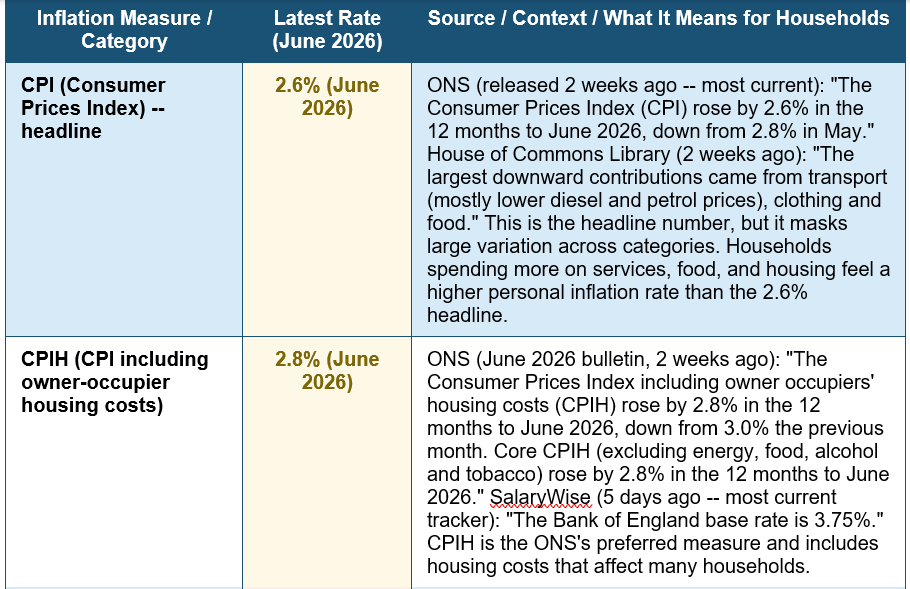
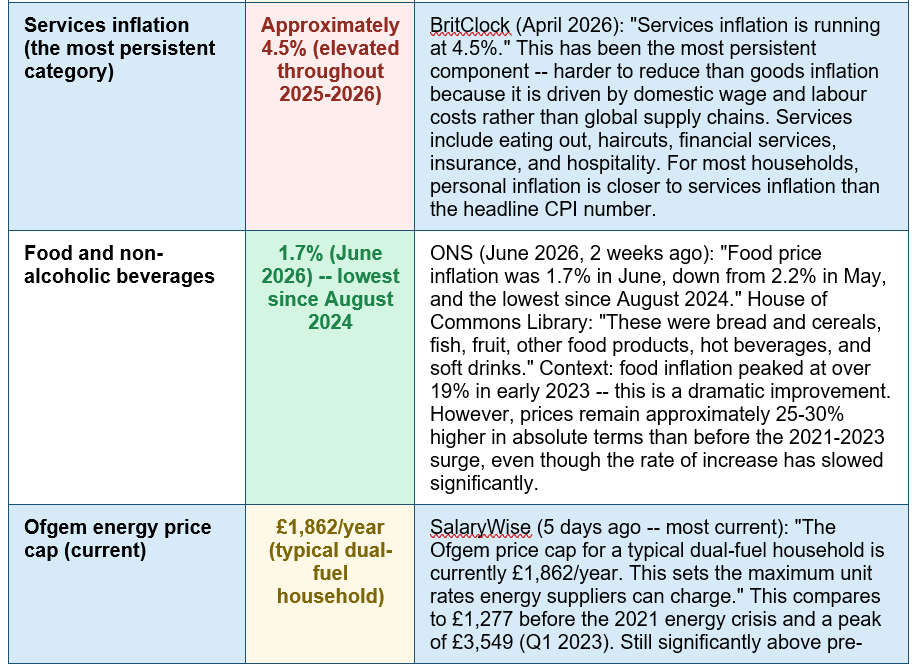
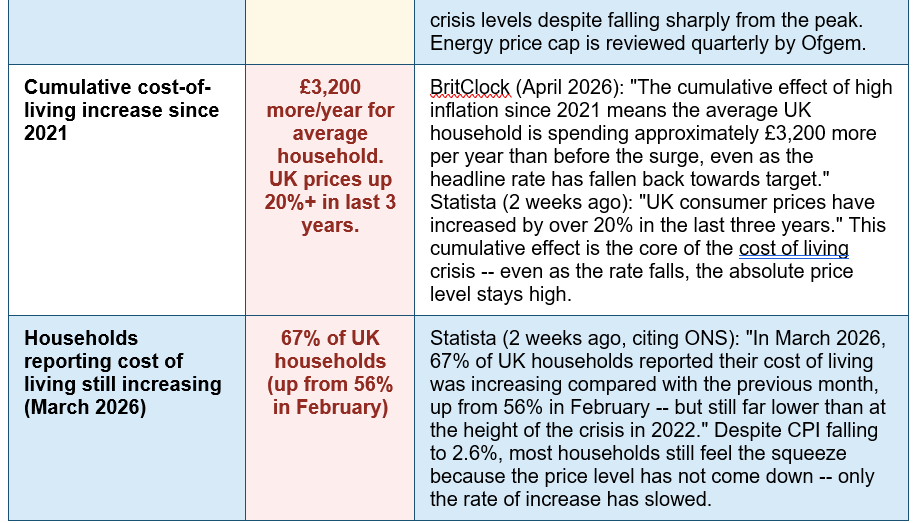
UK inflation snapshot -- July 2026: CPI 2.6%. CPIH 2.8%. Services 4.5%. Food 1.7% (lowest since Aug 2024). Energy cap £1,862/year. Bank Rate 3.75%. Avg household £3,200 more/year. — ONS June 2026 bulletin (2 weeks ago -- most current official data): 'CPI 2.6%, CPIH 2.8%, food inflation 1.7% -- lowest since August 2024.' SalaryWise (5 days ago -- most current tracker): 'Ofgem price cap £1,862/year. Bank of England base rate 3.75%.' BritClock (April 2026): 'Average household spending £3,200 more per year than before the surge.' Statista (2 weeks ago): '67% of UK households reported cost of living increasing in March 2026.'
Why the 2.6% Headline Misleads Most Households
The 2.6% CPI figure is a weighted average across all spending categories. It includes clothing and footwear, where prices fell 0.5% in the 12 months to June 2026 as the summer sales season drove discounting. It includes food, now at 1.7% -- significantly lower than its 19% peak. These lower-inflation categories drag the average down, producing a headline figure that is below many households' actual experience.The categories that matter most to typical household budgets are running hotter than the headline. Services inflation -- which covers eating out, haircuts, mobile and broadband contracts, financial services, and hospitality -- was running at approximately 4.5% in early 2026. Education inflation was running at 7.6% in recent months (Statista, 2 weeks ago). The Ofgem energy price cap, at £1,862/year, remains £585 (46%) above the £1,277/year pre-crisis level. And mortgage payments for the 2 million households whose fixed-rate deals ended in 2023 and 2024 have surged even as the Bank Rate has begun easing -- because most were refinancing from sub-2% deals to deals in the 4-5% range.
The personal inflation rate -- what an individual household actually experiences -- depends on how their spending is distributed across these categories. A household spending heavily on services, eating out, and still servicing a recently refinanced mortgage will experience an effective personal inflation rate considerably above 2.6%. Understanding this distinction is the starting point for the survival strategies that follow.
The Survival Strategies: What Saves You the Most Money in 2026
The following table maps the six highest-impact spending categories with specific, actionable strategies and realistic annual saving estimates: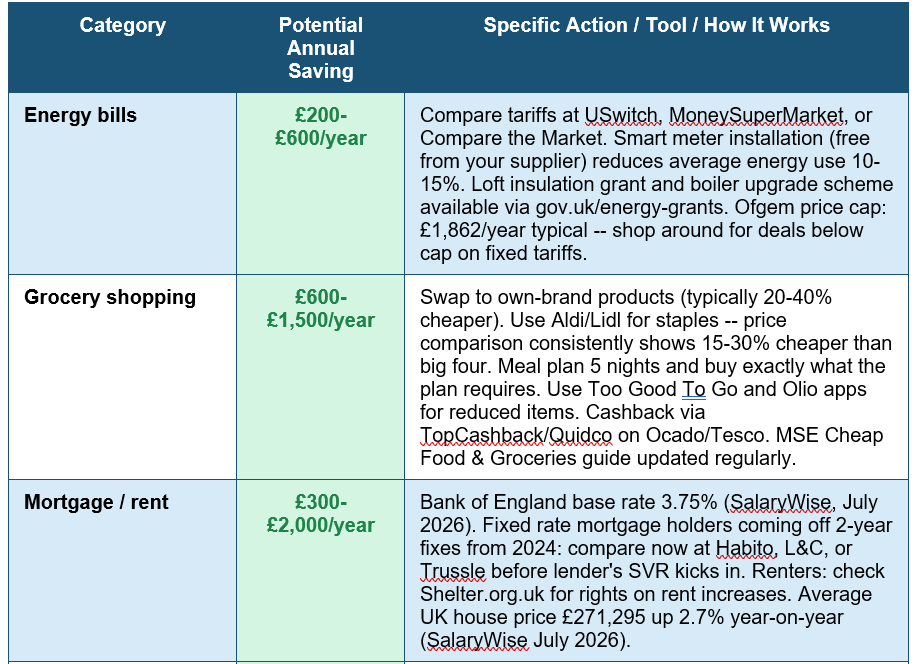
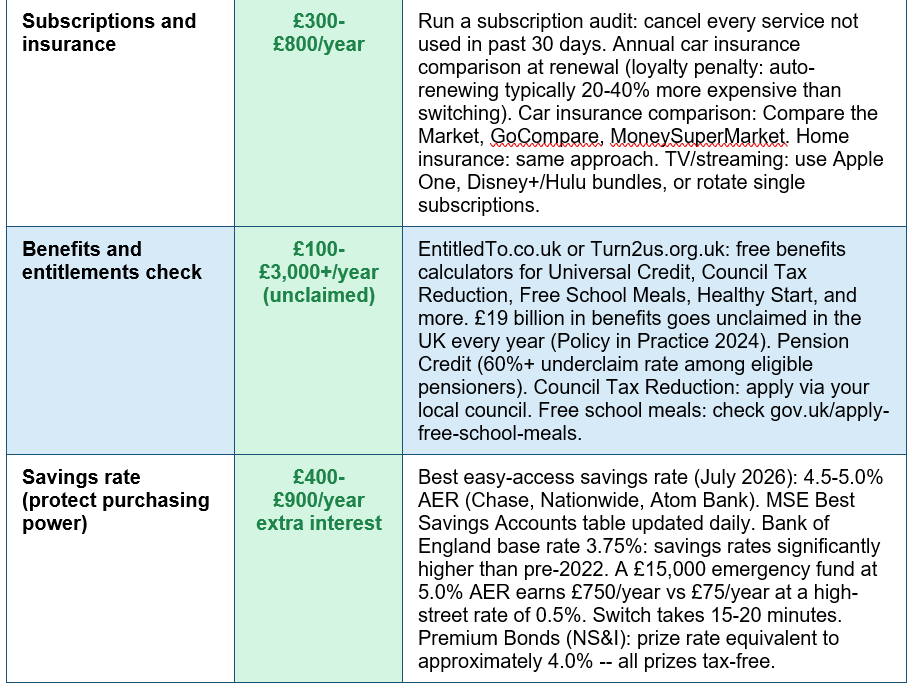
Category-by-Category Action Plan: The Specific Steps That Save Real Money
1 ENERGY BILLS -- FIGHT THE CAP FROM BELOW | Ofgem cap is the ceiling. Your bill doesn't have to reach it.
The Ofgem price cap of £1,862/year is the maximum unit rate energy suppliers can charge for a typical dual-fuel household (SalaryWise, 5 days ago). But paying the cap rate is optional. Many households can reduce their actual energy bill below the cap figure through a combination of tariff comparison, smart meter use, and efficiency measures. Smart meter installation is free from your energy supplier and gives you real-time visibility of energy use. Research consistently shows households with smart meters reduce consumption by 10-15% on average -- on a £1,862 bill, that is £186-£280 saved per year. Beyond usage reduction: compare tariffs at USwitch, MoneySuperMarket, or Compare the Market. Fixed tariffs above the price cap exist (and should be avoided), but competitive fixed tariffs below the cap have been available intermittently in 2026 -- locking in before the next Ofgem quarterly review (October 2026) could protect against any increase. Government efficiency grants are available: the Boiler Upgrade Scheme, Loft Insulation Grants, and Energy Company Obligation (ECO4) scheme all provide free or subsidised home improvements that reduce energy costs. Check eligibility at gov.uk/energy-grants. Free MoneyHelper guidance: 0800 138 7777.2 GROCERY BILLS -- FOOD INFLATION IS FALLING BUT PRICES ARE STILL 25% ABOVE 2020 | The rate is improving. The level is not. These strategies respond to the level.
Food inflation of 1.7% in June 2026 (ONS) is the lowest since August 2024 and a dramatic improvement from the 19% peak of early 2023. But this means food prices are still rising -- just more slowly. The cumulative food price increase since 2020 is approximately 25-30%, and that absolute level is what households experience every week at the checkout. The strategies that save the most: own-brand switching is consistently the single biggest available saving in the grocery budget. Aldi and Lidl own-brand products typically cost 15-30% less than equivalent branded products at Tesco, Sainsbury's, Asda, or Morrisons. Meal planning before shopping eliminates the impulse buys and forgotten-item top-up trips that add £40-80 per visit. The shop-the-fridge-first rule (using what is already in the refrigerator and freezer before any grocery trip) reduces food waste -- and the average UK household throws away approximately £500-700 in food per year (WRAP estimates). Cashback on grocery delivery: TopCashback and Quidco both list cashback rates for Ocado, Tesco, Asda, and Morrisons online shopping. Free food resources: Too Good To Go (surplus food from restaurants and cafes at 50-70% discount), OLIO (free food from neighbours and local businesses), and FoodCycle (community meals). Healthy Start vouchers (£4.25/week) for eligible households with children under 4.3 MORTGAGE AND RENT -- THE SINGLE LARGEST HOUSEHOLD COST AND THE MOST VOLATILE IN 2026 | Bank Rate 3.75%. What to do now if your fixed deal is ending.
SalaryWise (5 days ago -- most current): 'Bank of England base rate (Bank Rate) is 3.75%.' The Bank Rate has been falling gradually from its 5.25% peak, which is easing some mortgage cost pressure for those on tracker rates and those remortgaging. But for households whose 2-year fixed deals (taken in 2022 at sub-2% rates) are ending in 2026, the refinancing shock is still significant. A £250,000 mortgage refinancing from 1.8% to 4.2% adds approximately £310 per month (£3,720/year) in mortgage payments. The most important action for anyone whose fixed deal ends in the next 6 months: start comparing now. Mortgage offers can typically be locked in 6 months ahead of the switch date. Use a whole-of-market broker (L&C Mortgages -- no fee; Habito; or Trussle) to access the full market rather than a single lender's product range. For renters: if your landlord is attempting to impose a rent increase, check Shelter.org.uk for your rights. In England, landlords must serve a formal Section 13 notice for rent increases. You can challenge unreasonable increases at the First-tier Tribunal (Property Chamber). Scotland, Wales, and Northern Ireland have different rules -- check Shelter Scotland, Shelter Cymru, or Housing Rights NI respectively.4 SUBSCRIPTIONS AND INSURANCE -- THE LOYALTY PENALTY COSTS HUNDREDS PER YEAR | Auto-renewing without comparing is the most expensive habit in any UK household budget.
The loyalty penalty in insurance is not a metaphor. It is a documented, systematic overcharging of renewing customers versus new customers. For car insurance: auto-renewing without comparing typically costs 20-40% more than switching. A full market comparison at Compare the Market, GoCompare, or MoneySuperMarket takes 10-15 minutes and saves, on average, £150-£400 per year on car insurance alone. For home insurance: the same comparison approach applies. For subscriptions: run a monthly audit of every recurring charge in your bank and credit card statements. Cancel everything not actively used in the past 30 days. The average UK adult has £560/year in active subscriptions (Barclays research), of which an estimated £180-£240 goes to services they rarely or never use. Streaming: Netflix, Disney+, Amazon Prime, Apple TV+, and Now each charge £5-£18/month. Rotating one subscription at a time (subscribing for the month a new series drops, then cancelling) can reduce streaming costs from £50-£80/month to £10-£20/month without missing any specific content.5 UNCLAIMED BENEFITS -- £19 BILLION GOES UNCLAIMED IN THE UK EVERY YEAR | The most underused inflation survival tool is the one you are already entitled to.
Policy in Practice (2024) estimates that £19 billion in means-tested benefits goes unclaimed in the UK every year. This is not abstract government waste -- it is money that eligible households are entitled to but not receiving. The most commonly underclaimed benefits: Pension Credit (worth on average £3,900 per year) is underclaimed by approximately 60% of eligible pensioners. Council Tax Reduction (up to 100% of council tax) is widely underutilised, particularly among private renters who may not realise they qualify. Universal Credit and its component elements (housing element, childcare element, carer element) are complex enough that many households do not claim everything they are entitled to. Free School Meals (available to families with children where household income is below the threshold) are underclaimed particularly among households who became newly eligible during the cost of living crisis. Free benefits check tools: EntitledTo.co.uk and Turn2us.org.uk run calculations based on your income, household, and postcode to identify every benefit you may qualify for. This service is free. MoneyHelper's Benefits Calculator: moneyhelper.org.uk. Cost of living payments and top-ups: check gov.uk/cost-of-living-payments for the most current eligibility and payment schedule.6 SAVINGS -- YOUR CASH IS FINALLY EARNING AGAIN. MAKE SURE IT IS. | Bank Rate at 3.75% means high-yield accounts now offer 4.5-5.0% AER. Are you getting it?
For the first time since before 2008, keeping savings in the right account makes a material difference to household finances. SalaryWise (5 days ago): 'Bank of England base rate is 3.75%.' The best easy-access savings rates in the UK as of July 2026 are 4.5-5.0% AER (Chase, Nationwide FlexRegular, Atom Bank, and others -- check MSE Best Savings Accounts for the current best-buy table, updated daily). A £10,000 emergency fund in a standard high-street account paying 0.5% AER earns £50/year. The same £10,000 in a best-buy easy-access account at 5.0% AER earns £500/year -- £450 more for 20 minutes of account switching. Premium Bonds (NS&I): the current prize fund rate is approximately 4.0% equivalent (all prizes are tax-free and count toward no Personal Savings Allowance). For larger savings pots, Premium Bonds are tax-efficient, particularly for higher-rate taxpayers who have used their £500 annual savings allowance. Stocks and Shares ISA: for savings you will not need for at least 5 years, consider a Stocks and Shares ISA with a low-cost global index fund. Inflation at 2.6% means cash savings earning less than 2.6% AER are losing purchasing power in real terms. The current 4.5-5.0% rates are genuinely ahead of inflation -- but this may not persist as Bank Rate falls further.The cumulative effect: why the falling rate does not mean the crisis is over. BritClock (April 2026) captures the core frustration of UK households in 2026: 'Even as the headline rate has fallen back towards target, the average household is spending approximately £3,200 more per year than before the surge.' This is the mathematical reality of cumulative inflation. If prices rose 11.1% in 2022, then fell back toward 2.6% in 2026, the price level is still approximately 25-30% above where it was in 2020. A lower inflation rate means prices are rising more slowly -- not that they are falling back to their 2020 level. For wages to restore real purchasing power, they must grow faster than inflation for a sustained period. For many households, particularly those in public sector roles with below-inflation pay settlements in 2022-2023, the real wage recovery is incomplete. Statista (2 weeks ago): '67% of UK households reported their cost of living was still increasing in March 2026.' This is not irrational. It reflects the experience of services inflation at 4.5%, education costs running at 7.6%, and the absolute price level that accumulated between 2021 and 2023 remaining in place. The survival guide strategies in this article address the price level -- not the rate. They are as relevant in a 2.6% environment as they were in an 11% one.
FIVE COST-OF-LIVING MISTAKES THAT MAKE INFLATION MORE EXPENSIVE THAN IT NEEDS TO BE: (1) AUTO-RENEWING ENERGY, INSURANCE, AND BROADBAND WITHOUT COMPARING. The loyalty penalty across these three categories alone typically costs £400-£900 per year. Every auto-renewal is a choice not to save that money. Set a calendar reminder for one month before each policy or contract renewal date. Compare first. Then decide. (2) KEEPING SAVINGS IN A LOW-RATE HIGH-STREET ACCOUNT. With best easy-access savings at 4.5-5.0% AER (July 2026) versus high-street rates of 0.5-1.5%, the cost of the wrong account on a £15,000 savings pot is approximately £525-£675 per year in forgone interest. The switch takes 15 minutes. (3) NOT CHECKING BENEFIT ENTITLEMENTS. Policy in Practice 2024: £19 billion in benefits goes unclaimed. A free 10-minute check at EntitledTo.co.uk or Turn2us.org.uk could identify hundreds or thousands of pounds in annual entitlements that are already yours by law. (4) FOOD WASTE. The average UK household throws away approximately £500-£700 in food per year (WRAP). Meal planning and the shop-the-fridge-first rule reduce this to near zero without any change in diet or food quality. (5) NOT REMORTGAGING IN TIME. For households whose fixed-rate mortgage deals end in the next 6 months, failing to start the comparison process now risks defaulting to the lender's Standard Variable Rate (SVR) -- typically 1-2% above the available fixed rate, costing £100-£200+ per month in unnecessary interest.
YOUR UK INFLATION SURVIVAL CHECKLIST -- ACTIONS FOR THIS WEEK: ENERGY (20 mins): Log into your energy account and check your current tariff rate vs the Ofgem price cap unit rates (gas: 5.48p/kWh; electricity: 24.50p/kWh). Compare at USwitch.com. Contact your supplier about smart meter installation if you do not have one. GROCERY (30 mins): Write out a 5-night meal plan. Buy only what it requires. Try one Aldi or Lidl shop if you do not already use them. MORTGAGE (15 mins if deal ends within 6 months): Contact a whole-of-market broker (L&C at landc.co.uk -- no fee). Get a comparison before your current deal ends. SUBSCRIPTIONS (30 mins): List every recurring charge in your bank statement from last month. Cancel anything not used in past 30 days. BENEFITS (10 mins): Go to entitledto.co.uk. Enter your details. Check every result. SAVINGS (20 mins): Check MSE Best Savings at moneysavingexpert.com/savings. If your current rate is below 4.5% AER, open a better account today. INSURANCE (15 mins at renewal): Run a full comparison on car and home insurance before each renewal. Never auto-renew. FREE HELP: MoneyHelper 0800 138 7777. StepChange debt charity 0800 138 1111. Citizens Advice citizensadvice.org.uk.
Conclusion
UK CPI inflation fell to 2.6% in June 2026. Food price inflation hit 1.7% -- the lowest in two years. The Bank of England base rate is 3.75%, down from its 5.25% peak. On the macroeconomic charts, the trajectory is encouraging. For most UK households, it does not yet feel that way -- because 67% still report their cost of living rising in March 2026, and the £3,200 annual extra cost per household relative to 2020 is not going to disappear as the rate falls back toward the Bank of England's 2% target.The strategies in this guide do not require the inflation rate to keep falling. They work at 2.6% and they worked at 11%. The subscription audit. The insurance comparison. The benefit entitlement check. The easy-access savings switch. The mortgage comparison before the fixed rate ends. The grocery meal plan. None of these depend on what the ONS publishes next month. They respond to the price level as it currently exists -- and the combined annual saving from applying all of them is £2,000-£6,000 per household, depending on starting position.
The inflation emergency of 2021-2023 may be receding in the data. Its financial consequences are still embedded in every UK household's monthly budget. The survival guide remains relevant -- because the cumulative cost of those years has not been reversed, only slowed. Act on the checklist above. The savings are already available. They are waiting to be claimed.
Frequently Asked Questions (FAQ)
What is the current UK inflation rate in July 2026?The most current official figure is CPI inflation of 2.6%, from the ONS Consumer Price Inflation bulletin for June 2026, published two weeks ago. This is down from 2.8% in May. The CPIH measure (which includes owner-occupier housing costs and is the ONS's preferred measure) was 2.8% in June 2026, also down from 3.0% in May. The Bank of England's inflation target is 2.0%, so both measures remain modestly above target. Services inflation -- the most persistent component -- was running at approximately 4.5% in early 2026 per BritClock. Food price inflation was 1.7% in June 2026, the lowest since August 2024 (ONS). The Ofgem energy price cap is currently £1,862/year for a typical dual-fuel household (SalaryWise, 5 days ago). Core CPIH (excluding energy, food, alcohol and tobacco) was 2.8% in June 2026 -- unchanged from May, suggesting underlying inflation pressures are stabilising but not yet at target. For context: UK inflation peaked at 11.1% in October 2022, the highest since 1981. The cumulative effect of inflation since 2021 means UK consumer prices are approximately 20-25% higher than before the surge, even though the annual rate has fallen sharply.
Why do I still feel the cost of living crisis if inflation is falling?
This is one of the most important distinctions in economics, and it is poorly communicated in most media coverage: the difference between the inflation rate and the price level. When inflation falls from 11.1% to 2.6%, prices are still rising -- just more slowly. They are not falling back to where they were. The price level is approximately 20-25% higher than before the surge began in 2021, and a 2.6% annual rate means prices will continue rising from that elevated base, albeit at a slower pace. BritClock (April 2026): 'The cumulative effect of high inflation since 2021 means the average UK household is spending approximately £3,200 more per year than before the surge, even as the headline rate has fallen back towards target.' Statista (2 weeks ago): 67% of UK households reported their cost of living was still increasing in March 2026 -- up from 56% in February. This is not irrational or misperceived. Services inflation at 4.5% is genuinely above the CPI headline. Education costs running at 7.6% affect many families. Mortgage costs for those who refinanced recently are significantly higher than before. And the absolute grocery bill remains 25-30% above 2020 levels even as the rate of food price increases has slowed to 1.7%. The lived experience of the cost of living crisis is the product of the price level, not the inflation rate. That price level has not reversed.
What is the Ofgem energy price cap and how does it affect my bills?
The Ofgem energy price cap is the maximum rate per unit (pence per kilowatt-hour) that energy suppliers can charge for default and standard variable tariffs. It is not a cap on what your total bill can be -- it is a cap on the unit rate, so higher energy use still produces higher bills. SalaryWise (5 days ago -- most current): 'The Ofgem price cap for a typical dual-fuel household is currently £1,862/year.' This is calculated based on average household energy consumption. Your bill may be higher if your usage is above average, or lower if it is below average. The cap is reviewed quarterly by Ofgem -- the next review takes effect in October 2026. Context: the pre-crisis Ofgem cap was approximately £1,277/year. The peak was £3,549/year in Q1 2023. The current £1,862/year is significantly below the peak but still 46% above pre-crisis levels, representing a permanent increase in the energy cost baseline for UK households. What to do: you are not required to stay on a default tariff subject to the cap. Some suppliers offer fixed tariffs below the cap rate that provide price certainty for 12-24 months. Compare at USwitch.com or MoneySuperMarket.com. A smart meter (free installation from your supplier) provides real-time consumption data that typically reduces energy use by 10-15%.
How much money could I save by switching savings accounts in 2026?
The saving from switching savings accounts in July 2026 can be substantial -- because the gap between the best available rates and typical high-street rates is very wide. SalaryWise (5 days ago): 'Bank of England base rate is 3.75%.' Best easy-access savings account rates as of July 2026: 4.5-5.0% AER, available from Chase, Nationwide, Atom Bank, and several others (check MSE Best Savings at moneysavingexpert.com/savings for the current daily updated best-buy table). Typical high-street bank easy-access rate: 0.5-1.5% AER. On a £10,000 balance: at 5.0% AER, you earn £500/year. At 1.0% AER, you earn £100/year. The switch saves £400/year. On a £20,000 balance: the saving is £800/year. The switch takes approximately 15-20 minutes online and can typically be done without visiting a branch. Premium Bonds (NS&I) currently offer a prize fund rate equivalent to approximately 4.0%, with all prizes tax-free and no risk to capital -- useful for higher-rate taxpayers who have used their £500 Personal Savings Allowance. For money you do not need for at least 5 years: a Stocks & Shares ISA invested in a low-cost global index fund at 0.1-0.2% annual charge offers long-term growth potential that cash savings cannot match, though capital is at risk.
Are there government benefits I might be missing in 2026?
Almost certainly yes -- for many households. Policy in Practice (2024) estimated that £19 billion in means-tested benefits goes unclaimed in the UK every year. The most commonly underclaimed benefits that are worth checking include: Pension Credit (worth on average approximately £3,900 per year) is eligible for households where a person over state pension age has income below the threshold. Around 60% of those eligible do not claim it. Council Tax Reduction (up to 100% off council tax) is available to low-income households -- apply directly to your local council. Universal Credit: if your household income has fallen due to a job loss, reduced hours, or illness and you are not receiving Universal Credit, check your eligibility. The childcare element, carer element, and housing element of Universal Credit are frequently unclaimed by those who do qualify. Free School Meals: check your eligibility at gov.uk/apply-free-school-meals. Healthy Start vouchers: £4.25/week for eligible pregnant women and families with children under 4. Cold Weather Payment and Warm Home Discount: energy cost support for eligible households. Disabled facilities grants: for those with disabilities or long-term health conditions. The fastest way to check what you might be entitled to: use the free calculators at entitledto.co.uk or turn2us.org.uk. These are entirely free, confidential, and provide a comprehensive list of all benefits, grants, and support your household may qualify for based on your specific circumstances.

0 Comments Comments