
Finance
Andy Burnham's Plan to Change UK Council Tax

Table of Contents
- Britain's New Prime Minister and the Most Controversial Bill in British Homes
- Andy Burnham's Position on Council Tax: What He Has Said and What He Has Done
- What Is Wrong With Council Tax? The Case for Reform
- The 1991 Valuation Problem
- The Regional Disparity Problem
- The Regressive Tax Problem
- The Arrears and Enforcement Problem
- The Fairer Share Proposal: What Is a 0.48% Proportional Property Tax?
- Council Tax vs 0.48% PPT: Winners, Losers, and 2026 Numbers
- The Current Council Tax System: Five Core Problems
- What Burnham Has Confirmed, What Is Proposed, and What Remains Uncertain
- Confirmed Policy Changes (These Are Happening)
- Under Active Consideration (These May Happen)
- What Council Tax Reform Means for Different Households
- Conclusion
- Frequently Asked Questions (FAQ)
Britain's New Prime Minister and the Most Controversial Bill in British Homes
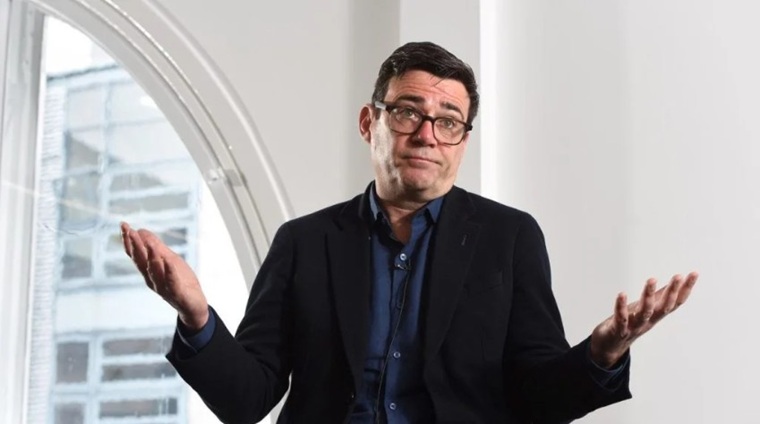
On 20 July 2026, Andy Burnham became the United Kingdom's Prime Minister, succeeding Keir Starmer who resigned on 22 June 2026. Among the many policies Burnham brought to Downing Street, one has dominated the headlines and landed directly in the bank accounts of millions of homeowners: council tax reform. In his first major television interview as Prime Minister -- with the BBC's Laura Kuenssberg -- Burnham went straight to it: "There are people here in Greater Manchester who pay a much higher council tax than people living in much larger homes in London."That single sentence captures a structural unfairness in the UK's property tax system that has been building for 35 years and which every government of every colour has avoided confronting -- until now. Council tax in England is still based on property values assessed on 1 April 1991. The average UK house price in 1991 was approximately £55,000. By 2026 it has reached approximately £290,000. In parts of London and the South East, prices have risen more than 600% since those original valuations were set. Yet the council tax bands that determine what people pay have not moved.
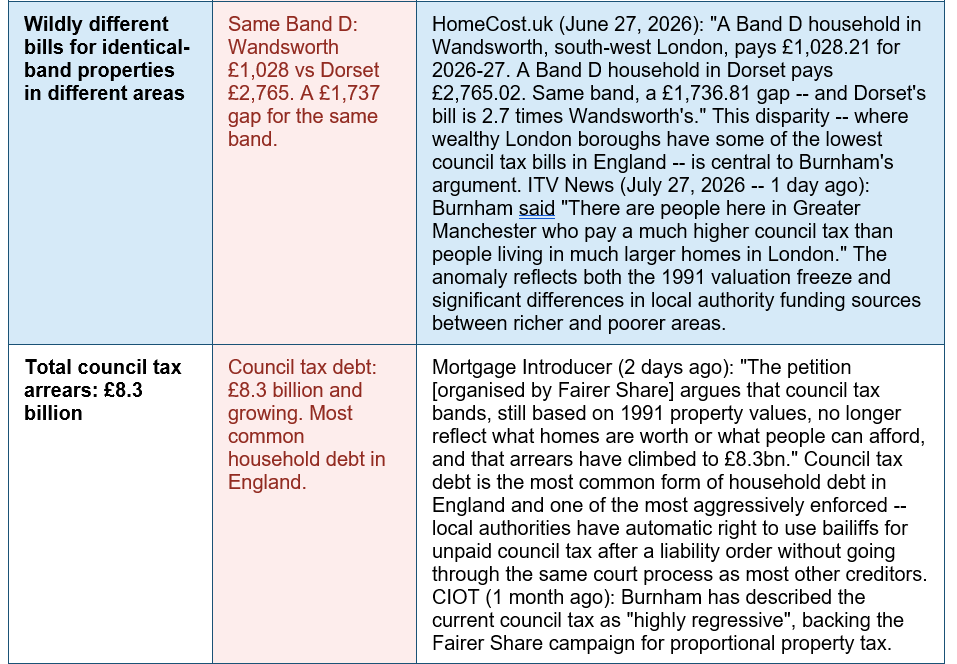
The result is a system so distorted that a Band D property in Wandsworth, one of London's wealthier boroughs, attracts a council tax bill of just £1,028 in 2026-27, while a Band D property in Dorset -- a less affluent area -- pays £2,765. A moderately priced home in Greater Manchester pays proportionally far more of its market value in council tax than a multi-million pound property in Mayfair. Burnham has described the current council tax as "highly regressive" and said "big decisions" lie ahead. Meanwhile, a petition backed by the campaign group Fairer Share -- which proposes replacing council tax and stamp duty with a flat 0.48% annual charge on current property values -- has surpassed 100,000 signatures, triggering a formal debate in Parliament. This guide explains what is being proposed, what the evidence shows, who would win and who would lose, and what it means for your household finances in 2026 and beyond.
Andy Burnham's Position on Council Tax: What He Has Said and What He Has Done
Andy Burnham's views on council tax reform did not emerge when he became Prime Minister. They have been consistent throughout his time as Mayor of Greater Manchester and as a Labour leadership figure. The Chartered Institute of Taxation (CIOT, 1 month ago) summarised his position from multiple speeches and interviews: 'A consistent thread in Burnham's economic thinking is that the UK "over-taxes labour and under-taxes assets". Perhaps the most developed area of Burnham's tax thinking concerns property. He has described the current council tax as "highly regressive", backing the Fairer Share campaign, which advocates for a proportional property tax to replace both council tax and stamp duty land tax (SDLT).'The House of Commons Library (published 2 days ago -- among the most current authoritative sources available): 'A report in The Times on 22 May 2026 quoted him as saying: "I've long been persuaded of the argument for a land value tax. I'm personally keen to see reform of council tax. It's a highly regressive tax. I see a big case for land and property and business taxation to be changed."' Fairer Share lists Burnham as a supporter on its website. The petition Fairer Share organised, which backs a 0.48% proportional property tax to replace both council tax and stamp duty, passed 100,000 signatures -- the threshold at which the House of Commons Petitions Committee must schedule a debate.
However -- and this is critical -- Burnham's position as Prime Minister has been more cautious than his previous advocacy. HomeOwners Alliance (published 10 hours ago -- the most current source available at time of writing): 'Andy Burnham became Prime Minister on 20 July 2026, following the resignation of Keir Starmer. He has previously argued the case to reform property taxation. However, in his first interview as PM, he has now ruled out scrapping council tax and stamp duty or replacing them with a single property tax at this stage. Stamp duty will not be reformed in this year's Budget.' ITV News (July 27, 2026 -- 1 day ago): 'Andy Burnham says his government has "big decisions" to make on council tax, as he criticised the unfairness of the current system. The prime minister acknowledged he needed to stick to Labour's manifesto commitments from the 2024 election.' The position, then, is one of clear direction of travel -- reform is coming -- but no specific timeline or legislative commitment yet.
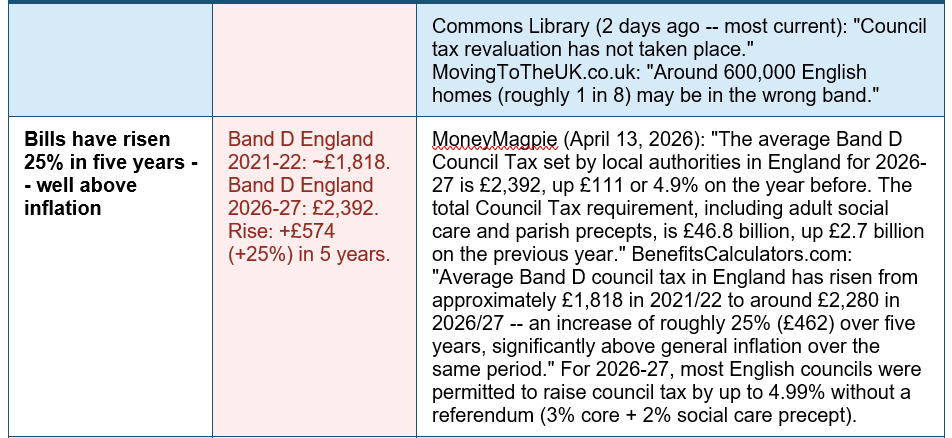
Council tax in 2026 -- the defining numbers: Average Band D bill: £2,392/year (+4.9%). Total CT requirement: £46.8 billion. Total arrears: £8.3 billion. Wandsworth pays £1,028 -- Dorset pays £2,765 (same band). Bands based on 1991 values. — MoneyMagpie (April 13, 2026): 'Average Band D council tax for 2026-27: £2,392 -- up £111 or 4.9%. Total Council Tax requirement: £46.8 billion.' Mortgage Introducer (2 days ago): 'Council tax arrears have climbed to £8.3 billion.' HomeCost.uk (June 27, 2026): 'Wandsworth Band D: £1,028.21 -- Dorset Band D: £2,765.02 -- same band, £1,737 gap.' CouncilTaxAdvisors.co.uk (March 19, 2026): 'Average house price 1991: ~£55,000. Average 2026: ~£290,000. Some London prices up 600%+ since 1991.'
What Is Wrong With Council Tax? The Case for Reform
To understand why Burnham's council tax position is generating so much attention -- and why a 100,000-signature petition has forced a parliamentary debate -- it helps to understand precisely what the current system does and why critics across the political spectrum have described it as broken.The 1991 Valuation Problem
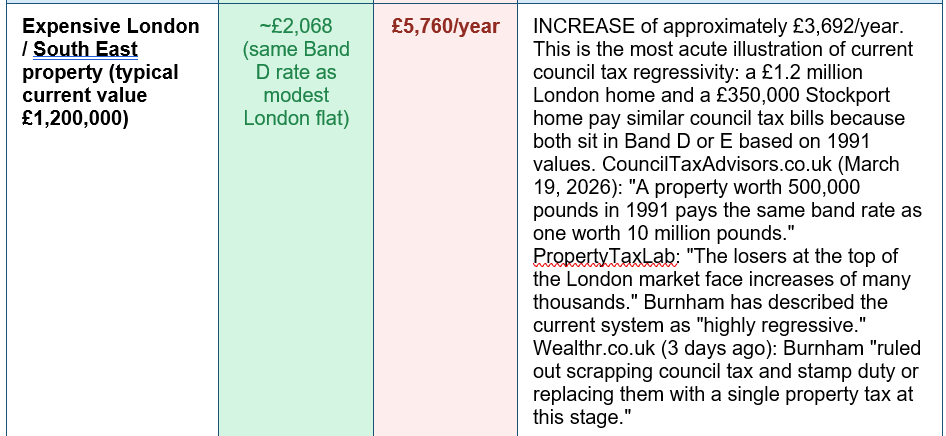
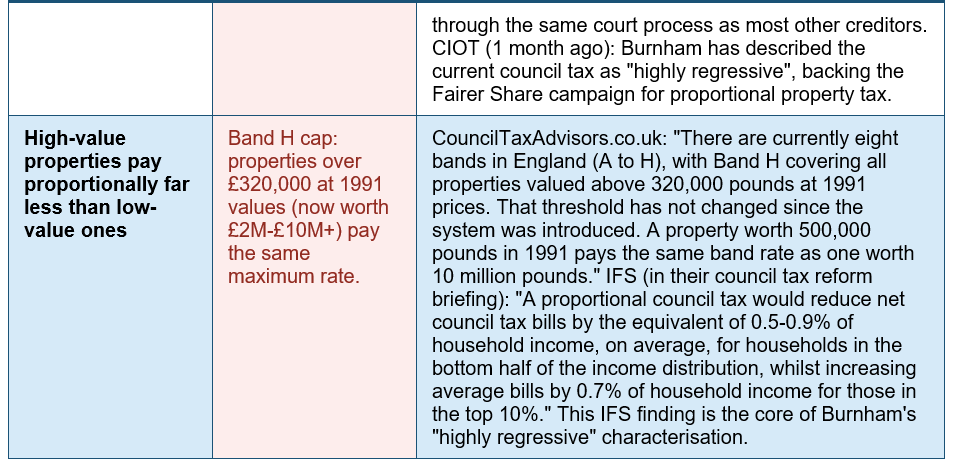
CouncilTaxAdvisors.co.uk (March 19, 2026): 'The council tax system in England relies on property valuations carried out over three decades ago. Back in 1991, the average house price was around 55,000 pounds. By 2026, the average sits closer to 290,000 pounds. In some parts of London and the South East, prices have risen by more than 600% since those original valuations were set.' The current Band H -- the highest band, which carries the maximum council tax rate -- covers all properties that would have sold for more than £320,000 in 1991. That figure now encompasses properties worth anywhere from £600,000 to many millions of pounds. A £500,000 property in 1991 pays the same council tax band rate as one worth £10 million today -- because the bands have never been updated. MovingToTheUK.co.uk: 'Around 600,000 English homes (roughly 1 in 8) may be in the wrong band.'The Regional Disparity Problem
ITV News (July 27, 2026): Burnham said 'There are people here in Greater Manchester who pay a much higher council tax than people living in much larger homes in London.' This is not a populist exaggeration -- it is arithmetically demonstrable. Because London property prices have risen far more since 1991 than property prices in the Midlands and North, London homeowners enjoy the double benefit of lower council tax (in absolute terms, relative to their property value) and higher property wealth. HomeCost.uk (June 27, 2026): the Wandsworth-to-Dorset Band D gap of £1,737 per year is the same band producing bills that differ by a factor of 2.7 times. Within this same dynamic, a £1.5 million Islington townhouse and a £220,000 Rochdale terrace can sit in neighbouring bands and pay similar annual bills.The Regressive Tax Problem
The Institute for Fiscal Studies (IFS) analysis of council tax reform found: 'A proportional council tax would reduce net council tax bills by the equivalent of 0.5-0.9% of household income, on average, for households in the bottom half of the income distribution, whilst increasing average bills by 0.7% of household income for those in the top 10%. Younger households, renters and those receiving disability benefits would see their average bills fall.' The IFS also found: '24% of the poorest fifth of households would see their net tax bill fall by more than £200 a year under a proportional council tax.' This is the evidence base for Burnham's 'highly regressive' characterisation. A regressive tax is one that takes a larger proportional share of the income of poorer households than of richer ones. By this measure, council tax is highly regressive.The Arrears and Enforcement Problem
Mortgage Introducer (2 days ago): council tax arrears have climbed to £8.3 billion. Council tax is the most common form of household debt in England and one of the most aggressively enforced -- local authorities can obtain a liability order and instruct bailiffs without the normal court processes required for most other consumer debts. The combination of rapidly rising bills (up 25% in five years, significantly above inflation) and 1991-era bands that bear no relationship to current ability to pay is pushing hundreds of thousands of households into arrears. MoneyMagpie (April 13, 2026): the total council tax requirement is now £46.8 billion -- up £2.7 billion in a single year. In this context, the case for reform is not just one of fairness; it is also one of system sustainability.The Fairer Share Proposal: What Is a 0.48% Proportional Property Tax?
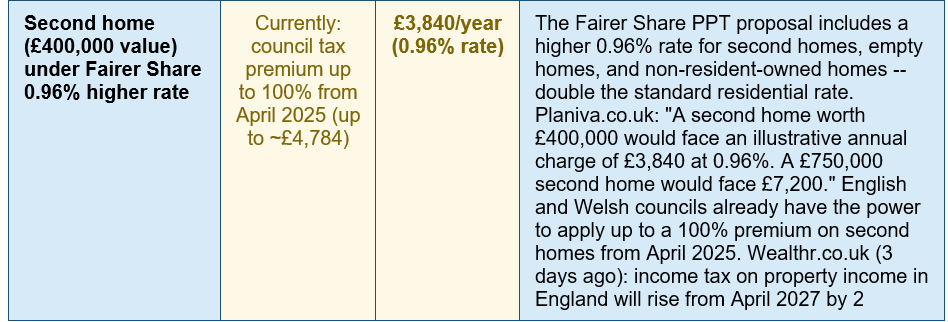
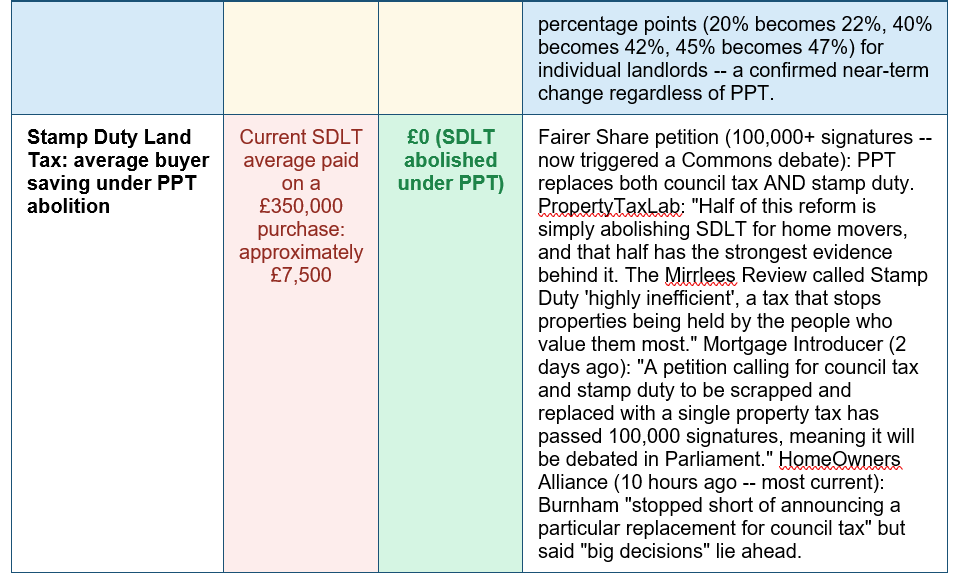
The specific reform most closely associated with Burnham is the Proportional Property Tax (PPT) proposed by the campaign group Fairer Share, which lists Burnham as a supporter. The proposal is straightforward in structure: abolish council tax and stamp duty land tax, and replace both with a single annual charge of 0.48% of the current market value of each property. The Fairer Share proposal also includes a higher 0.96% rate for second homes, empty homes, and non-resident-owned properties.At 0.48%, the annual charge for illustrative property values would be: a £250,000 property pays £1,200/year; a £300,000 property pays £1,440/year; a £500,000 property pays £2,400/year; a £1 million property pays £4,800/year; a £2 million property pays £9,600/year. Fairer Share claims 77% of households would be better off under this change. PropertyTaxLab.org: 'On our narrower dwelling-level test the claim holds up; if anything it is conservative. 82% of dwellings would pay less under PPT.' The additional benefit of abolishing stamp duty is the removal of one of the most economically distorting UK taxes: PropertyTaxLab: 'The Mirrlees Review called Stamp Duty "highly inefficient", a tax that stops properties being held by the people who value them most; the empirical literature consistently finds transaction taxes suppress mobility.'
Fairer Share also proposes a deferral mechanism for owners who cannot immediately afford the annual charge -- allowing the liability to be rolled up against the property and paid on eventual sale. This is specifically designed to protect older homeowners who are asset-rich but income-poor: a retired person living in a property that has increased significantly in value should not be forced to sell because their property tax bill has risen with house prices. Planiva.co.uk: 'The rate will remain fixed at 0.48%; if house prices rise as they have historically then the amount paid will rise in line with the average rise across the last three years. If house prices are flat then the PPT will be unchanged. If prices fall you will pay less. The system acts as an automatic stabiliser: in tough times your bills would freeze or fall.'
Council Tax vs 0.48% PPT: Winners, Losers, and 2026 Numbers
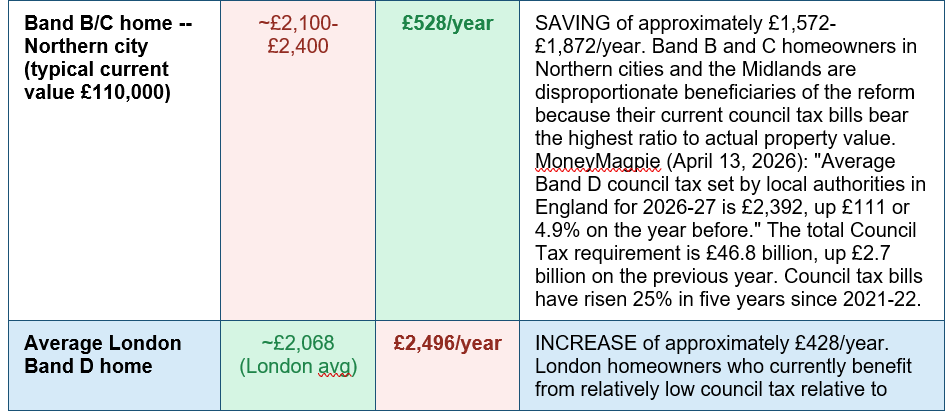
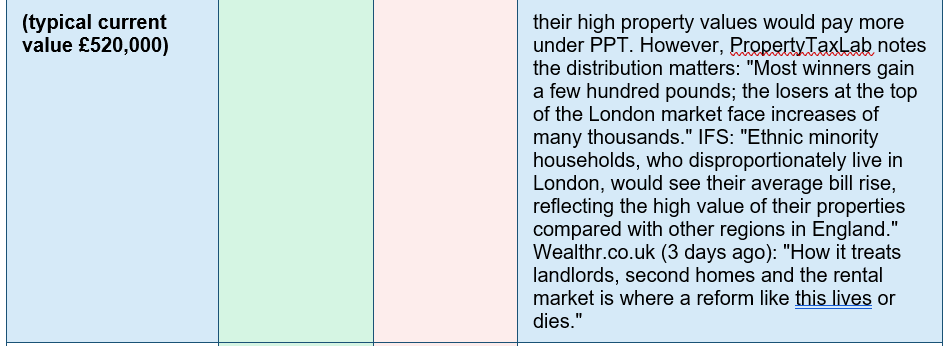
The following table maps the financial impact of the Fairer Share PPT proposal against current 2026-27 council tax bills for different property types and locations: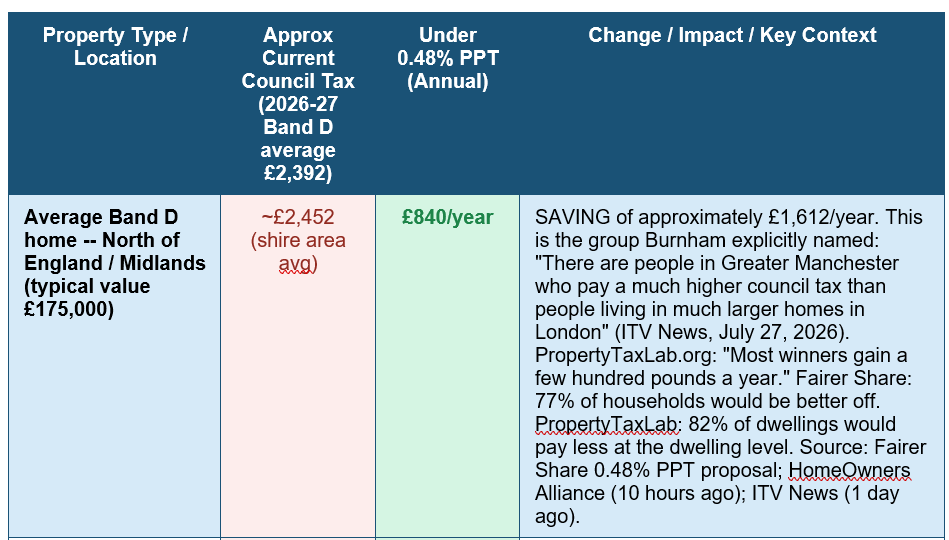
The Current Council Tax System: Five Core Problems
This table summarises the five structural problems that make the current council tax system indefensible in the view of Burnham and the reform campaign: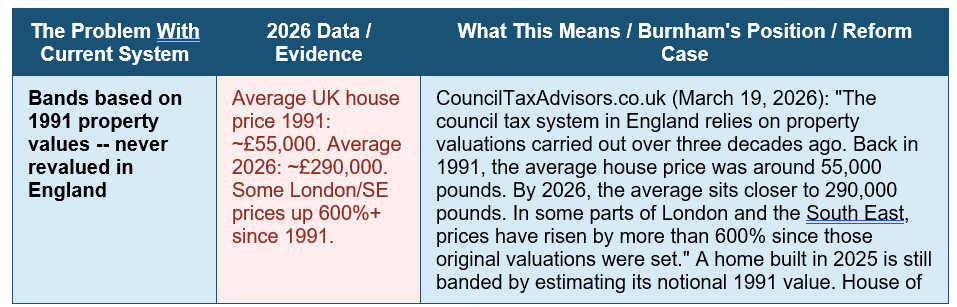
What Burnham Has Confirmed, What Is Proposed, and What Remains Uncertain
Understanding the distinction between what is confirmed policy, what is actively proposed, and what is still speculative is essential for anyone trying to plan their household finances around council tax. The landscape as of 29 July 2026:Confirmed Policy Changes (These Are Happening)
- No wholesale council tax or stamp duty replacement in the 2026 Autumn Budget: HomeOwners Alliance (10 hours ago -- most current): 'Stamp duty will not be reformed in this year's Budget.' Burnham has also 'ruled out scrapping council tax and stamp duty or replacing them with a single property tax at this stage.' The 0.48% PPT is not happening immediately.
- Income tax on property income rising from April 2027: Wealthr.co.uk (3 days ago): 'The government has confirmed an increase to income tax on property income in England from April 2027 -- the rates landlords pay on rental profits rise by two percentage points across the board (20% becomes 22%, 40% becomes 42%, 45% becomes 47%). It applies to individual landlords, not those holding through a limited company.' This is a confirmed change affecting landlords.
- Council tax premiums on second homes (up to 100%) are already in force: From April 2025, English and Welsh councils have had the power to apply up to a 100% council tax premium on second homes and empty properties. Many councils are already applying this.
- VAT removed from electricity bills from October 2026 for 6 months: HomeOwners Alliance (10 hours ago): 'Burnham has announced that electricity bills for households in Great Britain will not attract VAT for 6 months from 1 October 2026.' Not council tax, but a confirmed household cost reduction.
- Fairer Share petition triggers Parliamentary debate: Mortgage Introducer (2 days ago): 'A petition calling for council tax and stamp duty to be scrapped and replaced with a single property tax has passed 100,000 signatures, meaning it will be debated in Parliament.' This creates formal political pressure for reform.
Under Active Consideration (These May Happen)
- Mansion tax threshold lowering from £2M to £1.5M: HomeOwners Alliance (10 hours ago): 'There's speculation that Burnham is going to lower the property value threshold at which the 'mansion tax' is payable, from £2 million to £1.5 million.' Scotland has confirmed its own version on high-value homes. This would affect a relatively small number of high-value properties.
- Mayoral powers to raise revenue via Community Infrastructure Levy and visitor levy: House of Commons Library (2 days ago): 'Mayors will be able to introduce a Community Infrastructure Levy using powers in the English Devolution and Community Empowerment Act 2026. A bill to enable mayors to raise an overnight visitor levy featured in the 2026 King's Speech. This power is not likely to be available to mayors until 2028 at the earliest.'
- Fiscal devolution roadmap: House of Commons Library (2 days ago): 'In March 2026, the Chancellor of the Exchequer Rachel Reeves committed the Treasury to developing a 'fiscal devolution roadmap'. This is expected to be published alongside the autumn 2026 Budget.' This may include additional local tax-raising powers.
- Council tax reform -- the direction without the timeline: Burnham has committed to 'big decisions' on council tax. CIOT (1 month ago): his position is that the UK 'over-taxes labour and under-taxes assets.' The direction of travel points toward greater property taxation and less income taxation -- but the specific mechanism and timeline for council tax reform are not yet determined.
The political economy of council tax reform: why it has been avoided for 35 years. CouncilTaxAdvisors.co.uk (March 19, 2026): 'The simple answer is fear. Any party that commits to revaluation risks upsetting homeowners who would see their bills rise. Even though the research shows most bills would barely change, the perception of higher taxes is enough to put politicians off. Labour's 2024 election manifesto did not include a commitment to council tax revaluation. The Conservative Party avoided it throughout their 14 years in government from 2010 to 2024.' The Joseph Rowntree Foundation found that under a revaluation alone, around 70% of taxpayers would see little or no difference to their bills. But the political risk associated with the 30% who would see increases has been sufficient to prevent every government from acting. Burnham is the first Prime Minister in 35 years to govern with a stated commitment to reform the system. Whether that translates into legislation, and on what timeline, will be the defining domestic policy question of the Burnham premiership.
What Council Tax Reform Means for Different Households
NORTHERN AND MIDLANDS HOMEOWNERS (properties £100,000-£300,000): Most likely to see significant savings if PPT or any proportional reform is enacted.
This is the group Burnham explicitly championed. Under the current system, a £150,000 home in Rochdale or Sheffield that pays £2,300/year in council tax is paying 1.53% of its value annually. Under a 0.48% PPT that falls to £720/year -- a saving of over £1,580. These households currently pay the highest proportion of property value in council tax of any group in England. They are the primary beneficiaries of any proportional property tax reform. Burnham's political coalition is built substantially on this constituency, and the council tax reform agenda is in large part a transfer of tax burden away from Northern and Midlands homeowners toward higher-value properties in London and the South East. The IFS found that the bottom half of the income distribution would see bills reduced by 0.5-0.9% of household income -- and Northern homeowners make up a large proportion of this group.RENTERS: Could benefit significantly -- but the transmission mechanism is complex
Fairer Share's PPT proposal shifts payment responsibility for the property tax from tenants to property owners. Currently, the occupier (often a tenant) pays council tax on their rented property. Under PPT, the liability would fall on the owner. Fairer Share: 'Almost 18 million households will see a tax cut. There will also be less red tape for households buying a house due to the removal of Stamp Duty.' The IFS found: 'Younger households, renters and those receiving disability benefits would see their average bills fall.' However, the extent to which landlords pass any increased tax cost through to rents depends on local housing market conditions. In rental markets where supply is tight, some portion of any increased landlord tax burden may be reflected in higher rents over time. Wealthr.co.uk (3 days ago): the question of how the reform treats landlords 'is where a reform like this lives or dies -- and it's exactly the detail that's still missing.'LONDON AND SOUTH EAST HOMEOWNERS (properties £500,000+): Most likely to see bill increases if PPT is enacted
The political sensitivity of council tax reform is concentrated here. A £800,000 home in South London currently sitting in Band E (bill approximately £2,600/year) would face an annual PPT charge of £3,840 -- an increase of roughly £1,240/year. A £1.5 million property -- at the threshold where Burnham is considering lowering the mansion tax entry point -- would face a PPT charge of £7,200/year vs its current council tax of approximately £3,000-£3,500 (in the top Band H at current rates). PropertyTaxLab: 'The losers at the top of the London market face increases of many thousands.' The IFS: 'Ethnic minority households, who disproportionately live in London, would see their average bill rise, reflecting the high value of their properties compared with other regions.' This distributional impact creates genuine political complexity for a reform that is otherwise progressive on a national basis.OLDER HOMEOWNERS (asset-rich, income-poor): Protected by deferral mechanism, but need to understand how it works
One of the most politically sensitive concerns about any property-value-linked tax is the position of older homeowners who bought modestly-priced homes decades ago that have since appreciated significantly -- and who now live on pension income that could not support a proportional property tax on their home's current value. Fairer Share's proposal specifically addresses this: the deferral mechanism allows any PPT liability to be deferred against the property and paid from the eventual sale proceeds, with interest charged at a modest rate. This means an 80-year-old living in a house worth £700,000 (originally purchased for £80,000) would not face a forced sale -- but the accumulated deferred charge would reduce the inheritance. Planiva.co.uk: 'The system acts as an automatic stabiliser: in tough times your bills would freeze or fall.' The deferral option is a critical protection for this group and one of the features that distinguishes the Fairer Share PPT from a crude wealth tax on housing.WHAT SHOULD HOUSEHOLDS DO NOW -- ACTION CHECKLIST: IMMEDIATE ACTIONS (applicable regardless of reform outcome): (1) Check your current council tax band free at gov.uk/council-tax-bands. MovingToTheUK.co.uk: around 600,000 English homes (roughly 1 in 8) may be in the wrong band -- you can challenge a band assignment free through the Valuation Office Agency. A successful challenge is backdated. (2) Check whether you are entitled to any council tax discount or exemption: single person discount (25%), student exemption, disability reduction, severe mental impairment exemption, council tax reduction (means-tested support). MoneyMagpie: "Plenty of households may be entitled to discounts, reductions or local support without realising it." (3) If you are in arrears: contact your council before they escalate the debt. Many councils have hardship funds and payment plan options. Citizens Advice: 0800 144 8848. (4) Estimate your bill under 0.48% PPT: multiply your estimated current property value by 0.0048. Compare this to your current annual council tax bill. This tells you whether you are a likely winner or loser if reform proceeds. Free calculator: fairershare.org.uk/counciltaxcalculator. (5) If you are a landlord: note the confirmed April 2027 increase in income tax on property income (2pp across all bands). Model your portfolio costs including both this confirmed change and the hypothetical PPT rate for the property values you own. MONITORING: (6) Watch the Autumn 2026 Budget for any council tax announcements. The fiscal devolution roadmap expected alongside the Budget may signal the direction. (7) Follow the Fairer Share petition debate in Parliament -- this will reveal the degree of cross-party support for the 0.48% proposal.
FIVE THINGS THE COUNCIL TAX REFORM DEBATE IS GETTING WRONG -- AND WHAT TO WATCH OUT FOR: (1) CONFUSING POLICY DIRECTION WITH CONFIRMED POLICY. As of 29 July 2026, the 0.48% proportional property tax is NOT government policy. HomeOwners Alliance (10 hours ago -- most current): Burnham 'ruled out scrapping council tax and stamp duty or replacing them with a single property tax at this stage.' The reform agenda is real -- the timeline and mechanism are not yet determined. Do not make financial decisions based on an assumption that PPT is imminent. (2) ASSUMING THE 0.48% RATE IS FINAL. PropertyTaxLab.org: 'Nobody should legislate expecting 0.48% to be the final number. On 2025-26 figures it is somewhere between 0.52% and 0.62%, and it will drift every year that council tax requirements outrun house prices.' The 0.48% figure is a campaign proposal designed to be approximately revenue-neutral, but actual legislative rates could differ. (3) MISSING THE CONFIRMED NEAR-TERM CHANGES FOR LANDLORDS. Wealthr.co.uk (3 days ago): 'The government has confirmed an increase to income tax on property income in England from April 2027 -- rates landlords pay on rental profits rise by two percentage points across the board.' This is a real, dated, confirmed change that landlords must account for now. (4) ASSUMING LONDON AND SOUTH EAST HOMEOWNERS ARE THE ONLY LOSERS. IFS analysis: ethnic minority households, who disproportionately live in London, would see average bills rise. This creates a complexity in the distributional impact of reform that goes beyond a simple North-South narrative. (5) IGNORING THE COUNCIL TAX ARREARS CRISIS. The £8.3 billion arrears figure cited by Fairer Share is not an abstract statistic -- council tax debt is enforced more aggressively than almost any other consumer debt, with bailiff access available after a liability order without the standard court process. If your household is at risk of falling behind, act now: contact your council, check your entitlement to council tax reduction, and seek advice from Citizens Advice or StepChange.
Conclusion
Andy Burnham's arrival at Downing Street on 20 July 2026 has done what 35 years of political caution could not: placed council tax reform firmly at the top of the domestic policy agenda. The case for change is well-evidenced, widely supported across the political spectrum in principle, and increasingly unavoidable in practice -- with £8.3 billion in arrears, bills rising 25% in five years, and a system still anchored to 1991 property values in a world where average prices have risen 425%.The specific reform most closely associated with Burnham -- Fairer Share's 0.48% proportional property tax replacing both council tax and stamp duty -- has compelling distributional mathematics: PropertyTaxLab confirms 82% of dwellings would pay less at the dwelling level; the IFS confirms the bottom half of the income distribution would benefit on average; and the abolition of stamp duty would remove a tax widely regarded by economists as one of the most distorting in the system.
However, as of 29 July 2026, the 0.48% PPT is not government policy and Burnham has ruled out immediate wholesale replacement. The confirmed near-term changes are a 2pp increase in landlord income tax from April 2027, the Fairer Share petition debate now triggered in Parliament, and a fiscal devolution roadmap expected alongside the Autumn 2026 Budget. The direction of travel is clear. The timetable is not. For households, the most productive response is to act on what is already confirmed -- check your band, claim every discount you are entitled to, and model your position under the 0.48% proposal -- while monitoring the Budget for the first legislative signal of what council tax reform will actually look like when it arrives.

0 Comments Comments