
Finance
What Are the Odds of Winning the Lottery? Accountant Explains


Table of Contents
- The Dream vs The Mathematics
- How Lottery Odds Are Calculated: The Mathematics
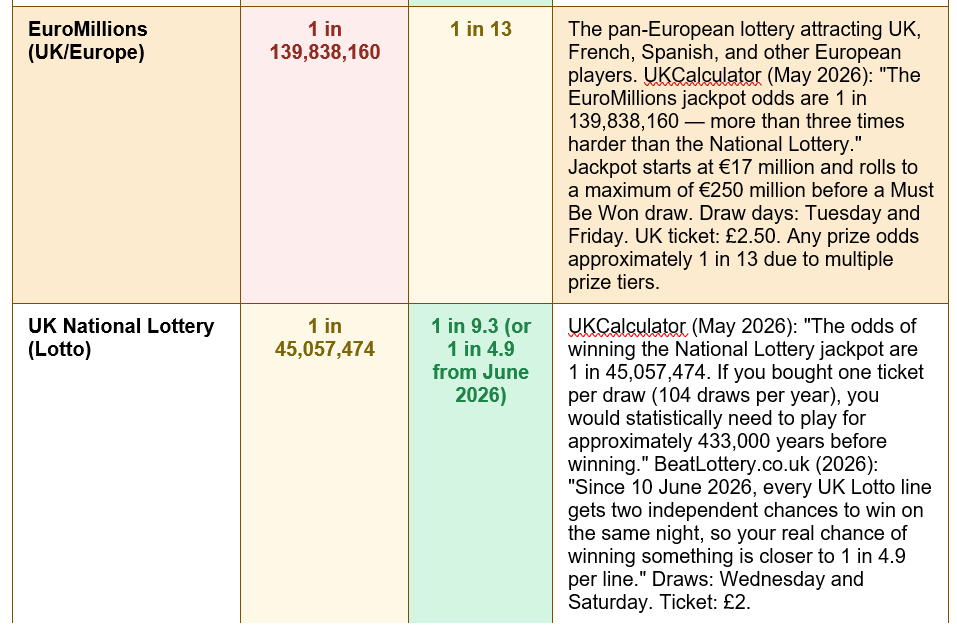
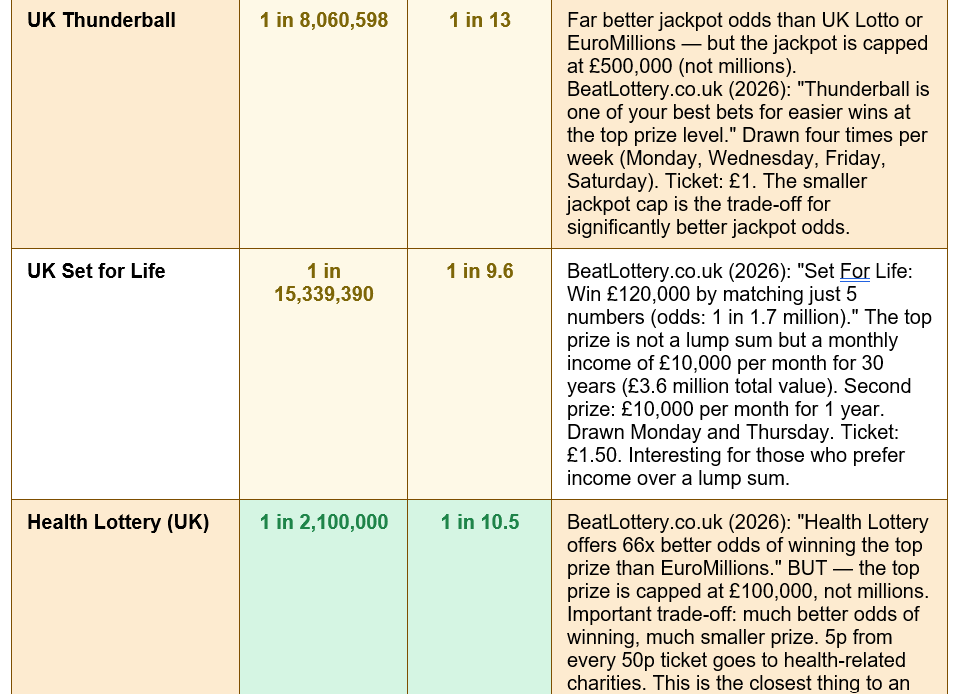
- Major Lottery Jackpot Odds: The Complete 2026 Comparison
- Putting the Odds in Perspective: What Is More Likely Than Winning?
- The Expected Value of a Lottery Ticket: The Accountant's Analysis
- The Opportunity Cost: What Lottery Spending Builds Instead
- Beyond the Jackpot: Understanding the Prize Tier Structure
- Tax on Lottery Winnings: UK vs US — A Critical Difference
- United Kingdom: Tax-Free Winnings
- United States: Substantial Tax on Winnings
- Conclusion
- Frequently Asked Questions (FAQ)
The Dream vs The Mathematics
Every week, millions of people in the UK and US hand over their money in exchange for a small piece of paper and a very large dream. The dream is vivid, specific, and immediately compelling: paying off the mortgage in one go, buying the car that has always felt unattainable, handing in the resignation letter the following Monday morning, securing the children's future, and never worrying about money again. The dream is powerful enough to make the mathematics irrelevant — or at least temporarily invisible. But for anyone who wants to understand what they are actually buying when they buy a lottery ticket, the mathematics is where the real story lives.The odds of winning the Mega Millions jackpot are 1 in 302,575,350. The odds of winning the Powerball jackpot are 1 in 292,201,338. The odds of winning the UK National Lottery jackpot are 1 in 45,057,474. According to UKCalculator's May 2026 analysis, if you bought one UK Lotto ticket per draw — every Wednesday and every Saturday for your entire life — you would statistically need to play for approximately 433,000 years before winning the jackpot. The same analysis finds you are 2,944 times more likely to be struck by lightning during your lifetime than to win the Lotto jackpot on any given ticket.
This guide is not here to tell you not to play the lottery. It is here to do something more useful: to explain the actual mathematics with complete clarity, to compare lottery odds against other improbable events to make the numbers intuitive, to show what the expected value of a lottery ticket actually is (the answer is always negative), to demonstrate what lottery spending would become if invested instead, to explain the prize tier structure and why any prize odds are far better than jackpot odds, and to give you the framework of a financially literate person who plays the lottery with clear eyes — rather than as a financial strategy.
How Lottery Odds Are Calculated: The Mathematics
Lottery odds are calculated using combinatorics — the branch of mathematics that counts how many different ways a set of numbers can be combined. For the UK National Lottery, players choose 6 numbers from 1 to 59. The number of possible 6-number combinations from a pool of 59 is calculated using the combination formula:C(59,6) = 59! / (6! x 53!) = 45,057,474 possible combinations
Each ticket you buy represents one of those 45,057,474 combinations. There is exactly one winning combination per draw. Therefore, the probability of any single ticket winning the jackpot is precisely 1 in 45,057,474. This is not a marketing approximation — it is exact mathematical fact derived from the game's structure.
For Powerball, players choose 5 numbers from 1-69, plus a separate Powerball number from 1-26. The total number of combinations: C(69,5) multiplied by 26 = 11,238,513 x 26 = 292,201,338. That is why Powerball's jackpot odds are exactly 1 in 292,201,338. Mega Millions adds 5 numbers from 1-70 plus a Mega Ball from 1-25: C(70,5) x 25 = 17,259,390 x 25 = 302,575,350 combinations — marginally harder than Powerball.
The important mathematical property of these odds is their independence: buying multiple tickets in the same draw proportionally improves your odds, but the improvement is negligible at any realistic scale. Buying 10 tickets improves your odds to 10 in 45 million — still approximately 1 in 4.5 million. To have a 50% chance of winning the UK Lotto jackpot in a single draw, you would need to buy 22.5 million tickets — at £2 each, costing £45 million, and you would be competing against every other ticket sold in the same draw.
The lottery odds in perspective — 2026: UK Lotto jackpot 1 in 45,057,474 — you are 2,944x more likely to be struck by lightning. EuroMillions: 1 in 139,838,160. — UKCalculator (May 25, 2026): 'Winning the Lotto jackpot (1 in 45 million) is approximately 2,944 times less likely than being struck by lightning during your lifetime (approximately 1 in 15,300 lifetime risk in the UK). You are also more likely to be dealt a royal flush in poker on your first hand (1 in 649,740 — about 69 times more likely than the Lotto jackpot).' Additionally more likely: winning the Thunderball jackpot (1 in 8 million), scoring a hole-in-one at golf, or being born with certain genetic conditions. Mega Millions 1 in 302,575,350 — statistically more people would win if every person on Earth bought a ticket than the odds alone suggest
Major Lottery Jackpot Odds: The Complete 2026 Comparison
The table below maps every major UK and US lottery with current 2026 jackpot odds, any-prize odds, and the context needed to understand what each number actually means: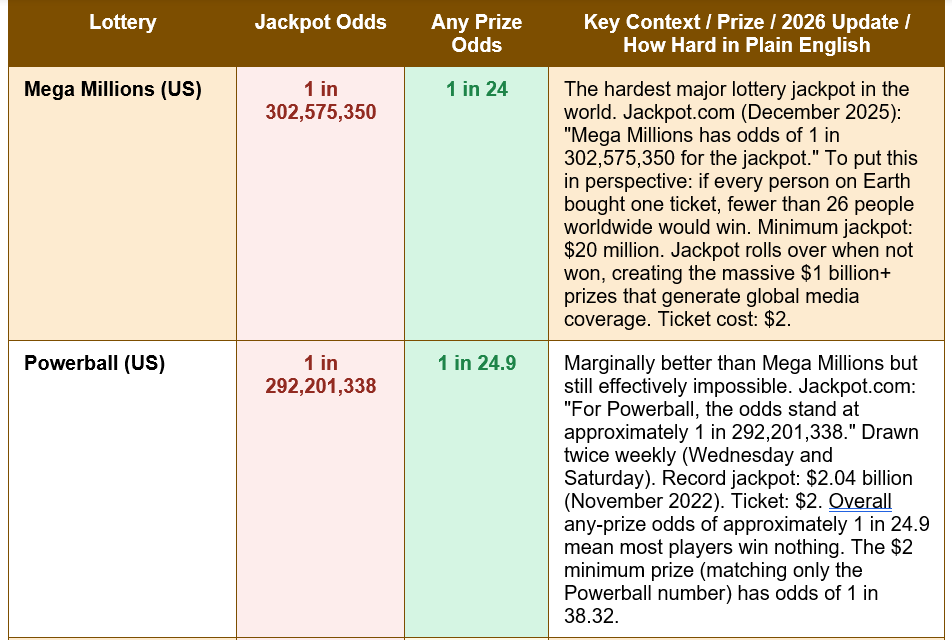

Putting the Odds in Perspective: What Is More Likely Than Winning?
The challenge with numbers like 1 in 45 million or 1 in 302 million is that the human brain cannot intuitively grasp their scale. These are not 'very unlikely' in the way that a coin landing heads ten times in a row is unlikely (1 in 1,024). They are in a different category of improbability altogether. The following comparisons, all based on verified probability data, help make the numbers viscerally real: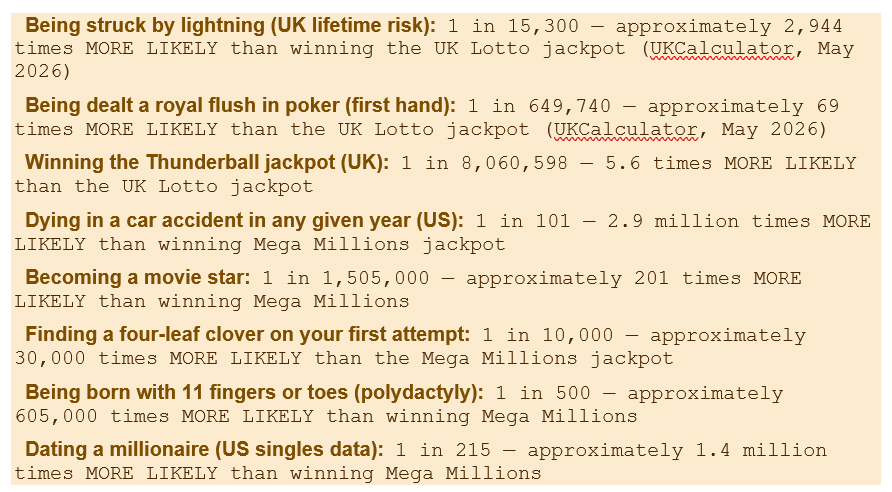
HonestBetting Reviews notes the intuitive framing that makes these numbers most useful: 'Numbers like 1 in 45 million and 1 in 139 million are so big they are hard to grasp. To make that more intuitive, it helps to compare with other rare events.' The conclusion is not that these events are comfortingly common — being struck by lightning is itself deeply unlikely. The conclusion is that the lottery jackpot occupies a category of improbability so extreme that it barely registers as a realistic possibility for any individual player.
The Expected Value of a Lottery Ticket: The Accountant's Analysis
Expected value (EV) is the central concept in probability and decision theory — the average outcome of a decision if it were made repeatedly over a large number of trials. For lottery tickets, the expected value calculation reveals the true financial nature of each purchase, and it is always negative for the player.The expected value of a lottery ticket is calculated as: the sum of (each prize amount multiplied by its probability of winning) minus the ticket cost. For a simplified UK Lotto example:
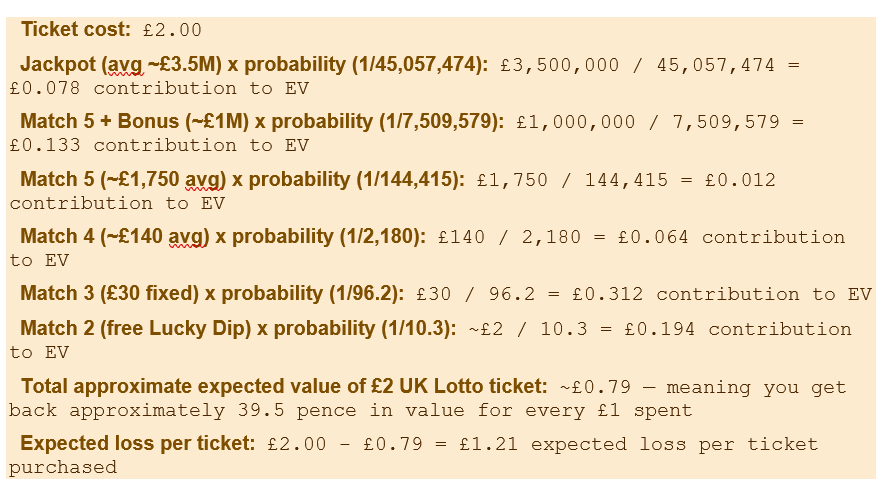
The expected value is always below the ticket price because the lottery operator retains a margin to fund operations, good causes, and profit. The Camelot operator of the UK National Lottery returns approximately 28p in every £1 to good causes (arts, sports, heritage, community), with prizes accounting for approximately 50-52p, retailer commission 5-6p, and operating costs taking the remainder. The 50-52p in prizes is what creates the negative expected value for the player. For Powerball, Factually.co (April 2026) confirmed: 'The expected value of a $2 Powerball ticket including all prize tiers is approximately $0.38 — meaning for every dollar spent, approximately $0.62 is structurally lost.'
Why do jackpot rollovers temporarily improve expected value? When a jackpot rolls over without being won, it accumulates to very large sums — sometimes hundreds of millions or even billions of dollars. At a certain jackpot size, the expected value of a ticket can theoretically exceed the ticket price — making it positive expected value. For example, if the Powerball jackpot reaches $584 million or more (approximately 2 x the number of possible combinations x ticket price), the expected value calculation crosses breakeven in purely mathematical terms. However, this analysis ignores three critical factors: (1) income tax on winnings (US lottery jackpot winners pay federal and state income taxes that can reduce the lump sum payout by 35-45%); (2) the lump-sum discount (the advertised jackpot is the annuity value — the immediate cash option is typically 60% of the advertised figure); and (3) jackpot splitting (when jackpots are large and attracting maximum publicity, ticket sales are highest, meaning the probability of splitting the jackpot with another winner rises sharply). After accounting for all three factors, even the largest jackpots rarely produce genuinely positive expected value for individual tickets. The rollovers are primarily marketing events that generate publicity and ticket sales — which is their structural purpose.
The Opportunity Cost: What Lottery Spending Builds Instead
An accountant's perspective on the lottery is not just about the odds — it is about the opportunity cost. Every pound or dollar spent on lottery tickets is a pound or dollar that could have been allocated elsewhere. The following table demonstrates what typical levels of lottery spending accumulate to when invested instead over 30 years: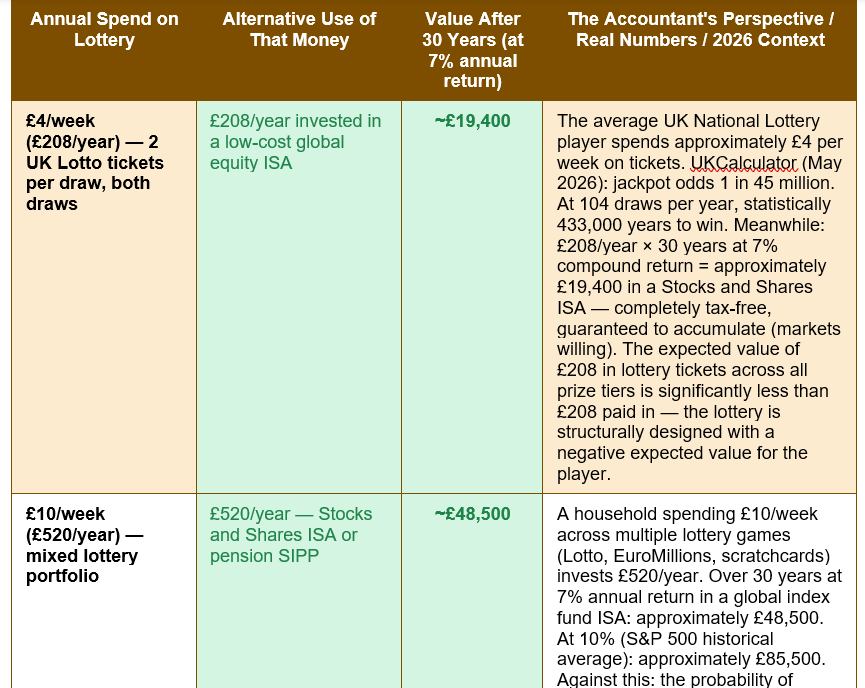
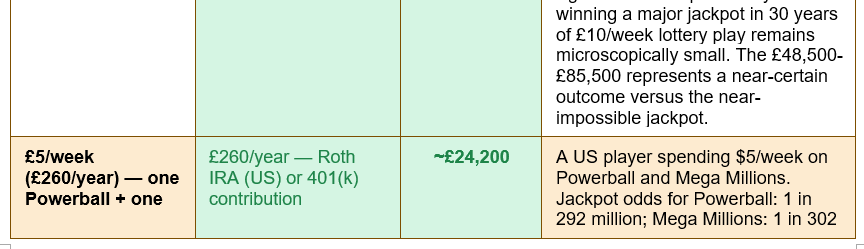
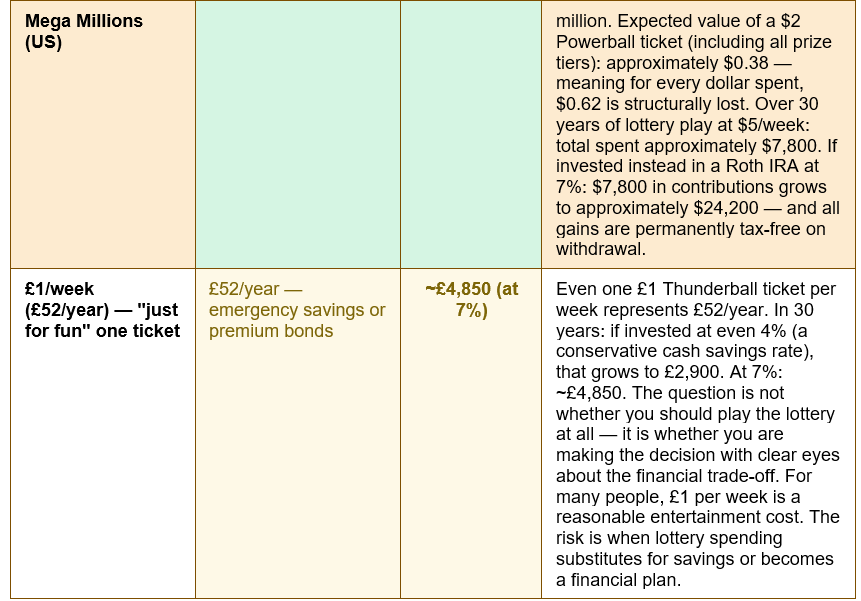
The mathematics of these comparisons is stark but requires honest context: this is not an argument against ever buying a lottery ticket. For many people, £1-£2 per week represents entertainment — the same category as a coffee, a magazine, or a cinema streaming subscription. The question an accountant asks is not 'should you never play?' but 'are you making this decision with clear eyes about the trade-off?' A lottery ticket is a terrible investment. It is a reasonable entertainment expense if you genuinely enjoy the process. It becomes problematic when the entertainment expense grows, when it substitutes for savings, or when it functions as a financial plan for the future.
Beyond the Jackpot: Understanding the Prize Tier Structure
The fixation on jackpot odds misses an important part of the lottery picture: every major lottery has multiple prize tiers, and the lower tiers have substantially better odds than the jackpot. Understanding the full prize structure gives a more accurate picture of what a lottery ticket actually offers:- UK National Lottery prize tiers: Jackpot (match 6): 1 in 45,057,474. Match 5 + Bonus Ball: 1 in 7,509,579 (prize approximately £1 million). Match 5: 1 in 144,415 (prize approximately £1,750). Match 4: 1 in 2,180 (prize approximately £140). Match 3: 1 in 96.2 (prize £30 — most accessible win). Match 2: 1 in 10.3 (prize: a free Lucky Dip ticket). Since June 10, 2026 (BeatLottery): 'Every UK Lotto line gets two independent chances to win on the same night, so your real chance of winning something is closer to 1 in 4.9 per line.' This new double-draw structure effectively halves the any-prize odds.
- Powerball and Mega Millions prize tiers: Jackpot.com (December 2025): 'Overall odds in both Powerball and Mega Millions are around 1 in 24.' This means roughly one in every 24 tickets wins something — but 'something' is typically a small fixed prize of $4. The pyramid structure of lottery prizes is heavily skewed toward the bottom tiers: the overwhelming majority of winners receive $4-$10, with an ever-smaller proportion winning higher amounts. The jackpot represents the pinnacle of an extremely steep pyramid.
- The smarter jackpot hunt: BeatLottery.co.uk (2026) makes a sharp analytical point: 'The more useful comparison is the prize-to-odds ratio, not just odds alone. Euro Dreams offers a life-changing prize (€20,000 per month for 30 years = €7.2 million total) at 1 in 19 million odds — 7 times better than EuroMillions for a comparable life-changing prize.' For players whose primary goal is maximising the expected value of their lottery spend, focusing on the prize-to-odds ratio across all tiers — rather than chasing the single largest jackpot — produces better statistical outcomes.
Tax on Lottery Winnings: UK vs US — A Critical Difference
The tax treatment of lottery winnings is one of the most dramatic differences between the UK and US lottery experience — and it significantly affects the real value of winning:United Kingdom: Tax-Free Winnings
In the UK, lottery prizes of all sizes are completely exempt from Income Tax and Capital Gains Tax. Whether you win £30 on a Match 3 or £100 million on a jackpot rollover, you keep every penny of the prize money. UKCalculator (May 2026) notes: 'Buy an average UK house (£285,000 in 2026) outright and have £715,000 remaining' if you win £1 million — the full £1 million is yours without any tax deduction. The earnings generated by investing lottery winnings after receipt (interest, dividends, capital gains) are subject to normal tax rules — but the initial prize itself is entirely tax-free.United States: Substantial Tax on Winnings
US lottery prizes are subject to federal income tax and typically state income tax, which can significantly reduce the actual amount received. Federal withholding on prizes over $5,000 is 24% — but the top federal marginal tax rate is 37%, and most large jackpot winners end up in the highest bracket. State taxes range from 0% (in states with no income tax, like Texas and Florida) to approximately 13% (California). For a $302 million Mega Millions jackpot: the immediate cash option is typically about 60% of the advertised jackpot ($181 million). After 37% federal tax: approximately $114 million. After a 10% state tax: approximately $96 million — meaning the winner receives roughly 32% of the headline jackpot figure. This is not a reason to avoid playing, but it is essential context for any realistic assessment of what winning actually means financially in the US.THE ACCOUNTANT'S VERDICT — THE ONLY RATIONAL FRAMEWORK FOR LOTTERY PARTICIPATION: The financially rational framework for playing the lottery in 2026 has four components: (1) TREAT IT AS ENTERTAINMENT, NOT INVESTMENT. A lottery ticket is entertainment with a small chance of a life-changing prize — not a financial product. The entry price is the cost of that entertainment. (2) SET A FIXED BUDGET AND DO NOT EXCEED IT. Decide in advance what you are willing to spend per month on the lottery — and treat that amount as already spent. Do not chase losses, do not increase spending when jackpots roll over, and do not substitute lottery spending for savings or debt repayment. (3) NEVER PLAY WITH MONEY YOU CANNOT AFFORD TO LOSE. The expected value of every ticket is negative. The structural design of lotteries guarantees this. Playing with disposable entertainment money is rational. Playing with money needed for bills, rent, or food is not. (4) UNDERSTAND WHAT YOU ARE DOING. The odds of winning the UK Lotto jackpot are 1 in 45 million. The odds of winning Mega Millions are 1 in 302 million. These are not near-misses — they are extraordinary long shots. Playing with that knowledge, for the entertainment of imagining the possibility, is a perfectly valid personal choice. Playing because you believe you have a realistic chance of winning is a misunderstanding of the mathematics that deserves correction.
Conclusion
The odds of winning the Mega Millions jackpot are 1 in 302,575,350. The odds of winning Powerball are 1 in 292,201,338. The odds of winning the UK National Lottery jackpot are 1 in 45,057,474 — and if you played every draw for your entire lifetime, UKCalculator's May 2026 analysis calculates you would need 433,000 years before winning statistically. You are 2,944 times more likely to be struck by lightning. You are 69 times more likely to be dealt a royal flush on your first poker hand. These numbers are not designed to be discouraging — they are designed to be accurate. The dream the lottery sells is real and vivid. The mathematics behind it is equally real, and far less compelling.From an accountant's perspective, a lottery ticket is a product with a consistently negative expected value — approximately £1.21 lost per £2 UK Lotto ticket, approximately $0.62 lost per $1 of Powerball spend. The operator retains this margin to fund prizes across all tiers, charitable causes, operations, and profit. The prize structure is not random — it is mathematically designed to return a specific proportion of ticket revenue, with the jackpot representing the extreme tail of the prize distribution that captures the public imagination while being effectively inaccessible to any individual player.
None of this means you should not play the lottery. It means you should play it honestly — as an entertainment expense with a defined budget, not as a financial strategy or a retirement plan. The lottery can be a source of genuine pleasure: the conversation about what you would do with the money, the temporary permission to imagine a different life, the excitement of checking the numbers. Buy that experience with eyes open, with a budget you have decided in advance, and with the savings and investments that represent your real financial future running alongside it. The jackpot is for dreaming. The investments are for building.
0 Comments
Be the first to share your thoughts on this article.