

Finance
Money Myths US Households Believe -- And the Real Truth

Table of Contents
Why Myths Persist Even Among the Financially Educated
The Data: How Many Americans Believe Each Myth
The Real Cost: What Each Myth Costs the Average US Household
The Ten Myths Debunked: What the Evidence Actually Shows
Conclusion: The Myths Are Widespread. The Truth Is Accessible.
Frequently Asked Questions (FAQ)
Why Myths Persist Even Among the Financially Educated
Ninety-six percent of Americans believe at least one financial myth, according to LendingTree's Financial Literacy Survey (April 2025). Not 96% of financially inexperienced households. Not 96% of low-income earners. Ninety-six percent -- including people with college degrees, people earning six-figure incomes, and people who describe themselves as at least somewhat financially literate. The myths persist not because people are uninformed but because they are emotionally intuitive, socially transmitted, and rarely challenged in formal education. They feel true.A Charles Schwab Money Myths survey conducted by independent research firm Lieberman Research Worldwide found something even more striking: respondents who believed they were the most financially knowledgeable were more likely to agree with financial misconceptions than those who were more uncertain. Confidence, not ignorance, was the primary risk factor for holding financial myths. The Queen Zone (July 1, 2026 -- most current): 'Outstanding student loan debt stood at $1.66 trillion at the end of 2025, making it clear that debt is a structural reality for many households rather than a simple personal failure.' And: 'LendingTree estimates Americans' total credit card balance reached $1.252 trillion in Q1 2026' -- a figure that would be materially lower if the myths driving credit card misuse were widely understood.
This guide examines ten of the most costly and persistent money myths believed by US households in 2026. For each one, the data on how many people believe it, what the myth actually costs in measurable financial terms, and what the current evidence actually shows. Financial myths are not neutral. Every myth on this list has a dollar cost attached to it. And the dollar costs, aggregated across the households that believe them, run into the trillions.
The Data: How Many Americans Believe Each Myth
The following table maps each major financial myth to the proportion of Americans who hold it and the financial cost of doing so: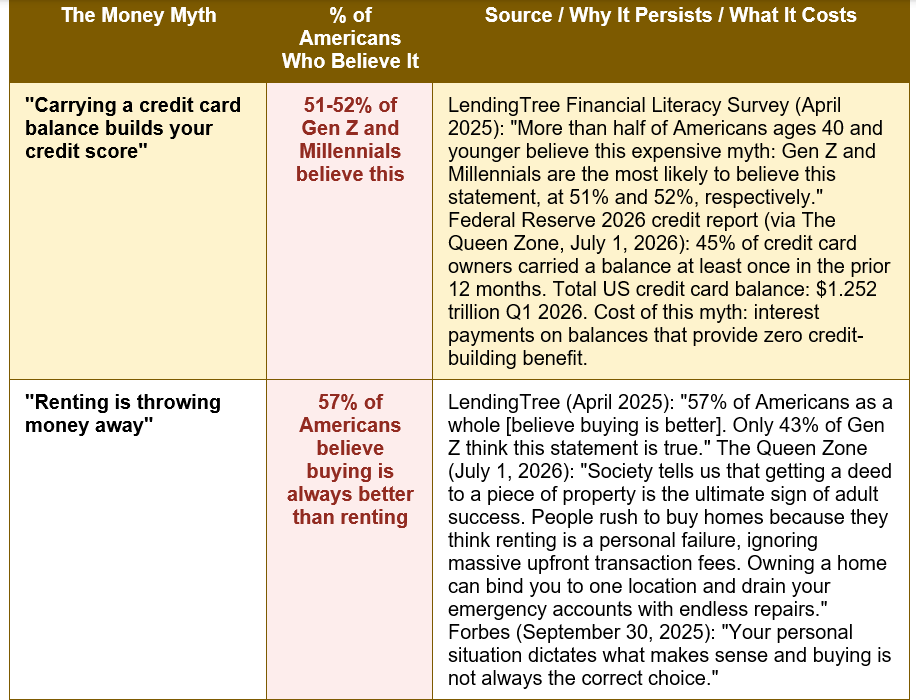
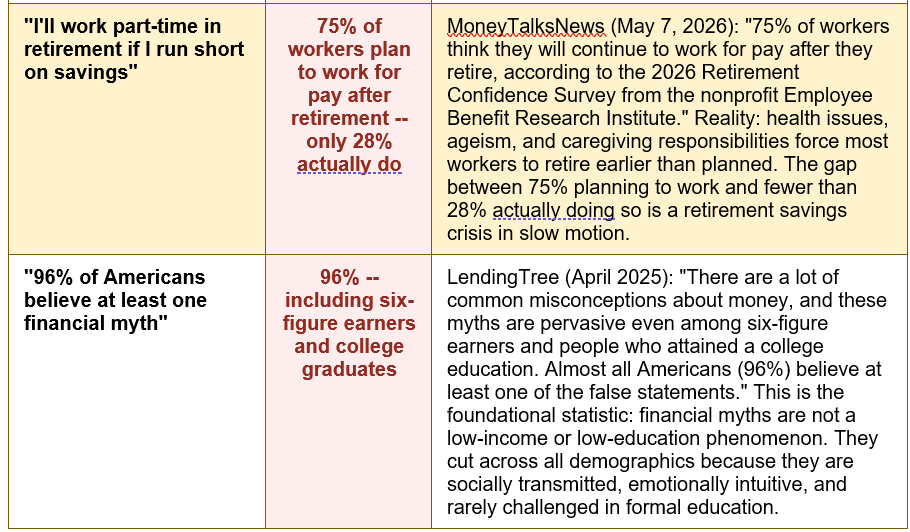
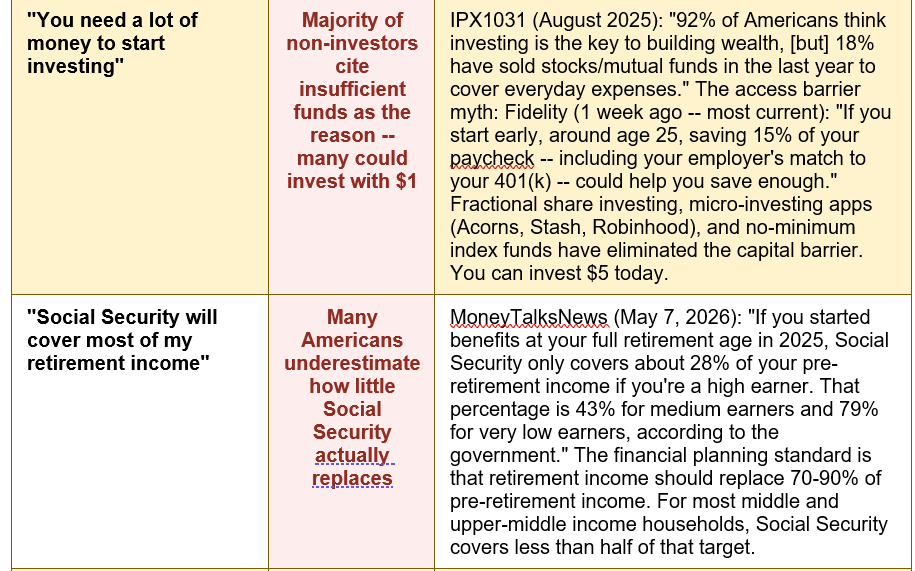

The money myth crisis in 2026: 96% believe at least 1 myth. 51-52% Gen Z/Millennials believe balance-builds-credit. 75% plan to work in retirement vs 28% who do. $1.252 trillion CC debt Q1 2026. — LendingTree Financial Literacy Survey (April 2025): '96% of Americans believe at least one financial myth -- including six-figure earners and college graduates.' 'Gen Z 51% and Millennials 52% believe carrying a CC balance builds credit.' MoneyTalksNews (May 7, 2026): '75% of workers plan to work in retirement per 2026 EBRI Retirement Confidence Survey.' Queen Zone (July 1, 2026 -- most current): 'Total US credit card balance $1.252 trillion Q1 2026. Federal Reserve 2026 credit report: 45% carried a balance at least once in prior 12 months.'
The Real Cost: What Each Myth Costs the Average US Household
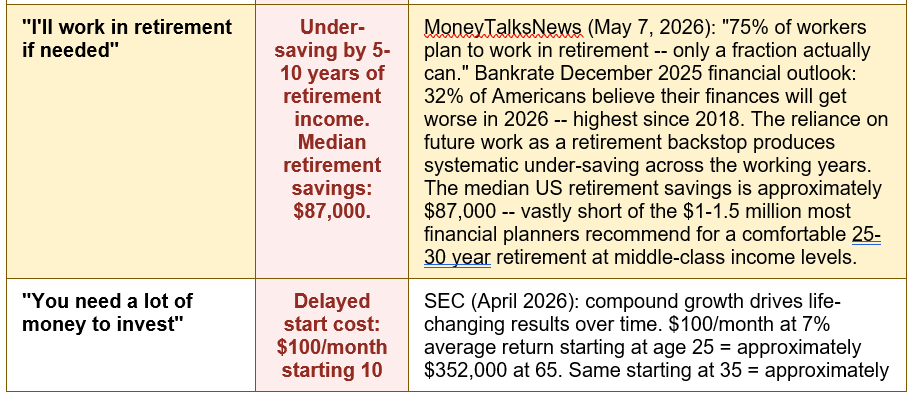
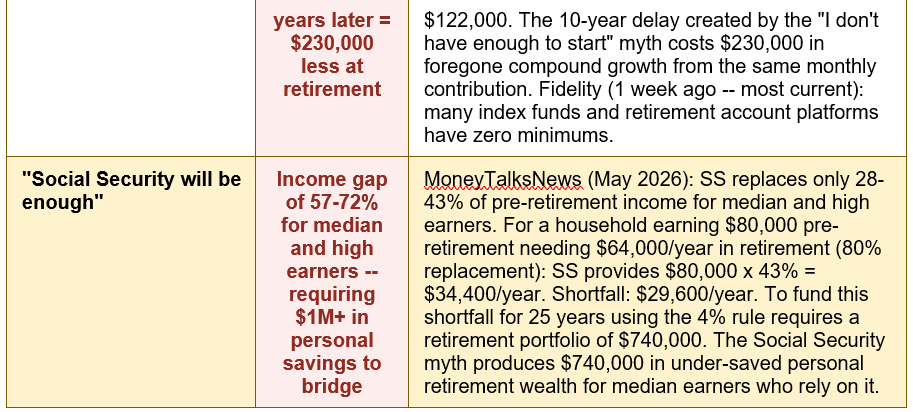
Myths are not just intellectually incorrect. They have specific, calculable financial consequences. The following table shows what each myth costs in dollar terms: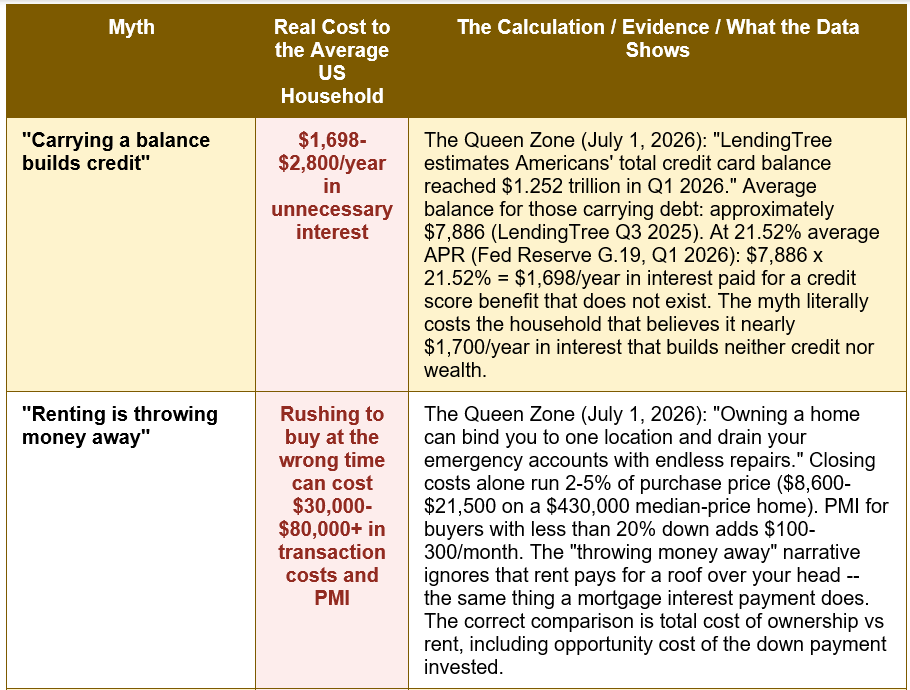
The Ten Myths Debunked: What the Evidence Actually Shows
MYTH #1 "CARRYING A CREDIT CARD BALANCE BUILDS YOUR CREDIT SCORE"
This is the single most costly and most widespread financial myth in America. LendingTree (April 2025): 'More than half of Americans ages 40 and younger believe this expensive myth.' The Federal Reserve 2026 credit report (via The Queen Zone, July 1, 2026): 45% of credit card owners carried a balance at least once in the prior 12 months. The myth has an obvious origin: people conflate using credit with using credit wisely. It is true that using a credit card and paying it off in full each month builds credit. It is absolutely not true that leaving a balance on the card provides any additional benefit. What actually determines your credit score: payment history (35%), credit utilisation ratio (30%), length of credit history (15%), new credit inquiries (10%), and credit mix (10%). Carrying a balance affects utilisation (making it worse if the balance is high) and payment history (making it worse if you ever miss a minimum). It has zero positive effect on any credit score factor. Every dollar left on a credit card at 21.52% average APR is costing the holder $0.2152 in annual interest per dollar -- for a benefit that does not exist.THE TRUTH: Pay your credit card balance in full every month, every month, without exception. This builds your credit history (payment record), keeps your utilisation low, and costs you zero in interest. Carrying a balance provides no credit-building benefit and costs an average household approximately $1,700/year in unnecessary interest (on the average $7,886 balance at 21.52% APR).
MYTH #2 "RENTING IS THROWING YOUR MONEY AWAY"
Forbes (September 30, 2025): 'Renting vs. buying a home is one of the biggest debates in all of personal finance. Buying a home is seen as a cornerstone of the American Dream. The reality is that your personal situation dictates what makes the most sense and buying is not always the correct choice.' LendingTree (April 2025): 57% of all Americans believe buying is always better than renting. The Queen Zone (July 1, 2026): 'People rush to buy homes because they think renting is a personal failure, ignoring the massive upfront transaction fees. Owning a home can bind you to one location and drain your emergency accounts with endless repairs.' The 'throwing money away' framing is economically incorrect. A rent payment pays for: shelter, maintenance services, flexibility to move, no exposure to property value decline, no obligation for repairs or upkeep, and no tied-up capital in a down payment. A mortgage payment pays for: shelter, the interest component (which does not build equity), and a small amount of principal reduction in the early years. In the first 5-10 years of a 30-year mortgage, the vast majority of each payment is interest -- which is, by the 'throwing money away' standard, as 'thrown' as rent. The correct question is not rent-or-buy but: what is the total cost of ownership compared to the total cost of renting the equivalent property, including opportunity cost of the down payment? In many US markets at 2026 price and rate levels, the break-even calculation has lengthened significantly.THE TRUTH: Renting is a financially rational choice in many circumstances -- particularly for shorter time horizons (under 5 years), in high-price markets where price-to-rent ratios are elevated, and when the alternative is buying with insufficient down payment (less than 20%) and incurring PMI and higher mortgage rates. Use a rent-vs-buy calculator (NYT Upshot, Bankrate, or Redfin) with your specific numbers before assuming ownership is the better financial choice.
MYTH #3 "I'LL JUST WORK PART-TIME IF I DON'T SAVE ENOUGH FOR RETIREMENT"
This is the most dangerous retirement myth because it sounds responsible and feels like a safety net. MoneyTalksNews (May 7, 2026): '75% of workers think they will continue to work for pay after they retire, according to the 2026 Retirement Confidence Survey from the nonprofit Employee Benefit Research Institute.' But the reality data is stark: far fewer than 75% of retirees actually work. Health issues, layoffs, caregiving responsibilities, and physical limitations force most workers to retire earlier than planned -- often involuntarily. The 2026 Retirement Confidence Survey shows workers' retirement expectations and retirees' actual experiences diverge dramatically. Kiplinger (May 11, 2026): 'The 4% rule suggests retirees can withdraw 4% of their total retirement savings every year... [but] requires substantial savings to fund.' The reliance on future work as a retirement backstop is the primary mechanism by which American households reach retirement age with inadequate savings. Each year spent relying on this myth is a year of compound growth permanently lost.THE TRUTH: Plan for retirement as if work will not be available. The 2026 Retirement Confidence Survey data is unambiguous: workers dramatically overestimate how long they will work. The correct approach: maximise 401(k) contributions (2026 limit: $23,500; $31,000 for 50+; $35,750 for ages 60-63 with super catch-up), capture the full employer match, and use the 2026 Roth IRA limit ($7,000; $8,000 for 50+) for tax-free retirement growth. Any future part-time work income is a bonus, not a plan.
MYTH #4 "YOU NEED A LOT OF MONEY TO START INVESTING"
This is the access barrier myth that keeps millions of Americans out of the market during their most valuable compounding years. The truth in 2026: you can invest $1. Fidelity (1 week ago -- most current): fractional share investing, zero-minimum index funds, and micro-investing apps have eliminated the capital barrier entirely. Fidelity's own zero-expense-ratio index funds ($FZROX, $FZILX) have no minimum investment. Vanguard, Schwab, and most major brokerages allow investments starting at $1 via fractional shares. The myth is particularly damaging because it targets the people who most need compound growth to work in their favour: younger, lower-income earners whose early years of investing produce the most powerful long-term results. The SEC (April 2026): 'Building wealth slowly by regularly setting money aside for investments helps investors benefit from compound growth, which can drive life-changing results over time.' IPX1031 (August 2025): '92% of Americans think investing is the key to building wealth' -- but a significant proportion are not starting because they believe they cannot until they have more money. This is the myth that causes the delay described in the cost table: $230,000 in foregone compound growth from a 10-year delay in starting $100/month investments.THE TRUTH: Start investing with whatever amount is available today. Open a Roth IRA at Fidelity, Schwab, or Vanguard with $1. Buy a fractional share of a low-cost total market index fund (VTI, FZROX, SWTSX). Set up an automatic monthly contribution of any amount. The habit and the time in the market matter more than the starting amount. Every year of delay costs compounding that cannot be recovered.
MYTH #5 "SOCIAL SECURITY WILL COVER MOST OF MY RETIREMENT INCOME"
MoneyTalksNews (May 7, 2026): 'Social Security only covers about 28% of your pre-retirement income if you're a high earner. That percentage is 43% for medium earners and 79% for very low earners, according to the government.' The Social Security replacement rate -- the percentage of pre-retirement income that benefits replace -- is specifically designed to provide adequate coverage only for very low earners. For the majority of middle-class American households, Social Security is intended to supplement retirement savings, not replace them. The common misconception arises from seeing the monthly Social Security benefit in isolation: $1,800/month sounds like a meaningful income until you calculate what it replaces of your current household income. At a $75,000 household income, Social Security benefits at full retirement age might provide approximately $2,000-$2,200/month -- covering $24,000-$26,400/year against a retirement income need of $52,500-$67,500/year (70-90% replacement). The gap: $26,000-$41,000 per year, requiring a retirement portfolio of $650,000-$1,025,000 at 4% withdrawal rate.THE TRUTH: Calculate your actual projected Social Security benefit at ssa.gov/myaccount. Then calculate what percentage of your pre-retirement income it replaces. Use a retirement calculator (Fidelity, Vanguard, or CFPB) to determine the personal savings needed to bridge the gap between your SS benefit and your target retirement income. For most middle-income households, personal savings of $600,000-$1.5 million are required alongside Social Security for a comfortable 25-30 year retirement.
MYTH #6 "ALL DEBT IS BAD"
The Queen Zone (July 1, 2026): 'There is a common belief that all borrowing is inherently evil and that it means you are failing to manage your assets. While high-interest consumer debt is dangerous, certain low-interest loans can act as leverage to build your long-term future. Sensible educational tracking or mortgages can sometimes help you climb into a much higher-earning bracket. The truth is that borrowing requires strict boundaries, not blanket fear, to keep your net worth moving up.' The 'all debt is bad' myth produces counterproductive financial behaviour: people pay down a 3% mortgage aggressively instead of investing in a market returning 7% historically, effectively costing themselves the 4% difference compounded over years. The correct framework: debt above the expected return on the alternative use of money is destructive; debt below the expected return on the alternative use is potentially wealth-accretive. Credit card debt at 21.52%: virtually always destroy; student loan at 4-6%: analyse the specific income premium from the degree; mortgage at 3-7%: usually rational given historical market returns of 7% and tax deductibility.THE TRUTH: Distinguish high-cost debt (credit cards, payday loans, buy now pay later above 0%) from structured, low-cost debt (mortgages, federal student loans, car loans at competitive rates). High-cost debt should always be the highest financial priority to eliminate. Low-cost debt may be better maintained while directing additional funds to investments returning above the debt rate. The blanket 'all debt is bad' framing prevents this rational analysis.
MYTH #7 "I'M TOO YOUNG TO WORRY ABOUT RETIREMENT"
Bankrate (December 2025): 32% of Americans believe their finances will get worse in 2026 -- the highest level since Bankrate began asking this question in 2018. Delayed retirement saving is a primary driver of financial anxiety in later decades. Fidelity (1 week ago): 'If you start early, around age 25, saving 15% of your paycheck -- including your employer's match -- could help you save enough to maintain your current way of life in retirement.' The mathematics of this myth: a 25-year-old who saves $300/month at 7% average return until 65 accumulates approximately $803,000. A 35-year-old saving the same $300/month accumulates approximately $379,000. The 10-year delay cost: $424,000 -- from the same monthly contribution. This is the most expensive decade in compound growth terms. IPX1031 (August 2025): '92% of Americans think investing is key to building wealth.' But thinking it and starting it are different actions -- and the gap between them is widest in the twenties, when retirement feels impossibly distant.THE TRUTH: The correct time to start retirement saving is the first day of the first job with an employer 401(k) match. Contribute at least enough to capture the full match -- which is a guaranteed 50-100% return on the matched amount. For those without an employer plan: open a Roth IRA immediately (2026 limit: $7,000). Every year of delay in your twenties costs more compounded growth than any equivalent delay later in life.
MYTH #8 "YOU NEED TO TIME THE MARKET TO MAKE MONEY INVESTING"
IPX1031 (August 2025): '39% have made changes to their investments in the last 12 months due to the economy. The top changes include shifting to safer investments.' This reactive behaviour -- adjusting investments based on short-term economic conditions -- is the textbook definition of market timing, and it consistently produces below-market returns. DALBAR's annual Quantitative Analysis of Investor Behaviour consistently shows that the average equity investor underperforms the market index by 1.5-3% annually -- primarily because they sell during downturns and buy during recoveries, producing the opposite of optimal timing. The market timing myth is actively dangerous because it feels rational: it seems obvious that you should move to safer investments when the economy looks risky. The problem is that 'when the economy looks risky' is precisely the moment when equity valuations are most attractive for long-term buyers, and the economy almost always looks risky in some way, providing continuous justification for delay. Fidelity's research on their best-performing accounts: they belonged to people who had died or forgotten they had the account. Inaction outperformed active management.THE TRUTH: Invest consistently at regular intervals regardless of market conditions (dollar-cost averaging). Never time the market. Set up automatic monthly contributions to a low-cost, diversified index fund (total US market or global index) and do not change the contribution based on economic news. Review the strategy annually -- not quarterly. Every year of consistent contributions compounds; every gap in contributions is permanently lost.
MYTH #9 "A WILL IS ENOUGH FOR ESTATE PLANNING"
Charles Schwab Money Myths Survey: '91% of survey respondents inaccurately agreed with this statement.' This myth has potentially severe financial consequences for families. A will controls what happens to assets that go through probate -- property held in the deceased person's name alone without a beneficiary designation. But significant assets do not pass through the will at all. Retirement accounts (401(k), IRA, Roth IRA) pass to the designated beneficiary on the account form, regardless of what the will says. Life insurance proceeds go to the policy beneficiary. Jointly held property passes to the surviving joint tenant. Bank accounts and brokerage accounts with transfer-on-death (TOD) designations pass directly. This means a will that names your children as heirs is overridden by an outdated beneficiary form that still lists an ex-spouse on your 401(k). Kiplinger (May 11, 2026): Medicare and long-term care planning also require advance directives and powers of attorney -- documents a will cannot provide.THE TRUTH: Estate planning requires five documents at minimum: (1) a current will; (2) a durable financial power of attorney; (3) a healthcare proxy/medical power of attorney; (4) a living will/advance healthcare directive; and (5) current beneficiary designations on all accounts (401k, IRA, life insurance, bank accounts). Review beneficiary designations after every major life event (marriage, divorce, death of a named beneficiary, birth of a child). An outdated 401(k) beneficiary form can override a will entirely.
MYTH #10 "MORE INCOME ALWAYS SOLVES MONEY PROBLEMS"
IPX1031 (August 2025): '88% of Americans believe you need passive income to be financially secure. 83% believe multiple income streams are essential.' These beliefs reflect the income-focus of US financial culture -- the conviction that the answer to financial problems is more money. But income alone does not build wealth. It is income minus spending, invested consistently over time, that builds wealth. A household earning $200,000 and spending $195,000 has worse financial security than a household earning $80,000 and spending $60,000. The income-maximisation myth diverts attention from the spending management, debt elimination, and investment habits that actually determine financial outcomes. Bankrate (December 2025): among those who believe their finances will improve in 2026, the top reason is rising income (47%) -- but 'better spending habits' (40%) was nearly as commonly cited. The spending side of the equation is as powerful as the income side -- and is considerably more within the individual's control in any given year.THE TRUTH: The wealth equation is: (income minus spending) invested consistently over time. Income is only half of the equation. A 10% increase in income that is entirely absorbed by lifestyle inflation produces no change in wealth trajectory. A 10% reduction in spending that is redirected to investment changes the wealth trajectory permanently. Both levers are available to most households in any given year, but spending optimisation is more immediately controllable than income growth.
The myth that surprised researchers the most: the knowledge-confidence paradox. Charles Schwab's Money Myths survey found that respondents who believed they were the most financially knowledgeable were more likely to agree with financial misconceptions than those who were more uncertain. This is the Dunning-Kruger effect applied to personal finance: confidence in financial knowledge does not accurately predict financial knowledge accuracy. The implication is significant: the households most at risk from financial myths are not those who know they lack financial education but those who believe they are financially informed and therefore do not question the 'rules' they have absorbed through social transmission, media, and conventional wisdom. LendingTree (April 2025): '96% of Americans believe at least one financial myth -- including those with college degrees and six-figure incomes.' The myth problem is universal. The only defence is specific, evidence-based scrutiny of every financial belief you hold.
THE FIVE MOST EXPENSIVE MYTHS TO LEAVE UNCHALLENGED: (1) CARRYING A CREDIT CARD BALANCE. Cost: approximately $1,700/year in interest for the average balance holder. The belief produces no credit benefit and costs $1,700/year for zero return. (2) WAITING TO START INVESTING BECAUSE YOU DON'T HAVE ENOUGH. Cost: $230,000 in foregone compound growth from a 10-year delay starting at $100/month. Fidelity: zero minimum accounts are available today. (3) RELYING ON WORKING IN RETIREMENT AS A SAVINGS BACKSTOP. Cost: under-saving by potentially $400,000-$700,000 in retirement assets by treating future work income as a reliable plan. EBRI 2026: 75% plan to work in retirement; a fraction actually can. (4) BELIEVING SOCIAL SECURITY WILL COVER MOST RETIREMENT INCOME. Cost: a $650,000-$1,000,000 gap in personal savings for median earners who do not bridge the difference. SS replaces only 43% of pre-retirement income for median earners. (5) BELIEVING A WILL IS SUFFICIENT ESTATE PLANNING. Cost: potentially the entire value of retirement accounts, life insurance, and jointly held property directed to an unintended beneficiary if designation forms are not current. 91% of respondents incorrectly believe a will alone is sufficient.
YOUR MONEY MYTH AUDIT -- CHECK THESE BELIEFS THIS WEEK: CREDIT CARDS: Are you carrying a balance in the belief it helps your credit score? Log into your credit card account. The balance. The APR. Calculate the annual interest cost. Pay it in full this month if possible. If not: make a specific payoff plan (debt avalanche: highest APR first). INVESTING: Do you have a retirement account? If not: open a Roth IRA at Fidelity, Vanguard, or Schwab today (zero minimum). If yes: are you contributing enough to capture the full employer match? RETIREMENT: Go to ssa.gov/myaccount and see your projected SS benefit. Calculate what percentage of your current income it replaces. If it is below 70-80%, you need personal retirement savings to bridge the gap. Calculate the required portfolio size at 4% withdrawal rate. ESTATE PLANNING: List every major financial account: 401(k), IRA, life insurance, bank accounts. Who is listed as beneficiary on each? Are those designations current and intentional? RENT VS BUY: If you are considering buying primarily because "renting is throwing money away" -- run the numbers first using Bankrate's rent vs buy calculator with your specific numbers and timeline. FREE RESOURCES: CFPB consumerfinance.gov | FINRA finra.org/investors | SEC Investor.gov | NEFE nefe.org.
Conclusion
Ninety-six percent of Americans believe at least one financial myth. More than half of Gen Z and Millennials believe that carrying a credit card balance builds credit -- a belief that costs the average balance-holder approximately $1,700 per year in interest for a benefit that does not exist. Seventy-five percent of workers plan to work in retirement; far fewer than 28% actually will -- and the under-saving produced by this plan produces a retirement income gap measured in hundreds of thousands of dollars.The myths persist because they feel true. 'Renting is throwing money away' captures something emotionally real about the desire for ownership and stability. 'You need a lot of money to invest' feels like a reasonable observation about financial resources. 'Social Security will be enough' is a reassuring belief in a system designed for exactly this purpose. The myths are comforting. Their costs are not.
Fidelity (1 week ago -- most current): 'There is no shortage of bad information out there -- and falling for some of it can cost you money.' The Queen Zone (July 1, 2026): 'LendingTree estimates Americans' total credit card balance reached $1.252 trillion in Q1 2026.' The Charles Schwab survey: '91% of Americans incorrectly believe a will alone is sufficient for estate planning.' These are not abstract statistics. They represent specific, correctable financial behaviours across millions of households. The truth about each myth is accessible, specific, and actionable. The audit at the end of this guide identifies the five beliefs worth checking this week -- each with a specific action that can be taken today.
Frequently Asked Questions (FAQ)
Does carrying a credit card balance actually help your credit score?No -- this is one of the most widespread and expensive financial myths in America. LendingTree (April 2025): 'More than half of Americans ages 40 and younger believe this expensive myth.' The reality: your credit score is determined by payment history (35%), credit utilisation ratio (30%), length of credit history (15%), new credit (10%), and credit mix (10%). Carrying a balance does not improve any of these factors -- it potentially worsens credit utilisation (if the balance is high relative to the credit limit) and payment history (if you ever miss a minimum payment). The optimal credit-building behaviour is: use the credit card for normal purchases you would make anyway, then pay the statement balance in full every month before the due date. This records on-time payments (improving payment history), keeps the reported balance near zero (improving utilisation), and costs zero in interest. The Federal Reserve 2026 credit report (via The Queen Zone, July 2026) found that 45% of credit card owners carried a balance at least once in the prior 12 months. At the average APR of 21.52%, this represents billions of dollars in interest paid annually for a credit-building benefit that categorically does not exist.
Is renting always worse than buying a home financially?
No -- this is one of the most persistent myths in US personal finance, rooted in deeply held cultural values about homeownership. Forbes (September 30, 2025): 'Renting vs. buying is one of the biggest debates in all of personal finance. The reality is that your personal situation dictates what makes sense and buying is not always the correct choice.' LendingTree (April 2025): 57% of all Americans believe buying is always better than renting. The correct framework: the financial outcome of renting versus buying depends on the price-to-rent ratio in your local market, how long you plan to stay, your available down payment, your credit score's effect on your mortgage rate, and what you would do with the down payment if you rented instead. The Queen Zone (July 1, 2026): 'Owning a home can bind you to one location and drain your emergency accounts with endless repairs.' Closing costs run 2-5% of the purchase price ($8,600-$21,500 on a $430,000 median home) -- making any purchase held for fewer than 3-5 years likely to be a net financial loss versus renting. PMI for buyers with less than 20% down adds $100-300/month to the cost of ownership. The New York Times Upshot rent-versus-buy calculator allows you to model the specific numbers for your situation, local market, and time horizon before making the decision based on actual financial analysis rather than cultural assumption.
How much does Social Security actually replace in retirement income?
MoneyTalksNews (May 7, 2026): 'Social Security only covers about 28% of your pre-retirement income if you're a high earner. That percentage is 43% for medium earners and 79% for very low earners, according to the government.' This is the official Social Security replacement rate -- the percentage of your pre-retirement earnings that benefits are designed to replace. The system is intentionally progressive: it replaces a higher proportion of income for lower earners. For middle and upper-income households, the gap between the SS benefit and a comfortable retirement income is large and must be funded by personal savings. For a household earning $80,000 before retirement and targeting 80% income replacement ($64,000/year), SS provides approximately $34,400/year (at the 43% medium-earner rate). The shortfall is $29,600/year. Using the 4% safe withdrawal rule, bridging this shortfall for a 25-year retirement requires a personal portfolio of approximately $740,000. This is the scale of personal savings that Social Security mythologists are typically not accounting for. The 2026 Retirement Confidence Survey (via MoneyTalksNews, May 2026) suggests that many workers planning to rely heavily on Social Security are likely to face significant income shortfalls in retirement. Get your personal Social Security estimate at ssa.gov/myaccount -- it is based on your actual earnings history and provides a concrete starting point for retirement income planning.
What is the minimum amount needed to start investing?
In 2026, the minimum amount needed to start investing is effectively zero -- or technically $1, via fractional share investing at most major brokerages. Fidelity (1 week ago -- most current): 'If you start early, around age 25, saving 15% of your paycheck -- including your employer's match to your 401(k) -- could help you save enough to maintain your current way of life in retirement. It sounds like a lot, but don't lose your motivation if you can't save that much.' Specific zero-minimum options available in 2026: Fidelity ZERO index funds ($FZROX, $FZILX) have no minimum investment and no expense ratio. Vanguard, Schwab, and Fidelity all allow fractional share purchases starting at $1 or $5. Robinhood, Acorns, Stash, and SoFi all offer investment accounts with no account minimums. Roth IRA accounts at Fidelity, Schwab, and Vanguard have zero account minimums. The practical starting point: open a Roth IRA, contribute $25-50/month to a total market index fund, and set up automatic monthly contributions. The compound growth on $50/month starting at age 25 produces approximately $177,000 by age 65 at 7% average return -- from an investment that most people could begin today. The 'I don't have enough to start' barrier is not financial in 2026. It is psychological. IPX1031 (August 2025): 92% of Americans think investing is key to building wealth -- but believing it and doing it require crossing the starting barrier, which automation makes trivially easy.
Why do financial myths persist even among educated and higher-income Americans?
The persistence of financial myths among educated and higher-income Americans is one of the most consistent and surprising findings in financial literacy research. LendingTree (April 2025): '96% of Americans believe at least one financial myth -- these myths are pervasive even among six-figure earners and people who attained a college education.' Charles Schwab's Money Myths survey (Lieberman Research Worldwide) found the most striking explanation: 'Respondents who believed they were the most financially knowledgeable were more likely to agree with misconceptions about important financial planning decisions.' The Dunning-Kruger effect -- overconfidence in partial knowledge -- is the primary mechanism. Financial myths persist for several specific reasons: they are emotionally intuitive ('renting is throwing money away' captures a real feeling of wasted spending); they are socially transmitted (beliefs shared by parents, communities, and cultural narratives feel validated without being examined); they are rarely challenged in formal education (personal finance is not a required subject in most US high schools or universities); and they are often partially true in some circumstances, which makes them feel more reliable than they are ('debt is bad' is true of high-interest consumer debt; untrue of a sub-5% mortgage). The defence against myth-persistence is specific, evidence-based scrutiny -- checking the specific claim against current data (Federal Reserve, SEC, CFPB, SSA) rather than accepting culturally transmitted financial wisdom without examination.

0 Comments Comments