
Professional & Career Development
The Shift Worker's Sleep Recovery Guide

61% of permanent night workers meet clinical criteria for Shift Work Sleep Disorder. Emergency healthcare professionals average just 6h 09 min sleep with a Sleep Regularity Index of 52%. Night shift work raises cardiovascular disease risk by 40%. Here is what the 2025-2026 research says actually helps.
There is a version of this article that opens with a sympathetic acknowledgement of how hard it is to work nights and irregular shifts. This is not that version. This is the version that opens with the data. The average permanent night shift worker sleeps 5.3 hours per day (Sleep Research Society). Emergency healthcare professionals in a 2025 peer-reviewed actigraphy study achieved an average Sleep Regularity Index of 52% — meaning that half the time, sleep was occurring at a completely different clock time than it did in the previous session. Sixty-one percent of permanent night workers meet the clinical diagnostic criteria for Shift Work Sleep Disorder. And chronic circadian disruption raises cardiovascular disease risk by 40% while night shift work has been classified by the WHO as a probable human carcinogen. This article covers the research behind the sleep problem that 15 million American shift workers — disproportionately in healthcare, hospitality, and emergency services — are navigating every day, and the specific, evidence-based recovery strategies that the research supports for each of those three groups. Not medical advice. Always consult a qualified healthcare professional.
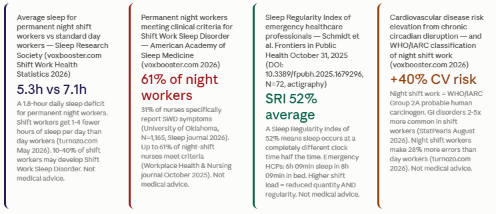
15 million US shift workers (16% of wage/salary workforce). Permanent night workers: 5.3h average sleep vs 7.1h for day workers — 1.8h daily deficit (Sleep Research Society, voxbooster.com 2026). 61% of permanent night workers: clinical criteria for Shift Work Sleep Disorder (AASM, voxbooster.com 2026). Not medical advice.
Cardiovascular disease risk +40% from chronic circadian disruption (voxbooster.com 2026). Night shift work = Group 2A probable human carcinogen (WHO/IARC). GI disorders 2-5x more common in shift workers (StatPearls August 2026). Shift work disorder associated with greater risk of GI problems, cancer, depression, heart disease, excessive sleepiness, accidents (medlink.com 2026). 28% more errors by night shift workers vs day shift (turnozo.com 2026).
Emergency healthcare professionals: 6h 09 min sleep average; 8h 09 min in bed; SRI 52% = highly irregular. Higher shift load = reduced sleep quantity AND regularity (Schmidt et al. 2025). 31% of nurses report Shift Work Disorder symptoms; 49% average under 7 hours; 27% use sleep medications (University of Oklahoma, N=1,165, published April 2026, cited safetyandhealthmagazine.com August 2026).
Food service and hospitality employs 15.9 million workers (US, 2025 projection; turnozo.com 2026). Shift work in hospitality 'increasingly common to meet consumer demands' — health effects on US hotel workers 'remain understudied' (Workplace Health & Nursing journal October 2025). Shift workers get 1-4 fewer hours of sleep per day than day workers; night shift workers 2-3x more likely to report insufficient sleep (turnozo.com May 2026).
Night shift workers make 28% more errors than day shift workers (turnozo.com 2026). IAFF July 2026: cognitive function and performance impaired by shift work; cancer risk elevated for female firefighters by combination of circadian disruption + carcinogen exposure.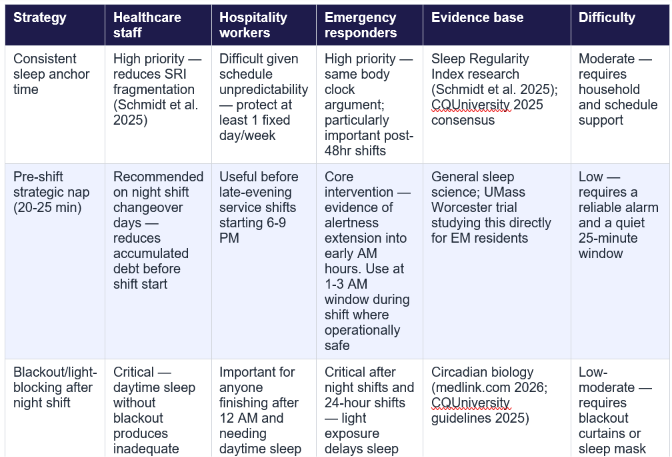
What you can control: the consistency of your sleep anchor time; your pre-sleep light exposure; your caffeine timing; your use or non-use of alcohol as a sleep aid; whether you nap strategically on shift-chang
The practical takeaway for the 15 million shift workers navigating this daily is not to achieve perfect sleep — the structural constraints make that impossible for many. It is to use the research-supported strategies available, advocate for scheduling improvements where the evidence supports it, and recognise that the sleep debt accumulated in shift work is real, measurable, and addressable. It is also, in the words of the CQUniversity Healthy Shiftwork Hub, something that ‘no one told us how to manage.
Shift Work Sleep Disorder (SWSD) is a circadian rhythm sleep disorder that occurs when your work schedule conflicts with your body's internal clock. The medlink.com 2026 review identifies that it presents with insomnia or excessive sleepiness in the setting of evening, nighttime, or rotating work schedules, and may also present with metabolic issues and digestive and mood complaints. The American Academy of Sleep Medicine reports that 61% of permanent night workers meet clinical diagnostic criteria. A 2026 University of Oklahoma study of 1,165 nurses found 31% reported symptoms. If you regularly experience difficulty sleeping during your off-hours, excessive sleepiness during shifts, mood symptoms, or gastrointestinal issues, and you work non-standard hours, SWSD is a possibility. Diagnosis requires assessment by a qualified healthcare professional.
Is it safe to use melatonin to manage shift work sleep?
Melatonin is one of the evidence-based treatment tools for shift work sleep disorder, but it requires correct timing to be effective — and incorrect timing can worsen circadian alignment rather than improve it. The CQUniversity Healthy Shiftwork Hub and its 2025 SLEEP journal consensus guidelines address this in their research-to-practice translation work. Because the effective dose, timing, and application of melatonin for shift work sleep depends on the specific shift pattern and individual chronotype, this should be discussed with a qualified healthcare professional rather than self-managed. A 2026 NIOSH health survey found that 28% of shift workers rely on prescription sleep aids or sedatives — a figure that underscores the prevalence of the problem and the importance of medical guidance for pharmacological approaches.
What does 'sleep regularity' mean and why does it matter for shift workers?
Sleep regularity refers to the consistency of sleep timing — specifically, whether you go to sleep and wake at predictable clock times. The Sleep Regularity Index (SRI) is the metric used in research: a score of 100% means you sleep at exactly the same time every session; 50% means your timing is essentially random. Schmidt et al.'s 2025 Frontiers in Public Health study found that emergency healthcare professionals averaged an SRI of 52% — reflecting highly fragmented, unpredictable sleep timing. The study found that SRI and total sleep time together explained 48% of the variance in shift load burden. Why does regularity matter beyond total duration? The circadian system requires consistent timing cues to produce melatonin and cortisol at appropriate times. Random sleep timing continuously confuses the circadian clock, preventing the hormonal entrainment that underlies effective sleep, energy, and immune function.
How do I manage sleep when I have young children or caring responsibilities?
This is one of the most under-addressed practical challenges in shift work sleep research. The structural barriers are real: a household with young children cannot maintain the blackout, quiet, and do-not-disturb conditions that night-shift sleep requires without active family coordination. The CQUniversity Healthy Shiftwork Hub research notes that 'no one told us how to manage shiftwork' as a key gap between research and lived practice. Practically: communicate your sleep window clearly and in advance with household members; use physical signals (a sign on the bedroom door, a scheduled phone-off period) to manage interruptions; identify at least one protected longer sleep block per week where household support is arranged; and where possible, use the pre-shift nap strategy to partially compensate for a shortened main sleep. These are imperfect accommodations of an inherently difficult situation, not complete solutions.
Are there resources specifically for healthcare workers managing shift work sleep?
Yes. The NIOSH (National Institute for Occupational Safety and Health) offers specific training resources on sleep, shiftwork, and fatigue for healthcare workers and emergency responders (community.the-hospitalist.org). The CQUniversity Healthy Shiftwork Resource Hub (cqu.edu.au) is Australia's first evidence-based healthy shiftwork hub, providing practical guidance on sleep, nutrition, physical activity, and mental health, translated from research specifically for healthcare, emergency services, and hospitality workers. The 2025 SLEEP journal consensus sleep hygiene guidelines for shift workers (Delphi methodology) produced by the CQUniversity team provides the most current research-to-practice recommendations. The StatPearls Shift Work Hazards continuing education module (August 2026, 1 ANCC contact hour) covers the health implications for nurses and provides clinical screening guidance.
There is a version of this article that opens with a sympathetic acknowledgement of how hard it is to work nights and irregular shifts. This is not that version. This is the version that opens with the data. The average permanent night shift worker sleeps 5.3 hours per day (Sleep Research Society). Emergency healthcare professionals in a 2025 peer-reviewed actigraphy study achieved an average Sleep Regularity Index of 52% — meaning that half the time, sleep was occurring at a completely different clock time than it did in the previous session. Sixty-one percent of permanent night workers meet the clinical diagnostic criteria for Shift Work Sleep Disorder. And chronic circadian disruption raises cardiovascular disease risk by 40% while night shift work has been classified by the WHO as a probable human carcinogen. This article covers the research behind the sleep problem that 15 million American shift workers — disproportionately in healthcare, hospitality, and emergency services — are navigating every day, and the specific, evidence-based recovery strategies that the research supports for each of those three groups. Not medical advice. Always consult a qualified healthcare professional.
Table of Contents
- The Data Before the Sympathy
- The Scale of the Problem: Who Is Most Affected
- What Circadian Disruption Actually Does to the Body
- The Sleep Debt That Compounds: Healthcare Workers
- The Hidden Sleep Deficit: Hospitality Workers
- The Emergency Responder’s Specific Challenge
- Recovery Strategies by Role: What the Research Supports
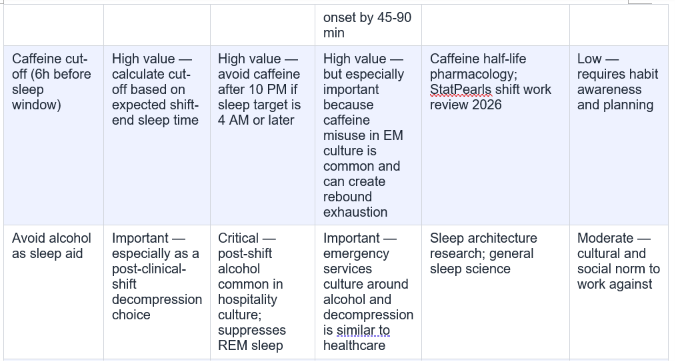
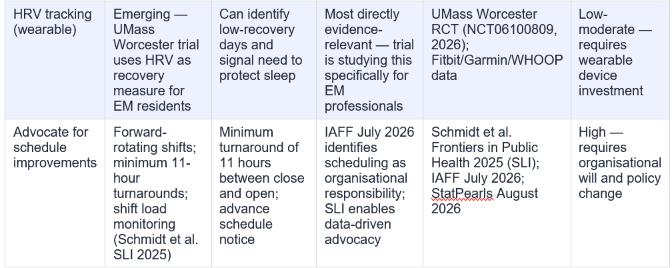
- The Shift Worker’s Sleep Toolkit: A Side-by-Side Comparison
- What You Cannot Control — and What You Can
- Conclusion: Sleep Is Occupational Safety
- Frequently Asked Questions
The Data Before the Sympathy
The NIOSH — the US National Institute for Occupational Safety and Health — offers training and resources specifically for healthcare workers and emergency responders on sleep, shift work, and fatigue. Not because these workers are uniquely careless about their health. Because their job design makes adequate sleep structurally difficult in ways that individual effort alone cannot fully resolve. The medlink.com 2026 review is direct: approximately 15 million American workers, or roughly 16%, work nights or rotating shifts. This occupational accommodation ‘is not always well tolerated and may result in misalignment between circadian-influenced physiology and the environment, producing the symptoms of shift work disorder.’ This article is for those 15 million — particularly the subset working in healthcare, emergency services, and hospitality, where the health and safety stakes of their own sleep deprivation extend beyond their personal wellbeing to the people they care for and serve.15 million US shift workers (16% of wage/salary workforce). Permanent night workers: 5.3h average sleep vs 7.1h for day workers — 1.8h daily deficit (Sleep Research Society, voxbooster.com 2026). 61% of permanent night workers: clinical criteria for Shift Work Sleep Disorder (AASM, voxbooster.com 2026). Not medical advice.
The Scale of the Problem: Who Is Most Affected
Shift work is not a niche working pattern. According to the Bureau of Labor Statistics, 16% of US wage and salary workers — approximately 15 million people — work non-standard or rotating schedules. Within that population, those in healthcare, emergency services, and hospitality carry a disproportionate share of the sleep burden. Nursing, psychiatric, and home health aides have the highest adjusted prevalence of short sleep duration among all occupational subgroups (NIOSH, cited community.the-hospitalist.org). An October 2025 analysis in the Workplace Health & Nursing journal identified that nurses suffer from higher levels of sleep disorders than the national average, especially night-shift nurses, with rates as high as 61%. A 2026 University of Oklahoma Health Sciences Center study — surveying 1,165 nurses at a tertiary care medical centre — found that 49% averaged less than seven hours of sleep per night, and that the overall average registered at 6.6 hours. In the same study, 31% reported symptoms of Shift Work Disorder and 27% used medications to help them sleep. A 2025 study published in Frontiers in Public Health (Schmidt et al., DOI 10.3389/fpubh.2025.1679296) studied 72 nurses and physicians in French emergency departments using actigraphy and found that emergency healthcare professionals obtained an average of just 6 hours 9 minutes of sleep, with a Sleep Regularity Index of 52% — indicating highly fragmented, unpredictable sleep patterns. For firefighters and emergency responders, the IAFF’s July 2026 Shift Work and Firefighters report found cognitive function and performance impaired by shift work disruption, with particular concern about cancer risk from circadian disruption. Hospitality workers face similar pressures: the Workplace Health & Nursing journal October 2025 analysis noted that shift work in hospitality is increasingly common but that its health and wellbeing effects on US hotel workers ‘remain understudied.What Circadian Disruption Actually Does to the Body
The circadian rhythm is the body’s internal clock — a 24-hour biological cycle that regulates sleep, wakefulness, hormone release, body temperature, digestion, and immune function. It is synchronised primarily by light exposure. Night shift work forces the body to be active and alert during hours when the circadian clock is producing sleep-promoting hormones — particularly melatonin — and to sleep during daylight hours when the clock is suppressing them. The conflict between social/work time and biological time is called circadian misalignment, and its health consequences are well-documented and serious. The medlink.com 2026 review of shift work disorder identifies that shift work disorder — the clinical condition produced by this conflict — is associated with greater risk of gastrointestinal problems, cancer, depression, heart disease, excessive sleepiness, and accidents. The voxbooster.com 2026 health statistics compilation places the cardiovascular disease risk elevation from chronic circadian disruption at 40%. Gastrointestinal disorders are reported 2-5 times more commonly among shift workers than day workers (StatPearls Shift Work Hazards August 2026). Night shift work has been classified as a Group 2A probable human carcinogen by the WHO and IARC due to circadian disruption. The IAFF’s July 2026 report on shift work and firefighters specifically identifies that this cancer risk is compounded for female firefighters by the combination of interrupted sleep, carcinogen exposure during fires, and circadian misalignment. For all three groups covered in this article — healthcare, hospitality, and emergency services — the circadian disruption is not optional. Their work schedules cannot move. The recovery strategies must therefore work within and around the circadian biology rather than eliminating the disruption.Cardiovascular disease risk +40% from chronic circadian disruption (voxbooster.com 2026). Night shift work = Group 2A probable human carcinogen (WHO/IARC). GI disorders 2-5x more common in shift workers (StatPearls August 2026). Shift work disorder associated with greater risk of GI problems, cancer, depression, heart disease, excessive sleepiness, accidents (medlink.com 2026). 28% more errors by night shift workers vs day shift (turnozo.com 2026).
The Sleep Debt That Compounds: Healthcare Workers
For nurses, doctors, and allied health professionals, the shift work sleep problem is both the most studied and the most severe. The sleep deficit is structural: shift rotation makes consistent sleep architecture nearly impossible. The 2025 Frontiers in Public Health study by Schmidt et al. introduced the Shift Load Index as a tool for quantifying exactly this burden. Their findings are specific: higher shift load was associated with both reduced sleep quantity and reduced sleep regularity — and the two together explained 48% of the variance in the Shift Load Index. The practical meaning is that it is not just how little emergency healthcare professionals sleep, but how unpredictably they sleep. A Sleep Regularity Index of 52% in that cohort means that half the time, sleep occurs at a completely different clock time than it did the session before. This matters because the body’s circadian systems require consistent timing to function optimally. The CQUniversity Healthy Shiftwork research hub — Australia’s first evidence-based resource of its kind, producing consensus sleep hygiene guidelines for shift workers in the SLEEP journal in 2025 — identifies sleep regularity as a key target alongside total sleep time, nutrition, and physical activity. For healthcare workers specifically, the recovery window is often short: the turnaround between a late shift and an early start can be as little as 9 hours, which leaves inadequate time for sleep hygiene, a full sleep cycle, and a normal morning routine before the next shift begins.Emergency healthcare professionals: 6h 09 min sleep average; 8h 09 min in bed; SRI 52% = highly irregular. Higher shift load = reduced sleep quantity AND regularity (Schmidt et al. 2025). 31% of nurses report Shift Work Disorder symptoms; 49% average under 7 hours; 27% use sleep medications (University of Oklahoma, N=1,165, published April 2026, cited safetyandhealthmagazine.com August 2026).
The Hidden Sleep Deficit: Hospitality Workers
Hospitality workers — hotel staff, restaurant and bar workers, event venue teams — face a specific pattern of shift work pressure that differs from healthcare in one important way: the variability. A nurse on a rotating schedule knows their roster weeks in advance. A hospitality worker may receive their shift schedule with 48-72 hours’ notice, work a closing shift that ends at 2 AM, and be scheduled for an opening shift at 7 AM the same week. The turnaround time and the unpredictability combine to make consistent sleep architecture almost impossible. The turnozo.com 2026 shift work statistics compilation identifies food service and hospitality — with 15.9 million restaurant industry workers projected in 2025 — as one of the industries with the highest proportion of shift workers. The Workplace Health & Nursing journal’s October 2025 analysis identified that the health effects of shift work on US hotel workers ‘remain understudied,’ but the physiological mechanisms are the same as in any shift worker: circadian misalignment, reduced melatonin at appropriate times, impaired slow-wave sleep, and daytime sleepiness. The hospitality context adds a social dimension: many of the social spaces — the bars, the late-night venues, the post-shift debrief culture — operate during the exact hours that the body most needs sleep. The combination of a work culture built around nighttime and a physiology that was not designed for it produces a uniquely compounding deficit.Food service and hospitality employs 15.9 million workers (US, 2025 projection; turnozo.com 2026). Shift work in hospitality 'increasingly common to meet consumer demands' — health effects on US hotel workers 'remain understudied' (Workplace Health & Nursing journal October 2025). Shift workers get 1-4 fewer hours of sleep per day than day workers; night shift workers 2-3x more likely to report insufficient sleep (turnozo.com May 2026).
The Emergency Responder’s Specific Challenge: Alertness When It Matters Most
For firefighters, paramedics, police officers, and emergency medical technicians, the stakes of shift work sleep deprivation are not just personal. Impaired cognitive function in an emergency response setting directly affects decision-making speed, clinical judgment, motor precision, and team communication — each of which has life-safety implications. The IAFF’s July 2026 report on shift work and firefighters identifies that shift work can affect cognitive function, performance, family functioning, and that night shift work and circadian disruptions may increase cancer risk. The UMass Worcester clinical trial (NCT06100809), beginning in January 2026 and running to January 2027, is specifically designed to study whether personalised fatigue-mitigation lifestyle coaching for Emergency Medicine residents on overnight shifts can reduce the effects of circadian rhythm disruption on performance and recovery. The study measures sleep, heart rate variability, readiness and recovery, alertness, and cognitive performance using Fitbit and validated instruments. Outcome measures are assessed specifically at the peak vulnerability window of 2:00 AM to 5:00 AM — when, as the trial protocol states, ‘sleep propensity and decreased alertness peak.’ The turnozo.com 2026 statistics compilation places the error rate for night shift workers at 28% higher than day workers in industrial settings — a figure that translates in emergency services into higher risk of equipment failures, treatment errors, and judgment lapses during exactly the shifts where correct decisions matter most.Night shift workers make 28% more errors than day shift workers (turnozo.com 2026). IAFF July 2026: cognitive function and performance impaired by shift work; cancer risk elevated for female firefighters by combination of circadian disruption + carcinogen exposure.
Recovery Strategies by Role: What the Research Supports
The CQUniversity Healthy Shiftwork research hub — which produced the 2025 consensus sleep hygiene guidelines for shift workers using a Delphi methodology, published in the SLEEP journal — identifies that lifestyle strategies including sleep practices, nutrition, and physical activity can effectively optimise performance and recovery. What follows are evidence-informed strategies specific to each of the three worker groups, drawn from the 2025-2026 research literature. Not medical advice — consult a qualified healthcare professional for personalised guidance.Healthcare Workers: Recovery Strategies
-
Anchor sleep — target consistency in start time, not duration
-
Pre-shift nap (20-25 minutes) on night shift changeover days
-
Post-night-shift blackout protocol
-
Caffeine cut-off 6 hours before sleep window
-
Rotating shift sequence: forward-rotating is less disruptive
Hospitality Workers: Recovery Strategies
-
Wind-down protocol for late hospitality shifts (ending 12-3 AM)
-
Anchor one fixed sleep time per week
-
Strategic light exposure management on split-shift days
-
Short-turnaround shifts: protect the minimum sleep window
- Avoid alcohol as a sleep aid
Emergency Responders: Recovery Strategies
-
Scheduled strategic napping during long shifts where available
-
Cold water and movement during the 2-5 AM vulnerability window
-
Post-24-hour shift: complete the recovery sleep before driving
-
Heart rate variability (HRV) as a readiness monitor
-
Peer accountability for fatigue management
The Shift Worker’s Sleep Toolkit: A Side-by-Side Comparison
What You Cannot Control — and What You Can
The research is honest about what individual strategies can and cannot achieve. The Schmidt et al. 2025 Frontiers in Public Health study concludes that the Shift Load Index provides a useful tool for optimising shift schedules and informing fatigue risk management strategies at the organisational level. The individual sleep hygiene strategies covered in this article improve sleep quality within the constraints that exist. They do not eliminate those constraints. A 9-hour turnaround between a night shift and an early shift cannot produce adequate recovery regardless of sleep hygiene quality. A schedule that rotates backward — from nights to evenings to days — will produce greater circadian disruption than a forward-rotating schedule regardless of the individual worker’s preparation. The StatPearls August 2026 Shift Work Hazards review explicitly calls for collaborative organisational and individual interventions — not individual interventions alone. The NIOSH training resources for healthcare workers and emergency responders exist precisely because this is recognised as an occupational health problem with both individual and structural dimensions.What you can control: the consistency of your sleep anchor time; your pre-sleep light exposure; your caffeine timing; your use or non-use of alcohol as a sleep aid; whether you nap strategically on shift-chang
Conclusion
The 2025 Frontiers in Public Health study by Schmidt et al. introduced the Shift Load Index not as a wellness tool but as a fatigue risk management instrument for optimising shift schedules in emergency medicine. That framing matters. In research terms, the sleep deficit of shift workers is not being categorised as a lifestyle problem. It is being categorised as an occupational safety issue with measurable consequences for individual health and, where clinical judgment is involved, for patient safety. The University of Massachusetts Worcester clinical trial, beginning in January 2026, is explicitly studying whether personalised coaching can reduce the effects of circadian disruption on cognitive performance in emergency medicine residents. The IAFF’s July 2026 report on shift work and firefighters frames impaired cognitive function and elevated cancer risk as occupational health concerns requiring organisational response.The practical takeaway for the 15 million shift workers navigating this daily is not to achieve perfect sleep — the structural constraints make that impossible for many. It is to use the research-supported strategies available, advocate for scheduling improvements where the evidence supports it, and recognise that the sleep debt accumulated in shift work is real, measurable, and addressable. It is also, in the words of the CQUniversity Healthy Shiftwork Hub, something that ‘no one told us how to manage.
Frequently Asked Questions
What is Shift Work Sleep Disorder and how do I know if I have it?Shift Work Sleep Disorder (SWSD) is a circadian rhythm sleep disorder that occurs when your work schedule conflicts with your body's internal clock. The medlink.com 2026 review identifies that it presents with insomnia or excessive sleepiness in the setting of evening, nighttime, or rotating work schedules, and may also present with metabolic issues and digestive and mood complaints. The American Academy of Sleep Medicine reports that 61% of permanent night workers meet clinical diagnostic criteria. A 2026 University of Oklahoma study of 1,165 nurses found 31% reported symptoms. If you regularly experience difficulty sleeping during your off-hours, excessive sleepiness during shifts, mood symptoms, or gastrointestinal issues, and you work non-standard hours, SWSD is a possibility. Diagnosis requires assessment by a qualified healthcare professional.
Is it safe to use melatonin to manage shift work sleep?
Melatonin is one of the evidence-based treatment tools for shift work sleep disorder, but it requires correct timing to be effective — and incorrect timing can worsen circadian alignment rather than improve it. The CQUniversity Healthy Shiftwork Hub and its 2025 SLEEP journal consensus guidelines address this in their research-to-practice translation work. Because the effective dose, timing, and application of melatonin for shift work sleep depends on the specific shift pattern and individual chronotype, this should be discussed with a qualified healthcare professional rather than self-managed. A 2026 NIOSH health survey found that 28% of shift workers rely on prescription sleep aids or sedatives — a figure that underscores the prevalence of the problem and the importance of medical guidance for pharmacological approaches.
What does 'sleep regularity' mean and why does it matter for shift workers?
Sleep regularity refers to the consistency of sleep timing — specifically, whether you go to sleep and wake at predictable clock times. The Sleep Regularity Index (SRI) is the metric used in research: a score of 100% means you sleep at exactly the same time every session; 50% means your timing is essentially random. Schmidt et al.'s 2025 Frontiers in Public Health study found that emergency healthcare professionals averaged an SRI of 52% — reflecting highly fragmented, unpredictable sleep timing. The study found that SRI and total sleep time together explained 48% of the variance in shift load burden. Why does regularity matter beyond total duration? The circadian system requires consistent timing cues to produce melatonin and cortisol at appropriate times. Random sleep timing continuously confuses the circadian clock, preventing the hormonal entrainment that underlies effective sleep, energy, and immune function.
How do I manage sleep when I have young children or caring responsibilities?
This is one of the most under-addressed practical challenges in shift work sleep research. The structural barriers are real: a household with young children cannot maintain the blackout, quiet, and do-not-disturb conditions that night-shift sleep requires without active family coordination. The CQUniversity Healthy Shiftwork Hub research notes that 'no one told us how to manage shiftwork' as a key gap between research and lived practice. Practically: communicate your sleep window clearly and in advance with household members; use physical signals (a sign on the bedroom door, a scheduled phone-off period) to manage interruptions; identify at least one protected longer sleep block per week where household support is arranged; and where possible, use the pre-shift nap strategy to partially compensate for a shortened main sleep. These are imperfect accommodations of an inherently difficult situation, not complete solutions.
Are there resources specifically for healthcare workers managing shift work sleep?
Yes. The NIOSH (National Institute for Occupational Safety and Health) offers specific training resources on sleep, shiftwork, and fatigue for healthcare workers and emergency responders (community.the-hospitalist.org). The CQUniversity Healthy Shiftwork Resource Hub (cqu.edu.au) is Australia's first evidence-based healthy shiftwork hub, providing practical guidance on sleep, nutrition, physical activity, and mental health, translated from research specifically for healthcare, emergency services, and hospitality workers. The 2025 SLEEP journal consensus sleep hygiene guidelines for shift workers (Delphi methodology) produced by the CQUniversity team provides the most current research-to-practice recommendations. The StatPearls Shift Work Hazards continuing education module (August 2026, 1 ANCC contact hour) covers the health implications for nurses and provides clinical screening guidance.
0 Comments
Be the first to share your thoughts on this article.