

Professional & Career Development
Does Changing Jobs Really Increase Your Earnings?

The average salary increase from changing jobs is 14.8% — nearly triple the 3.5% typical annual raise. But the job-switching premium has shrunk significantly from its 2022 peak. Here is the complete, data-driven 2026 picture.

The question is not whether changing jobs pays more. It does. The question is how much more it pays in 2026 specifically, whether that premium is worth the disruption and risk, and what drives the variation between workers who gain 5 percent and workers who gain 30 percent from the same fundamental decision. This guide examines all three questions with the most current available data.
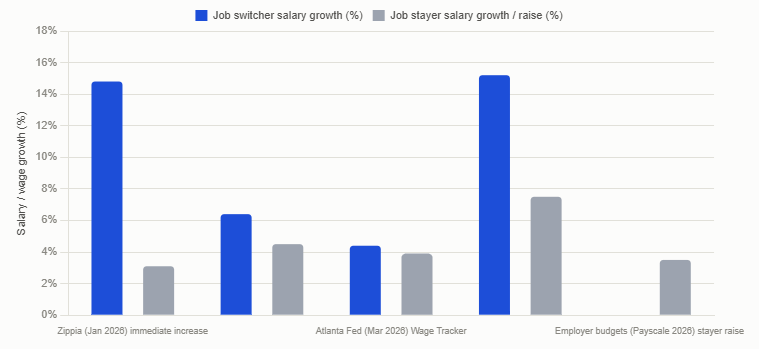
The short answer: the average salary increase from changing jobs is 14.8 percent, compared to a 3.5 percent typical annual raise for staying put (Zippia, January 2026). But the job-switching premium has narrowed significantly from its 2022 peak, when switchers were earning 15 percent median year-over-year wage growth while stayers earned 7 to 8 percent. In 2026, the gap has compressed: switchers are earning approximately 4.4 percent wage growth versus 3.9 percent for stayers, according to the Federal Reserve Bank of Atlanta’s Wage Growth Tracker (CNBC, March 2026).
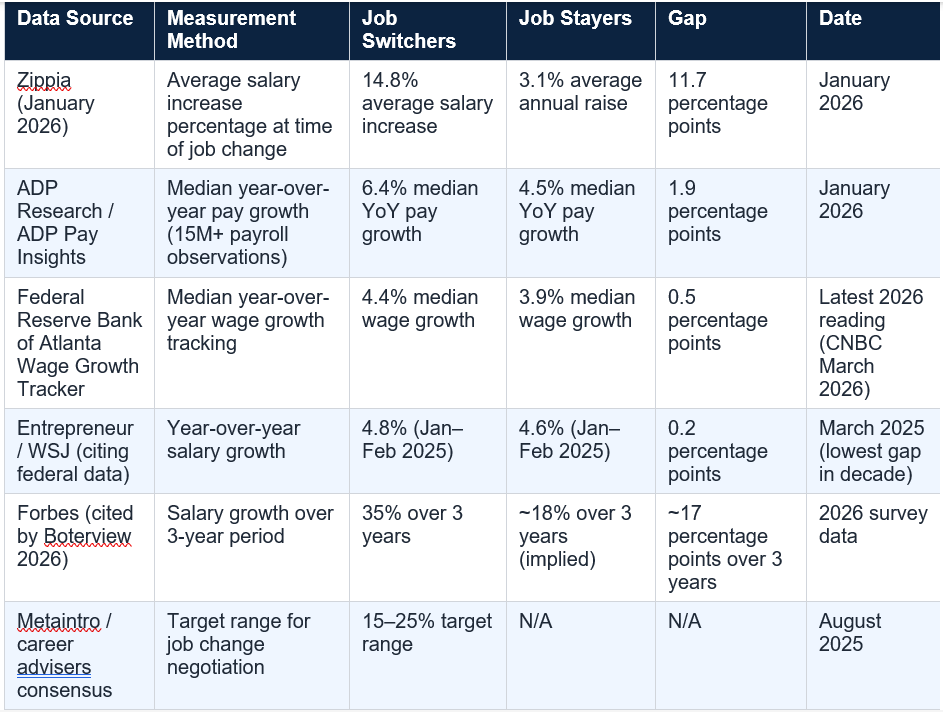
The variation across data sources reflects different methodologies: the 14.8 percent Zippia figure measures the immediate salary increase at the point of job change, not the annualised wage growth. The ADP and Atlanta Fed figures measure annualised median wage growth in the 12 months following a job change, which smooths the comparison. The Forbes 35 percent figure tracks cumulative salary growth over three years for consistent job hoppers. All three figures capture different aspects of the same fundamental truth: changing jobs accelerates salary growth substantially.
Key Insight: The different measurements are all correct — they are measuring different things. If you change jobs and immediately earn 14.8% more, that is the Zippia measure. If your pay grows 6.4% in the following 12 months (compared to 4.5% for stayers), that is the ADP measure. Over three years of strategic job hopping, total salary growth may reach 35%. The question is which measure is most useful for your specific decision.
CNBC (March 9, 2026), citing Atlanta Fed Wage Growth Tracker: While switching jobs can often lead to a higher salary, the increase is likely smaller than before. For much of 2022 and 2023, workers who changed jobs saw median year-over-year wage growth roughly 2 percentage points higher than those who stayed. That gap largely disappeared through most of 2025.
The consequence: if market rates for a given role have risen by 8 percent since an employee’s last salary negotiation (which may have been three years ago), the employee’s 3.5 percent annual raise has fallen 4.5 percentage points behind market rate each year. After three years, they are earning significantly less than an equivalent new hire would be offered. When they eventually move to a new employer, the 14.8 percent average increase often simply represents the correction back to market rate — with some additional premium for the disruption of moving.
Zippia’s analysis is explicit: individuals who remain in the same role for more than two years often see stagnation in their earnings. The 80 percent of workers who report their pay is not keeping up with inflation (The Messy Parts Podcast, April 2026, citing research data) are primarily the workers whose salaries are compounding on a pre-inflation base rather than being reset to market rates.
Job hoppers saw their salaries increase by 35 percent over a recent three-year period — nearly double that of incumbent employees, according to a Forbes survey cited by Boterview in 2026. The cumulative compounding of this difference over a 30 to 35 year career is substantial. The same research found that 64 percent of job hoppers believe switching jobs boosts their careers and salary.
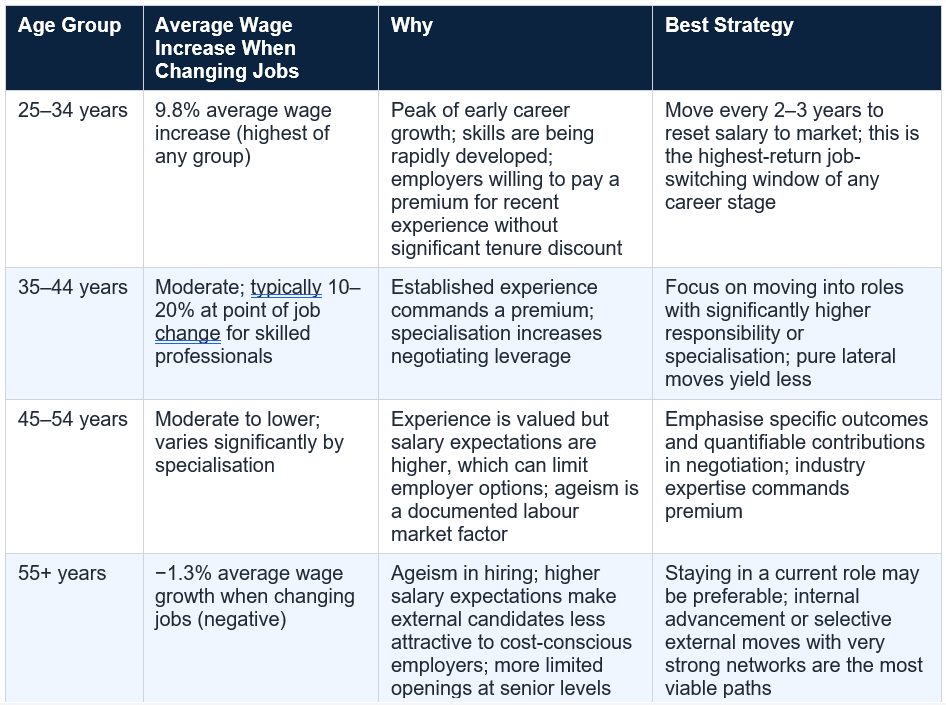
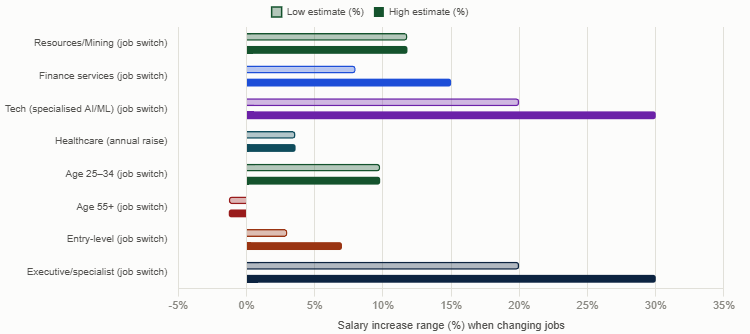
The data is particularly striking at the two extremes: workers aged 25 to 34 see the highest job-switching premium at 9.8 percent average wage increase, while workers 55 and older see negative wage growth when changing jobs on average. This generational asymmetry in job-switching returns has significant implications for career planning: the most important years to be strategically mobile are the 20s and early 30s, not the mid-career plateau.
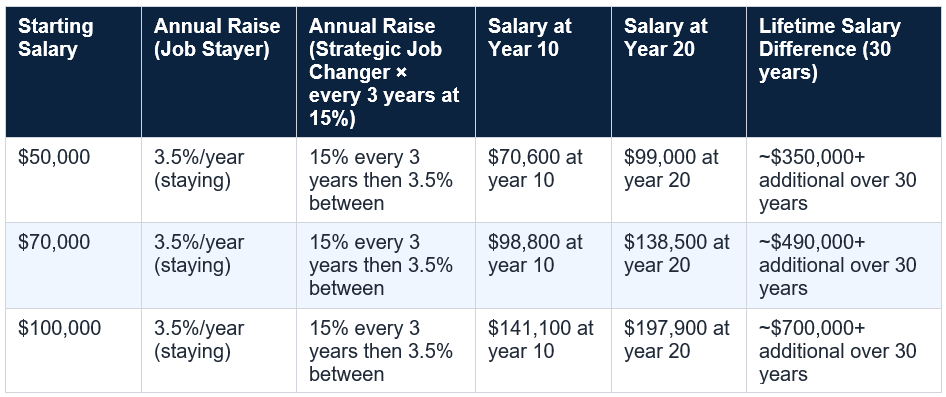
These projections are illustrative based on consistent 3.5 percent annual raises for stayers and 15 percent increases at each three-year job change followed by 3.5 percent annual raises until the next move. The lifetime salary differences are substantial — and before accounting for additional employer retirement contributions, equity grants, and other percentage-based benefits that scale with salary. The compounding effect of starting each new job at a higher base makes the total difference considerably larger than the initial job-change premium suggests.
Key Insight: The most financially powerful thing about a 15% job-change salary increase is not the 15%. It is that all future raises are applied to a base that is now 15% higher. After 10 years of 3.5% annual raises, that 15% premium has compounded to approximately 21% higher total salary than if the raise had not occurred. Each job change that sets a new, higher baseline multiplies the benefit of all subsequent raises.
The answer is yes, with critical qualifications:
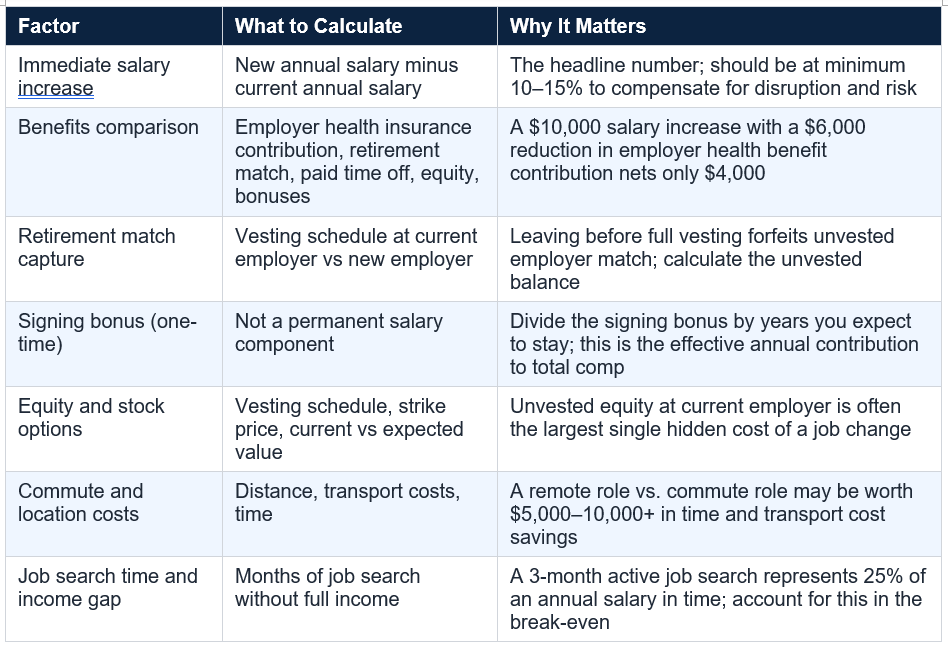
The full compensation comparison — not just base salary — is what determines whether a job change is worth it financially. A new job offering $10,000 more per year in base salary but costing $4,000 more in benefits, $3,000 more in commuting, and requiring forfeiture of $8,000 in unvested equity produces a first-year net of negative $5,000, not positive $10,000.
Watch Out: 29% of job changers report receiving a salary hike of over 30% (Zippia). But ‘salary hike’ refers to base salary only. Always model the full total compensation comparison, including benefits, equity, retirement match, and all-in cost differences, before concluding that a higher base salary makes a new role financially superior to the current one.
The case for changing jobs on salary grounds is strong in most circumstances — but not all. Staying is the better financial decision when:
The 2026 caveat is equally important: the job-switching premium has compressed from its 2021 to 2023 peak. The Atlanta Fed’s latest reading shows switchers earning 4.4 percent wage growth versus 3.9 percent for stayers — a 0.5 percentage point gap, not the 2-plus percentage point gap of two years ago. The market has cooled, competition for roles has increased, and the days of workers demanding and receiving 20 percent increases in any industry at any time are over.
What remains true: changing jobs strategically — with adequate tenure (minimum two years), in the right sectors (finance, specialised technology, resources and mining), at the right career stage (25 to 44 years old), with full total compensation analysis (not just base salary), and with rigorous negotiation — remains the highest-return per-hour financial activity available to most American workers. The salary is in the move. The skill is in timing it correctly.
Zippia's January 2026 analysis found the average salary increase when changing jobs is 14.8%, compared to an average annual raise of 3.1–3.5% for staying in the same job. However, the Federal Reserve Bank of Atlanta's Wage Growth Tracker (cited by CNBC in March 2026) shows a much smaller median year-over-year wage growth gap: approximately 4.4% for job switchers versus 3.9% for job stayers. The difference in these figures reflects different measurement methodologies: Zippia measures the immediate salary increase at the point of job change, while the Atlanta Fed measures annualised median pay growth over the following 12 months. ADP Research's January 2026 data shows job-changers at 6.4% median year-over-year pay growth versus 4.5% for stayers — a 1.9 percentage point gap.
Is job hopping still worth it in 2026 or has the premium disappeared?
The job-switching salary premium has compressed significantly from its 2021–2023 peak but has not disappeared. The Atlanta Fed gap (4.4% vs 3.9%) is much smaller than the 2022 peak (approximately 15% vs 7–8%), but the immediate salary increase at the point of job change remains meaningful: 14.8% average per Zippia January 2026. The premium is now significantly more industry- and experience-dependent. Finance, specialised technology (AI/ML, cloud, cybersecurity), and resources and mining still show strong switching premiums. Leisure and hospitality shows a negative premium — switchers earn less on average than stayers. For workers in high-demand sectors with specialised skills, job switching remains the most effective salary growth strategy available.
How often should I change jobs to maximise salary growth?
The general guidance from career advisers and data is to stay in each role for a minimum of two years. Wharton management professor Matthew Bidwell told Yahoo Finance: 'If you're systematically in jobs less than two to three years, they start to get nervous.' Two years is enough time to produce quantifiable results that strengthen negotiation leverage for the next move. Three years is the sweet spot that balances salary reset frequency (every three years at 15% produces significantly faster growth than 3.5% annual raises) with the reputational cost of appearing to be a job hopper. Career advisers at Metaintro target 15–25% salary increases at each three-year job change.
What industries offer the best salary increase when changing jobs?
According to Zippia's January 2026 data, Resources and Mining offer the highest wage increase for job switchers at 11.8%. ADP Research's February 2026 analysis found financial services delivered the biggest return from job-switching in the service sector. The finance sector was described by the Wall Street Journal (via Entrepreneur, March 2025) as the only sector unaffected by lower job-switching returns, with banks paying higher switcher salaries after record 2024 earnings. Specialised technology (AI engineers, cloud architects, cybersecurity specialists) remains strong, though general software engineering has moderated significantly since the 2022–2023 peak. Leisure and Hospitality is the worst sector for job switching — workers are better off staying put, with switchers experiencing negative wage growth on average.
How should I calculate the total value of a job change beyond base salary?
Base salary is only one component of total compensation. Before evaluating a job change financially, compare: (1) Employer health insurance contribution (a $500/month employer contribution difference = $6,000/year). (2) Employer retirement match (a 50% match on 6% of salary for a $70,000 earner = $2,100/year). (3) Unvested equity at the current employer that would be forfeited. (4) Vesting timeline at the new employer — typically 4-year standard with a 1-year cliff. (5) Signing bonus amortised over expected tenure. (6) Commute/remote work cost differences. (7) Paid time off (additional week = ~2% of salary). The 29% of job changers who report salary hikes of over 30% (Zippia) are measuring base salary; total compensation increases are typically smaller and sometimes negative when all factors are included.
Why does staying at the same job lead to lower salary growth?
Companies set salaries for new hires by benchmarking against current market rates. They set salaries for existing employees by applying percentage raises to the employee's existing salary — which may be significantly below current market rates for the role. Over two to three years, market rates for a role may rise 8–12% cumulatively while the existing employee receives 3.5% annual raises, creating a growing gap between the employee's salary and what a new hire would be offered. When the employee eventually changes jobs, the 14.8% average increase often represents salary catch-up to market rate rather than a premium above it. This is why 80% of workers report their pay is not keeping up with inflation (The Messy Parts Podcast, April 2026): staying creates a compounding under-market salary position that is only corrected by leaving.
Table of Contents
- The Most Financially Significant Career Decision You Can Make
- The Headline Number: What Changing Jobs Actually Pays in 2026
- The Historical Context: From 15% to 4.4% — What Changed
- Why Job Stayers Are Falling Behind on Salary
- How Salary Increases by Age When Changing Jobs
- How Salary Increases by Industry When Changing Jobs
- How Salary Increases by Experience Level
- The Compounding Effect: What the Lifetime Salary Gap Looks Like
- Is the Job-Switching Premium Worth It in 2026?
- What You Need to Earn to Make a Job Change Worth It
- The Hidden Costs of Changing Jobs
- The 15–25% Rule: Setting Your Salary Target
- How to Negotiate the Maximum Possible Increase
- When Staying Put Actually Wins
- Conclusion: The Salary Is in the Move — But Only if You Move Strategically
- Frequently Asked Questions
Premium Data Source
Salary Increase By Industry & Age
The Most Financially Significant Career Decision You Can Make
The single most effective pay rise available to most American workers is not the annual performance review. It is not a promotion. It is not a cost-of-living adjustment. It is changing jobs. The data on this has been consistent across multiple years, multiple data sources, and multiple economic environments: workers who change employers earn meaningfully more, on average, than workers who stay — even controlling for performance and merit.The question is not whether changing jobs pays more. It does. The question is how much more it pays in 2026 specifically, whether that premium is worth the disruption and risk, and what drives the variation between workers who gain 5 percent and workers who gain 30 percent from the same fundamental decision. This guide examines all three questions with the most current available data.
The short answer: the average salary increase from changing jobs is 14.8 percent, compared to a 3.5 percent typical annual raise for staying put (Zippia, January 2026). But the job-switching premium has narrowed significantly from its 2022 peak, when switchers were earning 15 percent median year-over-year wage growth while stayers earned 7 to 8 percent. In 2026, the gap has compressed: switchers are earning approximately 4.4 percent wage growth versus 3.9 percent for stayers, according to the Federal Reserve Bank of Atlanta’s Wage Growth Tracker (CNBC, March 2026).
The Headline Number: What Changing Jobs Actually Pays in 2026
Multiple data sources converge on a consistent picture of the job-switching pay premium in 2026, though they measure it differently:The variation across data sources reflects different methodologies: the 14.8 percent Zippia figure measures the immediate salary increase at the point of job change, not the annualised wage growth. The ADP and Atlanta Fed figures measure annualised median wage growth in the 12 months following a job change, which smooths the comparison. The Forbes 35 percent figure tracks cumulative salary growth over three years for consistent job hoppers. All three figures capture different aspects of the same fundamental truth: changing jobs accelerates salary growth substantially.
Key Insight: The different measurements are all correct — they are measuring different things. If you change jobs and immediately earn 14.8% more, that is the Zippia measure. If your pay grows 6.4% in the following 12 months (compared to 4.5% for stayers), that is the ADP measure. Over three years of strategic job hopping, total salary growth may reach 35%. The question is which measure is most useful for your specific decision.
The Historical Context: From 15% to 4.4% — What Changed
To understand 2026 job-switching pay data accurately, it is essential to understand where it came from. The 2021 to 2022 labour market produced an extraordinary job-switching premium that created unrealistic expectations about the value of changing employers. ADP Pay Insights data, cited by Statista in April 2025, shows that median year-over-year pay growth for job switchers was above 15 percent for most of 2022, while stayers earned 7 to 8 percent. This was a historically anomalous environment driven by:- The Great Resignation: millions of workers voluntarily left roles, forcing employers to compete aggressively on salary for replacement hires.
- Record job openings: JOLTS data showed over 11 million job openings at the 2022 peak — nearly double the available unemployed workers.
- Inflation driving wage demands: workers demanded and received higher wages to compensate for the highest inflation in 40 years.
- Remote work expanding the talent pool: workers could apply for roles in any geography, increasing competitive pressure on employers nationally.
CNBC (March 9, 2026), citing Atlanta Fed Wage Growth Tracker: While switching jobs can often lead to a higher salary, the increase is likely smaller than before. For much of 2022 and 2023, workers who changed jobs saw median year-over-year wage growth roughly 2 percentage points higher than those who stayed. That gap largely disappeared through most of 2025.
Why Job Stayers Are Falling Behind on Salary
The gap between job-switcher and job-stayer earnings is not primarily about the absolute salary at any given moment. It is about the compound effect of salary benchmarking. When a company sets salaries for new hires, it benchmarks against the current external market rate for the role. When a company sets the annual raise for an existing employee, it benchmarks against the employee’s current salary.The consequence: if market rates for a given role have risen by 8 percent since an employee’s last salary negotiation (which may have been three years ago), the employee’s 3.5 percent annual raise has fallen 4.5 percentage points behind market rate each year. After three years, they are earning significantly less than an equivalent new hire would be offered. When they eventually move to a new employer, the 14.8 percent average increase often simply represents the correction back to market rate — with some additional premium for the disruption of moving.
Zippia’s analysis is explicit: individuals who remain in the same role for more than two years often see stagnation in their earnings. The 80 percent of workers who report their pay is not keeping up with inflation (The Messy Parts Podcast, April 2026, citing research data) are primarily the workers whose salaries are compounding on a pre-inflation base rather than being reset to market rates.
Job hoppers saw their salaries increase by 35 percent over a recent three-year period — nearly double that of incumbent employees, according to a Forbes survey cited by Boterview in 2026. The cumulative compounding of this difference over a 30 to 35 year career is substantial. The same research found that 64 percent of job hoppers believe switching jobs boosts their careers and salary.
How Salary Increases by Age When Changing Jobs
The salary increase from changing jobs is not uniform across age groups. Zippia’s January 2026 analysis of salary data by age group reveals a striking pattern:The data is particularly striking at the two extremes: workers aged 25 to 34 see the highest job-switching premium at 9.8 percent average wage increase, while workers 55 and older see negative wage growth when changing jobs on average. This generational asymmetry in job-switching returns has significant implications for career planning: the most important years to be strategically mobile are the 20s and early 30s, not the mid-career plateau.
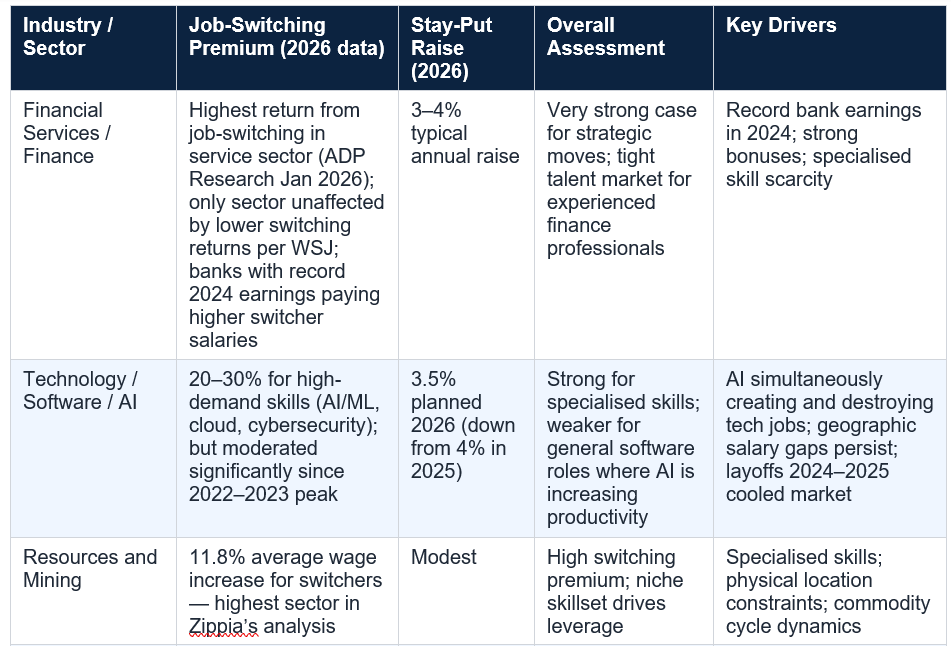
How Salary Increases by Industry When Changing Jobs
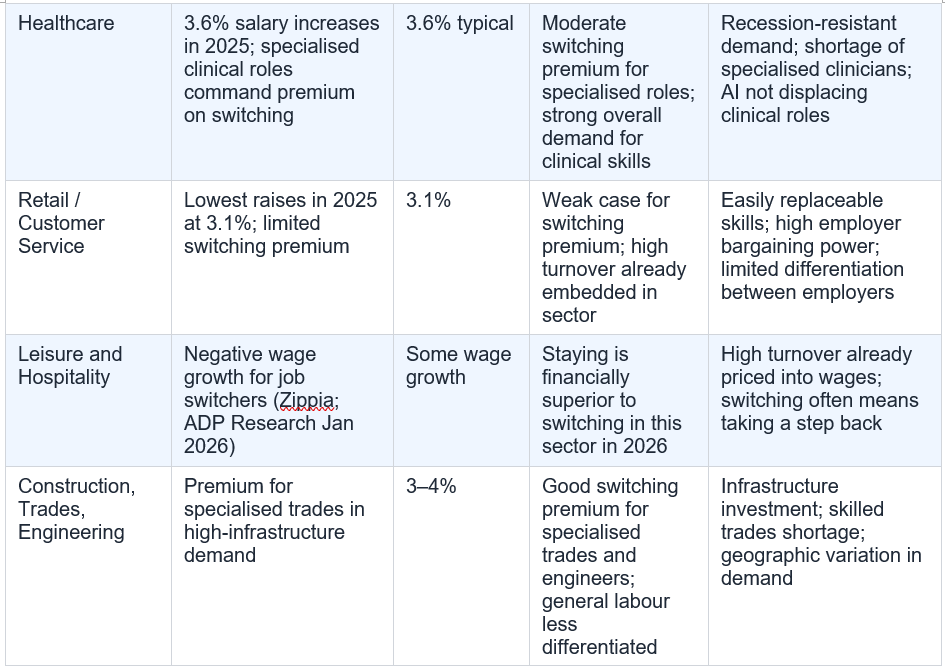
Industry is the most significant determinant of the job-switching pay premium after experience level. The variation across sectors is substantial:
How Salary Increases by Experience Level
Entry-level, mid-career, and senior professionals experience the job-switching premium very differently:- Entry-level (0–3 years experience): average 3 to 7 percent increase when changing jobs. Skills are not yet sufficiently differentiated to command significant premiums. The most effective strategy at this stage is moving for title advancement rather than pure salary — a promotion that comes with 10 percent is worth more than a lateral move for 5 percent because it resets the salary negotiation base at a higher title.
- Mid-career (4–10 years experience): the sweet spot for job-switching returns. Specific domain expertise and quantifiable track records command significant premiums. The 10 to 20 percent range is most common; high-demand specialisations can achieve 20 to 30 percent.
- Senior / executive (10+ years): executives and specialised workers can negotiate 20 to 30 percent increases (Marketing Scoop). However, the positions available at this level are fewer, the hiring processes are longer, and the cultural fit requirement is more demanding. Specialised expertise that is genuinely difficult to replace is the key leverage factor.
The Compounding Effect: What the Lifetime Salary Gap Looks Like
The true financial case for strategic job changes is not the immediate pay increase. It is the compounding effect of a higher salary base on all future raises. Every percentage raise, every bonus calculated as a percentage of salary, every equity grant based on compensation level, every employer retirement contribution as a percentage of pay — all of these scale with the salary base that was established by the last negotiation.These projections are illustrative based on consistent 3.5 percent annual raises for stayers and 15 percent increases at each three-year job change followed by 3.5 percent annual raises until the next move. The lifetime salary differences are substantial — and before accounting for additional employer retirement contributions, equity grants, and other percentage-based benefits that scale with salary. The compounding effect of starting each new job at a higher base makes the total difference considerably larger than the initial job-change premium suggests.
Key Insight: The most financially powerful thing about a 15% job-change salary increase is not the 15%. It is that all future raises are applied to a base that is now 15% higher. After 10 years of 3.5% annual raises, that 15% premium has compounded to approximately 21% higher total salary than if the raise had not occurred. Each job change that sets a new, higher baseline multiplies the benefit of all subsequent raises.
Is the Job-Switching Premium Worth It in 2026?
The compression of the job-switching premium in 2026 — from 2 percentage points above stayers in 2022–2023 to 0.5 percentage points in the latest Atlanta Fed data — raises a legitimate question: is switching jobs still worth it in the current environment?The answer is yes, with critical qualifications:
- The immediate salary increase (14.8% at point of change per Zippia) has not compressed as dramatically as the annualised wage growth comparison suggests. The wage growth gap reflects both a cooling market and the fact that many 2022–2023 switchers over-negotiated relative to market and are now in roles with limited upside for the next annual review.
- The compounding baseline effect makes the immediate switch premium valuable regardless of the annual growth rate comparison.
- Industry matters enormously: finance, specialised technology, and resources and mining still show strong switching premiums. Leisure and hospitality shows a negative premium — workers in that sector are better off staying.
- The cooling labour market means longer job search timelines, more competition, and more selectivity from employers. The time cost of a job search in 2026 is higher than in 2021–2022. This changes the break-even calculation.
What You Need to Earn to Make a Job Change Worth It
Not all job changes produce salary increases. According to Zippia’s data, while 49 percent of job changers receive a pay increase, a meaningful minority experience flat or lower compensation after moving. The calculation of ‘what makes a job change worth it financially’ requires accounting for the full picture:The full compensation comparison — not just base salary — is what determines whether a job change is worth it financially. A new job offering $10,000 more per year in base salary but costing $4,000 more in benefits, $3,000 more in commuting, and requiring forfeiture of $8,000 in unvested equity produces a first-year net of negative $5,000, not positive $10,000.
Watch Out: 29% of job changers report receiving a salary hike of over 30% (Zippia). But ‘salary hike’ refers to base salary only. Always model the full total compensation comparison, including benefits, equity, retirement match, and all-in cost differences, before concluding that a higher base salary makes a new role financially superior to the current one.
1The Hidden Costs of Changing Jobs
The financial analysis of a job change cannot be limited to the salary comparison. Several categories of cost consistently surprise job changers:- Unvested equity: if you hold restricted stock units or options with a vesting schedule, leaving before full vesting forfeits the unvested portion. For tech workers with standard four-year vesting schedules, leaving at the two-year mark could forfeit 50 percent of the original grant. Calculate the specific dollar value of what you would be walking away from.
- Retirement contribution lag: the first 90 days at a new employer are often an exclusion period before retirement plan participation begins. This means losing 3 months of employer contributions that would have accumulated at the current employer.
- Probationary period vulnerabilities: the first 90 days at a new employer are a period of higher termination risk. In an environment where LinkedIn application volume rose 45 percent between 2024 and 2025 (signalling employer leverage), new hires have limited protections in their first months.
- Tax year implications: a signing bonus received in December 2026 is taxed as ordinary income in 2026, potentially pushing the recipient into a higher marginal tax bracket for that year.
- Counter-offer complications: accepting a counter-offer from a current employer after tendering resignation preserves current compensation but typically does not address the underlying reasons for job searching and may signal to management that the employee is a flight risk.
The 15–25% Rule: Setting Your Salary Target
Career advisers and salary negotiation experts have converged on a target range of 15 to 25 percent as the appropriate salary increase to target when changing jobs in 2025–2026 (Metaintro, August 2025). This range accounts for:- Inflation compensation: with US inflation running approximately 2 to 3 percent in late 2025 and cumulative inflation of 18 to 21 percent over the preceding four years, a 15 to 25 percent increase captures both real wage growth and market rate correction.
- Foregone stayer raises: a 3.5 percent annual raise compounded over two years produces approximately 7 percent total. A 15 to 25 percent job-change increase captures the raises not received plus the additional premium for moving.
- Risk premium: a job change involves disruption, cultural adjustment, learning curve, and the risk that the new role is not as represented. A 15 to 25 percent premium is the minimum that makes this risk worthwhile for most workers.
13. How to Negotiate the Maximum Possible Increase
The salary offered in a job change is not the salary available. The first offer is a starting point, not a constraint. The evidence consistently shows that the majority of first offers have upward flexibility:- Always negotiate: 70 percent of employers have room to negotiate salary; most candidates do not push back on the first offer. The discomfort of negotiation has an extremely high expected return.
- Use competing offers as leverage: if you have multiple offers, use them. A competing offer is the most powerful negotiating tool available. Even without a competing offer, referencing market data for the role establishes that the ask is grounded in evidence, not ambition.
- Negotiate total compensation, not just salary: if salary is genuinely capped, negotiate on signing bonus, additional vacation time, remote work flexibility, equity, or faster vesting. These have real dollar value that salary alone does not capture.
- Get all terms in writing before giving notice: verbal offers are not binding. Confirm the full compensation package — salary, bonus target, equity grant, vesting schedule, benefits — in writing before resigning from the current role.
- Know the timeline of offers: hiring managers are motivated to close candidates quickly. Using this momentum to negotiate efficiently — within 24 to 48 hours of receiving an offer — often produces better outcomes than extended back-and-forth.
The case for changing jobs on salary grounds is strong in most circumstances — but not all. Staying is the better financial decision when:
- You are close to full vesting of significant equity or retirement contributions. A $50,000 unvested RSU grant that vests in 8 months is a compelling reason to wait.
- The job-switching premium in your sector is negative. ADP Research and Zippia both show leisure and hospitality as sectors where switchers earn less on average than stayers. This is the structural reality of high-turnover, commoditised-skill sectors.
- You are 55 or older and would face the documented −1.3 percent average wage decline that Zippia’s data shows for older workers changing jobs. The ageism premium is real and must be factored into the decision.
- The current employer is offering significant opportunities for advancement or specialisation that external employers are not. Title advancement and skill development matter as much as base salary for the 10-year trajectory.
- The labour market in your specific sector is significantly employer-favoured at the moment. With LinkedIn applications up 45 percent, hiring timelines have extended and employer leverage has increased. A job search that takes six months of effort and opportunity cost may produce a marginal salary improvement that the effort does not justify.
Conclusion
The data is clear: changing jobs produces meaningfully higher salary growth than staying put across most industries, most experience levels, and most economic environments. The 14.8 percent average salary increase at the point of job change versus 3.5 percent annual raises for stayers is a 4.2-times difference that compounds significantly over a career. The Forbes survey data showing job hoppers earning 35 percent more over three years versus roughly half that for incumbents captures the cumulative power of this effect.The 2026 caveat is equally important: the job-switching premium has compressed from its 2021 to 2023 peak. The Atlanta Fed’s latest reading shows switchers earning 4.4 percent wage growth versus 3.9 percent for stayers — a 0.5 percentage point gap, not the 2-plus percentage point gap of two years ago. The market has cooled, competition for roles has increased, and the days of workers demanding and receiving 20 percent increases in any industry at any time are over.
What remains true: changing jobs strategically — with adequate tenure (minimum two years), in the right sectors (finance, specialised technology, resources and mining), at the right career stage (25 to 44 years old), with full total compensation analysis (not just base salary), and with rigorous negotiation — remains the highest-return per-hour financial activity available to most American workers. The salary is in the move. The skill is in timing it correctly.
Frequently Asked Questions
What is the average salary increase when changing jobs in 2026?Zippia's January 2026 analysis found the average salary increase when changing jobs is 14.8%, compared to an average annual raise of 3.1–3.5% for staying in the same job. However, the Federal Reserve Bank of Atlanta's Wage Growth Tracker (cited by CNBC in March 2026) shows a much smaller median year-over-year wage growth gap: approximately 4.4% for job switchers versus 3.9% for job stayers. The difference in these figures reflects different measurement methodologies: Zippia measures the immediate salary increase at the point of job change, while the Atlanta Fed measures annualised median pay growth over the following 12 months. ADP Research's January 2026 data shows job-changers at 6.4% median year-over-year pay growth versus 4.5% for stayers — a 1.9 percentage point gap.
Is job hopping still worth it in 2026 or has the premium disappeared?
The job-switching salary premium has compressed significantly from its 2021–2023 peak but has not disappeared. The Atlanta Fed gap (4.4% vs 3.9%) is much smaller than the 2022 peak (approximately 15% vs 7–8%), but the immediate salary increase at the point of job change remains meaningful: 14.8% average per Zippia January 2026. The premium is now significantly more industry- and experience-dependent. Finance, specialised technology (AI/ML, cloud, cybersecurity), and resources and mining still show strong switching premiums. Leisure and hospitality shows a negative premium — switchers earn less on average than stayers. For workers in high-demand sectors with specialised skills, job switching remains the most effective salary growth strategy available.
How often should I change jobs to maximise salary growth?
The general guidance from career advisers and data is to stay in each role for a minimum of two years. Wharton management professor Matthew Bidwell told Yahoo Finance: 'If you're systematically in jobs less than two to three years, they start to get nervous.' Two years is enough time to produce quantifiable results that strengthen negotiation leverage for the next move. Three years is the sweet spot that balances salary reset frequency (every three years at 15% produces significantly faster growth than 3.5% annual raises) with the reputational cost of appearing to be a job hopper. Career advisers at Metaintro target 15–25% salary increases at each three-year job change.
What industries offer the best salary increase when changing jobs?
According to Zippia's January 2026 data, Resources and Mining offer the highest wage increase for job switchers at 11.8%. ADP Research's February 2026 analysis found financial services delivered the biggest return from job-switching in the service sector. The finance sector was described by the Wall Street Journal (via Entrepreneur, March 2025) as the only sector unaffected by lower job-switching returns, with banks paying higher switcher salaries after record 2024 earnings. Specialised technology (AI engineers, cloud architects, cybersecurity specialists) remains strong, though general software engineering has moderated significantly since the 2022–2023 peak. Leisure and Hospitality is the worst sector for job switching — workers are better off staying put, with switchers experiencing negative wage growth on average.
How should I calculate the total value of a job change beyond base salary?
Base salary is only one component of total compensation. Before evaluating a job change financially, compare: (1) Employer health insurance contribution (a $500/month employer contribution difference = $6,000/year). (2) Employer retirement match (a 50% match on 6% of salary for a $70,000 earner = $2,100/year). (3) Unvested equity at the current employer that would be forfeited. (4) Vesting timeline at the new employer — typically 4-year standard with a 1-year cliff. (5) Signing bonus amortised over expected tenure. (6) Commute/remote work cost differences. (7) Paid time off (additional week = ~2% of salary). The 29% of job changers who report salary hikes of over 30% (Zippia) are measuring base salary; total compensation increases are typically smaller and sometimes negative when all factors are included.
Why does staying at the same job lead to lower salary growth?
Companies set salaries for new hires by benchmarking against current market rates. They set salaries for existing employees by applying percentage raises to the employee's existing salary — which may be significantly below current market rates for the role. Over two to three years, market rates for a role may rise 8–12% cumulatively while the existing employee receives 3.5% annual raises, creating a growing gap between the employee's salary and what a new hire would be offered. When the employee eventually changes jobs, the 14.8% average increase often represents salary catch-up to market rate rather than a premium above it. This is why 80% of workers report their pay is not keeping up with inflation (The Messy Parts Podcast, April 2026): staying creates a compounding under-market salary position that is only corrected by leaving.
0 Comments
Be the first to share your thoughts on this article.