

Professional & Career Development
Is University Worth It in the Gig and AI Economy?

Table of Contents
- Introduction
- What the Data Still Shows: The College Earnings Premium
- But the Averages Hide the Real Story: It Depends Enormously on What and Where
- Lifetime Earnings and Breakeven Comparison Across Paths
- The Gig Economy Dimension: A Genuine Alternative, With Real Trade-Offs
- The AI Disruption: What's Genuinely Changing About Entry-Level Work
- The Social and Creator Economy: A Narrow but Real Path
- A Practical Decision Framework for Today's Environment
- Conclusion
- Frequently Asked Questions (FAQ)
- External References & Further Reading
For most of the 20th century, the calculation was simple: a four-year university degree was the single most reliable path to a stable, well-paid career. Borrow what you need, study for four years, graduate, and a clear earnings premium awaited on the other side. That calculation is no longer simple — and for an entire generation weighing this decision today, it may not even be the right framework at all.
Three forces have converged to upend the traditional university value proposition. First, the financial cost: the average four-year public university education now totals approximately $108,000, and the average borrower graduates with $38,375 in student debt, against a backdrop of $1.75 trillion in total US student loan debt. Second, the rise of the gig and creator economy, which has demonstrated that meaningful income — sometimes substantial income — can be built without a degree, through freelancing, content creation, e-commerce, and skilled trades. Third, and most disruptively, the emergence of generative AI, which is already reshaping which skills command a wage premium and which entry-level, degree-gated jobs may not exist in their current form within a decade.
This guide examines the university decision through the lens of these three forces, using current data rather than nostalgia or assumption. It presents the actual lifetime earnings data, breaks down what is changing about entry-level hiring in an AI-influenced labour market, evaluates the legitimate alternatives that did not exist a generation ago, and provides a practical framework for making this decision based on your specific field of study, financial situation, and career goals — because the honest answer is no longer the same for everyone.
What the Data Still Shows: The College Earnings Premium
Despite the genuine disruption underway, the aggregate statistical case for a four-year degree remains measurably positive — a fact that often gets lost in the broader cultural debate about whether college is 'still worth it.'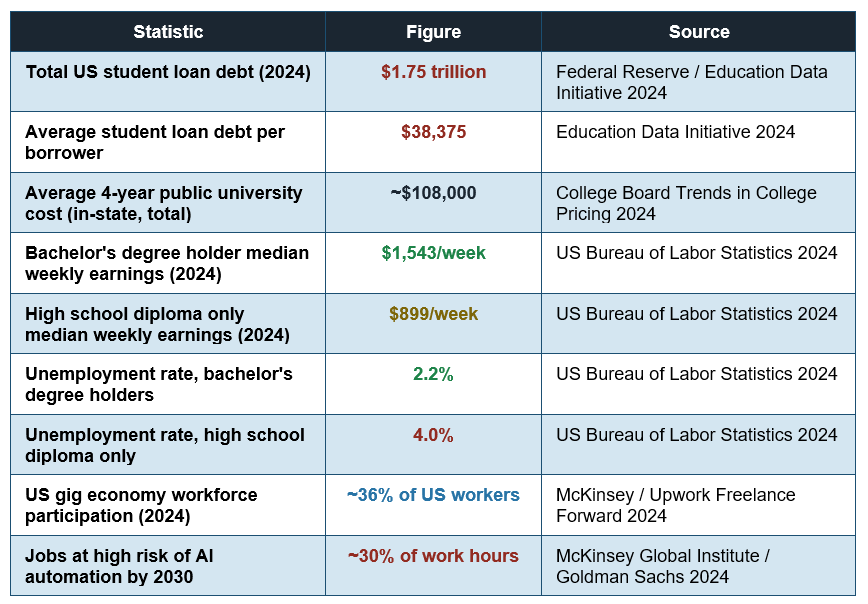
The earnings gap between degree holders and non-degree holders remains substantial and has not meaningfully narrowed despite a decade of debate about credential inflation and alternative pathways. Bachelor's degree holders earn a median of $1,543 per week compared to $899 for those with only a high school diploma — a 72% earnings premium that compounds significantly over a career. The unemployment rate gap (2.2% versus 4.0%) further demonstrates that, in aggregate, a degree continues to provide meaningful labour market protection.
College earnings premium over a career: +72% weekly earnings — Bachelor's degree holders earn $1,543/week versus $899/week for high school diploma holders — a gap that compounds to roughly $1.2 million in additional lifetime earnings on average (BLS 2024)
But the Averages Hide the Real Story: It Depends Enormously on What and Where
The aggregate statistics above are real, but they obscure a critical truth: the value of a degree varies enormously by field of study, institution, and how it is financed. A computer science or nursing graduate from a respected public university with manageable debt faces a fundamentally different financial outcome than a humanities graduate from an expensive private institution financed entirely through loans.Research from the Federal Reserve Bank of New York and Georgetown's Center on Education and the Workforce consistently shows that engineering, computer science, nursing, and other STEM and healthcare fields produce a return on investment that comfortably justifies the time and cost involved, frequently recouping the full cost of the degree within 5-10 years of graduation through earnings premiums. Conversely, certain humanities, fine arts, and some social science degrees from expensive institutions show meaningfully longer payback periods — in some calculated cases, decades — particularly when significant debt is involved.
The field-of-study reality: A 2023 Georgetown CEW analysis found that the gap in lifetime earnings between the highest-paying and lowest-paying bachelor's degree fields exceeds $3.4 million — larger than the average gap between having a degree at all versus not having one. The question 'is a degree worth it' is statistically less important than the question 'is THIS degree, at THIS cost, worth it for THIS career path.'
Lifetime Earnings and Breakeven Comparison Across Paths
The table below compares average lifetime earnings, total cost, and net financial premium across the major educational and career pathway options available today: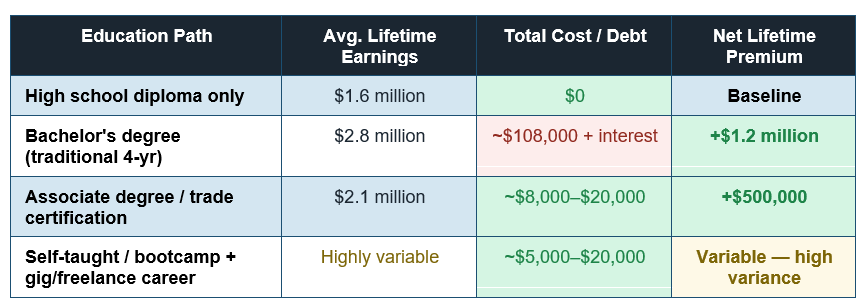
This comparison reveals an important nuance often missing from the polarised 'college vs no college' debate: trade certifications and associate degrees frequently deliver a strong return on a much smaller upfront investment, while the self-taught and gig/freelance path shows the highest variance of any option — some individuals build substantial, even extraordinary, careers without formal credentials, while others struggle with income instability and a lack of the structured skill development and credentialing that employers in many fields still require.
The Gig Economy Dimension: A Genuine Alternative, With Real Trade-Offs
Approximately 36% of the US workforce now participates in some form of gig or freelance work, according to McKinsey and Upwork's 2024 Freelance Forward research — a structural shift that has created legitimate income-generating pathways entirely outside the traditional degree-and-employer model. Successful freelance developers, designers, marketers, consultants, and content creators can and do build substantial six-figure incomes without a university credential, particularly in digital skills where portfolios and demonstrated results matter more to clients than formal qualifications.However, the gig economy comes with structural trade-offs that the popular narrative around 'beating the system' frequently understates. Gig workers typically lack employer-sponsored health insurance, retirement matching, paid leave, and the income stability that traditional employment provides. Income volatility is a genuine and persistent challenge: research from the Federal Reserve's Survey of Household Economics and Decisionmaking shows gig workers report higher rates of income unpredictability and financial stress than traditionally employed workers, even at comparable income levels.
The gig economy is best understood not as a universal replacement for a degree, but as a genuinely viable alternative pathway for individuals with strong self-discipline, a marketable digital skill, and the temperament to manage income volatility and self-directed benefits planning — characteristics that are not universal, even among ambitious young people.
The AI Disruption: What's Genuinely Changing About Entry-Level Work
The most significant and least understood force reshaping the university value calculation is generative AI's impact on entry-level, degree-gated white-collar work — precisely the jobs that a traditional bachelor's degree has historically been the credential for accessing.McKinsey Global Institute and Goldman Sachs research both estimate that approximately 30% of current work hours across the US economy could be automated by AI technologies by 2030, with the heaviest impact concentrated in tasks involving information synthesis, basic analysis, drafting, and administrative coordination — precisely the tasks that have traditionally formed the bulk of entry-level graduate roles in fields like paralegal work, junior financial analysis, basic copywriting, and administrative coordination.
This creates a genuinely new strategic consideration that did not exist for previous generations evaluating the university decision: it is not enough to ask whether a field currently pays well; the more important question is whether the specific skills developed during a degree program will remain differentiated and valuable as AI capability continues to advance. Fields requiring genuine human judgment under uncertainty, complex interpersonal skills, hands-on physical expertise, and the ability to direct and evaluate AI output rather than simply perform tasks AI can now do are showing more resilience in current labour market data than fields focused primarily on information processing and routine analysis.
Work hours at risk of AI automation by 2030: ~30% of current work hours — concentrated heavily in entry-level analytical and administrative tasks — precisely the roles many degree programs have traditionally prepared graduates to enter first (McKinsey Global Institute / Goldman Sachs 2024)
- The skills-resilience reframe: The most strategically sound response to AI disruption is not necessarily avoiding university, but choosing fields and skill development deliberately oriented toward AI-complementary capabilities — critical evaluation of AI output, complex judgment, interpersonal and leadership skills, and hands-on technical or physical expertise — rather than fields whose core value proposition is routine information processing that AI tools increasingly perform faster and more cheaply.
The Social and Creator Economy: A Narrow but Real Path
The rise of the creator and social media economy has introduced a third alternative pathway into the university decision calculus — building an audience and monetising content, influence, or community directly, without traditional employment or formal education as an intermediary step. This path has produced genuine, well-documented financial success stories across content creation, e-commerce, affiliate marketing, and online education.However, this pathway shows the highest variance and lowest probability of meaningful success of any option discussed in this guide. Industry analysis consistently shows that a very small percentage of content creators earn a full-time, sustainable income from their content — the large majority earn negligible amounts despite significant time investment. The creator economy should be evaluated as a high-variance entrepreneurial pursuit with a low base rate of significant financial success, not as a reliable alternative income pathway comparable to a structured career path, whether that path runs through university or a trade.
A Practical Decision Framework for Today's Environment
Given this more complex landscape, the following framework provides a structured way to evaluate the university decision for your specific circumstances:- Research the specific ROI data for your intended field, not college in general: Use resources such as the Georgetown CEW's College Scorecard data, the Department of Education's College Scorecard tool, and Bureau of Labor Statistics occupational data to find the actual earnings and employment outcomes for your specific intended major and target institutions.
- Calculate your realistic total debt and repayment burden: Use your specific institution's cost of attendance, expected financial aid, and family contribution to project your actual likely debt — not the national average — and model your monthly repayment against realistic entry-level salary expectations in your field.
- Assess whether your target field is AI-resilient or AI-exposed: Honestly evaluate whether the core skills of your intended career path emphasise human judgment, interpersonal capability, and hands-on expertise (more resilient) or routine information processing and analysis (more exposed to disruption over your career timeline).
- Consider hybrid and lower-cost pathways seriously: Community college transfer programs, in-state public universities, co-op and apprenticeship-integrated degree programs, and trade certifications in skilled fields all offer meaningfully different cost-and-return profiles worth comparing directly against the traditional four-year residential university path.
- Evaluate your personal risk tolerance and self-direction honestly: The gig and creator economy pathways require genuine self-discipline, comfort with income volatility, and self-directed benefits and retirement planning. Be honest about whether this matches your temperament before treating it as a primary strategy rather than a supplementary option.
Conclusion
The honest answer to whether university is still worth the student loan and four years is: it depends, more than at any point in recent history, on specifics that previous generations could largely take for granted. The aggregate data continues to show a meaningful earnings and employment premium for degree holders — but that premium varies enormously by field of study, institution cost, and how effectively the resulting skills withstand the genuine disruption underway from AI and the restructuring of entry-level work.The gig, social, and creator economy have created legitimate alternative pathways that did not exist for previous generations, but they come with real trade-offs in income stability, benefits, and probability of significant financial success that deserve honest evaluation rather than uncritical enthusiasm. Meanwhile, the disruption AI is bringing to entry-level white-collar work means that the traditional assumption — that a degree credential alone guarantees access to a stable career ladder — requires more scrutiny than it once did, regardless of which path you choose.
The students and families who will navigate this decision most successfully are not those who default to the traditional path out of habit, nor those who reject it out of contrarian enthusiasm for alternative pathways — they are those who research the specific, current data for their intended field, calculate their actual financial exposure honestly, and choose a path deliberately aligned with both their genuine interests and the skills likely to remain valuable as the broader economy continues to be reshaped by automation and changing models of work. That is a more demanding analysis than the conventional wisdom of a generation ago — but it is the analysis this moment in the economy genuinely requires.
Frequently Asked Questions (FAQ)
Which college majors have the best return on investment in 2024?
Engineering, computer science, nursing, and other healthcare fields consistently show the strongest return on investment, according to Georgetown CEW and Department of Education College Scorecard data, typically recouping the full cost of the degree within 5-10 years through earnings premiums. Business, finance, and certain applied sciences also show strong returns at most institutions. Fields with the longest payback periods tend to be those combining lower median starting salaries with higher institutional costs — researching specific institutional outcomes data for your intended major, rather than relying on general field reputation, is essential.Can you really make a good living in the gig economy without a degree?
Yes, for a meaningful subset of workers — particularly those with marketable digital skills such as software development, design, digital marketing, or specialised consulting expertise. However, this is not a guaranteed or even typical outcome; income volatility, the absence of employer-sponsored benefits, and the self-discipline required for self-directed income generation represent genuine challenges that affect a majority of gig workers more than the success stories suggest. The gig economy is best evaluated as a viable alternative for individuals with a specific marketable skill and an appropriate risk tolerance, not as a universally accessible replacement for traditional education and employment.Will AI make a college degree obsolete?
Current evidence does not support the conclusion that AI will make degrees obsolete, but it strongly suggests that the value of specific skills and fields of study is shifting. Fields emphasising routine information processing, basic analysis, and tasks AI can increasingly perform are showing more vulnerability to disruption, while fields emphasising complex human judgment, interpersonal skills, hands-on technical expertise, and the ability to direct and evaluate AI systems are showing more resilience. The strategic response is choosing fields and skill development deliberately, not avoiding higher education altogether.What are the best low-cost alternatives to a traditional 4-year degree?
Strong alternatives include: community college transfer programs that complete general education at a fraction of university cost before transferring to complete a bachelor's degree; trade and vocational certifications in fields such as electrical work, plumbing, HVAC, and skilled manufacturing, which frequently show strong lifetime earnings relative to cost; coding bootcamps and technical certifications for software development and related digital fields; and apprenticeship-integrated degree programs (increasingly common in the UK and growing in the US) that combine paid work experience with formal education, eliminating much of the debt burden associated with traditional residential university attendance.How much student debt is considered 'reasonable' relative to expected earnings?
A widely cited guideline from financial aid experts is that total student loan debt at graduation should not exceed your expected first-year starting salary in your chosen field — and ideally significantly less. Using this benchmark, a student expecting to earn $50,000 in their first job after graduation should aim to keep total debt below $50,000, and ideally well below that figure to maintain a manageable debt-to-income ratio during early career years when income growth is still developing. Borrowing significantly more than this benchmark substantially increases financial risk and the likelihood that loan repayment will meaningfully constrain other financial goals for years after graduation.External References
The following authoritative sources were used in researching this article and are recommended for further reading:1. US Bureau of Labor Statistics — Education Pays: Earnings and Unemployment by Educational Attainment
https://www.bls.gov/emp/chart-unemployment-earnings-education.htm
2. Georgetown University Center on Education and the Workforce — The College Payoff
https://cew.georgetown.edu/cew-reports/collegepayoff2021/
3. College Board — Trends in College Pricing and Student Aid 2024
https://research.collegeboard.org/trends/college-pricing
4. US Department of Education — College Scorecard
https://collegescorecard.ed.gov/
5. McKinsey Global Institute — Generative AI and the Future of Work in America
https://www.mckinsey.com/mgi/our-research/generative-ai-and-the-future-of-work-in-america
6. Upwork — Freelance Forward 2024: The US Independent Workforce Report
https://www.upwork.com/research/freelance-forward-2024
7. Federal Reserve — Report on the Economic Well-Being of US Households
https://www.federalreserve.gov/publications/report-economic-well-being-us-households.htm
8. Goldman Sachs Research — The Potentially Large Effects of Artificial Intelligence on Economic Growth
https://www.goldmansachs.com/insights/articles/generative-ai-could-raise-global-gdp-by-7-percent
0 Comments
Be the first to share your thoughts on this article.