
Vehicles & Cars
UK Car Accident Compensation: How Payments Work in 2026

Table of Contents
- The System Most Drivers Never Need Until They Do
- The Two Types of Compensation: General Damages and Special Damages
- Who Pays? Understanding Liability in Car Claims
- The Two Claim Routes: OIC Portal vs. Traditional Litigation
- The Whiplash Tariff: Updated for 2025 and What It Means
- Compensation Amounts: What Typical Cases Are Worth
- The Step-by-Step Claims Process
- No Win No Fee: How It Works and What It Costs
- Time Limits: The Three-Year Rule (and Its Exceptions)
- Special Situations: Uninsured Drivers, Passengers, Children, and Hit-and-Run
- Practical Tips for Maximising Your Claim
- Conclusion: Know Your Rights Before You Need Them
- Frequently Asked Questions
- External References and Further Reading
The System Most Drivers Never Need Until They Do
In 2024, 1,671 people were killed on UK roads and a further 28,804 were seriously injured, according to official STATS19 data. The Compensation Recovery Unit recorded 348,806 motor injury claims in the year to March 2024. Road traffic accidents account for around half of all personal injury claims in the UK. Yet despite these numbers, the Association of British Insurers estimates that only around 30 percent of people injured in collisions actually make a claim — meaning the vast majority of those entitled to compensation never receive it.Car accident compensation in the UK is a structured legal system with specific rules, timelines, and procedures that most people have no reason to know about until they find themselves needing them. This article explains the entire system clearly: the two types of compensation available, who pays, how claims are made, what amounts are typical, how the no win no fee arrangement works, and what special circumstances apply when the other driver is uninsured, when children are involved, or when a hit-and-run driver cannot be identified.
Whether you have just been in an accident, are supporting someone who has, or simply want to understand your rights before you ever need them, this guide covers the UK car compensation payment system as it currently operates in 2026, including the 2025 whiplash tariff uprating and the Official Injury Claim portal.
Legal Disclaimer: This article is for general informational purposes only and does not constitute legal advice. UK personal injury and car compensation law is complex and changes regularly. Compensation amounts are estimates only. Always consult a qualified solicitor for advice specific to your circumstances.
The Two Types of Compensation: General Damages and Special Damages
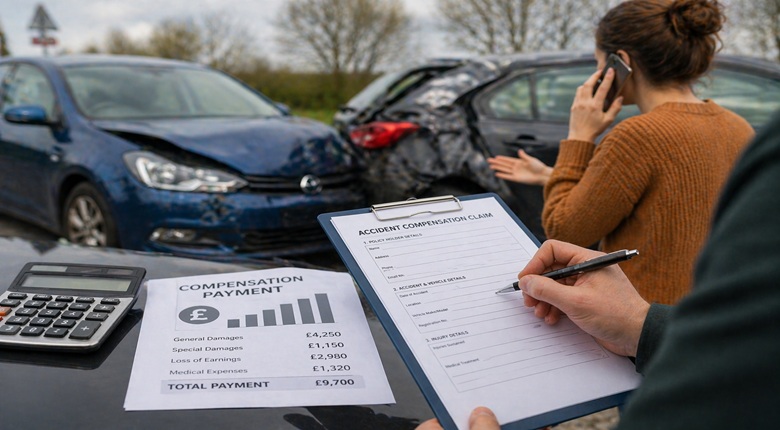
UK car accident compensation is divided into two legally distinct categories: general damages and special damages. Understanding this distinction is fundamental to understanding how compensation is calculated and what you can claim.General Damages
General damages compensate you for the injury itself — the pain, suffering, and loss of amenity caused by your physical and psychological injuries. They are calculated by reference to the Judicial College Guidelines (JCG), a regularly updated publication produced by the Judicial College that sets out the range of awards appropriate for different types of injury. General damages compensate for what is inherently unquantifiable: your suffering. They are estimated based on the nature of the injury, the severity, the duration of symptoms, and any lasting effects.Special Damages
Special damages compensate for the actual financial losses you have suffered as a direct result of the accident. Unlike general damages, special damages must be proved with evidence — receipts, payslips, invoices, and documentation of every loss claimed. Special damages can include:- Loss of earnings: income lost while unable to work, both during recovery and, in serious cases, future lost earnings if permanent disability affects work capacity.
- Medical expenses: private treatment, physiotherapy, prescription costs, specialist consultations, and any healthcare not covered by the NHS.
- Vehicle repair or replacement: the cost of repairing or replacing your vehicle if it was damaged in the accident.
- Travel costs: transport to medical appointments, alternative transport while your vehicle is off the road, and any other accident-related travel.
- Care costs: if you required assistance at home during recovery, the cost of professional or informal care.
- Other out-of-pocket expenses: any reasonable costs you incurred as a direct result of the accident and your injuries.
Who Pays? Understanding Liability in Car Claims
In the UK, compensation is almost always paid by the insurer of the driver who was at fault for the accident, not by the at-fault driver personally. The legal obligation for all drivers to hold at least third party motor insurance — required under the Road Traffic Act 1988 — means that their insurer steps in to meet valid claims against their policyholder.If liability is disputed — each driver blames the other — the case will involve establishing fault through the evidence available: police reports, witness statements, dashcam footage, CCTV, and any traffic camera data. In cases of shared fault, compensation is reduced proportionately through the doctrine of ‘contributory negligence.’ If you are found to be 20 percent responsible, your compensation will be reduced by 20 percent.
If the at-fault driver is uninsured or cannot be traced (a hit-and-run), the Motor Insurers’ Bureau (MIB) provides a compensation route. The MIB is funded by UK insurers and exists specifically to ensure that innocent victims are not left without compensation due to the negligence of uninsured or untraceable drivers. Claims through the MIB follow a specific process, and a solicitor can help navigate the requirements.
| Scenario | Who Pays | Key Point |
| At-fault driver fully insured | At-fault driver’s insurer | Standard route; most straightforward |
| Shared fault (contributory negligence) | Both insurers in proportion | Your award is reduced by your share of fault |
| At-fault driver uninsured | Motor Insurers’ Bureau (MIB) | MIB compensates victims of uninsured drivers |
| Hit-and-run / driver not traced | Motor Insurers’ Bureau (MIB) | Separate MIB scheme for untraced drivers |
| Your own insurer (if comprehensive) | Your own insurer | For vehicle damage; may affect your no-claims bonus |
| Passenger claiming against driver | Driver’s insurer | Passengers always have a right to claim |
The Two Claim Routes: OIC Portal vs. Traditional Litigation
Since May 2021, how you make a car accident compensation claim in England and Wales depends on the value of your injuries. There are two fundamentally different routes:Route 1: The Official Injury Claim (OIC) Portal
The Official Injury Claim (OIC) portal is a government-run digital platform for road traffic accident claims where the claimant is a driver or adult passenger and the total value of injuries is £5,000 or less (or total claim under £10,000). This covers the majority of whiplash claims and minor soft tissue injuries.Through the OIC portal, claimants can submit their claim, provide accident details, obtain a medical report through the MedCo system, and negotiate settlement with the at-fault insurer — in many cases without a solicitor. The portal was designed to be accessible to unrepresented claimants, with a step-by-step guide. For accidents occurring from 31 May 2025, the updated whiplash tariff (increased by approximately 15 percent) applies.
The key limitation of the OIC route is that solicitors’ legal costs are not recoverable from the other side for claims within the portal. This means that if you use a solicitor for an OIC claim, you may have to pay their fees from your own compensation, or the solicitor may charge a fixed fee rather than a percentage. Many people use the OIC portal unrepresented for straightforward minor injury claims.
Route 2: Traditional Litigation (Claims Above £5,000)
For injuries valued above £5,000 — which includes most moderate to serious injuries, injuries lasting more than 24 months, or cases involving significant financial losses — claims follow the traditional litigation route. This involves a solicitor negotiating directly with the insurer, the Pre-Action Protocol for Personal Injury Claims, court proceedings if settlement cannot be reached, and full cost recovery from the other side if the claim succeeds.Motorcyclists, cyclists, pedestrians, and horse riders are exempt from the OIC portal rules regardless of claim value, and their claims follow the traditional route. This is significant because these road users often suffer more serious injuries and the traditional route provides full legal representation with recoverable costs.
The Whiplash Tariff: Updated for 2025 and What It Means
Whiplash — a soft tissue neck injury caused by the sudden jerking of the head, typically in rear-end collisions — is the most common car accident injury in the UK. The Association of British Insurers estimates over 1,500 whiplash claims are made daily, costing insurers more than £2 billion every year.Since the Whiplash Reform Programme took effect in May 2021, whiplash compensation for injuries lasting up to two years is determined by a fixed tariff rather than individual negotiation. The tariff was uprated by approximately 15 percent from 31 May 2025 under the Whiplash Injury (Amendment) Regulations 2025, reflecting inflation since the original 2021 figures.
| Injury Duration | Whiplash Only (from May 2025) | Whiplash + Minor Psychological (from May 2025) |
| Up to 3 months | ~£275 | ~£505 |
| More than 3 months, up to 6 months | ~£590 | ~£710 |
| More than 6 months, up to 9 months | ~£895 | ~£1,075 |
| More than 9 months, up to 12 months | ~£1,190 | ~£1,435 |
| More than 12 months, up to 15 months | ~£1,515 | ~£1,835 |
| More than 15 months, up to 18 months | ~£1,840 | ~£2,215 |
| More than 18 months, up to 24 months | ~£2,755 | ~£3,330 |
| More than 24 months (severe) | Judicial College Guidelines apply | No fixed tariff; full assessment |
Important exceptions and additions: a judge may apply a discretionary uplift of up to 20 percent in exceptional circumstances. Special damages (financial losses including lost earnings and medical costs) are claimed on top of the tariff amount and are not capped. Injuries to other body parts (back, shoulder, etc.) alongside whiplash are assessed under the Judicial College Guidelines and can significantly increase the total award.
Compensation Amounts: What Typical Cases Are Worth
For injuries more serious than minor whiplash, or for any injury to a motorcyclist, cyclist, or pedestrian, the Judicial College Guidelines (JCG) provide the assessment framework. These are the figures courts and insurers use to value personal injury claims throughout England and Wales.| Injury Type | JCG Compensation Range | Notes |
| Minor psychological injury (anxiety, PTSD mild) | ~£1,510 – £7,510 | Must be supported by medical evidence |
| Moderate neck injury (non-whiplash) | ~£7,890 – £23,460 | Includes disc problems, restricted movement |
| Severe neck injury | ~£45,470 – £148,330 | Permanent disability and chronic conditions |
| Minor back injury | ~£2,450 – £11,730 | Soft tissue without lasting consequence |
| Moderate back injury | ~£11,730 – £26,050 | Prolapsed discs, significant continuing symptoms |
| Severe back injury | ~£26,050 – £69,330+ | Including paralysis at high end |
| Moderate knee injury | ~£8,550 – £23,460 | Disruption to cartilage, ligament damage |
| Fracture (e.g., wrist, collarbone) | ~£3,310 – £18,020 | Depends on recovery and permanence |
| Brain injury (moderate) | ~£43,060 – £219,070 | Broad range reflecting outcome variation |
| Brain injury (very severe) | ~£282,010 – £1,540,000+ | Highest awards in UK personal injury law |
These figures represent general damages only — compensation for the injury itself. Special damages for financial losses are added on top and can substantially increase total awards in cases involving significant time off work, ongoing rehabilitation, or care requirements.
The Step-by-Step Claims Process
Understanding the process from accident to compensation payment helps claimants know what to expect and what they need to do.Step 1: At the Scene and Immediately After
- Get medical attention as soon as possible, even if injuries seem minor. Medical records are the foundation of any compensation claim.
- Document the scene: photograph vehicle damage, road conditions, skid marks, and traffic signals.
- Exchange details: name, address, insurance details, and vehicle registration of all drivers involved.
- Get witness information: names and contact details of independent witnesses.
- Report to the police if required (in cases of injury, suspected uninsured driving, or serious damage).
- Retain dashcam footage immediately — most cameras overwrite after 24 to 48 hours.
Step 2: Report to Your Insurer
Report the accident to your insurer promptly, even if you are not making a claim. Most policies require notification within a specific timeframe. Your insurer will advise you on vehicle repair and replacement processes.Step 3: Seek Legal Advice
Consult a personal injury solicitor, especially for any injury beyond very minor whiplash. Most initial consultations are free. The solicitor will advise whether the OIC portal or traditional litigation route applies and whether no win no fee arrangements are available.Step 4: Medical Assessment
A medical report from an independent expert is mandatory for both routes. For OIC portal claims, you will be directed to a MedCo-accredited medical expert. For traditional claims, your solicitor will arrange an appropriate assessment. The medical report establishes the nature, severity, and prognosis of your injuries and forms the primary evidence for your general damages claim.Step 5: Liability and Negotiation
The at-fault insurer will review the claim and either admit or dispute liability. If liability is admitted, negotiation over the compensation amount begins. Your solicitor (or you, if self-representing via OIC) negotiates based on the medical evidence, JCG or tariff valuations, and your documented special damages. Most claims are settled at this stage without court proceedings.Step 6: Settlement or Court
If a settlement is agreed, compensation is paid — typically by bank transfer within 14 to 21 days of settlement. If liability or quantum (amount) is disputed and no agreement is reached, the matter proceeds to court. The large majority of personal injury claims settle before trial.No Win No Fee: How It Works and What It Costs
No win no fee agreements — formally called Conditional Fee Agreements (CFAs) — allow you to pursue a car accident compensation claim without paying legal fees upfront. If your claim is unsuccessful, you pay nothing to your solicitor. If it is successful, the solicitor takes a success fee from your compensation.Under current rules, the success fee is a percentage of your general damages and past financial losses, capped at 25 percent of those elements of your award. In practice, this means if you receive £10,000 in compensation, the success fee cannot exceed £2,500. Your solicitor will explain the specific percentage they charge before you instruct them.
For claims worth more than £5,000 (outside the OIC portal), the at-fault insurer’s insurance is required to pay the fixed costs of the claim, and no success fee applies in most straightforward cases. The no win no fee arrangement is particularly important for OIC portal claims and cases where upfront payment would be a barrier to pursuing compensation.
Choosing a solicitor: For claims above £5,000, always instruct a solicitor regulated by the Solicitors Regulation Authority (SRA). Check their registration on the SRA website. Be cautious of unsolicited calls or texts offering to handle your claim — ‘ambulance chasing’ and cold-call marketing is banned under the Legal Services Act.
Time Limits: The Three-Year Rule (and Its Exceptions)
The Limitation Act 1980 establishes that personal injury claims arising from car accidents must be brought within three years of the date of the accident. This is one of the most important rules in UK personal injury law, and missing this deadline will almost always extinguish your right to claim, regardless of how strong the case is.There are important exceptions and special rules:
- Children: the three-year period does not start running until the child’s 18th birthday, meaning a child injured in a car accident has until their 21st birthday to bring a claim.
- Mental incapacity: where a claimant lacks mental capacity, the three-year period does not begin until capacity is restored.
- Late discovery: where an injury is not immediately apparent (for example, a progressive condition that only becomes linked to the accident later), the three-year period may run from the date of ‘knowledge’ rather than the accident date.
- Deceased persons: where the injured person has died, their estate has three years from the date of death (or date of knowledge of the link to the accident) to bring a claim.
Special Situations: Uninsured Drivers, Passengers, Children, and Hit-and-Run
Uninsured Drivers
If the driver who caused your accident was uninsured, you can claim compensation from the Motor Insurers’ Bureau (MIB) through its Uninsured Drivers’ Agreement. The MIB compensates innocent victims who would otherwise have no recourse. A solicitor with MIB experience is advisable for these claims, as the process has specific requirements.Untraced Drivers (Hit-and-Run)
If the driver cannot be identified and traced, the MIB’s Untraced Drivers’ Agreement provides a separate route. Compensation is available for personal injury, though the rules are more restrictive than for uninsured driver claims. You typically need to have reported the accident to police within 5 days and have cooperated fully with any investigation.Passengers
Passengers have full rights to claim compensation against the driver at fault, even if that is the driver of the vehicle they were in. Passengers cannot be found contributorily negligent simply by being in the vehicle (though not wearing a seatbelt can reduce their award). Passengers claiming against a driver they know are sometimes concerned about the impact on the driver personally — but the claim is against the insurer, not the individual.Children
A parent or guardian acting as ‘litigation friend’ brings personal injury claims on behalf of children. The child’s own three-year limitation period begins at age 18. Any settlement reached on behalf of a child must be approved by the court to protect the child’s interests.Practical Tips for Maximising Your Claim
- Seek medical attention immediately after any accident, even if you feel fine. Symptoms like whiplash can take hours or days to fully develop. A delay in seeking treatment weakens the medical evidence for your claim.
- Preserve all evidence from the start. Photographs, dashcam footage, witness details, and police reference numbers should all be retained. The quality of evidence is one of the most significant factors in claim outcomes.
- Keep a symptom diary from the day of the accident. Record daily how your injuries are affecting your life, work, sleep, hobbies, and family. This contemporaneous record is powerful evidence for your general damages claim and for the prognosis questions in your medical report.
- Document all financial losses with evidence. Keep receipts for every accident-related expense, including fuel receipts for journeys to medical appointments. Request payslips or employer letters confirming lost earnings. Every documented loss adds to your special damages claim.
- Do not accept an insurer’s early settlement offer without advice. Insurers sometimes make early settlement offers before the full extent of injuries is known. Accepting too early can permanently close your right to further compensation, even if your condition worsens.
- Instruct a specialist personal injury solicitor for anything beyond very minor whiplash. The average award with proper representation is £8,000 to £12,000 — research suggests unrepresented claimants typically recover significantly less.
Conclusion
Car accident compensation in the UK is a structured system with clear rules, defined processes, and real money available to those who are injured through no fault of their own. In 2024 alone, nearly 350,000 motor injury claims were processed. Yet only around 30 percent of those injured in collisions actually make a claim, meaning hundreds of thousands of people every year leave compensation they are entitled to on the table.The system has been significantly reformed since 2021, with the Official Injury Claim portal changing how smaller whiplash claims are processed, and the 2025 tariff uprating increasing compensation values by approximately 15 percent. Understanding these changes — which route applies to your claim, what the tariff covers, and when a solicitor adds value that outweighs their cost — is the difference between receiving fair compensation and receiving nothing.
The three-year limitation period means time matters, but early action matters even more for evidence quality and case strength. The fundamental message is simple: if you have been injured in a car accident that was not your fault, you have legal rights. Understanding how the system works before you need it is the best preparation you can have.
0 Comments
Be the first to share your thoughts on this article.