
Planning
What Are the 7 Steps of Financial Planning? Accountants' Guide

Table of Contents
- Why Most People Navigate Their Finances Without a Map
- What Is the CFP Board's Seven-Step Financial Planning Process?
- The Seven Steps at a Glance: The CFP Board Process
- Each of the Seven Steps Explained in Depth
- The Financial Planning Statistics: Why the Seven Steps Matter in 2026
- Applying the Seven Steps to Your Own Finances: A Self-Directed Framework
- The Most Common Financial Planning Mistakes -- and How the Seven Steps Prevent Them
- Conclusion
- Frequently Asked Questions (FAQ)
- What are the seven steps of financial planning?
- Why is financial planning important?
- Can I do the seven steps of financial planning myself, without a financial adviser?
- How often should a financial plan be reviewed?
- What is the difference between a financial plan and a budget?
- External References & Further Reading
Why Most People Navigate Their Finances Without a Map
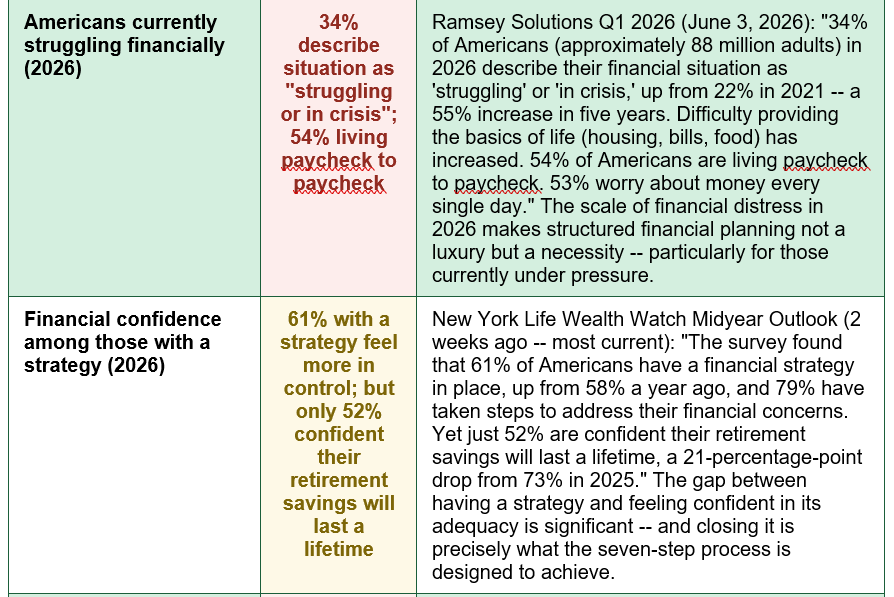
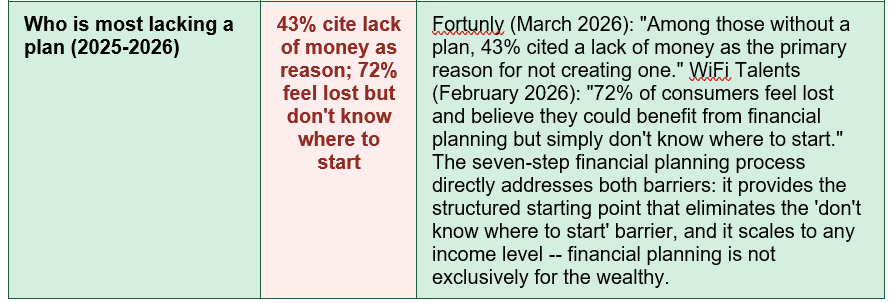
Most people manage their money the same way most people manage their health: reactively. They deal with financial problems as they arise rather than anticipating them. They make individual financial decisions -- whether to save, invest, borrow, or insure -- without reference to an integrated plan that connects those decisions to defined goals and a long-term vision. And statistically, the results of this reactive approach are predictable and not encouraging.WiFi Talents (February 12, 2026): 'Only 27% of Americans have a written financial plan.' Fortunly (March 31, 2026): 'Only 31% of US households had a documented, long-term financial plan in 2025. Among those without a plan, 43% cited a lack of money as the primary reason for not creating one.' Ramsey Solutions (June 3, 2026): '34% of Americans (approximately 88 million adults) describe their financial situation as struggling or in crisis, up from 22% in 2021. 54% are living paycheck to paycheck. 53% worry about money every single day.' These statistics are not coincidental. The absence of a structured financial plan is both a cause and a consequence of financial difficulty.
The contrast with those who do have a plan is striking. Fidelity's 2026 Retirement Planning Study (June 9, 2026): 'People who have actually written down a retirement plan are more than twice as likely to feel confident about their future as those who have not.' The 'planning premium' -- the financial confidence advantage generated by having a documented, structured plan -- is one of the most consistent findings in personal finance research. The good news: the framework that professional financial planners use to build these plans is publicly documented, structured, and applicable at any income level. It is the CFP Board's seven-step financial planning process -- the professional gold standard for comprehensive financial planning, used by all CFP (Certified Financial Planner) professionals worldwide.
What Is the CFP Board's Seven-Step Financial Planning Process?
The seven-step financial planning process is the structured framework established by the CFP Board -- the certifying body for Certified Financial Planner (CFP) professionals in the United States, with equivalent bodies operating globally -- to govern how professional financial planners approach client engagements. It applies whether the planner is working with a new graduate just starting to save or a senior executive managing a complex estate.Institute of Business & Finance (June 9, 2026): 'The CFP financial planning process is a 7-step, client-centered framework established by the CFP Board. It covers everything from understanding a client's goals and gathering their financial data to building a plan, implementing it, and monitoring it over time. It's the gold standard for comprehensive, ethical financial planning.' SmartAsset (June 24, 2026, most current): 'In January 2026, the CFP Board announced that it would require candidates who follow the Standard Pathway to certification to have professional experience that demonstrates at least three of the seven steps in the process. This change is set to take effect beginning in Q1 of 2027 and reflects the CFP Board's commitment to ensuring the highest competency standards for CFP professionals.'
The process is designed to be sequential -- each step builds on the previous one -- but also iterative: as circumstances change and new information emerges, the process cycles back through relevant steps. The common mnemonic for the seven steps is CGADPIM: Circumstances, Goals, Analyse, Develop, Present, Implement, Monitor (OpenExamPrep, March 2026). Understanding each step equips both financial planning professionals and individuals who want to build their own plan with the same structured approach that certified professionals follow.
Financial planning in 2026 -- the planning gap: Only 27% of Americans have a written plan. Written plan holders are 2x+ more likely to feel financially confident. 54% are living paycheck to paycheck. — WiFi Talents (February 2026): 'Only 27% of Americans have a written financial plan.' Fidelity 2026 Retirement Planning Study (June 9, 2026): 'People with a written plan are more than twice as likely to feel confident about their future.' Ramsey Solutions Q1 2026 (June 3, 2026): '54% of Americans living paycheck to paycheck; 34% describe situation as struggling or in crisis.' New York Life Wealth Watch (2 weeks ago -- most current): '61% of Americans have a financial strategy in place; yet only 52% are confident their retirement savings will last a lifetime.'
The Seven Steps at a Glance: The CFP Board Process
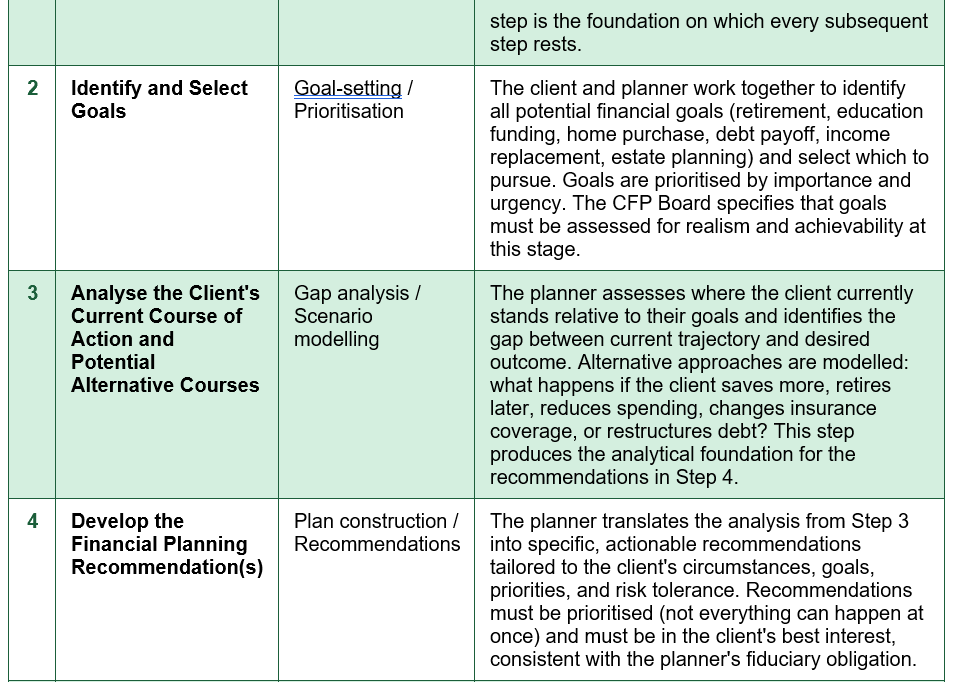
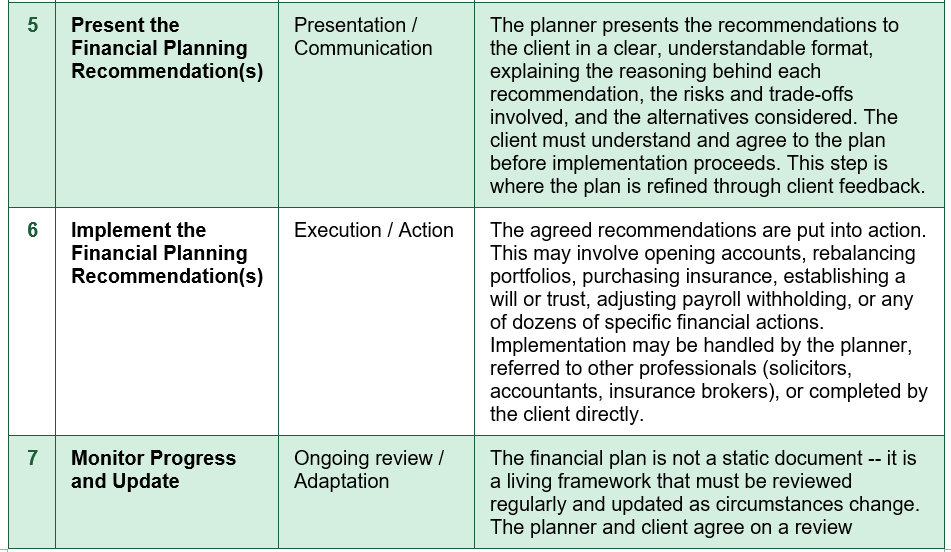
The following table provides a structured overview of all seven steps, their purpose, and what they involve. This framework (mnemonic: CGADPIM) is the professional gold standard for comprehensive financial planning: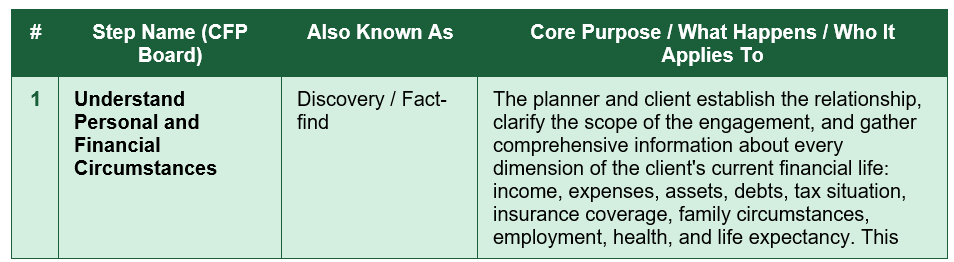
Each of the Seven Steps Explained in Depth
STEP 1: Understand Personal and Financial Circumstances | Know Where You Are Before Planning Where to Go
The first step of the financial planning process is the most comprehensive information-gathering exercise in personal finance. SmartAsset (June 24, 2026): 'The first step when engaging clients is asking questions to gather a broad spectrum of relevant qualitative and quantitative information. This may involve collecting information about the client's personal circumstances, such as age, health status, family situation and life expectancy, along with financial details like income, spending habits, cash flow, assets, debts.' For a professional planner, this step also involves establishing the scope of the engagement -- agreeing with the client on which aspects of their financial life will and will not be covered. This scope agreement protects both the planner and the client and ensures that the plan is calibrated to the actual situation rather than assumptions. For someone building their own financial plan, Step 1 is the personal financial audit: a comprehensive review of every aspect of the current financial position. This means listing all income sources and their amounts and reliability; all regular expenses (fixed and variable); all assets (savings, investments, pension pots, property, vehicle); all liabilities (mortgage, car finance, credit card balances, personal loans, student loans); current insurance coverage; tax status; and family and life circumstances that affect financial planning (dependents, health considerations, anticipated major life events). This information, once assembled in one place, is the foundation of every subsequent step. Most people have never seen this complete picture in one document -- and seeing it for the first time is often the most clarifying financial experience available. Private Financial Design: 'The CFP collects qualitative information such as the client's health status, life expectancy, and family circumstances to begin identifying and evaluating the client's specific needs, wants, goals, and expectations.'STEP 2: Identify and Select Goals | Decide What Financial Success Actually Means to You
Goals are the destination that the financial plan is designed to reach. Without them, the plan has no direction. With them, every subsequent financial decision can be evaluated against a clear standard: does this decision move me toward my goals or away from them? SmartAsset (March 31, 2026): 'The second step of the financial planning process is where you'll talk with your clients to identify their potential goals, help them select which to pursue and prioritize those goals in order of importance. In this step, the focus is on determining whether a client's goals are achievable and realistic.' The goal-setting conversation is more complex than it first appears. Most people have more goals than they can pursue simultaneously with their current resources -- and the process of selecting and prioritising requires making genuine trade-offs. A 35-year-old with a moderate income cannot simultaneously maximise pension contributions, aggressively overpay the mortgage, fund their child's university education in full, maintain a large emergency fund, and take a significant holiday every year. The second step is where these trade-offs are made explicit and a priority order is established. The CFP Board specifies that goals should be assessed for realism -- a goal that cannot be achieved given the client's resources and timeline requires either adjustment (extend the timeline, reduce the target amount) or a plan to change the inputs (increase income, reduce expenses). New York Life (2 weeks ago): '61% of Americans have a financial strategy in place, up from 58% a year ago, and 79% have taken steps to address their financial concerns. Yet just 52% are confident their retirement savings will last a lifetime.' The gap between having goals and being confident in their achievement is closed by the analytical work in Step 3.STEP 3: Analyse Current Course of Action and Alternatives | Measure the Gap Between Where You Are and Where You Want to Be
Step 3 is where financial planning becomes analytical. Having gathered all relevant information (Step 1) and established the goals and their priority order (Step 2), the planner now assesses the gap between the current financial trajectory and the desired outcomes -- and models what happens under different scenarios. SmartAsset: 'In the third step of the CFP planning process, you'll assess where the client is now and whether any potential alternative courses of action may be needed to get them where they want to go.' The analysis in Step 3 covers every major financial planning domain: retirement projection (will current savings and contribution rates produce the required retirement income by the target retirement date?); debt analysis (what is the optimal payoff strategy given the client's cash flow and interest rate profile?); insurance needs analysis (is the client's current coverage appropriate for their income, liabilities, and dependents?); tax analysis (what is the current effective tax rate, and are there legal opportunities to reduce it?); estate planning assessment (are the client's assets appropriately structured for their wishes on death?); and education funding (if applicable, is the current trajectory sufficient to meet the funding target?). For each domain, the analysis compares the current course of action (do nothing) with potential alternatives (save more, invest differently, restructure debt, adjust insurance, change tax arrangements). This is the step that most clearly demonstrates the value of professional financial planning: the analytical tools and knowledge required to project retirement income, model tax scenarios, and calculate insurance needs are not available to most individuals without professional assistance.STEP 4: Develop the Financial Planning Recommendations | Build the Specific Plan That Closes the Gap
Step 4 is where the analysis from Step 3 is translated into specific, prioritised recommendations. This is the plan itself -- not a description of the problem but a prescription for addressing it. OpenExamPrep (March 2026): 'The CFP Board defines financial planning as a collaborative process that helps maximize a client's potential for meeting life goals through financial advice that integrates relevant elements of the client's personal and financial circumstances.' Recommendations must be specific enough to be actionable, prioritised (not everything can be done at once), realistic given the client's resources and circumstances, and in the client's best interest -- which for CFP professionals is a fiduciary obligation, not merely a preference. A well-developed set of financial planning recommendations might include: increase pension/401(k) contribution to X% of salary immediately; pay off Credit Card A before Credit Card B (debt avalanche); switch from whole life to term life insurance and use the difference in premiums to increase retirement savings; update will and beneficiary designations; establish power of attorney; investigate whether ISA allowance (UK) or Roth IRA (US) is being fully utilised; and review property/home insurance at next renewal date for potential savings. Each recommendation should include the specific action, the reason (what gap does it close or what risk does it address), the expected financial impact, and the priority relative to other recommendations. The Kiplinger article by CFP Scott Levin (November 2025): 'Does my financial plan support the life I want to live?' -- this question is the test every recommendation must pass.STEP 5: Present the Financial Planning Recommendations | Communication That Enables Informed Decision-Making
The quality of a financial plan is only as good as the client's understanding of it. A brilliant set of recommendations that the client cannot comprehend, does not believe in, or feels was not discussed with them will not be implemented effectively. Step 5 ensures that the plan is presented clearly, explained fully, and refined through client feedback. Private Financial Design: 'The CFP and the client agree upon the scope of the plan, outlining the responsibilities of both parties. Modern tools, such as digital questionnaires or secure client portals, can streamline this process and enhance clarity.' During the presentation, the planner explains each recommendation in plain language, explains the reasoning (what problem does it solve, what risk does it address, what benefit does it produce), describes the risks and trade-offs of the recommended approach versus alternatives, and provides the opportunity for the client to ask questions, express concerns, and request modifications. This step is particularly important because financial planning recommendations often involve trade-offs that the client must genuinely understand and accept: the recommendation to reduce current lifestyle spending to increase retirement savings requires the client to consciously choose future security over current enjoyment, and that choice must be made with full understanding. A plan that is imposed rather than collaboratively developed will not be maintained. WiFi Talents (February 2026): '72% of consumers feel lost and believe they could benefit from financial planning but simply don't know where to start.' The presentation step is where professional planners provide this orientation, and where self-directed planners need to commit their plan to writing and review it objectively.STEP 6: Implement the Financial Planning Recommendations | Turn the Plan Into Action
The transition from plan to action is the most practically demanding step in the process. It is also the step where many financial plans stall. Millennial Money: 'The financial planning process is an ongoing one that requires time and dedication.' Implementation involves specific actions: opening or changing accounts, transferring funds, purchasing insurance products, updating legal documents, adjusting payroll contributions, and executing investment instructions. Some of these actions can be completed in a single session. Others -- such as establishing a trust, completing a property re-mortgage, or navigating a pension transfer -- may take weeks or months and involve multiple third parties. For professionally advised clients, the CFP planner typically either handles implementation directly (if qualified and regulated to do so for the specific product) or coordinates with a network of other professionals: solicitors for estate planning, accountants for tax matters, insurance brokers for protection products. For self-directed planners, implementation requires breaking the plan into specific, dateable action items and holding themselves accountable to completing each one. The most common implementation failure is allowing perfect to be the enemy of good: waiting for the 'right time' to start investing, the 'right product' to open, or the 'right amount' to save all result in implementation delay that has a compounding cost. Ramsey Solutions Q1 2026: '47% now create a monthly budget, up from 39% in 2021' -- budget creation is an example of successful implementation of a financial plan element at scale. Each percentage point of increase in budget adoption represents millions of people taking a concrete implementation step.STEP 7: Monitor Progress and Update | The Step That Makes Financial Planning a Process, Not an Event
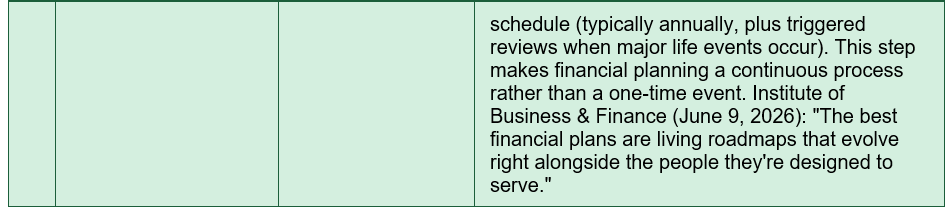
The seventh step distinguishes a genuine financial plan from a one-time financial exercise. It is also the step that most people skip -- and the one whose absence most reliably undermines the long-term value of the plan. Institute of Business & Finance (June 9, 2026): 'Regular reviews help ensure the plan stays aligned with the client's goals, priorities, and changing circumstances. Some changes are planned. Others arrive unexpectedly. Either way, a financial plan should be flexible enough to adapt. The best financial plans are living roadmaps that evolve right alongside the people they're designed to serve.' Monitoring has two components: performance tracking (is the plan achieving the projected outcomes? Are savings growing as projected? Is debt reducing at the expected rate? Is the investment portfolio performing in line with assumptions?) and update triggers (have circumstances changed in ways that require the plan to be revised?). The most common update triggers include: significant income change (pay rise, job loss, career change); major life event (marriage, divorce, children, bereavement, inheritance); property transaction (purchase, sale, remortgage); health change (affecting insurance needs, retirement timeline, or estate planning); legislative change (new tax rules, pension regulations, ISA allowances); and significant market movement (affecting portfolio valuations and retirement projections). A well-maintained financial plan is reviewed formally at least annually -- and more frequently in response to significant life or financial events. The annual review is perhaps the most valuable hour of financial activity available to most households: it calibrates the plan to current reality, identifies actions that have slipped, and ensures the plan continues to serve the goals it was designed to achieve.The Financial Planning Statistics: Why the Seven Steps Matter in 2026
The statistical context for the seven-step process reveals both the scale of the planning deficit and the measurable benefit of addressing it: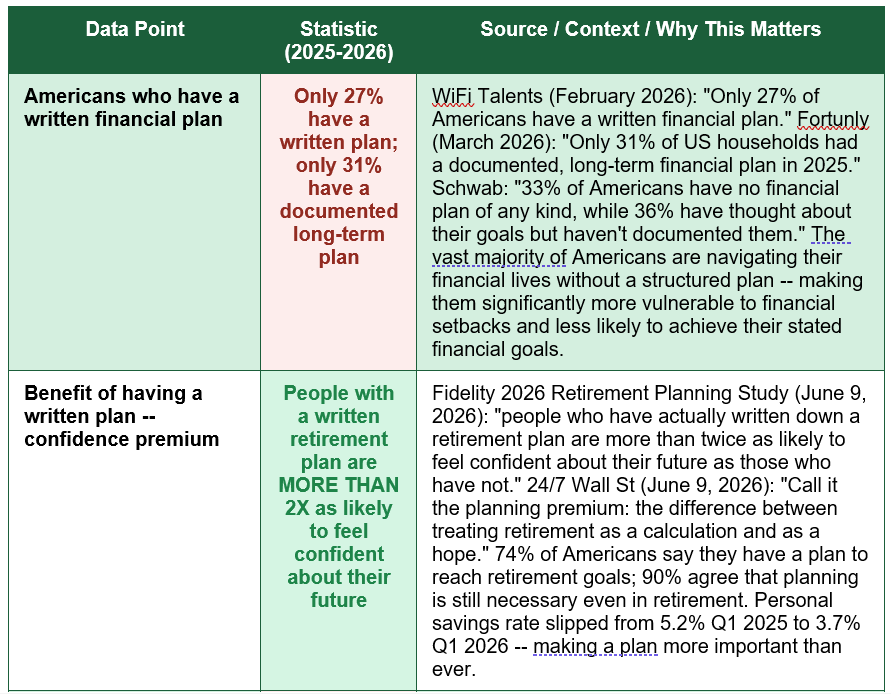
Applying the Seven Steps to Your Own Finances: A Self-Directed Framework
The seven-step process is used by professional financial planners, but its structure applies equally well to someone building their own financial plan without professional assistance. The following framework adapts each step for self-directed use:Step 1 (DIY): Complete a personal financial audit. Open a spreadsheet or notebook. Document: all income sources and amounts; all monthly expenses (separate fixed and variable); all assets (savings balances, investment accounts, pension values, property equity, other); all liabilities (mortgage balance, car finance, credit card balances, personal loans, student loans, buy now pay later). Include insurance policies and their coverage amounts. This takes 1-3 hours and is the foundation of everything that follows.
Step 2 (DIY): Write your top 5 financial goals with target dates and amounts. Examples: "Build £/$10,000 emergency fund by December 2027"; "Clear all credit card debt by June 2028"; "Contribute 15% of gross income to pension/401(k) by January 2027"; "Save £/$50,000 house deposit by 2030." Rank them by priority. Identify any that are currently not achievable on the current trajectory (Step 3 tells you this).
Step 3 (DIY): Use a retirement calculator (MoneyHelper.org.uk UK; Fidelity or Vanguard US) to project your current pension/retirement savings against your target retirement income. Use a debt payoff calculator to project your current debt payoff timeline. Use a savings calculator to project whether your emergency fund target is achievable by the target date. Identify the gaps: where current trajectory does not reach the goal.
Step 4 (DIY): For each gap identified in Step 3, develop a specific recommendation for yourself. Use the priority hierarchy: emergency fund first; employer pension match second; high-rate debt third; ISA/Roth IRA fourth; additional retirement savings fifth. Be specific: "I will reduce eating out from £400/$400/month to £200/$200 and redirect the difference to ISA contributions." Write each recommendation down.
Step 5 (DIY): Share your written plan with someone you trust -- a partner, a financially literate friend, or a family member -- and explain it aloud. The act of articulating the plan exposes gaps, unrealistic assumptions, and actions that have not been fully thought through. If you have any complex areas (pension transfers, tax planning, estate planning, investment selection), consider a one-off consultation with a regulated financial adviser even if you plan to manage most of the plan yourself.
Step 6 (DIY): Create a specific implementation schedule. Each recommendation from Step 4 becomes a dated action item. "By 15 August: open a Stocks and Shares ISA / Roth IRA with [provider]. By 1 September: set up monthly automated transfer of £/$X. By 30 September: contact employer HR to increase pension contribution to X%." Without specific dates and accountability, implementation stalls. Block time in the calendar to complete each action.
Step 7 (DIY): Schedule an annual review date -- the same time every year (many people choose January, after reviewing the previous year). Also identify your update triggers: any major life event, income change, or significant market movement should prompt a review within 30 days. At each review, reassess Steps 1-4 with current data and update the plan accordingly. A financial plan that has not been reviewed in three years is not a plan -- it is a historical document.
The UK-specific application: how the seven steps align with British financial planning priorities. The seven-step process is US-origin but applies universally. For UK individuals, the specific tools and products that populate the plan differ: Step 2 goals in the UK context often include: achieving the 35 qualifying National Insurance years for the full new state pension (£221.20/week in 2024/25); using the £20,000 annual ISA allowance (Stocks and Shares ISA for long-term growth; Cash ISA for short-term savings); utilising the Lifetime ISA (up to age 40, up to £4,000/year, 25% government bonus) for first home purchase or retirement; and reviewing workplace pension contributions under auto-enrolment (minimum 5% employee contribution to receive 3% employer minimum match). Step 3 analysis in the UK: use the government's state pension forecast service (gov.uk/check-state-pension) to establish the projected state pension; check NI record for gaps; use PensionBee, Hargreaves Lansdown, or Vanguard UK's pension calculator for workplace and private pension projections. Step 7 UK update triggers: ISA allowance changes (annual, each April); pension lifetime and annual allowance changes; major tax legislation (Autumn Budget, Spring Statement); and changes to employer auto-enrolment minimums. UK free regulated financial guidance: MoneyHelper 0800 138 7777 (government-backed; free; covers all areas of personal finance planning).
The Most Common Financial Planning Mistakes -- and How the Seven Steps Prevent Them
The seven-step process is not just a framework for what to do -- it is a systematic defence against the most common financial planning errors. Understanding which mistake each step prevents helps explain why the structure matters:- Making investment decisions without a goal: Prevented by Step 2. The question 'what should I invest in?' cannot be answered meaningfully without knowing the goal (retirement in 30 years versus a house deposit in 5 years require completely different investment strategies) and the risk tolerance. Step 2 establishes the goal; Step 3 establishes the risk profile; Step 4 then produces an appropriate investment recommendation. Investing without completing Steps 2 and 3 first is like building a house before drawing the plans.
- Ignoring insurance until it is too late: Prevented by Step 1 (information gathering includes current coverage) and Step 3 (insurance needs analysis compares required coverage against actual coverage). Most people discover their insurance is inadequate only when they need to make a claim. The seven-step process surfaces this gap in advance and produces a specific recommendation in Step 4.
- Treating the plan as a one-time document: Prevented by Step 7. A financial plan written in 2026 without any subsequent monitoring will be significantly out of date by 2029. Life events, legislative changes, and market movements make continuous monitoring not optional but essential. The plan without Step 7 is an aspiration; the plan with Step 7 is a living tool.
- Setting unrealistic goals and abandoning the plan when they are not met: Prevented by Steps 2 and 3 together. Step 2 assesses whether goals are achievable and realistic; Step 3 models the gap between current trajectory and goal. Together, they produce goals that are ambitious but achievable -- and a clear picture of what changes are required to achieve them. Fortunly (March 2026): '43% cited lack of money as the primary reason for not creating a financial plan.' The seven-step process specifically addresses this misconception: a financial plan is not a document for people who already have money. It is the mechanism for directing the money available -- at any income level -- toward its most effective uses.
- Implementing financial products without a comprehensive view: Prevented by the integrated nature of the process. A person who buys a life insurance policy without having completed Step 1 (knowing their total financial picture) and Step 3 (analysing what coverage level is required) may purchase inadequate coverage, the wrong type of policy, or an amount they cannot sustain. The seven-step process ensures that any implementation action is part of an integrated plan rather than a response to a sales conversation.
YOUR FINANCIAL PLANNING QUICK-START CHECKLIST -- 2026: STEP 1 -- DO THIS TODAY (30 MINUTES): Open a notes document or spreadsheet. Write down every source of income and its monthly amount. Write down every debt and its balance, interest rate, and minimum monthly payment. Write down every savings or investment account and its current balance. This is your financial baseline -- and you cannot plan without it. STEP 2 -- DO THIS THIS WEEK (60 MINUTES): Write down your top 5 financial goals with specific amounts and target dates. Be specific: "£/$10,000 emergency fund by December 2027" not just "save more money." Rank them 1-5 by priority. STEPS 3-4 -- DO THIS THIS MONTH (2-3 HOURS): Use free online calculators (MoneyHelper UK; Fidelity/Vanguard US) to project your retirement position, debt payoff timeline, and emergency fund growth. Identify the gaps. Write specific recommendations for closing each gap. STEPS 5-6 -- DO THIS QUARTER (ONGOING): Share the plan with someone you trust for accountability. Set dated action items for every recommendation. Complete each action by its date. STEP 7 -- SCHEDULE THIS ANNUALLY: Set a calendar reminder for your annual financial review. Also commit: any major life event or income change triggers a review within 30 days. UK free help: MoneyHelper 0800 138 7777. US free help: CFPB consumerfinance.gov. For complex planning needs (tax, pensions, estate): consult a regulated financial adviser.
FIVE FINANCIAL PLANNING MISTAKES THAT THE SEVEN-STEP PROCESS IS SPECIFICALLY DESIGNED TO PREVENT: (1) STARTING WITH STEP 4 (THE PRODUCT) BEFORE COMPLETING STEPS 1-3. The financial services industry is structured around products -- savings accounts, investment funds, insurance policies, mortgages. The seven-step process is structured around people -- their circumstances, goals, and analysis. Starting with the product (should I get a stocks and shares ISA? Which fund should I invest in?) before completing Steps 1-3 is structurally backwards. The product should be the output of the plan, not its starting point. (2) SETTING GOALS WITHOUT ANALYSING WHETHER THEY ARE ACHIEVABLE (SKIPPING STEP 3). A financial goal that cannot be achieved given the client's resources and timeline is not a plan -- it is a wish. Step 3 (analyse current course and alternatives) is the step that converts wishes into plans by quantifying the gap between current trajectory and desired outcome and modelling the specific changes required to close it. Ramsey Solutions (June 2026): 54% of Americans are living paycheck to paycheck -- not because goals are impossible, but because the gap-closing analysis has not been done. (3) IMPLEMENTING WITHOUT MONITORING (DOING STEP 6 BUT NOT STEP 7). The most common failure mode for financial plans built by individuals is implementation without ongoing monitoring. The plan is built, the initial actions are taken, and the plan is then filed and never reviewed. Institute of Business & Finance (June 2026): 'The best financial plans are living roadmaps that evolve right alongside the people they're designed to serve.' A plan not reviewed is a plan not serving. (4) TREATING 'I DON'T HAVE ENOUGH MONEY TO PLAN' AS A VALID REASON TO SKIP STEP 1. Fortunly (March 2026): '43% cited a lack of money as the primary reason for not creating a financial plan.' The seven-step process is specifically designed for use at all income levels. Step 1 (understand circumstances) works regardless of the size of the numbers. Step 2 (set goals) is more important, not less, when resources are constrained. And Step 3 (gap analysis) is the tool that shows how the available money can best be directed toward the goals that matter most. (5) CONFLATING 'HAVING THOUGHT ABOUT' GOALS WITH HAVING A PLAN. Fortunly (March 2026): '36% of Americans have thought about their goals but haven't documented them.' The Fidelity 2026 study is specific: it is people who have 'written down' a plan who are more than twice as likely to feel confident -- not people who have thought about it. The act of writing the plan creates the structure, accountability, and clarity that thinking about it does not.
Conclusion
The seven steps of financial planning -- Understand Circumstances, Identify Goals, Analyse Current Course and Alternatives, Develop Recommendations, Present Recommendations, Implement, and Monitor and Update -- constitute the professional gold standard for comprehensive personal financial planning, as established by the CFP Board and refined over decades of professional practice. In January 2026, the CFP Board reinforced this standard by announcing that Standard Pathway certification candidates will be required to demonstrate professional experience in at least three of these seven steps, effective Q1 2027 (SmartAsset, June 24, 2026).The statistics make the case for engaging with this framework more clearly than any theoretical argument. Fidelity's 2026 Retirement Planning Study: people who have written down a plan are more than twice as likely to feel confident about their financial future. Yet only 27% of Americans have a written financial plan, and 34% describe their financial situation as struggling or in crisis (Ramsey Solutions, June 2026). The planning gap is large, the benefit of closing it is measurable and documented, and the framework for doing so is publicly available and applicable at any income level.
Whether you work through the seven steps with a CFP professional or adapt them for self-directed planning, the process provides what reactive financial management does not: a comprehensive view of your current financial position; defined goals against which every financial decision can be evaluated; a gap analysis that shows specifically what needs to change; prioritised recommendations for closing those gaps; an implementation schedule with accountability; and the ongoing monitoring that keeps the plan aligned with reality as life evolves. Institute of Business & Finance (June 9, 2026): 'A great financial plan isn't just about accumulating wealth for the sake of a bigger number on a statement.' It is about maximising the probability that your financial decisions support the life you want to live. The seven steps are how you build that probability.
Frequently Asked Questions (FAQ)
What are the seven steps of financial planning?The seven steps of financial planning, as established by the CFP Board, are: (1) Understand the Client's Personal and Financial Circumstances -- gather comprehensive information about current income, expenses, assets, debts, insurance, tax, family situation, and life circumstances; (2) Identify and Select Goals -- establish what the client wants to achieve financially (retirement, debt payoff, home purchase, education funding, estate planning) and prioritise those goals; (3) Analyse the Client's Current Course of Action and Potential Alternative Courses -- assess the gap between current trajectory and desired outcomes; model what happens under different scenarios; (4) Develop the Financial Planning Recommendations -- translate the analysis into specific, prioritised, actionable recommendations tailored to the client's circumstances and goals; (5) Present the Financial Planning Recommendations -- communicate the plan clearly, explain the reasoning, risks, and alternatives, and refine through client feedback; (6) Implement the Financial Planning Recommendations -- execute the agreed actions (open accounts, purchase insurance, update legal documents, adjust contributions); (7) Monitor Progress and Update -- review the plan regularly, track performance against projections, and update the plan as circumstances change. The common mnemonic is CGADPIM (OpenExamPrep, March 2026). SmartAsset (June 24, 2026): 'In January 2026, the CFP Board announced that it would require candidates following the Standard Pathway to certification to demonstrate professional experience in at least three of the seven steps, taking effect Q1 2027.' Institute of Business & Finance (June 9, 2026): this process is 'the gold standard for comprehensive, ethical financial planning.'
Why is financial planning important?
Financial planning is important because structured, documented financial plans consistently produce better financial outcomes and higher financial confidence than reactive money management. The evidence from 2026 is direct: Fidelity's 2026 Retirement Planning Study (June 9, 2026): 'People who have actually written down a retirement plan are more than twice as likely to feel confident about their future as those who have not.' 24/7 Wall St (June 9, 2026): 'Call it the planning premium: the difference between treating retirement as a calculation and as a hope.' The contrast with the current state of financial management for most households is stark: Ramsey Solutions Q1 2026 (June 3, 2026): '34% of Americans describe their financial situation as struggling or in crisis, up from 22% in 2021 -- a 55% increase in five years. 54% are living paycheck to paycheck. 53% worry about money every single day.' A structured financial plan addresses these challenges in specific, measurable ways: it identifies spending gaps before they become crises; it builds the emergency fund that prevents minor setbacks from becoming major debt events; it directs retirement contributions toward goals that have been quantified rather than hoped for; it ensures insurance coverage is adequate before it is needed; and it provides a clear priority order for every financial decision, eliminating the paralysis of competing priorities that prevents action. Financial planning is also important because complex financial decisions -- tax efficiency, pension transfer rules, estate planning, investment selection -- require the kind of structured analysis that the seven-step process provides, either from a professional or through disciplined self-directed application.
Can I do the seven steps of financial planning myself, without a financial adviser?
Yes -- the seven-step process was designed for professional financial planners but its structure applies equally to self-directed financial planning. The critical adaptations for self-directed use: Step 1: complete your own financial audit using a spreadsheet or budgeting app. List every income source, every expense, every asset, and every liability. This is achievable without professional assistance and takes 1-3 hours. Step 2: write your top 5 goals with specific amounts and target dates. The quality of goal-setting is determined by specificity, not by professional involvement. Step 3: use free online calculators -- MoneyHelper.org.uk (UK) provides free tools for retirement projection, mortgage comparison, and debt payoff; Fidelity, Vanguard, and the Social Security Administration (US) provide free retirement calculators. Step 4: write your own recommendations based on the gap analysis. Step 5: share the plan with a trusted person and explain it -- this serves the same function as a professional presentation. Step 6: create a dated implementation schedule and hold yourself to it. Step 7: schedule an annual review in the calendar and commit to completing it. The areas where professional advice adds the most value are: pension transfer decisions (complex tax implications); estate planning (wills, trusts, power of attorney); tax planning above basic personal allowance/standard deduction level; and investment selection where behavioural risk (panic selling, overconcentration) is significant. For these areas, a one-off consultation with a regulated financial adviser is worth considering even for those who manage most of their planning independently. UK free guidance: MoneyHelper 0800 138 7777. US free guidance: CFPB consumerfinance.gov.
How often should a financial plan be reviewed?
The CFP Board's seven-step process treats Step 7 (monitor and update) as an ongoing activity rather than a scheduled event, because financial plans need updating in response to both planned and unplanned changes. The standard guidance for review frequency: formal annual review (minimum): at least once per year, review the entire plan against current circumstances and update projections with current data. Many people choose January (after year-end financial review) or April (after tax year in the UK). The review should cover: have all the Step 6 implementation actions been completed? Are the projections from Step 3 still accurate given actual performance? Have any goals changed? Are any recommendations from Step 4 no longer appropriate? Event-triggered reviews: any of the following should trigger an immediate review of the relevant parts of the plan: significant income change (pay rise, job loss, new job); major life event (marriage, divorce, having children, bereavement); property transaction (purchase, sale, remortgage); inheritance; significant health change; new tax legislation; major market movement affecting portfolio value significantly. Institute of Business & Finance (June 9, 2026): 'Some changes are planned. Others arrive unexpectedly. Either way, a financial plan should be flexible enough to adapt. The best financial plans are living roadmaps that evolve right alongside the people they're designed to serve.' A financial plan last reviewed more than three years ago in a period of significant personal or economic change may be operating on assumptions that no longer reflect reality -- and in financial planning, acting on inaccurate assumptions has compounding costs.
What is the difference between a financial plan and a budget?
A budget and a financial plan address different scopes and timeframes of financial management and are complementary rather than alternatives. A budget is a short-term (typically monthly) tool for managing income and expenses: it allocates available income to categories (housing, food, transport, savings, entertainment) and tracks actual spending against those allocations. Ramsey Solutions Q1 2026 (June 3, 2026): '47% of Americans now create a monthly budget, up from 39% in 2021' -- this is an encouraging increase in budget adoption. A financial plan is a long-term, comprehensive framework that covers not just current income and expenses but goals (retirement, home purchase, education), assets (investments, pension, property), liabilities (debt strategy), risk management (insurance), tax efficiency, estate planning, and the ongoing monitoring required to keep the plan on track. The relationship: the budget is an implementation tool that serves the financial plan. The financial plan establishes that retirement contributions should be £/$500/month; the budget ensures that money is actually allocated and protected from being redirected to discretionary spending. WiFi Talents (February 2026): 'Only 27% of Americans have a written financial plan' -- compared to 47% who create a monthly budget. This means there are many Americans (and UK households) who manage their current expenses effectively through budgeting but have no long-term framework for connecting those expenses to goals. The seven-step financial planning process is specifically designed to build that framework around the budget, turning monthly cash management into a component of a comprehensive long-term strategy.

0 Comments Comments