

Planning
What Is Debt Consolidation? Complete UK & US Guide


Table of Contents
- One Loan to Replace the Many
- What Is Debt Consolidation?
- How Does Debt Consolidation Work? The Mechanics
- Debt Consolidation Options: The Complete 2026 Comparison
- Debt Consolidation Pros and Cons: The Balanced Assessment
- The Genuine Benefits
- The Real Risks
- Is Debt Consolidation Right for You? The Suitability Framework
- How Debt Consolidation Affects Your Credit Score
- How to Apply for Debt Consolidation in 2026: Step by Step
- Conclusion
- Frequently Asked Questions (FAQ)
One Loan to Replace the Many
Managing several debts simultaneously is one of the most common sources of financial stress for UK and US households. There is the credit card with a £2,000 balance charging 24.65% interest. The personal loan with £6,000 remaining at 15% APR. The overdraft at 39.9% effective annual rate. The buy now pay later agreements with different due dates throughout the month. Each has its own lender, its own interest rate, its own minimum payment, and its own due date. The cognitive load of managing them — combined with the escalating interest charges — makes the total debt feel larger and more permanent than any individual balance would suggest.Debt consolidation is the financial strategy of combining some or all of these separate debts into a single, unified debt — typically with one lender, one monthly payment, one interest rate, and one payoff date. Done well, it simplifies financial management, reduces the total monthly interest paid, provides a clear and structured path to becoming debt-free, and reduces the psychological burden of multiple simultaneous obligations. Done poorly — by taking a lower rate over a much longer term, or by accumulating new debt on the cleared accounts after consolidating — it can make the overall debt situation worse.
This guide explains debt consolidation completely and practically for 2026: the precise definition and mechanics, the five main consolidation routes available in the UK and US with their current rates, the detailed worked examples showing exactly how much you save (or don't save) in each scenario, the suitability framework that determines whether consolidation is right for your specific situation, the critical risks that catch people out, the credit score implications, and the free professional resources available for those who need expert guidance before committing to a consolidation product.
What Is Debt Consolidation?
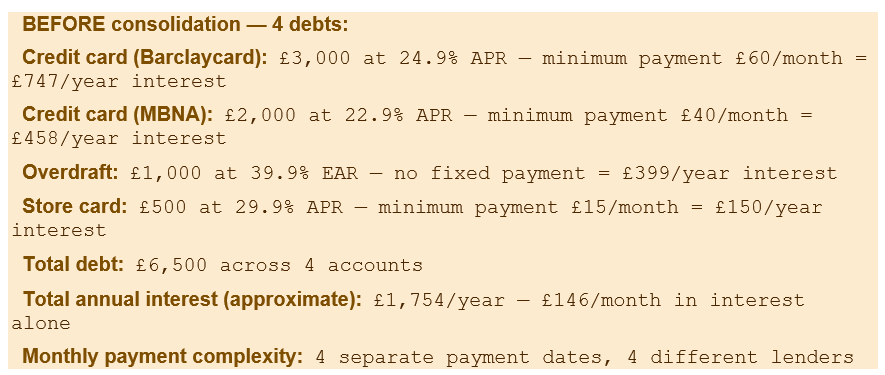
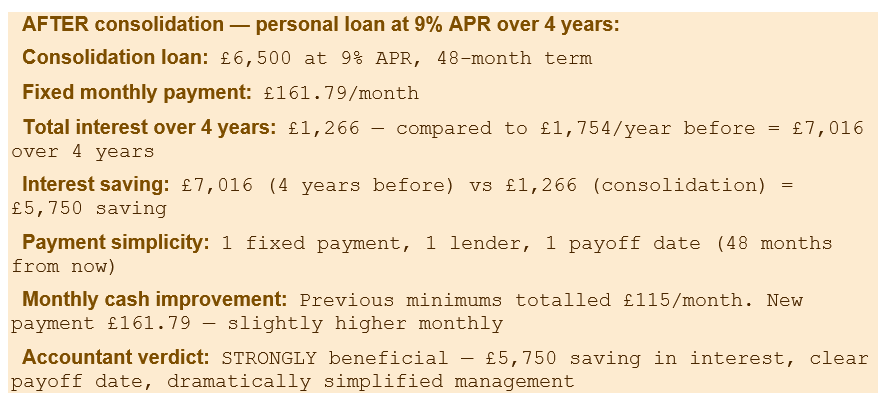
Debt consolidation means combining multiple debts — credit cards, personal loans, overdrafts, store cards, or other credit — into a single new debt product with one monthly payment. The consolidating loan pays off all the existing individual debts, leaving only the new consolidated debt to be repaid. Nesto (2026): 'Debt consolidation means combining multiple debts — credit cards, personal loans, overdrafts — into a single loan with one monthly payment and (ideally) one lower interest rate. The goal is to simplify your finances and reduce the total interest you pay. Done well, it can save significant money and reduce financial stress. Done poorly, it can make things worse.'The central financial logic of debt consolidation is the interest rate reduction. If you can combine debts currently charging 20-30% APR into a single loan charging 8-12% APR, you pay less interest every month — and every pound saved on interest is an additional pound reducing the principal. Debt.org (1 week ago, July 2026) illustrates the mathematics with a US example: '$15,000 on credit cards at a national average rate of 27.9% over 60 months costs a total of $27,968 — meaning $12,968 is paid purely in interest. The same $15,000 consolidated at 8% costs $18,248 total — only $3,248 in interest. A saving of $9,720.' My Mortgage Sorted (April 2026) provides the UK equivalent: '£15,000 of credit card debt at 22% APR over 5 years costs roughly £9,400 in total interest. The same £15,000 consolidated into a loan at 9% over 5 years costs around £3,700 in interest — a saving of £5,700.'
Debt consolidation does not reduce the amount you owe — the principal balance remains the same. What it changes is the interest rate applied to that balance and the structure of repayment. CCFCU (December 2025): 'Debt consolidation works by taking out a new loan or balance transfer that pays off your existing debts. You then make payments on this new loan or credit card until the debt is paid in full.' The simplification benefit is also real: Debt.org notes that 'the average credit card user owns four cards, meaning four payment dates a month. Consolidation simplifies that by reducing it to one payment a month' — reducing the risk of missed payments from scheduling complexity alone.
Debt consolidation — the 2026 numbers: UK credit card APR: avg 24.65%. Unsecured personal loan: 5–15% UK. US credit card APR: 19.58% (April 2026). US personal loan: avg 12.04%. — Bankrate (April 2026): 'As of April 2026, the average credit card rate is 19.58%. Meanwhile, the average personal loan rate is 12.04%.' My Mortgage Sorted (April 2026): 'Moving from credit cards at 20–30% APR to a secured consolidation loan at 6–15% APR (typical ranges as of April 2026).' Nesto (2026): personal loans typically 5–15% for good credit in UK. Debt.org (1 week ago, July 2026): $15,000 at 27.9% = $12,968 interest; consolidated at 8% = $3,248 interest — $9,720 saving across the loan term. UK example (My Mortgage Sorted): same debt at 22% vs 9% = £5,700 saving over 5 years.
How Does Debt Consolidation Work? The Mechanics
The mechanics of debt consolidation are straightforward in principle and important to understand in practice:- You apply for a consolidation product: a personal loan, a balance transfer credit card, a secured loan, or you arrange a remortgage or DMP. The product must either provide funds to pay off existing debts, or directly transfer existing balances to the new account.
- The existing debts are paid off: either you use the loan funds to pay each creditor in full, or (in the case of balance transfers) the new lender transfers the balances directly. After the payoffs, the individual accounts show a zero balance.
- Only the consolidated debt remains: one lender, one balance, one monthly payment, one APR, one payoff date. The previous creditors have been paid and their accounts can be closed (which is strongly advisable to remove the temptation to re-use them).
- You repay the consolidated debt: over the agreed term, through fixed monthly payments (for a loan) or variable payments (for a credit card). Nesto: 'Consolidation replaces several debts with a single one — ideally at a lower interest rate and with one monthly payment.'
Debt Consolidation Options: The Complete 2026 Comparison
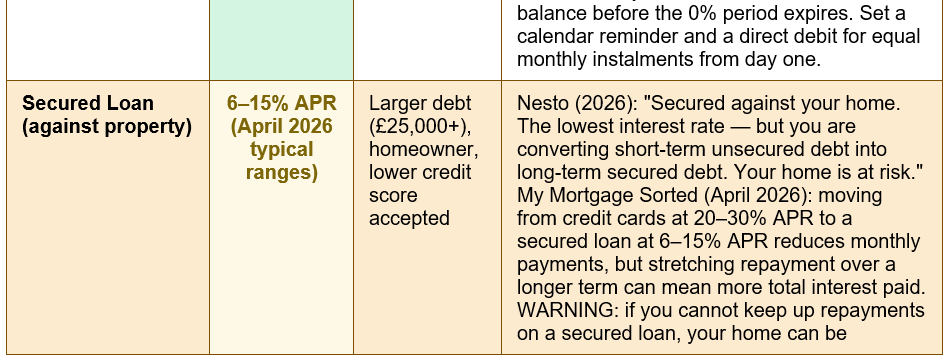
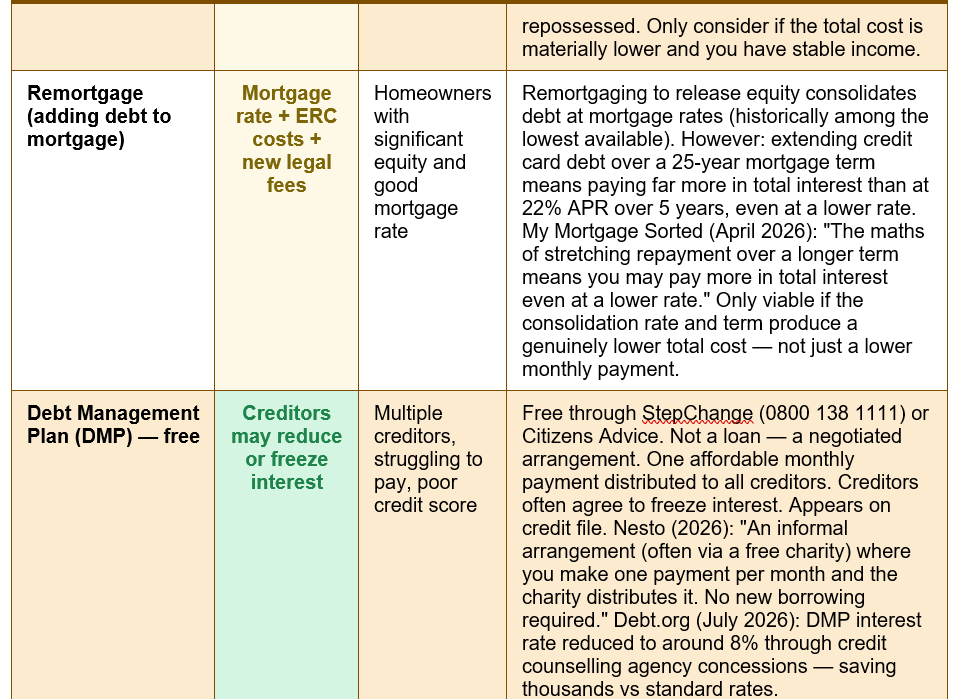
There are five main routes to debt consolidation in the UK and US in 2026, each suited to different debt amounts, credit profiles, and risk tolerances. The following table compares all five with their current rates, eligibility requirements, and the accountant's assessment of each: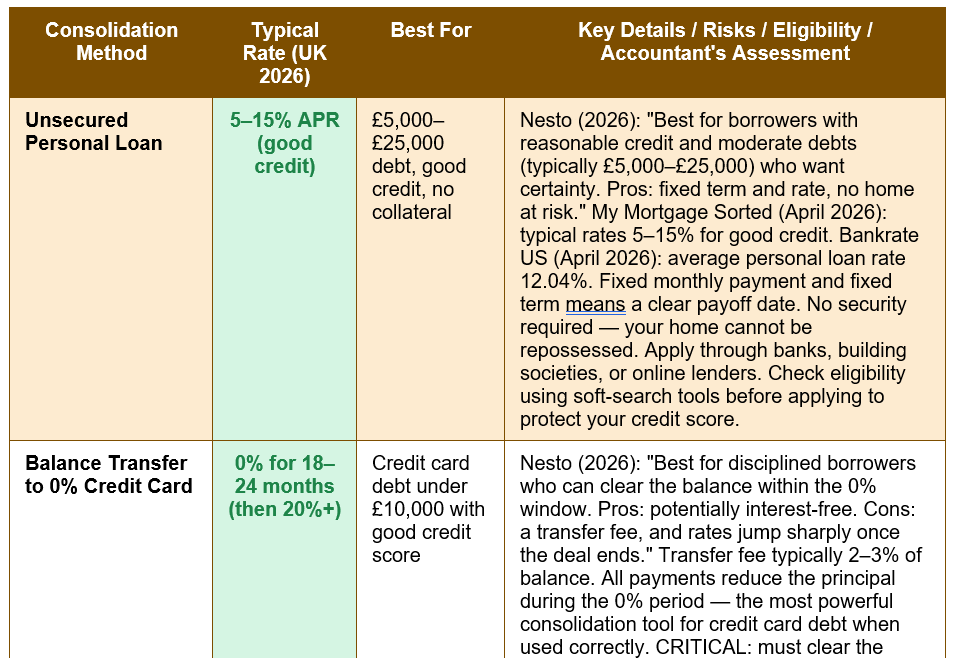
Debt Consolidation Pros and Cons: The Balanced Assessment
The Genuine Benefits- Lower interest rate reduces total cost: The primary financial benefit. Moving from 20-30% credit card APR to 8-12% personal loan APR reduces monthly interest charges and means more of each payment reduces the principal. Bankrate (April 2026): those with excellent credit can get rates under 7% on a personal loan — vs 19.58% average credit card rate.
- Single payment reduces administration and missed payment risk: Debt.org (July 2026): 'The average credit card user owns four cards, meaning four payment dates a month. Consolidation simplifies that by reducing it to one payment a month.' Multiple payment dates increase the risk of missing one — which damages credit scores and incurs late fees. One payment date removes this risk.
- Fixed repayment term creates a clear payoff date: Bankrate (April 2026): 'Credit cards don't come with a set repayment term and loans do. With a fixed repayment schedule, your payment and interest rate remain the same for the length of the loan — no unexpected fluctuation.' Knowing precisely when you will be debt-free is psychologically powerful and practically useful for financial planning.
- Reduced financial stress: Quick Funds (March 2026): 'For the right person, consolidation can bring structure, clarity, and a more manageable path forward.' The combination of lower interest, simpler payments, and a clear end date reduces the cognitive and emotional burden of debt management significantly.
The Real Risks
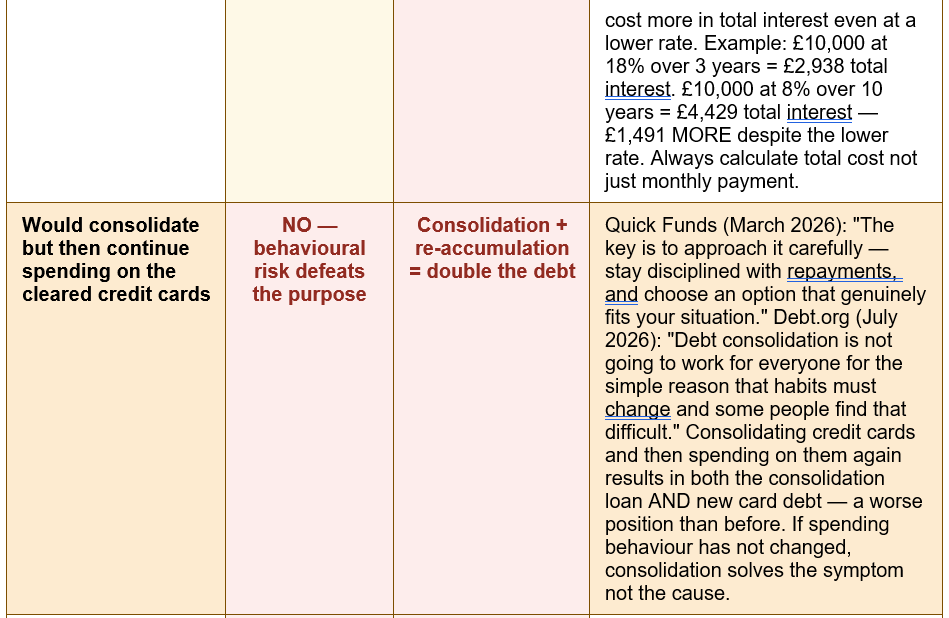
- Re-accumulation defeats the purpose: The most common consolidation failure. Clearing credit card balances through a consolidation loan and then spending on the now-empty cards results in the consolidation loan plus new card debt — a worse position than before. Debt.org: 'Debt consolidation is not going to work for everyone for the simple reason that habits must change and some people find that difficult.' After consolidating, close the cleared accounts or at least freeze the cards.
- Longer term can mean more total interest despite lower rate: My Mortgage Sorted (April 2026) identifies this trap explicitly: 'Stretching repayment over a longer term can mean you pay more in total interest even at a lower rate.' A £10,000 debt at 18% APR over 3 years costs £2,938 in total interest. The same debt at 8% over 10 years costs £4,429 — £1,491 more. The rate is lower but the term is so much longer that total interest paid is higher. Always calculate total cost over the full loan term, not just the monthly payment.
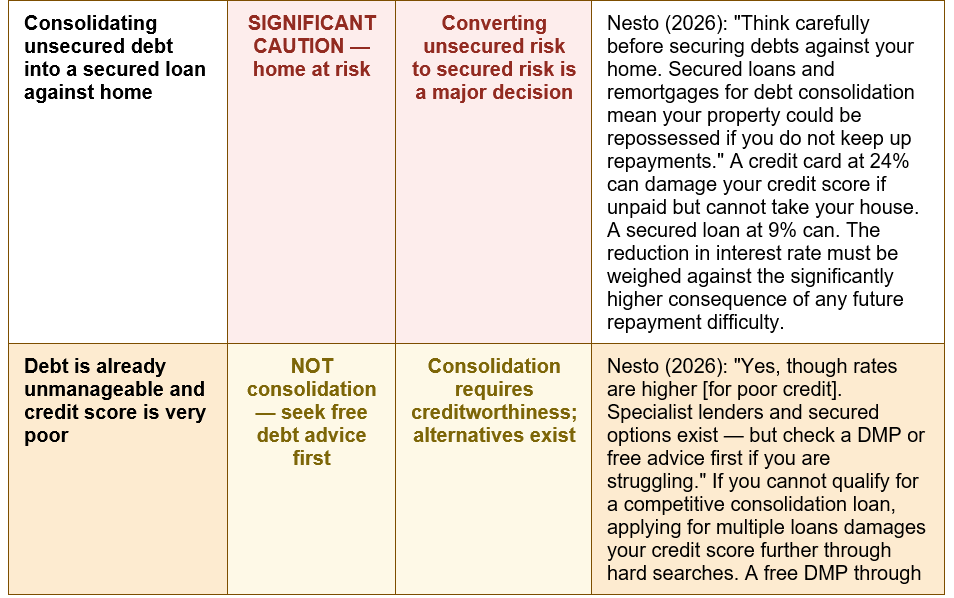
- Securing debts against your home converts manageable risk: Nesto (2026): 'Think carefully before securing debts against your home. Secured loans and remortgages for debt consolidation mean your property could be repossessed if you do not keep up repayments.' A credit card default damages your credit score and leads to collection activity — it cannot take your house. A secured consolidation loan at a lower rate CAN take your house. This conversion from unsecured to secured risk is a fundamental change in consequence that the interest rate reduction must genuinely justify.
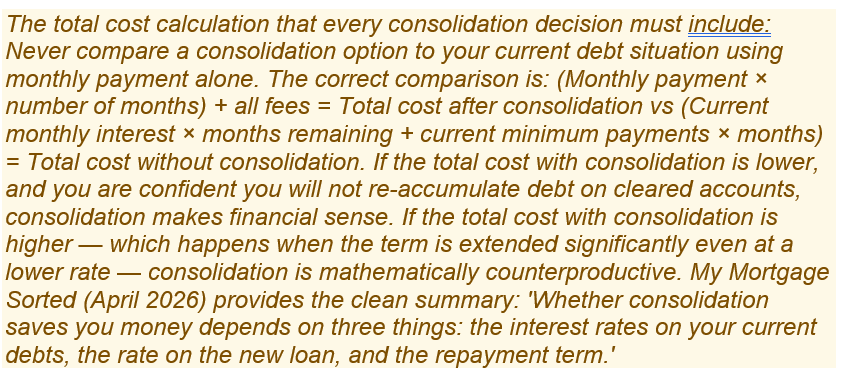
- Fees and early repayment charges can erode the saving: Balance transfer fees (2-3%), personal loan arrangement fees, early repayment charges on existing products, and legal costs on secured loans or remortgages all reduce the net saving from consolidation. Always calculate: (total interest after consolidation + all fees) vs (total interest without consolidation). If the difference is small, consolidation may not be worth the administrative effort and credit applications.
Is Debt Consolidation Right for You? The Suitability Framework
The right decision about debt consolidation depends on your specific circumstances — your debt amounts, your credit score, whether you own a home, and honestly whether your spending habits have changed enough to prevent re-accumulation. The following table maps the most common situations to a clear recommendation: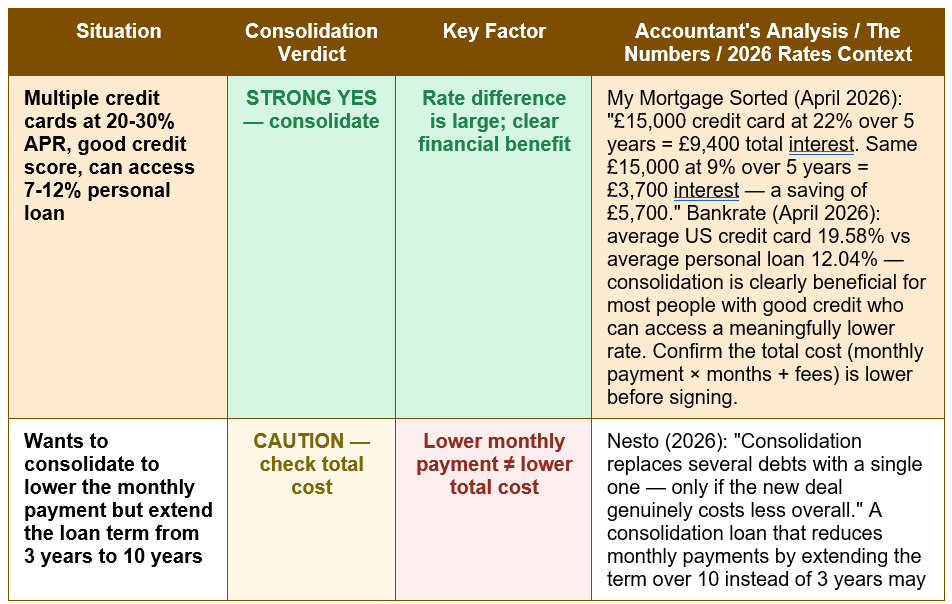

How Debt Consolidation Affects Your Credit Score
Debt consolidation has a nuanced, multi-stage effect on credit scores that plays out over months and years:- 13. Short-term: potential slight dip from new application: Applying for a consolidation loan or balance transfer card triggers a hard credit search, which temporarily reduces your credit score by a small amount (typically 5-10 points). If you apply to multiple lenders and are declined, multiple hard searches in a short period can compound this effect. Always use eligibility checkers (soft searches) before applying formally.
- 14. Short-term: credit utilisation falls sharply: When the consolidation loan pays off credit card balances, those cards show zero utilisation. Credit utilisation — the percentage of available credit being used — is a significant credit score factor. Paying card balances to zero improves the utilisation ratio, which typically produces a score improvement that more than offsets the hard search impact within 1-3 months.
- 15. Medium-term: consistent single payment builds positive history: One fixed monthly payment that is consistently met builds a positive payment history far more reliably than multiple payments to multiple creditors with different due dates. Bankrate (April 2026): 'With a fixed repayment schedule, your payment and interest rate remain the same for the length of the loan.' Consistent on-time payments improve credit score over time.
- 16. Risk: re-using cleared cards destroys the credit score benefit: If cleared credit cards are used again after consolidation, utilisation rises and the minimum payments due across multiple accounts increase again — potentially creating the same missed payment risk as before. The credit score improvement from consolidation is quickly reversed if spending continues on cleared accounts.
How to Apply for Debt Consolidation in 2026: Step by Step
- 17. List every debt: Amount, APR, and minimum payment for each. This is your starting position for the total cost comparison. Total them to know the consolidation loan size needed.
- 18. Check your credit score: Obtain your credit report from Equifax, Experian, and TransUnion (all free in the UK). Identify and dispute any errors. Your score determines which rate tier you will access — Bankrate: excellent credit can get under 7%; average credit 12-15%.
- 19. Use eligibility checkers (soft searches): Most major UK lenders (Lloyds, NatWest, Halifax, Sainsbury's Bank, Zopa, Tesco Bank, Cahoot) offer pre-approval eligibility checkers that use a soft credit search — visible only to you, not to other lenders. Use these to identify the best available rate before making any formal application.
- 20. Calculate the total cost: Using the rate from the eligibility checker, calculate: total payments over the full consolidation term + any arrangement fee. Compare this to your current total if you continue with existing debts. If the saving is genuine and meaningful, proceed. If not, explore other options.
- 21. Apply formally and pay off existing debts immediately: Once approved, use the consolidation loan funds to clear every qualifying debt as quickly as possible. Do not wait — every day the old high-rate debts remain outstanding costs interest. Then: cancel or cut up the cleared credit cards, remove the accounts from Apple Pay/Google Pay, and set up a standing order for the full consolidation loan payment.
- 22. Monitor and do not re-accumulate: Set a monthly reminder to check the consolidation loan balance is reducing as planned. The old accounts with zero balances are where discipline is most needed — the cards still work, the limits still exist, and the temptation to use them is real. Nesto: 'Consolidation can make repayment simpler and cheaper, but only if the new deal genuinely costs less overall and you don't run the old credit straight back up.'
THE TWO CONSOLIDATION MISTAKES THAT MAKE DEBT WORSE: (1) SECURING UNSECURED DEBT AGAINST YOUR HOME WITHOUT UNDERSTANDING THE RISK. Nesto (2026): 'Think carefully before securing debts against your home. Secured loans and remortgages for debt consolidation mean your property could be repossessed if you do not keep up repayments.' Moving credit card debt — which cannot take your home even in a worst case — to a secured loan that CAN take your home is a fundamental change in risk profile that many people do not fully appreciate when attracted by the lower headline rate. Only use secured consolidation when: the total cost saving is substantial, your income is stable and secure, and you have genuinely addressed the spending behaviour that created the original debt. (2) EXTENDING THE REPAYMENT TERM SO FAR THAT TOTAL INTEREST ACTUALLY RISES. My Mortgage Sorted (April 2026): 'Whether consolidation saves you money depends on three things: the interest rates, the rate on the new loan, and the repayment term.' A 10-year consolidation loan at 8% on debt that would otherwise have been cleared in 3 years at 18% pays more total interest despite the lower rate. Always calculate total cost — not just monthly payment — before signing any consolidation agreement.
Conclusion
Debt consolidation is one of the most powerful debt management tools available — when it is applied correctly. Combining multiple high-rate debts into a single lower-rate loan with a clear payoff date can save thousands of pounds or dollars in interest, simplify financial management to a single monthly payment, and provide the psychological clarity of knowing exactly when debt will be gone. My Mortgage Sorted (April 2026) demonstrated the UK numbers: £15,000 of credit card debt at 22% costs £9,400 in total interest over 5 years; consolidated at 9%, it costs £3,700 — a saving of £5,700. Debt.org (July 2026) showed the US equivalent: $15,000 consolidated from 27.9% to 8% saves $9,720 across the loan term.But consolidation is not automatically beneficial, and it carries real risks that must be understood before committing. The total cost calculation — monthly payment multiplied by term, plus all fees — must be lower than the current debt trajectory. The term must not be so extended that total interest paid rises despite the lower rate. Cleared credit card balances must not be re-accumulated. And securing unsecured debts against a home converts a manageable credit consequence into the risk of losing the property — a trade-off that requires very careful consideration of income stability and the specific numbers involved.
The accountant's verdict: debt consolidation makes financial sense when the consolidation rate is meaningfully lower than the current average rate, the term produces a genuinely lower total cost, you can access a competitive rate through your credit profile, and your spending behaviour has changed sufficiently that cleared accounts will not be re-used. When those conditions are met, consolidation is an excellent tool. When they are not — particularly when debt is already unmanageable or credit is poor — free professional debt advice through StepChange (0800 138 1111), Citizens Advice (0800 144 8848), or National Debtline (0808 808 4000) will identify better-suited alternatives including free Debt Management Plans that achieve similar outcomes without taking on new borrowing.
0 Comments
Be the first to share your thoughts on this article.