

Investing
What Happens When Your Brokerage Account Hits $10K

Key Statistics & Data (2026): A third of US household wealth was tied up in stocks at end of 2025 — the highest share on record (Federal Reserve). $10,000 at 10% annual return for 25 years = $108,000+ (Motley Fool, historical S&P 500 data). $10,000 is described as the point where ‘compound interest starts to manifest in tangible, meaningful dollar amounts’ (Hendricks Wealth, June 2026). Pattern Day Trader (PDT) rule: requires $25,000 minimum equity in a margin account to execute 4+ day trades in 5 business days (FINRA). Minimum margin account requirements: typically $2,000 minimum, but most brokerages require $10,000+ for full margin access. Short selling requires a margin account (minimum $2,000 FINRA requirement; typically $10,000+ for practical access). IRS: qualified dividends taxed at 0%, 15%, or 20% depending on income (capital gains rates apply). Long-term capital gains tax rate (2026): 0% for single filers with income up to $47,025; 15% up to $518,900; 20% above $518,900. Short-term capital gains taxed as ordinary income (10%–37%). Tax-loss harvesting becomes meaningful at larger portfolio sizes. SIPC protection: up to $500,000 per customer ($250,000 cash) at all SIPC-member brokers. Fidelity won NerdWallet Best Investing App and Best Broker for Beginners 2026 (NerdWallet). Vanguard 2026 IRA contribution limit: $7,500 ($8,600 age 50+). 401(k) 2026 limit: $24,500. IRS 2026 IRA income limit for deductibility varies by tax filing status and whether covered by workplace plan.
As of the end of 2025, a third of US household wealth was tied up in stocks — the highest share on record, according to the Federal Reserve. More Americans are investing than ever before, driven by zero-commission platforms, fractional shares, and an unprecedented democratisation of market access. Many of those new investors are now approaching or crossing the $10,000 threshold for the first time. Understanding what changes at this level — and what to do about it — is the practical question this article answers.
This guide covers exactly what happens when your brokerage account reaches $10,000: the features that unlock, the tax obligations that arrive, the investing strategies that become both possible and necessary, the mistakes that are most costly at this level, and the single decision about what to prioritise next that will determine more about your long-term outcome than almost anything else.
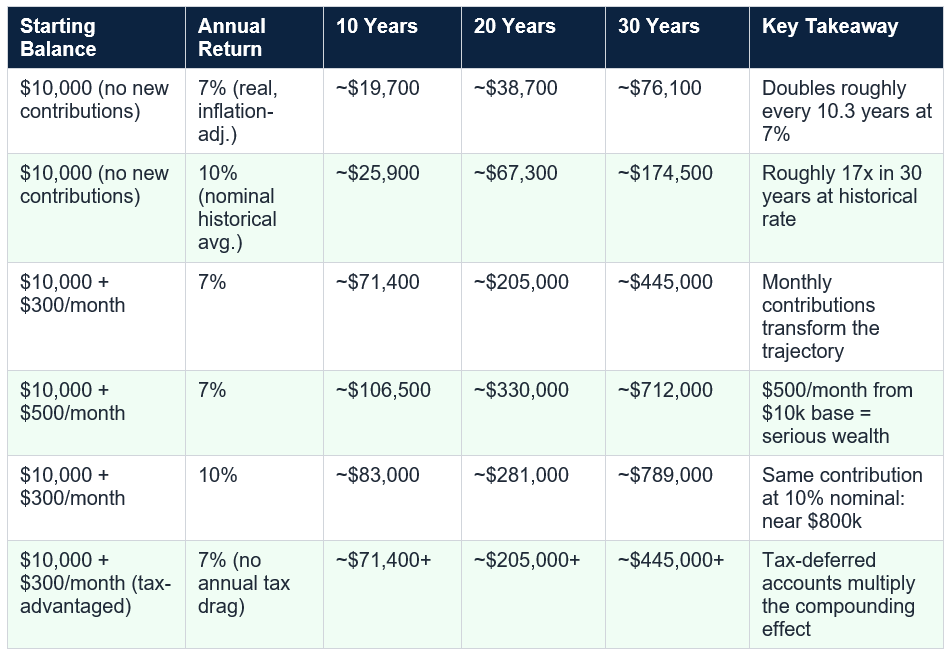
The table makes clear why $10,000 is a meaningful threshold: it is large enough that even modest ongoing contributions produce outcomes that genuinely matter. The $300 per month investor who starts with $10,000 and maintains that contribution for 30 years at 7 percent real return ends with approximately $445,000. The same investor who waits until their portfolio is $25,000 to start contributing loses not just the five-year contribution gap but all the compounding on those contributions for the remaining 25 years.
At $10,000, the theoretical margin capacity at most brokerages is approximately $10,000 of additional purchasing power (Regulation T allows up to 50 percent of the purchase price to be borrowed). This means a $10,000 account could in theory control $20,000 of stock. This amplifies both gains and losses proportionally: a 10 percent gain on a $20,000 position is $2,000, which represents a 20 percent return on the $10,000 of the investor’s own capital. A 10 percent loss is also $2,000, which represents a 20 percent loss.
Pro Tip: For the vast majority of investors reaching $10,000 for the first time, margin is not a tool to immediately activate. The interest cost on borrowed capital (5 to 12 percent) must be overcome by investment returns before any net profit is made. In a year when the market returns 10 percent and margin costs 8 percent, the net advantage is only 2 percent — on a leveraged position that carries double the downside risk. The power of margin is real for experienced, disciplined traders. For most new investors at $10,000, the priority should be compound growth in a cash account, not leverage.
At $10,000, the PDT rule is acutely relevant because you are below the $25,000 threshold. The practical consequences:
Both strategies require Tier 1 options approval, which most brokerages grant relatively readily, and both have clearly defined maximum losses (bounded by the stock falling to zero for covered calls; bounded by the net cost basis for cash-secured puts). At $10,000, these two strategies represent the most appropriate entry point into options for most investors.
Capital Gains
Every time you sell a security in a taxable brokerage account at a profit, you generate a capital gain. The tax rate depends on how long you held the security: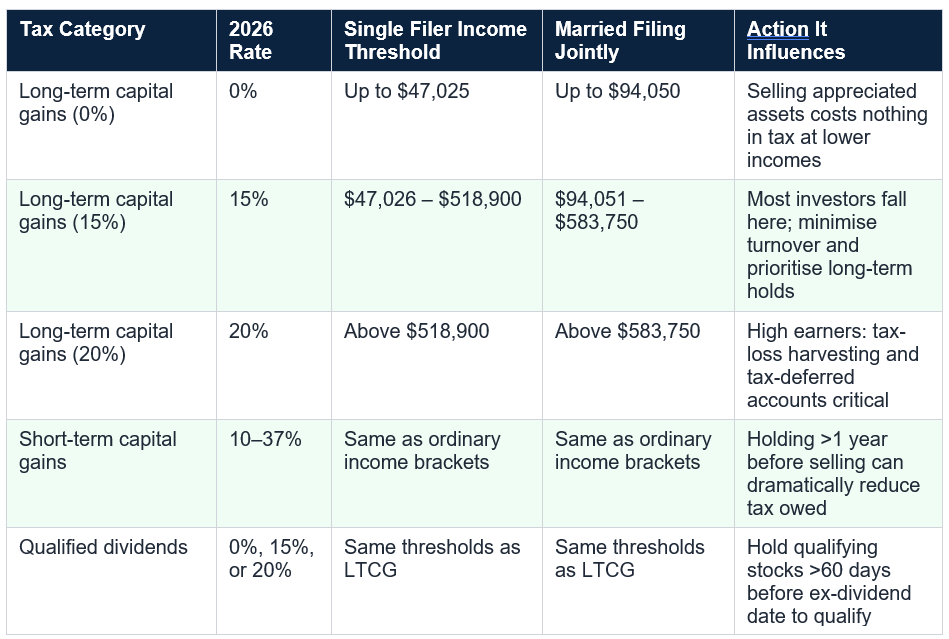

Pro Tip: The most powerful tax strategy available to a $10,000 brokerage investor is straightforward: hold index funds in the taxable account, never sell, and let dividends and capital gains build unrealised. Index funds generate far fewer taxable events than actively managed funds or individual stock portfolios because they trade infrequently. The combination of buy-and-hold with index funds and tax-advantaged accounts for more actively managed holdings is the most tax-efficient portfolio structure available.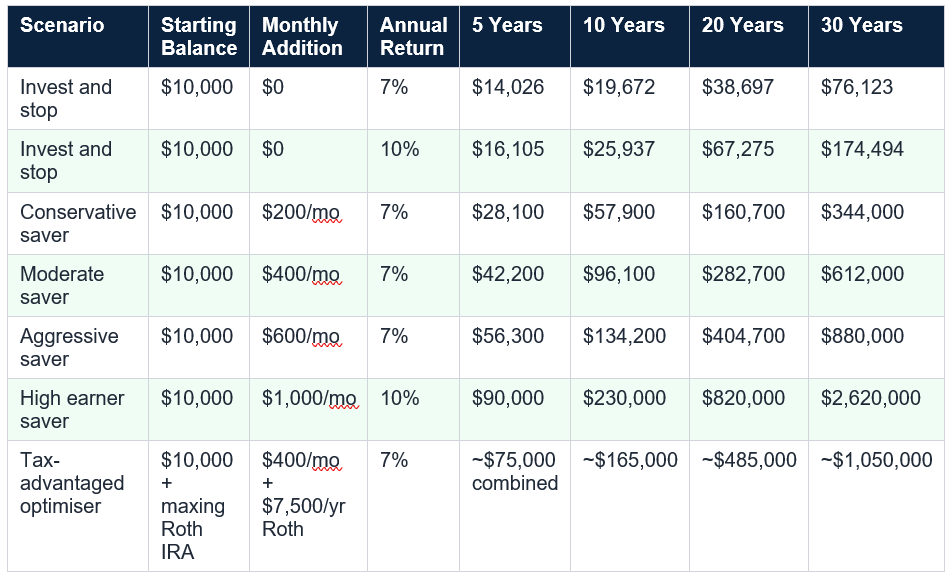
All projections are hypothetical, based on assumed constant annual rates of return, and do not account for taxes (in a taxable account), investment fees, or inflation. They are illustrative only. Past performance is not indicative of future results. The projections demonstrate why consistent contributions after reaching $10,000 are exponentially more important than the initial milestone itself.
$10,000 in a brokerage account means compound interest is generating $700 to $1,000 per year at historical average returns without any new contribution. It means the portfolio has enough mass for genuine diversification to be structurally coherent. It means tax considerations are real and worth planning around. It means margin, options strategies, and premium research features are accessible or becoming so.
But more than any specific feature or capability, $10,000 means the foundation is laid. A third of all US household wealth is now in stocks — the highest share on record. The investors who build the most wealth over the next three decades will not be the ones who find the cleverest trades or time the market perfectly. They will be the ones who reach $10,000, understand what changes at that level, keep contributing, stay invested through volatility, and let the mathematics of compounding do what they have always done for patient investors. The highway is open. The question is where you drive from here.
Several things change simultaneously. Mathematically, compound interest at $10,000 starts generating $700 to $1,000 per year at historical average returns — making growth visibly meaningful for the first time. Practically, margin account access becomes available at most brokerages (FINRA minimum is $2,000 but most require $10,000+ in practice), options trading tier upgrades become accessible, and the portfolio is large enough for genuinely diversified construction across 3 to 5 positions. Psychologically, as Hendricks Wealth’s June 2026 analysis describes, investors begin thinking of themselves as legitimate investors rather than just savers.
What is the Pattern Day Trader rule and does it affect me at $10,000?
The PDT rule, enforced by FINRA, requires investors who execute 4 or more day trades within 5 business days in a margin account to maintain at least $25,000 in equity at all times. At $10,000, you are below this threshold. If you make 4 or more day trades in 5 business days, your brokerage will restrict your trading or require you to deposit additional funds. The rule applies to margin accounts, not cash accounts. For most long-term investors at $10,000, the PDT rule is irrelevant because they are not day trading. For active traders at this level, maintaining a cash account and working within settlement constraints is the practical workaround.
What are the tax implications of a $10,000 brokerage account?
A taxable brokerage account generates two main types of tax obligation: dividend income (taxed at qualified or ordinary rates) and capital gains (taxed at short-term or long-term rates). In 2026, long-term capital gains rates are 0% for single filers with taxable income up to $47,025, 15% up to $518,900, and 20% above that. Short-term gains are taxed as ordinary income (10% to 37%). At $10,000, annual dividend income is typically $100 to $400, and capital gains are only realised when you sell. The most tax-efficient strategy is to hold low-turnover index funds in the taxable account, hold actively managed funds in tax-advantaged accounts, and delay sales to qualify for long-term rates.
Should I open a margin account at $10,000?
For most investors at $10,000, margin is not recommended as an immediate tool. Margin interest rates of 5 to 12 percent must be overcome by investment returns before any net benefit is realised. In a year when the market returns 10 percent and margin costs 8 percent, the net advantage is only 2 percent — on a leveraged position that carries double the downside risk. The appropriate use of a margin account at $10,000 is primarily to enable options strategies like covered calls and cash-secured puts, not to borrow money to buy more securities. A cash account is sufficient for most $10,000 investors.
What should I prioritise after reaching $10,000 in a brokerage account?
The priority order depends on your specific situation, but the general framework is: (1) maximise your 401(k) to the employer match — an immediate 50 to 100 percent return; (2) eliminate high-interest debt above 7 to 8 percent; (3) ensure a liquid 3 to 6 month emergency fund exists in a high-yield savings account; (4) maximise Roth IRA contributions ($7,500 in 2026, $8,600 if age 50+) for tax-free long-term growth; and (5) continue contributing to the taxable brokerage account. Always consult a qualified financial adviser for personalised guidance.
What could $10,000 grow to over 30 years?
At a 7 percent average annual return (approximately the real historical return after inflation), $10,000 alone with no additional contributions grows to approximately $76,000 in 30 years. With $400 per month in additional contributions, the same starting point reaches approximately $612,000. At a 10 percent nominal return with $400 per month, the projection exceeds $1 million. These are hypothetical projections based on assumed constant annual rates, do not account for taxes or fees, and past performance is not indicative of future results. The most important variable is not the return rate but the consistency of contributions after the $10,000 milestone is reached.
Is $10,000 enough to invest in options?
At $10,000, the two most appropriate options strategies are covered calls and cash-secured puts, both requiring only Tier 1 approval at most brokerages. A covered call involves owning 100 shares of a stock or ETF and selling a call option against it to collect premium income. A cash-secured put involves selling a put option while holding enough cash to purchase the shares if exercised. Both strategies have defined maximum losses and generate income regardless of whether the options are exercised. Complex multi-leg options strategies requiring higher Tier approvals and more capital are generally not appropriate at $10,000.
Table of Contents
- $10,000 Is Not Just a Number
- The Two Shifts That Happen at $10,000
- What Compound Interest Actually Looks Like at $10,000
- Features That Unlock or Become Practical at $10,000
- Margin Accounts: What They Are and Whether You Need One
- The Pattern Day Trader Rule and Why It Matters
- Options Trading: What $10,000 Makes Possible
- Tax Implications That Arrive With a $10,000 Portfolio
- Capital Gains Tax: The Numbers You Need to Know
- Tax-Loss Harvesting: Your First Real Tax Strategy
- How to Think About Portfolio Construction at $10,000
- The Key Decision: What to Prioritise Next
- What $10,000 Could Become: The Projection Table
- The Most Common $10,000 Mistakes
- Conclusion: The Highway On-Ramp
- Frequently Asked Questions
$10,000 Is Not Just a Number
The moment your brokerage account crosses $10,000, something changes. Not everything changes, and it does not happen overnight. But reaching this specific threshold is not an arbitrary milestone in the way that $9,000 or $11,000 is. It is the point at which the investing experience materially shifts across several dimensions simultaneously: the mathematics of compounding become genuinely visible, new features and account types become accessible or practical, tax considerations arrive in earnest, and the portfolio for the first time has enough mass to develop a coherent strategy rather than simply accumulating individual positions.As of the end of 2025, a third of US household wealth was tied up in stocks — the highest share on record, according to the Federal Reserve. More Americans are investing than ever before, driven by zero-commission platforms, fractional shares, and an unprecedented democratisation of market access. Many of those new investors are now approaching or crossing the $10,000 threshold for the first time. Understanding what changes at this level — and what to do about it — is the practical question this article answers.
This guide covers exactly what happens when your brokerage account reaches $10,000: the features that unlock, the tax obligations that arrive, the investing strategies that become both possible and necessary, the mistakes that are most costly at this level, and the single decision about what to prioritise next that will determine more about your long-term outcome than almost anything else.
2. The Two Shifts That Happen at $10,000
Hendricks Wealth’s June 2026 analysis, written by fiduciary adviser Tom Anderson, identifies the $10,000 level as a powerful psychological and mathematical tipping point and articulates the two specific shifts that occur at this level:The Mathematical Shift
At portfolios below a few thousand dollars, compound interest is technically working but visibly unimpressive. A 10 percent annual return on $1,000 is $100. On $5,000 it is $500. These are real gains but they feel like rounding errors relative to the monthly contributions most investors are making. At $10,000, the mathematics begin to change. A 10 percent annual return generates $1,000 of new portfolio growth in a single year — before any new contribution is added. The portfolio is now earning at a rate that represents meaningful progress. As Tom Anderson puts it: this is the baseline amount where the forces of compound interest start to manifest in tangible, meaningful dollar amounts rather than just pennies.The Psychological Shift
The second shift is harder to quantify but equally important. At $10,000, most investors stop thinking of themselves as someone who is ‘saving money’ and begin thinking of themselves as a legitimate investor. This identity shift matters enormously for long-term behaviour. Investors who see themselves as investors make different decisions under pressure: they are more likely to hold during market downturns, more likely to continue contributing during difficult periods, and more likely to think in terms of long-term strategy rather than short-term price movements. Warren Buffett’s observation that ‘someone is sitting in the shade today because someone planted a tree a long time ago’ resonates differently when you have $10,000 than when you have $1,000. The tree is visible.What Compound Interest Actually Looks Like at $10,000
The Motley Fool’s analysis, drawing on historical S&P 500 data, provides the most widely cited projection: a $10,000 investment in a basic S&P 500 index fund, left entirely alone at a 10 percent annualised return, grows to approximately $108,000 over 25 years. This is the mathematics of a single lump sum, no additional contributions, simply left to compound. The real-world outcome for an investor who continues contributing after reaching $10,000 is significantly better.The table makes clear why $10,000 is a meaningful threshold: it is large enough that even modest ongoing contributions produce outcomes that genuinely matter. The $300 per month investor who starts with $10,000 and maintains that contribution for 30 years at 7 percent real return ends with approximately $445,000. The same investor who waits until their portfolio is $25,000 to start contributing loses not just the five-year contribution gap but all the compounding on those contributions for the remaining 25 years.
Features That Unlock or Become Practical at $10,000
Beyond the mathematics, several specific features of the investing experience change meaningfully when a brokerage account reaches $10,000:Margin Account Access
Most major brokerages require a minimum account balance to open or maintain a margin account. While FINRA’s regulatory minimum is $2,000, most brokerages require $10,000 or more in equity before extending meaningful margin capacity. At $10,000, the margin conversation becomes practical for the first time. Whether to use margin is a separate question entirely; the point is that the option now exists.Options Trading Tier Upgrades
Options trading is structured in tiers at most brokerages. Tier 1 (covered calls and cash-secured puts) is generally available at any balance. Tier 2 (long calls and puts, spreads) typically requires demonstrated trading experience but not a specific minimum balance. Tier 3 (complex spreads, strangles, condors) and Tier 4 (naked options) require higher balances and equity. At $10,000, investors who have trading experience are more likely to qualify for Tier 2 and potentially Tier 3 approvals, unlocking strategies that were not practically available at smaller balances.Premium Research and Advisory Services
Some brokerage platforms tier their research, advice, and analytical tools to balance size. Betterment’s premium tier, for example, previously required $100,000 but now uses balance-based fee structures that activate at different thresholds. SoFi previously offered unlimited free financial planner access; as NerdWallet noted in its 2026 brokerage review, SoFi discontinued this as a universal feature but still offers financial planner access through SoFi Plus Premium at $10/month — a cost that represents roughly 0.48 percent of a $25,000 account but 1.2 percent of a $10,000 account. The decision calculus becomes more favourable as balances grow.More Meaningful Diversification
Below $10,000, achieving genuine portfolio diversification can be difficult without fractional shares. At $10,000, an investor can build a properly diversified portfolio across 3 to 5 index funds or ETFs with enough in each position for the diversification to be meaningful. A $10,000 portfolio might reasonably hold $4,000 in a total US market ETF, $2,500 in international equities, $2,000 in bonds, and $1,500 in a REIT or commodity ETF — a genuine 4-way diversification that is structurally coherent rather than symbolic.Margin Accounts: What They Are and Whether You Need One
A margin account allows you to borrow money from your brokerage to purchase securities, using your existing portfolio as collateral. The borrowed amount is called ‘buying on margin,’ and you pay interest on the loan (margin interest rates typically range from 5 to 12 percent depending on the broker and the amount borrowed).At $10,000, the theoretical margin capacity at most brokerages is approximately $10,000 of additional purchasing power (Regulation T allows up to 50 percent of the purchase price to be borrowed). This means a $10,000 account could in theory control $20,000 of stock. This amplifies both gains and losses proportionally: a 10 percent gain on a $20,000 position is $2,000, which represents a 20 percent return on the $10,000 of the investor’s own capital. A 10 percent loss is also $2,000, which represents a 20 percent loss.
Pro Tip: For the vast majority of investors reaching $10,000 for the first time, margin is not a tool to immediately activate. The interest cost on borrowed capital (5 to 12 percent) must be overcome by investment returns before any net profit is made. In a year when the market returns 10 percent and margin costs 8 percent, the net advantage is only 2 percent — on a leveraged position that carries double the downside risk. The power of margin is real for experienced, disciplined traders. For most new investors at $10,000, the priority should be compound growth in a cash account, not leverage.
The Pattern Day Trader Rule and Why It Matters
One of the most consequential regulations that most new investors encounter as their account grows is the Pattern Day Trader (PDT) rule, enforced by FINRA. If you execute four or more day trades within five business days in a margin account, and those day trades represent more than six percent of your total trades for that period, you are classified as a Pattern Day Trader. This classification requires you to maintain a minimum of $25,000 in equity in your margin account at all times.At $10,000, the PDT rule is acutely relevant because you are below the $25,000 threshold. The practical consequences:
- If you have a margin account with $10,000 and make 4 or more day trades in 5 business days, your account will be flagged. Your brokerage will require you to deposit additional funds to bring your equity to $25,000, or restrict your trading to non-day-trading activity.
- In a cash account (not a margin account), the PDT rule does not apply. But cash account day trading is constrained by settlement rules: trades settle in T+1 (one business day after the trade date), meaning you must use settled cash for each transaction.
- For investors who want to day trade actively before reaching $25,000, maintaining a cash account and staying within settlement rules is the primary strategy.
Options Trading: What $10,000 Makes Possible
With $10,000 in a brokerage account, the most appropriate options strategy for most investors is not complex multi-leg spreads but the two most straightforward income-generating options strategies:Covered Calls
If you own 100 shares of a stock or ETF, you can sell a call option against it and collect premium income. With $10,000, you can own 100 shares of a stock priced at approximately $100 per share and write covered calls against that position. The call premium provides income regardless of whether the option is exercised. If the stock does not rise to the strike price, the option expires and you keep the premium. If it does, you sell at the agreed strike — a price you were willing to accept when writing the call.Cash-Secured Puts
A cash-secured put involves selling a put option on a stock or ETF at a price you are genuinely willing to pay, with enough cash set aside to purchase the shares if the option is exercised. With $10,000, you can write cash-secured puts on stocks or ETFs priced up to $100 per share, collecting premium income while committing to buy if the price falls to your target level. This strategy effectively allows you to get paid to wait to buy a stock at the price you want.Both strategies require Tier 1 options approval, which most brokerages grant relatively readily, and both have clearly defined maximum losses (bounded by the stock falling to zero for covered calls; bounded by the net cost basis for cash-secured puts). At $10,000, these two strategies represent the most appropriate entry point into options for most investors.
Tax Implications That Arrive With a $10,000 Portfolio
A brokerage account generates taxable events that do not exist in tax-advantaged retirement accounts. Once your taxable brokerage account reaches $10,000 and begins generating meaningful dividends and capital gains, understanding your tax obligations is no longer optional.Dividend Income
Dividends paid by stocks, ETFs, and mutual funds in a taxable brokerage account are reported on Form 1099-DIV. Two types of dividends are treated differently for tax purposes:- Qualified dividends: dividends from most US corporations and many foreign corporations, provided the holding period requirements are met (generally 60 days before the ex-dividend date). Taxed at the lower long-term capital gains rates: 0%, 15%, or 20% depending on total income.
- Ordinary dividends: dividends that do not meet the qualified dividend criteria. Taxed as ordinary income at your marginal tax rate, which can be as high as 37 percent for high earners.
Capital Gains
Every time you sell a security in a taxable brokerage account at a profit, you generate a capital gain. The tax rate depends on how long you held the security:
- Short-term capital gains (held less than one year): taxed as ordinary income at your marginal rate (10 to 37 percent in 2026).
- Long-term capital gains (held more than one year): taxed at preferential rates. In 2026, the 0% rate applies to single filers with taxable income up to $47,025; the 15% rate applies up to $518,900; the 20% rate applies above $518,900 (IRS 2026 Publication 550).
9. Capital Gains Tax: The Numbers You Need to Know
Pro Tip: The most powerful tax strategy available to a $10,000 brokerage investor is straightforward: hold index funds in the taxable account, never sell, and let dividends and capital gains build unrealised. Index funds generate far fewer taxable events than actively managed funds or individual stock portfolios because they trade infrequently. The combination of buy-and-hold with index funds and tax-advantaged accounts for more actively managed holdings is the most tax-efficient portfolio structure available.
Tax-Loss Harvesting: Your First Real Tax Strategy
Tax-loss harvesting is the practice of selling a security that has declined in value to realise a capital loss, which can then be used to offset capital gains from other sales. At portfolio sizes below $10,000, the available losses are typically too small to be worth the administrative complexity of tracking and executing. At $10,000, particularly after a market downturn, tax-loss harvesting becomes a genuinely useful strategy.How it works at $10,000:
- Suppose you invested $3,000 in a US equity ETF and it has declined to $2,400. Selling it realises a $600 capital loss.
- This $600 loss offsets $600 of capital gains elsewhere in your portfolio. If you have $600 of realised gains from selling another position, the net taxable gain is zero.
- Capital losses can also offset up to $3,000 of ordinary income per year if losses exceed gains. Any remaining losses carry forward to future tax years.
- The wash-sale rule: you cannot buy the same or a ‘substantially identical’ security within 30 days before or after the sale and still claim the loss. Solution: immediately buy a similar but not identical ETF (e.g., sell Vanguard Total Stock Market ETF and buy Schwab US Broad Market ETF) to maintain market exposure while realising the loss.
How to Think About Portfolio Construction at $10,000
At $10,000, the question of what to hold moves from academic to practical. Three structural decisions matter most at this level:Decision 1: Taxable vs. Tax-Advantaged Allocation
If you have not already maximised contributions to tax-advantaged accounts (401(k) to the employer match, then Roth IRA up to the $7,500 annual limit in 2026), doing so before adding to a taxable brokerage account is almost always the right priority. A Roth IRA contribution at $10,000 grows tax-free for decades; the same $10,000 in a taxable account generates annual tax obligations on dividends and capital gains. The tax-advantaged account is worth materially more over 20 to 30 years.Decision 2: Core vs. Satellite Structure
A practical portfolio structure for a $10,000 taxable account is a core/satellite approach: allocate 70 to 80 percent to a single globally diversified index fund (the core), and 20 to 30 percent to two or three targeted positions (the satellite). The core provides diversification and low cost; the satellite allows for specific views on sectors, geographies, or asset classes. This structure is simple enough to manage without constant attention and coherent enough to develop over time.Decision 3: Rebalancing Threshold
Establish a rebalancing rule before you need one, not after. The most practical rule for a $10,000 account: review quarterly and rebalance when any position is more than 5 percentage points above or below its target allocation. Use new cash contributions to rebalance before selling existing positions, to minimise taxable events in a taxable account.12. The Key Decision: What to Prioritise Next
With $10,000 in a brokerage account, the single most important question is: where does the next dollar go? The priority order that most qualified financial planners recommend for this decision:- First priority — 401(k) to the employer match: if your employer matches contributions and you are not capturing the full match, this is an immediate, guaranteed 50 to 100 percent return on the contribution. No investment can reliably replicate this return.
- Second priority — High-interest debt elimination: any debt above 7 to 8 percent interest rate represents a guaranteed return equal to the debt rate when paid off. This is a better guaranteed return than most investments can reliably deliver.
- Third priority — Emergency fund (if not yet established): a liquid emergency fund of 3 to 6 months of expenses in a high-yield savings account is the financial foundation on which any investment strategy rests. If this is not yet in place, establishing it before investing additional brokerage funds is the correct priority.
- Fourth priority — Roth IRA contributions: the $7,500 annual Roth IRA limit (2026) provides tax-free growth with no required minimum distributions. At $10,000 in taxable brokerage, the Roth IRA is typically the most valuable next dollar.
- Fifth priority — Additional taxable brokerage contributions: once the above priorities are addressed, additional contributions to the taxable brokerage account build the investable base that generates the compounding shown in the projection table.
What $10,000 Could Become: The Projection Table
All projections are hypothetical, based on assumed constant annual rates of return, and do not account for taxes (in a taxable account), investment fees, or inflation. They are illustrative only. Past performance is not indicative of future results. The projections demonstrate why consistent contributions after reaching $10,000 are exponentially more important than the initial milestone itself.
The Most Common $10,000 Mistakes
Reaching $10,000 in a brokerage account is an achievement. The most common ways investors immediately undermine it:- Activating margin without understanding the cost: borrowing against your portfolio at 7 to 10 percent interest to invest in assets that may or may not return more than that is a losing proposition in most environments. Most $10,000 investors should not use margin.
- Day trading below the PDT threshold: executing three day trades per five business days repeatedly while staying under the PDT limit is not a trading strategy. It is a constraint that most investors should work around by not day trading at this level at all, rather than gaming the rule.
- Treating the brokerage account as a savings account: a taxable brokerage account is not a savings account and should not be used as one. Frequently selling positions to fund expenses generates taxable events, disrupts compounding, and erodes the portfolio’s long-term trajectory. Maintain a separate emergency fund for liquidity needs.
- Chasing individual stock performance: at $10,000, the risk of a single stock position declining significantly has a meaningful impact on the total portfolio. A 50 percent decline in a $2,000 position represents a 10 percent portfolio loss. Index funds at this level provide the diversification that individual stock picking cannot.
- Ignoring tax-advantaged accounts in favour of taxable investing: a $10,000 portfolio in a Roth IRA growing at 7 percent for 30 years generates approximately $76,000 — all of it tax-free at withdrawal. The same portfolio in a taxable account faces annual taxes on dividends and capital gains that compound into a meaningful reduction in the final balance.
Conclusion
The analogy that Hendricks Wealth’s Tom Anderson uses for the $10,000 milestone is the one that best captures what actually changes: it is like finally getting onto the highway after driving through every single frustrating red light in town. You have not reached your destination. But you have finally built up the speed where momentum does meaningful work.$10,000 in a brokerage account means compound interest is generating $700 to $1,000 per year at historical average returns without any new contribution. It means the portfolio has enough mass for genuine diversification to be structurally coherent. It means tax considerations are real and worth planning around. It means margin, options strategies, and premium research features are accessible or becoming so.
But more than any specific feature or capability, $10,000 means the foundation is laid. A third of all US household wealth is now in stocks — the highest share on record. The investors who build the most wealth over the next three decades will not be the ones who find the cleverest trades or time the market perfectly. They will be the ones who reach $10,000, understand what changes at that level, keep contributing, stay invested through volatility, and let the mathematics of compounding do what they have always done for patient investors. The highway is open. The question is where you drive from here.
Frequently Asked Questions
What actually changes when a brokerage account hits $10,000?Several things change simultaneously. Mathematically, compound interest at $10,000 starts generating $700 to $1,000 per year at historical average returns — making growth visibly meaningful for the first time. Practically, margin account access becomes available at most brokerages (FINRA minimum is $2,000 but most require $10,000+ in practice), options trading tier upgrades become accessible, and the portfolio is large enough for genuinely diversified construction across 3 to 5 positions. Psychologically, as Hendricks Wealth’s June 2026 analysis describes, investors begin thinking of themselves as legitimate investors rather than just savers.
What is the Pattern Day Trader rule and does it affect me at $10,000?
The PDT rule, enforced by FINRA, requires investors who execute 4 or more day trades within 5 business days in a margin account to maintain at least $25,000 in equity at all times. At $10,000, you are below this threshold. If you make 4 or more day trades in 5 business days, your brokerage will restrict your trading or require you to deposit additional funds. The rule applies to margin accounts, not cash accounts. For most long-term investors at $10,000, the PDT rule is irrelevant because they are not day trading. For active traders at this level, maintaining a cash account and working within settlement constraints is the practical workaround.
What are the tax implications of a $10,000 brokerage account?
A taxable brokerage account generates two main types of tax obligation: dividend income (taxed at qualified or ordinary rates) and capital gains (taxed at short-term or long-term rates). In 2026, long-term capital gains rates are 0% for single filers with taxable income up to $47,025, 15% up to $518,900, and 20% above that. Short-term gains are taxed as ordinary income (10% to 37%). At $10,000, annual dividend income is typically $100 to $400, and capital gains are only realised when you sell. The most tax-efficient strategy is to hold low-turnover index funds in the taxable account, hold actively managed funds in tax-advantaged accounts, and delay sales to qualify for long-term rates.
Should I open a margin account at $10,000?
For most investors at $10,000, margin is not recommended as an immediate tool. Margin interest rates of 5 to 12 percent must be overcome by investment returns before any net benefit is realised. In a year when the market returns 10 percent and margin costs 8 percent, the net advantage is only 2 percent — on a leveraged position that carries double the downside risk. The appropriate use of a margin account at $10,000 is primarily to enable options strategies like covered calls and cash-secured puts, not to borrow money to buy more securities. A cash account is sufficient for most $10,000 investors.
What should I prioritise after reaching $10,000 in a brokerage account?
The priority order depends on your specific situation, but the general framework is: (1) maximise your 401(k) to the employer match — an immediate 50 to 100 percent return; (2) eliminate high-interest debt above 7 to 8 percent; (3) ensure a liquid 3 to 6 month emergency fund exists in a high-yield savings account; (4) maximise Roth IRA contributions ($7,500 in 2026, $8,600 if age 50+) for tax-free long-term growth; and (5) continue contributing to the taxable brokerage account. Always consult a qualified financial adviser for personalised guidance.
What could $10,000 grow to over 30 years?
At a 7 percent average annual return (approximately the real historical return after inflation), $10,000 alone with no additional contributions grows to approximately $76,000 in 30 years. With $400 per month in additional contributions, the same starting point reaches approximately $612,000. At a 10 percent nominal return with $400 per month, the projection exceeds $1 million. These are hypothetical projections based on assumed constant annual rates, do not account for taxes or fees, and past performance is not indicative of future results. The most important variable is not the return rate but the consistency of contributions after the $10,000 milestone is reached.
Is $10,000 enough to invest in options?
At $10,000, the two most appropriate options strategies are covered calls and cash-secured puts, both requiring only Tier 1 approval at most brokerages. A covered call involves owning 100 shares of a stock or ETF and selling a call option against it to collect premium income. A cash-secured put involves selling a put option while holding enough cash to purchase the shares if exercised. Both strategies have defined maximum losses and generate income regardless of whether the options are exercised. Complex multi-leg options strategies requiring higher Tier approvals and more capital are generally not appropriate at $10,000.
0 Comments
Be the first to share your thoughts on this article.