

Investing
What Is an Unrealized Gain? Accountant Explains


Table of Contents
- The Profit You Have But Have Not Yet Collected
- What Is an Unrealized Gain?
- How to Calculate an Unrealized Gain: Formula and Worked Examples
- Example 1 — US Stock Portfolio (Kiplinger April 2026 Framework)
- Example 2 — Bitcoin Unrealised Gain (Blockstats, March 2026)
- Example 3 — UK Property (Principal Residence)
- Unrealized vs Realized Gain: The Complete Seven-Dimension Comparison
- Unrealized Gains Across Asset Types: A 2026 Reference
- The Strategic Value of Unrealized Gains: Tax Deferral and Compounding
- Unrealized Losses and Tax Loss Harvesting: The Flip Side
- Unrealized Gains in 2026: New Reporting Obligations and the Wealth Tax Debate
- Conclusion
- Frequently Asked Questions (FAQ)
The Profit You Have But Have Not Yet Collected
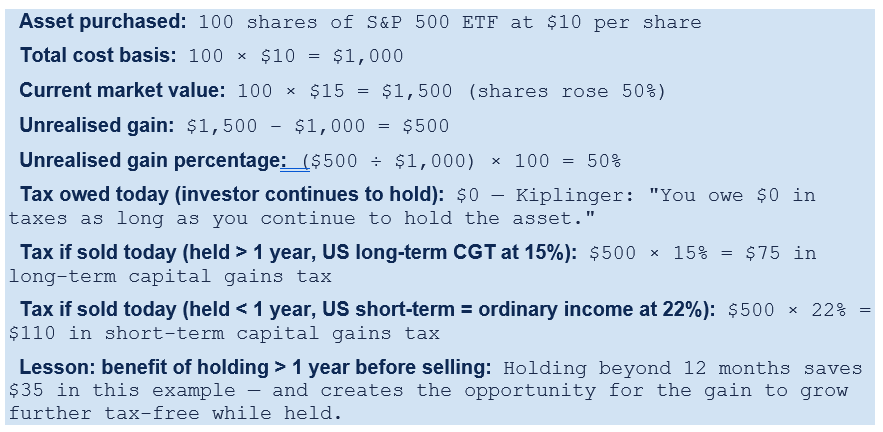
Imagine you bought 100 shares of a technology company for £20 per share three years ago — a total investment of £2,000. Today, those shares trade at £38 each, making your position worth £3,800. You have made £1,800. But you have not collected a single penny of it. You cannot spend it, transfer it to your bank account, or use it to buy groceries. More importantly, you owe no tax on it. This £1,800 is an unrealised gain — and understanding precisely what that means, how it differs from a realised gain, and why the distinction matters fundamentally to investing strategy and tax planning is the subject of this guide.An unrealised gain is the increase in value of an investment that you continue to hold — the difference between what you paid for it (the cost basis) and what it is worth today on the open market, while the investment remains in your portfolio unsold. Kiplinger's April 2026 capital gains tax guide captures the essential point with clarity: 'If your stock grows from $1,000 to $1,500, you have an unrealised gain of $500. You are technically wealthier, but you owe $0 in taxes as long as you continue to hold the asset.' The moment you sell, the gain becomes 'realised' — and the tax clock starts ticking.
This guide explains unrealised gains completely for 2026: the precise definition and formula, the difference between unrealised and realised gains across every dimension, the tax treatment in both the UK and US (including the important 2026 changes to digital asset reporting), the seven asset types where unrealised gains arise, the strategic value of keeping gains unrealised through tax deferral, the risk that unrealised gains can evaporate before realisation, the concept of tax loss harvesting using unrealised losses, the new CARF and Form 1099-DA reporting frameworks for digital assets in 2026, and the practical strategies investors use to manage their unrealised position wisely.
What Is an Unrealized Gain?
An unrealised gain is the positive difference between the current market value of an investment and the price originally paid for it, when the investment has not yet been sold. Jackson Hewitt's July 2026 guide (published four days ago) defines it precisely: 'Unrealised gains are profits on investments or assets that have increased in value but haven't been sold yet. While unrealised gains can boost your net worth on paper, their value can change with market fluctuations. Unrealised gains don't affect your available cash or income until you sell the asset.'The formula is straightforward: Unrealised Gain = Current Market Value − Cost Basis. The cost basis is the total original investment — the purchase price plus any commissions or fees paid at the time of purchase. If you bought 50 shares at £10 each (£500 total) and those shares now trade at £16 each (£800 total), your unrealised gain is £300. The gain is 'unrealised' because it exists only on paper — it is what you would profit if you sold right now, but you have chosen not to sell, and until you do, the money remains tied up in the investment rather than in your bank account.
The word 'unrealised' is particularly precise in financial terminology. Bankrate's guide explains: 'An unrealised gain or loss is the change in value of a stock, bond, or other asset you have purchased but not yet sold. The gain or loss is unrealised or on paper, as some refer to it, because you are still holding the investment. The gain or loss is only determined or realised when you sell the asset.' The contrast with a 'realised gain' — where the asset has actually been sold and the profit has been locked in through a completed transaction — is the most important distinction in investment taxation.
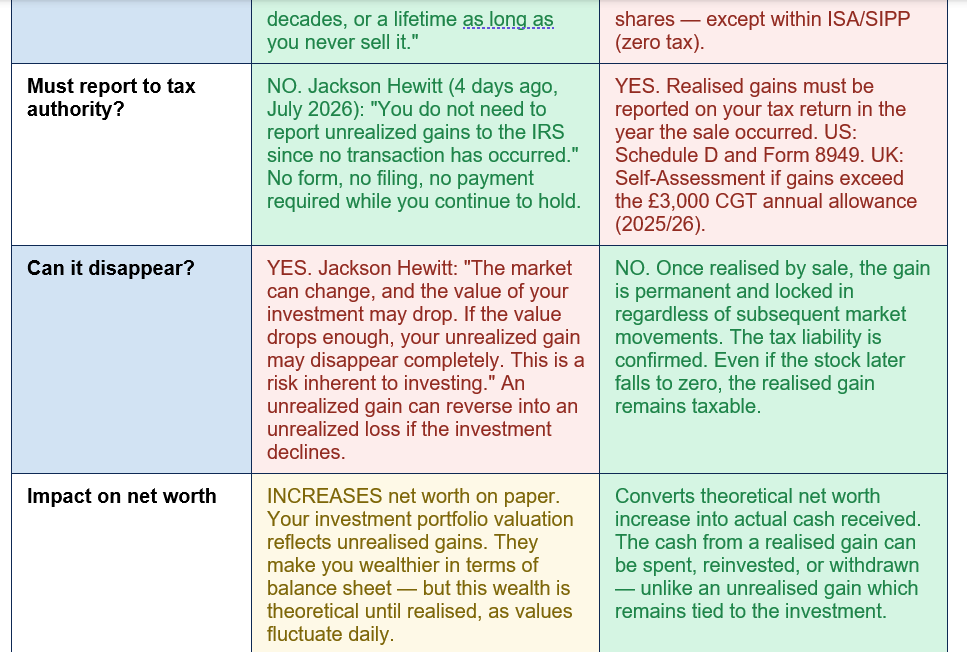
The power of tax deferral on unrealised gains: An asset can triple in value and owe $0 in taxes — for years, decades, or a lifetime — as long as it is never sold. — LegalClarity (April 15, 2026): 'The IRS does not tax unrealised gains. You can hold an asset that has tripled in value and owe nothing for years, decades, or a lifetime as long as you never sell it. Tax liability is triggered only by a realization event, which is typically a sale, exchange, or other disposition. This principle creates a powerful incentive to hold appreciating assets rather than trading frequently. Every sale creates a taxable event. Every year you hold is another year of tax deferral.' This incentive structure is foundational to the long-term buy-and-hold investing philosophy
How to Calculate an Unrealized Gain: Formula and Worked Examples
The calculation of an unrealised gain is one of the most straightforward in investing. The formula:Unrealised Gain = Current Market Value − Cost Basis
Where the cost basis is the original purchase price plus all fees and commissions paid to acquire the asset. The unrealised gain percentage is the unrealised gain divided by the cost basis, multiplied by 100.
Example 1 — US Stock Portfolio (Kiplinger April 2026 Framework)
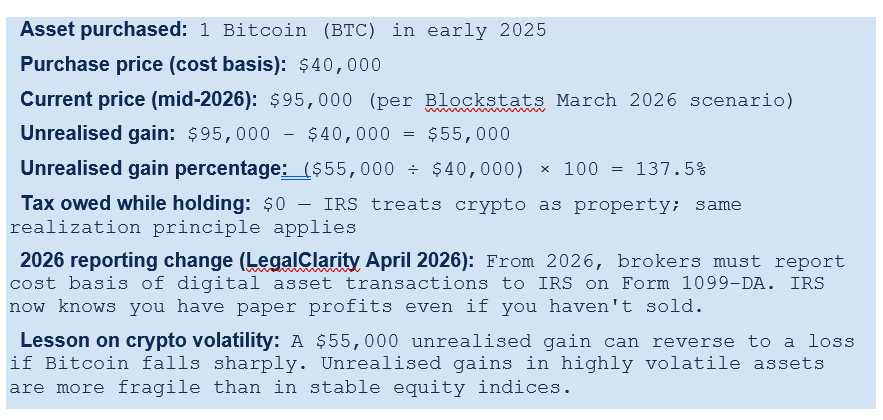
Example 2 — Bitcoin Unrealised Gain (Blockstats, March 2026)
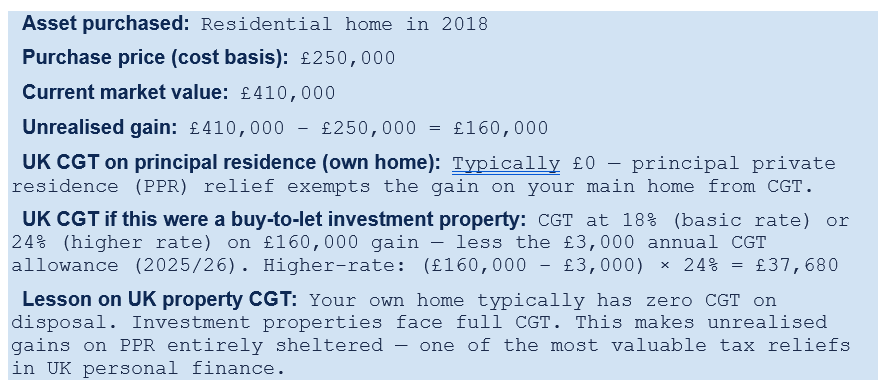
Example 3 — UK Property (Principal Residence)
Unrealized vs Realized Gain: The Complete Seven-Dimension Comparison
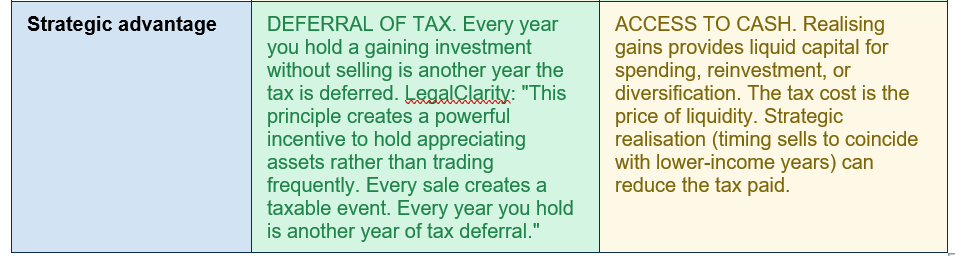
The distinction between unrealised and realised gains is the most fundamental divide in investment taxation. The table below maps every key dimension: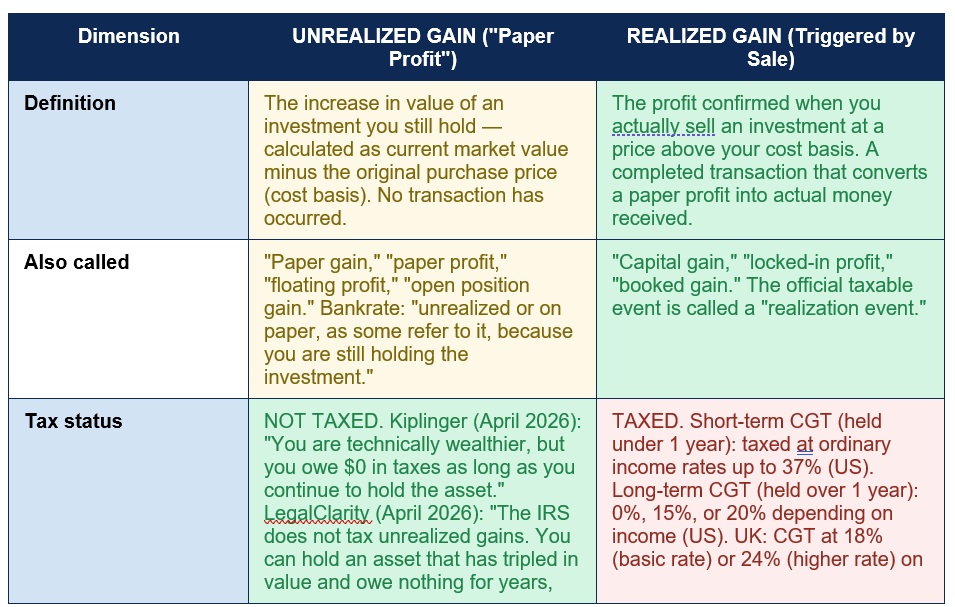
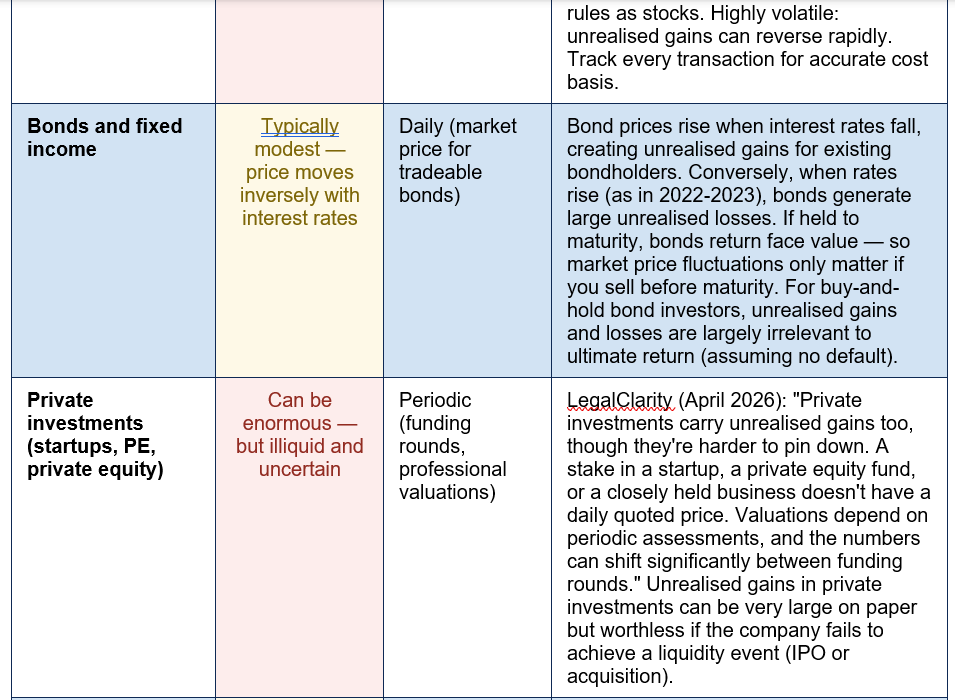
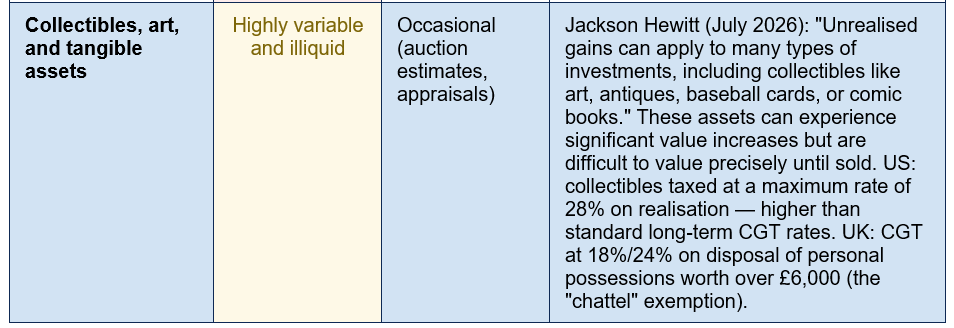
Unrealized Gains Across Asset Types: A 2026 Reference
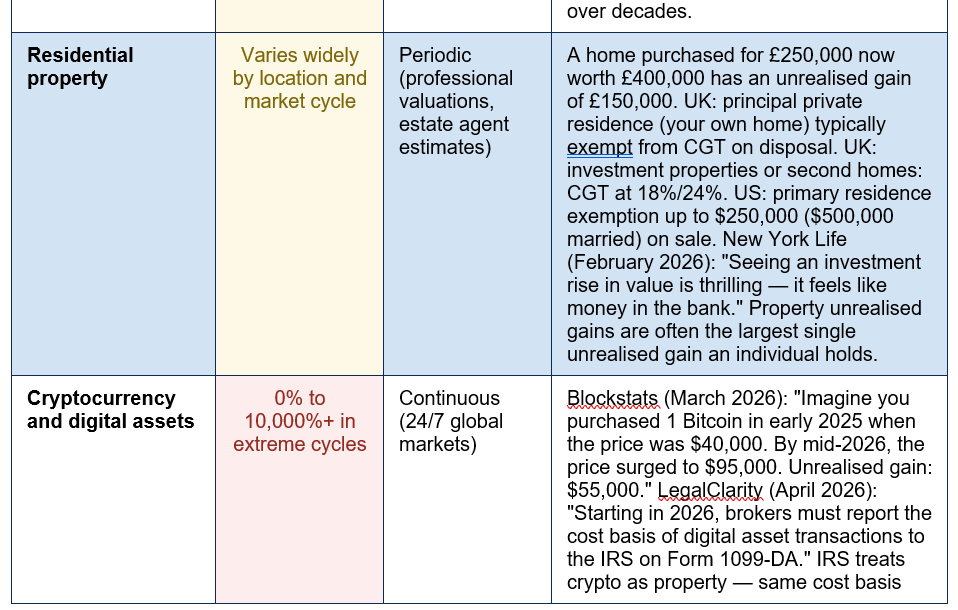
Unrealised gains arise across all asset categories — not just stocks. The characteristics and tax treatment on realisation differ significantly by asset type: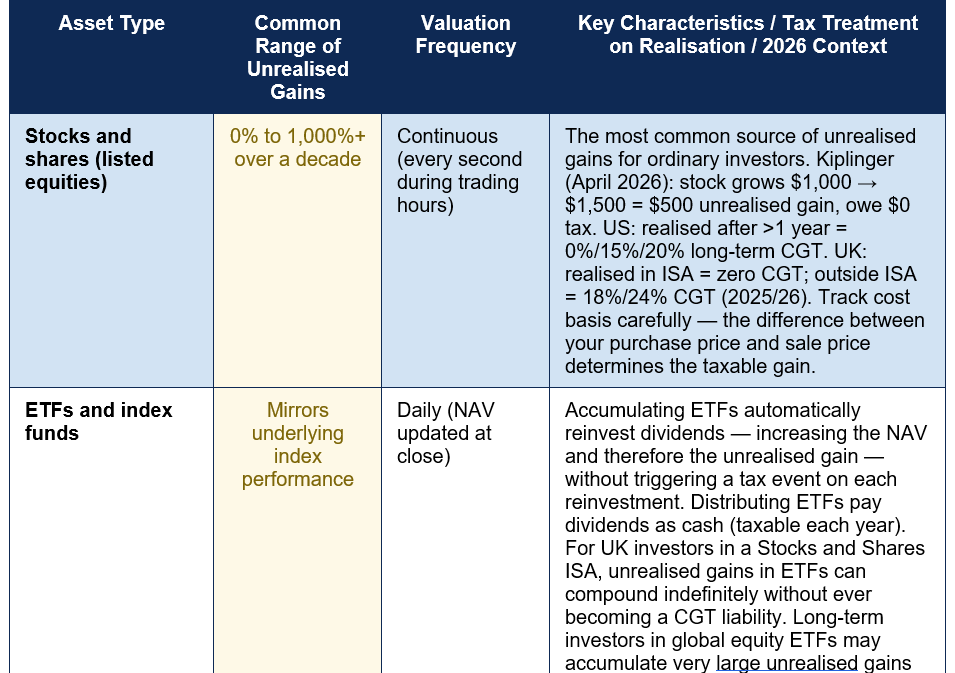
The Strategic Value of Unrealized Gains: Tax Deferral and Compounding
The fact that unrealised gains are not taxed creates one of the most powerful strategies in long-term investing: deliberate tax deferral through holding. Every year you hold an appreciating investment without selling it is a year in which you defer the tax that would otherwise be due on the gain. This deferral has genuine financial value — the money that would have gone to the government in tax continues to compound inside your investment instead.LegalClarity (April 2026) identifies the mechanism explicitly: 'This principle creates a powerful incentive to hold appreciating assets rather than trading frequently. Every sale creates a taxable event. Every year you hold is another year of tax deferral.' Consider a UK investor with £50,000 of unrealised gains in a general investment account. If they sell and realise the gain, they pay CGT at 24% (higher rate, 2025/26): £50,000 × 24% = £12,000 in tax (less the £3,000 annual CGT allowance). If they continue to hold, that £12,000 remains invested, generating further returns. At 10% per year, that deferred £12,000 grows to approximately £31,000 over 10 years — making the deferral significantly valuable.
The most extreme expression of this strategy — holding forever and never triggering a realisation event — is sometimes described as 'the best tax strategy.' Buffett's Berkshire Hathaway has held some positions for decades, with enormous unrealised gains accumulated over that time. The death of an asset owner in the US triggers what is known as a 'step-up in basis' — the cost basis of inherited assets is 'stepped up' to the current market value at the date of death, effectively eliminating all previously accumulated unrealised capital gains tax. This means that unrealised gains held until death may never be taxed at all. This rule does not currently apply in the UK, where CGT on death-inherited assets has different treatment.
Tax deferral compounding — a worked illustration of the value of holding: Suppose an investor has a £100,000 investment that doubles to £200,000 — a £100,000 unrealised gain. Scenario A: Sell and pay CGT immediately. UK higher-rate CGT (24%): approx. £24,000 tax. Net proceeds to reinvest: £176,000. If reinvested for another 10 years at 10%/year: £176,000 × (1.10)^10 ≈ £456,000. Scenario B: Hold and defer — the full £200,000 continues to compound for 10 years: £200,000 × (1.10)^10 ≈ £519,000 (then CGT payable on sale: ~£75,000, leaving £444,000). Over 10 additional years, the deferred investor retains approximately £444,000 vs the selling investor's £456,000 after tax — a closer result than expected, but the timing difference matters: Scenario B investor had £200,000 working for a full decade vs £176,000, and in higher-growth scenarios the deferral advantage widens considerably. In a UK ISA or SIPP, or a US Roth IRA, all gains are permanently tax-free — making the deferral value infinite.
Unrealized Losses and Tax Loss Harvesting: The Flip Side
Just as an unrealised gain exists when an investment's current value exceeds cost basis, an unrealised loss exists when the current value falls below what was paid. The same principles apply: the loss is 'on paper' and has no tax consequence until realised. Bankrate: 'You will have unrealised gains if the asset's value has increased since you purchased it. Conversely, if the asset's value has decreased, they have an unrealised loss.'However, unrealised losses can be strategically converted into realised losses through a technique called tax loss harvesting — deliberately selling a declining investment to realise the loss, then using that loss to offset realised gains elsewhere in the portfolio. In the US, realised capital losses offset realised capital gains dollar for dollar, reducing the taxable gain. If losses exceed gains, up to $3,000 of net capital losses per year can offset ordinary income, with excess losses carried forward to future years. In the UK, realised capital losses in the same tax year are deducted from capital gains before applying the £3,000 annual CGT allowance.
The key restriction on tax loss harvesting in the US is the 'wash sale rule': if you sell a security at a loss and then repurchase the same or a 'substantially identical' security within 30 days before or after the sale, the loss is disallowed. This prevents investors from selling purely for the tax benefit while maintaining their market position. The UK has an equivalent rule — 'bed and breakfasting' — where selling and repurchasing the same shares within 30 days negates the CGT benefit. The standard solution in both countries is to replace the sold security with a similar (but not identical) fund or ETF for 30 days before reacquiring the original position.
TAX LOSS HARVESTING PRACTICAL EXAMPLE (US AND UK): US investor scenario: £10,000 realised gain from selling Stock A. Stock B has fallen from £8,000 to £5,500 — an unrealised loss of £2,500. Action: Sell Stock B to realise the £2,500 loss. Net taxable gain: £10,000 − £2,500 = £7,500. At 15% long-term CGT, tax is now £1,125 instead of £1,500 — saving £375. Replace Stock B with a similar (not identical) ETF to maintain market exposure during the 30-day wash sale window. UK investor scenario: identical logic using CGT allowance and loss offset before the £3,000 annual allowance. Timing: Tax loss harvesting works best near tax year-end (US: December; UK: early April before April 5 year-end) when the full-year gains picture is clear. Never sell an investment purely for tax reasons if it still represents a strong long-term holding — the market recovery on a prematurely sold investment can exceed the tax saving.
Unrealized Gains in 2026: New Reporting Obligations and the Wealth Tax Debate
While unrealised gains remain non-taxable for most retail investors in 2026, the reporting and transparency landscape around them has changed significantly — particularly for digital assets and high-net-worth individuals:- IRS Form 1099-DA for digital assets (US, from 2026): LegalClarity (April 2026): 'Starting in 2026, brokers must report the cost basis of digital asset transactions to the IRS on Form 1099-DA, which brings crypto reporting closer to the standards that already apply to stocks and bonds.' Blockstats (March 2026): 'The IRS knows you have paper profits even if you haven't sold them yet.' This increased transparency means crypto investors must now maintain accurate cost basis records for every digital asset purchase, as the IRS will have visibility into holdings and transactions through broker-submitted forms. Unrealised gains in crypto remain non-taxable, but the information infrastructure now exists to enforce taxation precisely when realisation occurs.
- CARF and DAC8 — global automated reporting (48+ countries): Blockstats (March 2026): 'In 2026, unrealised gains matter because global tax authorities now use automated reporting (CARF and DAC8) to track your total net worth and holding balances in real-time. Exchanges are now required to report not just your sales, but your holdings.' The OECD's Crypto-Asset Reporting Framework (CARF) and the EU's DAC8 directive ensure that tax authorities in 48+ countries can share information about individuals' crypto holdings — making it increasingly difficult to hold unrealised crypto gains in undisclosed accounts outside the home country.
- Proposed unrealised gains taxes (US policy debate, 2025-2026): At various points in 2023-2025, US legislative proposals included taxes on unrealised gains held by ultra-high-net-worth individuals (typically those with net worth above $100 million). These proposals have not been enacted into law as of 2026. LegalClarity and Blockstats confirm that in 2026, unrealised gains remain non-taxable for most retail investors. The wealth tax momentum continues with several jurisdictions proposing taxes on the net worth of high-wealth individuals inclusive of their unrealised gains. The proposal remains politically contentious. Standard retail investors are not affected by any current wealth tax legislation.
- UK CGT changes post-2025 Autumn Budget: The 2025 Autumn Budget raised CGT on shares from 10%/20% to 18%/24% for basic/higher rate taxpayers — making the decision of when to realise unrealised gains more consequential than before. The £3,000 annual CGT allowance (reduced from £12,300 in 2020/21) provides only limited shelter. UK investors with significant unrealised gains in taxable accounts should review their strategy of when and how to realise those gains, and should maximise use of their £20,000 annual Stocks and Shares ISA allowance to shelter future gains from CGT entirely.
THE UNREALIZED GAIN TRAP — WHEN PAPER PROFITS BECOME REAL LOSSES: The most dangerous psychological pitfall with unrealised gains is becoming so attached to the 'wealth on paper' that you fail to sell when you should. Three specific traps: (1) OVER-CONCENTRATION: A single stock position that has grown to represent 60% of your portfolio has enormous unrealised gains — but also enormous concentration risk. The unrealised gain can reverse rapidly if the company deteriorates. Diversifying (realising some gains) may cost tax but reduce catastrophic downside risk. (2) WATCHING GAINS EVAPORATE: Holding through a market decline because 'it was up 300%' and 'I'll sell when it recovers' can result in watching an unrealised gain first become smaller, then disappear, then become an unrealised loss. Jackson Hewitt (July 2026): 'The market can change, and the value of your investment may drop. If the value drops enough, your unrealised gain may disappear completely. This is a risk inherent to investing.' (3) ANCHORING TO PEAK UNREALISED VALUE: Basing decisions on a portfolio's peak value ('I was up £50,000') creates psychological distress when the portfolio retreats to £30,000 up. A position is only worth what it is worth today — not what it was worth at its peak. Unrealised gains are more fragile than realised gains.
Conclusion
An unrealised gain is one of the most important and most frequently encountered concepts in personal investing — and yet it is also one of the most easily misunderstood. The core definition is simple: an unrealised gain is the positive difference between the current market value of an investment and its original cost basis, when the investment has not yet been sold. It is paper wealth — real in the sense that it is reflected in your portfolio's market value, but theoretical in the sense that it can grow, shrink, or disappear before you ever convert it to cash.The most strategically important fact about unrealised gains is that they are not taxed. Kiplinger (April 2026) confirms: 'You are technically wealthier, but you owe $0 in taxes as long as you continue to hold the asset.' LegalClarity (April 2026) identifies the long-term consequence: 'The IRS does not tax unrealised gains. You can hold an asset that has tripled in value and owe nothing for years, decades, or a lifetime.' Every year of holding is a year of compounding on capital that would otherwise have been reduced by tax — creating a meaningful advantage for long-term investors over those who realise gains frequently. This is the foundational logic behind buy-and-hold investing, Warren Buffett's decades-long holding periods, and the strong preference for tax-advantaged accounts (UK ISA and SIPP; US Roth IRA and 401(k)) where the gain-to-realisation cycle becomes entirely irrelevant to tax liability.
The seven asset types where unrealised gains arise — listed equities, ETFs, property, crypto, bonds, private investments, and collectibles — each carry different valuation frequency, volatility, and tax treatment on realisation. The practical strategies — tax deferral through holding, tax loss harvesting of unrealised losses, strategic timing of realisations, and maximising tax-advantaged account usage — represent the toolkit through which sophisticated investors manage the interplay between unrealised gains, portfolio risk, and tax efficiency simultaneously. Understanding unrealised gains is the entry point to understanding all of these strategies.
0 Comments
Be the first to share your thoughts on this article.